



Abstract
The fun integration theory provides a theoretical framework for understanding the totality of determinants that make sport fun. Understanding the relative prioritisation of those determinants for youth sport participants is one way of creating environments that encourage continued participation and mitigate dropout. Like many sports around the world, in Sweden, dropout in youth ice hockey typically occurs during early to mid-adolescence. This study is part of ongoing efforts to explore determinants of fun, and players’ prioritisation of those determinants, in Swedish ice hockey. Junior ice hockey players (n = 343) aged 10–19 years were asked to rate the importance of 83 fun determinants previously identified among Swedish youth athletes; these determinants were organized into 11 fun factors in parallel with previous research, and importance of the fun factors and determinants explored by subgroup comparisons. Results indicated few differences, and overwhelming similarity of players’ fun priorities when compared by sex, age, and perceived competence, with the fun factors Trying Hard, Positive Team Dynamics, and Positive Coaching of highest priority across all subgroups, and the fun determinant ‘trying your best’ rated highest. These findings support the fun integration theory's previous findings of a fun ethos, that is, a distinct and similar prioritisation of the fun factors and determinants regardless of player characteristics. Overall, results demonstrate generalisability of the fun integration theory and further contributing to this important and growing body of knowledge.
Ice hockey is the third most popular sport in Sweden, with nearly 38,000 registered junior players aged 10–20 years. 1 It is the third most popular sport in Sweden for people aged 7–25 years, with 4,445,350 participation occasions per year 2 and is of longstanding national cultural importance in Sweden. 3 Despite the sport's popularity, over 50% of children who begin ice hockey around age 6 will dropout by mid-adolescence. 4 This pattern is alike many other sports across Sweden 5 and the European Union, 6 leading to calls for greater understanding of ways to retain children and adolescents in sports for longer periods, 6 so they can gain the greatest physical, mental, psychological, and social benefits that are associated with organised sport participation. 7 This is particularly noteworthy for team sports, where behavioural (e.g., decreased odds of smoking/tobacco, alcohol, and drug use), psychological (e.g., improved self-esteem; decreased odds of depression and anxiety) and social (e.g., improved academic performance) benefits can be achieved. 7 Consequently, understanding ways children and adolescents’ participation in ice hockey can be maintained, as well as safeguarding the sport's future via sustainable participation, could contribute to the nation's overall health and wellbeing. One such approach that provides potential in this regard is understanding what makes sport fun for children and adolescents. 8
Pertinently, fun has a longstanding position as being the main reason for children and adolescents to maintain their sport participation,8,9 whilst the absence of fun is one of the most common reasons given for sport dropout.10–13 Notably, the sharpest decline in participation occurs around early- to mid-adolescence.6,14 Hence, understanding what makes a sport fun for adolescents, including potential age-related differences during that period of life, may support targeted approaches to enhance perceptions of fun for youth sport participants.
The landmark study that invigorated this body of research, 8 forwarded the fun integration theory, for understanding what makes organised sport a fun experience. That mixed-method study engaged key stakeholders in its development, including youth soccer players from different age groups (U9 to U19), coaches, and parents, who identified 81 fun determinants (the specific, actionable elements that directly create fun in sport) that comprise 11 fun factors (fun determinants clustered together thematically) within 4 fun domains (fun factors grouped into higher order dimensions of fun). These fun domains and the fun factors within them included: (1) contextual (Games, Practices); (2) internal (Learning & Improving, Trying Hard, and Mental Bonuses); (3) external (Swag, Game Time Support, Positive Coaching); and (4) social (Positive Team Dynamics, Team Friendships, Team Rituals). Qualitatively, the determinants and factors, together, illustrated the multidimensionality of fun as a construct. Quantitatively, the landmark study introduced a fun ethos for understanding the relative prioritisation of the fun factors and determinants based on their importance, which was further confirmed in a series of secondary-follow up studies15,16 that isolated players’ fun priorities in tiers of primary importance (Trying Hard, Positive Team Dynamics, Positive Coaching), secondary importance (Learning & Improving, Games, Practices, Team Friendships, Mental Bonuses, Game Time Support), and tertiary importance (Team Rituals, Swag). Further, the prioritisation of fun factors was the same regardless of players’ sex, age, or skill level. These findings then forwarded fun tenets (guiding principles for informing how fun factors and fun determinants can be systematically designed for and integrated into sport experiences based on player characteristics). Taken together, the fun integration theory's fun tenets, fun ethos, fun domains, fun factors, and fun determinants provide the full conceptualisation for understanding fun from its broadest facets to its smallest units, respectively.8,15,16
The fun integration theory's foundational body of work garnered international mainstream media and academic attention which has since energised additional research and applied efforts into how we ameliorate our understanding of fun. Given that sports can be contextually different, findings from one sport may not necessarily underpin strategies in a different sport that are aimed at understanding and enhancing sport-based fun. Furthermore, findings from one nation may not be culturally sensitive or immediately transposed to a different country with different societal and cultural values. For these reasons, research efforts have been extended to the study of fun in youth ice hockey and basketball players in Sweden 17 and junior tennis players in the United States. 18 The research undertaken to study fun in Swedish ice hockey and basketball 17 is the first cross cultural effort to extend this body of work internationally. Similar to the fun integration theory's foundational work, 83 fun determinants within the same 11 fun factors as soccer in the United States were identified, providing an initial picture of what makes sport participation fun for Swedish adolescents in ice hockey and basketball. 17 Given the popularity of ice hockey in Sweden coupled with the challenges of dropout from ice hockey, and the role that fun can have in maintaining youth sport involvement, further exploration of fun in Swedish youth ice hockey is merited. In fact, such exploration may augment further theoretical advancements, either in the form of compounding theoretical understanding by confirming theoretical posits in additional sport and cultural contexts, or by offering new conclusions which may then be used to advance the theoretical framework itself.8,15,18 Moreover, on an applied level, exploring theoretical assumptions across different contexts may lend itself to advances in evidence-informed practice. As perceptions of what constitutes fun in sports can vary between coaches and different types of players, 16 it is important that any efforts to understand fun in Swedish youth ice hockey – with a view toward creating fun environments – have a predominant player perspective. Notwithstanding this, a common principle that underscores any efforts to facilitate adolescent sport participation through fun experiences first requires understanding of adolescents’ fun priorities. 15 It is also acknowledged that dropout in youth ice hockey is influenced by a mix of personal, social, and environmental factors, including factors that motivate the player, the ecological dynamics in the ice hockey environment, and coach support and behaviours.19–22 Therefore, the purpose of this study was to further understand the fun priorities of ice hockey players in Sweden, and to explore those priorities as a function of their sex, age, and perceived competence, with a view to then informing fun-based strategies that could permeate Swedish ice hockey and perpetuate participation.
Methods
Participants
A total of 343 junior ice hockey players (299 boys, 37 girls, 4 others), aged between 10 and 19 (Mage = 13.94, SD = 2.68), representing approximately 0.9% of all junior ice hockey players in Sweden took part in the study. Their participation in the study was voluntary. Of the age ranges, 184 players were younger (aged 10–14) and 155 players were older (aged 15–19). Four did not indicate age. The participants were active in ice hockey clubs from either larger cities or small communities and had been participating in the sport between 1 and 16 years (M = 8.49, SD = 3.21) and 38% were active in at least one additional sport.
Measurement
Demographic information, training history, and perceived competence
We collected demographic data on sex, age, participation years in ice hockey, other sport involvement (i.e., in addition to ice hockey) and how many hours they practiced ice hockey per week. We also asked participants to rate, on a scale between 1 (among the least skilled ice hockey players) and 10 (among the best skilled ice hockey players), how good a hockey player they considered themselves to be in comparison to their peers of the same age. Similar self-rated competence measures have been used in previous research of athletic competence 23 and perceived ability.24,25
Fun in ice hockey
Participants were asked to rate, on a scale from 1 (not at all important) to 5 (very important), 83 fun determinants. These determinants had previously been identified in foundational work in a large sample of Swedish ice hockey and basketball. 17 The 83 fun determinants were organised into 11 fun factors: Trying Hard (12 fun determinants, e.g., trying your best), Positive Team Dynamics (5 fun determinants, e.g., when the team works together), Positive Coaching (13 fun determinants, e.g., when a coach treats players with respect), Learning & Improving (9 fun determinants, e.g., being challenged to improve and get better at your sport), Games (7 fun determinants e.g., getting playing time), Practices (7 fun determinants, e.g., doing different drills during practice), Team Friendships (6 fun determinants, e.g., getting along with your teammates), Mental Bonuses (4 fun determinants, e.g., winning together), Game Time Support (7 fun determinants, e.g., a ref who makes consistent calls), Team Rituals (6 fun determinants, e.g., going out to eat as a team), and Swag (7 fun determinants, e.g., traveling to new places to play).
Procedure
In collaboration with the Swedish Ice Hockey Association, we contacted several clubs from large cities and small communities across Sweden. Written information about the purpose and procedure of the study was given to relevant people (e.g., regional club developers, coaches and sports directors) in the clubs. Specifically, they were asked “Within your region, please include one so-called ‘elite club’ and one smaller so-called ‘participation/development club’” These contacts were asked to forward the study information with an invitation to participate to potential participants. For participants below the age of 15, parental or guardian permission to participate was also required, and as such parent/guardians provided signed informed consent for their child to participate. Informed consent was obtained from children/adolescents before data collection. The study was approved by the Swedish National Ethical Review Board (2024-03530-01).
Data analysis
We used descriptive analysis to understand the data. Based on the participants’ rated importance for each of the 83 fun determinants, we calculated the mean (M) importance and standard deviation (SD) for each determinant, and then subsequently ranked the mean importance rating from highest to lowest for each determinant. We also calculated and subsequently ranked the mean and standard deviation for each of the 11 fun factors. For further analysis and refining applied recommendations, we separated participants into subgroups by sex (boys and girls), age range (younger and older), and perceived competence (lower competence and higher competence). Following this, we reported rank differences, whereby we recorded the difference in rank from the full sample for each subgroup, to better facilitate applied implications that can be specific to the individual subgroups. For each subgroup, we calculated effect sizes 26 (Cohen's d) to demonstrate the magnitude of effect of sex, age, and perceived competence on fun determinant prioritisation. We used a quintile analysis to understand the top 20% of fun determinants as we anticipated these would be the main priorities for making ice hockey fun for players, a process akin to other youth sport research27,28 seeking to maximise the potential and sustainability of different sport environments. This quintile analysis allowed us to further elucidate where we might find the most impactful differences in priorities for the different subgroups.
Results
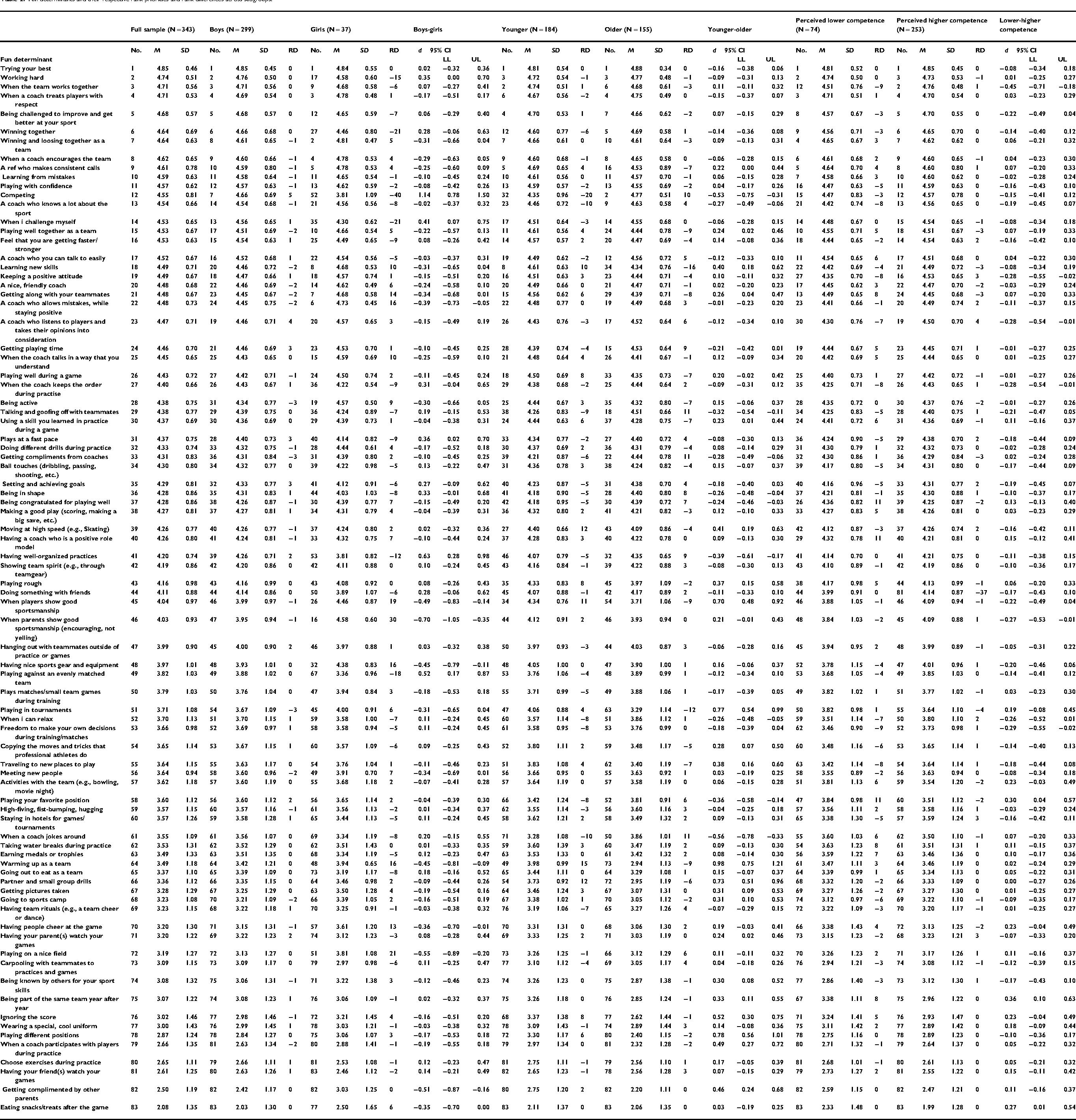
, We first report the ranking of the 11 fun factors for the full sample and then for each of the subgroups with the difference from the overall sample indicated (see Table 1). Next, we outline the ranking of the 83 fun determinants for the full sample, then report effect sizes for each of the subgroups with the difference from the overall sample indicated for each determinant. We also detail the rank by subgroup and rank differences for subgroup comparisons (see Table 2). Finally, we outline the results of the subgroup analysis using effect sizes and rank differences.
Rank order of the 11 fun factors based on players’ reported importance and their differences in rank across subgroups.
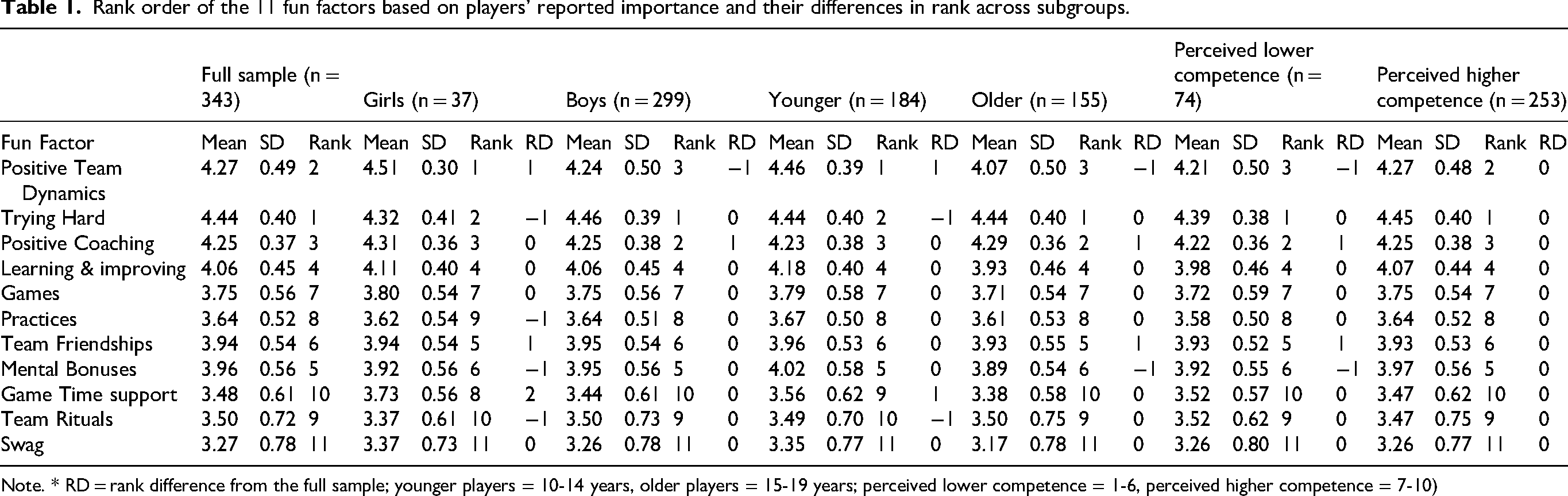
Note. * RD = rank difference from the full sample; younger players = 10-14 years, older players = 15-19 years; perceived lower competence = 1-6, perceived higher competence = 7-10)
Fun determinants and their respective rank priorities and rank differences across subgroups.
Fun factors
Results from the full sample show the rank order of the 11 fun factors are: (1) Trying Hard, (2) Positive Team Dynamics, (3) Positive Coaching, (4) Learning & Improving, (5) Mental Bonuses, (6) Team Friendships, (7) Games, (8) Practices, (9) Team Rituals, (10) Game Time Support, (11) Swag. Broadly speaking, for the full sample, and subgroups, the rank order of fun factors from highest to lowest relative importance was generally the same with very little variability when examined independently by sex, age, and perceived competence level (see Table 1), therefore few rank differences were observed.
Fun determinants
When examining the relative importance of the fun determinants, significant similarity across the group comparisons was observed. The effect size of difference was generally no effect or at most a small effect (d = 0–0.49) for over 92.78% of fun determinants for girls-boys, meaning only notable differences of mostly moderate effect (d = 0.50–0.79) and one large effect (d = >0.80) were observed for 7.22% of the sample. Likewise, the effect size of difference was no effect to small effect for 87.95% of fun determinants for younger-older players, meaning only 12.05% were of moderate to large effect. Finally, the effect size of difference was generally no effect or at most small effect for 98.80% of fun determinants for low and high perceived competence players, with only 1 determinant of moderate effect, just 1.20% of the total fun determinants, respectively (see Table 2). For the full sample, the top quintile of fun determinants were: (1) trying your best, (2) working hard, (3) when the team works together, (4) coach treats players with respect, (5) being challenged to improve, (6) winning together, (7) winning and losing together as a team, (8) coach encourages the team, (9) ref makes consistent calls, (10) learning from mistakes, (11) playing with confidence, (12) competing, (13) a coach who knows a lot about the sport, (14) when I challenge myself, (15) playing well together as a team, (16) feel that you are getting faster/stronger, and (17) a coach who you can talk to easily.
Subgroup differences
In this section, we show the subgroup differences for sex, age, and perceived competence.
Sex subgroup differences
When exploring differences by sex, the observed moderate or large differences (d = ≥0.5) were for the following fun determinants: competing (ranked 12/83 for the overall sample, 7/83 for boys, and 52/83 for girls; d = 1.14, 95% CI 0.78–1.50); having well organised practices (ranked 41/83 for the overall sample, 39/83 for boys, and 53/83 for girls; d = 0.63, 95% CI = 0.28–0.98); when parents show good sportsmanship (ranked 46/83 for the overall sample, 47/83 for boys, 16/83 for girls; d = -0.70, 95% CI = -1.05 - −0.35); playing against evenly matched team (ranked 49/83 for the overall sample, 49/83 for boys, 67/83 for girls; d = 0.52, 95% CI = 0.17–0.87); playing on a nice field (ranked 72/83 for the overall sample, 72/83 for boys, 51/83 for girls; d = -0.55, 95% CI = -0.89 - −0.20); and getting complimented by other parents (ranked 82/83 for the overall sample, 82/83 for boys, 82/83 for girls; d = -0.51, 95% CI = -0.87 - −0.16).
Age subgroup differences
When considering the younger–older differences, the observed moderate or large differences were for the following fun determinants: competing (ranked 12/83 for the overall sample, 32/83 for younger, 2/83 for older; d = -0.53, 95% CI = -0.75 - −0.31); when players show good sportsmanship (ranked 45/83 for the overall sample, 34/83 for younger, 54/83 for older; d = 0.70, 95% CI = 0.48 - 0.92); playing in tournaments (ranked 51/83 for the overall sample, 47/83 for younger, 63/83 for older; d = 0.77, 95% CI = 0.54 - 0.99); warming up as a team (ranked 64/83 for the overall sample, 49/83 for younger, 73/83 for older; d = 0.98, 95% CI = 0.75 - 1.21); partner and small group drills (ranked 66/83 for the overall sample, 54/83 for younger, 72/83 for older; d = 0.73, 95% CI = 0.51 - 0.96); ignoring the score (ranked 76/83 for the overall sample, 68/83 for younger, 77/83 for older; d = 0.52, 95% CI = 0.30 - 0.75); and playing different positions (ranked 78/83 for the overall sample, 72/83 for younger, 80/83 for older; d = 0.78, 95% CI = 0.56 - 1.01).
Perceived lower-higher competence
When considering lower-higher perceived competence, there were no observed differences of moderate or large effect sizes for any of the fun determinants. The only fun determinant approaching a moderate effect size was ‘when the team works together’ (ranked 3/83 for the overall sample, 12/83 for perceived lower competence, 2/83 for perceived higher competence; d = -0.45, 95% CI = -0.71 - −0.18).
Rank differences
When exploring the fun determinants from the full sample and the different subgroups (see Table 2), the determinant ‘Trying your best’ was the highest ranked determinant within the full sample and across all subgroups. Similarly, the fun determinant ‘eating snacks/treats after the game’ was ranked among the lowest in importance within the full sample and across the subgroups. There are some notable differences in priorities across the different subgroups. For example, whilst the fun determinant ‘competing’ is in the upper quintile for the overall sample, boys, older, perceived lower competence, and perceived higher competence players, it ranked 53rd for girls. Similarly, the fun determinant ‘when I challenge myself’ is in the upper quintile for the full sample, boys, younger players, older players, perceived lower competence, and perceived higher competence; it ranked 35th for girls. Conversely, the fun determinant ‘a coach who allows mistakes while staying positive’ is only a second quintile fun determinant for the full sample, boys, younger players, older players, perceived lower competence, and perceived higher competence, it ranked 6th for girls. See Table 2 for a breakdown of the 83 fun determinants, their rank by full sample and subgroup, and the rank difference between the full sample and individual subgroups.
Discussion
The purpose of this study was to explore the fun priorities of junior ice hockey players among children and adolescents in Sweden, and to explore those priorities as a function of their sex, age, and perceived competence, with a view to then inform fun-based strategies that could permeate Swedish ice hockey and perpetuate participation. This would allow us to provide recommendations that could be as contextually specific as possible and support the development of fun ice hockey environments in Sweden.
For junior players in Swedish ice hockey, fun is driven most by fun factors and their respective determinants within the fun integration theory's internal domain (Trying Hard) and social domain (Positive Team Dynamics), which are supported by coaching behaviours that characterise the external domain (Positive Coaching). As shown in Table 1, these three fun factors were of utmost importance within the full sample group and across all subgroups. This finding is consistent with previous research literature and, in turn, further supports the generalisability of the fun integration theory8,15,18 Similarly, the fun factors including Game Time Support, Team Rituals, and Swag were consistently the three lowest prioritised fun factors, with Swag being the lowest prioritised factor both for the total sample and across each of the subgroups. There is a tremendous consistency in the findings shown in Tables 1 and 2 that highlight the “bigger picture” priorities for making environments fun, with more nuanced understanding in subgroup prioritisation of the fun factors and determinants, which will be discussed below.
Sex related considerations
Whilst there are long-held opinions that what makes sport fun for children and adolescents will vary by sex and gender, the scientific literature in this regard suggests that boys and girls may be more similar than different. 8 Our study supports findings from earlier fun integration theory research8,15 acknowledging that what makes sport fun for girls and boys is more similar than it is different when we consider the relative rank order of the 11 fun factors. This is further supported by the lack of rank order differences observed (see again Table 1); and, when a rank order difference was observed, e.g., Trying Hard ranked first for boys (M = 4.46) and second for girls (M = 4.32) a mean importance difference of 0.14 is not meaningful, neither analytically nor practically. Among the fun determinants, few effect size differences were observed, though these included: competing, having well organised practice, when parents show good sportsmanship, playing against evenly matched teams, playing on a nice field, and getting complimented by parents. That said, it must be noted this study included a small sample of girls (N = 37), especially compared to that of the boys (N = 299), which is a limitation to subgroup comparisons of boys and girls. Future research that draws on a larger sample of girls is required. Overall, the lack of sex differences reported herein are consistent with previous research, which may provide sport governing bodies greater confidence in using the findings to inform organisational strategies designed to enhance participation retention in ice hockey, and coach education programme efforts to equip coaches with an understanding of fun for all players, boys and girls included.
Age related considerations
Similar to sex, younger and older players were relatively the same in their reported prioritisation of the importance of the fun factors. Additionally, among the fun determinants, few age effects were observed; and, where differences were observed, these would be expected given the association between biological age and skill development or years playing the sport. For example, we would expect older players to place greater importance on competing as they did, and younger players to place greater importance on playing different positions through their position sampling years, along with greater emphasis on good sportsmanship given the emphasis on fair play and game rules in earlier years. Also, younger players placed greater importance on warming up as a team than their older counterparts. This may be expected as adolescence is a period during which autonomous functioning increases, 29 and therefore older players may have their own warm up routines that are specific to their individual playing needs and position.
Perceived competence related considerations
When considering perceived competence, our results demonstrate players were the same in their reported importance across both the fun factors and fun determinants. Among the fun determinants, ‘when the team works together’ was the only determinant that approached a magnitude of difference worthy of note. Sport peers have been identified as the most important influence in both perceived competence and relatedness. 30 Hence, an environment that fosters working well together with teammates would be important for players no matter their perceived competence, though may have a greater influence for higher competence players who could likely be more achievement oriented, where working and playing well together plays a more influential role in having fun. Likewise, when people with lower perceived competence play sport as a form of physical activity, it is often the case that friendships and social support can play an important role in sport participation and enjoyment, helping to provide a sense of belonging, 31 increasing confidence and motivation, 32 and reducing or buffering feelings of inadequacy.30,33 Fostering positive peer-relationships can increase important behaviours such as encouragement and co-operation, which can help players feel more competent. 34 Coaches who intentionally cultivate team cohesion can also then indirectly strengthen players’ perceived competence through constructive feedback and peer affirmations. 30 As such, it is expected working well together plays a role in ice hockey, a team sport that is based on dynamic game play with others.
Strengths, limitations, and future research directions
This study contributes to the ongoing efforts to understand fun in child and youth sports and further explore fun factors in Swedish youth ice hockey. In doing so, it has added new knowledge to the evidence base that has conducted research informed by the fun integration theory. Probably most notably, the study furthers the fun integration theory's fun ethos having explored the role of perceived competence in the fun factor and fun determinant prioritisation. In doing so – and noting no moderate or large effect sizes between self-reported lower perceived competence and higher perceived competence players – this study provides preliminary evidence for adding perceived competence among other player characteristics, such as sex, age, and skill level, as the most recent way in which fun is almost universally the same for child and adolescent athletes. It enables stakeholders to develop coach education programmes aimed at enhancing adolescents’ fun whilst playing ice hockey and, in turn, hopefully sustaining and enhancing ice hockey participation in Sweden. This is informed by the understanding that what drives fun for low and high competence players is more similar than it is different. Findings from this study may also be helpful to other countries where ice hockey is a mass participation sport (e.g., Finland, Canada) to underpin further interventions or develop future research within this space. Overall, this study provides further generalisability of the fun integration theory.
These strengths aside, the study is not without limitations. First, the small sample sizes for girls and lower perceived competence subgroups mean the subgroup analysis by sex and perceived competence should be viewed with caution. For example, the girls sample comprised only 10.78% of the total sample of players who participated in this study. It is noteworthy, however, that despite the unequal groups of boys and girls in this study, the ratio of boys to girls in this study does reflect the ratio of boys to girls playing junior ice hockey in Sweden (approximately 8:1). Regarding perceived competence, there is also potential social desirability in rating oneself as high competence, which may have contributed to the smaller number of lower perceived competence players. In team sports like ice hockey, competence is multi-faceted (e.g., comprising technical, tactical, fitness, cognitive, and social elements), therefore it may be difficult for players to self-evaluate competence in this more multi-faceted manner within a comparative statement. As such, alternative ways of conceptualising and assessing perceived competence 35 may indeed influence results. Next, while strength of the study lay in its investigation of youth ice hockey in Sweden, this also gives rise to a limitation regarding the generalisability of findings as a sport-specific study. As is the practical trade-off, the specificity of context in data collection potentially reduces the generalisability to other contexts. Notwithstanding this, this study further adds to the growing body of research across sports in this area of research.
Future research would benefit from exploring how findings related to fun factors can inform interventions (e.g., fun-based coach education intended to sustain participation) and then explore whether such an intervention has a long-term impact on participation rates, preferably in different contexts and cultures where youth ice hockey is a popular sport. This could be in the form of applied research within a single case study design whereby an individual organisation partners with research scientists to trial a new way of making ice hockey fun or could be on a larger scale in the form of a community trial research design that wide scale implements such an intervention and longitudinally explores participation rates. In either scenario, this would fill a current void in the fun integration theory research by exploring the impact of this understanding on long-term participation levels. It has been noted by experts in the field, that incumbent next steps are to develop, test, and scale strategies designed to optimise children and adolescents’ fun experiences in sport. 36
Future experimental research should examine whether implementing the recommended coaching behaviours, such as autonomy-supportive strategies, effort-based praise, and positive reinforcement, leads to measurable improvements in fun, player engagement, and retention in Swedish ice hockey. Studying the implementation of ‘athlete-centred approaches’ like ‘game-based approaches’ could be worthy of consideration. Comparing intervention effects across sex/gender and age groups could clarify whether tailored approaches outperform generic strategies. Furthermore, investigating links between fun determinants and psychological variables such as self-esteem, resilience, and social connectedness would provide insight into the broader developmental benefits of fun sport environments and possible differential effects. Additionally, examining whether these factors reduce dropout rates could strengthen the case for their inclusion in coaching curricula. Future research could also investigate the impact of different gameplay formats, such as small-area or modified games, on adolescents’ perceptions of fun in Swedish ice hockey. Evidence from other team sports 37 and preliminary ice hockey studies38,39 suggests that small-area games, ensuring players are getting plenty of touches on the puck, and paired/small group activities increase player engagement, skill repetitions, and social interaction, all of which align with the top-ranked fun factors identified in this study (e.g., Trying Hard, Positive Team Dynamics). Experimental and longitudinal designs could examine whether these formats enhance fun across sex/gender, age, and perceived competence subgroups, and whether they contribute to sustained participation and developmental outcomes. Such research would provide context-specific insights for optimising practice structures and game formats within Swedish youth ice hockey.
Conclusion
This study contributes knowledge to the ongoing efforts to explore fun factors and determinants in youth sport, adding a new dimension by exploring the effect of perceived competence on players’ fun priorities. Data suggests that the fun factors of Trying Hard, Positive Team Dynamics, and Positive Coaching are most pertinent in Swedish youth ice hockey – and this holds true regardless of players’ sex, age, and perceived competence, which further validates the fun ethos and fun tenets that should inform sport programme design and delivery. Of additional note, there is a preponderance of similarity between this study's findings and previous research, thereby supporting the generalisability of the fun integration theory and providing bigger picture priorities for creating fun environments. This study's nuanced examination of sex-, age-, and perceived competence-related effects in the ranked priority of fun determinants could be used to underscore more context-specific recommendations for creating fun environments in Swedish youth ice hockey. Collectively, findings suggest that, in order to give the best chance environments are experienced as fun by players, Swedish ice hockey programmes should focus on creating appropriately challenging opportunities for players to try hard and give their best (e.g., using effort-based praise; celebrating attempts at a new skill, even if it was not successful the first time; designing small-area, high-intensity games), create positive social dynamics within the team (e.g., peer mentoring with more experienced players; implementing warm-up or game activities that emphasise teamwork and communication; varying linemates during practice to develop communication and teamwork with all players with the team), and adopt positive approaches to coaching (e.g., actively looking for opportunities to praise players/offer positive reinforcement; involving players in decision making processes; adopting autonomy supportive coaching behaviours; creating connection before correction by appreciating ideas and attempts before correcting them; being a positive role model).
Footnotes

Ethical considerations
The study was approved by the Swedish National Ethical Review Board (2024-03530-01).
Consent to participate
Written information about the purpose and procedure of the study was given to relevant people (e.g., regional club developers, coaches and sports directors) in the clubs. These contacts were then asked to forward the study information and a participation request to potential participants. When the potential participants were below age 15, parental/guardian permission for the child/adolescent to participate was also required. Therefore, we first asked parents/guardians to sign informed consent agreeing that the child/adolescent may participate in the study. Informed consent was obtained from adolescents before data collection.
Authors’ contributions
All authors were involved in the work to conceptualise and design the study. AG, JL, JS, and JB conducted data collection and data analysis, and AJV contributed to data analysis and results interpretation. All authors contributed to the manuscript writing. All authors have read and approved the final version of the manuscript and the order of authorship.
Funding
This project was funded by the Swedish Ice Hockey Association. The sponsors have supported publication of the article by contributing to the authorship of the manuscript and the decision to publish the work open access.
Declaration of conflicting interests
The authors declared no potential conflicts of interest with respect to the research, authorship, and/or publication of this article.
Data availability
Consent was not sought for data availability.