



Abstract
Objectives
This study compared the effectiveness of traditionally-planned (TPT) and randomly-planned (RPT) jump training regimens on physical performance metrics in youth academy soccer players. The groups undertook jump training with identical total programme volume and intensity, differing only in the order in which the prescribed training weeks were executed.
Design
A total of 28 male youth academy soccer players (mean age: 12.6 ± 0.26 yrs; height: 158.1 ± 7.24 cm; mass: 43.3 ± 5.1 kg; maturity offset: 0.81 ± 0.38 yrs; soccer experience: 4–5 years) were randomly assigned to either TPT or RPT groups, undertaking an eight-week training programme.
Methods
While the TPT group executed a planned training programme, the RPT group undertook identical training weeks performed in a randomised order with all other training variables being the same between the groups.
Results
Results indicated significant within-group improvements across all metrics (sprint speed [10 m, 20 m, 30 m], countermovement jump [CMJ], drop jump, and change of direction speed; [dz = 0.37 to 1.15; p = <0.001]) except for the change-of-direction (CoD) test with no ball. No significant between-group differences were found except for in the CMJ, where the TPT group outperformed RPT (dz = 1.15 vs. 0.45, p < 0.001).
Conclusion
These findings suggest that RPT regimens may yield similar performance outcomes to TPT programmes when matched for jump volume and intensity, though there may be a specificity advantage to using planned schemes. Using more flexible approaches might prove beneficial over time as it appears to encourage greater variability and could benefit coaches who are negatively affected by scheduling difficulties or other time constraints to a programme. This pilot investigation can help coaches and future researchers by serving as a basis for further study of flexible planning in youth populations and can provide preliminary guidance on how coaches can establish effective training programmes without necessarily having to adhere to rigid frameworks.
Introduction
The systematic planning of physical training involves the prescription of variables such as volume, intensity, frequency and exercise selection to elicit specific physiological adaptations within a wider training programme. 1 By structuring these variables systematically over time, planning serves as a vehicle whereby stress and recovery, as well as the minimisation of the risk of overtraining and the maximisation of performance outcomes, can be coordinated. 1 Modern planning strategies integrate the principles of progression, specificity, variation and individualisation with coaches needing to adapt to both short-term and long-term goals to maximise performance. 2 Such strategies are not limited to rigid structures however and can include planned fluctuations or random variations in training loads, enabling athletes to successfully negotiate the relatively unstable environment created by so-called ‘real world’ performance demands within a training programme. 3 Consequently, varied planning strategies can serve as influential tools within a framework for athletic preparation, accommodating the complex needs of the athlete across a single sports season, or longer.
Given the effectiveness of such structured planned methods to optimise the performance of athletes, 4 a relatively high number of studies, albeit in the literature relating to periodisation, have been carried out. Rhea and Alderman 5 reported that planned strength and power training was more effective than non-periodised in both men and women, individuals with different levels of training experience, and, also, across all age groups. Williams et al. 6 undertook a meta-analysis which compared the effect of periodised and non-periodised resistance training programmes on maximal strength. Across 18 studies, the researchers reported that planned periodised programmes generally led to greater strength gains (ES = 0.43, 95% CI: 0.27–0.58; P < 0.001) with the variation of planning variables within the training plan a seemingly influential factor in the magnitude of the response. A later meta-analysis by Moesgaard et al. 7 reported similar findings for maximal strength (ES = 0.31, 95% CI: 0.04, 0.57; P = 0.02) through planned periodized training, though the authors found no difference between periodized and non-periodized programmes in relation to muscle hypertrophy (ES = 0.13, 95% CI: −0.10, 0.36; P = 0.27). These findings have consistently indicated that training which is systematically planned and programmed appears to be superior, supporting its continued use within the field of strength and conditioning (S&C).
Despite the above study results, recently, an alternative school of thought has emerged with Kiely8,9 contending that the main factors that support physiological adaptation to a programme are the inherent variability and individualisation of training stimuli rather than the preplanned, stage-based structures that are more characteristic of a systematically planned approach. Indeed, a number of authors have indirectly supported this stance, suggesting that variable or more flexible practice can be just as effective as systematic practice, at least in relation to motor learning which can have significant implications for any athlete.10,11 Indeed, this has been suggested to be an underlying mechanism for the use of blocked and random practice in skill acquisition with Wulf and Shea 11 previously identifying that variable practice enhanced motor learning to a greater extent than repetitive, blocked practice. Halperin et al. 10 also advocate for the benefits of more flexible training routines with their support of athletes’ need for autonomy in training. When athletes are permitted to make training variable choices (e.g., sets, repetitions, rest intervals, exercises) there is evidence for enhanced motor skill acquisition through rewarding feedback, greater intrinsic motivation, performance and motor skill learning, with even minor choices improving performance and learning.10,12,13
While many of the above examples are derived from the literature on motor learning which is somewhat different to that of physical training, recent studies14,15 appear to highlight the importance of motor learning within S&C approaches to developing youth athletes. For example, differential learning, a pedagogical approach that promotes skill development through practice conditions that continually vary execution, has been found to increase the physical capabilities of youth athletic populations.15,16 In the context of JT as a skill-development tool for children, the execution of more varied movement challenges can expose participants to a more diverse range of demands than those typically encountered in conventional training.17,18 This varied stimulus may better prepare young athletes for the dynamic scenarios experienced within sport. However at the current time, it is unclear how variation can be incorporated into a youth's S&C programme and, indeed, what form it might take when it is. Accordingly, we used jump training (JT) as a lens through which to address the issue of a varied stimulus, comparing the effects of traditionally planned (TPT) and randomly planned (RPT) JT on athletic performance in male youth soccer players. By controlling for as many programming variables that could impact upon changes in performance, we hoped this exploratory pilot study could isolate any potential effects of the aforementioned training scheduling structures on the chosen sprint- and jump-based outcome measures.
Methods
Study design
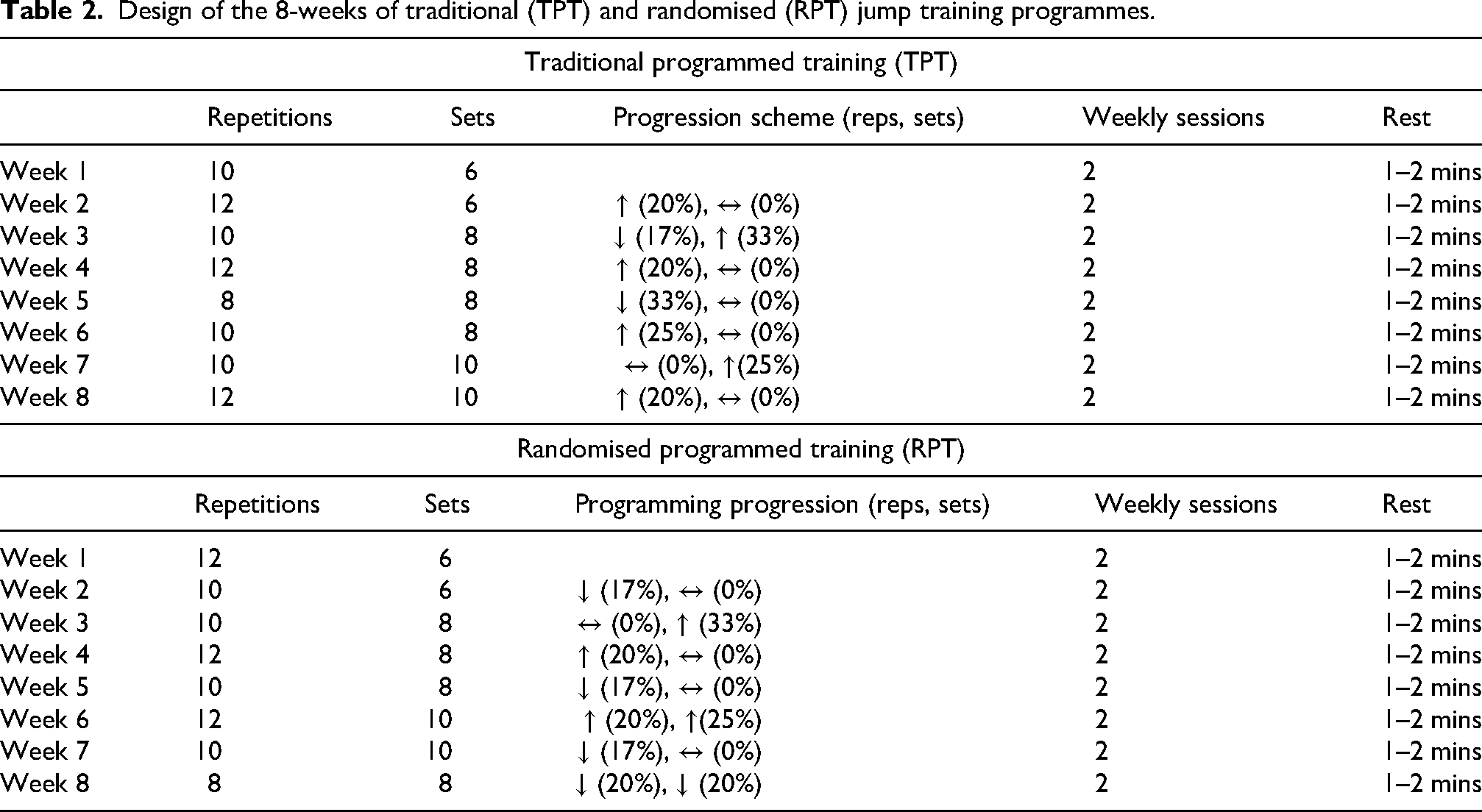
This comparative longitudinal experimental trial examined the effects of TPT and RPT JT in youth soccer players. The training programmes were conducted during the in-season period from January to March 2024 and were identical in terms of the training volume and total foot contacts undertaken in each intervention. The only difference between the programmes was the order in which the training weeks were carried out. Whereas the TPT group undertook each training week in a traditionally-planned and structured fashion (Table 2), the RPT group executed identical training weeks in a randomised order, thus constituting an approach that simulated a more varied training structure that might be typical of the often variable nature of a soccer season. In this way, all JT exercise prescription variables were identical except the order of the training weeks. Training lasted eight weeks with two weekly JT sessions 19 implemented following the warm-up and prior to the main soccer training session. This ensured that total weekly training volume remained consistent across participants. Both groups completed the same number of technical-tactical sessions and matches, minimising between-group differences in external load. As previous studies have already demonstrated the effectiveness of JT for enhancing physical performance in youth, 19 the objective of the present study was to compare the relative effects of these two differing programmes with a view to evaluating the efficacy of more structured approaches to the planning of training. Baseline measurements were performed over four days and included anthropometric (stature, mass and body fat percentage) and physical fitness tests (i.e., 10, 20 and 30 m sprint, and change of direction with (CoDb) and without the ball (CoD), countermovement jump (CMJ) and drop jump (DJ).
Descriptive information for the study participants.
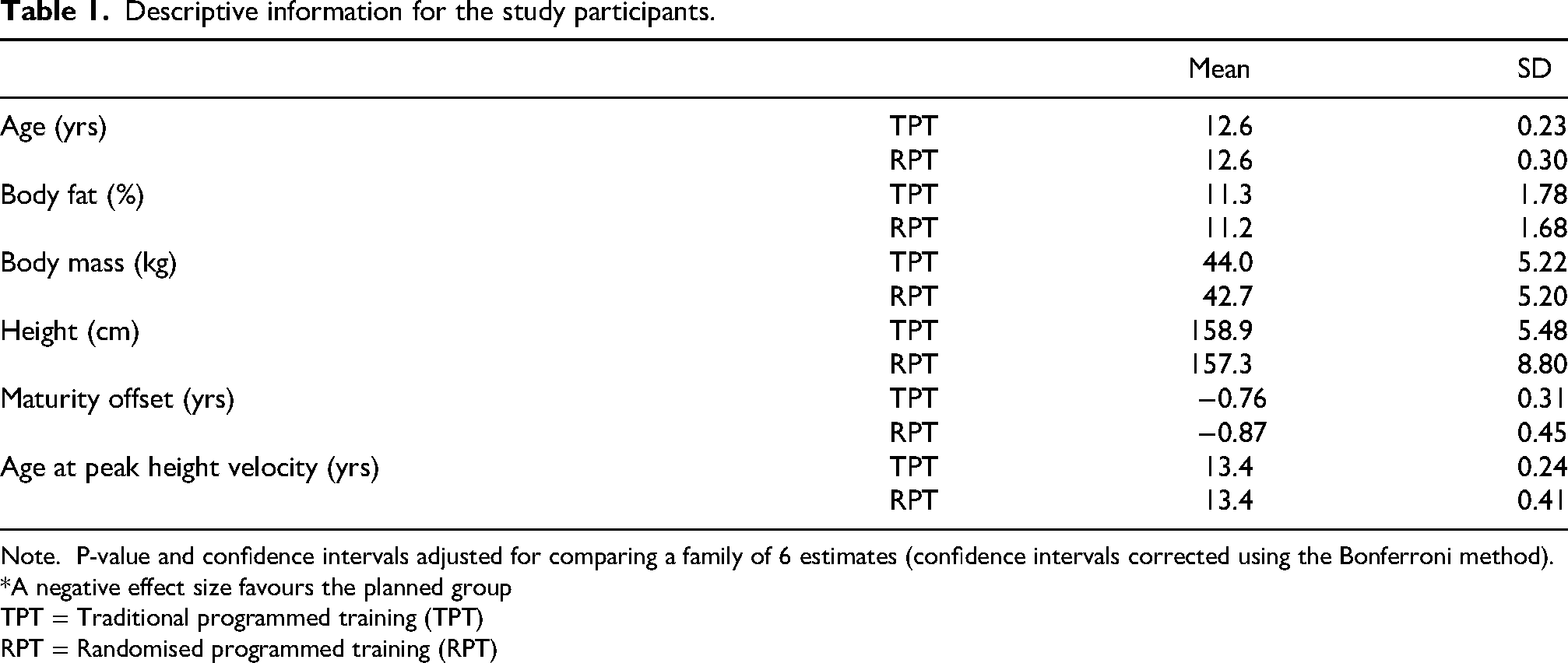
Note. P-value and confidence intervals adjusted for comparing a family of 6 estimates (confidence intervals corrected using the Bonferroni method).*A negative effect size favours the planned groupTPT = Traditional programmed training (TPT)RPT = Randomised programmed training (RPT)
Participants
A total of 28 male youth soccer players (mean age: 12.6 ± 0.26 yrs; height: 158.1 ± 7.24 cm; mass: 43.3 ± 5.1 kg; maturity offset: 0.81 ± 0.38 yrs) were recruited to participate in this study. All players were members of the same elite youth academy competing at the national level and had been engaged in structured soccer training for four to five years. Although they did not have formal JT or resistance training experience, they routinely engaged in soccer-specific S&C activities integrated into their weekly training sessions. Thus, they were sufficiently experienced to safely and effectively complete the intervention. The players were randomly assigned (List Randomizer, random.org) to TPT (n = 14) and RPT (n = 14) (Table 1). We conducted a preliminary sample size calculation for CoD speed with the type I error rate being set at 0.05, and the statistical power at 80%. The estimated effect size of d = 0.8 was derived from similarly sized (n = 27–33) previous studies of JT in youth.20,21 To account for potential participant dropout, 28 healthy, male youth soccer players from the same regional team were recruited for the study. All participants practiced systematic soccer training for at least 4–5 years prior to study participation and competed in the top division of the national soccer leagues. All groups followed the same soccer training programme under the supervision of the same coaches. The TPT and the RPT groups conducted two weekly training sessions implemented after the warm-up of regular soccer-training sessions. Participants’ biological maturity status was estimated based on the maturity offset method using the prediction equation of Moore et al.. 22 Before the start of the study, players received a document detailing the experimental procedures alongside a parental consent request form. Parental consent and participant assent were obtained after a thorough explanation of the study purpose, procedures, risks, and benefits. The present study was conducted following the latest version of the Declaration of Helsinki and the protocol was fully approved by the university's ethics committee before the commencement of the procedure. None of the participating players had a history of psychological and musculoskeletal, neurological, or orthopedic disorders six months prior to the start of the study.
Design of the 8-weeks of traditional (TPT) and randomised (RPT) jump training programmes.
Procedures
One week prior to the start of the study, a familiarisation session was scheduled to allow players to become acquainted with the applied tests and exercises. During this session, participants received instructions on technically proficient exercise technique. The same test sequence was applied during the pre- and post-intervention testing sessions. Before testing, all participants conducted a standardised 10-minute warm-up which consisted of submaximal running (e.g., skipping, hopping), balance exercises (i.e., forward or backward beam walking, single-leg stance on stable surface) and landing drills (i.e., snap downs, 1-leg drop squat). All tests were separated by a five to ten minute period for rest and the time taken between test trials was three minutes to ensure maximal performance on each occasion. Athletes performed the jump tests followed by sprint and CoD/Codb tests and on each occasion, the best out of two trials was used for further statistical analyses. 23 Training and testing sessions were conducted within a consistent time window (16:00–18:00 hours) for all participants to limit the potential effects of circadian rhythms.
Anthropometrics
Athletes’ stature and mass were collected using a wall-mounted stadiometer (Florham Park, NJ) and an electronic scale (Baty International, West Sussex, England), respectively. The sum of skinfolds was assessed using the Harptenden's skinfold callipers. Body measurements were conducted according to Deurenberg et al. 24 who reported similar prediction errors between adults and adolescents. Afterwards, biological maturity was evaluated non-invasively using chronological age and stature as input parameters for a regression equation to subsequently predict the maturity offset. 22 The equation has previously been validated for boys and presents a standard error of the estimate reported as 0.54 years. 22
Sprint speed and change of direction testing
Linear sprint speed was calculated using 10-m, 20-m and 30-m maximal sprint tests, all of which were derived from the same run. For all players, the start stance was consistent. Participants started 20 cm behind the starting line position and were instructed to run as fast as possible along the assigned distance. Sprint time was captured using photocell gates (Brower Timing Systems, Salt Lake City, UT, United States; accuracy of 0.01 s) placed 0.4 m above the ground. Players performed two trials, with at least three minutes of rest between each trial, with the best trial being recorded for analysis. Previous studies have demonstrated good reliability for this test being used in youth soccer players. 25 The intraclass correlation coefficient for these tests for the current cohort ranges from 0.903 to 0.959.
For the 15 m CoD test (Figure 1), players initiated performance running 3 m behind the first set of timing gates. Players then performed 3 m of straight running, before entering a 3-m slalom section marked by three aligned markers (1.6 m of height) placed 1.5 m apart. They were then required to manoeuvre through a 0.5-m hurdle placed 2 m beyond a third marker. Following this, players ran 7 m to pass through a second set of photocell gates which concluded the test. 26 Excellent test–retest reliability has been reported for the 15 m CoD run test (ICC: 0.93 [0.86, 0.97]). 27
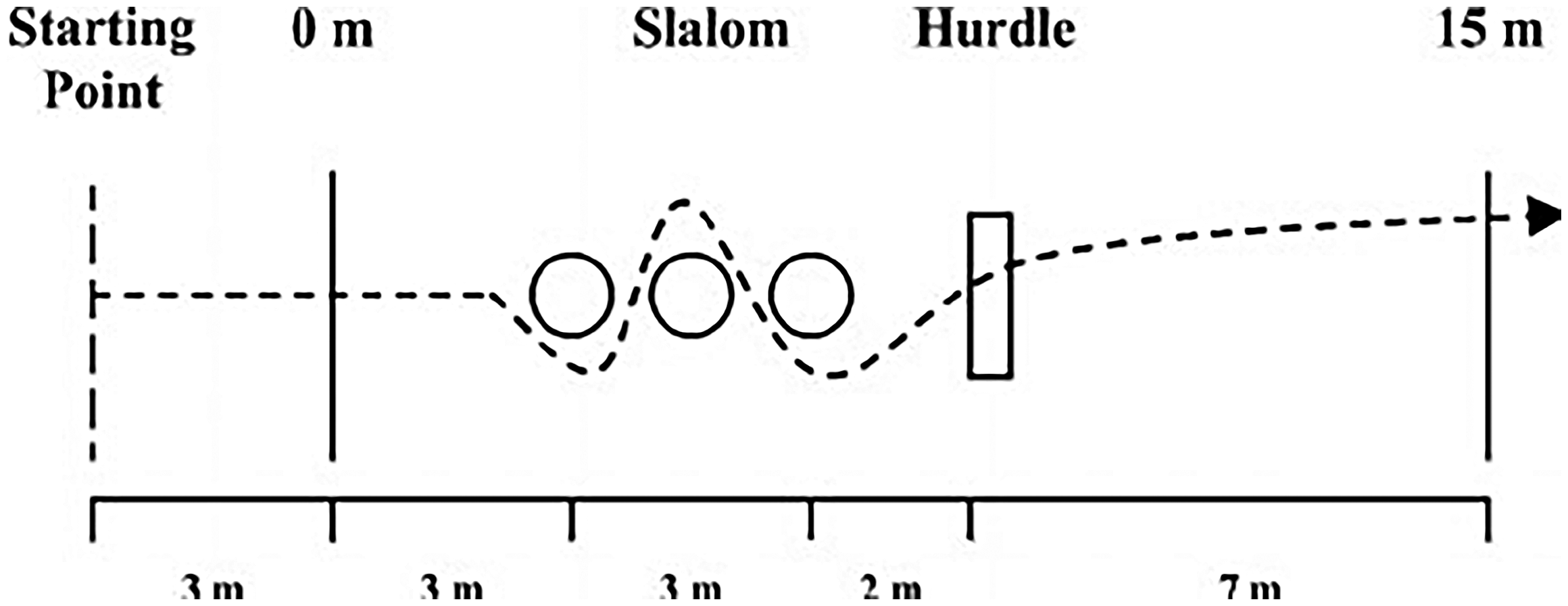
Change of direction test course.
The CoDb test is similar to the previously described 15 m CoD shuttle run, however, players were required to dribble a ball while performing the test. In the slalom section of the test, the ball was kicked under the hurdle while the player passed through it. Following this, the participant then kicked the ball toward one of two small goals placed 7 m diagonally to the left and the right sides of the hurdle, before ending the trial with 7 m straight sprint. 26 Previous test–retest reliability scores for the CoDb have been shown to be reliable in a similar pediatric population (ICC = 0.87, SEM = 0.04). 27 The intraclass correlation coefficient for the CoD tests in the current study ranged was 0.908 to 0.990. Players performed two trials of each test with three minutes of recovery taken between trials. The best performance was used for further analysis.
For all running tests, athletes started from a standardised standing position with the lead foot placed just behind the starting line and the body in a self-selected ‘ready’ stance. Participants were instructed to remain stationary until the delivery of a verbal start cue. All received the same standardised instructions to: ‘run as fast as possible through the finish line’ for linear sprints and to ‘complete the course as quickly as possible while following the marked route’ for the CoD/CoDb tests. Strong verbal encouragement was provided during all trials to ensure maximal effort. The same investigator delivered the instructions and encouragement for all sessions.
Jump performance
Two different vertical jump tests were used in this study: CMJ and DJ. These tests have been shown to be reliable and valid measures of lower limb muscular power in pediatric populations and all jumps were performed using an Ergojump system (Ergojump apparatus; Globus Italia, Codogne, Italy) which recorded jump height, ground contact time, and flight time. 25 Participants were instructed to begin from an upright stance, then bend their knees and hips in a controlled downward movement (eccentric phase) to a self-selected depth, immediately followed by a rapid upward extension of the legs (concentric phase) to jump vertically as high as possible, keeping the hands on the hips throughout. They were encouraged to perform the movement smoothly, without pausing between the downward and upward phases. Two trials were performed with approximately three minutes of recovery, and the best result was used for analysis.
For the execution of DJs, participants stood in an upright position on a raised platform, of 30-cm of height, with the feet positioned shoulder-width apart and the hands placed on the hips. Participants were then asked to step off the platform with their dominant leg and to drop down to land evenly on the ground with both feet, avoiding excessive heel contact upon touch down. Once the participant made contact with the ground, they were to bend their knees and hips in a controlled downward movement (eccentric phase) to a self-selected depth, immediately followed by a rapid upward extension of the legs (concentric phase) to jump vertically as high as possible, keeping the hands on the hips throughout. They were encouraged to perform the movement smoothly, without pausing between the downward and upward phases. All participants were also instructed to keep contact with the ground as brief as possible. The intraclass correlation coefficient for the jump tests for the current cohort ranged from 0.523 to 0.999. Two trials were performed with approximately three minutes of recovery, and the best result was used for analysis.
Training programmes
The TPT and RPT programmes were undertaken for a period eight weeks, with two weekly sessions lasting 15 minutes each. The RPT protocol was merely a research tool structured in such a way that it could somewhat ‘simulate’ the unpredictable nature of a typical sporting season. Both programmes were implemented following the warm-up of a soccer-specific training session and comprised JT exercise (CMJ) with 6 to 10 sets of 8 to 12 jumps undertaken with one to two minutes recovery between sets. This was to facilitate adequate phosphagen system recovery between high-intensity efforts. 28 As this study was a pilot study and we wanted to isolate the effects of just a single type of easily-executable training, without confounding the expected adaptation with other training types, we chose to include only one type of jump (CMJ) in the programme. The TPT and RPT exercises were conducted on a soccer pitch and the reader can see a more detailed description of the programmes in Table 1. For the RPT programme, the training weeks were randomised using an online randomisation tool (List Randomizer, random.org). Both programmes were determined a priori, with no changes made once the training intervention was initiated.
Jump training was specifically chosen for this research design because it is simple to prescribe and perform, requiring no equipment and allowing for straightforward implementation. 29 This simplicity also made it easy to standardise player workloads, since one repetition equated to one jump. Moreover, the CMJ used in the study is relatively easy for athletes to learn and execute, making it an ideal choice for a youth-based intervention where reliability is important. Given that every aspect of the intervention, apart from the sequence of training weeks, was intended to remain identical between groups, this level of standardisation aligned well with the overall research design. To optimise adaptation, the TPT programme also contained a strategically placed deload week (week 4) which afforded a 33% decrease in training load halfway through the intervention. For the RPT, the placing of this deload week was randomised and thus it occured at the very end of the training cycle where it could not exert any regenerative or performance-recovery effect on subsequent training weeks. The prescribed soccer-specific training sessions were identical for both groups but we chose to include just one form of S&C training, in the form of the JT intervention, with a view to isolating any observed effects to a single training type. Accordingly, training load (i.e., total training exposure) was the same with both groups undertaking the same number of jumps during the programme, but in different weekly sequences. Qualified coaches and experienced sports scientists supervised the intervention groups. To be included in the final study, participants must have attended at least 80% of the scheduled training sessions. However, no participant failed to meet the established threshold.
Statistical analyses
Statistical analyses were carried out using JASP (version 10.2, University of Amsterdam). The normality and equality of variances for all data were checked with the Shapiro-Wilk and Levene tests respectively. An independent samples t-test was used to compare groups at baseline. A 2 × 2 repeated-measures ANOVA was used to detect statistically significant (p < 0.05) changes in the dependent variables with Bonferroni-adjusted post-hoc tests conducted to identify statistically significant comparisons. Cohen's d effect sizes (ES), with 95% confidence intervals, were also computed with the formula d = (M2–M1)⁄SDpooled and were classified as ‘trivial’ (<0.2) ‘small’ (>0.2–0.59), ‘moderate’ (>0.6–1.19), ‘large’ (>1.2–1.99), or ‘very large’ (>2). 30 All data were examined for normality and homogeneity of variance prior to analysis. Visual inspection of distributions and results from Shapiro–Wilk and Levene's tests indicated that the assumptions for parametric testing were met. Variances were homogeneous across groups (p > 0.05 for all Levene's tests), and the data were judged to be sufficiently normally distributed. Consequently, no data transformations were required, and all analyses were conducted using the original data.
Results
Prior to the study, there were no significant differences between the groups in any of the measured variables (p = 0.054 to 0.903). All baseline variables were normally distributed (Shapiro–Wilk tests, all p > 0.05), and homogeneity of variance was confirmed using Levene's test (all p > 0.05). The performance data of the TP and RPT groups during the intervention can be seen in Table 3. Both groups showed significant within-group improvements across all assessed performance metrics with the exception of the CoD test (no ball). However, there were no significant group by time interactions in any of the measured variables, other than in the CMJ with the TPT demonstrating significantly greater, large magnitude gains compared to the small magnitude improvements of the RPT (p < 0.001).
Results of the statistical analyses.
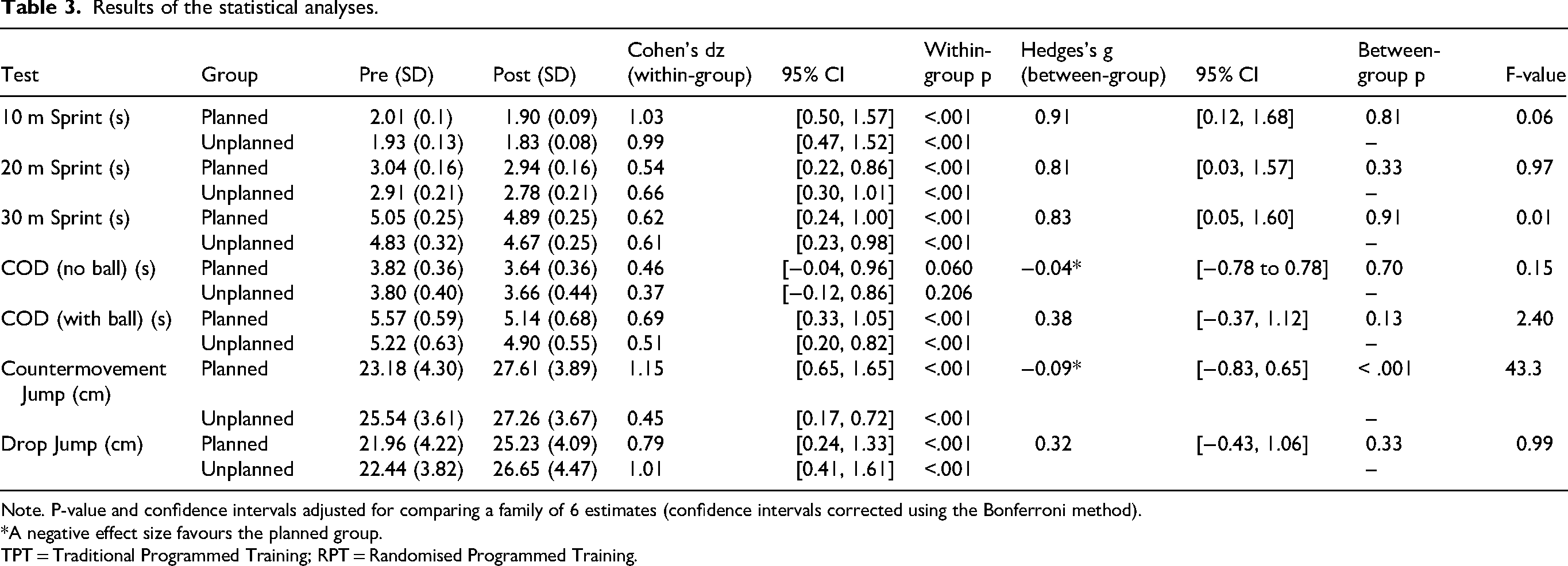
Note. P-value and confidence intervals adjusted for comparing a family of 6 estimates (confidence intervals corrected using the Bonferroni method).
*A negative effect size favours the planned group.
TPT = Traditional Programmed Training; RPT = Randomised Programmed Training.
Discussion
The purpose of this study was to compare the effects of TPT to an intensity- and volume-matched programme whose training week order was determined in a randomised fashion (RPT). This contrasted with the TPT programme which was structured in a traditionally-planned format following a planned pattern of progression over the course of the study (see Table 3). We were interested in the relative effects of these programmes on a variety of performance metrics in youth soccer players. Within the study design, the TPT group carried out each training week in a systematically progressive manner while the RPT group carried out identical training weeks ordered in a randomised fashion that was determined a priori. All other training variables (i.e sets and repetitions) remained identical between the groups. The results of the study indicated that there were no significant differences between any of the performance outcomes between either group, except for the CMJ. These findings suggest that RPT, when volume and intensity are matched to TPT, can yield similar outcomes across performance metrics through the execution of JT.19,31,32 Indeed, while the literature often proposes that specific training adaptations can be achieved by structuring training through particular planned formats, the current research indicates that the resulting adaptations from both structured and unstructured approaches are largely comparable.
Our within-group analysis indicated that both programmes were effective in enhancing all physical variables except for the CoD test with no ball. The similarity in performance outcomes between the TPT and RPT groups supports the notion that planned and non-planned programmes, with equalised workloads, demonstrate comparable short-term efficacy under controlled conditions. This therefore adds support to the potential for coaches to exercise greater adaptability in the structuring of JT during a sports season. This is particularly important because there may be moments in an in-season period when, due to residual fatigue from accumulated workload, athletes may be more susceptible to sustaining injury. 33 This would necessitate the coach adjusting the training programme in a reactive manner to account for any unforeseen circumstances in a potentially chaotic sports season. The similar results between the groups in this study imply that there may be multiple planning pathways by which to achieve similar adaptive responses through differentiated jumping programmes. This is where a more flexible approach to the planning of training could be important in allowing the coach and athlete the latitude to change pre-planned routines based on their specific needs at a given time.
One important result to highlight is that of the CMJ which was the only test in which the TPT programme appeared superior to the RPT. A potential explanation for this difference may be attributed to the nature of the training programme which itself consisted solely of vertical CMJs. Accordingly, it is reasonable to assume that this result relates to the specificity of the test to the applied training stimulus. A similar finding was previously observed by Williams et al., 18 who found youth basketball players improved their 10-metre sprint performance and overhead squat depth to a greater extent following a training intervention that included kinematically similar exercises, compared to an intervention that did not. This could be a potential indicator that TPT was superior to RTP in this case because the training stimulus was highly specific (and in this case identical) to the jump test that was utilised. In this way, this result was potentially driven by the similarities between the training stimulus and the utilised test. This somewhat relates to the concept of the periodisation of training which operates on the basis that the timing and magnitude of physiological adaptation to a programme is relatively predictable. 9 Programming methodologies are utilised by coaches to plan and regulate the volume, intensity and frequency of physical training throughout the course of a periodised season or some other defined period of time. 34 In the sport of soccer for instance, a seasonal approach is often adopted to prescribe and regulate players’ workloads, balancing training intensity with the events of the specific competitive and off-season calendars. Because different sports impose different complex demands on athletes, it can be difficult for coaches to manage athlete training loads around the rigid structure of a sports season. 35
Based on the above, coaches could potentially demonstrate flexibility in their application of planning principles. More flexible approaches to the structuring of training, avoiding a ‘one-size-fits-all’ approach when considering the intricacies of various athletic disciplines could yield benefits to the athlete by providing some freedom in how training activities are specifically prescribed. For example, the planning of a soccer player's activities would differ significantly from that of an Olympic rower with the greater regularity of important competitive events for the former making planning a more unpredictable and difficult endeavour for the S&C coach. Indeed, team sports can be significantly more challenging to programme for due to the multidimensional nature of training goals, the volume of required training and the intricacies of the competitive season. 36 In contrast, a rower may be focused on a far smaller number of key competitive events over the course of a quadrennial cycle, meaning they could potentially adopt a more rigid and structured approach to training. Based on the results of this study, which show group differences only in the CMJ, it could be argued that a more flexible approach to the planning of training could be beneficial for a team sport athlete, with a more structured and rigid approach fitting more easily into the more predictable cycle of an Olympic sport such as rowing or weightlifting.
In recent years, a body of work has emerged advocating the benefits of a more flexible approach to the long-term planning of training. Kiely 9 argues that physiological adaptation is driven primarily by the variability and individualised nature of training stimuli, rather than by rigid, pre-planned and stage-based structures that are typically associated with highly systematic programming approaches. Jovanovic argues that though a constant training stimulus (ie. the TPT) can elicit consistent adaptations, such an approach could also undermine athlete engagement, increase the risk of chronic overload and limit exposure to training variability if overused. Indeed, certain athletes may favour a more variable method which coaches can adjust when training load needs to be peaked or tapered. 37 Of course, in the context of youth athlete populations, the results of this study might well have been expected due to a low training age with respect to S&C which, in turn, logically determines a low threshold for adaptation (Williams et al., 38 Given that the age and pre-PHV maturation status of the participants, it could be that the planned structure was less important compared with simple exposure to the jumping exercise. On this, it has previously been reported that training-related mechanisms that could explain such effects include changes to the stiffness of various elastic elements of the muscle–tendon complex, transition to type II muscle-fibre, increases in the magnitude of muscle contractility, increased muscle size, altered fascicle angle, enhanced motor unit recruitment and discharge rate, greater intermuscular coordination, higher stretch-reflex excitability, enhanced neural drive to agonist muscles and better use of the stretch-shortening cycle. 19 Support for this can be found in the research into so-called neuromuscular training programmes which, despite being heterogeneous in both content and structure, appear to be efficacious in the development of athletic capabilities of youth athletes.39,40 Regardless of patterns of adaptation, the results of the current study potentially offer value to S&C coaches working with youth athletic populations where the constraint of time and varying schedules creates challenges to the planning of training. Where limited time may dictate a reduction in S&C training load at various times, the results of this study suggest that, with regard to JT, such variation would bear no negative consequence to the development of the young athlete if total loads are equalised.
Though this study relates specifically to the short-term planning of training, observing from a wider perspective, the findings could have relevance to the periodisation of training in youth athletes. For example, the aforementioned concept of agile periodisation 37 involves the progression of training in cycles while continuously monitoring and assessing an athlete's response to an individualised training programme. In one study, 41 young men and women (mean age ≈ 24 years; n = 585) underwent 12 weeks of strength training, resulting in average gains in upper body strength (one repetition maximum) of more than 50%. 8 However, individual increases in strength in response to training varied quite dramatically, ranging from 0% to 250% when one repetiton maximum was considered. Accordingly, when considering the performance increases that are possible after a structured training plan, it appears that responses are highly individualised and could therefore benefit from a more flexible approach to planning training as and where required.
Further to the above, an agile or flexible training plan need not be solely directed by the coach. An evolving field of training research provides evidence that individual daily training session modulation based on the athlete's ratings of perceived exertion, 42 or self-selected choice of training variables,43,44 can serve as a viable approach to training prescription. Hence, a fixed or static TPT plan may not have the flexibility to respond adequately to individual changes in an athlete's daily or weekly variability of psychological and physiological states. This follows previous findings which indicated that practice of a skill in a randomised fashion resulted in superior learning outcomes compared with blocked practice of repeated, identical task trials. 45 It is important to indicate however, that some of the approaches cited here, though presenting flexible alternatives, are not necessarily fully comparable. For example, Halperin et al. 10 advocate for an autonomous athlete-lead approach as opposed to the randomly assigned protocol adopted in the current study. Accordingly, the reader must approach our results with caution.
This study has several limitations. Due to technical and study design limitations, we were unable to incorporate internal or mechanistic measures of human performance such as RPE, EMG and muscle stiffness metrics. This creates a degree of uncertainty between the reported adaptation patterns and the potential mechanisms that might underpin them. Moreover, the TPT programme related exclusively to JT, the structuring of which may not be directly applicable to other forms of S&C training, such as endurance running or strength training. Indeed, the programme week randomisation process used in this investigation could be considered ‘pseudo-random’ and was a deliberate feature of the study design as opposed to any truly adaptively-responsive planning model. In this way, it does not represent a truly flexible or reactive planning strategy. Also, the body of evidence supporting the concept of structured planning relies predominantly on relatively short-term studies such as this, with a significant deficit in long-term studies with which more robust conclusions can be made. 35 The study was carried out over an eight-week period and this timeframe may not be sufficient to fully assess the effectiveness of long term planning of training given the short timescale of the intervention. Accordingly, if TPT programmes retain any defining characteristics that induce changes in performance that are over and above those that can be achieved through more flexible methods, these could become apparent in studies conducted over a longer period of time. Given this ambiguity, it is natural to question the true effectiveness of more structured training plans and whether more adaptable and practical approaches can be beneficial. Further to the above, the low level of training experience and the age of the current cohort must be considered with regard to the generalisability of the results. Accordingly, there is a requirement for further original research on this particular topic to determine whether it is the systematic planning of training or simply the random variation of it, that contributes to the observed responses to a given programme.
Practical applications
As an alternative to the application of structured planning models to the often chaotic and unpredictable season of soccer players, coaches could adopt a more flexible volume- and intensity-matched approach that adheres to a general plan but enables adjustments based on unforeseen occurrences such as injuries, unexpected fatigue or other such circumstances. The RPT protocol used in this study served as a research tool to simulate certain planning conditions and was not necessarily a recommended form of training. Moreover, it pertains only to one form of training which was the JT intervention that was executed in a relatively naïve population which were likely highly receptive to any applied training stimulus. 46 Also, these findings should not be overinterpreted due to the small sample size (n = 14 per group) and wide confidence intervals observed. Nevertheless it serves as evidence that coaches could still implement flexible approaches to the planning of JT. They may choose to do this by utilising strategies to assess an athlete's readiness before each training session and making subsequent adjustments to the prescribed training intensity on an ongoing basis. 8 Coaches can also use TPT to good effect, however, the use of more rigid planning methods should always be based on empirical evidence. Accordingly, a flexible approach could be crucial for optimising performance, depending on the particular sport that a coach is planning for. This involves consideration of the dynamic environmental conditions that influence the athlete's needs and relevant supporting research to underpin the adopted approach.
Footnotes

Ethical considerations
This study was conducted following the latest version of the Declaration of Helsinki and the protocol was approved by the local ethics committee of the National Centre of Medicine and Science of Sports, Tunis (CNMSS-LR09SEP01) before the commencement of the study.
Consent to participate
All participants were informed verbally and in writing about the purpose, procedures, potential risks, and benefits of the study prior to participation. Written informed consent was obtained from all participants. Written informed consent was obtained from their parents or legal guardians, and assent was obtained from the participants themselves.
Consent for publication
The participants provided informed consent for the publication of this work. They were informed that the material may be published in print and/or electronic formats and may be made publicly available. The participants were advised that reasonable efforts would be made to ensure confidentiality.
Funding
The authors received no financial support for the research, authorship, and/or publication of this article.
Declaration of conflicting interests
The authors declared no potential conflicts of interest with respect to the research, authorship, and/or publication of this article.