




Abstract
Virtual reality (VR) sports games have the potential to positively influence intentions and attitudes towards sport. This study adopted a between-subjects design with 71 sport and exercise science university students to compare two modes of a VR golf game – Traditional Golf and Gamified Golf – against a non-sport VR game (Control). Intention and attitude towards golf were measured at baseline (four weeks prior to the intervention), immediately after a 20-min VR session, and at four-week retention. Perceptions relating to the VR gameplay were also obtained post-intervention. Results found that intentions towards golf did not change across time for any of the three groups. However, a significant time x group interaction was found for attitude towards golf. Specifically, the Gamified Golf group showed a decrease in attitude from baseline to post-intervention, whereas the Traditional Golf and Control groups showed no meaningful change. Analysis of the gameplay perceptions found that the Gamified Golf was perceived as being significantly easier and less effortful than the Traditional Golf. These findings suggest that gamification in VR golf may oversimplify the real-world experience of the sport and coincide with less favourable attitudes within this likely sport-engaged student cohort. These results are surprising given prior evidence supporting gamification principles. Nevertheless, we recommend that practitioners and stakeholders carefully consider that gamification may, in some contexts, have unintended effects on individuals’ intentions and attitudes toward sport. Future research should test whether these effects replicate in more diverse participants (e.g., varying in age and baseline sport engagement) before generalising to wider populations.
Introduction
Virtual reality (VR) technologies have been growing in different areas in recent years, including domains such as education, 1 health, 2 and sport. 3 VR forms part of a broader group of technologies called extended reality, which also includes 360° video, mixed reality, and augmented reality. 4 One of the advantages of VR is its capability to provide a more immersive experience compared to two-dimensional displays, helping users to feel as though they are physically present in the simulated virtual environment.5–7 The benefit of this immersive experience is that it provides an enhanced means of engaging users in the content that is being displayed.1,6 For example, VR has been used in a range of educational settings because it enables simulation-based learning, which can have a significant influence on learner engagement and outcomes.1,8 In the context of sport and exercise, virtual training has been shown to significantly improve sporting performance, 9 and evidence suggests that VR can generate enhanced intrinsic motivation, 10 and provide users with high levels of enjoyment when performing physical activity. 11
Positive emotions (such as enjoyment), intentions, and attitudes are important factors that can drive participation in sport,12–14 but such emotions may also encourage the consumption of sport in other ways such as watching televised or live events. 15 The heightened levels of engagement and emotional responses elicited by VR (and similar extended reality technologies) could therefore be used as a means of increasing sport consumption. 16 For example, college students who watched a 360° VR recording of a volleyball game showed increased levels of presence and arousal which, in turn, influenced the intentions of those students to consume VR sports products and services. 16 In a similar vein, playing a VR table tennis game, that included enhanced levels of vividness and presence to promote the sport, generated higher levels of interest (e.g., playing or learning more about table tennis) amongst people with limited previous experience of the sport, compared to an informational video advertisement. 17 These examples highlight how VR can positively influence people's intentions to consider engaging in other forms of sport consumption that are not limited to actual participation of that sport in the real world.16,17 Research has shown that such consumption (e.g., watching televised competitions, following the sport via digital media platforms, or attending live events) may then have a positive, indirect impact on participation rates by fostering interest, increasing basic knowledge, and enhancing self-efficacy prior to more practical involvement.18,19
Another method of encouraging end-users to increase their consumption of sport is to combine VR technology with gamification to potentially influence attitudes towards the sport. 20 Gamification uses the typical elements from video games (e.g., leaderboards, collecting points or badges, advancing through levels) 21 in contexts that are not inherently game-like in nature. 22 The mechanisms that underpin the benefits of gamification for the end-user include, but are not limited to, the provision of immediate feedback and positive reinforcement, the capability to adapt the level of complexity to suit the individual, and the option for users to select different pathways and goals to achieve. 23 The combination of gamification and VR has been shown to significantly increase the amount of fun experienced by the user, leading to an increase in their intentions to use VR sports content. 20
Given the benefits of VR in providing an engaging, emotive, and immersive experience, 6 it is possible that a gamified sports-based VR intervention may increase the intention of individuals to consider other means of sport consumption, including watching live or televised events and/or engaging in actual physical participation.16,17,20 Whilst previous research has shown that the use of videogames can increase involvement in real-life sport, 24 research is required to examine how exposure to a more immersive and gamified VR sports game may influence users to consume sport across a broader array of settings. Drawing on the Theory of Planned Behaviour,13,25 which posits that attitudes toward a behaviour, subjective norms, and perceived behavioural control jointly shape intentions and subsequent behaviour, more research is required to determine whether exposure to immersive VR sport simulations can influence attitudes and intentions to engage with that sport. Golf is a particularly interesting sport to explore for this concept, given that it is played more by older adults than younger populations. 26 In addition, golf is a sport that has commercially available VR games, with different formats such as traditional game play and gamified versions.
Therefore, the aim of the present study was to explore the impact of playing a traditional or gamified version of a VR golf game on intention to engage with golf and attitude towards the sport in young adult university students recruited from a sport and exercise science class. A control condition involving a non-sport VR game was also included for comparison. Golf intention was defined as the aim of the user to engage with the sport through various means (e.g., participate, watch on television, or play digital games), whereas golf attitude was defined as their perception of the level of physical, mental, and technical skills and qualities needed to play golf. In addition, we sought to compare two distinct VR golf game modes: A traditional version intended to reflect real-world play on a golf course (Traditional Golf), and a gamified version intended to reflect arcade-style golf experiences (Gamified Golf). Finally, by obtaining data on the gameplay experiences of participants regarding each game condition (e.g., perceptions of complexity, effort, competence, and enjoyment), we explored the potential mechanisms underpinning any changes in golf intention and attitude.
The following hypotheses were made:
Both the Traditional Golf and Gamified Golf groups will significantly increase (i.e., make more positive) their intention towards golf. No such change will occur for the Control group. Both the Traditional Golf and Gamified Golf groups will significantly increase (i.e., make more positive) their attitude towards golf. No such change will occur for the Control group.
Materials and methods
Participants
Participants were recruited from a cohort of sport and exercise science students at a university in Australia. The VR game exposure was delivered to the full cohort as part of a timetabled class within their ‘Introduction to Sport and Exercise Science’ subject, however, participation in the research component (i.e., the study questionnaires; see Measures below) was voluntary and required consent. The subject was not taught by any member of the research team and, to further minimise perceived coercion in a classroom context, consent and questionnaire administration were conducted independently of subject teaching staff.
In total, 71 participants completed all three phases of the study. The Traditional Golf group contained 29 participants (M age = 19.21 ± 2.37; 10 females); the Gamified Golf group had 25 participants (M age = 19.04 ± 3.59; 8 females); and the Control group contained 17 participants (M age = 18.25 ± 0.61; 10 females). To reduce potential bias from pre-existing golf enthusiasm, participants were asked to report their favourite sport. Australian rules football (n = 17), basketball (12), soccer (10), and netball (6) were the most frequently cited; importantly, no participants stated golf, suggesting it was not a primary sport of interest within this cohort. Beyond this, no additional demographic characteristics were collected, consistent with the approved ethics protocol and a minimisation approach to participant data collection. All participants gave informed consent before taking part in the study, and they were reminded at the start of each phase of their right to withdraw without consequence. Ethical approval was obtained by the lead researcher's institution (ID: HEC23502).
An a priori power analysis for a 3 (Time)×3 (Group) mixed-design ANOVA targeting the main hypothesis testing for a Time×Group interaction was conducted. Input variables included an α of .05, power of .80, and medium effect size (f = .25). Assuming ρ = .50 and ε = 1.00, the required sample size was 36 (n = 12 per group). To be conservative under modest sphericity violation (ε = .75), the target sample size was increased to 42 (n = 14 per group). Thus, the achieved sample size exceeded the a priori requirement.
Design
The study adopted a single-blind, between-subjects experimental intervention design, with participants randomly assigned to either the Traditional Golf, Gamified Golf, or Control group for their intervention condition. Randomisation was conducted at the level of class groups (cluster allocation) to enable delivery within scheduled classes; consequently, three classes were allocated to each golf condition and two classes to the Control condition. Participants were informed that the study explored the effect of playing VR games on perceptions towards sport but were not told the specific hypotheses or group comparisons. Golf intention and golf attitude data were obtained at three time points including baseline (approximately four weeks prior to the intervention), post-intervention (immediately following the intervention), and retention (approximately four weeks post the intervention).
Apparatus
The Meta Quest 3 was used during the intervention. This is a standalone VR headset developed by Meta Platforms, Inc. It features an untethered, head-mounted display (HMD) and ‘Touch Plus’ handheld controllers for navigation and interaction within the virtual environment. The HMD has a high-resolution display with a pixel density of 2064 × 2208 per eye, refresh rates up to 120 Hz, and a field of view of approximately 110°. It has built-in spatial audio through integrated speakers and has various adjustable components at the lenses and head strap to ensure comfort and clear vision for each participant.
The Golf + VR game was used for the two golf conditions. Participants in the Traditional Golf group played the ‘Stroke Play’ mode, which is designed to reflect the real-world default scoring system used in golf as the individual navigates each hole on a typical course. These participants played the ‘Castle Links’ course, with settings fixed to moderate difficulty. Participants in the Gamified Golf group played the ‘Topgolf’ mode, which is designed to reflect the Topgolf sports-entertainment company (https://topgolf.com/us/) that provides a real-world arcade-style driving range for customers. The participants in the Gamified Golf group played target-based games set in a virtual driving range environment, with gamified features such as bonus points zones, combo-streak rewards, and celebratory sound effects and animations. The Fruit Ninja 2 VR game was used for the Control condition. This game involved using virtual swords to slice flying fruit in a virtual outdoor environment. These participants played the classic and arcade modes, where the objective was to slice as many fruits as possible in a set amount of time to earn points, whilst also avoiding bombs. This served as a gamified non-golf control condition that aimed to match the potential positive experience (and/or novelty) of using VR technology, but without the sport exposure. Screenshots of typical gameplay for each condition can be seen in Figure 1 below.
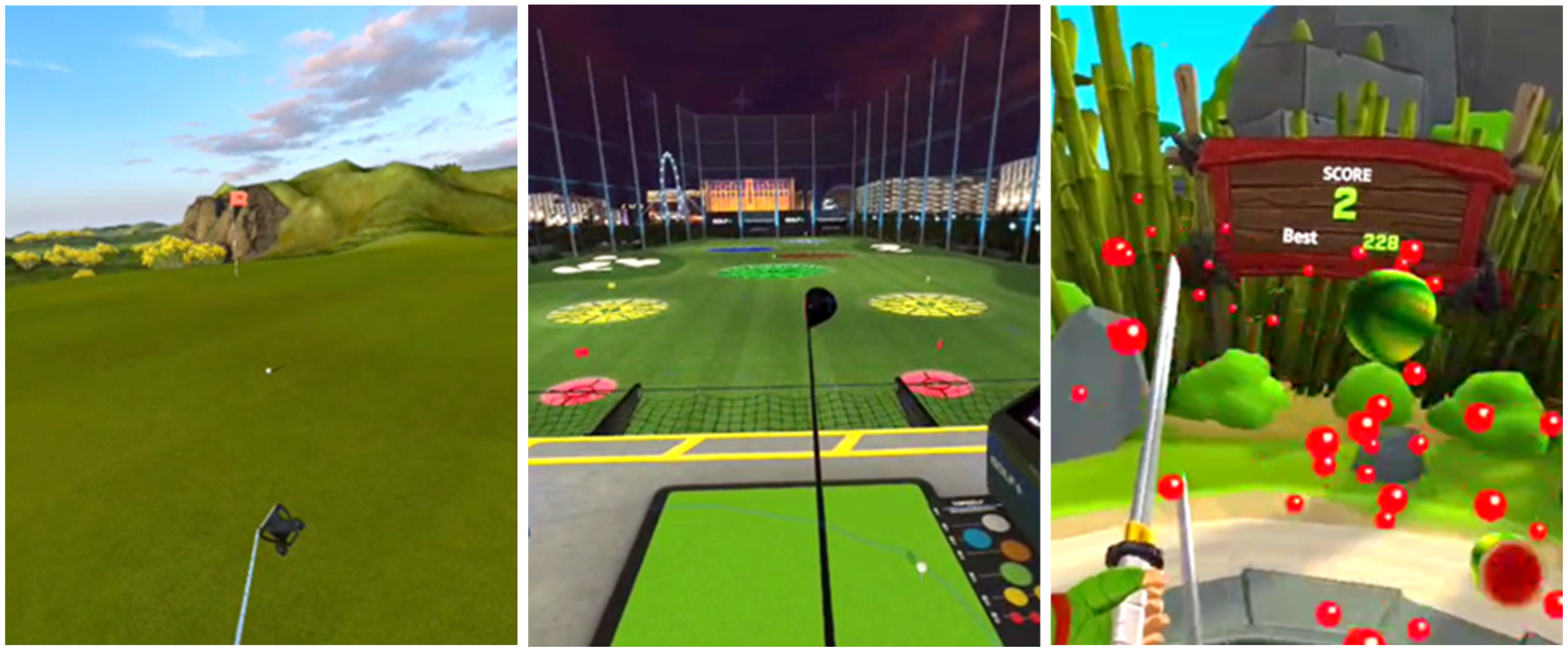
Example gameplay for traditional golf (left), gamified golf (centre), and control/fruit ninja (right).
Measures
Aside from the demographic data obtained during the baseline phase, the main measures used in the present study are outlined below and are adapted from comparable research exploring the effect of VR sports on attitudes and intentions in adolescents. 27 Golf intention and attitude were measured at all three time points, whilst gameplay experience was measured only once – immediately after playing the game in the post-intervention phase.
Golf intention
Golf intention was measured via responses to six items that asked participants to rate how likely they would be to (i) participate in golf, (ii) attend a live golf event, (iii) watch golf on television, (iv) follow golf events via other means (e.g., social media, internet, non-live TV), (v) play digital golf games, and (vi) purchase golf merchandise or equipment. This operationalisation reflects a multi-dimensional view of engagement, capturing both participatory and spectator/consumer behaviours, which may represent meaningful forms of engagement in their own right, and may also relate to future participation. For the ‘participate’ and ‘attend’ items, the opening stem included the caveat, ‘if there was a course/tournament near you and money was not an issue…’ to help ensure that participants gave their ratings free of individual logistical constraints. Each item ended with ‘in the next 12 months’, to provide a realistic timeframe for participants’ intentions. All ratings were given on a 100 mm visual analogue scale with the anchors of extremely unlikely and extremely likely. Visual analogue scales allow participants to express more nuanced perceptions, as they are not restricted to the fixed response points used in Likert-type scales. 28
Golf attitude
Golf attitude was measured via responses to three items that asked participants to rate their agreement with the following statements: (i) the physical skills and qualities needed to play golf are very high, (ii) the mental skills and qualities needed to play golf are very high, and (iii) the technical skills and qualities needed to play golf are very high. For this measure, the 100 mm visual analogue scales had the anchors of strongly disagree and strongly agree.
Gameplay experience
Five items were used to obtain data about the experiences of the participants when playing the game for their respective conditions. These were: (i) the game I played was easy to understand, (ii) the game I played required a lot of physical effort, (iii) the game I played required a lot of mental effort, (iv) I was very good at the game I played, and (v) I would like to play the game again. Item (v) was included as an indicator of appeal, a commonly used proxy for enjoyment in game evaluations,29,30 and is distinct from our primary behavioural intention measures. The same 100 mm visual analogue scale with anchors of strongly disagree and strongly agree was used for all items.
Procedure
Participants completed all the questionnaires using the QuestionPro online survey software using their phone or laptop. The majority of participants completed these in a classroom setting during their allocated class time, however, a reminder email was sent, and subsequent four-day extension was provided to accommodate any participants who did not complete the questionnaire at that time.
For the intervention (phase two), participants spent 20 min playing in the game condition to which they had been randomly assigned: Golf+, Topgolf mode (Gamified Golf); Golf+, Castle Links course (Traditional Golf); or Fruit Ninja 2 (Control Group). A single-session exposure was selected to capture first-contact effects on attitudes and intentions – a design commonly used in immersive technology research. 31 This approach has been effective in changing attitudes within health, 32 environmental, 33 and hospitality settings, 34 with some interventions lasting as little as three minutes. 33 The single-session design also minimises participant burden and attrition and helps reduce confounding influences associated with repeated exposure (such as reduced novelty of VR), whilst ensuring a standardised exposure dose across conditions.
Prior to participant arrival, a member of the research team had set up each game such that the participants were able to commence playing the main game immediately, as opposed to first navigating through settings and introductory screens. Following this, participants completed the Gameplay Experience questionnaire reflecting on the game they had just played, as well as the same measures of golf attitude and golf intention as at baseline and retention. The intervention took place on a basketball court, with the virtual environment setup as an approximate 4 m×4 m square.
Statistical analyses
All data were analysed using IBM SPSS Statistics (Version 29). Statistical significance was determined using an alpha level of p < .05. Where appropriate, partial eta squared (ηp2) was reported as a measure of effect size. To address hypotheses one (golf intention) and two (golf attitude), separate 3 (Time: Baseline, Post-Intervention, Retention)×3 (Group: Traditional Golf, Gamified Golf, Control) mixed-design ANOVAs were conducted. Time was treated as a within-subjects factor, and Group as a between-subjects factor. When Mauchly's test indicated a violation of the assumption of sphericity, Greenhouse-Geisser corrections were applied to adjust the degrees of freedom. To explore the potential mechanisms underpinning any potential changes in golf intention and attitude, a series of one-way ANOVAs were conducted to compare intervention groups on each of the five gameplay experience items (ease of understanding, physical effort, mental effort, competence, and desire to play again).
Results
Descriptive statistics
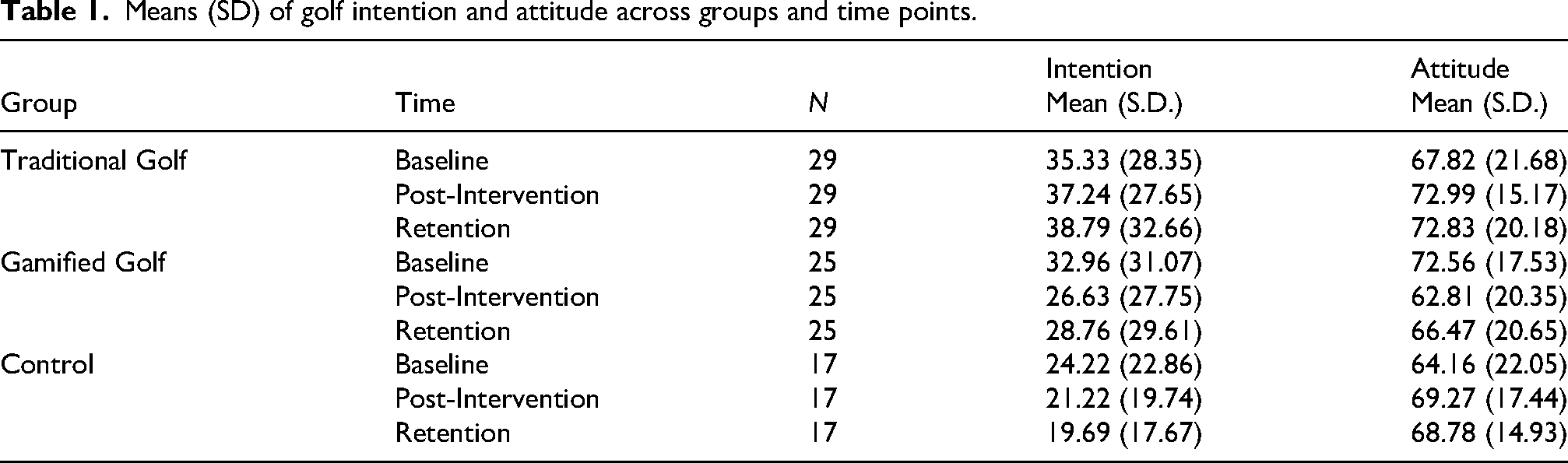
Data showing the means and standard deviations for each group at each time point can be seen in Table 1. Baseline comparability was assessed with Welch's ANOVA. No group differences were found for golf intention (F(2, 42.68) = 1.12, p = .336) or golf attitude (F(2, 39.28) = 0.95, p = .397).
Means (SD) of golf intention and attitude across groups and time points.
Golf Intention
There was no significant main effect of time, F(2, 136) = 1.30, p = .276, ηp2 = .019, indicating no overall change in golf intention across the three time points. Of primary importance, the interaction between time and group did not reach statistical significance, F(4, 136) = 2.10, p = .085, ηp2 = .058 (see Figure 2).
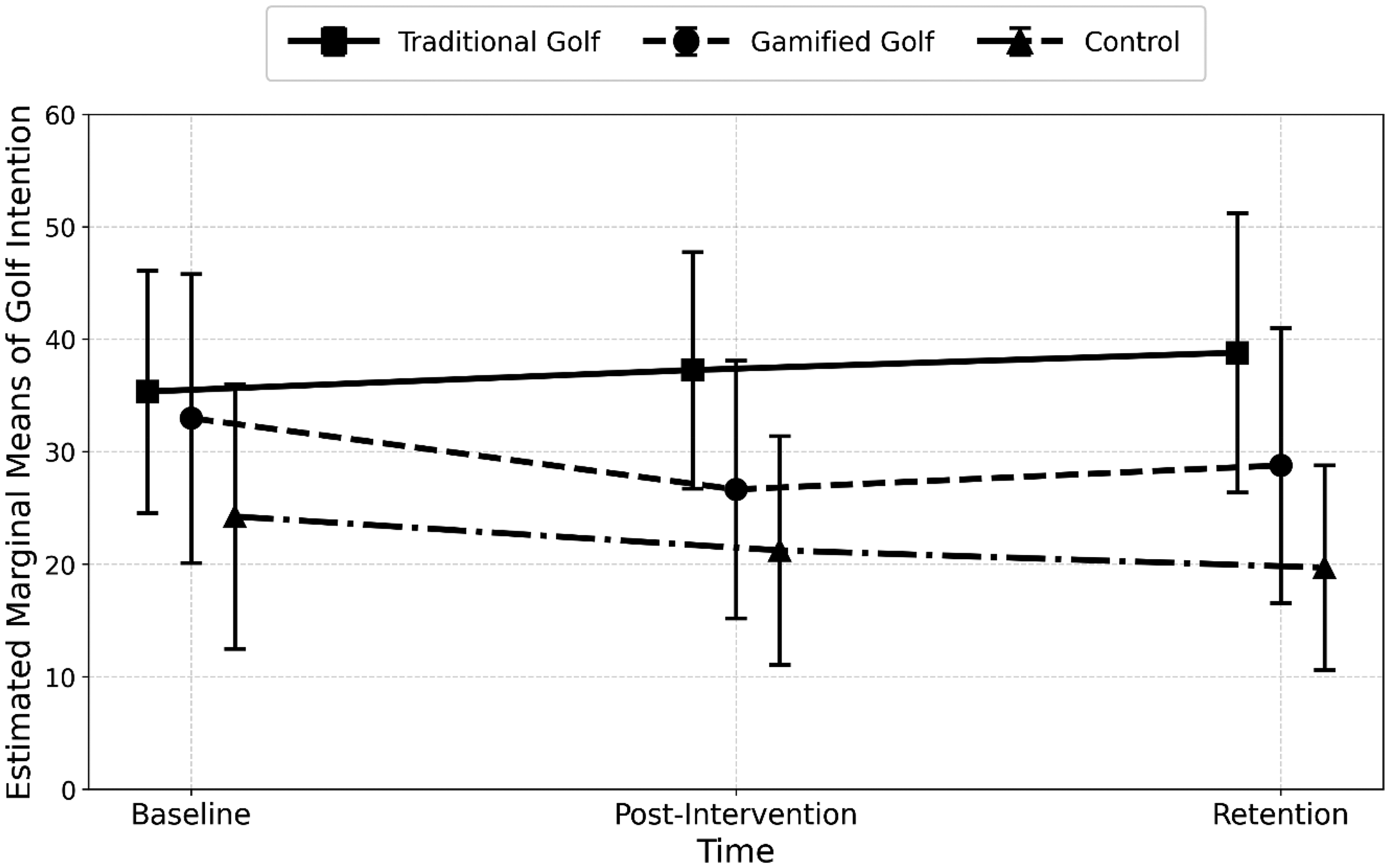
Change in Golf intention for each group from baseline to post-intervention to retention.
Golf Attitude
The main effect of time was not significant (F(1.83, 124.23) = 0.83, p = .447, ηp2 = .002), indicating no overall change in golf attitude over time. Of primary importance, the interaction between time and group was significant (F(3.65, 124.23) = 2.88, p = .027, ηp2 = .078). Within-group pairwise comparisons revealed that only the Gamified Golf group showed a significant change over time, with golf attitude decreasing from baseline (M = 72.56) to post-intervention (M = 62.81) (p = .018). No other within-group changes reached significance after Bonferroni adjustment (see Figure 3).
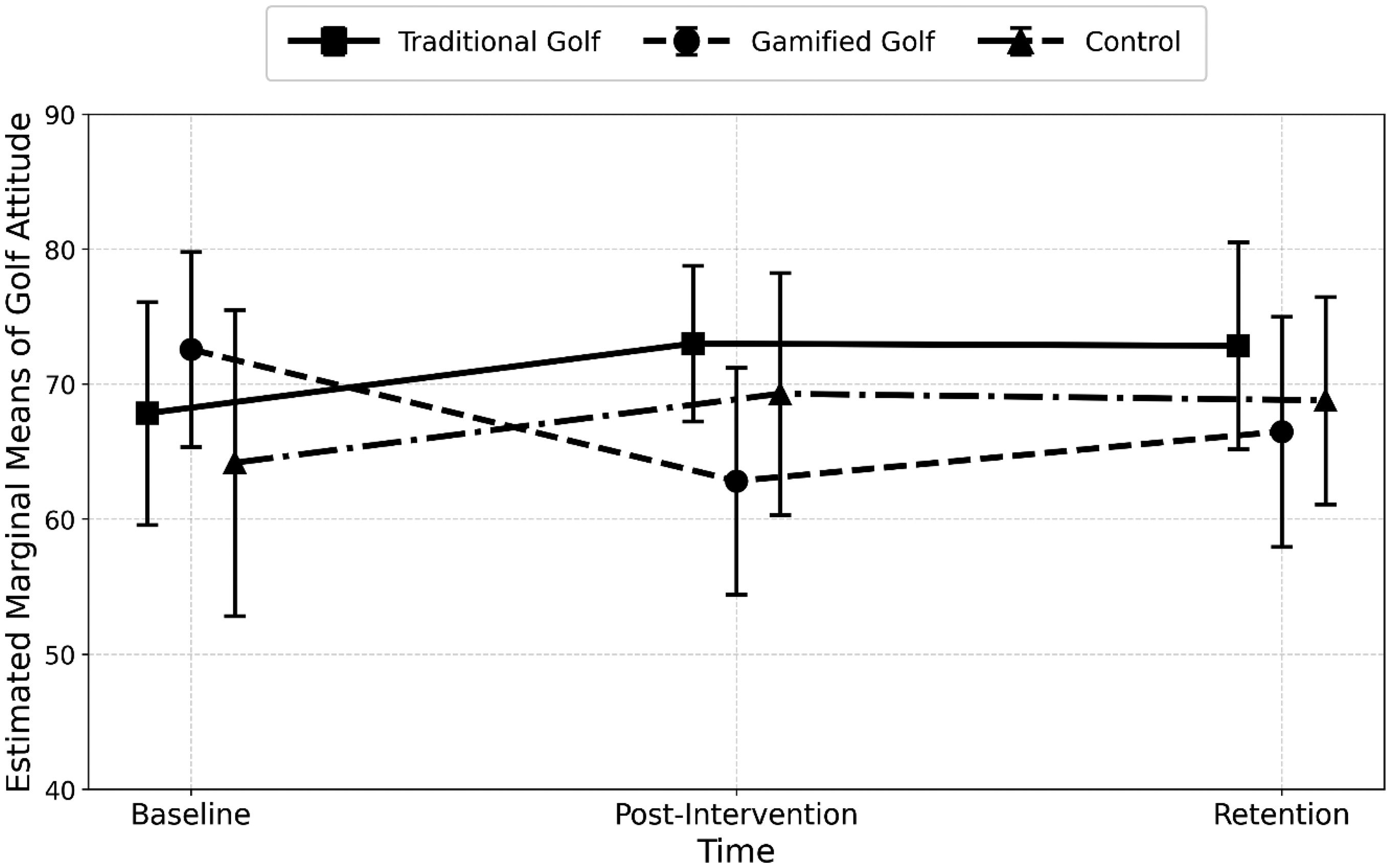
Change in Golf Attitude for each group from baseline to post-intervention to retention.
Gameplay experience
Levene's test for homogeneity of variances was non-significant for all five gameplay experience items (p > .05), indicating that the assumption of equal variances was met across the groups. A one-way ANOVA revealed a significant difference in mental effort between the three conditions, F(2, 68) = 4.12, p = .020, ηp2 = .108. A Bonferroni-adjusted post hoc test revealed that the Traditional Golf group reported significantly greater mental effort (M = 52.07 ± 25.13) compared to those in the Gamified Golf group (M = 34.00 ± 22.99, p = .031). A one-way ANOVA revealed a significant difference in perceived competence between the three conditions, F(2, 68) = 6.29, p = .003, ηp2 = .156. A Bonferroni-adjusted post hoc test revealed that the Gamified Golf group had significantly higher perceived competence (M = 68.56 ± 23.91) compared to those in the Traditional Golf group (M = 45.17 ± 24.06, p = .002)
No significant between-group differences were found for ease of understanding, F(2, 68) = 1.93, p = .153, physical effort, F(2, 68) = 0.04, p = .963, or desire to play again, F(2, 68) = 0.14, p = .870. Ratings on these items were similar across all three conditions, indicating comparable perceptions of game complexity, physical demand, and motivation to re-engage with the games (see Figure 4 below).
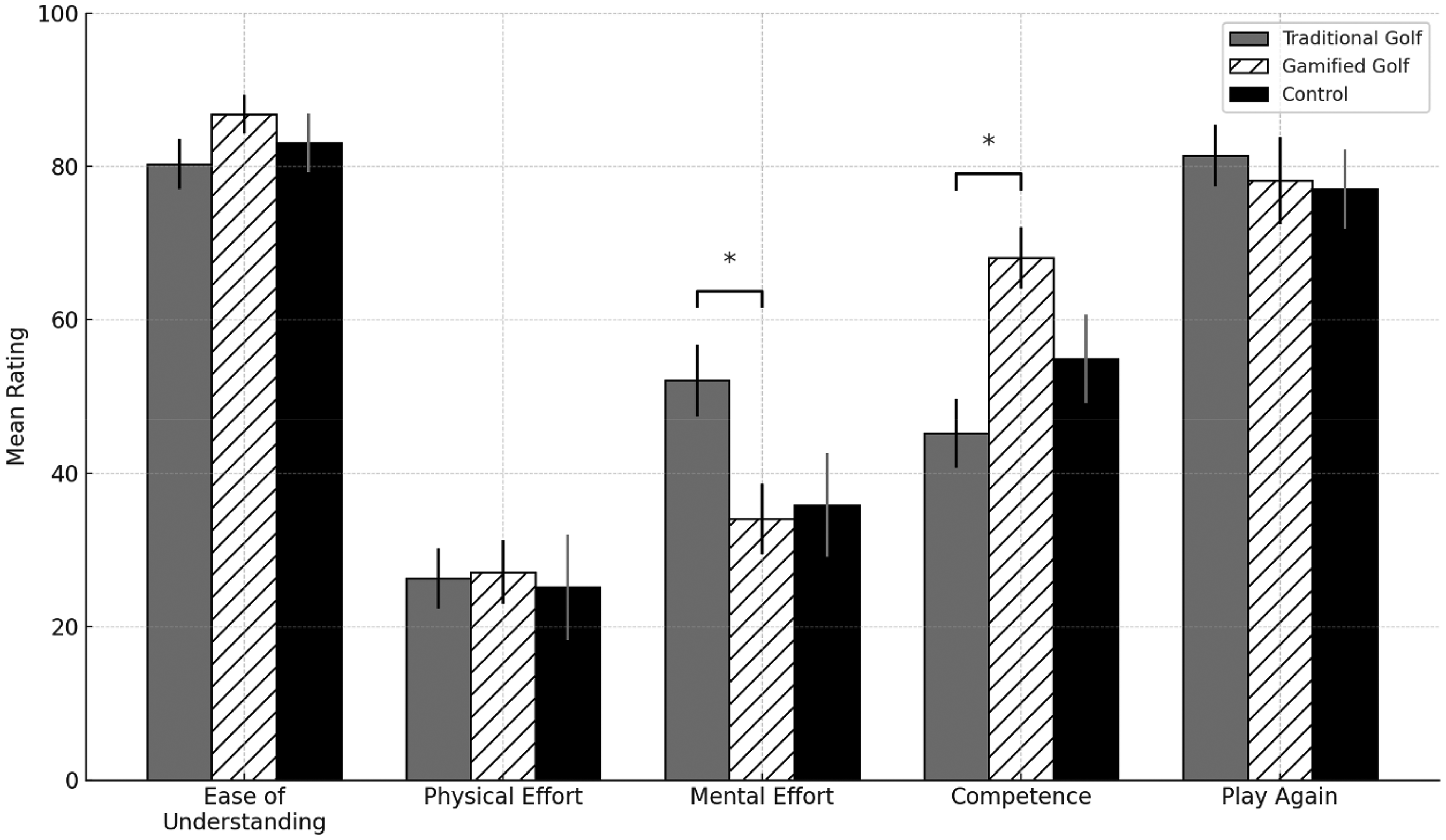
Comparison of gameplay experience items between the three conditions. Note. Ease of Understanding = “the game I played was easy to understand”; Physical Effort = “the game I played required a lot of physical effort”; Mental Effort = “the game I played required a lot of mental effort”; Competence = “I was very good at the game I played”; Play Again = “I would like to play the game again”.
Discussion
The aim of this study was to examine whether VR golf games could be used to positively influence participants’ intentions and attitudes towards the sport. To address this aim, we conducted a direct comparison between two versions of a VR game, with one of those versions using the principles of gamification in an arcade-style golf game, 23 and the other using a more traditional game that provided a closer simulation of real-world golf. In addition, we included a control condition in the form of a non-sport VR game (Fruit Ninja) to match the potential positive experiences and/or novelty of using a VR game.
For our first hypothesis, we predicted that the Traditional and Gamified Golf games would significantly increase the intentions of participants to engage in the consumption of golf (e.g., playing, spectating, purchasing golf merchandise), but there would be no change in the intentions reported by participants in the Control group. Contrary to our prediction, the results revealed no significant changes in the intentions of the participants for any of the three groups. Our results suggest that a 20-min exposure to a VR golf game (either gamified or traditional modalities) was not sufficient to influence the intentions of participants to further engage with the sport. Previous research has shown that playing a VR sports game can positively impact the intentions of users after similarly brief exposures (e.g., 15 min), 20 with some exposures being half the duration of that used in the present study (i.e., 10 min). 17 Similarly, watching only 3-min of a volleyball highlight reel using a VR headset can influence the intentions of observers to consider consuming VR sport content and products. 16 Whilst this past research suggests that VR may influence intention towards engaging with a sport, this may not always be the case, as evidenced by our results.
One of the key differences between the present study and those conducted previously is that our study compared three different versions of a VR game, whereas others have tended to compare VR simulations to two-dimensional displays6,17 (though for an exception, see Uhm, Kim and Lee). 20 Therefore, whilst the increased sense of immersion provided by VR may influence consumption intentions compared to a less immersive two-dimensional video, 17 the present results suggest that the influence may be diminished when the same information is presented using different versions of a VR display. Another explanation for the lack of significant differences in intentions for the present study is related to the fact that our participants were sport and exercise science students who likely had substantial previous experience with sport. As shown by Zhu, 17 observers with high levels of previous experience with a given sport are less likely to show significant changes in their interest towards that sport, regardless of whether they are exposed to a display that uses VR technology or a two-dimensional video. Given that our participants’ prior experiences in sport likely included a high volume of social interactions, it is possible that the absence of those interactions in the present study may have had a greater impact upon the participants’ intentions compared to the immersive experience offered by the VR technology. 35 Moreover, the participants’ prior experience with sport may have meant that exposure to the VR sport game failed to replicate the elements that they were accustomed to experiencing in real-world sport, thereby leading to an absence of any changes in their intentions to engage with golf.
For our second hypothesis, we predicted that the Traditional and Gamified Golf games would significantly increase the attitudes of participants regarding the physical, mental, and technical skills and qualities required to play golf, and that there would be no change in the attitudes reported by participants in the Control group. The results revealed no significant changes in the attitudes of the participants in the Traditional Golf group and the Control group, but there was a significant decrease in the attitudes for those in the Gamified Golf group. Given that gamification has been shown to provide numerous benefits in terms of motivation, learning, and engagement,1,36 the decrease in attitudes reported for the Gamified Golf group in the present study is surprising. One possible explanation for these results may come from the analysis of the gameplay experience data obtained from the participants. The participants in the Gamified Golf group reported significantly lower perceptions of mental effort and significantly higher perceptions of competence, suggesting that the gamified/arcade version of the golf game was potentially perceived as being overly simplistic and therefore requiring lower levels of physical, mental, and technical skill. It is also possible that the gamification features experienced by the Gamified Golf group failed to replicate the typical demands of traditional golf (the gamified version was a driving range, rather than a round of stroke-play golf), thereby providing a playing experience that failed to match the participants’ expectations of the challenges present in the real-world version of the sport. Whist speculative, given our participants were current sport and exercise science students, they may think about/engage with sport differently to the standard population. Given their likely high level of engagement with sport, this may have led participants to feeling the VR golf games lack key elements typically expected in real-world sport, thus potentially limiting intentions and attitudes.
Whilst gamification has been shown to offer a range of benefits, there have also been some reported challenges associated with its use. 36 For instance, accruing points and/or successfully moving through the different levels of a gamified learning intervention could encourage participants to become more extrinsically motivated, 37 and it could also distract participants from the key learning objectives of the intervention. 38 Some participants who used a gamified exercise application on their phones reported that the process was restricting, especially in the first session, due to the additional effort required to learn how to use the application. 39 It may therefore be important to ensure that the gamified features are closely aligned to the characteristics of the user,39,40 rather than simply assuming that gamification itself will achieve the desired levels of engagement and learning. 36 It is also worth noting that in VR applications explicitly aimed at training and transfer, authors have argued that effectiveness depends on preserving representative task constraints and targeting underpinning perceptual-cognitive mechanisms,41,42 rather than adding game elements which may dilute key informational demands. From this perspective, gamification may be beneficial only insofar as it supports – rather than competes with – representativeness and the intended mechanism of change.
Practical implications
These results have implications for key stakeholders who play a role in increasing sport participation and engagement in young adult, sport-engaged settings (e.g., university cohorts similar to the present sample), including exercise scientists, coaching staff, and physical education teachers. Given the decline in sport participation rates in young adults, 43 novel methods need to be considered to promote participation and engagement in this age group. The present study highlights that, in this sport-engaged student cohort, a short VR-based sport game exposure did not produce the hypothesised positive effect on golf intentions and attitudes, and alternative methods should be considered. This could be through other activities similar to the sport (in the golf example, this could be ‘mini golf’) or showcasing engaging opportunities as a spectator. The significant decrease in attitudes for the Gamified Golf group suggests that the gamification of a VR sport game may not always promote positive attitudes towards the sport, and in the case of the participants in the present study, gamification can have a negative impact. Therefore, practitioners should ensure the features of the VR sports game suit the characteristics of the user,39,40 and incorporating gamification within activities designed to engage people with sport may, in fact, not be the best approach.
Limitations and future research
There are several limitations and avenues for future research to consider with this study, most notably concerning the targeted sample and generalisability. Participants were recruited from a sport and exercise science university class and therefore likely represent a sport-engaged student cohort rather than a general community sample. Whilst student samples are commonly used to test behavioural and psychological processes, 44 differences between student and population samples can occur for attitudinal variables, 45 and effects should not be assumed to transfer without replication through further research. Accordingly, the present findings should be generalised primarily to similar cohorts. Importantly, despite being a sport-engaged cohort, baseline intentions to golf in our sample were low-to-modest on average (likely reflecting the fact that participation in the sport is typically higher amongst middle-aged and older adults) 26 and showed substantial variability (see Table 1). This indicates that participants did not hold uniformly fixed or ceilinged intentions towards golf despite their sport-engaged background, with sufficient room for change following exposure to the VR games. Nevertheless, future research should focus on recruiting more diverse samples – especially participants without explicit engagement in sports and a more heterogeneous age – to test whether responses to VR sport gamification differ across populations.
In addition, although a single, 20-min exposure was chosen similar to past research, 20 this may not have been sufficient to elicit significant effects. However, it is important to note that a short exposure was deliberately chosen, as it is rarely feasible to perform longer and/or multiple exposures to similar activities to promote engagement with sport. Moreover, to enhance control and for logistical purposes, the VR conditions were played in offline modes. This removed online features (e.g., personalised competition and social interactions) that may be key to eliciting the potential benefits of VR. Relatedly, it is important to acknowledge that our findings regarding gamification should be interpreted within the context of VR games. The real-world gamification of golf through experiences like Topgolf places greater emphasis on social elements than VR, even if online modes had been used. Furthermore, our gamified and traditional modes differed in context - the former set at a driving range and the latter on a golf course. Whilst this design reflects ecological validity in the gamification of golf, future research could examine whether integrating gamified elements into a golf course setting, or applying a traditional format within a driving range, leads to different outcomes. It should also be acknowledged that the traditional mode still offers some gamified features, 46 which may have reduced the contrast between conditions and limited our ability to isolate the gamification. Finally, for reasons of control and feasibility, difficulty settings were standardised across all participants. It may be that individualising the difficulty of VR sports games would be more effective in enhancing intentions and attitudes towards sport. Future research may wish to adopt qualitative approaches to explore how VR exposure duration, social interactions, and individualised difficulty settings influence attitudes and intentions towards sport in a way that is more practical to implement.
Conclusion
In conclusion, the results of this study suggest mixed findings for the use of VR golf games to influence attitudes and intentions towards golf in a likely sport-engaged university student cohort. Specifically, the exposure to a VR golf game was not sufficient to influence the intentions of participants to further engage with the sport, whilst the gamified golf format had a negative impact on the attitude of participants towards golf. Given the additional findings comparing the gameplay experience of each group, we hypothesise that gamification features oversimplify the nature of the sport, leading participants to devalue the perceived skills required to play it. These findings should be interpreted within the context of this sample, and replication across broader cohorts (e.g., varying in age and sport engagement) is needed before generalising to the wider population. Nevertheless, our results suggest that caution should be had when considering the use of gamified simulations like VR to influence intentions and attitudes towards sport engagement.
Footnotes

Ethical considerations
This study was approved by the Human Ethics Committee of La Trobe University (Ethics Code: HEC23502) on February 15, 2024. All participants provided written informed consent prior to enrolment in the study. This research was conducted ethically in accordance with the World Medical Association Declaration of Helsinki.
Consent to participate
All participants provided informed consent prior to participation. Consent was obtained in written form via an online questionnaire system. Participants were informed of the voluntary nature of the study and their right to withdraw at any time without penalty.
Consent for publication
Not applicable. This manuscript does not contain any individual person's data in a form that would allow identification (including personal details, images, or videos).
Funding
The authors received no financial support for the research, authorship, and/or publication of this article.
Declaration of conflicting interests
The authors declared no potential conflicts of interest with respect to the research, authorship, and/or publication of this article.
Data availability statement
Anonymised data may be made available from the corresponding author upon reasonable request, subject to ethical approval and institutional requirements.