



Abstract
Advancements in technologies such as 360°video and virtual reality (VR) open new possibilities for how athletes can train their perceptual-cognitive skills. However, few studies have explored the athletes’ perception of these different training approaches qualitatively. Therefore, this study engaged three quarterbacks (QBs) from an Australian American football team in four different sport-specific training approaches (on-field, 360°video, VR, traditional video) and explored their thoughts and preferences in relation to how each could help develop their perceptual-cognitive skills. The developmental QBs participated in semi-structured interviews after each of the training approaches. Interpretive Phenomenological Analysis was used to explore participants’ unique experiences of each approach. Two primary themes were identified, along with secondary themes: ‘Opportunities for training perceptual-cognitive skills’ (sub-themes: Making the best decision; Where to look; Awareness and reflection), and ‘Factors influencing perceptual-cognitive skill development’ (sub-themes: Control of movements; Realism). All participants ranked on-field training as their preferred approach, with two participants then ranking the technologies as 360°video > VR > traditional video, and one participant ordering them VR > traditional video>360°video. The findings can be contextualised through an ecological dynamics framework; specifically, the first theme in relation to affordances for action, while the second theme relates to perception-action coupling and representative learning design. Overall, the study provides unique individual insights on QBs’ perceptions and preferences towards technologies such as 360°video and VR and how they may be utilised to develop perceptual-cognitive skills. Future research should look to build on these findings by examining whether the positive perceptions transfer to actual performance improvements in a longitudinal intervention design.
Introduction
To achieve skilled performance, athletes need not only high physical qualities and motor skills, but also the ability to make effective decisions based on their environment. 1 Commonly, ability to make effective decisions encompasses ‘perceptual-cognitive’ skills, including not only decision-making, but also pattern recognition, visual search behaviours and anticipation. 2 While perceptual-cognitive skills a can be viewed through an information processing perspective, these skills can also be viewed through an ecological lens. 3 As highlighted by Renshaw and colleagues, 3 sports competition is in a dynamic performance environment, with existing approaches to training perceptual-cognitive skills typically isolating the inherent connection between perception and action. From an ecological dynamics perspective, perceptual-cognitive skills refer to the continuous attunement to affordances and the functional coupling of perception and action in response to dynamic performance environments.4,5 Here, affordances are the possibilities for action that an environment provides 6 ; for instance, the separation between a wide receiver and defensive back ‘affords’ the opportunity for a pass by the quarterback. The coupling of perception and action emphasises that movements and perception occurs in a continuous, reciprocal relationship; for instance, a quarterback's throwing motion may begin when they see a receiver breaking free, and as that perception evolves during the action, it will adjust to adapt for changes in the receiver and defender's positioning. Perceptual-cognitive skills may include reaction time, visual search strategies, advanced cue utilisation, anticipation, decision-making, and attentional flexibility.2,7 Training these skills outside of competition may lead to positive transfer to competition performance for athletes. 7 While these skills are an important component to successful athletic performance, 1 a challenge for athletes and coaches alike is understanding effective methods to develop these skills.
It has been acknowledged that competitive in-game performance is the optimal way to develop perceptual-cognitive expertise, 8 however, there are finite opportunities when this can occur. 8 As such, on-field practice presents the best method to train perceptual-cognitive skills and allows coaches the opportunity to manipulate task constraints and prompt decision-making through game-like scenarios. 8 However, similar to competitive matches, there is often a limited capacity for on-field training due to risk of injury and the need to involve several teammates and opposition to present game-like scenarios – a fact that is particularly pertinent for American football, given its contact nature and the involvement of 22 players, each with individual tasks. To complement on-field experience and expediate perceptual-cognitive skill development, a range of off-field approaches have been used. To date, video-based training has been one of the most common approaches researched,9–11 and can be used as a tool for reflection, discussion or perceptual-cognitive training. This method can be an active process, whereby short videos of in-game scenarios are presented, often from a third-person perspective, and athletes are required to make informed decisions on the potential outcome of the video scenario, typically through verbal or simple motor responses (e.g., pushing a button). 9 Such an approach can be considered as a direct method of training perceptual-cognitive skills like decision-making, anticipation, and pattern recognition. More passive use-cases of video-based training are also frequently adopted within American football organisations, whereby athletes watch video footage from an analytical perspective to encourage reflections on past performance or to encourage discussions on tactical components of performance. This approach can be considered a more indirect method of training perceptual-cognitive skills, as the enhancement of decision-making and pattern recognition skills may not be the primary intention of the training, they are inevitably utilised within the process. While researchers have found positive results associated with video-based training,12,13 there are limitations of using this approach as it often does not present the same perspectives as athletes in the game, limiting the ability to perceive realistic cues similar to competition.
With advances in technology, tools such as extended reality (XR) have been developed which overcome the limitations of traditional video-based approaches. 14 XR refers to a group of technologies including 360° video (sometimes termed 360 VR, which can be viewed on a screen, mobile device or Head Mounted Display [HMD]), virtual reality (VR), augmented reality, and mixed reality. While these technologies are not new – VR first being introduced in the 1960s – it is only since the introduction of the Oculus HMD in 2012 that these tools have begun to proliferate everyday use, 15 and this is reflected in Zhao and colleagues’ bibliometric analysis of XR research which shows an acceleration of publications from 2016 onwards. 16 These technologies have been used in education, medical training, and military training as an effective skill development tool, and are often presented using a HMD. 17 For 360° video, participants view real-world, pre-recorded footage, while for VR participants typically interact within a three-dimensional, simulated environment, similar to a video game. 18
In recent years there has been growing interest in the application of these technologies to assist in the development of athletes, with perceptual-cognitive skills highlighted as a particularly fruitful area for exploitation; a perspective seemingly in agreement with the academic literature given the increasing publication rate for VR-based perceptual-cognitive studies within sport (see Kittel et al. 19 for a recent systematic scoping review). Within the sport setting, athlete anticipation and decision-making have been the predominant perceptual-cognitive skill of focus with numerous studies in sports such as soccer20–22 and handball.23–25 Although the effectiveness of these technologies to develop perceptual-cognitive skills requires further investigation, 26 XR technologies such as 360° video and VR have been reported to be more game-like, enjoyable, and relevant compared to traditional video-based technologies.27,28
From a theoretical perspective, the use of XR approaches in sport aligns with principles derived from the ecological dynamics framework. Central to ecological dynamics is the emphasis on perception-action coupling, task representativeness, and the importance of context-rich environments. Within this framework, representative learning design is a key guiding principle used to design practice tasks that closely reflect real-world competitive performance environments. 14 The key premise of representative learning design is ensuring the training environment is representative of the competition environment. To enable this to occur, perception and action should be coupled (i.e., combine a sport-specific movement such as a throw with visually seeing a teammate as ‘open) and constraints/factors should replicate those experienced in competition. 29 Virtual and augmented reality provide the opportunity to create realistic game scenarios whereby participants can interact with the environment and, where appropriate, produce movement responses, such as interacting with a virtual opponent in a tennis match by swinging a virtual racquet. 30 However, if the response and/or the stimulus in the simulation misrepresents key elements of competition, it may inadvertently develop skills that hinder real-world performance (i.e., negative transfer). 14 Importantly, the more representative a simulated task is (i.e., video or XR), the stronger the transfer effects to competition performance will likely be.31,32 A key model which supports this is the Modified Perceptual Training Framework, 31 which positions VR as having high response correspondence (i.e., a sport-specific action), with moderate visual stimulus correspondence. 360° video would have less response correspondence than VR according to this framework, but higher visual stimulus correspondence. Traditional video, on the other hand, would have similar visual stimulus correspondence to 360° video, depending on the viewing perspective, but less response correspondence.
The key differences between the various XR technologies are likely underpinned by the degree of fidelity each possesses. It has been suggested that 360° video has greater psychological fidelity than virtual environments due to the use of real-world video, 33 however, the inability to interact with a 360° video limits the extent to which biomechanical fidelity can be achieved. Research in a military context has shown decision making behaviours changed between three types of simulation training (VR, 2D video projector, and real world). This suggests that different environments provide different affordances which ultimately affect judgement behaviours. 34 How athletes experience these differences when using the technologies – and whether they are perceived to influence perceptual-cognitive skill development – remains unclear. Individuals experience of learning situations is a key consideration for using and refining the design of these learning tasks. 35 Despite the potential for XR as a perceptual-cognitive training tool, research to date has primarily focused on performance outcomes, with limited attention directly comparing athletes’ qualitative experiences and perceptions of various XR technologies. A qualitative approach would provide a unique perspective on athletes’ perceptions and interpretations of these different approaches in developing their perceptual-cognitive skills. This will provide important theoretical and practical implications on how perceptual processes inform practice design, which is typically not explored in the literature. 3
Research examining users’ perceptions of XR technology in other fields, such as higher education and medical training, tend to focus primarily on factors such as contextual relevance, perceived levels of immersion, and the control and realism of environments.36,37 Similar themes have emerged within sport-specific VR research. In a recent qualitative study by Lewellen and colleagues, 38 with regards to general experiences of VR use in sport, enjoyment and immersion were perceived as being important. In addition, engagement of multiple senses, realism of content, and level of physiological experience emerged as subthemes. Taken together these findings highlight the range of factors users consider when choosing to engage in these technologies and how these perceptions may influence their beliefs about the usefulness of these technologies for skill development. It is clear, then that there are several considerations for implementing these technologies that need to be explored. For example, while 360° video has been proposed as a middle ground between VR and traditional video-based approaches,11,18 to the best of our knowledge, no studies have explored the perceptions of athletes on how these different technologies may benefit their skill development. 19 It is important to understand these differences to make inferences about the effectiveness of each technology, rather than examining each in isolation under different circumstances. This will also contribute to understanding previous models such as the Technology Acceptance Model, 39 which when applied to sport, highlights that athletes using XR technologies should have a significant intention to use them, and find them useful, easy, and pleasant to use. 40
American Football Quarterbacks (QB) present an intriguing participant group to explore how the different training approaches may benefit athlete skill development. As the leader of the offense, the QB is tasked with deciding which play to run and then implementing it with 10 teammates while 11 opponents try to prevent it. This requires a wide variety of perceptual-cognitive skills to continuously attune to the evolving landscape of affordances emerging from the positioning, movement and intentions of both teammates and opponents. For instance, pre-snap, the QB is required to assess the defensive alignment through effective visual search strategies and advanced cue utilisation to detect opportunities for actions (e.g., favourable matchups). These affordances guide emergent behaviours, such as selecting a play in real time while simultaneously adapting to external constraints like the threat of being tackled. 41 There are logistical and practical challenges of replicating these representative performance contexts for QB's in training, particularly due to the number of teammates/opponents required, and the limited repetition opportunities. Although the focus of this study is on American Football QB, the findings should have implications for the majority of athletes given the importance of perceptual-cognitive skills and the growing use of XR technologies in sport. 19
This study aimed to explore developmental-level American football QBs’ subjective perceptions of four modalities – on-field practice, 360° video, VR, and traditional video – in terms of how these methods might support their perceptual-cognitive skill development. Importantly, our focus was on the participants’ user-experience and perceived capabilities of the technologies, rather than evaluating the inherent efficacy of them as specific perceptual-cognitive tools.
Methods
Ontology and epistemology
The present study adopts a critical realist stance with a realist ontology, which assumes that real phenomena exist independently of human experience, but that our understanding of them is theory-laden and shaped by social, psychological, and contextual lenses. Our interpretivist epistemological perspective aligns with this view, where our interpretation depends on the individual experiences and interpretations of the participants. This viewpoint allows the researcher to interpret the possible reasons that influence how participants view different approaches to training perceptual-cognitive skills.
Qualitative approach
In the present study Interpretative Phenomenological Analysis (IPA) as described by Smith and colleagues 42 was implemented. The rationale for selecting IPA was its focus on the lived experience of the individual 43 and its use when exploring athlete's experiences. 44 By employing IPA, the researchers recognised each participant has unique experiences when using different technologies and they are the experts in their experiences of these technologies. To understand the essences of each participant's experience, questions explored their experiences and participants were encouraged to share their thoughts on the factors that influenced their use of various technologies and what may be important to consider for more effective use of these training approaches. Central to IPA is the use of a double hermeneutic, where participants interpret their direct experience and the researchers then interpret the expressed experience of participants. 44 Although our study is informed by an ecological dynamics framework which helped guide our interpretation of the data, it did not constrain or predetermine our coding or theme development. Subsequently, analysis of interview transcripts was carried out using an empathetic and curious approach aiming to understand the meaning participants ascribed to their experiences. IPA adopts an idiographic lens, meaning it acknowledges the importance of each participant's personal experience while also recognising the presence of shared patterns and individual differences in experiences of the same phenomenon. 43
To illustrate the phenomenon of perceptual-cognitive skills using different training approaches, direct quotes from multiple participants were included in the results to ensure both individual voices and common experiences were represented. Following the individual analysis of each participant interview by the lead author (researcher characteristics outlined below), three other authors looked through identified themes for each participant and explored similarities and differences across all participants. While interviewing, the first author often reflected each participant's own words to gather more information from participants while allowing them to expand on the ideas they presented themselves. As well, the results present carefully selected quotes that dually represent the participants’ experiences and provide a clear look into the information that was used in the researchers’ interpretations. 42 Smith and colleagues 42 state that three is an appropriate sample size for IPA to go into appropriate depth but also provide detailed analysis of similarities and differences. This approach has been used previously to understand experiences of a small number of participants in sporting context.45–47 It is important to note that applied research, such as this study, in sport science can lead to difficulties of gaining large sample sizes, particularly in niche population groups like QB, but this does not mean research should not be conducted.
Participants
Given the position-specific demands in American Football limiting the number of participants available, purposive sampling was used to recruit participants for this study. Participants were recruited from a single American football club, as it was not possible to recruit participants from different clubs due to ethical considerations around displaying team-specific training video to opposition players. This club was one of the most successful clubs in Australia, training once per week as a team during the season and twice per week in the pre-season. Three male American Football QB volunteered to participate in this study and were currently playing in an Australian state-wide American football competition. They are scheduled to play approximately 12 matches per season, as part of a statewide competition within Victoria, Australia, that consists of 10 teams in total. The club has two teams which enable it to play the QBs across both teams to give them regular playing time. One participant (Participant 2) had 2 years’ experience playing overseas competitively (not in the USA), but otherwise, the only experience participants had was in their current competition. In addition to their on-field training, participants regularly reviewed each week's game footage using Hudl video analysis software, which was consistent with the traditional video condition. This was typically done in the players’ own time, but also sometimes presented to the team as a group for discussion. Participants had no prior experience of using 360° video or VR. Participant ages ranged from 20 to 31 years of age, with a range of experience playing contact American football from two to seven years. Although there are differences in years’ experience between participants, coaches deemed these participants to be of similar skill level. All participants would be classified as Tier 2 (Trained/Developmental) according to the Participant Classification Framework. 48 While they are not classified as a more elite-level player (e.g., U.S. college or National Football League), these participants still received regular training and coaching. Each participant provided informed consent prior to their involvement in the study. Ethical approval was obtained from the lead researcher's Human Research Ethics Committee (Approval number: 2024/HE000251).
Researcher characteristics
By following an IPA approach, the researchers act as interpreters of the participant experience. The lead researcher has played one year of American football, and six years of flag football (the non-contact version of American football). The lead researcher has explored different approaches to training sport-specific perceptual-cognitive skills in past research. The remaining authors all have relevant experience through completed PhDs in research exploring skill acquisition, most of whom have conducted research relevant to perceptual-cognitive development. The first author conducted the interviews, was the contact for the participants, and led the data analysis. Three of the co-authors acted as ‘critical friends’ throughout the process of developing the themes.
Procedure
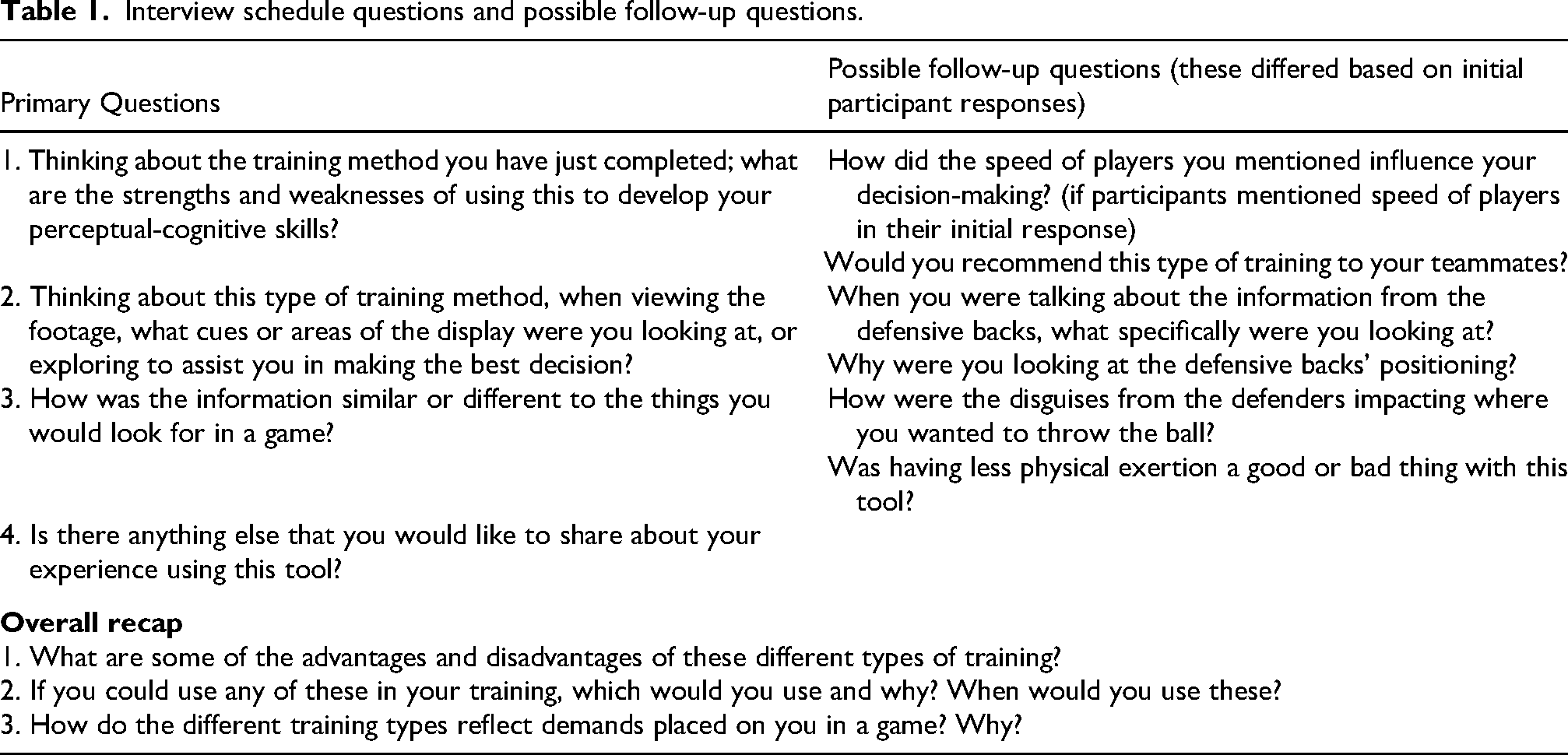
Participants were exposed to four training approaches in this study to understand their perceptions and preferences for each. The first approach for all participants was on-field training, followed by a randomised order of the remaining three off-field conditions for each participant; 360° video, VR, and traditional video. To provide consistency across different technology conditions while also acknowledging the inherent differences in modality (e.g., higher interaction in VR, or no previous use in 360° video or VR), participants were provided with minimal, but task-relevant instructions (e.g., “make as many passes as possible”). On-field training was always conducted first as this was the most ecological and representative training, essentially providing a baseline in comparison to the other conditions. Each of the off-field conditions were conducted in a private room at the participants’ regular training facility. Participants completed the 360° video and VR conditions standing up and were instructed to respond as naturally as possible similar to how they would during a game. Participants completed the traditional video condition seated (as participants typically use this seated). The order of the 360° video, VR and traditional video approaches was randomised between the participants and completed over two separate days one week apart. Following each of the four training approaches, the lead author led a semi-structured interview with each participant, which was followed by an overall ‘exit interview’ following the four conditions (i.e., a fifth interview – see Overall Recap questions in Table 1), leading to over 22,000 words of data across all interview transcripts. Table 1 presents the primary questions from the interview schedule, and possible follow-up questions which were dependent on the participants’ responses and condition. These questions were semi-structured but fluid in nature, and did not always follow the same order, but were dependent on the participants’ responses.
Interview schedule questions and possible follow-up questions.
The first condition was on-field training (often referred to as ‘scrimmage’) which involves 11v11 simulation of gameplay. The purpose of this activity was to present the most representative form of training to that of in-game, competition decision-making. However, as is typical for this type of training, certain practical constraints are implemented (often for safety or logistical purposes). The plays were chosen by the coach and according to the team's playbook, as this was also a practice repetition for the defensive players. This took approximately 30 min, with each QB typically involved for 5–10 min each, as only one QB could participate per repetition. Defensive players are instructed to avoid hitting the QB, while contextual information (such as the play clock, distance markers, and score) were absent.
360° video was obtained from on-field practice (as described above) that occurred earlier in the season using 11v11 training (as per the on-field, Video and VR conditions). These were filmed using a GoPro MAX 360° camera (GoPro Inc, California, USA) fixed to the crown of the helmet of one of the QB participating in this study (Participant 2), using a GoPro Head Strap (GoPro Inc, California, USA). This position was chosen after initial piloting, as it was not possible to fully secure on the top of the QB helmet, and when in that position, it was too high to view the scenarios. All videos were edited using GoPro Player (GoPro Inc, California, USA) to lock the orientation and stability of the video. Videos were then edited using Adobe Premier Pro 2024 video editing software. 360° video was presented on the Meta Quest 3 Head Mounted Display (HMD) (Meta, California, USA) in 4 K. Each video included a 5-s frame illustrating the play (i.e., where each of the team's receivers were running, also known as “routes”), allowing the participants to choose where they would like to focus (i.e., which routes). Following this, there was a 2-s pause of the initial frame of the video, then the video played. Participants were instructed to respond as was natural to them, whether through imitating a throw or attempting to visually identify an open receiver. It is important to note, this footage was of their own team, which may impact the reading of defenses. However, it was not possible to obtain video from other teams’ training for practical and ethical reasons. Twenty-five plays were present for this condition, which was approximately 15 min in duration.
The VR condition was also presented on the Meta Quest 3 HMD and involved participants playing the practice mode on the commercially available game NFL Pro Era II (StatusPRO Inc, California, USA). While it was not possible to match the exact plays to that of the participants’ team, the lead researcher selected plays that were comparable in their strategic aspects based on those conducted during training. Participants were able to select from the 25 plays prescribed in their own order using the ‘wrist coach’ available in the game. Participants were instructed to complete as many passes as possible as they would in a game, allowing agency of where and who to pass the ball to. Down and distance information (i.e., how far was needed to successfully attain a ‘first down’ and therefore maintain possession of the ball) was not available to the participant, consistent with the on-field training and 360° video conditions. Participants responded by attempting to complete a pass to a virtual teammate. This condition lasted approximately 15 min for each participant.
The traditional video condition used footage filmed from a fixed position on the sideline during games from the previous season and was presented on a computer screen (Lenovo ThinkPad X1, Hong Kong, China, 331 mm x 226.5 mm) using Hudl video analysis software. This video enabled participants to see the entire field and players from both teams from a third-person perspective. Participants were familiar with this approach as this is what they regularly used for their off-field training. Participants were instructed to respond as felt natural to them, which could be simply watching the video and analysing who was open or verbalising who they would pass to. Participants were given this option to allow agency over their actions. Each video was approximately 20-s in duration, allowing adequate time before the play to know the situation (i.e., see how the defenders were positioning prior to the start of the play), then allow the play to unfold. As per the above conditions, 25 plays were presented to the participants, with the condition lasting approximately 10 min for each participant. Participants were instructed go through the same thought processes they would use in a game and use this as an opportunity to practice their decision-making of who they would pass the ball to in the given situation.
Data analysis
Audio recordings and written transcripts were listened to and re-read multiple times by the lead author. Following this, the lead author identified 165 initial codes, which were phrases/quotes that presented key information. The lead author then reviewed these codes/notes, to identify repeated and/or related codes that could be grouped into themes. This initially led to six primary themes, with 22 sub-themes. These were then presented to the second author and senior author who independently reviewed the transcripts and initial themes/sub-themes. In following this process, the analysis followed key elements of IPA methodology, such as presenting an unfolding narrative and close analytic reading of the participants’ words. 49 Following group discussion, including the fourth author, these were then condensed to present in-depth themes. To present the data, representative quotes that align with the specific themes and associated sub-themes are presented. The quotes present the participant number and specific condition it is referring to. To highlight trustworthiness of this process, Supplementary Material 1 provides a broader range of quotes than those included in the manuscript. Supplementary Material 2 illustrates the methodological process to reaching the themes identified from a short excerpt of an interview transcript, including the initial code, then the initial theme/sub-theme, and then the final themes/sub-themes presented in this study.
Results & discussion
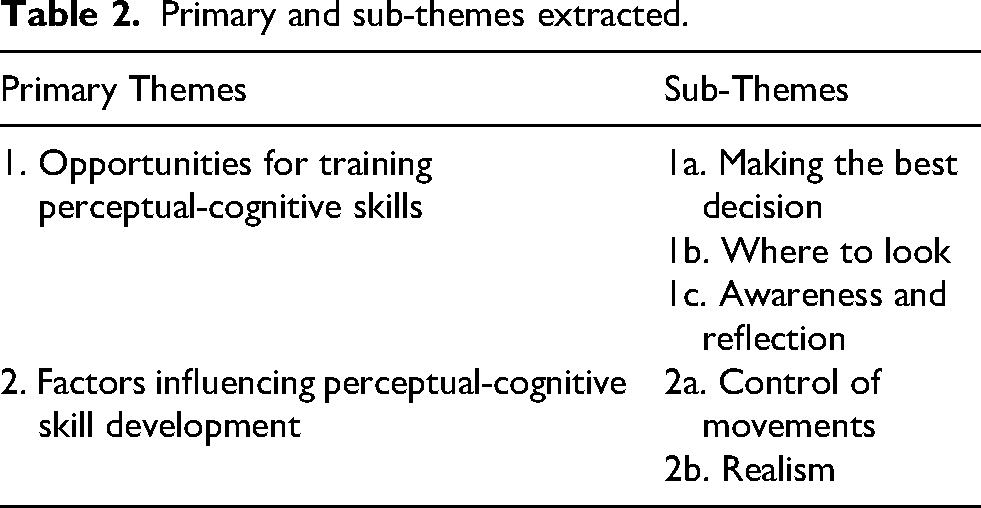
Following IPA of the interview data, two primary themes were identified (presented in Table 2). These were 1) Opportunities for training perceptual-cognitive skills, and 2) Factors influencing perceptual-cognitive skill development. Supplementary Material 1 includes a broader range of quotes aligning with primary themes and sub/themes.
Primary and sub-themes extracted.
Theme 1. Opportunities for training perceptual-cognitive skills
The first theme focussed on how each training modality provides possibilities for developing perceptual-cognitive skills. Within this theme, the participants discussed how each training modality can play a role in them making the best decision (Theme 1a), understanding where to look (Theme 1b), and their levels of awareness and reflection within these modalities (Theme 1c).
Theme 1a. Making the best decision
Within the primary theme, Opportunities for training perceptual-cognitive skills, the first sub-theme was Making the best decision, which referred to the participants making optimal decisions based on affordances, such as opponents (players and structure). Participants discussed how a key aspect of on-field training was identifying affordances to guide emergent behaviours: “The first thing is you got to identify whether it's kind of a man coverage or it's whether it's zone. So, if they're occupying an area, that's probably going to be a zone, so throwing in between zones is obviously something that we work on quite a lot. And then if it's man on man. You just got to hope your receiver is good enough to win that battle against the defender” (Participant 3 – on-field training) “Identifying what the defender does, and then saying, okay, if they do this, I have to do that” (Participant 1 – VR) “I know it's play X, so I look at this defender and he essentially decides for me if he goes back, I throw the short route. If he presses up, I throw a deeper route” (Participant 1 – traditional video) “Some of the linebackers were disguising how they were playing their zones. I think even on a couple of reps, they were showing blitz and then they're not dropping back into coverage… the ball might need to come out quicker than it needs to” (Participant 3 – 360° video)
Theme 1b. Where to look
To arrive at their decision of where to pass the ball to, participants emphasised the importance of attentional focus and gaze behaviour in each of the conditions except for on-field training. This may be because participants in the on-field training modality had the most representative conditions in which perception-action coupling was maintained and so perception was embodied within the participants movement and the environment. In contrast, in the other training approaches, they had greater opportunity to explore their environment visually due to task constraints that provided more time (e.g., no physical pressure) and the removal of technical requirements (e.g., executing a pass). This is highlighted by the below quote, where Participant 3 emphasised the differences between the 360° video and on-field training approaches. “Obviously, you get to kind of pick your poison and what you want to look at? Where you want to go with the ball, what do you want to watch? Because when you're out there, you really only have kind of one objective and that's to complete the pass and execute, whereas in this you can analyse it a bit more in-depth because there's no pressure on you to make a throw” (Participant 3 – 360° video)
While we did not measure gaze behaviour quantitatively in this study, participants suggested they were trying to focus on similar cues in the VR training condition: “Okay, I want to throw the route to the slot, so I'm going to stare at the defender on top of the slot, or maybe, if it's a deeper route, stare at the safety” (Participant 1 – VR) “I'm looking at what I would normally look at, which is the defense, trying to make a read on them pre snap and then post snap read. I'm looking at obviously the players out there before seeing the play itself and then reading the plays that were actually happening” (Participant 2 – traditional video) “I think with the 360 I found myself doing more of an analysis on what the defense was doing, how they were moving, what cues they would give, how they were playing certain routes… being able to see how defenders move. What cues they give off pre snap because you kind of have no obligation with the ball in this that you can just kind of stare down defenders and actually see what they do, see how they move” (Participant 3 – 360° video)
Theme 1c. Awareness and reflection
Another key element of perceptual-cognitive skill is the ability to recognise patterns to inform the decision of where and who to throw the ball to. Research in baseball has demonstrated that batters in VR can use situational probabilities to inform their decisions,
58
and participants in the current study alluded to becoming aware of patterns of defenses as a key element of training in these different modalities. For example, gaining repetitions of the same play against different types of defensive alignments in on-field training enables the QB to develop an understanding of which type of defense this play could exploit, or from an ecological dynamics perspective, the affordances for action: “If you know that you're doing this play and you've done it 1000 times against seven different types of defenses you know which one it works on” (Participant 2 – on-field training) “A really good way of learning defenses, because the defenses in this are pretty similar to what defenses are like in real life. You know, they have particular ways that they're meant to go, like if like a receiver is meant to go, but they generally run it pretty tightly in both real life and the VR” (Participant 2 – VR) “And even though it is more of an analysis, it really kind of gets the mind thinking and you find yourself really engaged and involved in what's happening because it is real life and it is going against your teammates that you've just kind of scrimmaged against. So yeah, I found it really engaging and really a useful tool that you could go out and improve on in the next scrimmage, which obviously would lead to probably better results in games” (Participant 3 – 360° video) “I just see what mistakes you've made. You see who's open on the particular plays and there wasn't and then you can figure out why he thought that was the right place to throw or right read to make” (Participant 2–360° video)
Theme 2. Factors influencing perceptual-cognitive skill development
The second theme focused on the aspects of the modalities which may impact its use and/or effectiveness in terms of developing perceptual-cognitive skills. Within this theme, participants highlighted control of their movement (Theme 2a) and Realism (Theme 2b) to be key concepts.
Theme 2a. Control of movements
The second higher order theme presents factors influencing perceptual-cognitive skill development within each of the training approaches. The Control of movements sub-theme highlights the importance of integrating the motor and perceptual components, which are vital for a higher sense of presence and agency,30,51 but this is a limitation of 360° video
18
and traditional video approaches. The participants in this study reiterated the importance of the perception-action coupling in the VR modality and having agency over their movements. This builds on the work of Runswick
60
who reported VR to have higher levels of control than 360° video for cricket players. Firstly, Participant 1 highlights how being in control of the movement is important for greater flow in the training within VR: “Being in control of the movement, and even though the throw physically doesn't matter, it does work nicely for your general rhythm and your sort of brain's cadence” (Participant 1 – VR) “You actually are throwing instead of in comparison to the 360 where it was just kind of watching and observing you are actually getting that physical movement” (Participant 3 – VR) “Yeah, because I actually had some sort of agency in there. And, you know, it's obviously fun to play. It is a spectator sport, but it's much more fun playing than watching” (Participant 2 – VR) “Tell the play to the players doing the huddle, doing the snap, dropping back, practically breathing, looking around, looking around can do practising and breathing. Rolling out all the physical things that you would do on the field, you can't do” (Participant 2 – traditional video) “It was sort of a bit harder to like get set because again you sort of feel a bit more of a disconnect between where you might be looking and where quarterback is looking” (Participant 1 – 360° video).
Theme 2b. Realism
Realism refers to the extent to which stimuli within each of the training conditions were similar to, or consistent with, real-world competition performance. Some of the factors identified by participants are the speed of the athlete-environment interaction, imperfections of their environment, and pressure (both physical and mental). Another key element of stimulus alignment is the speed of the scenarios presented. In line with previous research,
33
participants indicated that 360° video felt more representative of the speed of competition: “Real, reflective speed of your particular receivers, and the team's DBs (defensive backs)” (Participant 1 – 360° video) “The whole thing did feel a bit slower than real life speed as well . I think you sort of sitting there, compared to what you would see. You know, they're not getting to 10 yards as quick as you would expect” (Participant 1 – VR) “It doesn't give you what the real-life situation would be. Maybe that might be body language in disguising coverages, blitzes. How the safeties move all that kind of stuff. It just doesn't give you exactly what real life kind of human thought would be, or how they're taught” (Participant 3 – VR) “In VR, everyone does the correct thing” (Participant 1 – VR) “The defensive players had some sort of programming, or whatever they were meant to cover a certain spot, and they would just go straight to that spot. Whereas, in real life, if a guy moves through their spot and he's going past him, and they have deepest man, they would follow him” (Participant 2 – VR) “I think the 360° view having the players that you play with running the routes that they've run, that you're used to, the players that you are used to passing to is much more beneficial than having the simulated players who run their routes perfectly or, you know, catch the ball perfectly” (Participant 2 – 360° video) “You know they can't hit you, so it sort of drops the intensity a little bit from a game” (Participant 1 – on-field training) “I think obviously it puts you in the same situation as a scrimmage does, but without the pressure to perform” (Participant 2 – 360° video) “You obviously are then forced to get the ball out on time. You can't kind of just sit back in the pocket and do whatever you want” (Participant 3 – VR)
Participant preferences
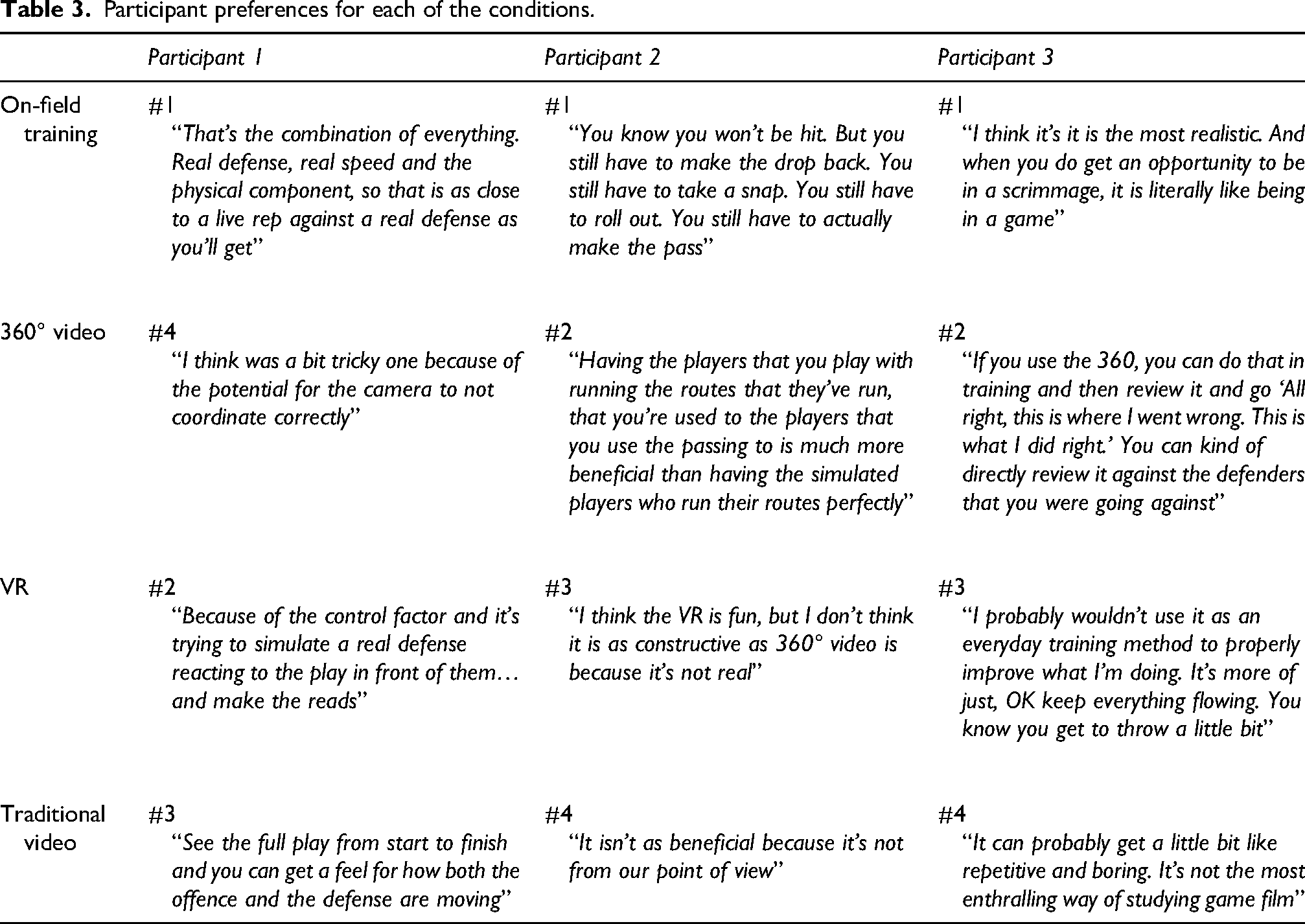
Table 3 shows how participants ranked each of the training modalities. All participants viewed on-field training as their top preference. This finding is similar to previous research highlighting on-field as the best approach to develop decision-making. 8 Participants 2 and 3 then viewed the 360° video as their second preference, followed by VR, then finally traditional video. Participant 1, however, ranked VR as second, followed by traditional video, then 360° video. This was primarily due to the viewpoint sometimes being obscured by the helmet of the participant within the 360° video. The rankings of Participants 2 and 3 are in line with previous research reporting 360° video to be a more enjoyable and game-like training tool than traditional video. 27 Runswick 60 quantitatively explored cricket player perceptions of VR and 360° video training modalities, presenting one of the few studies that have explored differences in athlete perceptions of video and XR technologies. Participant 1's higher ranking of VR aligns with the greater control factor of VR to 360° video, whereas the higher rankings of 360° video by Participants 2 and 3 align with the higher visual realism of 360° video. 60 These findings build on the previous literature by adding qualitative perception data on how participants view these different technologies.
Participant preferences for each of the conditions.
General discussion
The present study explored the perceptions of three developmental-level American football quarterbacks, from a single team in Australia, towards four different training approaches which have the potential to (directly or indirectly) develop key perceptual-cognitive skills. Two primary themes emerged: Opportunities for training perceptual-cognitive skills (three sub-themes: Making the best decision; Where to look; Awareness and reflection) and Factors influencing perceptual-cognitive skill development (two sub-themes: Control of movements and realism). While these themes emerged inductively from the participants lived experiences, what the participants have described can be contextualised within an ecological dynamics framework. For instance, the first theme can be understood as reflecting the availability of, and potential attunement towards, affordances within each training modality's environment. That is, participants were essentially discussing the factors that influenced their perception of sensory information and how this information was used to perform their skills to varying degrees of success. Similarly, the second theme can be considered within the guise of perception-action coupling and representative learning design. Specifically, participants clearly valued modalities which allowed perceptual-cognitive skill development through physical movement and were cognisant of the degree to which stimuli were able to accurately reflect the real-world competitive environment of American football.
Study limitations
There are several limitations of this study to consider alongside the findings. Firstly, this study only three participants, which may limit the breadth of data. However, through the use of IPA, 42 this is an appropriate qualitative framework to apply for such a small homogenous sample that has been purposively sourced. In addition, the participants were classified as part of the Trained/Developmental stage of the Participant Classification Framework, 48 as we did not have access to a more ‘elite’ cohort, particularly those who may have access to XR training. This is attributed to our recruitment of American football QB in Australia, which although is a developing sport, there is not the same calibre of QB as in the United States. These findings may therefore not be transferable to more elite populations, or indeed, quarterbacks just learning to play the sport. It has been suggested that the enhanced fidelity and realism of 360° video and VR could hinder skill development in novices due to the increase in potential informational sources (including irrelevant sources) provided within the environment, compared to traditional video.68,69 Thus, it is possible that a more novice group of quarterbacks in our study would have reported more promising perceptions towards the traditional video condition, while a more expert group of quarterbacks would have reported even more positive perceptions towards the 360° video and VR conditions. Future research should consider interviewing athletes across a diverse range of expertise levels to obtain a more thorough understanding of how these training modalities can be used to develop perceptual-cognitive skills. In terms of the analysis, the novel design of this study meant the qualitative methodology could have been conducted in different ways. While we used IPA to understand participants’ experiences following each condition, future studies could follow a different approach, such as a think-aloud protocol similar to Larkin and colleagues. 70 In addition, we did not analyse the conditions independent of each other, which may have influenced the interpretation of participants’ experiences.
Due to time constraints of the data collection with these participants, it was not possible to complete a familiarisation session for the participants prior to the VR and 360° video conditions. While this is a limitation, participants did each report that they felt comfortable with these novel technologies throughout the 15-min conditions. Furthermore, the absence of a familiarisation period likely enhances ecological validity by capturing athletes’ initial perceptions – an important consideration given that real-world opinions about new technologies are likely formed during first exposure. 71 Finally, the approach to filming the 360° video in this study could be considered a limitation, particularly considering that Participant 1 highlighted that their view may have been obstructed by the side of the helmet if they looked the opposite way to the quarterback wearing the head-mounted camera. This approach attempted to overcome limitations of past research, where 360° video has been filmed from a stationary tripod. The camera was positioned on the crown of the helmet, as initial piloting with the filming meant it was not possible to secure on top of the QB helmet. Also, when placed on top of the helmet, albeit in an unsecure position, this viewpoint felt higher and unnatural to view the scenarios. This is an important consideration for those interested in using 360° video as a training approach.
Future research directions
These findings highlight how different technologies could be used to manipulate task constraints within different representative environments to enhance attunement to key information sources that supports functional decision-making behaviours. For example, this study highlighted the importance of 360° video in identifying defender cues in the lead up to the play, and once the play commenced (see Themes 1b and 1c). On the other hand, VR provides athletes with the opportunity to interact with their environment and time their throw (see Theme 1a). Studies could explore interventions – particularly longitudinal designs – to explore how individualised off-field perceptual-cognitive training programs develop athletes’ skills. This is pertinent given the unique experience and viewpoints of each participant with each of the training approaches in this study and may also help elucidate whether the promising perceptions towards VR and 360° video are due to a novelty effect. Relatedly, given that the primary function of the VR modality in the present study was as an entertainment game (NFL Pro Era), future research would benefit from explicitly investigating whether our participants’ perceptions of effectiveness transfer to performance improvements, and how this compares to VR specifically designed as a training tool. The user-experience was not a major focus of the current study and while Realism was a theme participants spoke about, future studies could explore this concept in greater detail. Although it can be beneficial to couple third-person behavioural observations with phenomenological interviews for an ecological approach as there may be some divergence between participants’ affordance perception and the phenomenological approach, 72 it is important to note that some of the conditions in this study are likely not conducive to observing participant behaviours. While in the VR and in-person conditions it is possible to observe how and where a QB passes the ball, with the traditional and 360° video conditions this is more difficult due to the read-only nature of these approaches. 11 We attempted to maintain naturalistic responses and training processes with this study, and therefore a speak-aloud protocol to understand participants’ attunement to affordances would not have been an ecologically valid response. Future research could use eye tracking as an observational approach of the participants actions, with their ‘action’ being inferred by their gaze behaviour, which could then be combined with phenomenological interviews.
While this study is grounded in the context of American football QB, the findings may be applicable with other athletes where there are similar perceptual-cognitive skills of importance (e.g., decision-making for midfielders in soccer or visual search strategies for midfielders in Australian Rules football). Interestingly, no participants discussed the importance of haptic feedback, which has been highlighted as a key component of designing representative XR simulations. 73 It is possible that this may reflect the specific demands of QB, where the player has control of the ball, and the primary elements of the skill involve avoiding contact and releasing the ball. Future research could explore the importance of haptic feedback in VR and 360° video training for interceptive sports (such as baseball or cricket) where contact with the ball plays a more integral role in performance.
Implications
Coaches in American football have traditionally used video footage as a pedagogical tool for enhancing players’ tactical knowledge and support performance analysis. In doing this, a player's development of key perceptual-cognitive skills such as decision-making, visual search strategies, and pattern recognition are often an inherent part of the process. This study highlights the potential advantages of using VR and 360° video over traditional video to develop the perceptual-cognitive skills of American football QB. These technologies were generally deemed preferable to traditional video-based training. Together with the declining cost of XR hardware, the ‘value for money’ of implementing such approaches continues to increase, making them realistic options even for non-professional organisations. Importantly, the positive perceptions found for a commercially available VR game – designed primarily for entertainment rather than athlete development – suggest that existing tools can be adapted for training purposes. This presents an attractive alternative to specialised, custom-built solutions that can be more expensive, resource-intensive, or difficult to acquire.
The findings also evidence a desire from athletes to take advantage of these advances in technology, similar to previous research in other sports. 74 The themes that emerged from our participants’ responses clearly align with the construct of perceived usefulness from the Technology Acceptance Model, suggesting that (for the most part) providing exposure of sports technologies such as 360° video and VR to athletes should increase intentional and actual usage of XR modalities, should they be available. Furthermore, our participants’ preferences generally support the Modified Perceptual Training Framework, 31 which predicts that perceptual training tools of high response correspondence (i.e., VR) and stimulus correspondence (i.e., 360° video) should be superior to tools of lower correspondence (i.e., traditional video) in their transfer to real-world performance improvements.
The next question, then, should not be whether such technologies should be used, but how. Frameworks derived from other sports for the implementation of XR training for American football QB could help coaches and skill acquisition specialists identify specific cases where these advantages can be most optimally utilised, similar to that which has been developed in baseball. 66 For example, coaches may look to include VR training for players struggling to cope with the speed of on-field drills, or they might wish to exploit 360° video training when working with new players who require integrating into the team's system and playing style. With that said, it is nevertheless important to emphasise that these approaches should still be used as a supplement rather than a replacement to on-field training, as the latter was the preferred modality for each of our QB.
Conclusions
The present case-study aimed to explore the perceptions and preferences of three American football QB following exposure to on-field, 360° video, VR, and traditional video training, in terms of their potential perceptual-cognitive skill development. The QBs suggested that the training approaches varied in the extent to which they impacted how decisions were made (‘Making the best decision’), the visual search strategies they afforded (‘Where to look’), and how they engaged with their perceptual-cognitive skill development (‘Awareness and reflection’). The QBs also identified constraints to these training approaches. Specifically, having control over one's movements was deemed a significant advantage of on-field and VR training (‘Control over movements’), while the degree to which each method replicated real-world competitive environments emerged as a key consideration (‘Realism’). Overall, the study provides unique, qualitative perspectives on the use of 360° video and VR training approaches and their perceived viability for developing perceptual-cognitive skills in developmental-level American football QB. Importantly, these findings send a clear message to sporting organisations at all levels: XR technologies such as 360° video and VR offer considerable advantages over traditional video approaches, and athletes themselves perceive these tools positively and as valuable additions to their perceptual-cognitive skill development. Future research should look to confirm this using experimental designs with larger samples and/or elite participants.
Supplemental Material
sj-docx-1-spo-10.1177_17479541251407997 - Supplemental material for Athlete perceptions of in-person training, extended reality and video technologies for perceptual-cognitive development: A qualitative exploration of developmental American football quarterbacks’ perspectives
Supplemental material, sj-docx-1-spo-10.1177_17479541251407997 for Athlete perceptions of in-person training, extended reality and video technologies for perceptual-cognitive development: A qualitative exploration of developmental American football quarterbacks’ perspectives by Aden Kittel, Paul Larkin, Riki Lindsay, David Broadbent, Lyndell Bruce and Luke Wilkins in International Journal of Sports Science & Coaching
Supplemental Material
sj-docx-2-spo-10.1177_17479541251407997 - Supplemental material for Athlete perceptions of in-person training, extended reality and video technologies for perceptual-cognitive development: A qualitative exploration of developmental American football quarterbacks’ perspectives
Supplemental material, sj-docx-2-spo-10.1177_17479541251407997 for Athlete perceptions of in-person training, extended reality and video technologies for perceptual-cognitive development: A qualitative exploration of developmental American football quarterbacks’ perspectives by Aden Kittel, Paul Larkin, Riki Lindsay, David Broadbent, Lyndell Bruce and Luke Wilkins in International Journal of Sports Science & Coaching
Footnotes
Acknowledgements
We would like to thank each of the reviewers for the depth of their review. Their insights and suggestions have been invaluable for this study.

Funding
The authors received no financial support for the research, authorship, and/or publication of this article.
Declaration of conflicting interests
The authors declared no potential conflicts of interest with respect to the research, authorship, and/or publication of this article.
Supplemental material
Supplemental material for this article is available online.
Notes
References
Supplementary Material
Please find the following supplemental material available below.
For Open Access articles published under a Creative Commons License, all supplemental material carries the same license as the article it is associated with.
For non-Open Access articles published, all supplemental material carries a non-exclusive license, and permission requests for re-use of supplemental material or any part of supplemental material shall be sent directly to the copyright owner as specified in the copyright notice associated with the article.
