



Abstract
This study investigated the effects of the number of allowed ball touches on the physical and technical responses of professional female players during 4v4 ball possession-based games (BPGs). Sixteen female professional soccer players (age: 25.33 ± 4.72 years; body mass: 62.90 ± 9.71 kg; body height: 1.63 ± 0.05 cm) participated in the three differing 4v4 BPG formats where the number of ball touches permitted per possession was altered (one touch = 1T; two touches = 2T; free play = FP). Information regarding players’ physical and technical variables was collected using commercially available foot-mounted inertial measurement units. There was a significant (p < 0.05) decrease in ball touches from 2T to 1T. With FP and 2T rules, players spent significantly more time on the ball than with 1T (p < 0.001). In addition, players performed significantly more successful passes when using 1T and 2T forms than when using FP form (p < 0.05). A significant difference was found on lost possession (p < 0.05), with players losing more balls when adopting the 1T rule than with the 2T and FP rules. No significant differences (p > 0.05) were found in any of the players’ physical variables when manipulating the number of ball touches. Soccer coaches may use this information to plan and manage their BPGs sessions to help female players achieve the technical demands of the game by adjusting the number of ball touches permitted per possession.
Keywords
Introduction
Ball possession-based games (BPGs) are drills designed to mimic similar demands of match play, with the aim of the session to keep the ball away from the opposing team, with no goals to score in. 1 On the other hand, small-sided games (SSGs) are drills designed to replicate the demands of a game with a reduced pitch size, reduced number of players and specific rules to elicit the required intensity from the players, with goals to score in. 1 BPGs and SSGs offer greater representativeness than isolated skill tests, and they are frequently a more practical assessment context than an 11v11 match. 2 Indeed, soccer coaches seem to prefer SSGs over isolated drills because they replicate actual game conditions. 3 Coaches favour the use of SSGs to help players of all ages and skill levels improve and get ready for regular games, 4 recognising the capacity of SSGs to enhance players’ abilities to meet the technical, tactical, physical and psychological demands of the game. 5
SSGs make it possible to replicate the perceptual-motor environment that players experience during professional games, which helps them learn to better coordinate their movements with the environmental information at their disposal.6,7 One of the benefits of SSGs is the opportunity they provide to emphasise and highlight players’ motor skills, running demands and space exploration as a result of altering various task constraints.7,8 Task constraints refer to the manipulation of game formats which involve modifying the pitch size, altering the number of players, variously using goalkeepers (GKs) or changing rules such as restricting the number of ball touches (e.g., playing one touch or two touches per player).9,10 However, despite extensive study of the effects of these task constraints on SSGs, research dealing specifically with female players is still scarce, which has resulted in a paucity of data to guide evidence-based coaching practices when working with this population.
Limiting the number of contacts allowed for each individual possession during SSGs is one of the most popular methods for improving players’ performance. 3 Research has examined the effects of varying the number of ball touches permitted to each player during SSGs on technical, tactical, and physical performance. According to a prior study, international male players engaged in more duels, induced the least declines in sprint and high-intensity running, and had less of an impact on technical actions (number of ball losses and successful passes) under the free play (FP) rule than with one-touch (1T) and two-touch (2T) forms during a 4v4 SSG. 11 Similarly, Dellal et al. 12 examined the physiological, perceptual-responses, time-motion and technical activities of professional and amateur male football players during SSGs, varying the number of ball touches permitted (i.e., 1T, 2T, and FP). The results showed that amateur players covered similar proportions of total distance run in high intensity running and sprinting (20.4% vs. 19.8% of the total distance, respectively) when the 4v4 was played in FP. No differences were found regarding the total number of ball possessions (35.9 vs. 35.6 for professionals and amateurs, respectively) in the 4v4 s tested. 12
Another study by Coutinho et al. 9 investigated how different age groups (U9–19) performed physically and technically during 4v4 SSGs with GKs in relation to the number of allowed ball touches per player possession. The results showed that playing with limited touches reduced the amount of distance travelled across all age categories. When restricting the amount of touches, the U9, U15, and U17s saw slight-to-moderate improvements in successful passes and an increase in unsuccessful activities. Playing with limited touches, in general, accentuated passing ability but also led to more unsuccessful actions and lower physical demands. The authors further concluded that coaches may utilise the 2T with younger age groups (U9–U13), who appear to be less able to handle 1T, while older age groups may employ 1T because of their greater capacity to engage with environmental information.
A recent study by Mahlangu et al. 3 explored how manipulation of ball touches (FP vs. 2T) on the physical and technical actions of elite male youth soccer players during 5v5 + 2 GKs in SSGs. The findings indicate that when players were restricted to 2T, there were noticeably more unsuccessful passes than when there were no pass limits. When touches were unrestricted, the physical measurements showed that overall distance travelled, meters per minute, low-speed running, and high acceleration were all much higher than when they were not. While these previous studies3,9,11,12 provided baseline information on how manipulating ball touches influences male players’ physical and technical demands during SSGs, such information in women's soccer remains unknown. However, the lack of such information is of great concern for coaches and practitioners working with this cohort, who may be forced to rely on literature involving male players to inform their training programmes. Therefore, coaches and practitioners need female-specific soccer data to ensure their practice is genuinely evidence-based. 13
Thus, the purpose of this study is to investigate how the physical and technical demands on professional female players during 4v4 BPGs are impacted by the number of ball touches (i.e., 1T, 2T, and FP). The results may help better guide the design and implementation of specific training practices that offer the intended physical and technical outputs to optimally prepare female soccer players for the demands of the game.
Methods
Study design
The study used repeated measure technique in the following three experimental conditions: (a) 1T, where each player could only touch the ball once while in possession; (b) 2T, where each player was only permitted to touch the ball no more than twice during each ball possession; and (c) FP, where there was no restriction on how many times the player might touch the ball. 9
Participants
Based on a preliminary power analysis (Cohen's d effect size (ES) of 0.60, probability of error of 0.05 and power of 0.80), a sample size of 10 players was required. Sixteen female professional outfield soccer players (age: 25.33 ± 4.72 years; body mass: 62.90 ± 9.71 kg; body height: 1.63 ± 0.05 cm) from a South African team in the Hollywoodbet Super League (the top tier in the domestic women's soccer league) took part in the study. The players trained five days a week for 60–120 min per session, with one match at the weekend. The study was conducted in line with the Helsinki Declaration and the protocol was approved by the Tshwane University of Technology Research Ethics Committee. All participants signed a consent form and were briefed about the potential risks and benefits associated with their participation in the study.
Experimental design
The 4v4 BPG was used because it is the most commonly used training drill in professional soccer. 11 All players performed three 4 × 4 min BPGs (4 days prior to the next game each week; MD-4), one in each of three conditions (1T, 2T and FP) over a four-week period during the in-season phase. This consisted of eight observations of each condition (1T, 2T and FP), and 64 individual player observations. During each 4 × 4 min BPG with four periods, all players perform 4-min periods separated by a 2-min passive recovery interval. The BPGs were conducted at the same time of day (16:00) to minimise the impact of circadian fluctuations on the variables being measured. 11 Prior to the experimental settings, the players warmed up for 15 min using low-intensity running activities. In the week before the testing, players were familiarised to wearing the foot-mounted inertial measurement units (IMUs) and playing 4v4 BPG formats. Each BPG was played on a 30 × 20 m (length×width; a player:area ratio of 1:75 m2) on the same natural grass pitch. All players were given the instruction to maintain possession of the ball during every BPG. Several balls were placed all throughout the playing field so that, in the event that the balls were out of play, they could be used right away. Throughout the several BPGs, the coaches verbally encouraged players to maintain a high work ethic. During the recovery times, players were free to drink as much as they wanted.
Data collection procedure
Data were collected using commercially available foot-mounted IMUs (PlayerMaker™, Tel Aviv, Israel). Each IMU integrated two components from the MPU-9150 multi-chip motion tracking module (InvenSense, California, USA), being a 16 g triaxial accelerometer and a 2000°•sec−1 triaxial gyroscope. Each player had two IMUs (one for each foot), which were situated at the lateral malleoli over the player's boots and were fitted with silicone straps provided by the manufacturer. Players wore the same IMUs during the data collection period in order to reduce inter-unit reliability concerns.14,15 The IMUs have been reported to show good intra-unit reliability for the technical actions (Proportion of agreement = 95.9%–96.9%, Coefficient of Variance = 1.4%–2.9%) and validity (PA = 95.1%–100.0%) compared to retrospective video analysis. 16 The locomotor activities have shown good agreement against a criterion measure of a motion capture system (−0.003 ± 0.531 m/s; limits of agreement: −1.044–1.037 m/s) and good to excellent levels of within- and between-unit reliability (intraclass correlation: 0.88–0.98) during football simulations by Myhill and colleagues. 17
Before each training session, all devices were turned on via a Bluetooth connection to a MacBook Air laptop (Apple Inc., California). After the session, the first author uploaded data to the manufacturer's cloud-based software (v.3.22.0.02). The beginning and ending of each BPG was tagged before the data was transferred into Microsoft Excel 2020 from the manufacturers cloud-based software. Technical actions were defined as the number of releases, the number of touches, the total time on the ball (Players time on the ball is defined as the time between a player receiving the ball (start of their possession) to when a player releases the ball (end of their possession)), successful passes, lost possessions and regains.16,18,19 The physical actions included total distance covered, top speed (m/s), high-speed running (HSR) distance (> 5.26 m/s), HSR per min, accelerations and decelerations (± 2 m/s/s).17,20,21
Statistical analysis
Data were reported as mean difference ± and standard error of the mean. Before inferential statistics were performed, the Shapiro-Wilk test was used to check the normality of the data. Therefore, for the variables (i.e., releases, successful passes and distance covered) that were normal distributed (p > 0.05), a repeated measures analysis of variance (ANOVA) was used to assess significant differences based on the number of ball touches. Furthermore, the non-parametric Friedman ANOVA test was used to examine variables (i.e., ball touches, time on the ball, lost possessions, regains, top speed, HSR, HSR per min, accelerations and decelerations) that were not normally distributed (p < 0.05). Significant F-ratios (p < 0.05) were followed up with Bonferroni-corrected pairwise comparisons. Furthermore, ES was computed to examine the meaningfulness of the difference and interpreted as 0.20 (small), 0.50 (moderate) and 0.80. 22 All data were analysed using Prism version 10 software (GraphPad, San Diego, California, United States) and the Statistical Package for the Social Sciences (SPSS) version 29 (SPSS Inc., Chicago, IL, USA).
Results
Figures 1 and 2 show the results on the impact of manipulating the number of ball touches permitted per possession on the technical demands of players. There was a significant decrease in ball touches from 2T to 1T (X2 = 7.10, p < 0.05; 6.03 ± 0.80), with a large effect size of 0.85. With FP (ES = 2.44, large effect, 8.81 ± 0.84) and 2T (ES = 1.81, large effect, 3.84 ± 0.89) rules, players significantly spent more time on the ball than with 1T (X2 = 39.53, p < 0.001). Furthermore, a significant difference in ball releases appeared when manipulating the number of ball touches allowed per possession (F[1.92, 59.50] = 12.96, p < 0.001). However, the post hoc test revealed that the use of 1T (ES = 1.32, large effect, 3.25 ± 0.60) and 2T (ES = 0.77, moderate effect, 2.56 ± 0.70) rules by players, differed significantly from FP. Moreover, players performed significantly more successful passes when using 1T (ES = 1.13, large effect, 1.97 ± 0.40) and 2T (ES = 0.73, moderate effect, 1.87 ± 0.62) forms than when using the FP form (F[1.63, 50.47] = 8.04, p < 0.05). A significant difference was found in lost possession (X2 = 7.91, p < 0.05), with a moderate effect between 1T and FP (ES = 0.63, 1.12 ± 0.38).
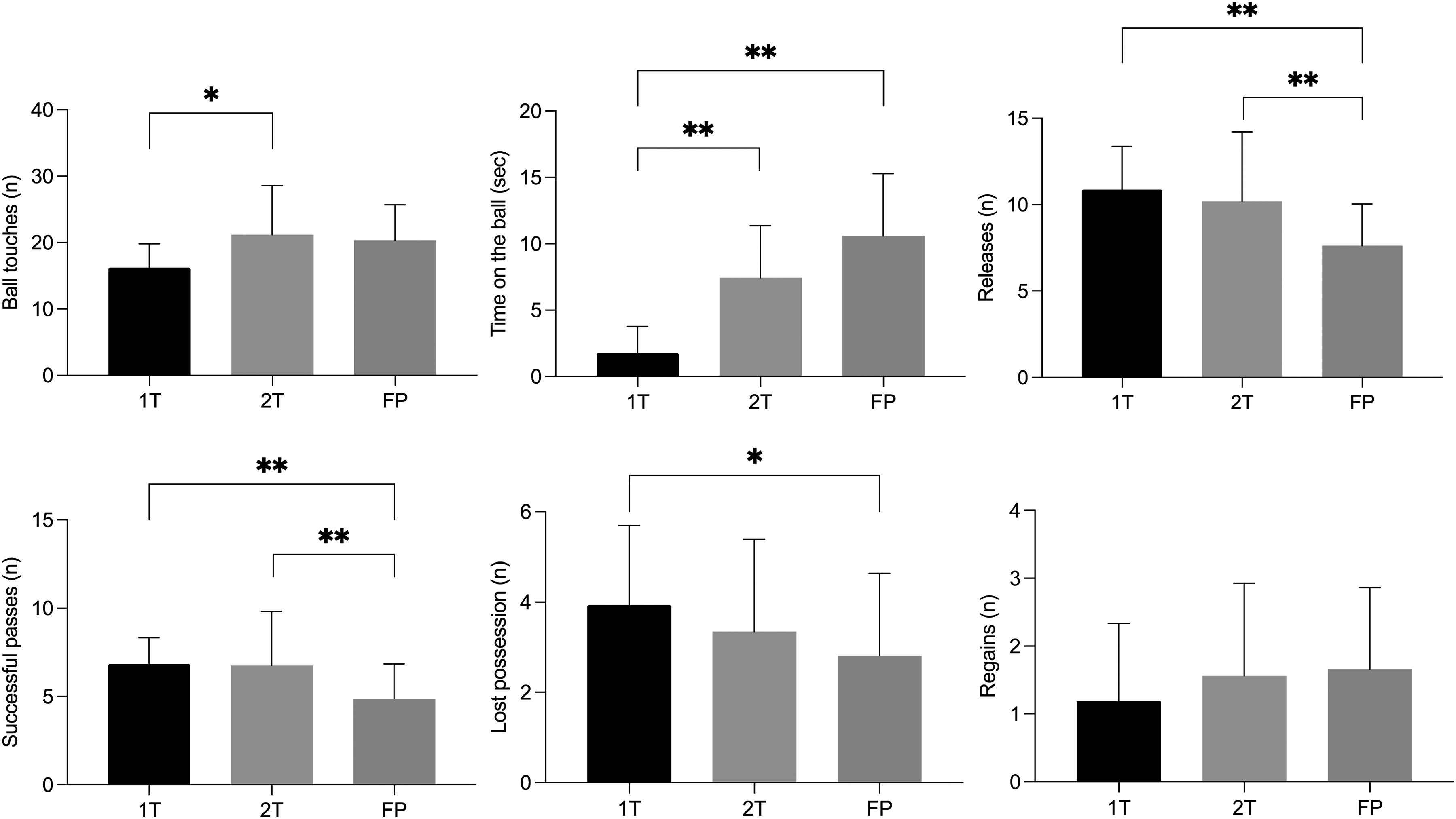
Technical variables according to the rule modification. Significant difference (p < 0.05*, p < 0.01**).
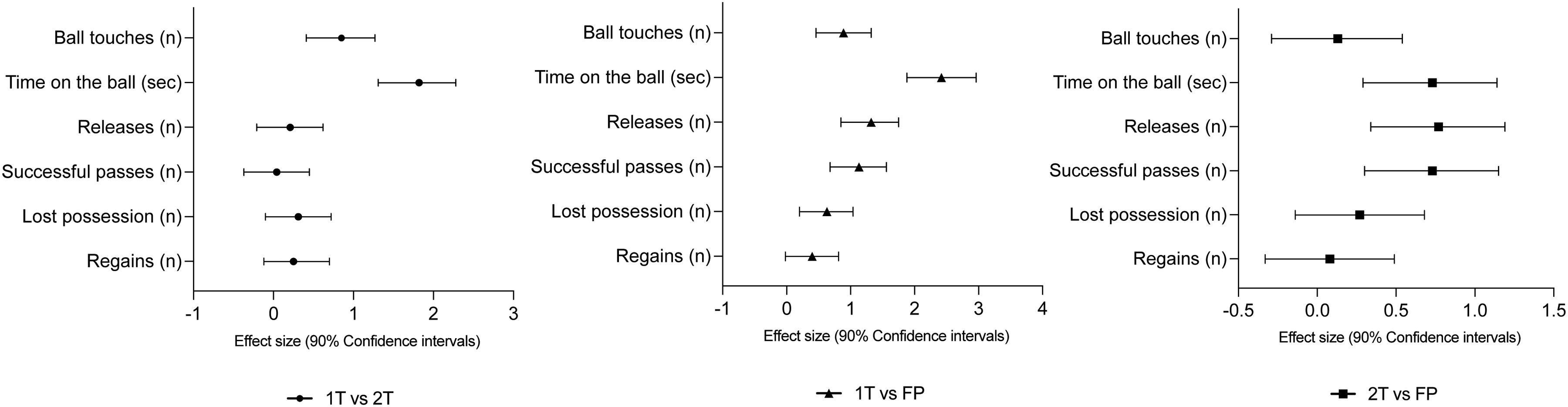
Effect sizes on the technical variables according to the rule modification. Error bars indicate uncertainty in the true mean changes with 90% confidence intervals.
Presented in Figures 3 and 4 are the effects on players’ physical demands by the number of touches allowed per possession. No significant differences (p > 0.05) were found in any of the players’ physical actions when manipulating the number of touches.
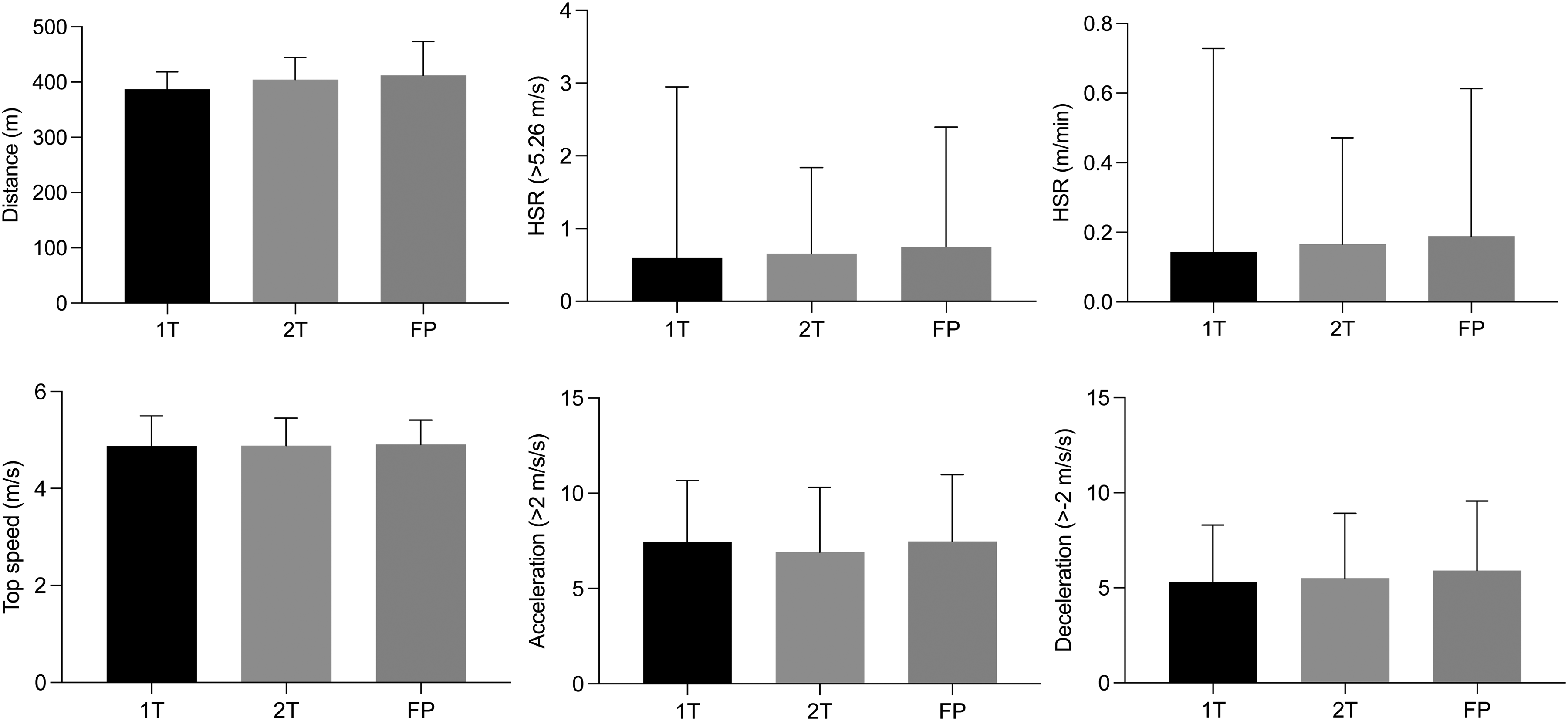
Physical variables according to the rule modification.
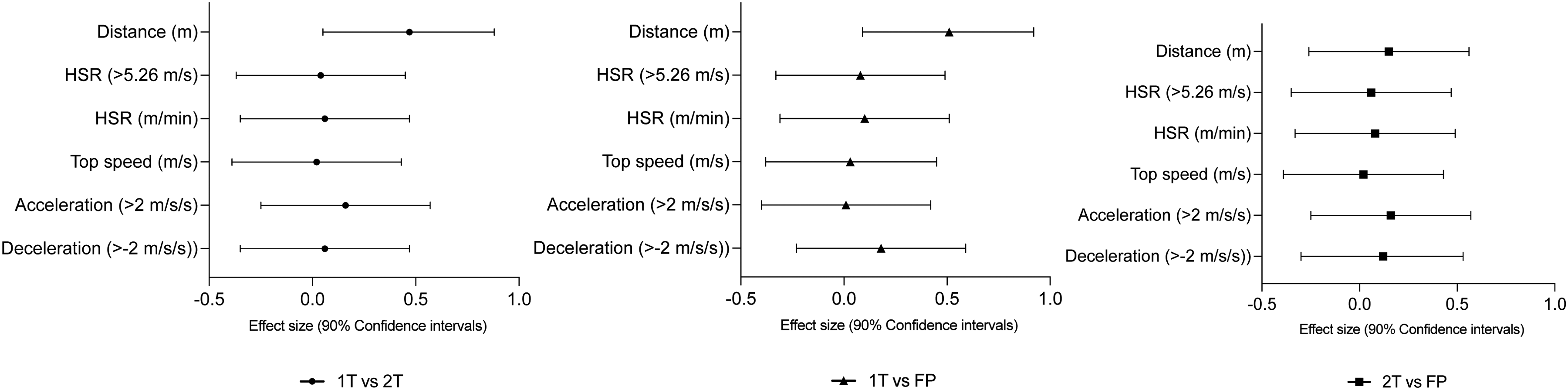
Effect sizes on the physical variables according to the rule modification. Error bars indicate uncertainty in the true mean changes with 90% confidence intervals.
Discussion
This is the first study known to have investigated how modifying rules around ball touches affects the physical and technical demands made on professional female players during 4v4 BPGs. The findings demonstrate that altering the number of ball touches permitted per possession significantly impacted the technical demands on players, but not their running activities. Previous research into women's football has shown that excellence in performing technical movements is a crucial prerequisite for contemporary high-level soccer and is directly related to team success. 23 The present study provides practical guidance for soccer coaches and practitioners tailoring training programmes to fit professional female soccer players.
The results showed that there were more successful passes when players used the 1T and 2T rules than the FP rule. This finding contradicts a previous study 11 of men's international players, which found that the number of successful passes decreased with the 1T rule. It is noteworthy that the Dellal et al. 11 study had four support players out of the playing area, which could have resulted in more successful passes when they applied the FP rule due to numerical superiority for the attacking team. Alternatively, players may be affected differently by a restriction on the number of ball touches based on their level of competition, with those who are accustomed to playing with two or fewer touches proving better able to adjust to such a restriction.24,25 This may further be explained by the fact that female players in the current study released the balls more often when playing 1T and 2T, which may have led to successful passes. While we acknowledge that comparisons between male and female players may not be ideal, it is difficult otherwise to offer comparisons of technical data for discussions.1,26
The findings showed that there were more ball touches when players used the 2T and FP rules than when they applied the 1T rule. A post hoc test showed a significant difference only between 2T and 1T, with a large ES. Furthermore, players significantly spent more time on the ball when using the FP rule than the 1T and 2T rules, aligning with findings by Mahlangu et al. 3 Therefore, it is possible that players in the current study could have created space by dribbling or even running with the ball, which could have led to an increase in the amount of time spent on the ball. Players might also have had more time to deliberate and not rushed their choices when using the FP rule. In contrast, players in the 1T form could have spent less time on the ball because they must know where and how to play the ball before they even receive it. However, it should be noted that despite being instructed to play 1T during this rule, players did not always abide by this rule, which is why some time on the ball was detected.
Our results showed that players lost possessions more frequently when they used the 1T and 2T rules than when applying FP. This finding is consistent with that of Dellal et al., 27 who reported that the 1T and 2T rules made it harder for players to execute technical actions as they resulted in more balls being lost than in FP. This could be explained by the fact that when the number of allowed touches is limited, time constraints mean that a player who gets the ball is more likely to be obliged to pass it, which could lead to a loss of possession. 9 The 1T form of play presents players with a greater technical challenge because in order to make a decision sufficiently quickly, players must process information about their opponents and partners before receiving the ball. It is noteworthy mentioning that players’ technical performance would not just be reliant on the individual with the ball within a 1T or 2T rules, teammates would also have a limited amount of time to move to be in a suitable position to receive the ball (or be a passing option for their teammate in possession). When compared to 2T and FP, the players’ technical actions in 1T form are of lesser quality since they have less time to make decisions and analyse the game. 11
A novel finding of the current study was that despite the changes in the technical actions and possession statistics, no differences in physical metrics between game formats were observed. This may have implications for session design and content, as coaches alter the technical aspects of the game to increase/decrease physical outputs as well as the technical outcomes. 11 The current investigation is inconsistent with those of previous studies3,9,11 that found that manipulating the number of ball touches yielded significant differences in physical metrics such as total distance covered, low-speed running, high-speed running and sprinting distances in male players. The disparity may be due to different approaches being used. For example, the current study with female players from a single club played against teams of equal size during the SSGs, but Dellal et al. 11 had numerical superiority (four supporting players), which could have led to greater total distance and HRS distances covered. Previous research has shown that teams with superior numbers typically run at a higher intensity and cover a larger overall distance than teams with equal or inferior numbers. 28 Additionally, goalkeepers were utilised in previous research3,9 but not in the current study, which would have led to notable differences in physical measures based on changing the number of touches. However, it is important to note that comparison between these findings with those of previous studies may be inappropriate due to physical and physiological differences between male and female players. 29 Emmonds et al. 1 examined the different technical and physical outputs from different drill types across 3 different levels of English women's soccer; the granularity of the drill and session design were not mentioned or observed due to the multi-club nature of the project. Further observations of other female teams are required, adopting multi-club approaches to avoid any potential bias toward an individual club and its playing style/philosophy.
Strengths of the study, limitations and future research
This study is the first of its kind to examine the effects of manipulating the number of ball touches on the technical and physical demands placed on professional female players during BPGs, both in Africa and globally. However, a few limitations should be taken into account while analysing the study's results. For example, the sample size was too small and only included one team, which limits the generalisation of the results to the whole population. Furthermore, data was presented as absolute (e.g., effective playing time was not accounted for between observations, and successful passes did not account for the total number of passes attempted), and players did not strictly adhere to the rules (number of ball touches), which could have compromised the data. Furthermore, the current results were compared to those of previous studies that employed SSGs, which may not accurately reflect female football, using BPGs. Future studies should, however, examine the results of limiting the number of ball touches at all age groups in female competition and consider adding goalkeepers and mini-goals to promote goal scoring. Further research should also include the effects of team dynamics, movement patterns and passing networks to better understand the role of players both in and out of possession.
Conclusion
The findings from this study highlight that changing the number of ball touches can have a significant impact on the players’ technical actions, but not locomotor activities in professional female soccer players. Specifically, the findings showed that there were fewer total ball touches, a greater number of lost possessions and successfully performed passes when using the 1T rule than with the 2T and FP rules. With the FP and 2T rules, players significantly spent more time on the ball than with 1T. This confirms that the coach must carefully plan how these variant rules are used based on the objectives of the BPG training.
Footnotes

Funding
The authors received no financial support for the research, authorship, and/or publication of this article.
Declaration of conflicting interests
The authors declared no potential conflicts of interest with respect to the research, authorship, and/or publication of this article.
Disclosure statement
The second author of the current study is employed by the company that supplied the foot-mounted IMUs which were used for data collection. To prevent any potential bias, however, the author did not participate in the statistical analysis.