



Abstract
This study examines peak performance by focusing on intergroup competitions. It is hypothesized that athletes would show their best ever performance in intergroup competitions more often than in interindividual competitions due to effort gains evoked by performing in a team. Using archival data, the performance of swimmers is analyzed because swimming offers highly standardized competitions and thus allows comparability of the performances in intergroup (or relay) and interindividual competitions. However, to draw clear conclusions, it is necessary to consider a possible relay start benefit. Based on unrelated video footage (N = 80 swimmers) this benefit was estimated. To test the hypothesis, the N = 100 fastest 100 m individual freestyle performances (of the 50 fastest male and 50 fastest female swimmers starting at Olympic Games and World Championships) from the years 2000 to 2019 were compared to the fastest relay split times from 4 × 100 m freestyle races of the same swimmers. The results showed that significantly more swimmers than would be expected by chance (n = 68, n = 36 females) had their best ever performance in a relay rather than in an individual race. Importantly, this result holds (for n = 65, n = 35 females) when controlling for a possible relay start benefit. Thus, most swimmers show their all-time peak performance in intergroup competitions by outperforming their best ever achieved times from individual competitions.
Introduction
Athletes strive to deliver a peak performance in their competitions. They do this either alone (e.g., in track and field or swimming) or in a team (e.g., in volleyball or soccer). In some disciplines individual athletes can become team members and perform in intergroup competitions (e.g., in relay swimming). In fact, there are impressive examples of absolute peak performances in relay swimming: The fastest 100 m time ever swum was achieved in a freestyle relay final and not in an individual race. Jason Lezak, the anchor swimmer of the U.S. team, swum a fabulous time of 46.02 s (reaction time corrected, i.e., from the moment they left the start block until touching the wall after 100 m) at the Olympic Games in Beijing 2008. Of note, the current world record is 46.21 s (also reaction time corrected) set by David Popovici in Rome 2022 in an individual race. Although interesting, it is not clear what happened in this freestyle relay final. It may have been pure coincidence that this extraordinary performance came about in a relay competition. Alternatively, it may have been because Jason Lezak was competing as part of a team.
Jason Lezak's 100 m split is a prime example for an athlete who successfully delivered an absolute peak performance. Peak performance is defined as “an episode of superior functioning” 1 (p1361) because of certain physical and psychological factors. While, for a long time, explanations of peak performance focused on physical parameters, more emphasis is now placed on psychological factors. 2 Thus, researchers are nowadays primarily interested in psychological factors possibly facilitating peak athletic performance like individual experiences, 3 exposure to stressors or growth from adversity,4,5 mental states like flow, 6 self-regulation, or self-control strength. 7
In this study, peak performance is examined from a different angle. Specifically, the focus is on the influence of intergroup competitions on the emergence of peak performance: It is expected that taking part in an intergroup competition (versus an interindividual competition) positively influences motivation and effort expenditure. Thus, the main interest of this study is in the general effect of performing in an intergroup as opposed to an interindividual competition on peak performance. By contrast, we are not interested in the influence of team cohesion, which can have an influence on peak performance (in team sports, such as basketball). 8
By studying this research question, the current study goes beyond prior research and contributes to research on (i) peak performance and (ii) performance gains in swimming (i.e., faster swimming times in the intergroup [or relay] versus the individual competition) in two ways. First, it contributes to peak performance research by focusing on a possible, hitherto not investigated psychological antecedent of peak performance: the motivating and possibly performance-enhancing influence of taking part in intergroup (or relay) competitions versus interindividual competitions.
Second, it contributes to research on performance gains. Specifically, it is currently not clear whether the strongest relay members do exhibit such gains at all. 9 Thus, by studying whether intergroup competitions reliably elicit peak performance among relay swimmers (i.e., their all-time personal best times) and by focusing on the most capable swimmers in the world, it is studied how variable, strong, and generalizable performance gains are.
Peak performance caused by the indispensability of one's own contribution
When people work in a group (not only a sport team), they choose how much effort they want to expend. According to the Collective Effort Model (CEM10,11; see also Shepperd, 12 ; Torka et al., 13 ), individuals’ choice is based on the following three factors : (a) expectancy (“the degree to which high levels of effort are expected to lead to high levels of performance”), (b) instrumentality (“the degree to which high-quality performance is perceived as instrumental in obtaining an outcome”), and (c) valence (“the degree to which the outcome is viewed as desirable”). 11 (p685) Moreover, the CEM assumes that instrumentality during teamwork is made up of the following three facets: the perceived relation of (i) own individual performance and group performance, (ii) group performance and group outcomes, and (iii) group outcomes and outcomes of the individual team member. 11 According to this model, the effort expenditure of team members, thus, depends on the manifestation of these five components (expectancy, three instrumentality facets, and valence) in a teamwork situation.
Prior findings on performance gains in relay swimming have generally been related to the instrumentality factor of the CEM (for an overview, see Hüffmeier and Hertel, 14 ). They are specifically explained with increasing social indispensability perceptions for later starting swimmers. These perceptions emerge because possibilities to compensate for bad individual performances by teammates decrease from the first to the last swimmers.15,16 Social indispensability is given “when a group member's performance is of major importance [i.e., indispensable] for the group outcome”. 17 (p1332) Thus, the first instrumentality facet of the CEM, i.e., the perceived relation between the own individual performance and the group performance is stronger for later starting swimmers.
However, the emergence of performance gains depends on further factors. Such gains are typically only observable when the relay has high chances to win a medal18,19 as compared to when it does not. Thus, group members expend more effort during group work when they perceive their individual contribution as instrumental for achieving a good group performance and attractive group outcomes (e.g., medals).
Peak performance in intergroup competition
To summarize the theoretical foundation of this study, it is assumed that team members expend higher effort during team as compared to individual work when they perceive the instrumentality of their individual contribution for the team as high (according to the CEM10,11). Moreover, if chances of valuable outcomes for the team are given, it is further argued that team members perceive a responsibility not only for their own, but also for their fellow members’ outcomes. 17 Thus, people should be more motivated during intergroup as compared to interindividual competition due to this perceived responsibility, which should result in greater effort expenditure.
There is empirical evidence supporting this view outside the study of peak performance.20–23 For instance, in a study by Cooke et al., 20 participants squeezed a hand grip dynamometer longer in an intergroup than in an interindividual competition condition. Tauer and Harackiewicz 21 observed comparable results in their studies. Their participants hit more basketball free throws under intergroup competition than pure cooperation or pure (interindividual) competition conditions.
These results are clearly relevant and informative, but it is an open question whether there are still performance gains in intergroup competition when (i) only very strong athletes are focused (as opposed to the weakest relay members in prior studies9,24) and (ii) the effort expended during intergroup competitions is compared to outstanding individual performances as a baseline (i.e., the strongest athletes’ personal best performances from interindividual competitions as the most demanding standard of comparison possible and not “only” the interindividual competition baseline from the same championship). Thus, do the strongest swimmers in the world (still) exhibit gains even if their peak performances from interindividual competitions are used as a baseline? Based on the above theoretical rationale, the following hypothesis is formulated for this research: Hypothesis: Athletes swim even faster in intergroup competitions than their personal best from an interindividual competition more often than can be expected by chance (i.e., this should apply for more than 50% of the studied athletes).
Method
To test this hypothesis, a different approach than in prior studies was chosen.15,18,24–26 While these studies compared relay and individual races from the same championship, here the best ever achieved performance from a 100 m interindividual freestyle competition of world-class swimmers was compared to their best ever achieved 100 m split from a 4 × 100 m relay competition. For this comparison, it is thus not necessary that swimmers took part in the two events (i.e., individual and relay competitions) of the same championship (e.g., the 2008 Olympics). This approach was chosen because of the intention to analyze peak performances, i.e., performances where the swimmer was in a state of “superior functioning.” 1 (p1361)
To make sure that any differences between the two competitions cannot be explained by obvious alternative variables, these variables were controlled for: Firstly, the final performance times were corrected for the times the swimmers spent on the block after the start signal until they left the block (i.e., reaction times [RTs] in the individual races and for first swimmers in the relay team) or from the moment the approaching swimmer touches the wall until the starting swimmer left the block (i.e., change-over times [CoTs] for second to fourth starting relay swimmers). Secondly, estimates of possible benefits from a more powerful start technique were determined, which then result in shorter start performances (i.e., a faster performance from the moment the swimmer left the block until the 15-m-mark). Thirdly, the temporal order was considered, in which both peak performances, in the interindividual and the intergroup competitions, occurred (for more details see below).
Sample
The 50 fastest male (age at individual race: M = 24.0 years, SD = 3.3; age at relay race: M = 24.2 years, SD = 3.5) and 50 fastest female (age at individual race: M = 23.1 years, SD = 3.8; age at relay race: M = 23.4 years, SD = 4.6) 100 m freestyle swimmers in interindividual competitions from Olympic Games or World Championships between the years 2000 (the year 2000 is the first competition year, in which the results of elite swimming competitions have been fully archived [including RTs/CoTs and split times of relay events]) and 2019 were selected as the sample in this study (N = 100). Written consent from the study participants was not obtained, as no data was collected directly; instead, all data were retrieved from publicly available databases (https://www.worldaquatics.com/results, verified by https://www.omegatiming.com/sports-timing-live-results). The study was approved by the local ethics committee of the University of Kassel (E05201703) and respected the principles of the latest Declaration of Helsinki (WMA, Oct. 2013).
Procedure
This study was conducted using archival data, with swimmers’ fastest performance times from individual competitions and the corresponding RTs obtained from the results archives of World Aquatics (www.fina.org). In addition, the fastest relay split times of the same swimmers swum in a 4 × 100 m freestyle event as well as the corresponding RTs and CoTs were also collected from this website, respectively. All data were verified by a second website that provides swim results (www.swimrankings.net). To account for the different starting procedures between individual and relay competitions all performance times/relay split times were corrected for the respective RTs or CoTs. That is, the final performance times (FPTs) from the individual races were subtracted by the corresponding RTs. The resulting swim times reflect the time from the moment the swimmers left the block until they touched the wall after 100 m. The FPTs of relay swimmers who acted as start swimmers were treated in the same way. For the relay performances of the second to fourth members, the relay split times (SpTs) were subtracted by the corresponding CoTs. That is, the resulting swim times reflect the times the relay swimmers needed from the moment they left the block until they touched the wall after 100 m. In doing so, the effect of different block times was fully controlled for when comparing the performances from individual and relay races. The following formula was used to determine performance gains or losses between the individual and relay race:

Please note that resulting positive values reflect performance gains (i.e., faster performances in the relay race) while negative values reflect performance losses (i.e., slower performances in the relay race).
However, relay swimmers starting at the second to fourth relay positions can also benefit from different starting regulations compared to individual starts. Those swimmers are allowed to move on the starting block when preparing the starting movement. 27 As a consequence, a wide variety of relay start techniques can be observed in elite competitions, ranging from the standard low start to techniques involving arm swings or starting movements with one or two running steps. 28 Those relay start techniques can lead to a more powerful take off with higher horizontal velocity, 29 which could result in a faster start performance (typically defined as the time from the start signal until the swimmers reach the 15 m mark, for an overview see Gonjo et al. 30 ).
It is not possible to correct the swim times for this benefit individually using available archival data, as there are only split times for whole laps available in the archival data of swimming competitions. Therefore, it was necessary to determine estimates for relay start benefits for male and female swimmers (see the supplementary material for details of this estimation procedure). To do so, video footage of N = 80 swimmers (n = 40 females) was analysed. The related videos stem from from the European Short Course Swimming Championships in Glasgow (2019, short course) and from the European Junior Swimming Championships in Kazan (2019, long course). The times the swimmers needed from toe-off (of the block) to 15 m were analyzed.
The sample included only those swimmers that swum 100 m freestyle (in Kazan 2019) or 50 m (in Glasgow 2019) in the individual event as well as a 100/50-m-split (freestyle) in a 4 × 100/50 m freestyle or medley event. Additionally, only those swimmers were included that started at the second to fourth position of their relay team. The relay start benefit was determined by subtracting the start time in the individual race from the start time of the relay race for each swimmer (for details, see the supplementary material). That is, a positive difference reflects a faster start in the relay. Results show on average significantly faster start performances in the relay compared to the individual race. Swimmers reached the 15 m mark in the relay after M = 5.49 s (SD = 0.45), while they needed M = 5.53 s (SD = 0.43) in the interindividual competition. Male swimmers showed a greater mean relay start benefit than female swimmers (M = 0.076 s, SD = 0.081 vs. M = 0.026 s, SD = 0.080). Thus, these mean values served as estimates to account for the different starting procedures between individual and relay competitions. Specifically, they were added to the change-over time corrected relay split times (gender-specific for relay swimmers at positions two to four):

As a result, faster swim times in a relay race can be more reliably attributed to increased effort (i.e., by correcting performance gains by adding the estimates, we avoid interpreting relay start benefits as effort gains in the relay). Please note that for start swimmers of a relay team, an effort gain or loss corresponds to a performance gain or loss (see the above formula for Performance Gains/Losses) since they start exactly like in an individual race.
Statistical analyses
Chi-square goodness of fit tests were performed to test our hypothesis. We thereby analyzed the frequencies of effort gains/no effort gains in the relay competition depending on swimmers’ gender and the temporal order, in which both performances took place (i.e., the best relay split performance occurred before or after the best individual race performance or both performances occurred at the same championship). An effect-size sensitivity analysis 31 revealed that, with an N = 100, we can detect a small effect size 32 of w = 0.28 with 80% power for the hypothesis test (with 0.1 < w < 0.3 as small, 0.3 < w < 0.5 as medium, and w > 0.5 as large effect). This means that the test had adequate sensitivity to detect the intended effect. Thus, our sample strikes a balance between having the smallest possible N, because we focused on the naturally small population of the world's best swimmers (and thus athletes who have shown absolute top performance), and still being large enough to ensure sufficient statistical power. 33
Further, in an exploratory approach, an LMM was conducted to analyze differences between the individual swim time and the relay swim time (RT- or CoT- as well as relay-start-benefit-corrected). We defined competition type (individual vs. relay) and gender (male vs. female) as fixed effects, while competition type was also defined as repeated variable. The covariance structure of the residuals was modelled by an unstructured matrix. 34 Post-hoc comparisons were adjusted by Bonferroni corrections. 35
In the second part of our analysis, we used only RT- or CoT-corrected data without the correction for relay start benefits. This analysis of performance gains, however, allows for a better comparability with previous studies.9,16,36 We conducted the above-described chi-square goodness of fit tests and LMM for this second part again. For all analyses, the alpha-error level was set to p < .05.
Results
Effort gains (analyses based on data corrected for a possible relay start benefit)
Effort gains, and thus all-time peak performances, in the relay competitions were shown by 65 swimmers (or 65% of the swimmers), χ2(1) = 9.00, p = .003, w = 0.30, thereby supporting the hypothesis. A chi-square test revealed no association between swimmers’ gender and effort gains, χ2(1) = 1.10, p = .30, w = 0.10. As shown in Table 1, there was no difference in the frequencies of effort gains and no effort gains in the relay as a function of the temporal order of the best relay and individual race results, χ2(2) = 0.72, p = .70, w = 0.08. There was a subgroup of n = 44 swimmers who did not achieve both peak performances at the same championship. The overall results pattern is not different for this group: n = 28 swimmers (or 63.6%) showed their peak performance in a relay competition, while n = 16 swimmers (or 36.4%) did not show their peak performance in a relay competition, χ2(1) = 3.27, p = .070, w = 0.27. Another chi square test revealed highly comparable results for the subsample of n = 56 swimmers, who achieved both peak performances (best ever relay split and best ever individual race time) at the same championship, χ2(1) = 5.79, p = .016, w = 0.32. Together, these findings speak against a significant influence of a time lag between the two competitions or the temporal order of the two competitions.
Frequencies of performance gains and losses in the relay depending on the temporal order that both peak performances (individual and relay) occurred.
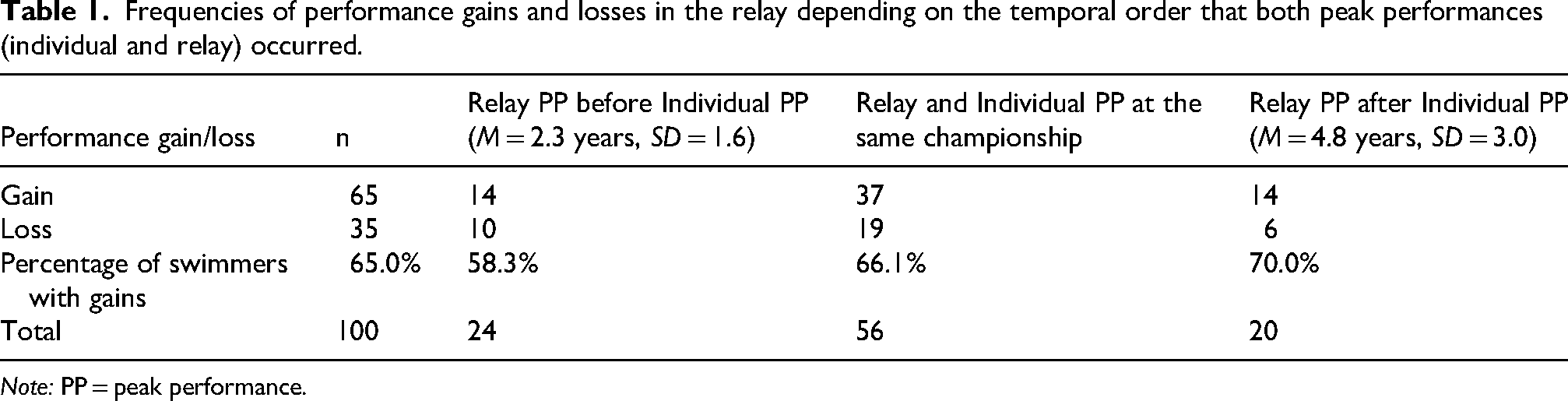
Note: PP = peak performance.
The ensuing LMM revealed a competition type main effect, F(1, 98) = 4.20, p = .043, d = 0.14, indicating on average (for males and females combined) faster swim times in the relay (M = 49.99 s, SD = 0.63) as compared to the individual competition (M = 50.07 s, SD = 0.59). Further, the LMM revealed a main effect for gender, F(1, 98) = 2374.32, p < .001, d = 9.75, showing that male swimmers (M = 47.25 s, SD = 0.57) swam faster than female swimmers (M = 52.81 s, SD = 0.57). There was no significant interaction effect of the two factors, F(1, 98) = 0.20, p = .65.
Performance gains (analyses based on data that were not corrected for a possible relay start benefit)
Sixty-eight swimmers (or 68% of the swimmers) swam faster in the relay competitions compared to their all-time best performance in an individual competition (i.e., all-time peak performances in the relay competitions), χ2(1) = 12.96, p < .001, w = 0.36, thereby again supporting the hypothesis. A chi-square test revealed no association between swimmers’ gender and performance gains, χ2(1) = 0.74, p = .39, w = 0.09. There was also no difference in the frequencies of performance gains as a function of temporal order of the relay and individual race result, χ2(2) = 0.44, p = .80, w = 0.07.
The LMM revealed a competition type main effect, F(1, 98) = 10.53, p = .002, d = 0.23, indicating on average (for males and females combined) faster swim times in the relay (M = 49.93 s, SD = 0.63) as compared to the individual competition (M = 50.07 s, SD = 0.59; see Figure 1). Further, the LMM revealed a fixed effect for gender, F(1, 98) = 2395.87, p < .001, d = 9.81, showing that male swimmers (M = 47.21 s, SD = 0.57) swam faster than female swimmers (M = 52.80 s, SD = 0.57). There was no significant interaction effect, F(1, 98) = 0.02, p = .89.
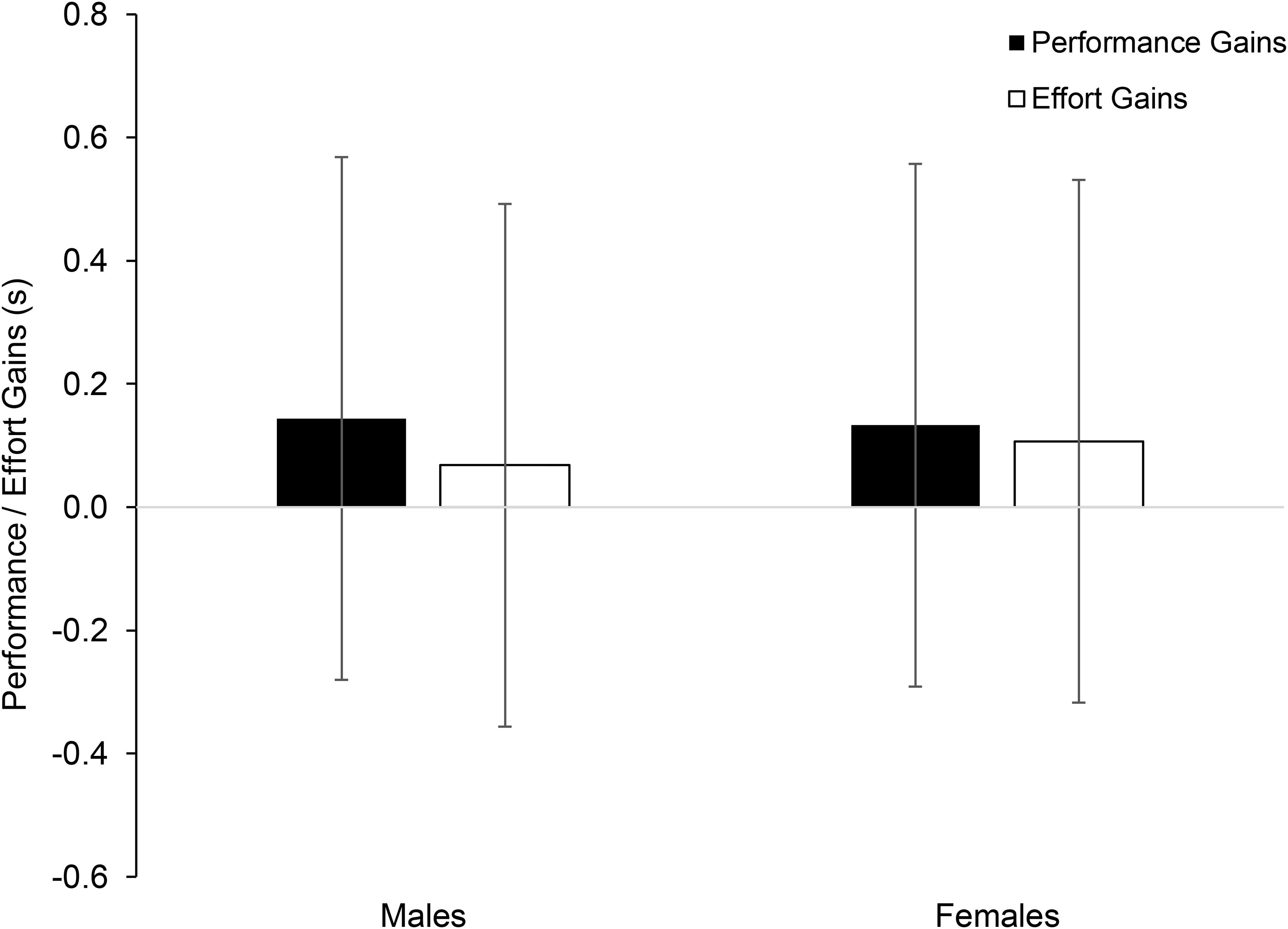
Estimated marginal means and standard deviations of performance gains and effort gains in the relay (as compared to the personal best from individual competitions) of the 50 best male and 50 best female 100 m freestyle swimmers between 2000 and 2019 competing at Olympic Games or World Championships.
Exploratory analyses
Further analyses were conducted to check possible reasons why about one third of the swimmers did not show their best ever performance in the relay. Specifically, two potentially influential factors identified by previous research were examined: (i) the position of a swimmer in the relay,15,16,37 and (ii) the relay's final placement.18,19 Therefore, the swimmers’ serial position within the relay and the medal chances of their relay (for the relay, in which they achieved their best ever relay performance) and any observed effort gains and effort losses were determined (see Table 2). Concerning (i), the results showed that serial positions did not significantly influence the emergence of effort gains and losses, χ2(3) = 2.15, p = .54, w = 0.15. However, the distribution of the data indicates that no effort gains occurred—at least descriptively—more frequently at the first relay position, while effort gains tended to occur more frequently at the fourth relay position.
Overview of swimmers’ gender, serial position within the relay, and medal chance of the relay and the emergence of effort gains and effort losses.
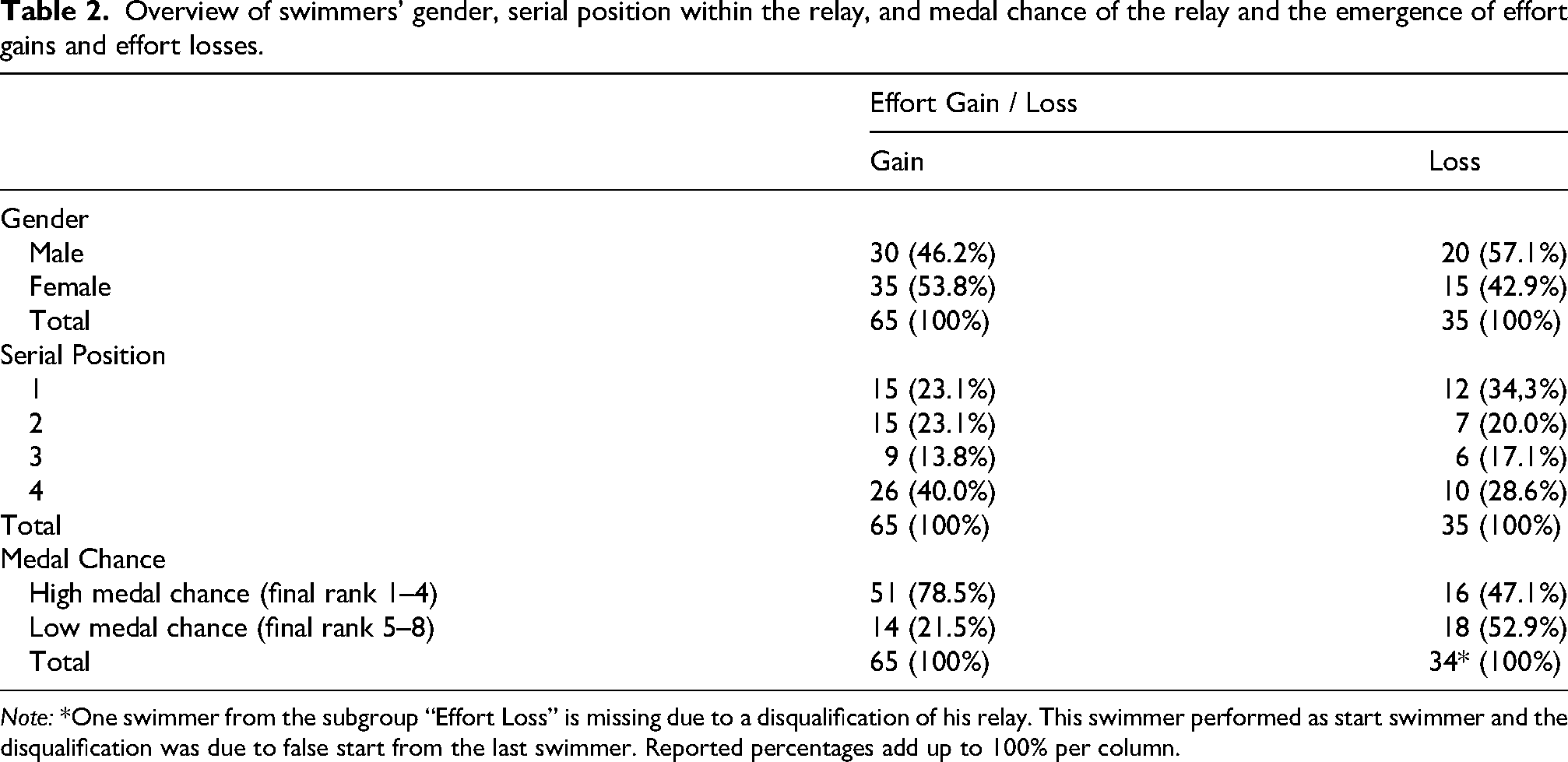
Note: *One swimmer from the subgroup “Effort Loss” is missing due to a disqualification of his relay. This swimmer performed as start swimmer and the disqualification was due to false start from the last swimmer. Reported percentages add up to 100% per column.
Concerning (ii), swimmers that were part of relays with high chances (with final relay placements from first to fourth place) or low medal chances (with final relay placements from fifth to eighth place) significantly differed from each other, χ2(1) = 10.1, p = .002, w = 0.32. Significantly more effort gains (78.5%) occurred when swimmers were part of relays with high medal chances.
Robustness analysis
To test the robustness of the results of the hypothesis test, a further analysis with a second sample was conducted: For this analysis, the original approach was reversed and the 100 fastest 100-m-relay split times ever swum by female (n = 50) and male (n = 50) swimmers were sampled and compared with these swimmers’ best ever performances from individual competitions. This second sample has a 68% overlap with the first sample of the main study. Procedures were the same as described above. Chi-square goodness of fit tests were again performed to test our hypothesis in this sample.
For RT-/CoT- and relay-start-benefit-corrected swim times, results showed 68 swimmers (or 68% of the swimmers) with effort gains, and thus all-time peak performances, in the relay competitions, χ2(1) = 12.96, p < .001, w = 0.36. Without a correction for relay start benefits, the number of swimmers with performance gains in the relay increased to 72 (or 72% of the swimmers), χ2(1) = 19.36, p < .001, w = 0.44. Thus, both analyses again clearly support the hypothesis.
Discussion
The first aim of this study was to investigate a previously neglected source of peak performance: competing with and for a group. Therefore, the fastest 100-m-freestyle swimmers in the world (between the years 2000 and 2019) were analyzed and their all-time personal best achieved in an individual race was compared with their all-time best performance in a relay race. The results of this study consistently and across various analyses supported our hypothesis: that most swimmers (65% to 68%, depending on the respective analysis) swam even faster in a relay competition as compared to their personal best lifetime performance in a corresponding interindividual competition. They, thus, showed the predicted peak performance in intergroup competitions. This was true for both genders, independent of the temporal order, in which both swimming performances took place, and also independent of whether the performances in the intergroup and interindividual competitions were achieved in the same championship. Moreover, the main results were also observed when the original approach was reversed, and the 100 best relay 4 × 100 m freestyle performances were used as the starting point for the analyses. From this sample, 68% or 72% of the swimmers (depending on the analysis) showed all-time peak performances in the relay. Thus, not only the weakest relay swimmers as in prior research, 9 but the majority of the strongest swimmers in the world exhibited gains, even if assessed against the most demanding baseline possible: their peak performance from interindividual competitions (i.e., their personal all-time best from these competitions).
The observed gains are not solely and not even mainly attributable to a relay start benefit. When controlling for the relay start benefit by adding an estimate to the already CoT-corrected relay split time, there were still significant effort gains in the relay among more of the fastest swimmers in the world than could be expected by chance. Specifically, most swimmers (65%) showed effort gains in their fastest relay split ever achieved as compared to their best performance ever achieved in an interindividual competition at World Championships or Olympic Games. That is, the intergroup competition created a motivational environment that pushed most of the swimmers—who had proven to be able to push themselves to an extraordinary limit already in interindividual races—even further to their absolute performance limit. Or, in other words: Even when correcting their swim time not only for faster reaction or change-over times, but also for a possible relay start benefit, most world-class athletes never swam faster than in a relay race.
This finding can be explained by relay swimmers acting in an intergroup competition. More specifically, it is assumed that increased effort in intergroup competitions is due to a strong perception of the instrumentality of one's own contribution for the team performance in a performance situation. If team members have this instrumentality perception, they should not only feel responsible for own outcomes, but also for the outcomes of their fellow group members.10,11,14,38 However, in the current study, this psychological process could not be measured and, therefore, other factors could also underlie the frequent peak performances in the relay. Anecdotally at least, the assumed positive linkage to each other, while pursuing a common goal is nicely reflected by the following quote of Michael Phelps, the most successful swimmer of all time: “It was an awesome feeling to be part of a team with a common goal. Individual races are good, but relays are a blast.” 39 (p111)
The second aim of this study was to investigate how variable, strong, and generalizable effort gains in swimming relays are. We found some variance in expended effort gains in relays: About two thirds of the swimmers showed such gains, while one third did not. Four of the variables that we controlled in our study did not explain this variability (the relay start benefit, gender, the temporal order of the relay and individual performance, and whether the relay and individual performance stemmed from the same championship or not). However, two further factors that we investigated in exploratory analyses could shed some light into possible factors for the one third of the sample who did not perform best in a relay team. Although not significant, those swimmers tended more often to swim at the first relay position, while swimmers with a personal all-time best in a relay, tended to swim more often at the fourth relay position. Thus, although most swimmers with effort losses showed their best ever performances in a relay at the starting position, their indispensability perceptions may not have been strong enough to elicit more effort compared to an individual race.15,16 However, this hunch should be further investigated in future research. As a second factor and in accordance with the CEM,10,11 the chances for a valuable group outcome influenced the effort expenditure of the group members. Compared to swimmers with an all-time best in the relay, swimmers without such an all-time best competed more frequently in relay teams that did not have realistic medal chances.
Concerning the strength of the observed effort gains, we observed that the effort gains in the relay were strong enough to emerge even when applying the most demanding individual baseline possible (i.e., individual peak performance or the swimmers’ all-time personal best from interindividual competitions). Concerning the generalizability of effort gains, we can conclude that effort gains clearly extended to stronger relay members as even most of the strongest swimmers in the world showed them. We thereby extend the findings by Braun et al. 9 who found only inconsistent evidence of effort gains among the strongest swimmers in relays.
Theoretical contribution
Research on teamwork has already shown that performing in a team can increase members’ performance beyond their performance achieved under individual work conditions (for a recent overview, see Torka et al. 13 ). This study extends those findings by showing that performing in intergroup competitions can actually lead to maximum individual performance—namely, to peak performance that is often not even achievable in individual performance situations. As far as the authors know, this is the first study to show this impact of intergroup versus interindividual competitions on team members’ peak performance.
The analyzed sample consisted of elite athletes that are absolute experts in their task and in achieving high performances in interindividual competitions. Nevertheless, most of them still had reserves that they could only recruit in intergroup competitions. This was still true for most swimmers when we corrected their swim times for a possible relay start benefit, which we determined as an estimate for this study (for details, see the supplementary material).
This increase beyond the personal best is explained with the CEM.10,11 Based on this model, strong instrumentality perceptions of relay swimmers are assumed: Especially for later starting swimmers, the perceived importance of the own individual performance for the team performance increases, as the possibility for compensation of bad individual performance decreases across the relay. 15 In this study, 73% of the swimmers (see Table 2) started at the second to fourth relay position. Swimmers at these positions showed reliable performance gains in prior research, while they typically did not show such gains at the first relay position.9,15,16,18,19,37 However, it is a new finding, which extends prior research, that even the most capable swimmers can further increase their performance when swimming in a team.
Practical implications
From the perspective of exercise science, intergroup competitions could be a beneficial training stimulus to bring athletes who typically compete in individual sports even closer to their natural performance limits. Therefore, it could be beneficial for the individual development of swimmers (and athletes from other sports) to put a stronger emphasis on intergroup competitions in training, but perhaps even more importantly in competitions. Integrating more social components into the training and competitions of young athletes in individual sports could lead to higher effort expenditure and, thus, better performances in both, training and competition. Importantly, it is also easier to leverage intergroup competitions to elicit peak performances than other already identified antecedents (individual differences such as growth after adversity).
Additionally, coaches may find it interesting to check whether their swimmers perform better in relay events than in individual races. This could provide insight into whether the swimmer is sensitive to the motivational environment of the team situation. This insight could then inform decisions about the relay team line-up.
From the perspective of psychology, another example of the motivating potential of teamwork (for overviews, see Hüffmeier et al., 40 ; Torka et al., 13 ; Weber & Hertel, 41 ) was observed. Especially if teamwork is designed well and if each team member perceives that their individual performance is strongly related to the team performance, 24 even extraordinary performances can be expected in teamwork. Another crucial factor for a motivating design of teamwork situations is the preferably close relationship of team performance and attractive team outcomes.11,37 Thus, designing team tasks in line with these theoretical principles may allow reliably eliciting high efforts in teams of all sorts.
Study limitations
The main limitation of this study concerns the interpretation of increased performance as being due to increased effort. Expended effort was not measured directly as this was not possible with the analyzed archival data. This is a common practice in studying effort expenditure in small groups. 13 However, in future studies, it would be important to use an experimental approach to supplement behavioral data with data from other sources, such as physiological measurements and questionnaires. Nevertheless, the approach used in this study allows for a reliable conclusion on underlying changes in expended effort, as quantifying the relay start benefit makes it possible to exclude the probably most prominent alternative explanation for the findings.
Another important limitation of this study concerns the different times and places, at which the individual and relay performances of the swimmers took place. Most swimmers in the sample achieved both types of peak performances at the same championship (n = 56, see Table 1). This means that 44 swimmers of the sample were maybe not in the same training condition at the time of the two best performances, as there was at least one year in between. However, these temporal differences are not considered problematic for the interpretation of the results for the following three reasons: Firstly, the overall pattern of results showed that around two thirds of the sample demonstrated an increase in effort in the relay. The pattern was the same for those swimmers, who achieved both peak performances at the same championship as well as for those who had at least one year between both peak performances. Secondly, this study analyzed two exceptional performances from each swimmer—their best ever performance in an interindividual competition and their best ever performance in an intergroup competition. At both times, the swimmers were in an exceptional physical and presumably also mental state. Otherwise, these peak performances would not have been possible. Thirdly, this study compared two swimming performances that took place under highly standardized conditions—even though, for several swimmers of the sample, both performances took place in different swimming pools. But since all analyzed competitions were organized by World Aquatics whose competitions are subject to precisely defined regulations and standards for swimming pools (see the FINA Facilities Rules, www.fina.org) this circumstance presumably has no systematic influence on the swimmers’ performance.
Conclusion
The results of this study show a systematic influence of intergroup competitions on the emergence of peak performance. Competing with their own group against other groups seems to be conducive to raising the motivation of group members to levels that they (mostly) cannot reach on their own in interindividual competitions. This finding may support the statements of many athletes that peak performances emerge nonvoluntarily. 2 These findings are encouraging and novel and, thus, require further investigation in, for example, other contexts (i.e., working or leisure contexts). Future studies on the topic could also analyze the exact person, group, and task characteristics leading to such extraordinary performances.
Supplemental Material
sj-docx-1-spo-10.1177_17479541251406242 - Supplemental material for Peak performance: Participating in intergroup competitions facilitates extraordinary performance
Supplemental material, sj-docx-1-spo-10.1177_17479541251406242 for Peak performance: Participating in intergroup competitions facilitates extraordinary performance by Claudia Braun, Sebastian Fischer and Joachim Hüffmeier in International Journal of Sports Science & Coaching
Footnotes
Author note
Part of the data contained in this manuscript has already been presented at a Congress: Braun, C., Fischer, S., Qiu, X., & Hüffmeier, J. (2022). Performance gains in relay swimming (Part II) – The motivation gains component. In M. Robinson, B. Baltzopoulos, M. Lake, & J. Vanrenterghem (Eds.), 40th Conference of the International Society of Biomechanics in Sports (pp. 90–93). NMU Commons. 
Ethical statement
The study was approved by the local ethics committee of the University of Kassel (E05201703) and respected the principles of the latest Declaration of Helsinki (WMA, Oct. 2013).
Consent to participate
We did not obtain written consent from the study participants, as we did not collect their data ourselves, but obtained it from publicly available databases (https://www.worldaquatics.com/results, verified by ).
Consent for publication
We did not obtain consent from the study participants, as we used competition results from publicly available databases.
Funding
The authors received no financial support for the research, authorship, and/or publication of this article.
Declaration of conflicting interests
The authors declared no potential conflicts of interest with respect to the research, authorship, and/or publication of this article.
Data availability statement
Supplemental material
Supplemental material for this article is available online.
References
Supplementary Material
Please find the following supplemental material available below.
For Open Access articles published under a Creative Commons License, all supplemental material carries the same license as the article it is associated with.
For non-Open Access articles published, all supplemental material carries a non-exclusive license, and permission requests for re-use of supplemental material or any part of supplemental material shall be sent directly to the copyright owner as specified in the copyright notice associated with the article.
