



Abstract
This study investigated the association between game-centric technical skills and running demands in elite male Australian football (AF). Gameplay running demands were analysed via global positioning system (GPS) technology for 43 professional male AF players from a single elite male AF club across 37 individual matches during the 2021 and 2022 Australian Football League seasons. Game-centric technical skill performance statistics were obtained from ChampionData®. The majority of game-centric technical skills had no association with running demands in elite male AF. However, some game-centric technical skills were associated with some GPS variables during elite AF gameplay. Main findings include negative associations between: uncontested statistics and accelerometry based variables (p < 0.001 between reference team uncontested marks and acceleration and deceleration distance), and positive associations between: uncontested statistics and running demands (p < 0.001 between uncontested possession percentage and relative total distance), and contested statistics and accelerometry-based variables (p < 0.001 between pre-clearance disposals and acceleration distance). Overall, these findings indicate that many game-centric factors may not have a large impact on gameplay running demands in AF, but certain variables indicate that the technical skills of the reference team may be more impactful on running demands than that of the opposition team.
Introduction
Elite Australian football (AF) is a unique field-based invasion sport encompassing some of the physical and technical skill of a range of sports such as basketball, soccer and rugby, however while performing a unique skill set within unique rules. 1 AF gameplay is intermittent in nature with players performing high-intensity activities such as sprinting, high-speed running (HSR), jumping and tackling, interspersed with periods of lower-intensity activities such as walking and jogging. 2 On average, elite male AF players complete between 11 and 13 km 1 at a rate of 131 ± 17 m.min−1 including 18.8 ± 9.1 m.min−1 of HSR (>18 km.h−1) 3 within a match. Resultantly, a detailed understanding of these running demands is important to best prepare AF athletes for competition. This has, however, proven difficult due to wide variability in these demands caused by the myriad of potential factors which can impact AF gameplay and which may in-turn contextualise the running demands required to compete; these constraints are commonly referred to as ‘contextual factors’. 4
A contextual factor is a variable associated with the interpretation of results, yet are not the primary objective of gameplay. 5 Examples of contextual factors which have been studied and found to be associated with running demands include playing position,3,4 aerobic fitness,4,6 and rotations.3,4 An understanding of gameplay running demands may be utilised by high-performance practitioners in elite AF as a central part of the planning, preparation, and recovery of their athletes throughout the season. Therefore, understanding the association between contextual factors and running demands can enhance the capabilities to promote desired physiological adaptations either during the planning of pre-season through small-sided games (SSG), 7 or the recovery modalities implemented post-game. Given the breadth of contextual factors studied in relation to running demands in elite AF, Gregorace et al. 4 conducted a scoping review to investigate associations. Findings suggest there is strong evidence to support a link between some contextual factors and running demands, such as, positive associations between relative total distance (TD) and aerobic fitness, number of rotations, season phase and nomadic position players, while negative associations with relative TD were found with the number of stoppages and time within game. However, evidence was equivocal for others, and the review identified a range of factors had not been thoroughly investigated in relation to their ability to contextualise running demands.
One contextualising factor which Gregorace et al. 4 identified as not having been previously investigated for their association with running demands was game-centric technical skills. These are defined as the skills/statistics required to compete such as kicking efficiency, uncontested marks, clearances, inside 50's etc, 8 and are commonly collected by sports analytics companies, and have been anecdotally linked to running demands, however do not appear to have been properly investigated in any sport. While previous studies have investigated contextual factors such as disposals,4,9 ChampionData® player ranking and pressure points,9,10 and pressure acts, 11 to the author's knowledge there is yet to be a study extensively focussing on the wide array of game-centric technical skills in AF. Consequently, this study aims to investigate the association between elite men's AF game-centric technical skills and running demands.
Methods
Research design and participants
Gameplay running demands as measured via global positioning system (GPS) technology, and a variety of contextual factors including technical skills obtained from ChampionData® were collected in 43 male professional AF players (age 22.9 ± 3.9 yrs [mean ± SD]; height 188 ± 7.5 cm; body mass 88.5 ± 7.5 kg at the conclusion of the data collection) from a single Australian Football League (AFL) club across 37 individual matches (12 wins; 25 losses) during the 2021 and 2022 seasons (final ladder positions: 15th and 14th, respectively) to determine the association between game-centric contextual factors and running demands in elite AF. The AFL club provided written informed consent for retrospective analysis of deidentified data, and this analysis was approved by the University of South Australia's Human Research Ethics Committee (HREC number: 204921).
Data collection
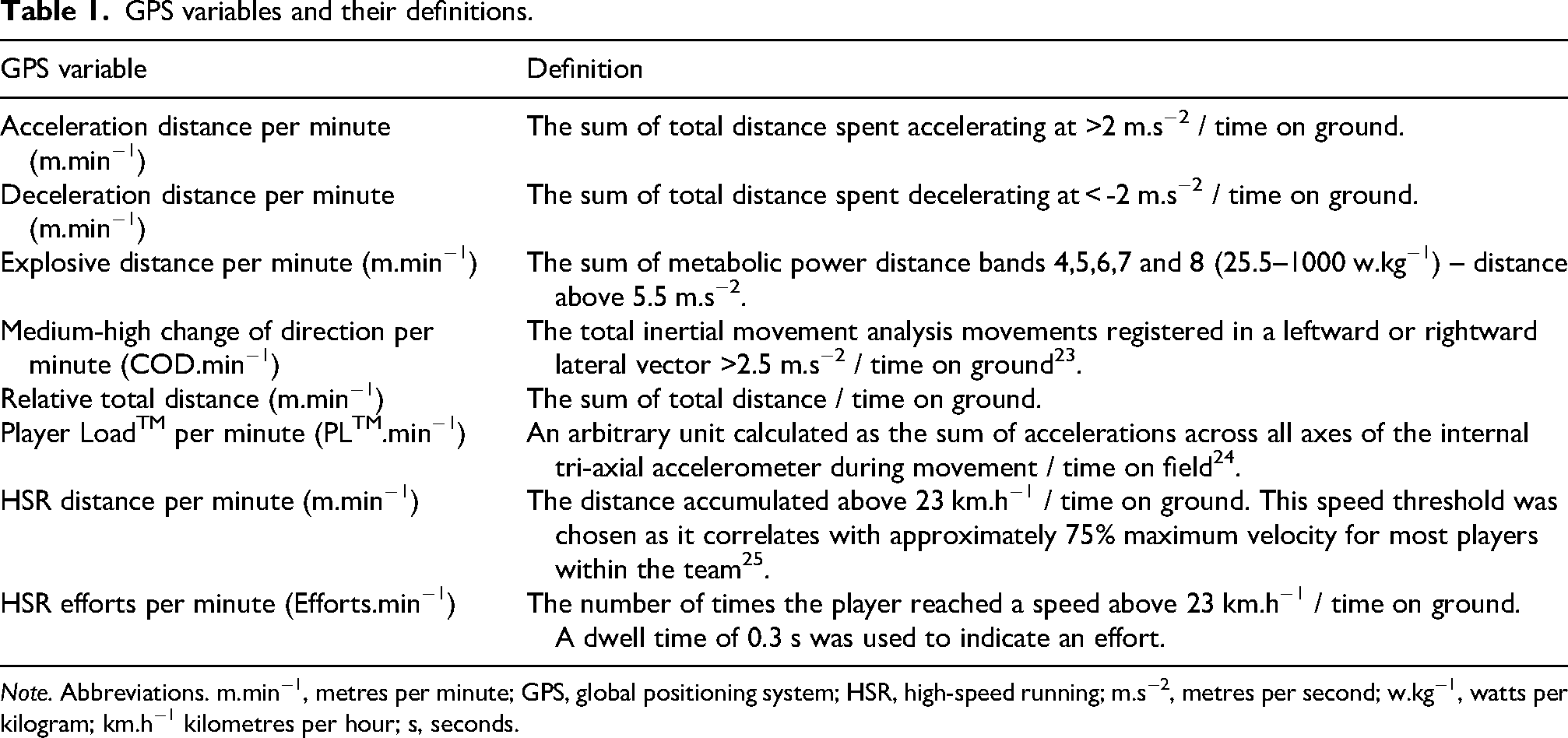
Gameday running demands were measured via GPS technology sampling at 10 Hz and an accelerometer sampling at 100 Hz (Catapult Vector S7 Catapult Innovations, Melbourne, Australia). Catapult Vector units have shown acceptable validity and reliability in capturing running demands during elite outdoor sporting competition.12–15 Units were turned on ∼60 minutes prior to match start and fitted to a custom pouch inside the players’ jersey positioned between and slightly superior to the scapulae. To reduce inter-unit variability each player wore the same GPS device for the duration of the data collection period. Data were downloaded post-match via Catapult proprietary software (Openfield version 3.3.0 and 3.3.1, Catapult Innovations, Melbourne, Australia), and appropriately processed to ensure only active playing time was analysed. A raw time-stamped data file was obtained for each match observation and exported for further analysis. Game-centric technical skill performance statistics were obtained from the commercial statistics provider of the AFL (ChampionData®, Victoria, Australia). ChampionData® have reported accuracy of 99% for individual player statistics, and to be within five seconds for time variables and within five to ten metres of true field position. 16 GPS variables and their definitions can be found in Table 1, while contextual factors utilised in the study are reported and defined in the supplementary material (Table S1). Relative TD, PlayerLoadTM, HSR and HSR efforts are popular metrics among gameplay running demand studies. 4 However, less common metrics were utilised in this study. Relative acceleration and deceleration distance was captured to allow comparison across different length matches, relative explosive distance was chosen to reflect the accumulative load associated with acceleration and decelerations whereby the thresholds utilised were chosen to reflect speeds of high metabolic load.17–20 Medium-high change of direction (COD) is an important aspect of gameplay to consider for AF players’ along with other key metrics, this metric was narrowed to include moderate and high changes of direction efforts based on the data cleaning process that was performed following collection.
GPS variables and their definitions.
Note. Abbreviations. m.min−1, metres per minute; GPS, global positioning system; HSR, high-speed running; m.s−2, metres per second; w.kg−1, watts per kilogram; km.h−1 kilometres per hour; s, seconds.
Matches were played on outdoor grass surfaces in a variety of weather conditions (temperature range 11.5–33.4˚C; rain present in 9/37 matches). Matches played on an indoor surface used local positioning system technology and were excluded from the analysis (n = 7) since Catapult's local positioning systems cannot accurately measure instantaneous speed.21,22 Data files were included for analysis if the player completed the full match (i.e., not involved in the medical substitution or withdrawn due to injury) and GPS was deemed accurate (satellite count >10 and horizontal dilution of precision [HDOP] < 1).
Statistical analysis
Individual linear mixed effect models evaluated the effect of contextual factors on running demands using STATA (Version 17, StataCorp, Texas, USA), specifically, individual linear mixed effect models were used to evaluate the association between running demands and all continuous contextual variables. For categorical contextual variables, each categorical group was added to the model as a base indicator to assess the difference in relationship between running demand variables and contextual factors across groups. Individual player was included as a random intercept effect in all models. Data were reported as b-coefficient and p-values where applicable. To reduce the incidence of type one error due to the number of comparisons, statistical significance was set at p < 0.001 on advice of a statistician. Standardised effect sizes were described using the magnitudes; < 0.2 trivial; 0.20–0.59 small; 0.60–1.19 moderate; 1.20–1.99 large; ≥ 2.0 very large.
Results
A total of 923 match data files were collected, with 777 data files included in analysis following data cleaning. Included match data files had an average satellite count of 13.2 ± 1.5 and average HDOP of 0.8 ± 0.1, and were therefore deemed valid and reliable GPS data measures. 26
Due to the magnitude of analyses performed, the results have been separated into individual player technical skills (i.e., those which are specific to a single player, rather than a team total), reference team technical skills and opposition team technical skills.
Individual player game-centric technical skills
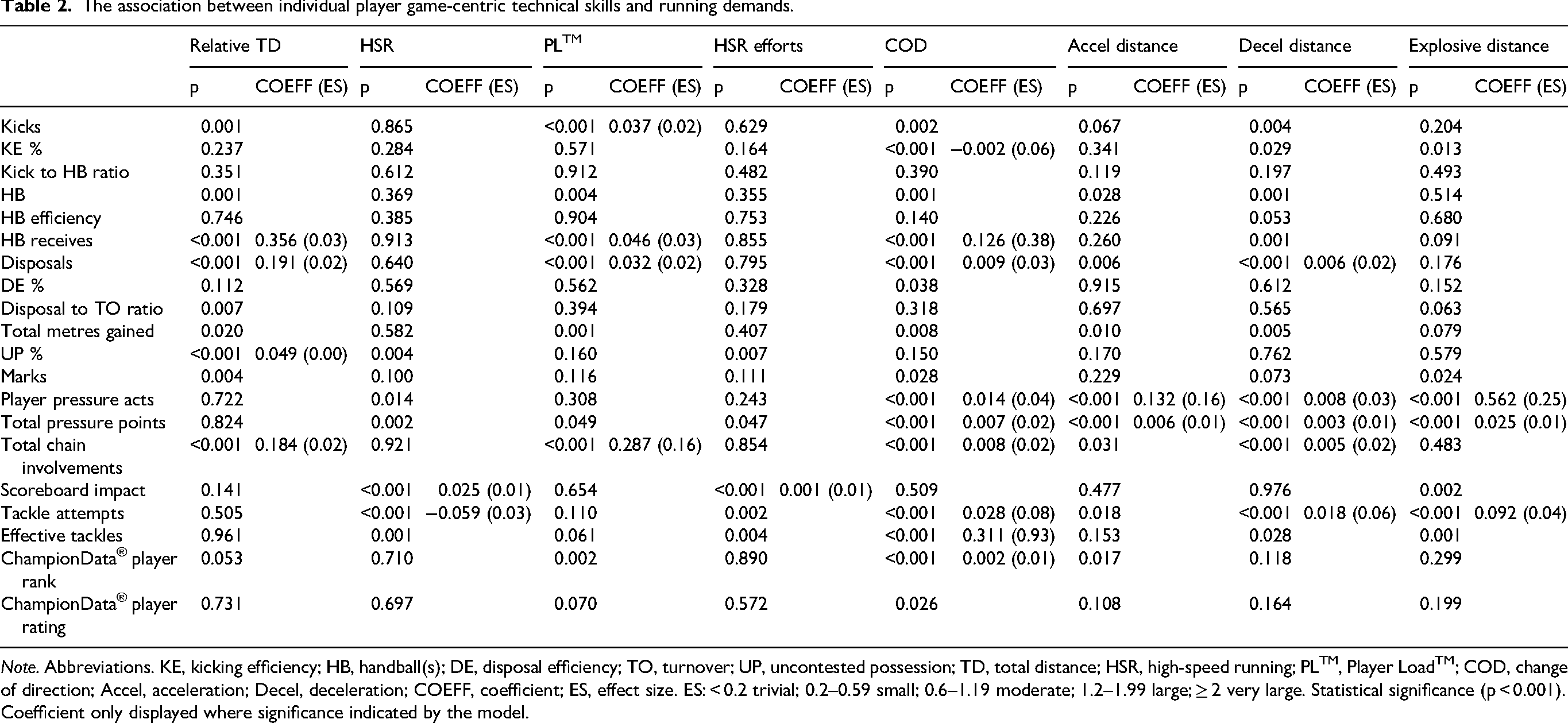
Associations between individual player game-centric technical skills and running demands can be found in Table 2. Number of disposals accumulated by a player had a trivial positive association with relative TD, PLTM, COD and deceleration distance. An individual's uncontested possession percentage had a trivial positive relationship with relative TD, and the number of handball receives had a positive relationship with relative TD, PLTM (trivial) and COD (small). Number of kicks had a trivial positive association with PLTM, while individual kicking efficiency had a trivial negative relationship with COD. ChampionData® player rank had a trivial positive association with COD, while ChampionData® pressure points, number of pressure acts and number of attempted tackles had positive correlations with accelerometry-based variables. Meanwhile, a player's effective tackles had a moderate positive relationship with COD. Total chain involvements were positively correlated with relative TD, PLTM, COD and deceleration distance (trivial), while individual scoreboard impact had a trivial positive association with high-speed running distance and efforts, No correlation with any measured variable was evident for an individual player's kick to handball ratio, handball number, handball efficiency, disposal efficiency, disposal to turnover ratio, total metres gained, marks and ChampionData® player ratings.
The association between individual player game-centric technical skills and running demands.
Note. Abbreviations. KE, kicking efficiency; HB, handball(s); DE, disposal efficiency; TO, turnover; UP, uncontested possession; TD, total distance; HSR, high-speed running; PLTM, Player LoadTM; COD, change of direction; Accel, acceleration; Decel, deceleration; COEFF, coefficient; ES, effect size. ES: < 0.2 trivial; 0.2–0.59 small; 0.6–1.19 moderate; 1.2–1.99 large; ≥ 2 very large. Statistical significance (p < 0.001). Coefficient only displayed where significance indicated by the model.
Reference team game-centric technical skills
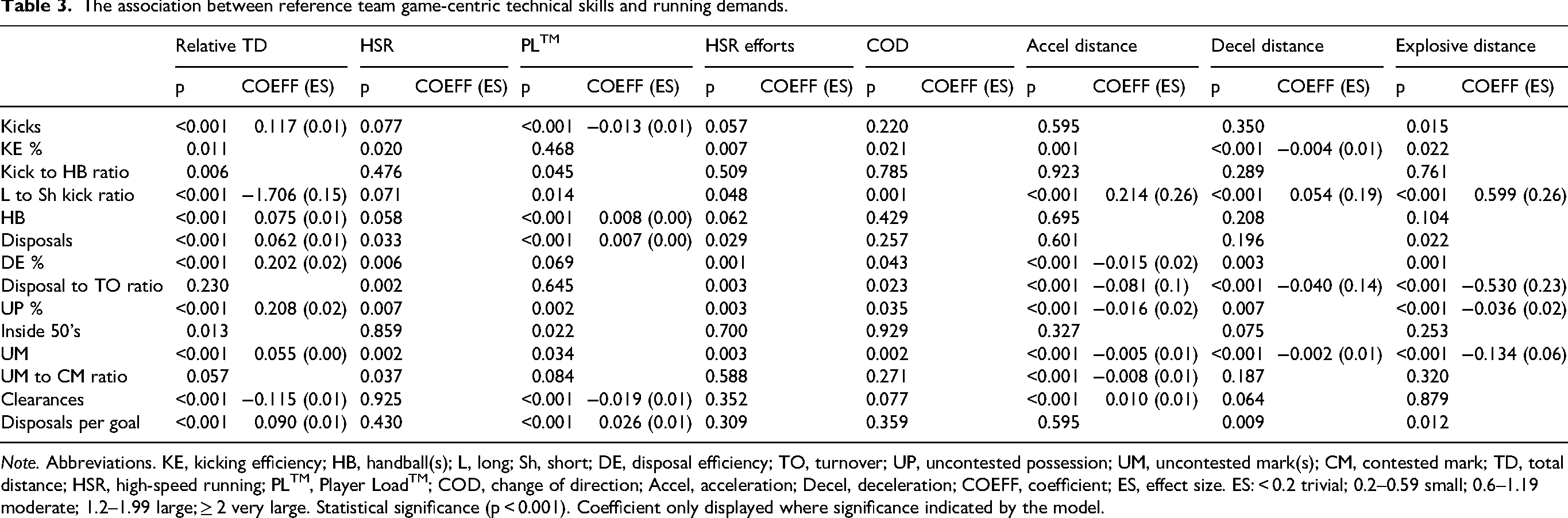
Associations between the reference team's game-centric technical skills and running demands can be found in Table 3. Total disposals accumulated by the reference team had a trivial positive association with relative TD and PLTM. The reference team's disposal efficiency had a trivial positive association with relative TD, but a trivial negative association with acceleration distance. Disposals per goal had a trivial positive relationship with relative TD and PLTM, while disposals per turnover had a negative relationship with acceleration, deceleration (trivial) and explosive distance (small). The reference team's uncontested possession percentage and number of uncontested marks had a trivial positive relationship with relative TD, but negative with the accelerometry-based variables. Additionally, the uncontested to contested mark ratio had a trivial negative association with acceleration distance. Number of kicks from the reference team had a trivial positive association with relative TD, but a trivial negative association with PLTM. The reference team's kicking efficiency had a trivial negative relationship with deceleration distance. The long to short kick ratio had a trivial negative relationship with relative TD, but was positively associated with deceleration (trivial), acceleration and explosive distance (small). Number of clearances from the reference team had a trivial negative association with relative TD and PLTM, but trivial positive with acceleration distance. Number of handballs had a trivial positive relationship with relative TD and PLTM. No correlation with any measured GPS variable was evident for the reference team's kick to handball ratio and inside 50's.
The association between reference team game-centric technical skills and running demands.
Note. Abbreviations. KE, kicking efficiency; HB, handball(s); L, long; Sh, short; DE, disposal efficiency; TO, turnover; UP, uncontested possession; UM, uncontested mark(s); CM, contested mark; TD, total distance; HSR, high-speed running; PLTM, Player LoadTM; COD, change of direction; Accel, acceleration; Decel, deceleration; COEFF, coefficient; ES, effect size. ES: < 0.2 trivial; 0.2–0.59 small; 0.6–1.19 moderate; 1.2–1.99 large; ≥ 2 very large. Statistical significance (p < 0.001). Coefficient only displayed where significance indicated by the model.
Opposition team game-centric technical skills
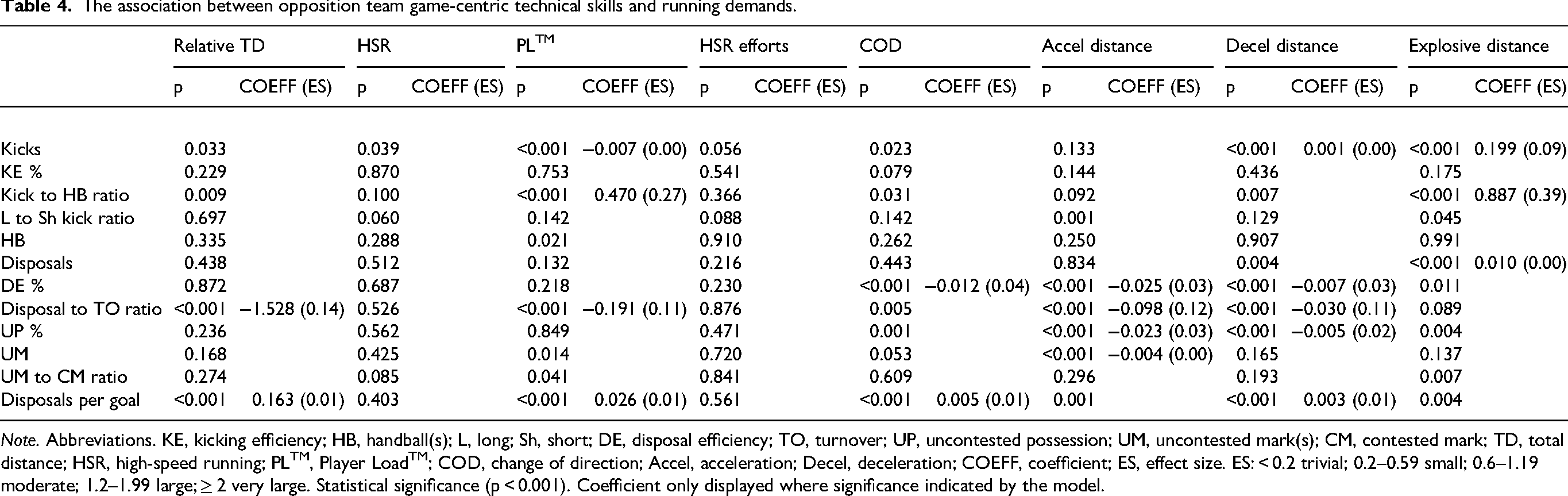
Associations between the opposition team's game-centric technical skills and running demands can be found in Table 4. Opposition disposal number had a trivial positive relationship with explosive distance, while disposal efficiency had a trivial negative relationship with COD, acceleration and deceleration distance. The opposition team's disposals per goal had a trivial positive association with relative TD, PLTM, COD and deceleration distance, while disposals per turnover had trivial negative relationships with relative TD, PLTM, acceleration and deceleration distance. The opposition team's uncontested possession percentage and uncontested marks had a trivial negative association with acceleration distance, while the former was also negatively related to deceleration distance. Number of kicks from the opposition team had a trivial negative association with PLTM, but a trivial positive association with deceleration and explosive distance. Kick to handball ratio had a small positive relationship with PLTM and explosive distance. No correlation with any measured GPS variable was evident for the opposition team's kicking efficiency, long to short kick ratio, handball number and uncontested to contested mark ratio.
The association between opposition team game-centric technical skills and running demands.
Note. Abbreviations. KE, kicking efficiency; HB, handball(s); L, long; Sh, short; DE, disposal efficiency; TO, turnover; UP, uncontested possession; UM, uncontested mark(s); CM, contested mark; TD, total distance; HSR, high-speed running; PLTM, Player LoadTM; COD, change of direction; Accel, acceleration; Decel, deceleration; COEFF, coefficient; ES, effect size. ES: < 0.2 trivial; 0.2–0.59 small; 0.6–1.19 moderate; 1.2–1.99 large; ≥ 2 very large. Statistical significance (p < 0.001). Coefficient only displayed where significance indicated by the model.
Discussion
The aim of the current research was to investigate the association between game-centric technical skills and gameplay running demands in elite male AF. This study is the first of its kind to extensively investigate the associations between elite AF game-centric technical skills and gameplay running demands, whereby technical-skill statistics of individual players, the reference team and the opposition team were all analysed for their association with gameplay running demands. The current research illustrates an overarching pattern that most game-centric technical skills had no association with most or any running demand parameters. However, certain game-centric contextual factors were associated with some running demand parameters. Contextual factors focused on a player's disposals found that uncontested possession statistics were associated with free-running as inferred by increased relative TD and HSR, but had a negative association with accelerometry-based variables such as COD, acceleration and deceleration distance, while the opposite was true for contested possession statistics.
In support of previous research, a player's number of disposals had a positive association with relative TD,4,9 while ChampionData® player rank and ChampionData® pressure points 9 had a positive relationship with acceleration distance. Building on these previously identified positive associations, the results from the current study indicate that previously unreported contextual factors such as the number of kicks (PLTM), total chain involvements (TD, PLTM), uncontested possession percentage (TD), handball receives (TD & PLTM), and scoreboard impact (HSR) had a positive association with free-running variables, while total chain involvements (COD & deceleration distance) also had a positive association with accelerometry-based variables, along with effective tackles (COD). These findings are intuitive as uncontested possessions often indicate a player has found space and vacated the density of the opposition, while handball receives are often associated with a ‘run and gun’ playstyle, 27 and both would indicate the requirement for an AF player to have covered more total distance and completed more work around the ground. Meanwhile, total chain involvements are related to disposal count, while pressure acts are included amongst ChampionData® pressure points, therefore it is intuitive that these contextual factors would have similar correlations. These correlations are positive associations between total chain involvements and disposals with TD, PLTM, COD, and deceleration distance, while ChampionData® pressure points and pressure acts had a positive association with COD, acceleration, deceleration, and explosive distance. Comparatively, number of tackle attempts had mixed results, with positive correlations regarding accelerometery-based variables but negative correlations with HSR. These findings are intuitive due to a high tackle count often being associated with inside midfielders, who complete more COD and less HSR than other positions such as outside midfielders. 28 This is the first study to investigate the relationship between tackles and gameplay running demands in AF, however this association has been investigated in rugby league where both positive 29 and negative 30 correlations have been reported in relative TD29,30 and HSR. 30 Kempton and Coutts 30 attribute fatigue arising from the action of tackling to the reduction in running output, while Delaney et al. 29 only investigated interchange players who are described to be exposed to greater frequency of physical collisions due to modern interchange strategies 31 and therefore would be expected to have a greater relative running output which has been demonstrated in several AF studies.3,4 Taken together, the results from the current study support assertions of previously reported contextual factors such as a player's number of disposals, ChampionData® player rank and pressure points. Additionally, new findings also indicate associations with a player's number of kicks, uncontested possession percentage, handball receives, scoreboard impact, total chain involvements, and effective tackles, indicating there may be a need for practitioners to consider a range of game specific factors when evaluating running demands. However, more research is required to provide greater clarity on the true association of all mentioned variables due to the sample size, utilisation of on elite AF club, and the lack of practical meaningfulness.
In 2018, it was suggested that contested possessions, pressure acts and disposal efficiency were the holy trinity in the AFL. 32 Statistics show that over a six-year period, the lowest winning percentage for teams that won all three of these statistics was 86.9%, 32 demonstrating the importance of disposal efficiency in elite AF. This study is the first time disposal efficiency has been investigated as a contextual factor which may be associated with running demands in elite AF, and there were negative relationships with accelerometery-based metrics regardless of whether reference or opposition team was considered. Greater disposal efficiency may lead to less congestion, and thus players may not be required to produce as many COD, acceleration and deceleration movements. This study was also the first of its kind to investigate disposals per goal, uncontested possession percentage and uncontested marks as contextual factors. The positive association between relative TD and PLTM with disposals per goal are intuitive due to a greater ratio relating to greater ‘time in play’, which is evident in elite soccer when comparing effective playing time between the two halves. 33 Similarly, the positive relationship between uncontested possession percentage and uncontested marks for the reference team with relative TD, and negative association with accelerometery-based variables are also expected. Anecdotally it appears greater running output is required to escape the opposition and obtain an uncontested possession, while accelerometery-based movements are associated with evading the opposition in congestion (i.e., when gaining a contested possession), which is supported by research regarding the modification of SSG to target certain physical output. 7 34–36 It has been stated that increasing the dimensions of the field likely reduces congestion in the drill as it results in greater TD and HSR in both soccer 34 and AF. 35
This study is the first of its kind to investigate both the reference and opposition teams’ technical skill statistics as contextual factors on gameplay running demands. The associations for the reference team show that number of kicks accumulated had a positive relationship with relative TD, but negative with PLTM. The long to short kick ratio had a negative relationship with relative TD, and a positive relationship with acceleration, deceleration and explosive distance. This finding may be explained as short kicks can often be due to having open-teammates and accompanies free movement up the field. Meanwhile, long kicks may flow from the opposition having superior defensive structure, thus players are forced to kick long to a contest which can typically end in a stoppage or turnover, in-turn leading to reduced relative TD, and increased accelerometery-based metrics. Interestingly, findings from this study indicate that the actions of the reference team may be more impactful on their running demands than the opposition's game style, as there are fewer statistical associations when considering the contextual factors based on the opposition's technical skills in comparison to data from the reference team. Regarding the opposition team, number of disposals accumulated had a positive association with explosive distance. Similar to the reference team, the number of kicks had a negative association with PLTM, but a positive association with deceleration and explosive distance. However, kick to handball ratio had a positive association with PLTM and explosive distance. This is relevant for practitioners as these findings indicate that physically preparing players for your team's game style may be more important, in comparison to preparing them for their specific opposition's game style. For example, it may be sufficient for practitioners to prepare their players for the high stoppage, mark focussed, short kicking game style of the reference team, rather than focussing on the opposition who play with high handball receives, long kicking and low tackle count.
While certain game-centric technical skills are associated with gameplay running demands, it appears there is an overall pattern demonstrating most game-centric technical skills had no association with running demands. Specifically, gameplay running demands had no association with an individual's kick to handball ratio, handball number, handball efficiency, disposal efficiency, disposal to turnover ratio, total metres gained, marks and ChampionData® player rating. Most of those findings are intuitive as kick to handball ratio, handball number, handball efficiency, disposal efficiency, disposal to turnover ratio and total metres gained are all technical skills that relate to skill execution rather than physical outputs such as running demands, however there is no other research to compare these findings to within AF to confirm this. The reference team's kick to handball ratio and inside 50's had no association with running demands, while the opposition's kicking efficiency, long to short kick ratio, handball number and uncontested to contested mark ratio had no association with any measured metric. Overall, the study showed that the statistics of the reference team had more frequent associations with running demands than those of the opposition, however given this is the first study of its type, future research should confirm these findings.
Limitations
Whilst this study is the first to examine the association between running demands and a range of game-centric technical skills in elite AF, caution should be taken when interpreting the present findings, as this study is cross-sectional in nature, and therefore these relationships may be specific to the team and players involved in the study at the specific timepoint studied. Consequently, additional studies involving other teams are required to gain greater understanding of these factors in the wider elite AF environment, particularly as the reference team in this study finished 15th and 14th respectively throughout the data collection period which may influence the interpretation of these results. Further, the present findings are preliminary findings, and although significant, they do not represent causal relationships. Another limitation within this study is the absence of a threshold determining practical meaningfulness, due to the practical meaningfulness of gameplay running demands not being known, along with this study being the first of its kind to investigate certain contextual factors, we would be unable to find practical meaningfulness for all outcomes due to a lack of reliable research.
Conclusion
The current study indicates that although there is an overall pattern demonstrating most game-centric technical skills had no association with running demands, however, there are a various number of game-centric technical skills that are associated with running demands in elite AF. It appears that uncontested possession statistics were associated with free-running variables as inferred by increased relative TD and HSR, but had a negative association with accelerometry-based variables such as COD, acceleration and deceleration distance, while the opposite was true for contested possession statistics. Additionally, key game-centric factors such as effective tackles (positive association with accelerometry-based variables and negative association with HSR) and disposal efficiency (negative association with accelerometry-based variables) were investigated in AF for the first time. The findings indicate that there are many contextual factors that are associated with physical output outside of an individual player's control, and although many game-centric factors do not appear to be associated with running demands, they do indicate that the technical skills of the reference team may be more impactful than that of the opposition team when analysing the gameplay running demands in elite men's AF.
Supplemental Material
sj-docx-1-spo-10.1177_17479541251396333 - Supplemental material for The association between elite Australian football game-centric technical skills and running demands
Supplemental material, sj-docx-1-spo-10.1177_17479541251396333 for The association between elite Australian football game-centric technical skills and running demands by Josh I Gregorace, Maximillian J Nelson, Grace E Greenham and Clint R Bellenger in International Journal of Sports Science & Coaching
Footnotes

Ethical considerations
The current study was approved by the University of South Australia's Human Research Ethics Committee (HREC number: 204921).
Consent to participate
Written informed consent was obtained by the reference team involved in the study stating the consent to analyse and publish results related to the study.
Consent to publish
Written informed consent was obtained by the reference team involved in the study stating the consent to analyse and publish results related to the study.
Author contribution
Josh Gregorace: Conceptualization, Methodology, Formal Analysis, Investigation, Writing – Original Draft, Visualisation
Maximillian Nelson: Conceptualization, Writing – Review & Editing, Supervision, Methodology Grace Greenham: Conceptualization, Methodology, Formal Analysis, Writing – Review & Editing, Supervision
Clint Bellenger: Conceptualization, Writing – Review & Editing, Supervision, Methodology
Funding
The authors received no financial support for the research, authorship, and/or publication of this article.
Declaration of conflicting interests
The authors declared no potential conflicts of interest with respect to the research, authorship, and/or publication of this article.
Data availability statement
The game-centric technical skill statistics are the property of ChampionData® and thus can only be provided with the written authorisation of ChampionData®.
The gameplay running output data remains the property of the relevant sporting organisation. Requests for access to said data can be submitted to the authors directly.
Supplemental material
Supplemental material for this article is available online.
References
Supplementary Material
Please find the following supplemental material available below.
For Open Access articles published under a Creative Commons License, all supplemental material carries the same license as the article it is associated with.
For non-Open Access articles published, all supplemental material carries a non-exclusive license, and permission requests for re-use of supplemental material or any part of supplemental material shall be sent directly to the copyright owner as specified in the copyright notice associated with the article.
