



Abstract
This study considers asymmetry during dynamic human movement as any biomechanical differences between left and right sides of the body. Previous studies have reported spatiotemporal and ground reaction force (GRF) asymmetries during sprint running and jumping tasks but have not found any associations between asymmetry and sprinting performance, however, have cross-sectionally examined asymmetry at only a single point in time. Therefore, the importance of asymmetry fluctuations across time or training sessions in relation to sprint performance changes remain unclear. The aim was clarifying whether changes in asymmetry of leg extension performance, measured by single-leg countermovement jumps (CMJ), influence fluctuations in sprinting asymmetry, and whether any such fluctuations are associated with changes in maximal running speed. Thirteen sprinters performed maximal effort 60-m sprints on a long force platform system and single-leg CMJs across two testing sessions, one month apart. Pearson's correlation coefficients were calculated to examine the relationships between the changes in spatiotemporal and GRF asymmetry across sessions with either the changes in CMJ asymmetry or changes in maximum running speed. Results demonstrated that small fluctuations in asymmetry occurred between sessions but were not significantly associated with sprint performance or CMJ asymmetry changes. Therefore, asymmetry may not need to be prioritised in periodic testing as a key performance indicator, and these findings provide valuable insight for coaches, suggesting that training should focus on known sprint determinants rather than minimising asymmetry. Moreover, asymmetry during sprinting may not necessarily relate to asymmetry of leg extension strength in non-injured well-trained sprinters.
Introduction
Symmetry and asymmetry exist on a spectrum from 0–100% and are often used interchangeably when referring to similar measures. This study considers asymmetry during dynamic human movement or sprint running as the proportional difference in magnitude between limbs or between left and right steps for a biomechanical variable, calculated via the symmetry angle formula. Previous research demonstrated populations with >15% inter-limb asymmetries may have increased injury risks, thus asymmetry values of <10% have been suggested as a target for athletes returning to sport from injury.1,2
Although the role of inter-limb asymmetry on performance measures over time is not well known, numerous asymmetries in leg extension jumping tasks and when sprinting in spatiotemporal variables and GRFs have been identified. 3 For example, one study showed significant inter-limb differences during squat jumps for vertical force, power, and work, and during sprinting for step length, step frequency, horizontal impulse, and vertical force, however, further reported large individual ranges (0.1–93.2%) in asymmetry values. 4 Another study comparing step-to-step asymmetries as a proportion reported asymmetry values during the maximum speed phase in male athletes for step length (4.60%), step frequency (4.70%), stance time (3.81%), flight time (6.11%), braking impulse (18.7%), propulsive impulse (7.73%), and vertical impulse (8.41%), and further found greater asymmetries in step length, step frequency, stance time, vertical impulse, and braking force in male compared to female athletes. 5 These findings suggest that asymmetry is not only common in sprinting but may also manifest differently based on sex and individual characteristics. In addition, these previous studies reported no consistent association between asymmetry and performance for any measured variables,3–5 however, most existing studies have focused on between-athlete asymmetry comparisons or are cross sectional studies that examine asymmetry at only a single point in time.1,4,6–8
Larger asymmetries in step-to-step spatiotemporal and GRF variables may indicate inter-limb imbalances and theoretically alter neuromuscular loading patterns and control, affecting stride efficiency or contributing to overuse injury due to compensatory loading. While it has been hypothesised that larger inter-limb asymmetries may be detrimental to sprint or jump performance, although only one known study has supported this hypothesis during sprinting, 9 it has also been suggested that a certain level of asymmetry may be a natural and functionally adaptive phenomenon having no relation to, or even being beneficial for, sprint performance in elite athletes.10,11 It is known that sprinting performance is subject to natural variability between training sessions due to multifactorial drivers such as fatigue, neuromuscular adaptations, and external conditions. However, the importance of asymmetry fluctuations over time or between training sessions in relation to sprint performance changes remain unclear. The specific spatiotemporal and GRF variables measured in this study were chosen due to previous findings observing asymmetries,3–5 and because they represent fundamental mechanical components of sprint performance. For example, vertical impulse relates to vertical displacement, anteroposterior force and impulse are linked to ratio of forces and horizontal propulsion, and step-to-step spatiotemporal variables (step length/frequency, stance time, and flight time) are indicative of inter-limb coordination/consistency.12–14 These are among the most commonly reported metrics in sprint literature and offer valid and repeatable measures for assessing performance relative to asymmetry. If asymmetry is correlated with performance changes over time, then symmetry specific training to meet target symmetry thresholds for each variable may be an important consideration for future research interventions. Conversely, if naturally occurring small to moderate variations in asymmetry between training sessions do not correlate with performance changes over time, this would suggest that periodic monitoring of or interventions of asymmetry may not be crucial for performance improvements. Therefore, clarifying whether regular fluctuations in asymmetry over time impact sprint performance change may better inform training prescription practices.
This study clarified whether changes in inter-limb asymmetry of measured spatiotemporal and GRF variables between regular sprint training sessions were associated with changes in sprint performance or countermovement jump (CMJ) asymmetry. The CMJ is a cheap and practical performance test practitioners use as a proxy for lower limb power, specifically for those without the capability to measure asymmetry or power during sprinting, and was included to clarify whether it translated into asymmetry measures during sprinting, thereby providing practical relevance to a common testing protocol. Specifically, the aim was to clarify whether changes in asymmetry of leg extension performance, as measured by single-leg CMJ testing, influence fluctuations in sprinting asymmetry, and whether any such fluctuations are associated with changes in maximal running speed. Given that sprint-trained athletes generally exhibit well-developed neuromuscular control, it was expected they may better compensate for any asymmetry changes without adverse performance effects. Therefore, it was hypothesised that minimal small to moderate variations in inter-limb asymmetry between sessions would occur naturally as part of regular sprint training in a cohort of experienced sprinters but would not significantly correlate with sprint performance changes.
Materials and methods
Study design
This observational study collected spatiotemporal and GRF variables during sprinting and single leg vertical jump height tests. Two separate testing sessions were conducted with an interval of one month between them, during which time participants continued their regular training programs without intervention or individual monitoring. Using the changes in measured variables between testing sessions, the association of changes in sprint performance or CMJ asymmetry with changes in other variables were examined.
Participants
Thirteen sub-elite male sprinters (mean ± SD: age, 20.3 ± 1.0 y; stature, 1.72 ± 0.05 m; body mass, 69.1 ± 3.8 kg; personal best 100 m race time, 11.40 ± 0.43 s) participated in this study. The participants had competed at regional and national levels and had at least five years sprint training experience (8.8 ± 2.2 y, range 5–12 y). All participants were free from injury at the time of data collection and they were fully informed of the aims, risks of involvement, and experimental conditions of this study, and gave written informed consent. This study was approved by the research ethics committee of the institute beforehand.
Data collection
Two separate data collection sessions (same protocol) were conducted with a one-month interval between, during which the participants trained in accordance with their regular training programs and there was no intervention. Their regular program consisted generally of five training sessions per week consisting of strength (resistance exercises with focus on lower body lifts) training twice per week and on track training three times per week (mix of speed, speed endurance, and plyometric exercises). All participants came from the same sprint group and did the same one-month training plan. Data collection consisted of a self-selected warm up, after which the participants (wearing their own spiked race shoes) performed 60-m indoor sprints with maximal effort from starting blocks for one to two trials. The rest period between trials was at least ten minutes. The experiment was done as part of regular periodical fitness measurements in the participants’ training program, and the number of trials completed was dependent on their physical condition. An electric starting gun provided a start signal and began data collection. A long force platform system, which consisted of fifty-four force platforms (TF-90100, TF-3055, TF-32120, Tec Gihan, Kyoto, Japan; 1000 Hz) was used to record GRFs for a 52 m distance from the start.14–16 After sprint trials, participants performed single leg vertical counter movement jump (CMJ) tests for each side. The CMJ was performed without arm swing (hands placed on the waist), and the participants were instructed to jump as high as possible and land with a plantar flexed position to avoid any effect of differences in landing posture. 17 Jump technique was qualitatively assessed via video recording and if a participant performed the test incorrectly, they were required to perform the trial again. The force plates were not used for CMJ tests due to equipment availability and instead jump heights were measured using a validated contact mat system (Multi Jump Tester; DKH Co., Tokyo, Japan; 1000 Hz) for practical integration into team testing routines, computed using the flight time in accordance with Bosco's theory. 18 The CMJ test was performed twice per leg and the better trial was selected for further analyses. Although three CMJ trials are typically used in testing, two trials per leg were used in the present protocol to manage testing duration and athlete fatigue within their training schedule. The starting gun, force plate system, and contact mat were calibrated and/or tested for validity prior to use according to manufacturer guidelines.
Data processing
The GRF signals were smoothed using a Butterworth low-pass digital filter with a cut-off frequency of 50 Hz. Spatiotemporal and GRF variables for each step until the 50 m mark were computed using the filtered GRF signals in accordance with previous studies.16,19,20 Briefly, the foot strike and toe-off instants were detected in the filtered vertical force to reduce signal noise consistent with previous methodologies,16,19,20 by a threshold of 20 N of vertical force. The step frequency was calculated as the inverse of step time which was obtained as the duration from one foot strike to the next contralateral foot strike. The stance and flight times were defined as the durations of the foot touching the ground or not, respectively. Horizontal velocity was calculated using the impulse-momentum relationship by integrating the mass-specific anteroposterior GRF subtracting the influence of aerodynamic drag force.15,16 Although indoors, to account for any influence of air resistance which may contribute toward errors across the trials, aerodynamic drag was estimated using the participants height and mass, with the estimated aerodynamic friction coefficient in reference to previous methods. 21 The mean running speed for every step was then calculated by averaging the time-series horizontal velocity during each steps duration. The step length was computed by dividing the mean running speed by step frequency. The braking, propulsive, vertical and anteroposterior forces were integrated to compute braking, propulsive, vertical and net anteroposterior impulses. Mean braking, propulsive, vertical and net anteroposterior forces during the entire stance phase were calculated at every step by averaging respective forces during the corresponding durations. All the GRF variables were divided by body mass. Durations during which the braking and propulsive forces were applied onto the ground were determined as braking and propulsive times.
This study focused on the maximal speed phase as step-to-step variables increase or decrease in the acceleration and deceleration phases of sprinting that make it difficult to evaluate asymmetry. The fastest four steps for each trial were extracted based on the average running speed of the serial four steps. Using the fastest average running speed of four steps in each trial, the fastest trial for each participant was determined and spatiotemporal and GRF variables for the fastest four steps of the fastest trial for each participant were used for further analyses. For each variable, the average of two steps for the right and the left sides was obtained to reduce the influence of step-to-step cyclic movement variability, enhancing the signal-to-noise ratio.22,23 The inter-leg asymmetry was evaluated using symmetry angle calculated using the below equation in reference to previous studies.4,6

Where symmetry angle ranged from −100% (right > left) to 100% (left > right) with 0% indicating perfect symmetry. XLeft was the measured variable magnitude for the left side, while XRight was the measured variable magnitude for the right side. Because this study evaluated changes in asymmetry, leg side in the equation was standardised.
Statistical analyses
Descriptive data were shown as means and standard deviations (SDs). Pearson's correlation coefficients were calculated to examine the relationships of the changes in running speed between sessions with the changes in magnitudes of asymmetries in the other measured variables during sprinting, to clarify whether changes in sprint performance would be accompanied with asymmetries. In addition, Pearson's correlation coefficients of the changes in magnitude of CMJ asymmetry between sessions with the changes in magnitudes of asymmetries in the other measured variables during sprinting were calculated, to clarify whether the magnitude of CMJ asymmetry may be associated with the magnitude of asymmetries during sprinting. The significance level was set at P ≤ 0.05.
Results
Table 1 shows changes in variables during sprinting and CMJ tests for each leg and the mean of both legs, as well as ranges and the magnitude of changes in mean values of variables. Although the magnitudes of changes in mean values (proportion to the values in the first measurement session) were small for all variables (<3.5%), changes in running speed individually differed widely (ranging from −0.25 to 0.29 m/s) between sessions. Table 2 shows symmetry angles for measured variables from two separate measurement sessions and the changes in symmetry angles between sessions (Supplementary Figure 1), as well as correlation coefficient results between changes in running speed or the changes in symmetry angle of CMJ height and the changes in measured asymmetry variables during sprinting. There were no significant correlations (P > 0.05) of changes in symmetry angles with changes in running speed or symmetry angle of CMJ height.
Mean ± standard deviation from two separate tests and the changes between these sessions for measured variables from the right side, left side, and combined.
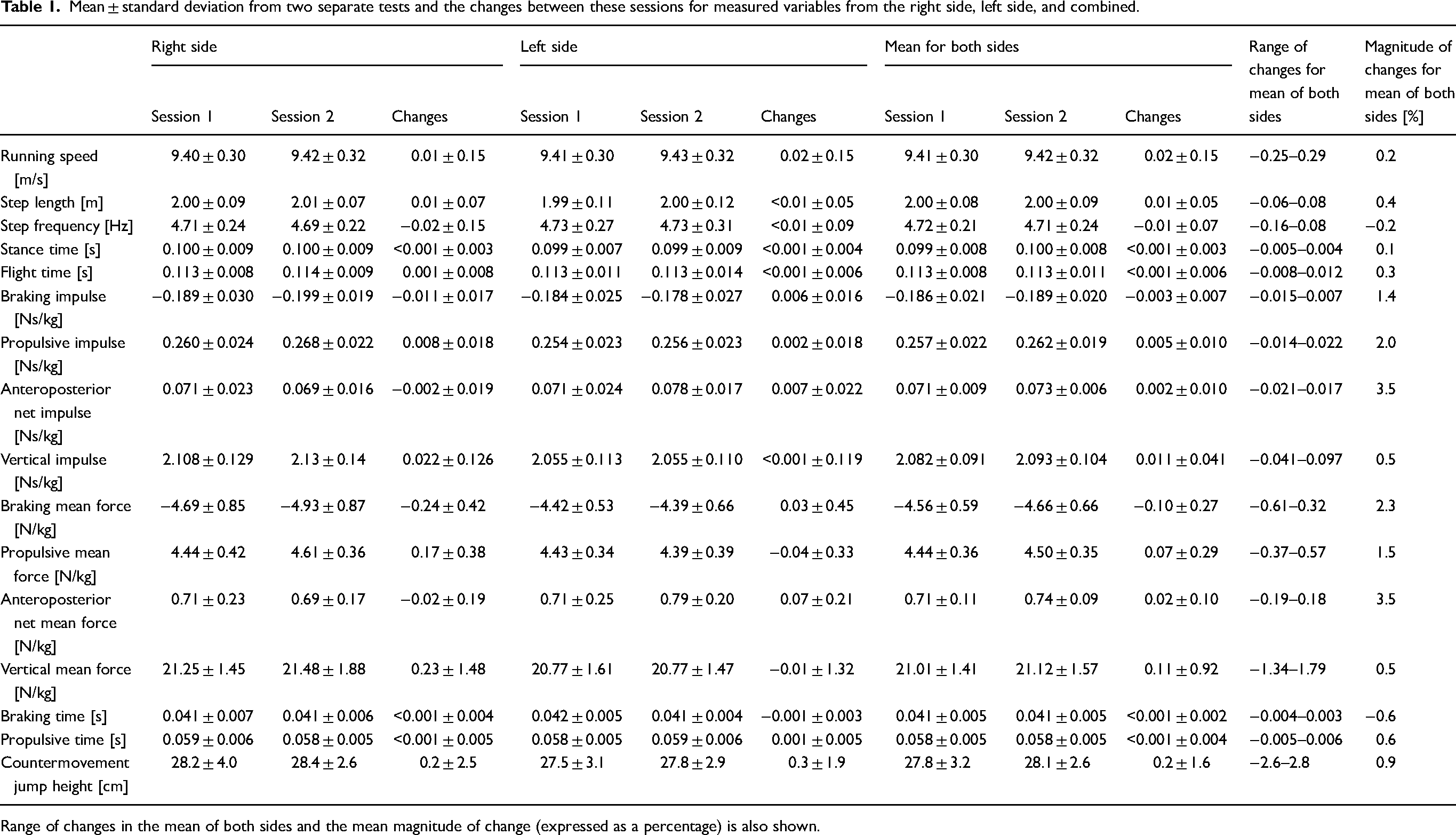
Range of changes in the mean of both sides and the mean magnitude of change (expressed as a percentage) is also shown.
Mean ± standard deviation for symmetry angle of measured variables during two separate measurement sessions and for the changes between sessions.
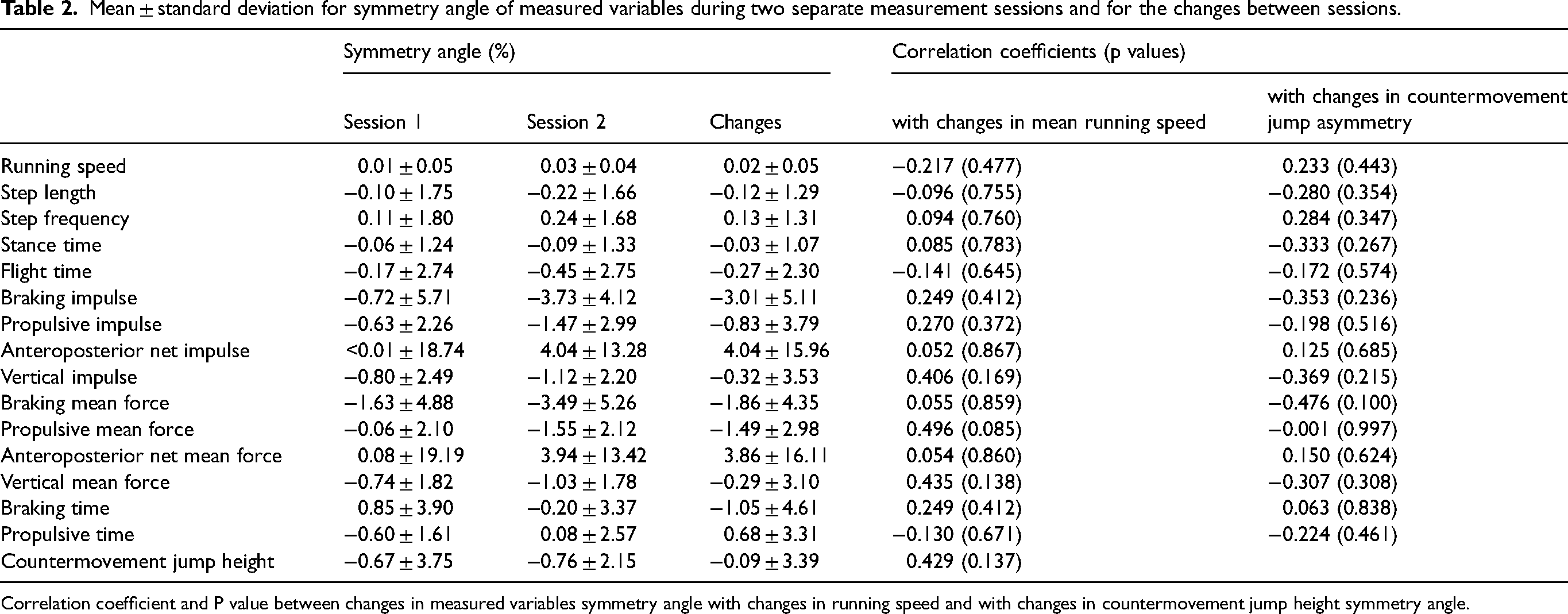
Correlation coefficient and P value between changes in measured variables symmetry angle with changes in running speed and with changes in countermovement jump height symmetry angle.
Discussion
This study examined whether changes in asymmetry of leg extension performance, as measured by single-leg CMJ testing, influence fluctuations in sprinting asymmetry, and whether any such fluctuations are associated with changes in maximal running speed. The main findings were that there were no significant correlations of changes in asymmetry during maximal speed sprinting with changes in CMJ asymmetry and changes in maximal running speed.
The current results demonstrated that small fluctuations in inter-limb spatiotemporal and GRF asymmetry may occur between regular training sessions in a sub-elite male sprinters’ training program. Only horizontal GRF variables (braking mean force and impulse, propulsive mean force and impulse, and anteroposterior net mean force and impulse) showed >1% (range 1.4–3.5%) mean changes across the group, which may have been due to higher inter-individual variations in changes compared to the other measured variables (Supplemental Figure 1). However, means and ranges measured were consistent with previous research in similar cohorts,5,14,24 and taken together with the lack of any significant correlations, may reflect regular neuromuscular variability in motor output rather than mechanical inefficiency. This observation is relevant for practitioners, suggesting that unless asymmetry in these variables reach a dysfunctional (individual) threshold, targeting asymmetry in routine training may not yield any performance benefit. These findings align with previous research suggesting that low asymmetry values within a single sprint session are common in athletes and may not necessarily reduce performance.4,7,8 Current results suggest that changes in the biomechanical demands of sprinting, such as high peak GRFs over short stance times, may slightly favour one limb over the other and may not be related to changes in bilateral leg extension asymmetry. Instead, sprinting asymmetry may occur through multifactorial individualised reasons that were not accounted for or measured in the present study including anthropometry discrepancies, strength variance, or motor control patterns. In addition, perfect bilateral symmetry has never been recorded for mean values in a cohort of athletes during sprint or jump performance tests, 1 and may even be impractical due to the inherent variability in dynamic human movement. Targeting symmetry improvements when dysfunctional asymmetry values >10–15% are reported may reduce the risk of injuries,1,2 however, attempting to achieve perfect symmetry through training may not be feasible, or potentially even be disruptive to an athlete's natural adaptations to small bilateral asymmetries. Taken together, small task specific asymmetry changes between training sessions in spatiotemporal variables and GRFs may not be a flaw, but instead be recognised as a functional trait accompanied without performance detriments.
Previous studies reported relatively larger individual asymmetries (up to 77%) compared to the present study, however, these larger asymmetry values were reported in leg joint kinetic and kinematic measures that were not included in the present study.4,6 Thus, joint specific measures, such as the thigh separation angle, may naturally show larger asymmetries compared to the measured variables included in the present study, and changes in joint kinetic and kinematic asymmetries may be an area for future investigation. Another possible reasoning for the low symmetry angles reported in the present study includes the number of steps used for analysis. Small step-to-step variations during sprinting may result in fluctuations in measured variables, and as a consequence sampling only one step per left/right side may introduce greater error compared to analysing two or more steps. Thus, averaging out multiple data points may improve the signal to noise ratio and improve validity and reliability of measures. The present methodology analysed four steps during maximum running speed (two steps from each leg) to minimise any influence of cyclic movement variability,22,23 whereas previous research used only two steps (one for each leg) which may have affected results more through greater step-to-step variability.4,6 Regardless, although the magnitude of changes in mean values (proportion to the values in the first measurement session) were small for all variables (<3.5%), changes in running speed did individually differ more widely (−0.25–0.29 m/s) between sessions. However, this range of running speed change seems to just be a product of regular expected individual variation in sprint performance between sessions, with previous research reporting standard deviations of ±0.58 s in 100 m sprint performance across a season in elite sprinters. 25 Overall, changes in CMJ asymmetry and changes in running speed between sessions were not significantly associated with the magnitude of any measured spatiotemporal or GRF asymmetry changes, supporting the hypothesis that low to moderate inter-limb asymmetry changes are not inherently detrimental to sprinting performance changes.
This study was limited to a specific cohort of sub-elite male sprinters and the variables measured, limiting potential result transfer to other asymmetry variables or populations such as female athletes, populations with inherently larger asymmetries, or more elite-level sprinters with higher training loads. Additionally, other external and psychological factors that may influence sprint performance changes between sessions such as training frequency, intensity, type, and recovery were not monitored individually during the one-month period between testing sessions. These uncontrolled factors may have influenced performance or asymmetry variability and should be considered a limitation of the present study, with the possibility that other cohorts of experienced sprinters may experience different changes over time. However, previous research (including the present study) has not found any associations between sprint performance and step-to-step asymmetry,3–5 and one study showed that male sprinters exhibited greater biomechanical asymmetries than female sprinters, particularly in braking force and vertical impulse, yet these differences did not translate to performance deficits. 5 This supports the notion that asymmetry may be an inherent characteristic of sprinting rather than a limitation to performance. A possible explanation for the findings of this study is that experienced sprinters or trained athletes may develop neuromuscular compensatory strategies that enable them to maintain effective sprinting mechanics or performance despite low to moderate asymmetries.6,26 The cohort of sub-elite sprinters included in this study all had 5 + years of sprint training history with sprint and strength and conditioning coaches; thus, they may be considered ‘experienced’ athletes that had previously been exposed to training practices targeting sprint performance while reducing any identified dysfunctional inter-limb asymmetries. The present study supports the perspective that asymmetry-targeted training may not be necessary for all athletes, particularly when asymmetry fluctuations are small and may not be significantly linked to performance changes.
Conclusion
In conclusion, the current results suggested that sprint coaches do not need to prioritise single leg extension performance asymmetry monitoring as a key performance indicator. Since fluctuations in asymmetry did not correlate with running speed changes, interventions aimed at reducing natural asymmetry may not provide significant performance benefits. Instead, training programs may focus on optimising previously reported determinants of sprint performance such as sprint-specific strength or power development, 27 technical refinement, 28 and sprint-specific conditioning. 29 These findings are relevant to coaches seeking to optimise sprint performance.
Supplemental Material
sj-tif-1-spo-10.1177_17479541251377991 - Supplemental material for Asymmetry changes in sprinting do not relate to changes in sprint performance
Supplemental material, sj-tif-1-spo-10.1177_17479541251377991 for Asymmetry changes in sprinting do not relate to changes in sprint performance by Sam Gleadhill and Ryu Nagahara in International Journal of Sports Science & Coaching
Footnotes
Acknowledgements
This study was partially supported by Japan Society for the Promotion of Science (24K25650).
Consent to participate
All participants were free from injury at the time of data collection, and they were fully informed of the aims, risks of involvement, and experimental conditions of this study, and gave written informed consent.
Declaration of conflicting interests
The authors declared no potential conflicts of interest with respect to the research, authorship, and/or publication of this article.
Ethical considerations
This study was approved by the research ethics committee of the institute beforehand.
Funding
The authors received no financial support for the research, authorship, and/or publication of this article.

Supplemental material
Supplemental material for this article is available online.
References
Supplementary Material
Please find the following supplemental material available below.
For Open Access articles published under a Creative Commons License, all supplemental material carries the same license as the article it is associated with.
For non-Open Access articles published, all supplemental material carries a non-exclusive license, and permission requests for re-use of supplemental material or any part of supplemental material shall be sent directly to the copyright owner as specified in the copyright notice associated with the article.
