



Abstract
This study aimed to investigate the influence of relative pitch size on external load parameters in professional soccer players during small-sided games (SSGs). Twenty-four professional male soccer players from the Greek first division participated in SSGs conducted over an eight-week period. The games were played on pitches of varying relative sizes (ranging from 45 to 184.62 m² per player), using two mini goals per side and a two-touch play restriction. External load metrics were recorded using by GPS units and included: (1) total distance covered; (2) high-intensity distance (≥ 15 km/h); (3) high-speed running distance (≥19.8 km/h); (4) distance covered within four predefined speed zones - Zone 3 (10.8–14.4 km/h), Zone 4 (14.5–19.8 km/h), Zone 5 (19.9–25.5 km/h), and Zone 6 (>25.5 km/h); (5) number of sprints; and (6) the number of accelerations and decelerations categorized as low (0–2.9 m/s²), moderate (3.0–3.9 m/s² or −3.0 to −3.9 m/s²), and high (>4.0 m/s² or < −4.0 m/s²).
Generalized linear mixed models revealed positive associations between relative pitch size and all running-related load variables (βRange = 0.004 to 0.033, p < 0.05). Inverse relationships were observed for all acceleration bands and most deceleration bands (βRange = -0.001 to −0.011, p < 0.05), except for high-intensity decelerations (p = 0.374).
Relative pitch size is a moderating factor for the external load in professional soccer players during SSGs. Increasing the relative pitch size can be used to augment external load, particularly by elevating running demands, whereas acceleration and deceleration activities are comparatively less influenced.
Introduction
Monitoring and manipulating external training load is a central component of performance optimization in professional soccer. 1 One widely employed strategy to achieve desired physiological and physical outcomes during soccer training involves the use of small-sided games (SSGs). These games replicate key elements of match play in a controlled, scalable format. 2 SSGs offer practitioners flexibility in modulating training intensity through manipulation of task constraints such as pitch dimensions, player numbers, bout duration, and specific game rules (e.g., touch restrictions). 3
Among these constraints, relative pitch size, defined as the total playing area divided by the number of players, 4 has been identified as a critical determinant of external load (i.e., the physical work performed by an athlete) parameters in SSGs.5,6 Understanding the manipulative effects of relative pitch size allows practitioners to customize training to physiological, physical, technical, and tactical requirements of players,5,7 thus enhancing the relevance of training sessions to match conditions. This is vital for preparing players for the physical demands encountered during competitive play, where relative pitch dimensions influence both the intensity and nature of gameplay. 8
Indeed, total distance (TD) increased by approximately 100 meters with a 10–20% increase in relative pitch size, 5 supporting prior findings of a positive linear relationship.9–11 This trend has been confirmed across different running bands, with existing research demonstrating consistent increases in running intensity across various speed zones as relative pitch size increases. 5 These include distances covered at 15–19.9 km/h,12–14 20–24 km/h,12,14,15 > 24 km/h,12,15,16 as well as individual peak running speed.16,17
Conflicting findings have been reported regarding the influence of relative pitch size on accelerative (ACC) and decelerative (DEC) demands.5,7 Specifically, an increase in relative pitch size (e.g., 20 m²) has been associated with a reduction in the frequency of ACC (>2 m/s²) and DEC (←2 m/s²) during 3 vs 2 transition games (i.e., training scenarios that simulate counter-attacking situations with rapid offensive and defensive transitions), 18 as well as in SSGs involving both youth 12 and professional soccer players. 19 In contrast, other investigations have demonstrated a positive relationship between larger relative pitch sizes and both the number and total distance of ACC and DEC in professional soccer players.10,19,20 Furthermore, additional variables assessing neuromuscular actions, such as high-metabolic load distance (i.e., HMLD, distance covered when metabolic power is > 25.5 W/kg), 21 as well as the number of change-of-direction events across varying intensity bands, exhibited alterations resulting from the manipulation of relative pitch size. 22
It has been suggested that coaches frequently manipulate pitch dimensions as a practical tool to elicit specific external load responses, such as running speed, ACC, and DEC. 23 This is particularly relevant in professional soccer, where effective load management is essential for maintaining fitness while minimizing the risk of overtraining or injury. Moreover, considering that external load variables appear sensitive to even small percentage changes in relative pitch size, 5 providing detailed information on the effects of a wider range of pitch sizes could significantly improve training planning by enhancing the specificity of training stimuli.
However, a review of the current literature reveals that most studies including professional soccer players have focused on comparisons of only two to three pitch size conditions, typically ranging between approximately 60 to 90 m² per player.11,20,24 Moreover, to the authors’ knowledge, just one study to date has investigated the effects of multiple relative pitch sizes on external load variables in professional soccer players. 8 Accordingly, to address the current gap in the literature, the present study aims to investigate the impact of varying relative pitch sizes on external load parameters in professional soccer players. Specifically, the study sought to examine how relative pitch size is associated with various external load variables during different SSGs. It was hypothesized that larger relative pitch sizes will result in greater external load demands, as reflected in running-oriented (e.g., TD) and mechanical (e.g., number of ACC) variables.
Material and methods
Participants
A convenience sample of 24 (n = 7 defenders, n = 9 midfielders, n = 8 attackers) professional male football players (mean ± SD: age = 24.8 ± 4.47 years; height = 181 ± 5.6 cm; weight = 74.1 ± 5.65 kg) from a team competing in the Greek First Division (“Super League”) participated in this study. An a priori power analysis was conducted using the simr package, 25 based on effect sizes (ES) reported in previous literature. 15 The analysis was grounded in a linear mixed-effects model with random intercepts for participants. Simulations (n = 1000) were conducted, assuming an alpha level of 0.05 and a desired statistical power of 0.80. The results indicated that a minimum of 20 participants was required to detect the expected effect.
All participants had a minimum of 5 years of professional playing experience and were actively competing at the highest national level. During the eight-week in-season observation period, players trained at least once daily and participated in one official match per week. On average, participants accumulated 8.43 ± 1.5 h of training per week. Training routines typically included technical drills (e.g., passing drills), SSGs, conditioning exercises, and match preparation sessions with a tactical focus.
Data were collected through routine daily monitoring; thus, formal ethical approval was not required in accordance with previous research. 26 All procedures were approved by the local club and conformed to the ethical standards of the Declaration of Helsinki. Informed consent was obtained from all participants, and all data were fully anonymized prior to analysis. Inclusion criteria were: (1) contract status with the club; (2) participation in ≥80% of scheduled training sessions during the study period; and (3) absence of injury throughout the eight weeks. Exclusion criteria included: (1) participation in <80% of training sessions; (2) injury or illness limiting full participation; and (3) playing position as goalkeeper, due to the distinct physical and tactical demands associated with that role.
Procedures
Data collection was conducted at the same time of day (e.g., 6:00–7:00 PM) for all sessions during the mid-season to minimize the influence of circadian and seasonal variability. 9 Participants adhered to standardized activity routines during the 48 h preceding each session, including consistent training modalities and daily schedules, verified through monitoring of training loads, to control for confounding factors.
To ensure consistency throughout the data collection period, all sessions were supervised by the same coaching staff, consisting of UEFA A-licensed coaches, who followed a predetermined, detailed training schedule specifying drills, durations, and rest periods. Additionally, standardized verbal instructions and demonstrations were provided to players before each session. The research team actively monitored adherence by recording any deviations from the protocol and ensuring that session conditions (e.g., warm-up structure, equipment setup) were replicated precisely.
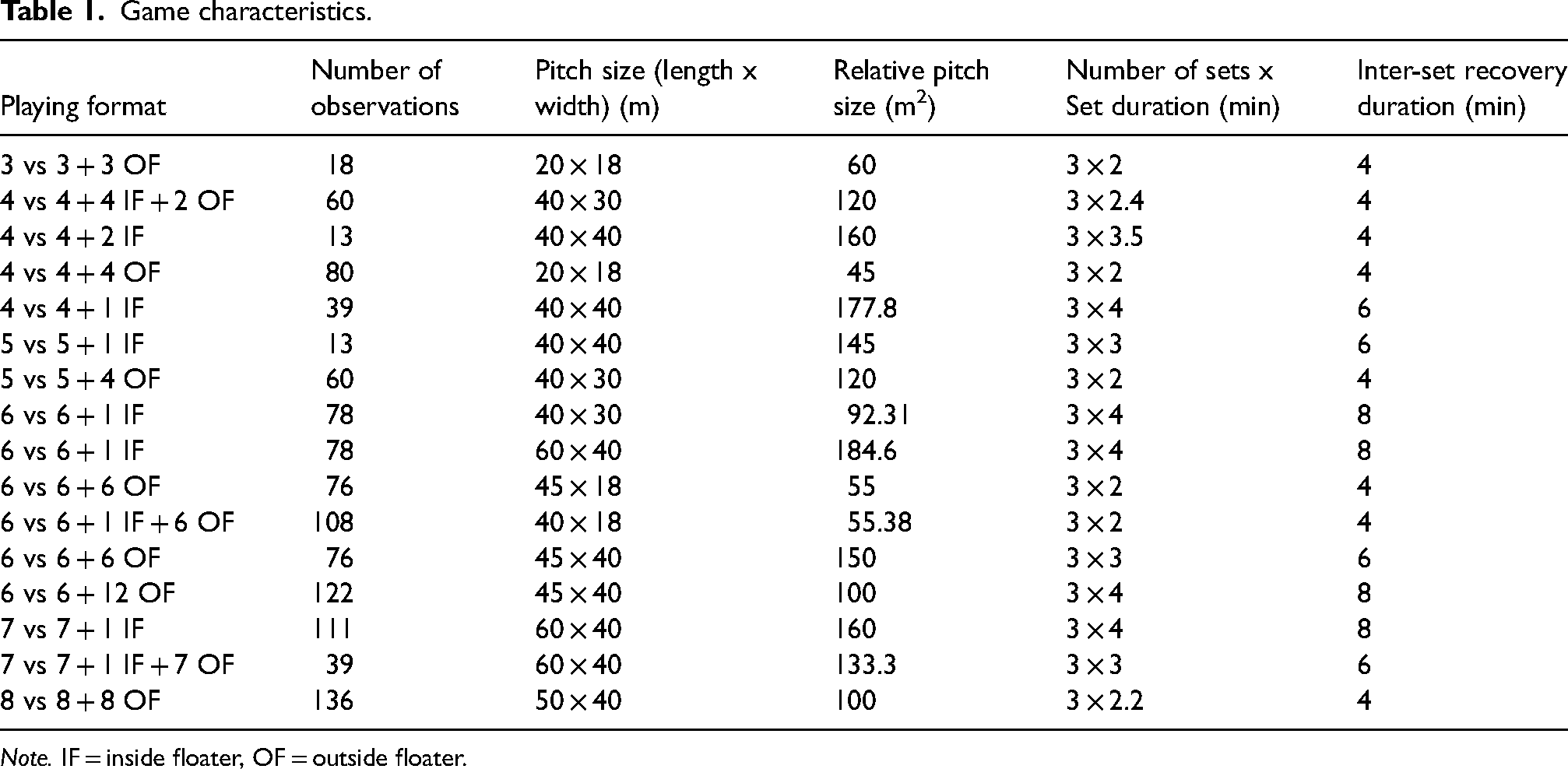
Prior to the commencement of training, players completed a standardized 10–15-min warm-up on the pitch (natural grass), consisting of running and change of direction drills, passing sequences, and a combination of static and dynamic stretching exercises (i.e., FIFA 11+). 20 Upon completion of the warm-up, the various SSG formats were implemented. Given that all formats were routinely employed throughout the competitive season, participants possessed prior familiarity with the specific SSG conditions before data collection commenced. Detailed configurations of each game format are presented in Table 1.
Game characteristics.
Note. IF = inside floater, OF = outside floater.
Although player numbers and pitch dimensions varied across game formats, all other task constraints were held constant. Each game utilized four mini-goals (1.5 × 1 m) and a two-touch restriction was imposed on regular players. 27 All games were played using FIFA-approved match balls (i.e., 410–450 g, 68–70 cm circumference), with additional balls strategically placed around the pitch to enable rapid restarts when the ball went out of play. 27
Global positioning systems
Global Positioning System (GPS) devices operating at a sampling frequency of 10 Hz (Intense, Insiders, Lausanne, Switzerland) were used to monitor players’ external load during all training sessions. In accordance with the manufacturer's guidelines, each device was activated 30 min prior to data collection to ensure adequate satellite signal acquisition. The GPS units were securely positioned in a small pocket located on the upper back of a custom-designed vest worn by each player.
Following each session, data were downloaded using the corresponding proprietary software (Intense, Insiders, Lausanne, Switzerland). The reliability and validity of these units have been previously established.28,29 Specifically, distance-based metrics demonstrated a coefficient of variation (CV) ranging from 3.5% to 17.8 for TD, with intraclass correlation coefficient (ICC) ranging from 0.88 to 0.97 for low-speed running, high-speed running, and very high-speed running. ACC and DEC metrics showed CVs between 4.0% and 6.5%. 29 ICC and percentage typical error of measurement (%TEM) across units ranged from 0.51 to 0.99 and 0.8% to 13.7%, respectively, for all variables assessed. 28
External load variables
The external load variables analyzed in this study encompassed TD and high-intensity distance (HID), with the latter defined as running speeds exceeding 15 km/h. Additionally, both the distance covered (HIR) and the number of efforts (#HIR) during high-intensity running above 19.8 km/h were examined. HIR was also categorized into four velocity zones: Zone 3 (10.8–14.4 km/h), Zone 4 (14.5–19.8 km/h), Zone 5 (19.9–25.5 km/h), and Zone 6 (>25.5 km/h). Sprint-related variables included the number of sprints per minute (#sprints/min) (>25 km/h). These metrics were selected based on previous research involving professional soccer players.24,30,31 Furthermore, the frequency of ACC and DEC actions was assessed across intensity bands: high ACC (>4.0 m/s²; #ACC 4), moderate ACC (3.0–3.9 m/s²; #ACC 3), and low ACC (0–2.9 m/s²; #ACC 2); as well as high DEC (<−4.0 m/s²; #DEC 4), moderate DEC (−3.9 to −3.0 m/s²; #DEC 3), and low DEC (−2.9 to 0 m/s²; #DEC 2).
To account for differences in playing time across sessions, all external load metrics were normalized and expressed relative to minutes of play. The processed data were subsequently subjected to statistical analysis.
Statistical analysis
Descriptive variables were reported using means and 95% confidence intervals (CIs). Homogeneity of variances was assessed with Levene's Test. Data were examined for outliers and tested for normality using Q-Q plots and the Kolmogorov–Smirnov test. Linearity and homoscedasticity assumptions were evaluated by inspecting scatterplots of independent versus dependent variables and residuals versus predicted values.
Due to violations of the normality assumption, generalized linear mixed models (GLMMs) were fitted for each of the 18 external load variables using the glmmTB package. 32 The models assumed a Tweedie distribution with a log-link function, which is appropriate for positively skewed and zero-inflated data structures 33 Relative pitch size and drill type were modeled as fixed effects, and random intercepts for each player (i.e., player ID) were included to account for repeated measures and inter-individual variability. 34 All models were estimated using full maximum likelihood estimation (MLE). Model fit was evaluated using marginal and conditional R² values, calculated via the r.squaredGLMM package, 35 representing the variance explained by the fixed effects alone and by the full model, respectively.
The statistical significance of fixed effects was tested using Type III Wald chi-square tests. To address the risk of inflated Type I error due to multiple comparisons across variables, p-values for the relative pitch size effect were adjusted using Bonferroni correction. Model-based predictions and 95% confidence intervals were generated to visualize estimated values across different pitch sizes. Statistical significance was defined as p < .05. All analyses were performed using RStudio (Version 2024.12.1.563).
Results
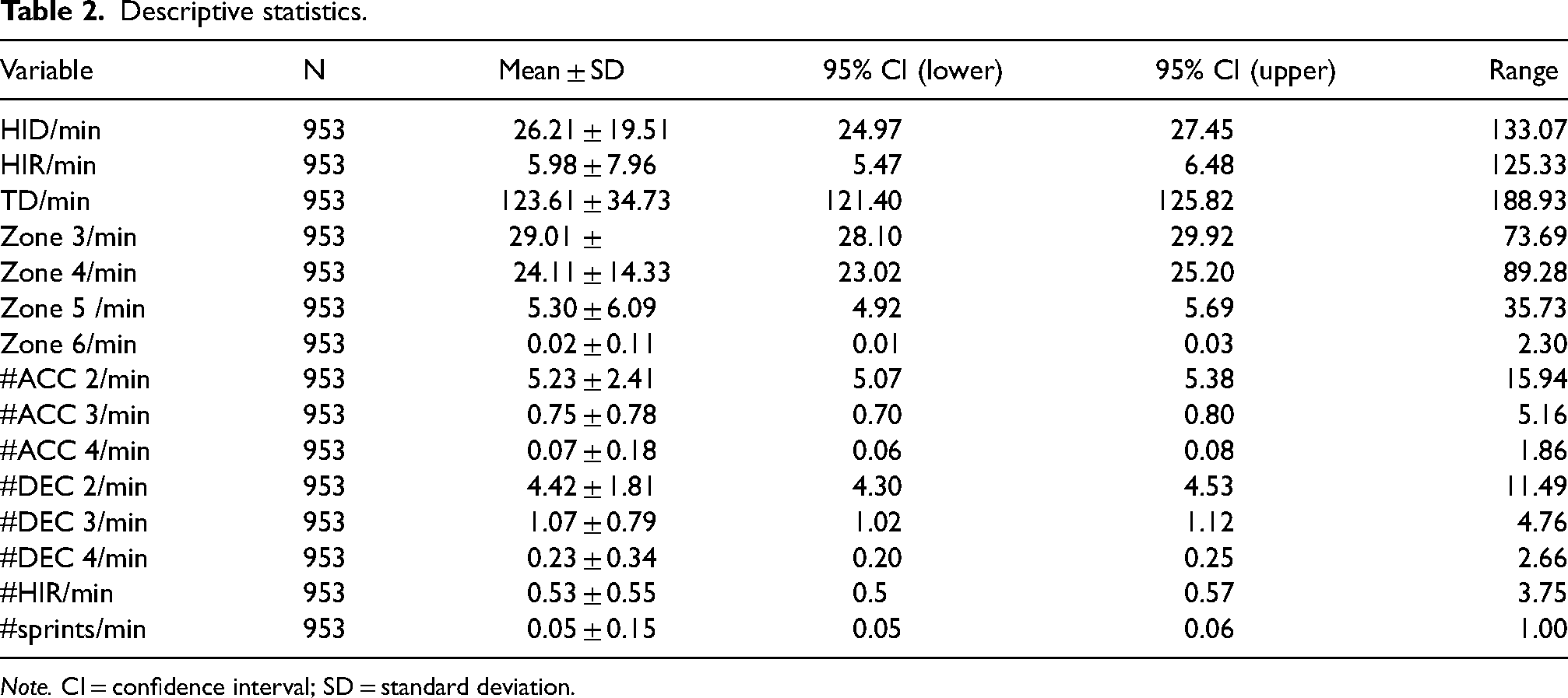
Descriptive statistics (means, standard deviations, and 95% CIs) for all external load variables are presented in Table 2. On average, players covered approximately 124 m/min, with HID/min and HIR/min averaging 26.21 and 5.98 m/min, respectively. The highest activity was observed in Zone 3 (29.01 m/min), with a decreasing trend across higher intensity zones. Similarly, the frequency of ACC and DEC was greater in the lower intensity bands (e.g., #ACC 2/min and #DEC 2/min) and declined as intensity increased.
Descriptive statistics.
Note. CI = confidence interval; SD = standard deviation.
Figures 1 and 2 illustrate the predicted effects of relative pitch size on as derived from the GLMMs. The corresponding model estimates, including fixed and random effects as well as model fit indices, are summarized in Table 3.
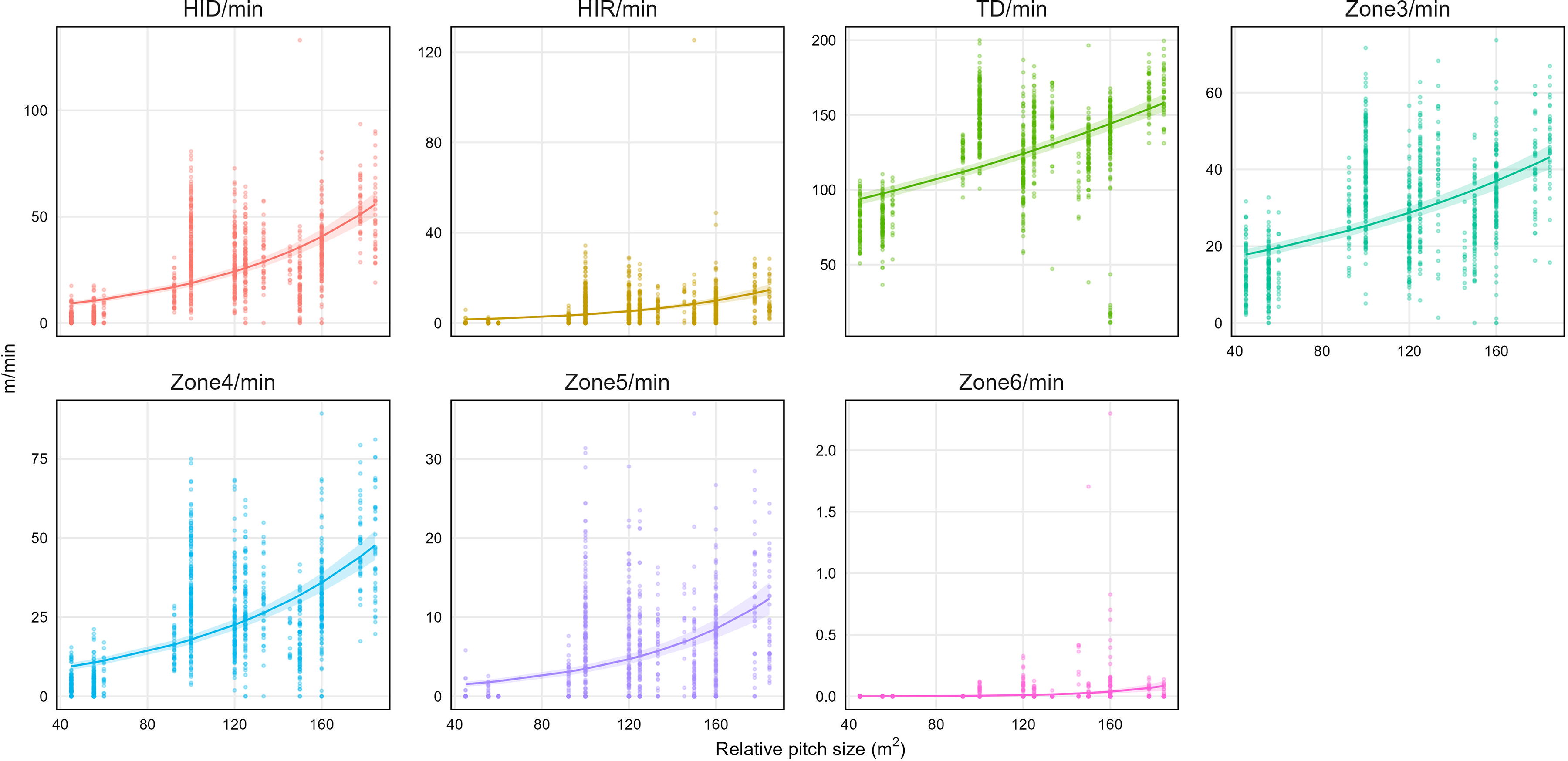
Relationship between distance-oriented parameters and increases in relative pitch size during SSGs.
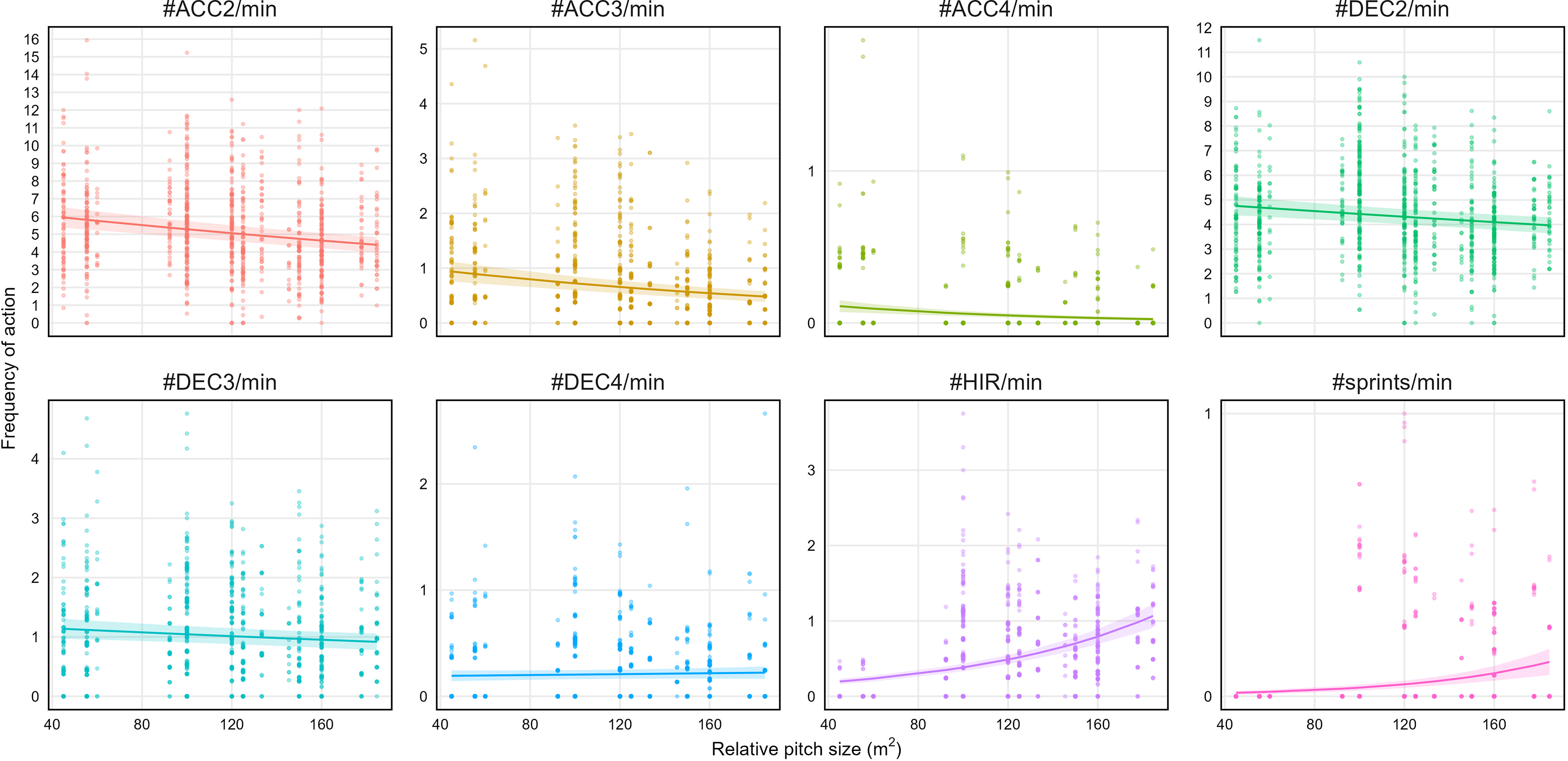
Relationship between frequency-oriented parameters and increases in relative pitch size during SSGs.
Results from generalized linear mixed models (GLMMs).
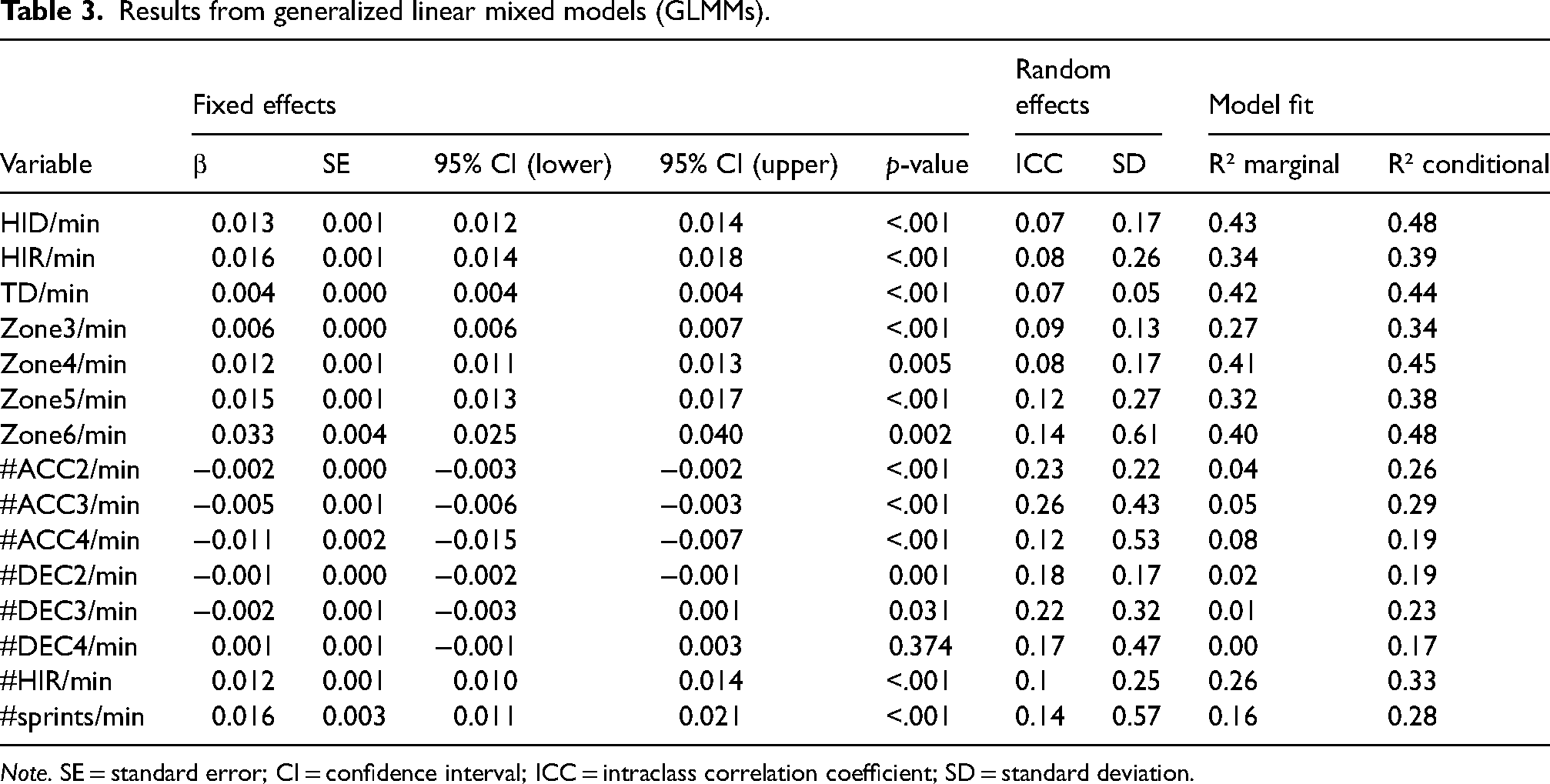
Note. SE = standard error; CI = confidence interval; ICC = intraclass correlation coefficient; SD = standard deviation.
Relative pitch size was positively associated with most distance- and intensity-based metrics. Across most variables, relative pitch size was a significant positive predictor, particularly for high-intensity metrics such as HID/min (β = 0.013, 95% CI [0.012, 0.014]), HIR/min (β = 0.016, 95% CI [0.014, 0.018]), and Zone6/min (β = 0.033, 95% CI [0.025, 0.040]), all p < .001. Conversely, ACC and DEC frequencies decreased with increasing pitch size, as seen in #ACC4/min (β = -0.011, 95% CI [-0.015, −0.007]) and #DEC3/min (β = -0.002, 95% CI [-0.003, 0.000]). Random effects indicated moderate between-athlete variance with ICCs ranging from 0.07 (TD/min) to 0.26 (#ACC3/min). The highest random variance was observed for high-intensity ACC and DEC counts (e.g., SD = 0.53 for #ACC4/min; SD = 0.47 for #DEC4/min).
Model fit statistics indicated moderate explanatory power of the fixed effects for several variables (e.g., R²marginal = 0.43 for HID/min). R²conditional values were generally higher, up to 0.48 for HID/min and Zone6/min (Table 3).
Discussion
The present study aimed to examine the influence of relative pitch size on various external load metrics during SSGs in professional men's soccer. Our findings suggest that relative pitch size serves as a predictor on running-oriented and mechanical variables placed on regular players. However, our initial hypothesis introduced that increases in relative pitch sizes increase the external load across all variables could only partly confirmed. More precisely, while running-oriented variables showed a positive association, mechanical variables reflected negative associations, while also no moderating effects of relative pitch size were found (i.e., #DEC4/min).
A strong association was observed for TD/min, with a progressive increase in external load corresponding to increases in relative pitch size (Figure 1). Specifically, TD/min increased by approximately 8% on average following a ∼50% increase in relative pitch size across the SSGs implemented in our study, which can be considered a meaningful change in the context of training in professional soccer (e.g., load management strategies). 36 However, caution should be exercised when interpreting these findings in absolute terms, as inter-individual differences are likely to persist. 37
Comparable effects have been reported in previous investigations involving professional soccer players, with increases in TD observed after average pitch size expansions of ∼51% 20 and ∼90%. 11 These findings suggest that greater spatial availability may enhance opportunities for players to cover more distance, likely due to the increased freedom of movement afforded by larger playing areas. 38 This upward trend extended into moderate-speed zones (Zone 3 and 4), aligning with previous research suggesting that larger relative pitch sizes shift physical demands toward higher-intensity running zones, 15 likely due to the increased spatial affordances available to players.
In more expansive playing areas, intra- and inter-team distances tend to increase. 13 As a consequence, players may perceive and act upon opportunities to engage in higher-speed locomotion, such as covering space, pressing, or supporting teammates. With regard to lower-intensity zones (i.e., Zone 3), the present study contributes to the limited existing evidence concerning the effect of relative pitch size on SSGs in professional soccer players. Our findings contrast with Sannicandro et al., 24 who reported a reduction in low-intensity running (7.3–14.5 km/h) by approximately 17% and 20% with increasing relative pitch size. This discrepancy may be explained by differences in the scaling of relative pitch size in the SSGs employed in our study. For example, the substantial increase in relative pitch size in our protocol (i.e., ∼54%, from 55.38 m² to 60 m² per player) may have elicited greater external load responses. This interpretation aligns with recent findings by Rumpf et al., 5 who observed that jogging distances (7–14 km/h) nearly doubled when relative pitch size increased by 50% compared to a 20% increase.
Nevertheless, other contextual factors must be considered, including motivational factors, player expertise or specific game rules. 3 Regarding the latter, the touch restrictions implemented in our study may have limited slower-paced ball circulation, thereby encouraging quicker decision-making and promoting higher-intensity actions. 39
With regard to higher speed zones, including HIR/min, Zone 5/min, Zone 6/min, and #sprints/min, statistically significant positive associations with relative pitch size were observed. These findings are consistent with previous research in professional men's soccer, reinforcing the importance of using larger relative pitch areas to elicit high-speed and sprinting actions, which are less frequently achieved in smaller formats.8,15,40 However, while larger relative pitch sizes appear to facilitate a greater frequency of high-speed and sprint-related actions, the magnitude of these effects was comparatively smaller than those reported in previous research. In the present study, relative pitch size accounted for 32%, 34%, and 40% of the variance in Zone 5/min, HIR/min, and Zone 6/min, respectively.
In contrast, De Dios-Álvarez et al. 15 found that relative pitch size explained 58% of the variance in very high-speed running distance (21–25 km/h) and 52% of the variance in sprint distance (SD, > 25 km/h) among elite U19 players. Similarly, Riboli et al. 9 reported that approximately 70% of the variance in total SD (>25 km/h) was explained by relative pitch size in professional soccer players, while Gaudino et al. 17 observed the largest ES for very high-speed running (19.8–25.2 km/h) in response to increases in relative pitch dimensions.
One explanation for the divergent findings in our study might be closer range of relative pitch sizes investigated compared to previous studies.9,15 A recent review suggested that the highest increases in SD (> 20 km/h) and high-speed running distance (18–21 km/h) can be expected after an elevation of 150% relative pitch size. 5 In our study, the relative pitch sizes used ranged from 45 m² to 184.62 m² per player, including formats that meet or exceed this 150% threshold. However, over half of the relative pitch sizes, such as 45 m², 55 m², 55.38 m², 60 m², 92.31 m², 100 m², 100 m², 120 m², 120 m², and 133.33 m², fall below. The subtle increases relative pitch sizes likely limit the space available for sustained high-speed efforts, which may shift the physical demands toward more submaximal running patterns.
Additionally, while certain tactical variables (e.g., stretch index, surface area) tend to increase on larger pitches, 7 it is plausible that the relative pitch size configurations used in our study were insufficient to elicit such adaptations at the team level. As a result, players may have had fewer opportunities to exploit space through actions such as deep runs, potentially constraining them to operate more frequently within moderate-speed zones. From a physiological perspective, factors such as ratings of perceived exertion (RPE) may also contribute to this shift. While RPE is generally positively associated with external load metrics such as very high-speed running, 41 players may regulate their effort to remain in submaximal zones in response to increased overall load or fatigue perception.
Our findings contribute furthermore to the ongoing debate regarding the influence of relative pitch size on accelerative and decelerative demands during SSGs. 5 While some studies have reported greater distances covered across various ACC and DEC thresholds when games are played on smaller relative pitch areas,8,12,42 others have documented a progressive incline with increasing relative pitch size.17,43 Consistent with the latter, our results demonstrate a negative association between relative pitch size and both accelerative and decelerative demands. This suggests that greater spatial availability may reduce the frequency of high-intensity locomotor actions, such as ACC and DEC. However, the relatively low explained variance values (R²marginal ranging from 0.01 to 0.08; see Table 3) indicate that these associations explain only a small proportion of the variance and thus should be interpreted with caution.
In line with the reductions observed in ACC bands below 4 m/s² (i.e., #ACC2, #ACC3) in our data, Calderón Pellegrino et al. 44 reported the lowest number of ACC (2.5–3.5 m/s²) in the game format with the largest relative pitch size (i.e., 300 m²), although these differences did not reach statistical significance. Similarly, Castillo et al. 45 found lower distances covered in moderate-intensity efforts (2.5–4 m/s²) following a 100 m² increase in relative pitch size. In adult cohorts, Casamichana et al. 22 reported significant reductions in the number of moderate DEC (> −3 m/s²) observed significant reductions in moderate DEC (> −3 m/s²), corresponding to our #DEC3 variable, following an extension of pitch length and a 100% increase in relative pitch size. However, contrary to our findings, they also reported significant reductions in high-intensity DEC (> −4 m/s²).
This discrepancy may be attributable to the inclusion of floaters in our SSG formats. Previous studies have demonstrated that the presence of floaters, particularly those positioned within the playing area, can reduce the frequency of ACC (> 2.5 m/s²) and DEC (> −2.5 m/s²) in semi-professional players. 46 As the current literature lacks consistent evidence regarding the effect of relative pitch size on accelerative and decelerative demands,5,7 it is plausible that task-specific constraints, such as the use of floaters, goalkeepers, or touch limitations, may significantly influence players’ kinematic profiles. Further research is therefore warranted to investigate the moderating effects of these constraints. 47
Limitations and future research
While this study provides new insights into the impact of relative pitch size on external load in professional soccer players, several limitations should be acknowledged. First, despite standardized training conditions (e.g., touch limitations, goal setups), the inconsistent use and roles of floater players may have introduced confounding effects. Second, although a wide range of external load variables was analyzed, including additional metrics like body impacts, change of direction, or high-metabolic load distance could have enhanced the findings. The relatively narrow range of relative pitch sizes investigated, coupled with uneven distribution of observations across formats (range: 13–136 data points per SSG format), also represents a limitation. Future research should explore the effects of larger relative pitch sizes (>200 m²) and adopt longer observation periods to enhance generalizability.
Third, the use of a convenience sample drawn from a single professional team limits the generalizability of the findings. Players’ physical capacities, tactical approaches, and contextual factors (e.g., training culture) may vary substantially across teams, potentially influencing external load outcomes. Moreover, this study did not examine specific interactions between playing positions and changes in external load associated with increases in relative pitch size. Future research should aim to include multiple teams and account for positional roles to enhance external validity. Additionally, our GPS devices sampled at 10 Hz, a common and reliable frequency for monitoring external load in team sports, though higher-frequency units may have provided more precise measurements of the examined variables.
Finally, although the findings are applicable to male professional soccer players, caution should be exercised when generalizing to other populations. Female players, youth athletes, and individuals competing at lower performance levels may exhibit different responses to variations in pitch size due to differences in performance characteristics (e.g., physical capacities). Accordingly, future studies should investigate how relative pitch size affects external load across diverse populations to support broader applicability.
Practical implications
Coaches should carefully consider the critical influence of relative pitch size when designing and implementing SSGs for professional soccer players, as varying spatial configurations markedly affect the external load imposed on players. These differences in external load can, in turn, influence internal load responses and have implications for load management strategies across the training cycle, as well as for specific purposes such as return-to-play and return-to-compete protocols.
When the objective is to increase external load, particularly TD covered and distance accumulated at submaximal running speeds (e.g., 15–25 km/h), larger relative pitch sizes should be prioritized. Such configurations are particularly suitable for aerobic and locomotor conditioning sessions, typically scheduled during the mid-week phase of a mesocycle (e.g., match day minus three). Additionally, larger pitch areas may help minimize neuromuscular strain by reducing the frequency of high-intensity ACC and DEC, making them appropriate for low-impact recovery sessions or rehabilitation contexts where mechanical load must be tightly controlled.
In contrast, smaller relative pitch sizes are more effective for targeting neuromuscular overload by increasing the frequency and intensity of accelerative and decelerative efforts. These configurations can be strategically incorporated into intensity-based drills, small-area pressing games, or agility-oriented training sessions. Lastly, coaches should note that relative pitch areas of ≤180 m² may not be optimal for developing sprint-related performance, as restricted spatial availability likely limits players’ ability to initiate and sustain high-speed efforts.
Conclusion
This study provides novel data in the relatively underexplored area of how relative pitch size influences external load in professional soccer. Increasing pitch size was associated with elevated external load, particularly through higher TD and greater distances at submaximal running speeds during SSGs. In contrast, the number of ACC across all intensity bands and low- to medium-intensity DEC decreased as pitch size increased. Although sprint-related metrics reached statistical significance, the associated ES were small, indicating limited practical relevance within the range of pitch sizes examined.
These findings suggest that manipulating relative pitch size is an effective strategy for modulating locomotor demands at submaximal intensities in training. However, larger pitch formats may be less suitable when the objective is to emphasize mechanical load through frequent ACC and DEC. As such, the results contribute to the limited body of research on pitch-based training design in professional soccer and provide a foundation for future investigations into task-specific external load regulation.
Footnotes
Declaration of conflicting interests
The authors declared no potential conflicts of interest with respect to the research, authorship, and/or publication of this article.
Data availability
The data of this study are available from the corresponding author upon reasonable request.
Funding
The authors received no financial support for the research, authorship, and/or publication of this article.
