




Abstract
Hamstring strain injuries (HSIs) remain a prevalent issue across sports, despite extensive research. Previously, the current authors have reported practices and perceptions of training for the mitigation of HSIs, however such practices are highly nuanced. In this study, the authors utilised semi-structured interviews to further understand applied practitioner perceptions and identify how evidence is translated into practice. Twelve practitioners (one physiotherapist and eleven strength and conditioning [S&C] coaches including one dual accredited S&C coach and physiotherapist) working in a range of sporting disciplines were interviewed across six broad categories of questioning (practitioner profile, job role challenges, resistance training, high-speed running training, athlete testing and monitoring and views on contemporary research). Thematic analyses highlighted key challenges relating to limited time spent with athletes, fixture schedules and planning of training across the broader multidisciplinary team (MDT) as well as strategies to deal with such challenges such as micro-dosing of the resistance training stimulus, utilisation of isometric exercise during fixture congestion periods. However, analyses also highlighted some areas of research that are not well translated into practice such as recommendations for the use of low-volumes of the Nordic hamstring exercise to elicit positive adaptations in strength and repeated bout effects and minimal effective dosages for resistance training. The findings of the study highlight the need for continued athlete and practitioner education, better communication and planning in the MDT and further research into minimum effective dosages to elicit strength adaptation in elite level athletes.
Keywords
Introduction
Epidemiological data have indicated that hamstring strain injuries (HSIs) continue to pose a substantial burden on athletes in numerous sports, 1 and injury rates have increased in elite level soccer over the past 20 years.2,3 It has been reported 3 that the proportion of total training and match-play absences due to HSI in soccer increased from 10% in the 2001/02 season to 20% in 2021/22 at the elite European level. While extensive research has been conducted into training approaches with the aim of mitigating the risk of such injuries,4–7 questions continue to be raised about whether such recommendations are adopted in applied practice.8,9 To better understand the applied practices of strength and conditioning (S&C) coaches and musculoskeletal therapists, further analyses are needed.
Recently a number of survey-based mixed methods analyses studies have been conducted into various aspects of applied practice in strength and conditioning, such as practices and perceptions of coaches in cricket 10 and perceptions of both coach and athlete in soccer,11–13 volleyball, 14 and rhythmic gymnastics 15 as well as the agreement between sports coaches and physical preparation practitioners in load monitoring in soccer. 16 The current authors recently published a survey-based mixed methods analysis of practices and perceptions specifically in the training of the hamstrings for the mitigation of injury risk factors. 17
The majority of existing literature on applied of S&C coaches and injury practitioners is limited to online survey-based data collection. While surveys do allow the researcher to adopt a mixed methods approach to study design through fixed response and open-ended questions, the nature of online surveys does not allow for two-way conversation. A lack of conversation does not allow the researcher to ask individualised follow-up questions, which may limit exploration around the nuances, reasonings and potential individual biases that may underpin applied practices.
From our previous research, 17 it was clear that practitioners tend to utilise combined training methods that include the use of resistance training and running drills (although the broad range of relative velocity thresholds to identify high speed running [HSR] and sprinting could be questioned as some practitioners stated that they used relative velocity thresholds of as low as 50% of maximal velocity as ‘high speed’). This lack of consensus relating to training practices such as HSR velocity thresholds used or approaches to progressive overload may be indicative of poor translation of recommendations made in the literature into applied practice. However, surveys alone allow for limited exploration of context-specific which may drive some of these decisions such as multidisciplinary team (MDT) dynamics, and scheduling constraints. These complexities reflect the inherently nuanced nature of applied practice, yet little is currently known about how these factors interact to influence practitioner decision making
The aim of the current study was to interview applied practitioners to develop a detailed understanding of the highly nuanced aspects of applied practice around HSI risk mitigation and training for enhanced athletic performance. The semi-structured interviews were designed to engage practitioners in a two-way discussion around the individual challenges they face in their role, their approaches to programming and rationales and biases that underpin such decisions.
Methodology
Twelve participants volunteered to participate in the study (Table 1). Twelve participants was identified as an appropriate sample size, based on the recommendations from Guest et al. 18 that twelve is a sufficient number to achieve data saturation in interview-based qualitative research. Eleven of the participants were strength and conditioning coaches with either a master's in strength and conditioning and / or certified by the National Strength and Conditioning Association (NSCA) or accredited by the United Kingdom Strength and Conditioning Association (UKSCA) and were based in the United Kingdom. One of the eleven UK-based participants was a chartered physiotherapist in their current role but also held master's qualification in strength and conditioning from an NSCA recognised institution. One participant was a licensed physiotherapist based in Argentina and a member of the Asociación de Kinesiología del Deporte. Details of the sports and athlete groups that participants worked with are presented in Table 1. Most participants (n = 8) worked only with male athletes, three worked with a mixture of male and female athletes and one worked exclusively with famles. The study used individual practitioner interviews to investigate practices and perceptions around training for athletic development and mitigation of HSI risk factors. The interviews utilised a semi-structured format, made up of six broad areas for discussion which were then split into subthemes of questions to provide some structure to each interview, the natural course of conversation allowed for some deviation from these subthemes as well as individualised follow-up questions based on practitioner responses. (Table 2) The interviews lasted between 26 and 57 min in duration.
Participant characteristics.
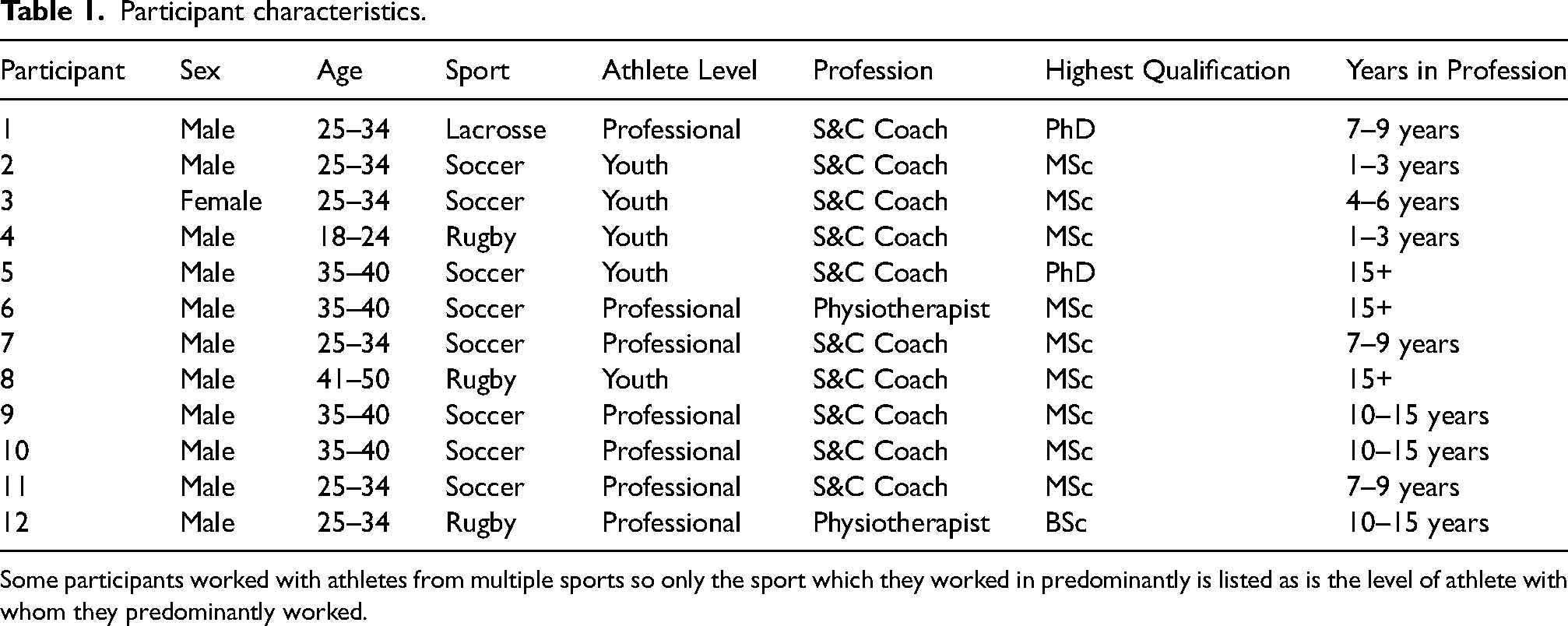
Some participants worked with athletes from multiple sports so only the sport which they worked in predominantly is listed as is the level of athlete with whom they predominantly worked.
The six broad areas (left) covered under the semi-structured interviews with the general subthemes (right).
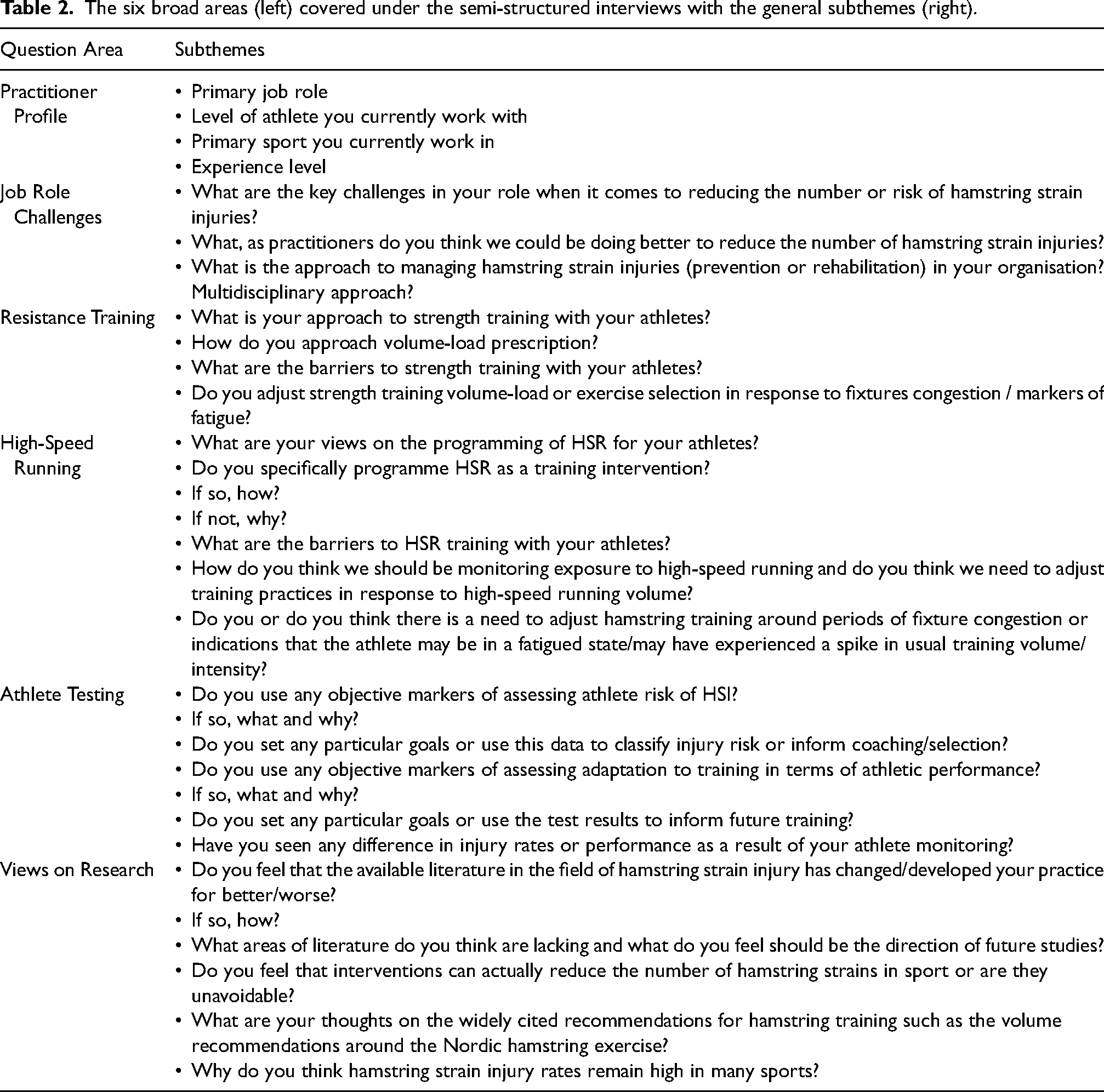
Semi-structured interviews were carried out through a combination of in-person and online via Microsoft Teams (Microsoft Corporation, Redmond, WA, USA). All interviews were audio recorded to allow for transcription. Interviews were transcribed using Descript AI voice-text transcription (San Francisco, CA, USA). Initial familiarisation with the data involved the researcher listening to the interview alongside the transcript to check for accurate transcription and correct any misinterpretations or inaccuracies.
Following transcription, the data familiarisation continued by the researcher reading each transcript a minimum of three times. Next, all transcripts were imported into Nvivo 12 Plus software (Lumivero, Denver, CO, USA) to identify initial codes within the data set. During this phase, initial codes were identified from each individual transcript, connecting them to a central theme or concept, and referencing the fundamental segments or elements within the raw data, 19 this process was repeated throughout each transcript. All coding was conducted by the lead author (SR). Ten initial codes were identified and are presented in Table 3.
The ten broad codes identified from the interview transcripts.
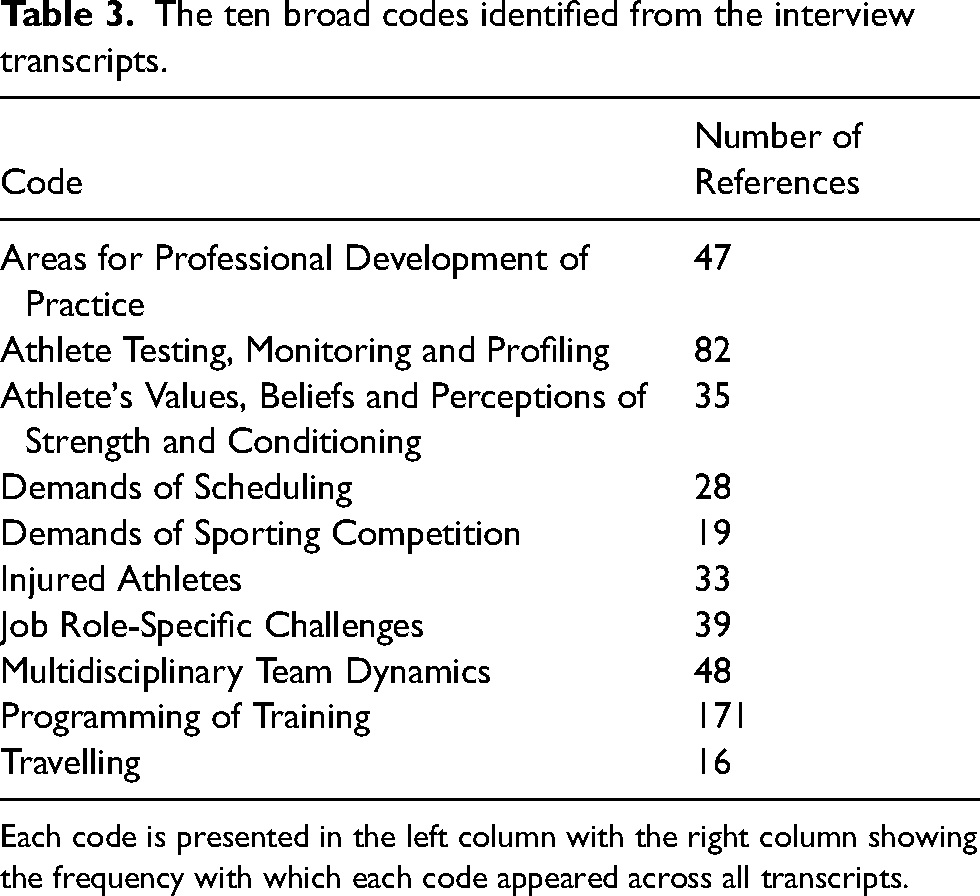
Each code is presented in the left column with the right column showing the frequency with which each code appeared across all transcripts.
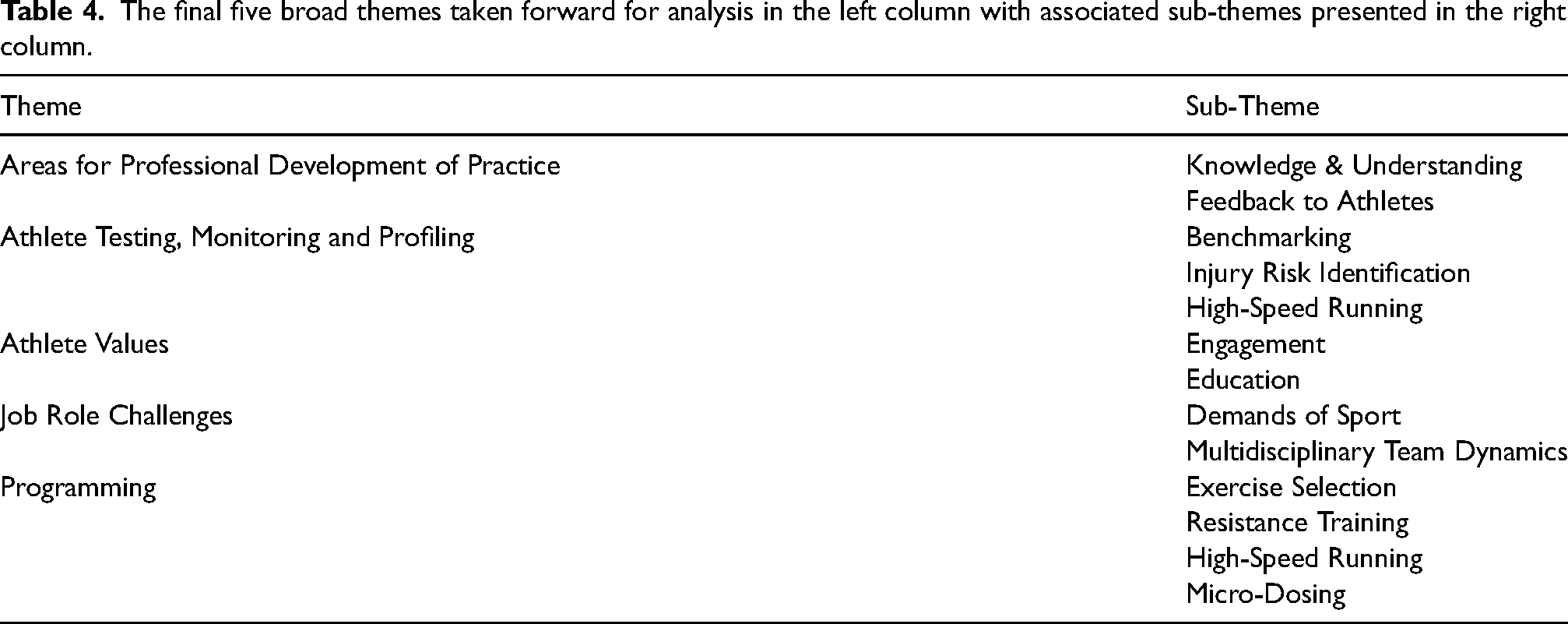
Next, as per Braun and Clarke, 20 the initial codes were reviewed to establish broader themes within the data set with these themes being broken down into ‘main’ themes with some further sub-themes for clarity. Themes were then reviewed, which led to the removal of some sub themes and the sub classifying of some of the broader themes, particularly those pertaining to programming of training, which required further sub classification into programming around resistance training, exercise selection, high-speed running and micro-dosing of the resistance training stimulus. The resulting five broad themes and their associated sub-themes are presented as a theme framework in Table 4.
The final five broad themes taken forward for analysis in the left column with associated sub-themes presented in the right column.
Results
Theme 1: Areas for professional development of practice
Practitioners working across youth and senior athlete groups highlighted a desire to continue to develop knowledge and understanding around the potential dose-response relationships of training and how to better individualise training, particularly in larger group settings. ‘In terms of future directions, I think getting a dose response relationship potentially for training load. If we're going to use it [dose response monitoring] for both monitoring and performance measurement, we need to know, someone of ‘this’ ability or ‘this’ level of strength can give ‘this’ level of output and have ‘this’ effect from it. Because when you have got a whole group of 20 players or more, all varying, it gets difficult to look at individuals. ‘One thing that has helped my practice a lot is the literature around NHE doses, if you think of some of the earlier work from the likes of Ekstrand, everyone was pushing fairly high volumes of NHEs because it seemed to be what the evidence suggested. In a way I kind of felt like I went along with it because of that [the evidence-base], even if I didn’t really think it was right compared with how I programmed other exercises. More recently, I’ve really reduced the overall volumes that we use, based on that meta-analysis from Cuthbert [et al. 2019] and some of the things coming out of the Australian groups, which seems to have helped compliance.’.
Theme 2: Athlete testing, monitoring and profiling
Strength testing through the use of the NordBord (VALD Performance, Brisbane, AUS), using the conventional NHE and variations of the NHE was a clear theme. While the specific thresholds of how athletes are benchmarked differed between participants, the use of thresholds relative to individual body mass was evident. ‘Our baseline benchmark is 10 newtons per kilo, but that then develops through the age groups so as they progress through the next age groups it goes 10 newtons per kilo, progressing to 11 newtons per kilo through to 12 newtons per kilo. But there's part of me that questions how appropriate that is for some players. For example, I’ve got one player that is 45 kilos, so I really doubt that she is ever getting a score of 10 newtons per kilo on her NHE [450 newtons absolute peak force], but we’ll have to see!’ ‘We tend to look at between-session changes in strength scores, so between 5–7% variation, we think is pretty good. It's when the changes are higher than that is when I tend to look into it a bit more as opposed to “that player is weak or stronger”. But going back to things like those NordBord thresholds, like we have players in our squad that can get 500–600 newtons, whereas the older research tells us to set that threshold of 337 newtons and it just shows that it can’t be that one size fits all model and that some of those stronger players may still suffer injuries even though they’re way above the threshold.’ ‘Typically, the lads [athletes] will get their sprints in during games. If they’re playing Wednesday and Saturday, then typically the match-day is their sprint exposure. It can be different based on position, for instance some positions on the pitch may not get exposed to top-end sprinting so if we pick that up then we’re not adverse to exposing them to a very small dose of probably 1–2 repetitions the day before the game if the turn around between games is particularly short or if they have gone 14 days without sprinting then we will exposure them to those 1–2 reps the day before the game.’ ‘I think with the absolute thresholds that we've got; I will take some of their numbers with a pinch of salt. We have a player in our group whose GPS data tells us that we that her max speed is 9 meters per second, which is rapid compared to the rest of the group. So, her sprint distance and her HSR distance compared to the rest of the group is crazy because she covers everything at high speed because the set thresholds we use are low for her, so she accumulates that across the game. But she is able to cope with it because it's a relatively lower percentage of her max compared to everyone else.’
Theme 3: Athlete values
Participants also discussed their approaches to providing continued feedback to athletes, involving athletes in the process of exercise selection and individualisation of the training stimuli and ensuring that athletes understand the expectations of the session. ‘It's [running-based data, such as distances covered, and velocities achieved] fed back to them on a daily basis. We’re constantly trying to close that feedback loop, I think that helps in terms of players understanding why they're doing certain things. it's almost like showing what they've achieved or potentially what they have not achieved so if a player has not hit the expected speed for instance, they know that they’re going to have to do a bit more tomorrow or some additional drills at the end of today's session.’ ‘I try to educate them on understanding why they're doing what they're doing. Personally, I find the RDL position, or the hinge position the most complex to teach. Some people get it straight away, but some people can take a long time. So, you have to take quite a long time to educate them on why it's important and, and how they should feel.’ ‘One thing I think could be done better could be to better educate the players e.g., how it will help them? Why is it important? Recently, I had a player that was doing deadlifts, and their understanding was that it was an arm exercise that was going to give them bigger biceps because in his mind he's picking the bar up with his arms so it's working the arms. ‘We very rarely get push-back from the players about NHEs, or for any of our “harder” exercises really. There's probably only one player that doesn’t do NHEs because of a previous injury, but out of a squad of about 25 players, that's pretty good. But rarely do we get any push back and I think that is probably because we are pretty consistent with them and then plus the volume is so low that there's very rarely any issues with DOMS etc.’
Theme 4: Job role challenges
Discussions centred largely on the demands of sport, particularly at the elite level of European football. Practitioners discussed challenges around the intensity of match-play, but primarily identified the demands of frequent congested fixture cycles (defined by Julian et al. 21 as a minimum of two successive bouts of match-play with an inter-match recovery period of <96 h), which was further compounded by the addition of the 2022 FIFA World Cup in Qatar being played during the regular season (November 20 – December 18, 2022).
Additionally, practitioners discussed the challenges associated with programming around competitive fixtures to ensure that athletes are still provided with focused training stimuli and the strategies they use to adapt their training programmes around fixture cycles. ‘One barrier with regards to gym sessions is when we have a rearranged game. So usually, they play on a Sunday but occasionally they will rearrange a game for a mid-week, so when they do that I still insist that they still do the gym session. We just position it as far away from the game as possible…Typically, I’ll keep the load the same, but I’ll reduce the volume.’
Practitioners discussed the importance of effective communication with technical coaches to develop an understanding of planned technical and tactical training sessions. Practitioners identified where effective MDT meetings allow for a coordinated approach to programming and management to athlete training loads. ‘This coaching staff are excellent with their organisation, so we try to plan from a drill-to-drill point of view at least around 4 weeks in advance. Obviously, there may be some alteration of that based on numbers [of players involved in the session] etc. but we’re pretty certain of what's coming.’
Theme 5: Programming
Participants, particularly those working in soccer identified that their primary focus on exercise progression is based on exercise complexity or movement velocity rather than a specific focus on progression of load. ‘We use movement as like a real sort of cornerstone of the programme. Really the complexity of the movement is something that will progress, so it might not necessarily be an increase in load. We don't really go chasing loads, it's more than movement driven program so that's either the speed of the movement will change, or the complexity of the movement will change.’ ‘I let them self-select the load, but it is guided by me. I don’t encourage any increase in load often, if at all. So, for example, with a RDL, I know in my head, if a kid weighs 50 kgs, then the absolute max load I would allow them to work with would be their body weight. Realistically, I want them to be lifting 60–70% of their body weight. But I am always chasing technical competency. There is other factors which underpin how I decide on the load, for instance, there are players in the U14 s that have reached peak height velocity, that I know could lift way more than they do, but it's not something I encourage. ‘The hip hinge is an ever present in our program, so we'll have a conditioning day where they will have a hamstring specific preparation session before they go out to training. Hip hinge work is always in that. So, within that hamstring programme, there’ll be a hip dominant movement and a knee dominant movement and then a resisted functional based movement and an unresisted functional based movement so, they are pretty much the four streams of movement that will be in that sort of session.’
Practitioners were asked how they typically programme sprint-based training sessions outside of congested fixture cycles or during pre-season and general preparation training blocks. Practitioners discussed that they primarily use these sessions to add a competitive and enjoyable element to their conditioning-based training. Discussions centred on the use of races between to promote maximal intent across repetitions, with the practitioner manipulating distances used to achieve the desired session volumes.
Practitioners discussed their approaches to programming resistance training around periods of fixture congestion. Practitioners identified several approaches that they take to mitigate the risks of accumulative fatigue around a congested fixture cycle, which primarily was identified as the micro-dosing of the resistance training stimulus. ‘We use a low volume of Nordics, that's for sure but then around a real heavy fixture congestion we go more towards the side of isometric work as opposed to the eccentric action of the Nordic.’ ‘I typically use micro doses for our strength work throughout the [training] camp, rather than loading it all in one go, which is another reason that as to like actually doing like one set of three Nordics and that way it doesn’t really have much of a negative effect in terms of soreness but if we dose it throughout the week they should still get the benefit in terms of adaptation.’
Discussion
The aim of the current study was to interview applied practitioners to develop a detailed understanding of the highly nuanced aspects of applied practice around HSI risk mitigation and training for enhanced athletic performance.
The interviews revealed that while practitioners do regularly utilise the NHE in their resistance training programmes, the overall volumes of NHEs tend to be low (e.g., single set of three repetitions, or two sets of four repetitions repeated across the training week) and largely programmed with the intention of micro-dosing (defined as ‘“the division of total volume within a micro cycle, across frequent, short duration, repeated bouts”) 22 the supramaximal eccentric training stimulus, indicating that lower-volume NHE programmes are utilised in applied sport. Additionally, contrary to previous claims in the literature8,9 that NHEs are not used in applied sport due to perceived association with post-training muscle soreness, practitioners did not identify such perceptions as barriers to compliance, nor did practitioners identify that they experience unwillingness from their athlete groups to engage in NHE training. Such findings seem to provide support to the use of micro-dosing to minimise potential negative effects of supramaximal eccentric training but also as a means of increasing compliance with training. However, it should be acknowledged that our findings are derived from a relatively small sample of practitioners and population backgrounds.
On the other hand, practitioners (n = 11) discussed strategies to reduce eccentric loading when athletes may be in periods of fixture congestion and in the day immediately following a competitive fixture when residual muscle fatigue may be present from the game itself. Practitioners (n = 7) discussed the use of isometric training during these periods as a means of providing a resistance training stimulus without the associated eccentric action of an eccentrically biased or traditional resistance training exercises. It could be argued here that a tendency to remove the eccentric stimulus in periods of fixture congestion could indicate a lack of practitioner understanding of the repeated bout effect. 23 Researchers24–28 have indicated that significant de-training can occur within one-to-four weeks of the removal of the eccentric training stimulus. Therefore, the removal of this stimulus around periods of fixture congestion (e.g., the winter period in the English football league or international tournaments) may potentially increase HSI risk. It could be argued that while the total removal of the NHE from the resistance training programme during periods of fixture congestion may be counterproductive, unless the athlete is exposed to an alternative eccentrically biased resistance training stimulus during this time period. Therefore, there is a need to better establish minimal effective maintenance dosages assist practitioners in adjusting training volumes during periods of high training loads, without the potentially negative impacts of de-training on muscle fascicle length. Very low dosages (one set of three repetitions) of exercises such as the NHE have been shown to be effective in increasing (p = 0.049; g, = 0.42) maximal muscle strength (measured via the NHE). 29 However, it is yet to be established whether a smaller dosage would be sufficient for maintenance of maximal strength and / or fascicle length. It could be argued that the increased sprinting demands during periods of fixture congestion result in a sufficient eccentric loading of the hamstring (during the late swing phase of the gait cycle). This loading may be sufficient to maintain muscle strength during periods of fixture congestion without the addition of resistance training, however further research is needed in this area. On the other hand, later in this section, the authors will discuss the variability of sprinting demands between fixtures, which likely requires close monitoring of individual player demands during these congested periods of match-play.
30 Another potential area for development could be the planning of long-term athlete development. For instance, practitioners (n = 4) working with academy level (≤ 18 years of age) soccer athletes stated that they utilise a movement competency framework that progresses with age and competency (e.g., starting with basic squat patterns at younger ages and progressing to hip hinge patterns), with a view to establishing movement competency prior to adding progressive overload. However, those working with senior-level soccer athletes also stated that they focus mostly on movement competency with the likes of the hip hinge. This raises the question as to why athletes would spend so much time in academies developing movement competency if then they are not being exposed to progressive overload once competency has been achieved? Such a reluctance to expose older soccer players to progressive overload may be one reason why HSIs remain a burden in this group, particularly as injury incidence has been reported to be higher in those over 23 years of age. 7 It must be acknowledged here that while there was a smaller sample of participants that worked with rugby players (n = 3), there was a trend towards an higher emphasis on maximal strength training (≥85% one repetition maximum), however it could be argued that the typically longer periods between competitive fixtures in ruby may allow for more dedicated time to maximal strength training within training microcycles.
All practitioners in the current study stated that they are involved in the programming and / or leading of HSR and sprint-running training sessions in their role. While most participants stated that the primary HSR and sprint running demands for their athletes are covered in competitive match day, all practitioners stated that there is still a HSR or sprint running focus in their weekly conditioning sessions. An interesting observation was that practitioners tend to use these sessions firstly as an opportunity to expose their athletes to running efforts at or close to maximal intent, but also that they look to identify opportunities to create a sport-specific context to such running-based sessions. Practitioners discussed that in soccer, relatively few HSR efforts are purely linear in nature, which is supported by Caldbeck et al. 31 that reported that approximately 85% of sprinting efforts during soccer match play are non-linear and Fitzpatrick et al. 32 that observed that mean sprint angle across playing positions was 5° but can be as high as 30° in some instances. 33 33 Further, participants (n = 6) in the current study discussed trying to adopt an individualised approach to monitoring weekly HSR volumes and “topping up” on additional HSR in scenarios in which athletes may not have reached near maximal or maximal speed in game scenarios. Several researchers have shown that there can be substantial between-match variability in HSR and sprint running in competitive soccer.34–37 For volume of between-match HSR the percentage coefficient of variation (%CV) has been shown to vary between 16% and 18% in male players and 28% and 41% in females.35–37 For sprint running, between match variability has been described as 31% and 37% and 35% and 65% in males and females, respectively.35–37 Further, the demands of HSR and sprint running have been shown to be impacted by positional demands, team tactics and quality of opposition.38–40 While some practitioners stated that they monitor weekly HSR and sprint running exposure and prescribe additional ‘top up’ sessions when total volumes may be low, this was not consistent across all responses. While more research is needed to establish optimal exposure to, and recovery from high-intensity running to mitigate injury risk, recent studies have demonstrated that combined linear 41 and curvilinear 42 sprint running with resistance training can lead to significant and meaningful adaptations in both maximal sprint speed and knee flexor strength. Until recently, studies relating to training for the mitigation of HSI risk have been limited to investigations of single exercise interventions such as the NHE alone. The studies from Ross et al. 42 and Ripley et al. 41 demonstrate the value of progressive overload of resistance training with regular, but relatively low volume high-intensity running. While more research is needed to investigate adaptations to such training protocols over longer training periods (Ross et al. 42 and Ripley et al. 41 limited to six and seven weeks, respectively), these studies demonstrate the potential to achieve positive adaptations with progressive overload in athletic populations. When athletes are not exposed to HSR or sprint running during match-play (e.g., unused substitutes, those not included in match-day squads, or where tactical or game situations do not allow of necessitate such high intensities), a low volume running intervention such as that used by Ross et al. 42 could offer an opportunity to induce positive adaptations in a manner of ‘topping up’ as described by practitioners in the current study. 32
Education was a central theme during discussions on challenges within job roles. The current study highlights that practitioners value athlete education in terms of developing knowledge and understanding of the underpinning rationale of training sessions and elements of training. The results also highlight that there is likely a need for continued development of the athlete's knowledge and understanding of physical preparation. One way this may be achieved, particularly in elite sporting academy settings in which young athletes’ complete part or all of their secondary and further education within the club setting, may be a focused approach within the physical education curriculum. Further enhancing the physical education curriculum to develop an understanding of the underpinning principles of strength and conditioning may help young athletes to enhance their appreciation of the benefits of strength and conditioning for athletic performance and long-term athlete development which may in-turn increase compliance with S&C in the applied setting.
Importantly, the dynamics of the MDT within the sporting environment seem to be both highly nuanced and likely key drivers of success when it comes to athlete monitoring and training, especially with respect to planning of overall training loads and the adaptation of the training environment in light of things like athlete injury. A key theme through all interviews in which participants identified that they felt that they had an effective MDT dynamic within their workplace was communication between individual facets of the team.
Conclusion
The findings of the current study expand on the practices and perceptions around training for the mitigation of HSI risk that were established from our previous work. 17 From the current study, it can be concluded that while individual practices are highly nuanced given that there are several challenges facing the practitioner including MDT dynamics, fixture congestion which can vary greatly based on sport and level of sport. Further, there is a potential that progressive overload of athletes is not consistently applied. For instance, it seems more commonplace with youth athletes that progressive overload is achieved through an increase in exercise complexity and training frequency as the athlete ages and advances in their movement competency. However, at the senior level, particularly in soccer, it seems that actual progression of loads to achieve positive adaptations is not consistently applied, and rather practitioners continue to focus on movement competency.
There are clear themes across practitioners pertaining to the use of concurrent resistance and HSR training which are more varied in nature than the majority of existing literature in the field. These findings highlight a need for the further development of more ecologically valid training intervention programmes. The NHE remains a common theme across resistance training programmes, with practitioners seeming to adopt varying approaches to the micro-dosing of this resistance training stimuli, which was not captured through the more quantitative approach to investigating typical NHE repetition dosages in our previous work. 17 It seems that practitioners engage well with the contemporary scientific literature from the likes of Cuthbert et al. 4 and Ripley et al. 5 in terms of adopting a relatively low repetition dosage and doing so in a way that promotes compliance with the training within their athlete groups. However, practitioners discussed that most of the existing literature is heavily focused around the NHE alone and is lacking in empirical evidence around adaptations to hip-hinge focused training and training adaptations to HSR. Therefore, future research should focus on the continued development of ecologically valid concurrent training programmes that include both resistance training and HSR. Future researchers could consider investigating adaptations to training from ecologically valid resistance training programmes that include the likes of the NHE and RDL, given their prevalence in applied practice, alongside HSR training.
Footnotes
Acknowledgements
The authors would like to extend thanks to all those that agreed to take part in the study.
Declaration of conflicting interests
The authors declared no potential conflicts of interest with respect to the research, authorship, and/or publication of this article.
Funding
The authors received no financial support for the research, authorship, and/or publication of this article.
Statements and declarations
The authors have identified that there was no conflict of interests associated with the study.
