



Abstract
Adolescent awkwardness is commonly referenced in sports science and medicine literature and is believed to impact athletic development and injury risk in youth sports. However, this concept is not well understood, and a literature synthesis has yet to be conducted. The aim of this narrative review was to synthesize and evaluate the evidence for adolescent awkwardness. Specifically, we examined how it has been defined and assessed in a youth sports setting. A literature search was conducted in MEDLINE, CINAHL Complete, and SPORTDiscus via EBSCO Health with 21 articles meeting our inclusion criteria. Most authors believe that adolescent awkwardness is a transitory period in which youth experience decreases in coordination and balance, impacting athletic performance and potentially increasing injury risk, yet there is no single accepted definition. There is also no consistency or standardization in the tests used. Measures of balance and lower limb power may be useful for tracking athletic performance across maturation, but their ability to identify a period of adolescent awkwardness appears limited. Some studies observed a decline in sensorimotor function during the growth spurt, while others show continuous improvement or high variability between youth. Cumulatively, it appears that adolescent awkwardness is poorly understood and there is no consensus definition or assessment method, warranting further research.
Introduction
The term “adolescent awkwardness” was first used in 1922 by Homburger to describe the period when growing teenagers face changes in their bodies that lead to a state of clumsiness. 1 Despite the concept of adolescent awkwardness/adolescent motor awkwardness being regularly referenced in sports science and medicine literature, there appears to be little consensus regarding how it is defined or assessed.2–7
Several authors have suggested that during the adolescent growth spurt (the period during which Peak Height Velocity [PHV] occurs), a temporary disruption in motor skills, such as neuromuscular control, postural stability, and intersegmental/interlimb coordination, may occur that could contribute to a period of motor awkwardness. Any awkwardness that does occur is likely to be highly individualized, experienced by some adolescents but not all, with varying impacts on their motor skill performance (contributing to the challenge of understanding this phenomenon from a scientific perspective).1,5,8–10 This disruption may be caused by sensorimotor mechanisms that are not fully developed at the time a child experiences the growth spurt or a regression in specific sensorimotor functions as the child's body adjusts to the changes occurring during the growth spurt. 10 More specifically, it has been suggested that adolescent awkwardness results from an asynchronous development of segment dimensions (e.g., trunk and leg length) and muscle strength, leading to decrements in movement performance and coordination.11–13
In youth sports, the development of adolescent awkwardness is often linked to growth and maturation. These processes vary markedly between individuals of the same chronological age, with differences in the magnitude, timing, and rate of change.8,9,14 Furthermore, the timing and rate of accelerated growth associated with the period of PHV differ between boys and girls. Boys typically experience their peak growth rate between 12 and 16 years old, whereas in girls, this occurs earlier (on average between the ages of 10 to 12 years). Additionally, early height and weight gains in boys are more intense, with gains in mass mainly the result of increases in muscle mass. The equivalent gains in females are predominantly the result of gains in fat mass.1,9,11,15 During the period of PHV, it is suggested balance and proprioception ability may temporarily regress, which is often described as adolescent awkwardness. 10 A combination of biomechanical, physiological, and perceptual changes during growth is thought to impair neuromuscular control and coordination, leading to a period of motor awkwardness that can negatively impact sports and athletic performance.15,16 Several authors have suggested that decreases in neuromuscular control during the adolescent growth spurt can potentially lead to an increase in the risk of sport-related injury.10,17,18 This is supported by research that has identified a greater incidence of overuse and traumatic injuries in the year of PHV.10,13,19–21
Although there appears to be an acceptance in the literature that adolescent awkwardness exists, there is a wide range of definitions and proposed methods of assessment. To guide practitioners working in youth sports, this review aims to synthesize and evaluate the evidence regarding what is (and what is not) understood as adolescent awkwardness, specifically, how it is defined and assessed in a youth sports setting. The findings of this review could help sports practitioners develop targeted interventions to optimize performance and reduce injury risk, enhancing the experience for youth athletes and creating opportunities for success later in life.
Methods
This narrative review employed a systematic literature search conducted using three electronic databases MEDLINE, CINAHL Complete, and SPORTDiscus via EBSCO Health in July 2024. The search strategy used Boolean operators and included the search terms: “adolescent awkwardness”; “awkwardness”; “clumsiness”; “teenage clumsiness”; “coordination”; “growth spurt”; and “peak height velocity”. Initially, only original articles in the English language published in peer-reviewed journals were included in this review. The selected articles had to explicitly use the term “adolescent awkwardness” or “adolescent motor awkwardness”. Despite the focus of the review, we did not limit the search to articles that defined the participants as athletes, but the outcome of the studies had to be deemed as useful to inform a youth sport context. The focus of the studies had to include (but may not have been limited to) healthy, adolescent-aged participants. Articles on social awkwardness or physical awkwardness resulting from disorders/diseases (i.e., developmental dyspraxia, developmental coordination disorder) were excluded. Due to a lack of original studies identified during a preliminary search, we decided to include literature reviews. In the final search, a total of 3397 studies were initially identified, duplicates were removed using EndNote 20 software, and the articles underwent a three-phase analysis. First, the articles were screened by title (177 articles selected), followed by abstract and keyword screening. Finally, the remaining 23 articles underwent a full-text screening. Thirteen articles were included initially, and a further eight studies were identified from their reference lists, providing a total of 21 articles for the purpose of this review.
Study characteristics
The reviewed studies were published between 1988 and 2024. Only three specifically focused on adolescent awkwardness, including two cross-sectional studies,7,11 and one systematic review. 10 The remaining studies addressed themes primarily focused on maturation and the changes/differences in neuromuscular performance during adolescence. Eight of these evaluated performance in sprinting and jumping/hopping tasks.2,22–28 One study assessed several motor skills tests, while another evaluated a number of physical performance tests.11,12 One study focused solely on the longitudinal changes in movement coordination capabilities via assessment of vertical stiffness. 29 Two studies focused on static and dynamic postural control.7,8 One study evaluated gait stability changes during adolescence, 3 and a final study analysed sports injuries during PHV and maturation. 13 Finally, one study analysed how youth football coaches evaluate players’ match performance around the time of the growth spurt, 30 and another study used a mixed-methods approach to understand football coaches’ experience, perception, and management of youth players. 31
The review articles included: 1) a systematic review analysing various sensorimotor mechanisms, how they mature during childhood and adolescence, and whether during adolescence people experience a period of delay/regression in sensorimotor function 10 ; 2) a narrative review on the physical performance of children during the growth spurt and maturation 1 ; 3) a narrative review of terminologies, methods for assessing maturation, and the implications of maturation assessment and age-related changes for sport and exercise practitioners working with youth 9 ; and 4) A narrative review on early sport specialization and the changes in the musculoskeletal system during growth and maturation. 15 These articles were primarily used to provide evidence as to the current understanding of what adolescent awkwardness is.
Discussion
Adolescent awkwardness: what is it and when does it occur?
Table 1 shows the various definitions of ‘adolescent awkwardness’ given in the reviewed studies. Many authors suggest adolescent awkwardness is poorly understood and defined.1–3,7,8,10,11,27–31 There appears to be agreement that adolescent awkwardness exists and is a phenomenon that occurs during the period of rapid growth when impairments in motor function (a term poorly defined in the reviewed studies) may occur, affecting mainly coordination and balance.1–3,7–13,15,22–31 How common it is and the exact timing of the changes caused by adolescent awkwardness are unclear; however, there is agreement that this phenomenon occurs during the peak growth spurt.1–3,7–13,15,22–24,26–31
The definition of adolescent awkwardness used in each reviewed study.
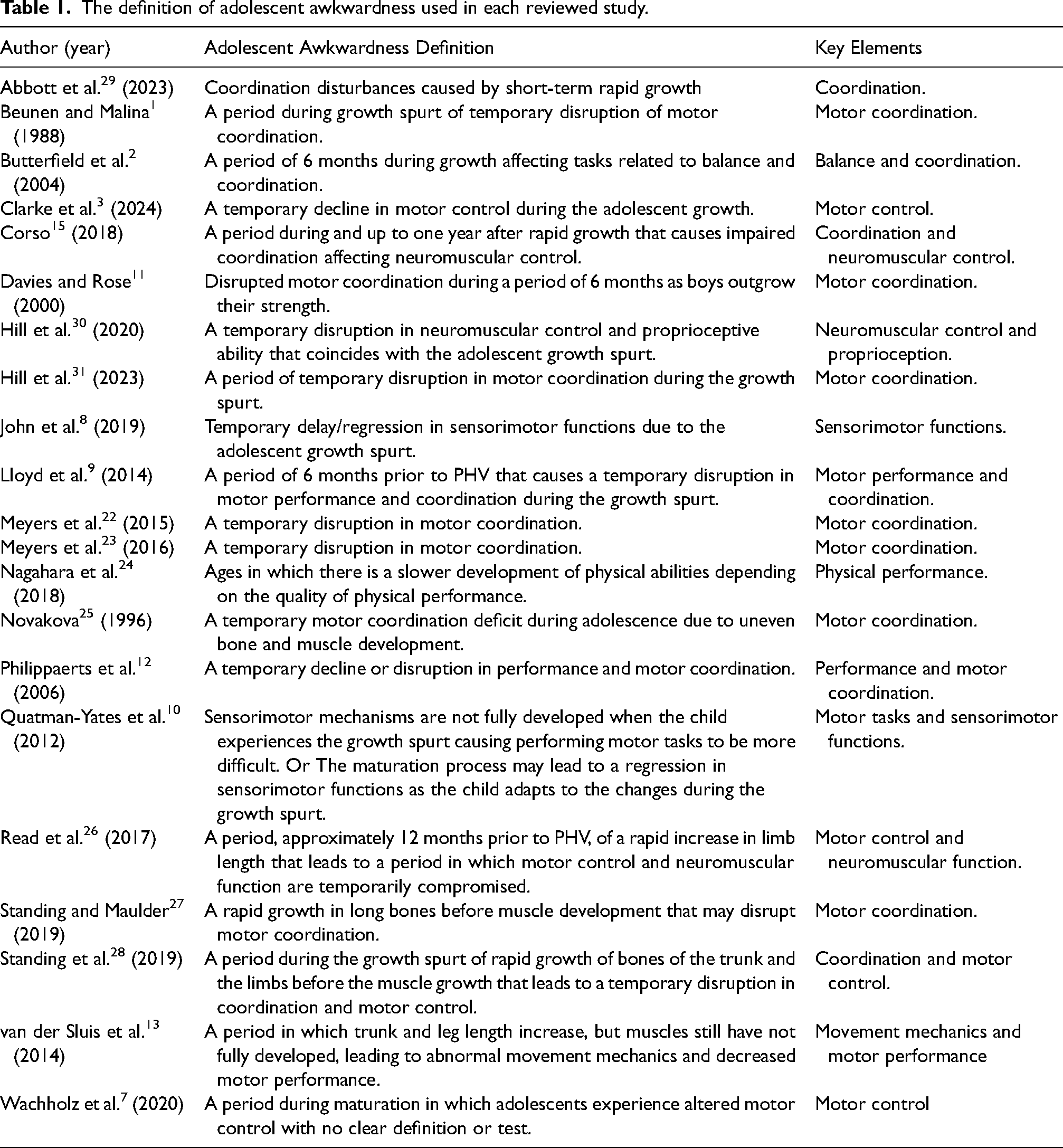
A few studies suggest that impairments in motor function can be observed six or even twelve months before the period of PHV.9,12,25,26 In addition, three studies build on previous work by Tanner 32 and argue that adolescent awkwardness has a duration of six months. It is worth noting this timeframe is not well justified and Tanner's work does not explicitly address adolescent awkwardness, but only suggests the existence of a period during adolescence in which the balance of specialized groups, such as dancers and athletes, could be impaired.1,2,11,32 In contrast, one study argued that the period of motor awkwardness starts immediately after the growth spurt and lasts for up to one year. 15 Four of the reviewed studies suggest that adolescent awkwardness is more prevalent in boys than in girls1,8,11,25 although it should be noted that few studies have analysed these changes in adolescent girls.2,3,11 Only three studies argued against the existence of a period of adolescent awkwardness. The authors indicated there is no decline in motor functions but rather high variability among adolescents (in relation to age and maturational stages), causing the appearance that some adolescents have superior coordination skills and perform motor tasks better than others.1,2,11 Similarly, the findings of a study involving 106 basketball players (age 11 to 25 years) found a higher variability in jump task performance in younger athletes when compared to older adolescents and adults. 33 While this variability may indicate individualized experience of adolescent motor awkwardness, it may also indicate variability in other physical attributes such as strength and flexibility.
What causes adolescent awkwardness?
Quatman-Yates et al. 10 proposed two hypotheses to explain adolescent awkwardness: 1) Sensorimotor function is not fully developed when the child experiences the growth spurt making it more difficult to perform motor tasks; or 2) the maturation process leads to a regression in sensorimotor functions as the child adapts to changes during the growth spurt. Although these claims have been used in more recent literature to explain adolescent awkwardness,3,7–9,29,30 they fail to provide a clear definition of the phenomenon.
It is not clear what the underlying mechanisms are that cause potential motor impairments in adolescents experiencing a growth spurt. Proposed contributors to the disruption in motor coordination and neuromuscular function include the growth of bones (distal prior to proximal, potentially increasing resistance to limb rotation due to increased moment of inertia 15 ) preceding that of muscle and the associated strength gains and decreases in mobility/flexibility due to lengthening of the skeleton occurring in advance of soft tissues.1,3,12,13,15,26,27,30 On the other hand, it has been suggested that the sensorimotor and neuromuscular changes experienced during the growth spurt are caused by deficits in postural control and balance.7,8 These deficits could be due to an inability to estimate internal body orientation, slower movement detection time, substantial muscle activation impacting processing mechanisms, and dependence on visual sensory mechanisms. 7
Evidence from the reviewed studies suggests that during the period of accelerated growth, young athletes will experience changes in sensorimotor and neuromotor performance, primarily impacting coordination.1–3,7–13,22–24,26,27,29–31 However, there is a lack of clarity regarding what these specific changes in coordination are and how coordination is measured. In their systematic review, Quatman-Yates et al. 10 reported that all the studies that analysed coordination showed a continuous improvement during adolescence. Similarly, Davis and Rose 11 analysed coordination in sixty boys and girls between 7 and 18 years old using motor output tests for lower limbs, shoulder girdle, and neck, plus fine motor tasks (i.e., running speed, standing long jump (SLJ), arm movement accuracy, head movement control, obstacle course, ped displacement, among others). The authors concluded that there was no evidence of decreased coordination during puberty for both boys and girls. Conversely, in a more recent study, movement coordination was assessed through vertical stiffness during a 15-s hopping task. 29 It was reported that adolescent competitive swimmers experienced disrupted coordination during their growth spurt, as evidenced by decreases in both average vertical stiffness and variation in vertical stiffness, regardless of their growth tempo.
It is suggested that vertical stiffness is a surrogate of the stretch-shortening cycle function and will impact force development and movement coordination.29,34 Vertical stiffness and intralimb coordination will decrease with fatigue in healthy adults 35 and can positively influence peak power production in adolescents, influencing the performance of motor tasks. 36 However, the evidence of a relationship between vertical stiffness and coordination, or more specifically, awkwardness, is limited.
Cumulatively, there is little to no evidence of an actual deterioration in coordination during adolescence. Limited evidence suggests that some adolescents (prevalence unknown) will experience a degree of motor awkwardness. However, due to inconsistencies in study designs and variables investigated, it is hard to draw strong conclusions regarding real changes and decreases in neuromotor performance and coordination. Importantly, there is a lack of longitudinal studies that investigate the changes in coordination or other performance variables across adolescence, and the available studies use a wide variety of tests/variables.2,12,23,29
How has adolescent awkwardness been assessed?
Table 2 displays the different tests used within the literature. A full description is beyond the scope of this review, and readers are referred to the original studies. Although it is suggested that adolescent awkwardness may disrupt different sensorimotor systems leading to a decline in physical performance, this has rarely been examined mechanistically.2,3,7,10,13,26 Assessing changes in stature and leg length is common for the purposes of monitoring growth rates and estimation of maturation status, and this is more appropriate than using chronological age.9,25 However, no specific test(s) to measure adolescent awkwardness have been described7,31 with an overreliance on indirect measures through a range of different physical performance tests.1–3,7–13,22–31
List of tests used in the reviewed studies.
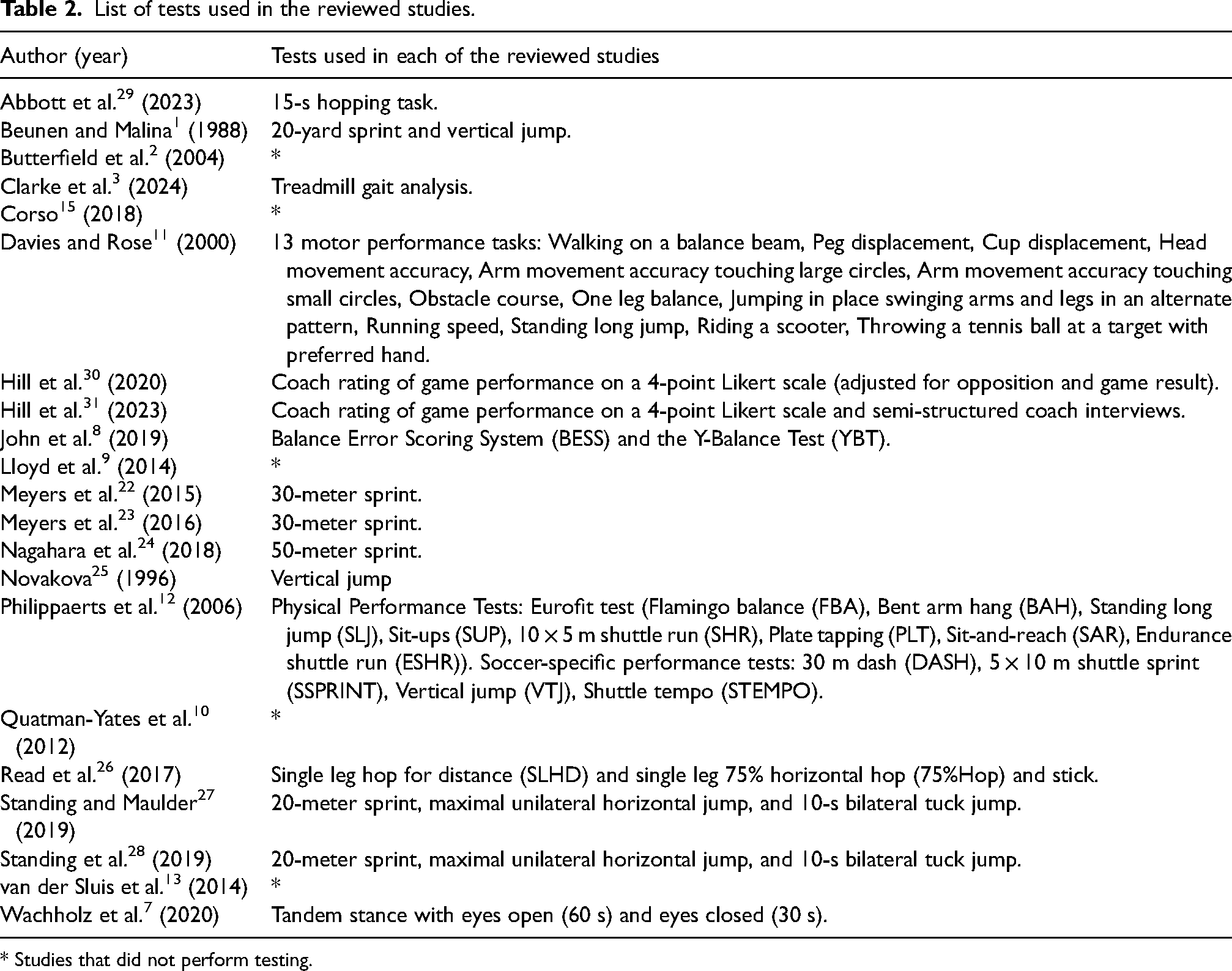
* Studies that did not perform testing.
Based on the evidence from the studies identified in this review, the most common assessments used to evaluate changes during the growth spurt focused on outcomes from explosive tasks including sprinting, jumping, and hopping2,22–29 followed by postural control/balance tasks,7,8 whilst one study analysed gait stability. 3 A further two studies evaluated a battery of motor skill tasks (e.g., walking on a balance beam, throwing a ball at a target, flamingo balance, bent arm hanging, etc.) and physical/sport-specific performance tests (e.g., 30-m dash, shuttle run, and others).11,12 These tests included, among others, the Eurofit of Physical Fitness and other football-specific performance tests12,37 and tasks adapted from the Bruininks-Oseretsky Test of Motor Proficiency (BOTMP).11,38
It has been suggested that coaches can subjectively identify athletes experiencing adolescent awkwardness due to accelerated growth by visually observing less efficient movements, which lead to inconsistent performance and mistakes in simple tasks such as striking a ball.30,31 However, there is a lack of studies confirming the reliability and validity of these visual observations. 30 Further studies are needed to develop valid and reliable tools to aid coaches and other sports practitioners in analysing coordination and balance in players during the growth spurt. Moreover, the influence of specific coaching styles/strategies on movement development in youth athletes could differ depending on the phase of maturation. 27 In addition, there is a lack of mechanistic assessment, and potential sensorimotor changes occurring during the growth spurt have not been examined, which requires further research.
Sprint assessments
The most common test was sprinting; however, there was variability in the test procedures and outcomes. The results suggest that running performance tends to improve during the growth spurt rather than deteriorate.2,11,12,22–24,27,28 Possibly, because of an increase in stride length due to an increase in leg length circa-PHV.22–24,39 In contrast, there is evidence from one study that sprint ability may slow or plateau during the adolescent growth spurt. 24 Although biological maturity was not assessed, boys between the ages of 8.8 and 12.1 years old (identified by the authors as the period when an accelerated period of growth happened for the subjects of the study) had lower step frequency and no increase in propulsive forces during sprinting phases when compared to older or younger boys. 24 However, the maximal running speed in boys aged between 10.4 to 13.7 years, during a 30-meter dash, has been reported to reach its peak circa-PHV followed by a plateau post-PHV. 12 In the same study, similar changes in maximal speed were reported during 10 m and 5 m shuttle run tasks supporting the idea that the maximal increase in power and strength occurs during the period of Peak Weight Velocity (PWV) (period that occurs after PHV) as a result of increased body mass.1,2,12,15,31 This increased body mass will consequently lead to an increased demand for higher force production relative to mass and, hence, the potential to improve performance.9,15 This is also consistent with the findings of a longitudinal study analysing coaching strategies to improve sprinting and jumping performance in adolescent boys, showing that post-PHV boys had an increase in sprint performance in all groups. 27 However, this study did not compare the changes between groups; only changes within groups, in relation to the coaching strategies, were analysed. Furthermore, the changes observed could be due to normal maturation and growth processes.
Furthermore, a cross-sectional analysis by Meyers et al. 22 of a large sample of boys showed that the period of PHV elicits the greatest enhancements in maximal sprint speed. In addition, the analysis of body size revealed that stature had a positive influence on maximal sprint performance, whereas body mass had a negative influence (possibly due to the elevated mass without increases in force production). Findings showed that stride length and contact time seem to increase with maturity as boys approach PHV but plateau as they experience PHV, while stride frequency decreases as boys approach PHV and stabilizes as they experience PHV. Moreover, longitudinal analysis confirmed that boys circa- and post-PHV had greater running speed and relative vertical stiffness than participants who had remained pre-PHV, and that, independent of maturation status, relative force production and relative vertical stiffness were the most important predictors of maximal sprint performance in boys. 23 Additionally, a study using hierarchical linear modeling to evaluate the longitudinal changes during a period of nine months showed a positive association between running speed and growth rate for both boys and girls aged 11 to 13 with no difference between sexes, demonstrating no period of decreased performance. 2 Similarly, another study using a single-measurement design analysing boys and girls from 7 to 18 years old showed that running speed increases with advancing stages of maturation (prepubertal, pubertal, and post-pubertal), with more advanced maturation stage adolescents performing better than those less advanced. 11 Likewise, a study with 95 youth males performing a 20-meter maximal sprint demonstrated that sprinting performance increased with maturation, with the post-PHV group having faster times than the circa- and pre-PHV group, and that the circa-PHV boys outperformed their pre-PHV counterparts. 28
Cumulatively, these data indicate the use of sprint tests to evaluate the impact of adolescent awkwardness may lack sensitivity, as it seems that even though the test typically appears to capture the performance improvements adolescents experience during the growth spurt, these changes do not characterize a period of adolescent awkwardness. Potentially, the assessment of different outcomes that reflect better coordinative abilities such as electromyography and kinematic and biomechanical analysis40–42 during sprinting in a youth athlete population are required to more appropriately assess for a period of motor awkwardness.
Jumping and hopping
Jumping and hopping tasks have also been widely used as a measure to identify physical performance changes during maturation displaying inconsistencies in the procedures used and variables analysed.2,11,12,25–29 Novakova 25 showed that between the ages of 10 to 18, athletes who experienced greater height gains circa-PHV exhibited decreased vertical jump performance. Conversely, athletes with more consistent increments in height, weight, and muscle mass showed continuous increases in strength impulse during the acceleration phase of the vertical jump. During the period circa-PHV, these athletes also demonstrated enhanced vertical jump height changes. 25 Philippaerts et al. 12 indicated that boys reach peak vertical jump performance at the time of PHV, followed by a plateau one year post-PHV. Moreover, the longitudinal changes in vertical jump over nine months showed a positive association with growth rate and height for boys and girls aged 11 to 13 years, which was attributed to increased leg length and muscle mass/strength. 2 No decreases in performance were evident to suggest a period of awkwardness in vertical jumping.
Two included studies used the SLJ as an assessment.11,12 Cross-sectional analysis indicated that SLJ performance gradually increases with maturation stage (pre, circa post-PHV, based on the Pubertal Maturation Observational Scale) and that boys tend to perform better than girls. 11 It is worth noting that in the abovementioned study, the authors did not analyse the maturational stage based on common estimates used in youth sport, such as the percentage of estimated adult height attained, or the maturity offset method that estimates the time from PHV.43,44 Rather, they used the Pubertal Maturation Observational Scale. 45 This scale uses observations in conjunction with a parent report to determine the maturation stage and has a strong convergent validity with the Pubertal Development Scale for both boys and girls.11,45 The use of observational scales may not be as accurate in assessing maturational stages compared to other assessments, including skeletal age and direct observation of sexual development by trained clinicians.9,45 Moreover, jumping tests should be normalized relative to leg length to allow comparison between athletes with different anthropometrics who are at different maturational stages. 46 Furthermore, many studies have used maturity offset to identify maturational stages in adolescents, which has recently been shown to have limitations in identifying growth stages and possibly leading to misclassifications. 47
Longitudinal data indicate that the maximal development velocity for SLJ and vertical jump peaked about 18 months prior to PHV, decreasing over the following 6 months and then progressively improving again from 12 months prior to 12 months after PHV 12 suggesting a temporary period where long jump performance is impaired. Read et al. (2017) 26 observed that the single-leg forward hop distance relative to leg length increased with the consecutive age groups, but showed a decrease with the under-13 male football players. This could indicate a period of awkwardness occurring 12 months prior to the growth spurt, assuming, on average, maturing boys reach PHV around the age of 14. 9 Moreover, when analysing the peak landing vertical ground reaction force during the 75% horizontal hop and stick test, absolute force increased with age and maturation. 26 However, those under-11 and under-12, as well as pre-PHV players, recorded a higher relative force when compared to other groups apart from the under-18 athletes, which indicates that as the children mature, their force attenuation improves. 26 These findings again point to a continuous improvement during the maturation process but with some variability during the period circa-PHV, indicating that horizontal / single-leg hop tests could potentially be used to identify changes in performance during growth, which could be associated with a period of adolescent awkwardness. However, it should be noted that the mechanisms that underpin these findings remain unclear. The assessment of the SLJ and hop distances only does not examine the strategy used. Similarly, no mechanistic data are available to determine if changes in intralimb coordination or sensorimotor function are evident. Finally, it is clear there is a lack of longitudinal studies that could help identify a true deterioration of performance to determine adolescent awkwardness.
Other jumping/hopping tasks in the reviewed studies included unilateral horizontal jump, repeated tuck jump, jumping in place swinging arms and legs in an alternate pattern, and a 15-s hopping task to assess vertical stiffness.11,27–29 It was observed that during unilateral horizontal jumping (taking off with one leg and landing on both), there is an increase in performance associated with more advanced stages of maturation, meaning that post-PHV boys jumped the longest distances and circa-PHV boys performed better than the pre-PHV boys. However, these studies did not normalize the jumping performance relative to leg length.27,28 Vertical hopping and, specifically, measures of mechanical stiffness during a 15-s hopping task in competitive youth male swimmers have shown that with increases in growth tempo, there was a concomitant decrease in vertical stiffness, which could indicate a period of awkwardness circa-PHV. 29 The decrease in vertical stiffness potentially represents a decrease in performance, as increased vertical stiffness during a jumping task corresponds to an increased peak power.29,36 Furthermore, one study used a test of jumping in place while swinging arms and legs in an alternate pattern, as this is claimed to involve fast movements of the body and the coordinated movement of the limbs. The objective of this test was to perform as many cycles of the task as possible for 20 s. The results showed no differences between either stage of maturation or sex. 11 Moreover, during a bilateral 10-s tuck jump test analysed qualitatively, with 95 adolescents divided into three groups (pre-, circa-, and post-PHV), no differences were found between the maturation groups. 28 This could be due to high test re-test variability in youth athletes for the various tuck jump criteria, which has been shown to be reliable for observation of knee valgus only. 48
Balance
Four studies analysed balance.7,8,11,12 It has been suggested that young athletes will reach peak static balance performance at the time of PHV, followed by a decline in the rate of development after PHV. 12 During the Balance Error Scoring System (BESS) test, it was found that maturation influences static balance, and under-14 and under-15 male football players with a higher maturity offset (more mature) recorded a higher BESS score. 8 When comparing adolescents and adults during two tandem stance tasks, one with eyes open and one with eyes closed, using a principal component analysis it was found that there was no difference in coordinative structure (the contribution of movement strategies and differences in temporal structure of movement strategies during stance) between adolescents and adults. However, the adolescents had less tightness of motor control (meaning that the sensorimotor system makes less frequent correction of agonist and antagonist muscle activation in order to maintain postural control), which the authors suggested is due to adolescent awkwardness. 7 When interpreting the findings of this study, it should be considered that a cross-sectional design was used comparing adults and adolescents rather than longitudinal tracking to examine adolescent awkwardness. It has also been reported that during a single-leg balance task, the stage of maturation did not influence balance in adolescents. 11 In contrast, using the Y-balance test to assess dynamic balance, lower anterior reach distances were shown for male football players with a higher maturity offset for both legs and for posteromedial reach on the left leg. 8 However, it has been shown that the anterior reach of the Y-balance test is influenced by dorsiflexion range of motion and not necessarily by balance performance. 49 Therefore, the contrasting findings in balance could represent that there is high variability among adolescents with a tendency of improved balance as they get older or more mature.
From the analysis of the reviewed studies, it seems that assessments of balance could potentially be a better indicator of adolescent awkwardness than explosive tasks, including sprinting and jump/hop tests. It appears that after the athlete experiences PHV they will have a decrease in balance, possibly due to missing automatization of postural control, consequently promoting some degree of motor awkwardness.7,8,12 However, it should be noted that the term ‘balance’ is not well defined, and again, a range of assessments was used.
Additional assessments
Clarke et al. 3 examined the influence of height and chronological age on gait stability. The procedures consisted of walking on a treadmill at different speeds, and the Harmonic Ratios from trunk acceleration were calculated to quantify the ‘smoothness’ of the gait (referred to as the consistency of rhythmic patterns during acceleration and deceleration while walking determined by the coupling of kinematics, kinetics, and the neural control of gait.3,50 It was observed that when normalized by height, gait smoothness increased with chronological age for males pre-fatigue, and when normalized by chronological age, height had a negative correlation with gait smoothness during fast walk pre-fatigue. For females, it was demonstrated that when adjusted for height, gait smoothness improved at all speeds pre- and post-fatigue, and when adjusted to chronological age, there was a negative relationship for gait smoothness and slow and preferred walk pre-fatigue and during fast walk post-fatigue. It is important to note that Clarke et al. 3 used chronological age and height as separate variables to inform maturity status. They acknowledged that differences in the timing of growth relative to chronological age could affect the development of gait. However, more reliable measures of maturity status were not used in this study. Adolescents with the same chronological age can vary greatly in maturation status, and it is recommended that somatic measures of maturity should be included. 9
Several other tests were performed including peg displacement, cup displacement, head movement accuracy, arm movement accuracy touching large circles, arm movement accuracy touching small circles, obstacle course, riding a scooter, throwing a tennis ball at a target, bent arm hang, sit-ups, plate tapping, sit-and-reach, and endurance shuttle run (see Davies and Rose 11 ; and Philippaerts et al. 12 for a description of these tests). None of these tests showed any period of decrease or plateau circa-PHV for both boys and girls that would be indicative of awkwardness. Rather, these tests seem to improve with maturation, apart from upper-body muscular endurance (tested via the bent arm hang) that appears to have a gradual decrease in the development rate approaching 12 months post- PHV.11,12
It has also been suggested that coaches can identify adolescents experiencing motor awkwardness through physical, technical, and psychological signs and symptoms. 31 These are often attributed to issues with proprioception and the changing size of limbs, which could consequently cause movements to be less controlled and efficient. Additionally, athletes experiencing awkwardness would present a reduction in speed, power, strength, and agility, causing inconsistent performance, poor coordination, and clumsy movements.30,31 In a study analysing coach evaluation of match performance in academy football players it was shown that coaches were able to identify decreases in player performance during the growth spurt, particularly in under-12 players. Additionally, performance ratings improved after the growth spurt in the under-15 group, in line with the phenomenon of adolescent awkwardness and potentially leading to a bias in player selection. 30 Similarly, in the study of Hill et al., 31 coaches were asked to subjectively grade young football players to indicate whether they were below, approaching, meeting, or exceeding academy standards in three time periods during one year. The authors found that, except for the under-12 players, all players had fluctuations or plateaus in their performance during the period of the study, with the under-13 group having a progressive decrease in performance. Of note, several of the coaches interviewed described these changes in performance as the period in which the players displayed adolescent awkwardness. 31 It was suggested that this could be considered a symptom of growth-related changes. Although the authors recognized they weren’t attempting to measure adolescent awkwardness, the findings of both studies indicate that sports coaches may be able to assess subjectively when a young athlete is experiencing challenges related to motor awkwardness by perceiving a decrease in the athlete's ability to perform controlled or efficient movements.30,31 This further highlights the need to develop valid and reliable tools to help coaches assess adolescent awkwardness.
Working towards a definition of adolescent awkwardness
Based on the studies reviewed, ‘adolescent awkwardness’ remains poorly defined. Most authors agree this is a temporary phenomenon that can be observed during the growth spurt, affecting mainly the coordination and balance of youth athletes causing motor tasks to be more difficult. Based on the limited available evidence from this review, we propose the following preliminary definition that could be used as a starting point for future studies to develop:
Adolescent motor awkwardness is a phenomenon that youth athletes may experience during their growth spurt, characterized by a temporary impairment/disruption in their sensorimotor functions, which can negatively impact their physical performance.
Practical recommendations
Although further evidence is needed, we recommend that sports organizations actively acknowledge the potential physical and performance-related challenges some young athletes may encounter during periods of rapid growth due to adolescent awkwardness. This awareness should then be translated into educational initiatives aimed at coaches and other stakeholders involved in youth sports, ensuring they consider developmental pathways, coaching practice, and player selection with these factors in mind.
Additionally, sports practitioners should systematically monitor changes in both performance metrics and growth during adolescence to optimize training practices, mitigate performance declines, enhance athletic progression, and reduce the risk of injury. In this regard, sports coaches and strength and conditioning professionals could implement sprint, jumping, hopping, or balance tests to assess athletic performance during PHV, allowing them to track fluctuations potentially linked to adolescent awkwardness. Furthermore, in some contexts it may be more appropriate for coaches to track player performance via systematic observational ratings. By identifying performance drops early, practitioners can adapt training approaches to support young athletes through their growth and maturation processes, recognizing adolescent awkwardness and supporting athletes to maintain progression in their sport.
Future research recommendations
Further research is needed to establish a consensus definition of adolescent awkwardness and to develop validated assessment methods. Validating observational ratings conducted by coaches during their practice could complement objective measures, offering a more comprehensive approach to identifying and managing adolescent awkwardness. Additionally, more mixed-methods and qualitative research (ideally longitudinal studies) are needed to explore how athletes and sports practitioners experience, perceive, and manage the phenomenon of adolescent awkwardness, and how it impacts athletic performance over time. Finally, more mechanistic evaluation of physical motor performance in youth athletes is warranted to determine if and why adolescent awkwardness exists, aiding practitioners in designing targeted strategies to mitigate any negative consequences. Investigating potential neurological mechanisms underlying motor awkwardness through brain imaging techniques could provide insights into how adolescent awkwardness manifests and affects performance.
While not within the scope of the aim of this review, we note that our search found only one study that investigated links between adolescent awkwardness and injury. 13 Therefore, we recommend further research that explores the associations between injury, injury risk, and adolescent awkwardness. Additionally, improving and standardizing growth and maturation assessment methods, appropriate for use in youth sport in a variety of populations, is needed to better understand the influence of these factors on athletic performance.
Conclusion
Adolescent awkwardness is a complex phenomenon with a vague definition, but the literature consistently suggests it is associated with a period of rapid growth characterized by temporary impairments in coordination and balance. Furthermore, it seems that assessments lack sensitivity for the purpose of identifying or quantifying adolescent awkwardness and/or its prevalence. Our review shows there is a lack of agreement regarding a definitive assessment methodology, leading to inconsistent outcomes. Some studies indicate that tests measuring lower limb power and balance may be useful for detecting changes in performance during maturation, but not for evaluating adolescent awkwardness. Other studies indicate a decline in physical performance circa PHV, while others show continuous improvement or high variability among adolescents. In addition, some evidence suggests that coaches can subjectively evaluate and identify adolescent awkwardness, but clearer frameworks aligned to mechanistic evaluations may be required to ensure the validity and reproducibility of this approach.
Footnotes
Author contributions
All listed authors must meet the following criteria:
Made a significant contribution to the concept, design, acquisition, analysis, or interpretation of data.
Drafted the article or revised it critically for important intellectual content.
Approved the final version of the article for publication.
Agreed to be accountable for all aspects of the work and resolved any issues related to its accuracy or integrity.
Consent to participate
There are no human participants in this article and informed consent is not required.
Consent for publication
There are no human participants in this article and consent for publication is not required.
Data availability
There is no data to be shared as there was no data collection. This article is a literature review, and the reviewing process is described in the methods section of this manuscript.
Declaration of conflicting interests
The authors declared no potential conflicts of interest with respect to the research, authorship, and/or publication of this article.
Ethical considerations
This article does not contain any studies with human or animal participants.
Funding
The authors disclosed receipt of the following financial support for the research, authorship, and/or publication of this article: This work was supported by an Auckland University of Technology Doctoral Scholarship.
