




Abstract
The processes underpinning half-time (HT) breaks in elite sport and their impact are an aspect of performance that has been under-researched in coaching literature. This study examines how players experience and interpret the HT interval in elite team sport. Specifically, it explored the perceptions and experiences of successful elite Gaelic Football players during HT. A qualitative design was employed, utilising semi-structured interviews with elite male Gaelic football players (N = 14) who had won the highest accolade in the sport. Interview recordings for each participant (Mduration = 71 min) were transcribed verbatim, and reflexive thematic analysis identified three higher-order themes. First, navigating poor HT standards to meet player needs. Players described HT talks as mundane, repetitive, and a missed opportunity to enhance second-half performance. Participants noted insufficient time for recovery and excessive tactical details, interspersed with coaches’ emotional outbursts, which led to player disengagement. Second, players experiencing harmful feedback and player coping strategies. Participants highlighted the negative psychological impact of harsh feedback, citing diminished confidence and self-esteem, as well as potential trauma after recalled instances of humiliation. While some players used these HT coach criticisms as a motivator to increase second half performance, most preferred constructive, solution-focused communication. Finally, optimising HT communication. Players emphasised the importance of a calm and tactically focused environment supported by visual aids that incorporated storytelling when the specific HT situation required inspiration. The findings highlight elite team sport players’ desire for more structured HT communication, higher player involvement, and an appropriate balance to tactical and motivational elements that enhance message clarity and talk impact, respectively. Thus, the above experiences regarding HT talks can serve coaches to understand players’ preferences albeit these might not necessarily match players’ needs during HT.
Introduction
Half-time (HT) in team sports is the longest in-game break where coaches and players can regroup, reset and exchange information about the first and second halves.1,2 Coaches’ primary objectives during the intermission extend beyond tactical adjustments 2 and include managing psychological states and maximising players’ understanding of their roles and responsibilities. 3 However, whilst coaches have undervalued the potential of their HT talks to enhance players’ morale or performance, 4 failure to appropriately manage the HT period can be shown to be detrimental. 5 Current research on HT has focussed on the coach's perceptions about talks’ delivery,1,2 with limited research examining players’ experiences and the perceived effectiveness of their coaches’ management strategies.6,7 Therefore integration of players’ perceptions of HT delivery with existing research on coaches could yield a more comprehensive understanding of the nuanced dynamics of HT.
Previous studies on HT have provided measurable insights into the duration, structure, and content included within team sport coaches’ speeches. For example, studies of non-elite teams in hockey 2 and basketball 7 highlighted that coaches’ talks typically last approximately 3 min. It is argued that players’ first half fatigue and tension6,8 may affect their HT memory retention capacity, which could exacerbate dissatisfaction with lengthy HT speeches. 9 Additionally, youth football coaches have stated that the initial minutes of HT (without the coach's presence) can facilitate player resting and enable coach reflection. 7 Further, studies in youth rugby 8 and football 5 have described that coaches’ speeches are typically directed from coaches to the whole team unilaterally, involving little player input and a predominance of criticism. This may involve harsh feedback strategies (i.e., castigations and shouting), which some coaches have claimed to be beneficial for players if used sparingly. 10 However, a study about HT involving professional rugby players emphasised the importance of allowing time for recovery and fostering a calm environment. 10 Despite this, there remains limited understanding of how such critical approaches are perceived by individuals within the team context. 11 Considering that coaches typically address the team collectively during HT, 8 an important challenge for the coach is to navigate the diversity of personalities within the changing room and the traits and proclivities of each individual. 12 Existing research on personality differences, as assessed by Goldberg's 13 Big Five traits (openness, conscientiousness, extraversion, agreeableness, and neuroticism), suggests that these traits significantly affect how athletes evaluate competitive situations and their resultant coping capabilities.14,15 It is argued that these personality traits could shape athletes’ responses to pressure (affecting perception and emotional responses)16,17 and potentially impact their second-half performance. Wright et al. 18 explored players’ perceptions regarding video feedback sessions, noting that some players were disappointed that the open discussions they had during post-match meetings were not replicated in pre-match briefings. This observation could also apply to HT in which limited opportunities for players contributing are typically enabled, 6 which could hinder effective HT message reception by certain individuals with specific personality traits. 3
In addition to highlighting the importance of receiving effective HT coaching, 2 players report several needs for addressing effectively HT periods. 10 These include fostering physiological requirements (i.e., hydration and rest), as well as psychological needs (i.e., mental rest and emotional support), with players having described themselves as ‘tired and on edge’ 19 (p22). Previous evidence 10 concurs with findings from other studies,4,20 suggesting that the structure of HT delivery by coaches should align with player preferences or needs. Exploring players’ accounts may yield coaching practice implications adjusted to players’ requirements.
Furthermore, relatively little is known about athletes’ preferences regarding HT talks’ content and delivery, 7 with players’ perceptions of talks’ content varying widely among studies. For example, whilst Avugos et al. 4 identified that participants expressed preferences for tactically focussed talks compared to motivational, Vargas and Guan 21 highlighted the influence of varying game scenarios (e.g., opposition level and familiarity) on athletes’ preferences for more emotional or informational-focussed team talks. Moreover, verbal communication skills such as tone of voice are perceived as important by players, with Breakey et al. 6 reporting that female players positively valued genuine emotion from their coach during matchday talks. Similarly, fostering an underdog spirit or cultivating a strong sense of team pride has been shown to inspire players, 22 highlighting the impact of emotionally resonant messaging.
Whilst previous research has explored coaches’ HT speeches in several team sports,5–7,10 examination of HT from players’ perspective and in Gaelic football has been under-explored. Gaelic football is an invasion team sport where the elite players compete for inter-county teams (i.e., regional) 23 and HT duration is 15 min. Considering there is no national team for Gaelic football, 24 national inter-county competitions represent Gaelic football's pinnacle with players being considered “elite”.25,26 In this highly competitive environment, winning a Sam Maguire medal (i.e., a national championship title) is the ultimate accolade and denotes “successful-elite athletes”.25,26 Additionally, HT in Gaelic football offers a compelling context to investigate the intermission dynamics due to the large pitch dimensions (i.e., 144 m×88 m), number of outfield players (i.e., 15-a-side), constraining the coach-player communication during the match. 27 Despite coaches having the potential to convey significant information and influence players during the break, there is no published research that has examined players’ experiences at HT in Gaelic football.
Studies examining youth non-elite players’ 5 and coaches’ perceptions 2 undoubtedly offer some implications for coaching practice, however, these samples might not fully represent elite players’ expectations and needs at HT. Thus, considering the elite player perspective and understanding how these experienced players perceive coaches’ HT strategies can raise awareness about players’ preferences and pose practical implications for coaching practice. Therefore, this study aimed to examine successful elite athletes past experiences during HT in Gaelic football. Specifically, it explored players’ accounts of their coaches’ strategies (including the coach talk) in addition to expectations and characteristics constituted by effective previously experienced HT routines.
Methods
Design
The interpretivist paradigm conceives the social world can be understood through interpretive inquiry, focusing on how individuals derive meaning from their lived experiences. 28 To explore athletes’ perceptions of HT, a qualitative semi-structured interview procedure was used to uncover their perspectives on the HT context. 29
Participants
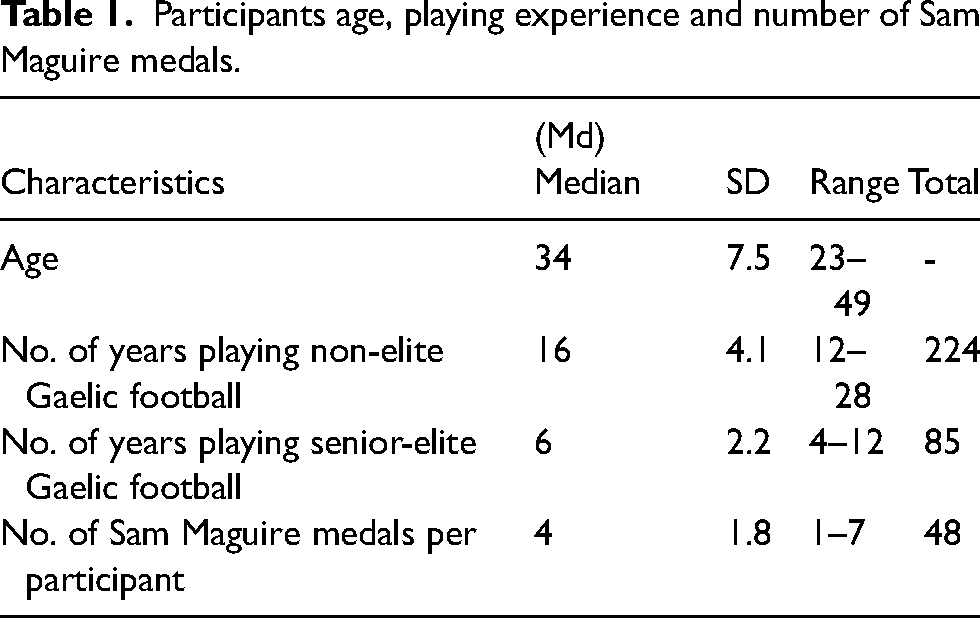
Following submission and approval by the lead researcher's (LR) University Ethics Committee (REF: 2023- 45089-2), 14 potential participants were purposively selected. 30 The LR contacted the potential participants, all of them personal contacts from his Gaelic football coaching experience. Criterion sampling was used to ensure participant consistency. 31 Participants were selected based on inclusion criteria identifying adult (age range 23–49) male elite players who: (1) were senior inter-county Gaelic football players, (2) had won at least one Sam Maguire medal (representing the highest-ranking medal in Gaelic games) within the last seven years. This criterion ensured the inclusion of successful elite athletes who not only competed at the highest level but had also achieved success such as winning a national title. 25 To illustrate this elite level, only 26 senior players are awarded Sam Maguire medals each season (0.009% of players). Demographic information for of each participant is provided in the Table 1.
Participants age, playing experience and number of Sam Maguire medals.
Procedure
Participants were informed about the purpose of the study and signed informed consent. A semi-structured interview guide was designed by the research team to unearth experiential, contextual, and situational factors perceived by participants to impact their experiences during HT covering the following concepts: (1) player needs at HT; (2) format and structure of HT; (3) content and delivery styles of coaches; (4) positive and negative experiences of HT; and (5) player recommendations to improve HT. The guide consisted of open-ended questions, along with potential prompting questions to facilitate a deeper exploration of specific issues brought up by participants. 28 Following two pilot tests, the interview guide was streamlined from 18 to 14 questions to remove overlapping questions. For example, one on HT environmental support (i.e., external resources or surroundings that help individuals meet their needs) was deleted due to similarity with a question relating to personal needs.
At the start of each interview, participants were reminded of the research objectives and confidentiality. Then, participants were asked questions covering pertinent background information and selective demographics to promote ease throughout the interview. 32 The interview then shifted to explore players’ HT experiences. At the end, participants were debriefed on the research and confidentiality was re-assured. Each participant was interviewed once using the online platform Zoom and all interviews followed a semi-structured approach. Adopting an interpretivist paradigm involved the LR employing an active listening approach during the interviews, encouraging participants to share their beliefs and perceptions. 33 Maintaining neutrality while emphasising the importance of participants’ insights aimed to foster a supportive environment, allowing participants to express their genuine thoughts and interpretations of past events. 34 Interview duration ranged between 39 and 132 min (Mduration = 71 min), reflecting their flexible and semi-structured format. Longer interviews occurred when participants decided to elaborate on more sensitive and emotionally charged HT past experiences.
Data analysis and trustworthiness
Over 18 h of interview recordings (1136 min were transcribed verbatim into separate Microsoft Word documents for each participant. 35 This provided 203 pages of single-lined-spaced text that were thematically analysed following Braun et al.'s36,37 six-stage approach. First, the first author took notes while conducting interviews that were reviewed and discussed with a member of the research team during the familiarisation phase (i.e., re-listening, reading, and re-visiting interviews and notes) to further immerse himself in the data. 38 Then, multiple readings of transcripts were taken to identify potential candidate themes within data. This involved dividing the text into small units of sentences or paragraphs that were assigned labels to identify patterns and connected ideas, 39 subsequently developed and refined to ensure they matched both data and coded extracts. This iterative process, involving further reflection on the transcripts, enabled the clustering of codes around common concepts into higher and lower-order themes. 37 The themes were then reviewed to ensure they consistently represented participants’ experiences, with re-working and re-examination being warranted. After this stage, a final structure was decided (i.e., 3 higher-order themes that stemmed from 9 first-order themes) (see the Figure 1).
Reflexive analysis highlights the LR's critical reflection and subjectivity throughout the process. 37 To ensure trustworthiness, ‘critical friends’ provided feedback, refining interpretations. 38 The LR worked with co-authors to review themes, challenge data allocation, and ensure meaningful resonance and depth to findings. 39 This reflective process led to revisions, including reducing higher-order themes from four to three and renaming all higher and first order themes. The final thematic structure was agreed upon by all authors.
Findings and discussion
This study examined players’ accounts of their experiences and expectations of HT. A reflexive thematic analysis of the interview data unveiled various perspectives and shared aspects among elite players, which were grouped into three higher-order themes (Figure 1).
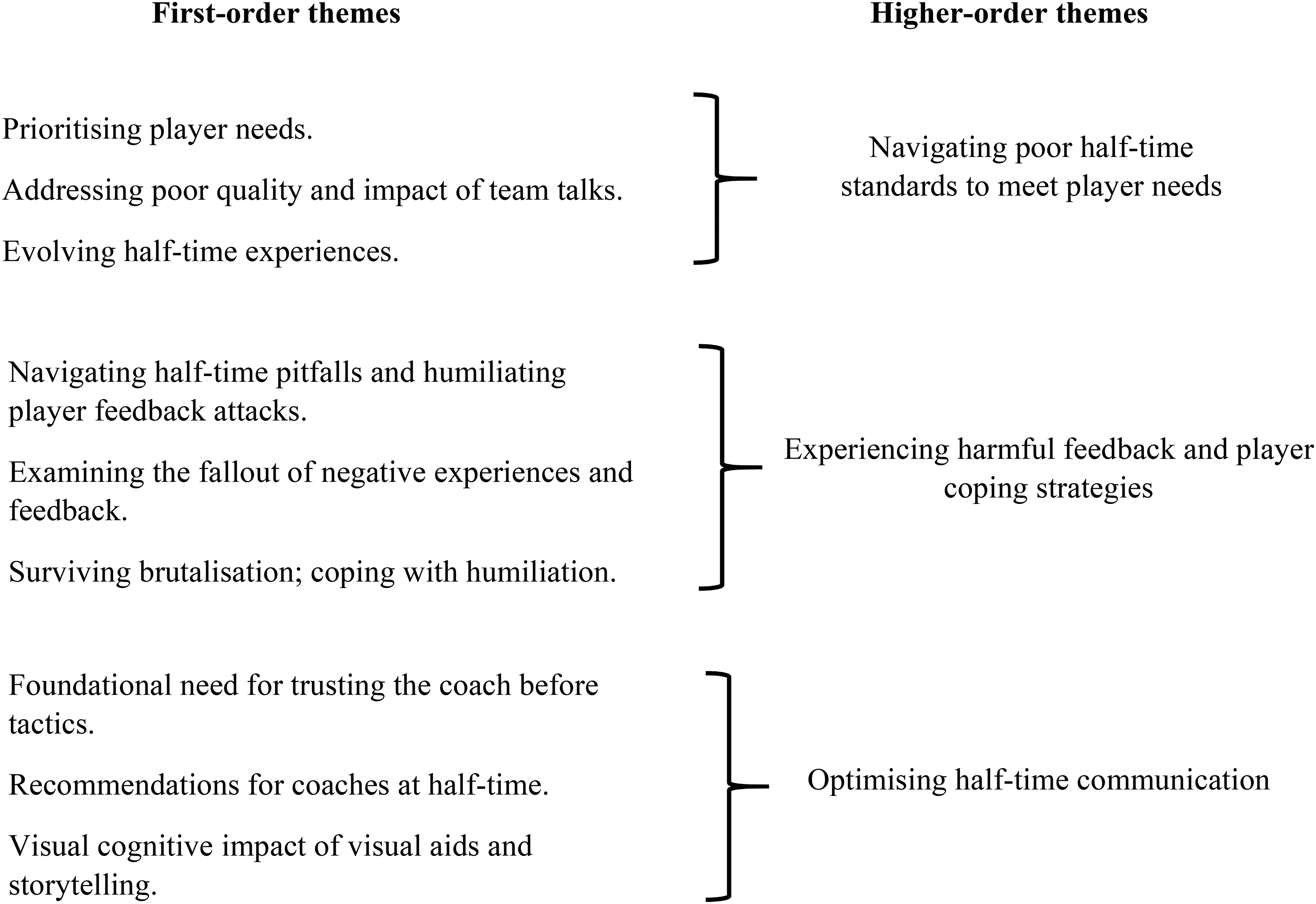
First and higher-order themes of semi-structured interviews.
Navigating poor HT standards to meet player needs
Addressing physiological needs at HT has been highlighted by athletes as a significant strategy for enhancing second half performance.
40
In the current study, nearly all players reinforced the intermission as a critical period for “physically recovering” and “refuelling”. Considering the intense physical demands of Gaelic football,
41
meeting physiological needs (i.e., hydration, food, and rest) becomes essential for optimal physical functioning.
42
In addition, players also stressed the importance of addressing emotional needs during HT due to the intense “war on the pitch”. Thus, creating the right environment to “physically and psychologically regroup” was considered important for fulfilling these needs and preparing to return “stronger and more composed” in the second half. Paul: You physically need a break. You need a rest and a drink, some food and tend to injuries. Half-time isn’t just a pause…it's a vital window to refuel, reset and refocus. Half-time can shift the momentum, turning a potential stumble into a second-half surge. Brendan: You’re completely drained, body aching, lungs burning, and before you even catch your breath, the manager is in your face. I needed space to reset, not more noise from the management team. Paul: We need more time to land and recover. Half-time is for us [the players], our benefit, not for coaches to show how clever or angry they are.
Furthermore, prior research suggests that coaches believe they are “very effective at coaching during intermissions”
2
(p216). However, this contrasts with findings on athletes’ post-match recall of feedback, where players remembered only 6% of the content one-week later.
51
Similarly, Mesquita et al.
52
found that Judokas poorly retained pre-competition coaching information, often recalling inaccurate details. This supports the present study, as participants expressed dissatisfaction with HT talks’ quality and admitted forgetting the vast majority of the content of their coach's talks because they often perceived them as repetitive and forgettable. Overall, consistently ineffective HTs were deemed “missed golden opportunity” to address technical insights and provide leadership. Sean: His [the manager's] team talks were like a podcast I didn’t subscribe to, just noise. I’d hear the first 20 s, then drift off. The words never stuck.
Stephen “Half-time? It's just recycled clichés ‘You must do this’, ‘You’re not doing that’, ‘We need to want it more’, ‘First ten minutes are key’, ‘Play for the jersey’. It's always the same; mundane, repetitive, and forgettable.
Mick: Half-time team talks followed the same routine: Too much information, boring, low quality. Also, the entire management circus [coaching staff] feels the need to speak with an ‘and another thing’ - it's just a relentless flood of unstructured words. Most blur into a monotonous haze. Brendan: Half-time team talks? I zone out completely. Every Sunday, the manager goes on for over seven plus minutes. By the end, I can’t even remember how it started. Cillian: But I remember the impactful half-times. When they ordered and structured, they can land right and make a difference to how I feel. Padraig: A powerful half-time talk can galvanise the team towards victory if it's concise, thought-provoking, creative, and grabs our attention. Sean: Half-times are now less psychological warzones, more ordered and stat-based, but there's also less honesty and truth flying around. Paul: When I started playing, half-time was chaotic. No structure. Tactical input was rare, just bluster and loud noise. Half-time is now more methodical, less aggressive, and more politically correct.
This shift towards more structured HT talks, while fostering a more constructive environment, has led some participants to reflect on the potential loss of emotional intensity and honesty.
Experiencing harmful feedback and player coping strategies
Research has demonstrated the negative feedback features exhibited by coaches during HT speeches. Specifically, Avugos et al.
4
identified that under-21 football coaches heavily relied on criticism. Coaches might resort to negative public feedback (i.e., castigations and shouting) despite of the detrimental effects that highlighting negative performance in front of teammates might have on certain players.
54
In the current study, participants stated an existing prevalence of negative feedback during elite HT talks, with most players recalling a minimum of two instances and noting that highlighting mistakes publicly affected players negatively. Michael: The manager said, tell me where’ve you been today? The game started 45 min ago. You’re fucking useless. You’ve made three key mistakes so far. Sean: I don’t need my errors pointed out by a baldy retired player [the manager].
Aidan: I just stood there frozen. It was humiliating, not just for Peter, my teammate, my friend. I felt helpless for Peter and I regret, to this day, not standing up for him and challenging the manager.
Similarly, four participants, including Tony and Stephen, shared vivid childhood memories when asked to recall a negative HT experience. Tony: It was a warm day and I couldn’t breathe properly. I asked to be substituted at half-time. The manager just laughed at me and refused to take me off. That resentment has stuck. I was 11 years old [31 years ago to date of the interview]. Stephen: Half-time was where I learned to shut down. I got screamed at for not ‘trying hard enough’ when I was a junior player. From then on, I just kept quiet and nodded. Cian: Drained, dejected and devoid of confidence. I was mugged of my self-esteem. I wanted to leave before the start of the second half. I wanted it to end. Sean: After the selector [assistant manager] tore into me about my ‘cowardly’ first-half performance, I remember thinking, Christ Almighty, if I'm that bad, what the hell am I doing here? Padraig: The criticisms, sometimes unfairly, was rough, and I felt it, but ultimately they made me a more resilient and better player. John: The feedback was brutal at times, but this is elite football - the objective is to win. I liked the manager being direct, but not all players did, especially those who were soft [sensitive].
This tension between fostering psychological safety and employing fear-based approaches is evident in how players cope with negative feedback. Among the eight participants who affirmed having experienced humiliation during HT talks, two coping strategies were identified. First, five participants described using distraction techniques to block out the “external noise” (i.e., the coach), mentally “shutting down” to shield themselves from the harsh criticism and minimise its impact on their performance. Second, the remaining three participants reported using negative comments as motivation, aiming to “prove the coach was wrong.” However, research by RayatSarokolaei et al.
64
indicates that although 5% of adolescent football players reported feeling motivated after experiencing emotional abuse, the vast majority internalise such experiences in harmful ways, resulting in negative emotions like guilt and shame.
65
This is reinforced by Moll and Cherrington,
66
who highlighted that coaches’ expressions of pride and shame can have a direct impact on players’ performance increasing or decreasing it, respectively.
67
Aaron: When I or the team get targeted with the hairdryer treatment [scolding], I try to switch off but it was hard and depended on my mental state of mind. Brendan: I'll show him - that washed-up former and retired player he's wrong.
Interestingly, certain players in this study attempted to “tune out” from criticism.
John: I drowned it out - I knew what I needed to do in the second half. The noise, after a while, did not register.
Whilst personality traits might play a role for players to receive HT feedback, these findings do also suggest that experience might be critical for players developing varying coping mechanisms to navigate the intense pressure and emotional toll of harsh HT feedback.
Optimising half-time communication
Participants expressed several recommendations for coaches to improve their HT delivery. First, they unanimously emphasised the importance of trust in the manager as a foundational pre-condition for effective HT communication, a factor that must be established in advance of the game and HT. Elite players place significant value on the level of trust between themselves and their coach68,69 and this coach-athlete relationship grounded in trust, honesty, and mutual respect seem to constitute a strong bond to foster development.
70
This trust seemingly “sets the tone” for the environment in the changing room, with participants reporting that when trust of the coach is present, the atmosphere shifts “from fear to focus” when the coach enters at HT. Sean: Trust is the precursor to unlocking the door to effective team talks. Without it, no tactic or strategy will ever have the impact it should. Mick: Once the manager steps in, the atmosphere shifts completely - it's like a switch flips. Trust in him creates a sense of calm and focus, allowing us listen and absorb what's being said. There's a sense of relief, the manager's taking over. Cillian: The manager said, ‘Brilliant, brilliant stuff. You’re putting in a man-of-the-match performance there.’ I felt invincible. Mick: Three points for coaches at half-time: Identify the issues, find solutions, and provide an actionable plan to fix the problems. Sean: I don’t want a running commentary of the first half from the manager. Plus, his summary of often inaccurate. I need instructions on what I should be doing. Aaron: Give us [the players] a proper voice at half-time…it should be more player-led. Too much control at HT is exerted by coaches. Brenden: The best half-times I’ve been in were when the players actually talked to each other, not just sat there getting told stuff in a one-way lecture. Cian: We learn best visually. Visual aids, video clips, and stills are key to our understanding. Coaches should use fewer words and more visuals to convey the story of the game. Aaron: I always understand things quicker with visuals. One freeze-frame can explain what seven minutes of talking can’t. Mick: Biggest game of my life. I can still hear the smash of that plaque in the shower - sharp, sudden, electric. In that moment, something clicked. It wasn’t just noise; it was fuel. Fire. Belief. Coach storytelling at its best. Brenden: Nine points down at half-time. Beaten. Hopeless. Then our manager walked in - vulnerable for the first time. ‘I got it wrong. The gameplan wasn’t right. But you can put it right.’ Raw honesty. By the time we left that room, we weren’t the same team. Stephen: The manager forced us [the players] to trample over the opposition's jersey thrown on the ground before returning to the field. Dara: Compassionate leaders, in control, tactically aware, and, when needed, able to unleash - painting a vivid picture with their actions.
Limitations and future directions
Despite the present study constituting the first investigation examining HTs in Gaelic football and offering valuable insights from male elite players through a rigorous methodology, this research was not without its limitations. Using purposeful sampling and a descriptive qualitative design, this study aimed to explore context-specific lived experiences rather than achieve broad generalisability. 88 While this approach provides depth and nuance, the reliance on self-reported data introduces potential recall and social desirability biases. 88 Additionally, the absence of video recordings of HT experiences, interviews occurring during the in-season period, and the lapse time for retired players since their last HT talk may have affected response accuracy.
Future research should include female players and players at various competitive levels and categories to establish initial comparisons across contexts. Further, incorporating diverse data sources, systematic video-based or field observations, and using quasi-experimental designs along with quantitative methods would enhance findings and provide further insight into the psychological impact and effectiveness of HT strategies.
Practical implications
When planning HT breaks and delivering HT talks, awareness of players’ HT experiences and preferences (e.g., more time left alone at changing room to meet physical and emotional needs, less information, and more emotional control from the coaches) can be beneficial though player preferences might not always equal to HT needs. First, allowing players time to recover and plan a specific HT protocol for the HT situation can enhance its effectiveness. Second, an appropriate balance between praise combined with targeted second half instructions can reinforce player confidence and provide clear objectives without fostering complacency. This would generate talks an environment projecting confidence while acknowledging challenges, outlining the most relevant forward-looking tactical and psychological messages, and avoiding excessive retrospective analysis. In addition, clarity and inspiration during adversity could be maximised using visual aids and storytelling, respectively. Furthermore, players’ experience seems to be a relevant factor for coaches using criticism, as most players stated being potentially negatively affected except more experienced players with more developed coping capabilities, thus, reinforcing the importance of individualising delivery style.
Conclusion
This study highlights the importance of clear, constructive communication and balanced feedback for effective HT talk delivery. It also emphasises the value of a calm and tactically-focused environment, supported by visual aids. The quality of HT talks was generally deemed inadequate, with excessive information leading to cognitive overload and player disengagement. Players emphasised the HT break as a crucial period for physical and psychological recovery and most participants found speeches to be mundane, repetitive, and ineffective, resulting in missed opportunities to provide meaningful guidance. Moreover, excessive negative feedback was a key concern, with harsh criticism often undermining confidence and morale. In fact, participants were able to recall instances of humiliation describing the psychological harm experienced long-term retrospectively. Whilst certain players perceived scolding as a motivator to increase performance or refined strategies to avoid the negative influence of harsh talks, most preferred receiving constructive feedback and encouragement. Furthermore, participants stressed the value of concise and problem-solving communication, visual aids enhancing message clarity, and storytelling increasing inspiration in moments of adversity, with a specific focus on the second half (rather than reflecting on the first half). These findings suggest that players’ perceptions of effective HT coaching are related to effective recovery, tactical clarity and concision, and meaningful psychological management (i.e., inspiration) as required per each specific HT situation.
Footnotes
Ethical considerations
Ethical approval was obtained from Brunel University Ethics Committee (REF: 2023- 45089-2).
Consent to participate
Participants were informed about the purpose of the study and signed informed consent.
Declaration of conflicting interests
The authors declared no potential conflicts of interest with respect to the research, authorship, and/or publication of this article.
Funding
The authors received no financial support for the research, authorship, and/or publication of this article.
