



Abstract
Coxing is a highly specialised skillset in the sport of rowing which has received limited research to date. The aim of this study was to explore what elite coxswains say during rowing races. The study involved a thematic analysis of coxswain recordings that were publicly available on YouTube. Sixteen elite coxswain recordings were found and eight met the inclusion criteria. Video recordings were from the following competitions: one from the World Senior Championships (2011), one from the World Under-23 Championships (2021), one from a World Cup (2022), two from Henley Royal Regatta semi-finals (2015 and 2022) and three from Henley finals (2014, 2017 and 2022). Coxswains made an average of 32 calls per minute. Out of the coxes’ total calls, 94% were directed towards the crew however on occasion coxes directed calls to individual rowers or specific sections of the boat (e.g., bow side). The content of the elite coxswains’ calls was classified under three themes: technical calls (40.4% of total calls), motivational calls (38.6%) and tactical calls (21%). In addition, four themes were developed in relation to how coxes delivered the calls: the direction, timing and tone of calls, as well as the use of chiding. This exploratory study provides a first step towards gaining a richer and broader understanding of what elite coxswains say during races and may stimulate reflection among coxswains and rowing coaches. The findings provide a basis for evaluating coxswain education and future research.
Introduction
The sport of rowing is competed over 2000 m. There are fourteen Olympic and five Paralympic boat classes. 1 Rowing can be divided into two technical disciplines: sweep rowing, which is performed with one oar and sculling, which is performed with two oars. There are also coxed and coxless boat classes. A coxswain (cox) steers a rowing boat and provides information (or calls) to their rowers during training and racing. 2 At Olympic and Paralympic level, three boat classes are coxed (the men's/women's eight and the Paralympic mixed four) while at club and junior level the coxed quadruple scull, coxed octuple and coxed four are widely contested events. The role of a cox is often poorly understood3,4 however they play a crucial leadership role as an in-boat coach and often act as the middleman/woman between the crew and coach while also ensuring the safety of the crew.4,5 During training or racing, rower's backs are positioned towards the finish line/end of the river or lake, unlike land-based sports such as running or cycling where an athlete can see their direction of travel. Therefore, steering safely and effectively is vital. A crew must trust a cox to keep them safe, communicate effectively and control the race or training plan on the water.4,5 Despite their importance in rowing, limited research has evaluated what coxes do and how they impact their crew.3,4,6
One way in which a cox might influence performance is through manipulating rowers’ attentional focus. Attentional focus is the process by which an individual devotes mental energy to cues, stimuli, or situations in relation to their performance in sport. 7 Attentional focus is often categorised into an internal, external or holistic focus of attention. An internal focus (IF) refers to instructions or feedback directed at the body movements being performed (e.g., drive with the legs) while an external focus (EF) directs attention to the effects of those body movements on the environment (e.g., push the foot stretcher away). 8 A holistic focus (HF) refers to the general feeling of the movement (e.g., “explosive” when referring to the leg drive in rowing).9,10 An EF and HF has been found to be advantageous and can improve both performance and learning in a variety of tasks and sports with participants of diverse expertise, skill, and age profiles.10–13 However, a number of studies in rowing suggest that a combination of IF and EF may be required.14,15 For example, Neumann and colleagues 15 assigned 27 novice rowers to three groups – an IF, an EF or a switching focus of attention group. The IF and EF groups consistently focused on an IF cue and EF cue respectively, while the switching group changed focus every 250 m. Performance was assessed using a 2, 000 m rowing ergometer test and was best in the switching group.
Gabana 6 investigated the effects of a cox on attentional focus, rate of perceived exertion (RPE), motivation and 1000 m rowing ergometer performance in 26 collegiate rowers. Attentional focus was measured using Tammen's 16 attention scale which ranges from 0 to 10, with 0 representing an IF and 10 representing an EF. Participants were also asked to rate their attentional focus on a second scale designed to capture the task-relevant versus task-irrelevant dimension of attentional focus. 17 This scale ranged from 0 (thoughts related to the task) to 10 (thoughts unrelated to the task). The findings indicate the attentional focus of the cox group during a 1, 000 m rowing ergometer performance was significantly more EF when compared to a control group (p < 0.01) and motivation was significantly higher (p = 0.02) however RPE and rowing ergometer performance did not change. A limitation of this study is that an audio recording of a cox was used within a laboratory setting. Despite this, the effects on attentional focus and motivation suggest that further research is warranted.
Several investigations have explored the attentional focus adopted by practitioners in a more natural environment, 18 such as coaches working with athletes 19 or physiotherapists working with clients. 20 Such investigations can reveal areas where practice deviates from the recommendations of the literature and identify novel areas for research. The experiential knowledge of successful practitioners and coaches can guide empirical research on sports performance.21–23 In a similar vein, exploring the current practice of coxswains may reveal important strategies to guide future research and educational initiatives. A cox's role is not restricted to the provision of technical guidance during the race; they are also responsible for steering the boat, overseeing the implementation of race tactics, motivating the crew and ensuring that they operate as a unit.3,6,24 However, this broader role has received no investigation in the literature. Consequently, the aim of this exploratory study is to examine what elite coxes say during rowing races. The findings will be compared to current literature and will help to provide a basis for both cox education and future research.
Methods
Sourcing data
The study involved a thematic analysis 25 of cox video recordings that were publicly available on the YouTube video platform (www.youtube.com), using the guidelines provided by Sui. 26 YouTube was used as the source of data collection because it yielded a diverse sample of cox recordings that were publicly available, readily accessible, and not subject to the geographical and logistical constraints typical of collecting offline data.26,27 A search of the YouTube platform was conducted on 17th April 2024 using the search strategy: “cox* recording world OR henley OR Olympic* OR euro* -junior,”. Video recordings were eligible if they met the following inclusion criteria: 1) the cox had to be elite, which is defined as competing at the Olympic Games, World Championships, World Cup, Henley Royal Regatta semi-finals/finals or European Championships, 2) the recording had to be from an under-23/senior level competition and 3) the recording needed to include the full race video with high quality audio to ensure accurate transcriptions. Where multiple recordings were available for a cox, only the most recent recording was used.
Data analysis
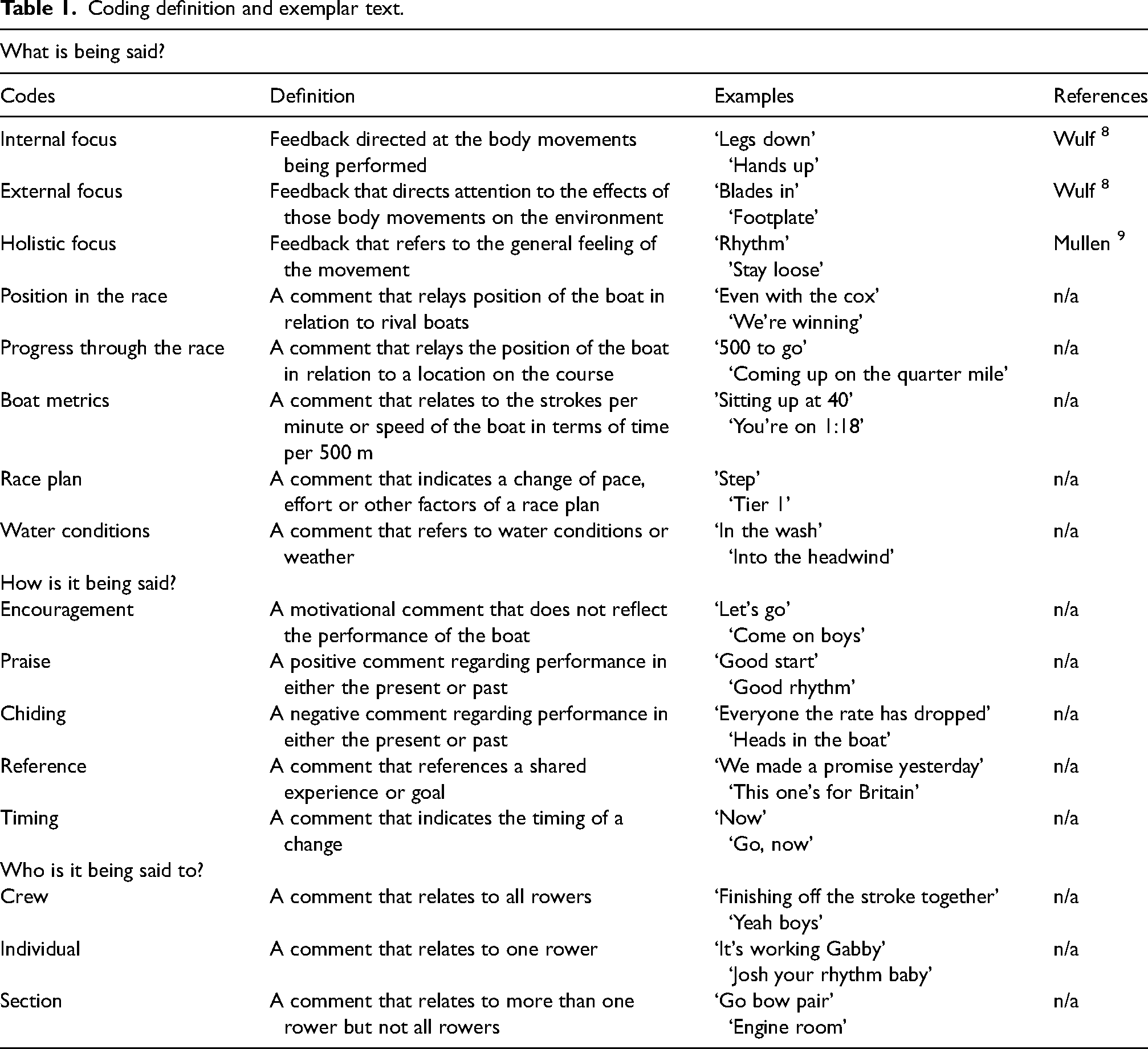
The video recordings were transcribed verbatim by the primary investigator and data was analysed using Microsoft Excel. The first phase of the thematic analysis 25 involved familiarisation with the data to establish a draft coding framework. 28 The research team had some preliminary ideas about how to organize the data (e.g., content and delivery of communications) and had a provisional deductive framework for coding the attentional focus of instructions (IF cues, EF cues and HF cues). The framework also included the following questions – 1) What is being said? 2) How is it being said? and 3) Who is it being said to? However, there was an inductive aspect to the development of the framework also based upon the team's observations when interacting with the data. That is, each author independently reviewed two videos that were randomly selected and from a discussion of observations the coding framework was further refined to include detailed definitions and exemplar text (Table 1). 28 The second phase involved generating codes from the full set of recordings. This phase was completed by the primary investigator and reviewed by the entire authorship team. Disagreements were resolved through discussion until consensus was reached. The third phase involved sorting the codes into candidate themes that reflected the overall content and meaning of the data. The primary investigator presented options for consideration at group meetings, focused on whether the relationships between codes and themes formed a coherent pattern. During these meetings, the definition and broad organisation of the themes was agreed (fourth phase). This fourth phase also involved reviewing the thematic structure against the transcripts to ensure that no elements had been missed or misrepresented in the initial coding. In the fifth phase, the themes within the refined structure were defined. In the final phase, several drafts were written up with a focus on selecting the most illustrative examples and the sequencing of the narrative.
Coding definition and exemplar text.
Techniques to enhance trustworthiness
Several procedures were followed to enhance trustworthiness of the findings. 28 All data (transcripts, coding, reflexive journal maintained by the primary investigator, etc.) was stored in a central repository with a unique identifier for each source (i.e., participant code and date) to provide an audit trail which detailed the decisions made by the authors regarding theoretical and methodological issues throughout the study. 29 Peer debriefing was used by the authorship team (one rowing coach/sport scientist, one skill acquisition specialist and one sports science student) throughout the coding and theme development process to help the authors examine how their thoughts and ideas evolved as they engaged more deeply with the data. 30 All themes and sub-themes were discussed and agreed upon during meetings with the authorship team. The final procedure involved inviting responses to our findings from key stakeholders to gain a sense of generalizability. 31 Specifically, identified themes were shared with an Olympic medallist cox who reported that the findings overlapped with their experiences and the experiences of others.
Results
Sixteen elite cox video recordings were found on YouTube and eight met the inclusion criteria. Six recordings were excluded because they were of the same cox, one recording was excluded due to poor audio quality and one recording was excluded as it was incomplete. The video recordings lasted an average of 6:11 min (range 5:31–7:36 min) and were from the following competitions: one from the World Senior Championships (2011), one from the World Under-23 Championships (2021), one from a World Cup (2022), two from Henley Royal Regatta semi-finals (2015 and 2022) and three from Henley finals (2014, 2017 and 2022). Six crews placed first and two crews placed second while all recordings were of the coxed eight event. Five coxes were male, and three were female. Five video recordings were of coxes from the UK, one from Australia, one from Canada and one from the USA. Figure 1 provides a summary of themes and sub-themes generated from the thematic analysis.
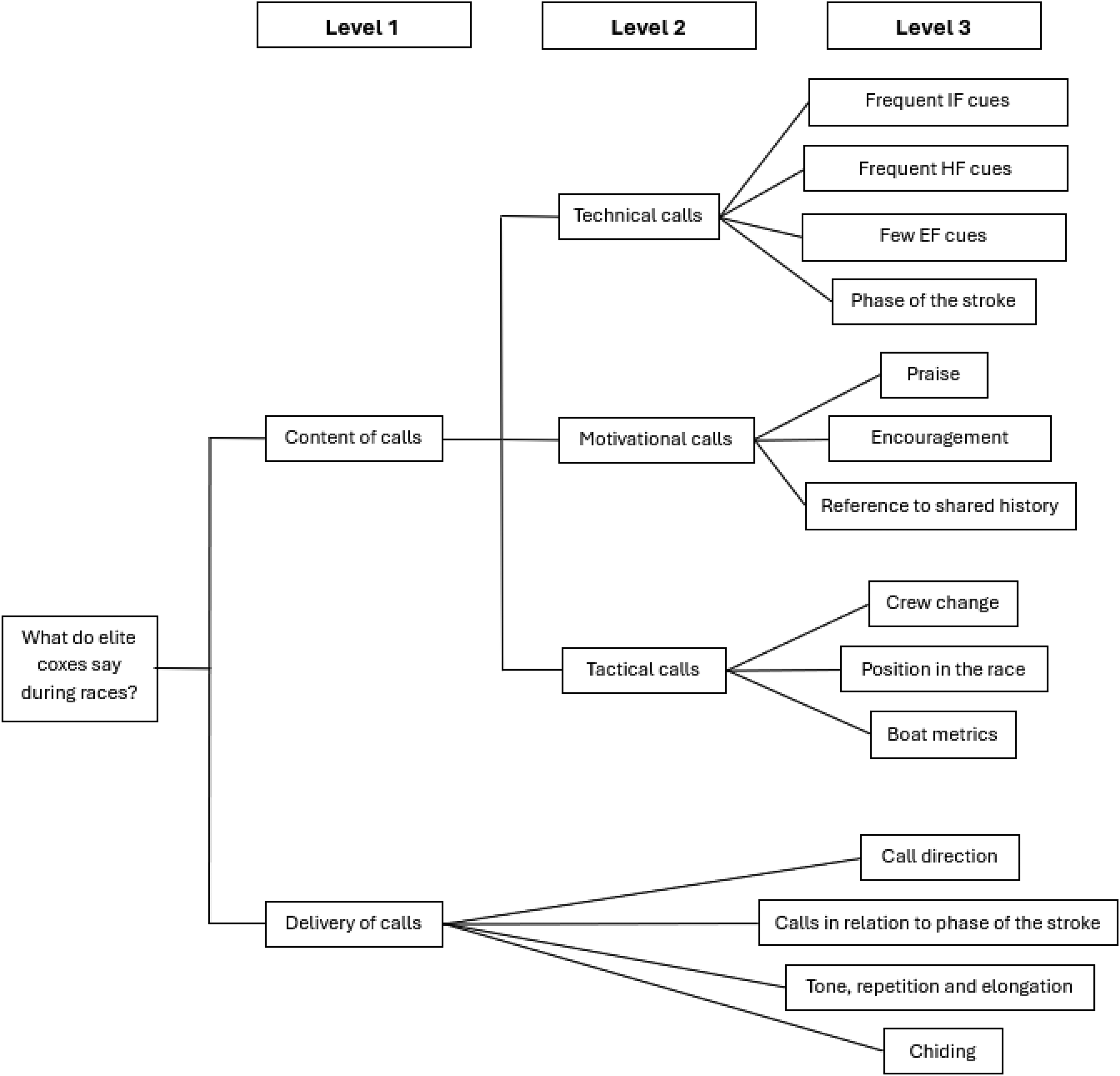
Main themes and sub-themes of thematic analysis. IF, internal focus; HF, holistic focus; EF, external focus.
Content of calls
Technical calls. Out of the coxes’ total calls, 40.4% were technical calls during a race. The majority had an IF and referred to instructions or feedback directed at the body movements being performed 8 such as ‘through the toes’ (Cox [C]2), ‘legs, hips’ (C5 and C6), ‘on the heels’ (C8) and ‘hands up’ (C1). Interestingly, all coxes used IF cues which directed attention towards the legs such as ‘legs down’ (C1 and C5), ‘legs’ (C2, C3, C4, C6 and C8), ‘legs on’ (C6), and ‘let's squeeze the legs’ (C7). Coxes also provided a large amount of HF cues which refer to the general feeling of the movement 9 such as ‘stay loose’ (C3, C4, C5 and C6), ‘squeeze’ (C2, C7 and C8), ‘stay clean, stay sharp’ (C3), ‘rhythm’ (C3 and C5) and ‘long’ (C4 and C6). However, EF cues which directed attention to the effects of body movements on the environment 8 such as ‘in and on through the front’ (C1), ‘footplate’ (C3) or ‘blades in’ (C5 and C7) had limited use by coxes. Focus of attention cues were primarily directed towards the drive phase of the rowing stroke followed by the catch phase, however one cox (C8) did provide numerous cues directed towards the finish and recovery phase of the stroke such as ‘push the finish longer’, ‘tidy around the finish’, ‘hold the knees’, and ‘separate and rock’.
Motivational calls. Out of the coxes’ total calls, 38.6% were motivational calls during a race, and they generally included praise (‘good start’ [C1 and C4], ‘good rhythm’ [C3 and C5]) or encouragement (‘we can take them’ [C2], ‘we’re walking’ [C7], ‘they’re not going to know what hit them’ [C8]). Motivational calls appeared to increase in the final minute of a race (‘yes boys’ [C5, C6 and C8], ‘courage’ [C1], ‘end it’ [C5 and C6]). Some coxes referred to a shared history such as ‘we made a promise yesterday at this point’ (C1), ‘10 months, every erg, every session together for this one ####### moment’ (C5) or ‘fight here seniors our last race’ (C7).
Tactical calls. Out of the coxes’ total calls, 21% were tactical calls which typically involved a crew change, and this usually began by preparing the crew for the upcoming change such as ‘ready?’ (C1, C3, C4, C5, C6, C7 and C8) or ‘in two, in one’ (C3, C4 and C6). These preparatory instructions were normally followed by the actual technical or tactical change – ‘go’ (C2, C4, C6 and C8) or ‘this one, now……legs, bodies’ (C1) or ‘this one, now……face out’ (C2). Coxes provided rowers with their position at the start, middle and end of a race such as ‘coming up on the 500 m mark/quarter mile’ (C4 and C8), ‘on the X seat’ (C1, C2, C4, C6 and C8) or ‘X meters to go’ (C1, C2, C3, C4, C5 and C6). They usually followed this up with how this position was changing or not changing throughout the race – ‘we’re coming back with the Americans’ (C3), ‘moving out to 2 lengths clear’ (C4) or ‘still sitting on that bow ball’ (C8). Most coxes also provided rowers with boat metrics such as stroke rate – ‘36 and a half’ (C4) and/or boat speed – ‘you’re on 1:18’ (C3) or ‘still on 1:30's’ (C5).
Delivery of calls
Coxes made an average of 32 calls per minute and delivered calls in a distinct pattern. Out of the coxes’ total calls, 94% were directed towards the crew however on occasion coxes directed calls to individual rowers (‘in and on Nick’ [C1], ‘yeah Mikey good rhythm’ [C3], ‘Buck I need you right now’ [C6]) or specific sections of the boat (‘more bow four’ [C2], ‘good port side let's stay on it here’ [C7], ‘ok bow pair keep picking up nice and tidy’ [C8]). Coxes made their calls in relation to the timing of the main phases of the stroke – the catch, drive, finish and recovery phase. Calls such as ‘sharp’ (C4) were made during the catch phase (i.e., when the oar is being placed in the water) or ‘legs, hips’ (C5) were made during the drive phase (i.e., when the oar is in the water). Coxes also made calls that were divided across two phases of the stroke such as ‘legs, there’ (C8). This was verbally delivered as ‘legs’ (during the drive phase) and ‘there’ during the finish phase (i.e., at the end of the drive phase). Another example was ‘legs, loose’ (C3, C6) where ‘legs’ was said during the drive phase and ‘loose’ was said during the recovery phase (i.e., when the oar is out of the water). It was common for coxes to manipulate their tone of voice (i.e., loud, quiet or increasing in tone), use repetition or elongation of words. For example, C5 said:
Coming up on the ¼ mile, stay loose, stay relaxed [quiet], stay relaxed, stay relaxed, yeah boys [loud], coming up on the rhythm call [quiet], loose [quiet and elongated], there [loud and elongated], there, there, there [increasing in tone and elongated].
Similarly, C3 said: The Germans gone out hard we’re about two seats down [quiet], getting ready for the one-minute boys [increasing in tone], here we go, long rhythm, in 2 [loud], in 1 [increasing in tone], rhythm baby [loud], now [increasing in tone and elongated], rhythm, legs, legs, legs [loud and elongated], good speed [quiet].
Most coxes delivered calls that were positive in nature however some coxes chided their rowers (‘cleaner now boys’ [C3], ‘eyes in’ [C7], ‘back end 5’ [C8]) and one cox (C2) provided extensive chiding throughout the race – ‘together Jess, head in the boat’, ‘everyone the rate has dropped’, ‘bow pair you need to empty it right here’.
Discussion
The aim of this exploratory study was to examine what elite coxes say during rowing races and compare the findings to current literature. The content of the elite coxswains’ calls was classified under three themes: technical calls, motivational calls and tactical calls. In addition, four themes were developed in relation to how these coxes delivered the calls: the direction, timing and tone of calls, as well as the use of chiding.
Coxes made an average of 32 calls per minute (around 1 call every 2 s) which indicates there was little to no silence during a race. This rate of commentary is much higher than has been observed in team sports32–34 or boxing. 35 For example, Halperin et al. 35 reported boxing coaches providing an average of eight statements in the one-minute break between rounds, while Zach 33 reported that basketball coaches provided 2.54 feedback statements per possession. Contextual factors such as the duration of the competition, the proximity to the performer and rowers facing away from the direction of travel may contribute to the higher rate of commentary observed within rowing. High performance coaches have reported a tension between providing enough feedback to provide adequate direction to athletes, but also not providing so much feedback that athletes were overloaded. 36 The high volume of information provided by coxes suggests that this tension between direction and overload should be an important consideration for coxes also.
The majority of technical calls had an IF (e.g., ‘legs’, ‘on the heels’, etc.) despite strong research evidence suggesting an EF (e.g., ‘footplate’, ‘blades in’, etc.) may be more advantageous.11,12 The beneficial effects of an EF include an increase in the effectiveness of movements and their outcomes, the efficiency with which movements are performed and automaticity in the control of movements 11 ; all three of which are desirable characteristics of rowing. However, rowing is a continuous cyclic movement and differs from acyclic movements involving a short period of movement (e.g., golf putting, dart throwing, jumping, etc.), which have been primarily investigated in attentional focus research.11,12 Rowing requires an athlete to sustain their attention over a longer period than many acyclic movements and the attentional foci are potentially more numerous and complex, such as balance, posture, stroke mechanics, competitors, time, distance, the effect of movement on seat, boat, oars, etc. 15 Neumann 14 found that focusing on IF cues instead of EF cues resulted in improved 6 min rowing ergometer performance. However, a later study by Neumann 15 found that switching between IF and EF cues resulted in better 2000 m rowing ergometer performance. Despite this, both studies were on novice rowers14,15 and the coxes in our study were working with elite rowers. Schücker 37 investigated the effects of attentional focus on oxygen consumption (VO2) in 18 highly trained competitive rowers and found that VO2 increased when an IF cue was provided which indicated a greater physiological demand and thus lower movement economy, while research in other cyclical tasks such as swimming has also demonstrated a detrimental effect of adopting an IF.38,39 Nevertheless, in our study elite coxes provided numerous IF cues which appears to conflict with guidance from research. 11 In addition, all coxes extensively used IF cues which directed attention towards the legs such as ‘legs down’, ‘legs’, or ‘legs on’. This aligns with the findings of previous research that indicates 45% of the total propulsive force during the stroke is generated by the legs, 32% by the trunk, and 23% by the arms. 40
Coxes also made use of HF cues (e.g., ‘stay loose’, ‘squeeze’, etc.). A HF may be beneficial to rowers due to the continuous and rhythmic nature of the sport and the complex coordination required between body parts, oars, boat and water. 9 Holistic cues which focus on the general feeling of a movement could potentially help to reduce conscious control of a movement and could lead to better performance under competitive pressure. 9 Research indicates that holistic cues are effective13,41 and may be particularly useful in complex tasks such as rowing where technical components such as fluidity, relaxation, boat run, rhythm, etc are crucial. 42 In our study, coxes also directed attention towards specific phases of the rowing stroke, primarily the drive phase followed by the catch phase. This is not surprising as evidence indicates that the majority of muscle activity 43 and power output40,44 occurs during the catch and drive phases of the stroke. Interestingly, one cox provided numerous technical calls that were directed towards the finish and recovery phase which are also vital elements of the rowing stroke 42 and this may reflect between crew preferences with regards to technical calls.
Coxes provided numerous motivational calls throughout a race, and this may be because rower's backs are positioned towards the finish line, unlike land-based sports where an athlete can see their direction of travel and thus motivate themselves throughout a race. Consequently, rowers rely heavily on the information provided by coxes as they cannot look around during a race as this can interfere with the balance and rhythm of a crew. Rowing is an endurance sport with a high physiological and psychological demand so motivating a crew during a race is critical and the positive effects of a cox on motivation have previously been established. 6 Due to their positioning in relation to the finish line, rowers also rely heavily on the tactical calls provided by a cox. Coxes in our study verbally prepared their crew for an upcoming technical or tactical change (e.g., ‘ready’, ‘in two, in one’, etc.) which was normally followed by the actual change (‘go’, ‘now’, etc.). This is because there are up to eight rowers in a coxed boat and to maximise crew synchronisation a technical or tactical change needs be performed with identical timing. 45 If there are time differences in blade placement, extraction or handle force production than this can have a disrupting impact on boat speed.46,47 Elite coxes delivered their calls in relation to the timing of the main phases of the stroke (e.g., ‘legs’ during the drive phase and ‘loose’ during the recovery phase). This delivery format may help improve the rhythm, timing and synchronisation of a crew which are important components of rowing technique. 42 Similarly, all elite coxes regularly repeated the same word (s) over a number of strokes (e.g., ‘legs’, ‘legs’, ‘legs’ or ‘end it!’, ‘end it!’, ‘end it!’) and the word (s) was generally repeated around 3 times. Repetition is widely utilised across many areas of learning such as music, 48 language and education 49 as brain research indicates repetition strengthens neural connections. 50
Calls were delivered by manipulating tone of voice (i.e., loud, quiet or increasing in tone). A quiet tone of voice was often used to deliver elements of a race plan which a cox may not want their competition to overhear (e.g., ‘I’m half a length down, coming up on the 500 m mark [quiet]). A loud tone of voice was used by coxes to deliver calls relating to timing or effort (‘here we go’ [loud]) as races are often noisy due to sound generated from the boat, crew and crowd. An increase in the tone of voice may reflect a crew building towards a technical change (e.g., a quicker catch) or tactical change (e.g., an increase in boat speed) over a number of strokes, for example – ‘blades in, blades in, BLADES IN!’. Elite coxes commonly elongated a word at specific phases of the stroke and this may be due to a cox trying to increase the distance or length of a particular aspect of the stroke (e.g., ‘legs’ [elongated]) during the drive phase may help a crew to push their legs a greater distance during the drive phase to increase stroke length, ‘there’ [elongated] during the finish phase may help a crew to increase the distance of the finish phase so as to avoid their blade exiting the water early, etc.). Consterdine 51 presented a case study of a high-performance track and field coach who had trained at the UK's Royal Academy of Dramatic Art (RADA). The coach's use of acting principles from RADA to enhance his communication, such as the control of pace and pitch, resonate with the techniques demonstrated by the elite coxes in our study. In the development of coxing education, it may be useful to explicitly view coxing as performance and draw upon techniques from drama to evaluate and develop coxes’ communication strategies.
There are limitations to this study. While it is possible to perform a systematic search of YouTube for research purposes, the algorithm of the platform may influence the findings. 26 To reduce the likelihood of this occurring the authors followed the guidelines of Sui 26 when designing and implementing the search strategy. The sample size of elite cox recordings was limited to those that had been uploaded to YouTube and there may have been a bias for coxes to upload their best recording of a winning race due to the recording being made publicly available. This study aimed to explore what elite coxes say during races so utilising recordings that were deemed high quality by elite coxes may be a positive rather than a negative. However, only two recordings were of a lost race, and all were of the coxed eight boat class which may limit the diversity of the findings. Future research should investigate if there are changes in the content and delivery of coxes’ communication over the course of a race (e.g., first 500 m, second 500 m, etc.) and the consistency or variability of what coxes say across two or more races. Studies should also examine the differences between what and how elite and novice coxes communicate during races to identify key areas of improvement for the development of aspiring coxes. Investigating what elite coxes say or choose to omit pre/post-race and during training may also help to build a greater depth of understanding into the requirements of this highly specialised skillset. Comparing cox communications against what elite coaches say pre/during/post-race and during training may help to identify potential areas of overlap between the cox and coach which may help to more clearly define role-specific tasks. In addition, rowers’ analysis of what coxes say may provide useful information on their requirements for an elite cox which may help to inform the future development of an evidence-based cox selection procedure. Finally, elite coxes used shortened words to describe technical and tactical changes which is common in numerous sports. 52 This made coding and theme development challenging to interpret on occasion; while the rowing-specific and skill acquisition knowledge of the authorship team helped to reach consensus on their meaning, retrospective interviews with coxes would also benefit in confirming the interpretation of specific messages.
Conclusion
The findings of this exploratory study provide a rich insight into what elite coxes say during rowing races. Elite coxes provide technical, motivational and tactical calls throughout a race. Coxing calls are delivered with direction, timing and tone, as well as the use of chiding. This exploratory study provides a first step towards gaining a broader understanding of what elite coxes say during races and may stimulate reflection among coxswains and rowing coaches. The findings provide a basis for evaluating cox education and future research.
Footnotes
Consent to participate
Not applicable
Consent for publication
Not applicable.
Data availability
All data is available upon request.
Declaration of conflicting interests
The authors declared no potential conflicts of interest with respect to the research, authorship, and/or publication of this article.
Ethical considerations
Not applicable.
Funding
The authors received no financial support for the research, authorship, and/or publication of this article.
Statements and declarations
Not applicable.
