



Abstract
This study investigated acute training load responses and physical fitness performance to two differing rest-redistribution interval training protocols. Sixty-eight semi-professional male Australian Rules football players were allocated into rest-redistribution 6 (RR6; 2 sets of 6 repetitions of 100 m sprinting efforts, every 40 s, with 3 min passive recovery between sets) or rest-redistribution 12 (RR12; 12 sets of 1 repetition of 100 m sprinting efforts, every 55 s) for a six-week intervention period. Acute training load responses included mean repetition time; mean repetition decrement; mean heart rate and rating of perceived exertion. Physical fitness performance tests (2 km running time-trial, 20 m sprint, standing vertical jump, Yo-Yo Intermittent Recovery Test two [Yo-Yo IRT2]), and sum of seven skinfolds were conducted pre- and post-intervention. During interval training, mean repetition decrement was significantly reduced in RR12 for repetitions 1–6 (p = 0.04), and 7–12 (p = 0.01) when compared to RR6. Only a within groups over time improvement in Yo-Yo IRT2 performance (p = 0.003) and sum of seven skinfolds (p = 0.001), was noted for physical fitness performance. These findings indicate that a rest redistribution with longer, more frequent rest periods enabled individuals to maintain a higher repetition speed for a longer duration.
Introduction
Team-sport athletes require a high level of aerobic fitness and repeated-sprint ability to be successful in competition.1–3 Australian Rules football is no exception, where athletes who sustain high intensity efforts with minimal performance decrement have more success performing match-defining plays, such as scoring and preventing the opposing team from scoring.3,4 Notably, total distance covered in a typical men's Australian Rules Football match can exceed 12 km, with total match duration lasting over 100 min. 4 Therefore, aerobic fitness remains a top priority for these athletes. Implementing efficient training strategies to optimise aerobic fitness adaptations is logistically important given the many competing demands on team-sport athletes’ time (i.e., conditioning, skill maintenance, team tactics, recovery).
In order to alter the desired training outcome of aerobic conditioning sessions, interval-to-rest ratio (I:R) can be manipulated and redistributed. 5 Previous research has compared the effects of five different I:R running protocols over a three-week period, where all protocols had similar interval times of approximately 10 min, but different total rest times and therefore differing total session durations. 6 This study concluded the protocol with the greatest I:R ratio, 90:30 s, elicited the greatest acute cardiovascular, metabolic, and perceptual responses. 6 However, not controlling for total interval and rest time makes it difficult to directly compare the physical conditioning outcomes and conclude which would be most optimal for a fixed time. Previous studies assessing performance following different I:R times while controlling total overall time found significant improvements in 10 km cycling time-trial performance, 1 improvements in peak oxygen consumption (V˙O2peak) and time to fatigue during a graded exercise test following different sprint training interventions. 7 However, neither study,7,8 identified significant differences between groups in V˙O2peak or time to fatigue in response to the different sprint training interventions, possibly due to the short intervention periods of four and two weeks, respectively. Further research should observe different rest-redistribution (RR) set structures, with the same total interval and rest times, to ascertain the most optimal training outcome in enhancing repeated-sprint ability and aerobic fitness.
Rest-redistribution has grown in popularity in resistance training, whereby participants’ total rest time is redistributed to create shorter, more frequent sets whilst controlling for overall session time, and is used to maintain constant kinetics and kinematics. 9 When a given number of repetitions are performed continuously without rest until the set is completed or failure is reached, this is termed traditional set. The insertion of a short rest period between the middle repetitions of a set is termed cluster sets and are used to reduce the decrement in movement speed when compared to a TS; decrements which are possibly caused by the depletion of phosphocreatine stores, 10 and/or the build-up of metabolic by-products. 9 Performing exercise at maximal movement velocity was found to result in greater improvements in strength (p = 0.002) and movement velocity (p = 0.006) amongst individuals completing a bench press at maximal velocity, compared with self-selected velocity, despite both groups lifting loads at 85% of their one repetition maximum. 11
While the benefits of cluster sets are well documented in resistance training, the addition of a rest period adds time to the overall training session, making the incorporation of cluster sets logistically difficult due to time constraints in team sports settings. Thus, RR, where the same number of repetitions are completed in the same amount of overall time, with rest periods redistributed in an attempt to maintain movement velocity and power output over the course of a set 9 may present as a viable option in team sport settings. Similar to cluster sets, the benefits of RR have been well documented in resistance training 9 with little on the use of RR on repeated-sprint ability in team-sport athletes. One such study compared two differing RR regimes, a traditional and a velocity based training method in rugby union athletes. 12 They found that both RR methods (4 sets × 3 reps and 12 sets × 1 reps) resulted in greater maintenance of velocity and higher heart rates (HR) without changing perception of effort compared to the traditional (2 sets × 6 reps) and velocity based (12 reps terminated when 5% reduction in mean velocity) training methods, highlighting the potential benefit of RR for interval training in team sport athletes. 12
The aim of this study was to compare acute training load responses to two different RR interval training protocols, matched for total distance and time in the field among semi-professional Australian Rules Football players. In addition, investigate physical fitness performance over a typical pre-season. First, it was hypothesised that mean repetition speed would follow the same pattern as previous research, where the RR group with more frequent rest will achieve a higher mean running speed, particularly in the latter repetitions of each set. Second, it was hypothesised that the participants with more frequent rest periods would achieve greater physical fitness performance improvements due to completing the same volume of running at a higher intensity.
Materials and methods
To test our hypotheses, a randomised, between groups study design was used. Participants completed a battery of pre-intervention physical fitness performance tests and were then assigned to one interval training group termed rest-redistribution 6 (RR6) and rest-redistribution 1 (RR12), for a six-week intervention period. All interval training sessions were completed during the team's pre-season training sessions and were therefore included as part of the team's total training load to enhance ecological validity of outcomes. Participants trained altogether in the same location, three times per week for the six-week pre-season period. During training sessions, all participants completed their club prescribed resistance (total volume based on player experience) and skills-based activities. In addition to their usual training, 10 interval training sessions were completed over the six-week period (1–2 interval training sessions per week). All training sessions were separated by a minimum of 48 h. The RR6 group completed two sets of 6 × 100 m efforts departing every 40 s, with an inter-set rest period of 3 min. The RR12 group completed 12 sets of 1 × 100 m efforts departing every 55 s (Figure 1). These set structures were selected to purposely test the smallest RR (one repetition) possible against a typical six repetition set structure. Total running distance and exercise time of the interval training sessions were matched between groups, however each group had differently distributed rest periods throughout the session. Sessions were completed at the same time of day (±1 h). Environmental conditions over the intervention period (mid January to end of February) were 24 ± 4.5°C (https://www.timeanddate.com). The same tests completed in the pre-intervention testing period were completed during the post-intervention testing period.
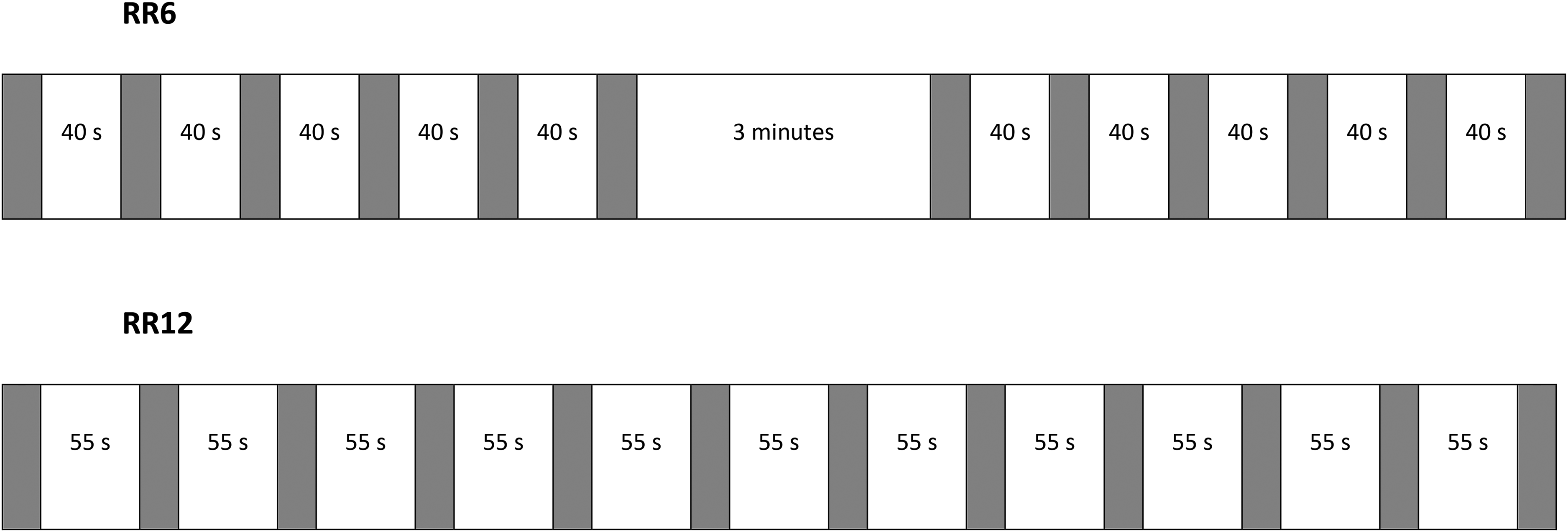
Diagrammatical view of rest-redistribution 6 versus rest-redistribution 1 protocols. Rest-redistribution 6 set protocol; 6 × 100 m every 40 s. Rest-redistribution 1 set protocol; 12 sets × 100 m departing every 55 s. Shaded zones represent work.
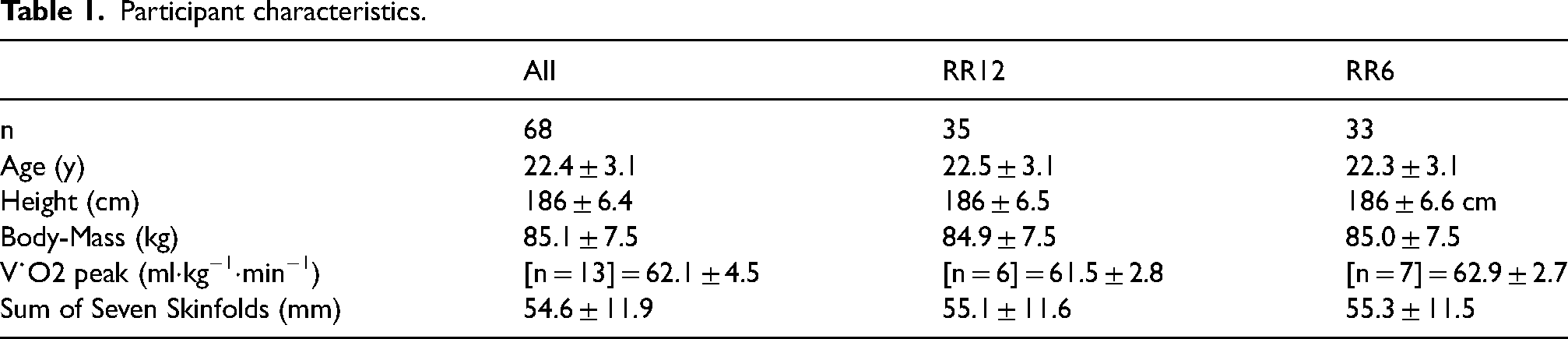
Seventy-seven male, semi-professional Australian Rules Football players were recruited from one West Australian Football League team to participate in this study, as part of their pre-season training program. Participants were excluded from the study if they had any injuries or illnesses preventing them from taking part in the performance tests or intervention period (n = 9). The final dataset consisted of 68 participants. This purposive sample reflects an ecologically valid sample of players from one team. Participants were pair matched (playing position, age, years in a senior tier and 2 km time trial time) and randomly assigned into one of two intervention groups by one researcher not directly associated with the prescription of training. This resulted in RR12 n = 35 and RR6 n = 33 (see Table 1 for participant characteristics). All participants corresponded with Tier 3 Highly Trained/National Level classification as per McKay et al. (2022). 13 This study was ethically approved by Curtin University Human Research Ethics Committee (HRE2018–0002). All participants were aware of the study aims, rationale and both interventions. This study was not registered.
Participant characteristics.
Pre- and post-intervention testing included a range of physical fitness tests. 14 Skinfold thickness (tricep, subscapular, bicep, supraspinale, abdominal, front thigh and medial calf) was measured by the same person using standard procedures set out by the International Society for the Advancement of Kinanthropometry (ISAK). A sum of seven skinfolds was used to observe changes in subcutaneous adipose tissue. Following this, on one day participants completed the standing vertical jump test (VJ; Vertec Yardstick Jumping Device, Swift Performance, Australia) and 20 m sprint (timing gates, SmartSpeed Pro, Fusion Sport, Australia) of which participants completed three attempts of each, on grass, with the best attempt used for analysis. This was followed by completion of a 2 km running time-trial (2 kmTT) on grass. On a separate day, minimum 48 h between, a subset of participants (n = 13) completed a graded exercise test on a motorised treadmill (Pulsar 3P, H/P/Cosmos, Germany) in order to determine V˙O2peak using a metabolic cart (Parvomedics TrueOne 2400, Parvomedics, USA). Intervals consisted of three minutes of running at a constant speed, separated by one minute of passive recovery. The treadmill incline was set at 1% for all tests and the speed in interval one was set at 12 km·h−1, and increased to 14 km·h−1 for interval two. From interval two onwards, speed was increased by 1 km·h−1 each interval until the participant reached volitional exhaustion. Each participant wore a chest strap to monitor HR (Polar T31, Polar, Australia), recorded at the end of each interval, as was RPE (1–10). 15 A randomised subset of participants (n = 13) completed the V˙O2peak test due to player time constraints. A minimum of 48 h post V˙O2peak tests all participants completed the Yo-Yo Intermittent Recovery Test two (Yo-Yo IRT2) on an indoor court.
The interval training component took place at the end of the total training session following resistance and skills-based elements. Participants completed their respective RR interval training session on grass following a standardised warm up. All participants completed the warm-up each session, which included running, dynamic stretches, static mobility, and ‘training-specific running’ while building intensity throughout each running repetition of the warm-up. Each warm-up lasted approximately eight minutes in duration. During the interval running sessions participants were asked to complete all repetitions as fast as possible back and forth between markers placed 100 m apart. HR was recorded continuously using a HR monitor (Polar T31, Polar, Australia), where mean HR for each set of repetitions (1–6, 7–12), was measured. Rating of perceived exertion (RPE) for the conditioning session was recorded immediately at completion of the interval session, using the Borg CR-10 Scale. 15 All interval training sessions were filmed using a video camera (Panasonic H85, Panasonic, Japan), in order to measure repetition time. Mean repetition time was measured to the nearest second, and was measured for each participant, each repetition. Time was measured from the second the participant started running to the second they crossed the line, and mean repetition time was then calculated for the session. The reported mean repetition time is the mean of all the sessions mean repetition time. Mean repetition decrement was calculated for three time points: 1–6 (mean repetition 6 minus mean repetition 1), 7–12 (mean repetition 12 minus mean repetition 7), and 1–12 (mean repetition 12 minus mean repetition 1).
During the 6-week intervention, participants took part in all training sessions prescribed by coaches and strength and conditioning staff as normal. At the completion of the intervention, participants completed the same physical fitness tests, in the same order, as they did in the pre-intervention phase, and at a similar time of day (±1 h) to account for any diurnal variation in performance.
Statistical analyses
Data were analysed in STATA 15 (StataCorp LLC, Texas, USA). Independent samples t-tests with Bonferroni correction were used for all primary outcomes being measures of training load (mean repetition time, mean repetition decrement for repetitions 1–6, 7–12, and 1–12, mean HR, and RPE). Secondary outcome, dependent variables (time to complete 2 kmTT, accumulated distance in the Yo-Yo IRT2, time to complete 20 m sprint test, vertical jump height, V˙O2peak, and sum of 7 skinfold thickness) were analysed using generalised linear mixed-models with random subject effects (to account for baseline variation) and fixed effect, group-time (pre/post) interactions. Maximum likelihood estimation methods are utilised by these models, which is a method that allows for incorporation of all data regardless of missing data points. Model fit testing was achieved through residuals analysis. The results are summarised as predicted marginal means and 95% confidence intervals (CI).
Results
Measures of training load
Mean repetition decrement was significantly reduced in RR12 for repetitions 1–6 (p = 0.04), and repetitions 7–12 (p = 0.01; Table 2, Figure 2) compared to RR6. No significant differences between groups were observed for RPE (p = 0.17), HR (p = 0.35), mean repetition time (p = 0.47).
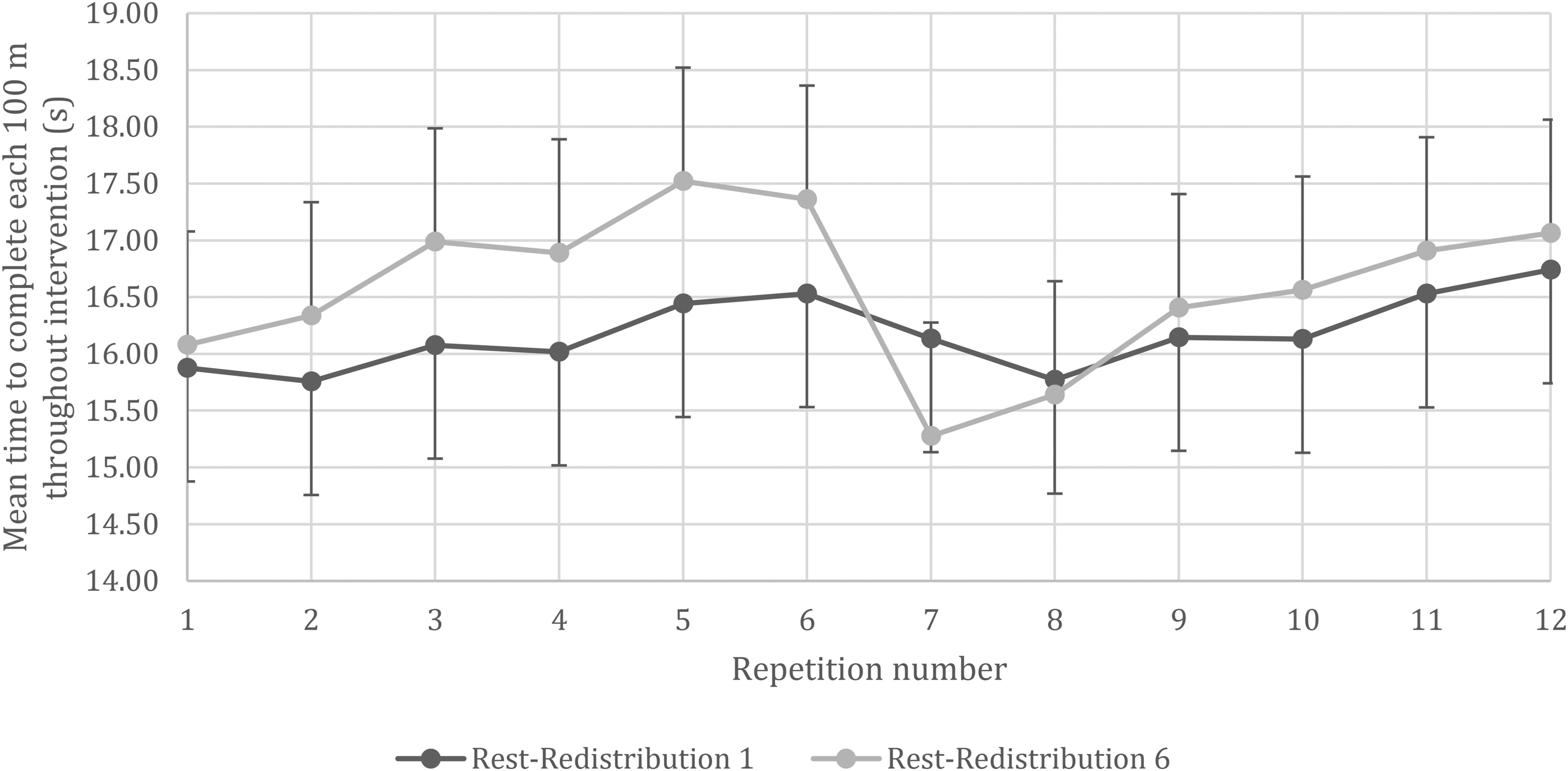
Mean 100 m completion time across all conditioning sessions in the rest-redistribution 6 and rest-redistribution 1 groups.
Within groups mean (± SD) training intervention variables in the rest-redistribution 1 (RR12) and rest-redistribution 6 (RR6) groups and between groups mean difference and 95% CI.
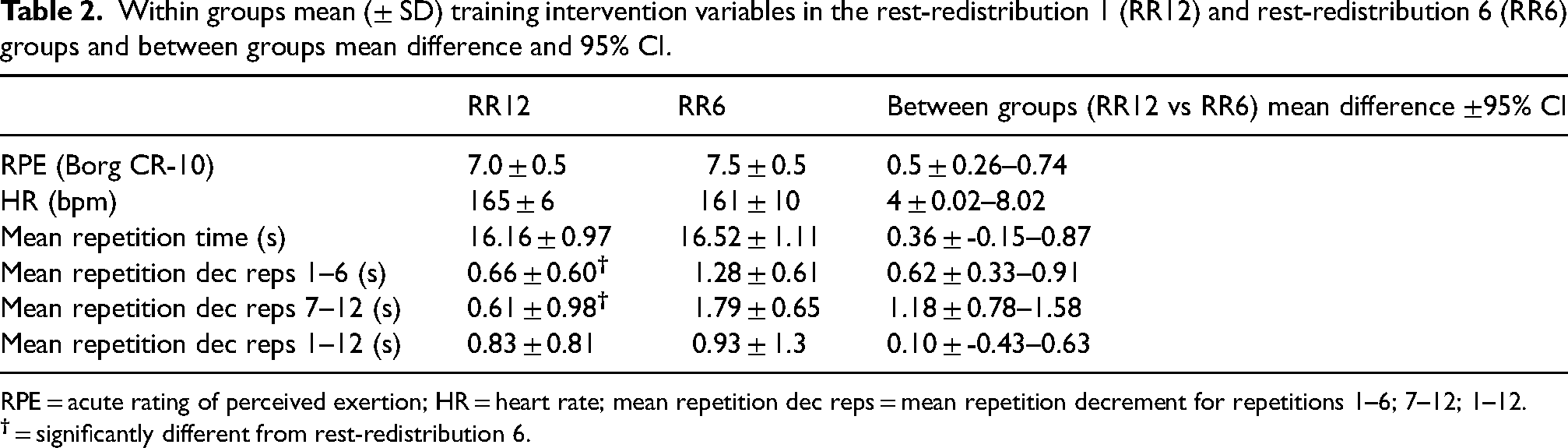
RPE = acute rating of perceived exertion; HR = heart rate; mean repetition dec reps = mean repetition decrement for repetitions 1–6; 7–12; 1–12.
Physical fitness performance
Significant main effects for time were found for the increase in Yo-Yo IRT2 accumulated distance (p = 0.003) and improvement in sum of seven skinfolds (p = 0.001), when comparing pre- to post-intervention results in both groups (Table 3). Two km running TT, 20 m sprint and standing vertical jump showed no significant effects for time (p = 0.193; p = 0.122; p = 0.454, respectively) in both groups. No significant interaction effects were found for 2 kmTT (p = 0.552), 20 m sprint (p = 0.579), standing vertical jump (p = 0.714), Yo-Yo IRT2 (p = 0.423), or sum of seven skinfolds (p = 0.859). Mean difference and associated 95% CI suggest positive changes for vertical jump, yo-yo IRT2, 20 m sprint and skinfolds may result from both interventions over time. Mean change and 95% CI suggest RR12 may result in improved 2 Km TT performance compared with RR6.
Physical fitness performance across both training interventions.
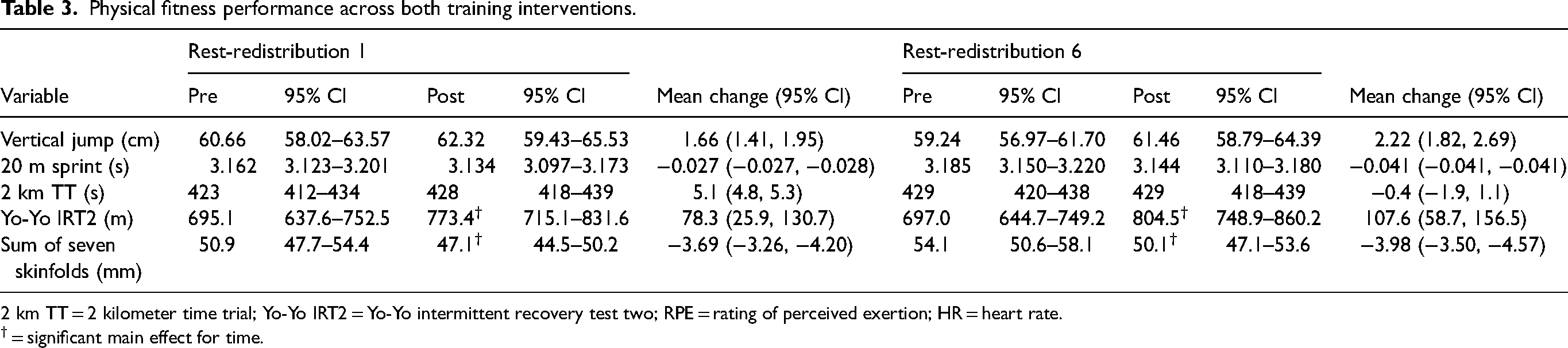
2 km TT = 2 kilometer time trial; Yo-Yo IRT2 = Yo-Yo intermittent recovery test two; RPE = rating of perceived exertion; HR = heart rate.
† = significant main effect for time.
Maximal oxygen consumption
The subset of participants that completed a V˙O2peak test showed no significant main effects for time (p = 0.089) or interaction effect (p = 0.576) when comparing the pre- to post-intervention results (RR6: n = 7, Pre = 63.26 ml.kg.min−1 (61.32–65.21) vs. Post = 64.62 ml.kg.min−1 (62.61–66.63); RR12: n = 6, Pre = 62.63 ml.kg.min−1 (61.05–64.22) vs. Post = 64.63 ml.kg.min−1 (62.69–66.57)). Albeit mean change for V˙O2peak increased from pre to post intervention, 95% CI suggest RR12 could result in a small potential decrease (mean change (95% CI); RR12 1.35 (−0.21–2.91) vs. RR6 = 2.00 (0.36–3.63)).
Discussion
This is the first study to examine the effect of different RR, short duration, interval running protocols on indicators of training load and physical fitness over a pre-season in semi-professional Australian Rules Football athletes. The main finding of this study was a reduced mean repetition decrement in RR12 for repetitions 1–6 and 7–12 compared with RR6. This highlights interval training protocols that allow longer inter-repetition rest compared to shorter inter-repetition rest can maintain running velocity over an entire interval running session. Specifically, the RR6 group completed each set of six repetitions in 3 min 35 s, compared to the RR12 group covering the same number of repetitions in 4 min 50 s. The additional 15 s of passive rest in between each repetition in RR12 protocol presented greater time available for the replenishment of phosphocreatine stores, therefore potentially reducing the effects of fatigue allowing maintenance of velocity.3,10 Maintenance of repetition time when longer inter-repetition rest is prescribed is a consistent finding within the literature.
To the best of our knowledge, the only other study conducted within a team sport athlete population, investigating acute responses to two different RR, in addition to a traditional interval set structure and velocity based RS training, also reported their RR conditions, which compared to other conditions included frequent rest intervals between repetitions, had the greatest maintenance of velocity. 12 Similarly, a cycling study reported power output was significantly higher when longer rest times were taken (12 × 6 s intervals, 24 s rest, 7 min active recovery period every three sprints) compared with shorter rest periods (12 × 6 s on, 24 s off), despite not matching for total interval or rest time between groups. 2 In resistance training, it is well documented that cluster sets improves movement velocity compared to traditional set structures. For example, Hansen, Cronin and Newton 16 found cluster set protocols attenuated decreases in movement velocity and power output, due to the insertion of rest periods allowing the regeneration of phosphocreatine stores. Furthermore, another study noted that the increased frequency and duration of rest periods in cluster sets enabled the maintenance of greater power output and movement velocity during a back-squat, compared to traditional set structures. 9 This suggests that greater time given to recover between sets and/or repetitions may cause greater phosphocreatine replenishment, subsequently improving movement velocity. Despite significantly reduced mean repetition decrements in repetitions 1–6 and 7–12 for RR12 compared to RR6, the standard deviations for mean repetition times are large indicating with maximal repeat sprint training there may be large individual variations which may be more apparent here given the large variation in participants within a typical team sport (i.e., midfielders vs. defenders).
Maintaining high HR during training is a vital stimuli for enhancing aerobic fitness. It has been suggested that greater cardiovascular adaptations occur from working at higher intensities (≥ 85% maximum HR). 17 A goal of interval training should therefore be to maximise the time spent at high-intensity, to assist in inducing such adaptations. Both RR protocols enabled participants to spend time above 85% maximum HR providing support for both of these RR as beneficial interval training protocols. Mean HR was not significantly higher in the RR12 group compared to the RR6 group (165 vs. 161 bpm, respectively) despite reduced mean repetition decrement. This contrasts with Weakley at al. 12 who reported moderate significant differences between the two set structures most similar to the current study (1 set×12 repetitions 40 s rest, 159 bpm vs. 2 sets × 6 repetitions with 20 s between repetitions and 240 s intra-set rest, 149 bpm). The lack of differences in the current study compared to Weakley et al. 12 may be due to the longer intra-set rest enabling a marked reduction in HR between the two set structures. Mean HR for RR12 was higher than the similar set structure of Weakley et al. 12 which may be due to the shorter sprint distances (30 m vs 100 m per rep) creating a greater cardiovascular stress which didn’t reduce to the same magnitude despite a 15 s longer rest between repetitions. Higher mean HR reported for interval protocols that have more frequent inter-repetition breaks compared to longer intra-set breaks typical of traditional set protocols assists in maintaining higher HR over the entire training session compared to a set structure that has a long intra-set break thus allowing time for HR to decrease significantly. 12 This may be an important consideration, particularly during pre-season periods where the aim is to enhance aerobic fitness as opposed to in-season where maintenance and team tactics become the priority.
It has been suggested by Tufano et al. 18 that there is a simultaneous decrease in movement velocity and power output, with an increase in the perception of effort. Given additional rest time is known to increase movement velocity and power output, it is expected that the perception of effort should decrease compared to set structures with shorter rest periods. This has been supported in resistance training 19 specifically RPE was lower in set configurations of the power clean exercise that included more rest between repetitions (0 s; 20 s; 40 s), while matching total interval time. 20 However, despite reduced mean repetition decrement in RR12 compared to RR6 there was no difference in RPE between conditions. This is similar to Weakley et al. 12 who also found no differences between two interval RR conditions or when both were compared to an interval TS structure.
Over a six-week pre-season (pre vs. post intervention) improvement was noted for both RR12 and RR6 in aerobic fitness (as determined by accumulated distance) and sum of seven skinfolds. Similar to this study, previous cycling studies (two- and four-week interventions) comparing set protocols matched for total time showed significant improvements in performance tests over time, but did not find significant differences between groups.7,8 Although our intervention was longer, it's possible this duration of six weeks was still not long enough and more time may be required to show significant differences between groups when total interval and rest time are matched. Overall, these findings suggest that while adequate aerobic stimulus causes changes in performance, as long as the total interval and rest time is matched, the distribution of interval and rest periods may not significantly alter six-week training outcomes. Interestingly, despite a significant increase in accumulated distance (pre vs. post) for both set structures, no difference was observed in 2 km TT times. Albeit both are considered aerobic tests perhaps the repeat-sprint training which is similar in nature to the Yo-Yo IRT2 test resulted in better transferability compared to a continuous aerobic test.
This study provides an ecologically valid insight into the effects of RR repeat sprint training on performance, as it involved semi-professional Australian Rules Football athletes as part of their pre-season training program including skills and tactical sessions, in addition to aerobic conditioning sessions. Given the study took place during real training sessions, the total time per session allocated towards aerobic conditioning (not including skills- or tactical-based training) was limited. Despite the study's ecological validity, a longer intervention period may have yielded greater levels of adaptation and more significant changes. The duration of the intervention period was six weeks, as this was the maximum amount of time during the pre-season phase that could be allocated towards aerobic conditioning, due to the reduction in aerobic conditioning during the competition phase. 21 In addition, the researchers were not able to control the resistance and skills-tactical-based training nor was the food or fluid intake controlled for prior to or during training. Future studies should compare similar set structures with a greater intervention duration whilst controlling other training components, as that may yield further improvements, and differences between groups.
Footnotes
Consent to participate
All participants provided written informed consent.
Consent for publication
All participants provided written informed consent.
Data availability
The authors confirm that the data supporting the findings of this study are available within the article or can be requested from the authors.
Declaration of conflicting interests
The authors declared no potential conflicts of interest with respect to the research, authorship, and/or publication of this article.
Ethical considerations
This study was ethically approved by Curtin University Human Research Ethics Committee (HRE2018–0002).
Funding
The authors received no financial support for the research, authorship, and/or publication of this article.
