




Abstract
This study compared traditional rugby union (RU) games to a modified small-sided game (SSG) aimed at improving opportunity for physical activity and enjoyment in children. Twenty-six school rugby players (aged 10 y) played 10 RU matches. Five traditional games on a full-sized field with 10–12 players per team and five SSG on a modified field with seven players per team. Movement patterns, enjoyment, involvements (e.g., possessions, passes, tackles, rucks and tries), and heart rate (HR) were recorded. Session rating of perceived exertion (sRPE) was measured at the end of each game and used to calculate game load (sRPE x duration). Significance was set at p ≤ 0.05. Individuals covered greater distances (total, low and high speed) overall and relatively (per min) and had higher HR whilst playing traditional format RU. Despite covering greater distances, perceived exertion and game load were similar and importantly, enjoyment was high for both game formats. Individual player match involvements (overall and relative possessions and passes, and relative tackles) were higher in SSG. Given that players enjoyed both game formats, movement pattern and physiological data suggest traditional games may be more suitable for improving physical activity and fitness, while individual involvement data suggest SSG may be more suitable for improving opportunities for participation and skill development.
Introduction
Despite the well-known benefits of physical activity (PA), only 23% of Australian children meet the PA guidelines, and only 67% participate in organised PA at least once a fortnight outside of school. 1 Importantly, when considering why PA participation rates are low, 31% of Australian children (aged 9–11 y) report disliking PA as one of the greatest barriers to participation in PA. 2 Therefore, programs aimed at improving enjoyment of PA could be an important consideration for increasing children's participation in PA. 3 One method to improve the levels of PA in children is to increase their participation in sport, particularly as a way of getting the required moderate to vigorous levels of PA that they need, 4 whilst having fun doing so. 5
Currently in Australia, several sports offer a modified alternative (e.g., netball - ‘NetSetGo’, soccer - ‘MiniRoos’ and rugby - ‘TryRugby’) in an attempt to enhance PA, involvement and enjoyment of children. 6 One common strategy these programs use is the inclusion of small-sided games (SSG), which involve modifications (e.g., reduced field size, less players, and modified rules) to standard sport match-play.7,8 In team sports, SSG are typically used in training as general conditioning and skill sessions7,9 because changing factors such as player numbers or field size can potentially target physical fitness, skill development and/or player enjoyment.7,10 Studies conducted in soccer, rugby and basketball training sessions have found that exercise intensity increases when playing area is increased and/or player numbers are decreased11–13. This is most likely due to players having more area per player to move within and potentially requiring more repeated high intensity efforts. 14 Furthermore, having less players allows more individual involvements, which may be beneficial for skill development and increasing children's engagement and enjoyment. 14 However, we know little about how SSG that modify matchplay in childrens’ sport affects player movement patterns (e.g., running distance and speed), enjoyment, player involvement, physiological response (e.g., heart rate [HR]), and perception of effort (e.g., rating of perceived exertion; RPE) when compared to the traditional game format.
Although enjoyment is an important factor to consider in children's sport participation,3,15 only two studies have reported the use of SSG in match-play to enhance enjoyment. Toh, Guelfi, Wong, and Fournier 16 studied whether enjoyment was impacted in a group of overweight 10-year-old boys playing 3 vs. 3 soccer on different court sizes and found that there was no difference in enjoyment (Physical Activity Enjoyment Scale [PACES]: scale maximum = 80; badminton = 59, volleyball = 64, basketball = 66), between court sizes. However, the largest court size (basketball court) resulted in higher energy expenditure (estimated through accelerometry), yet similar RPE compared to both smaller courts. 16 This suggests a larger playing area is preferable for playing SSG, as physiological load is higher with no difference in perceptual response. 16 Henley-Martin et al. 17 found that SSG (less players and a reduced field size) resulted in similar player enjoyment (measured using PACES) compared to traditional games in 10–12-year-old, male hockey players. Furthermore, the researchers found SSG resulted in similar total distance covered, HR, and session RPE (sRPE); however, player involvements were higher compared to traditional games. 17 Whether these results would be similar in children playing rugby union (RU) remains unclear. Limited literature highlights the need for further research on how manipulating the number of players and field size impacts the movement patterns, enjoyment, player involvements, physiological and perceived exertion of players, particularly in RU match-play.
Whilst most previous research has utilised SSG as a method of athlete conditioning and skill development, we aimed to be the first study to compare the movement patterns, enjoyment, player involvements, physiological response, perceived exertion and game load of players between traditional children's RU games and a modified SSG aimed at enhancing PA and enjoyment. We hypothesised that SSG would increase movement patterns (i.e., greater distance covered), enjoyment, physiological (i.e., greater HR) and perceived exertion when compared to the traditional game. In addition, we hypothesised that in SSG, there would be greater player involvement (i.e., team/individual statistics).
Materials and methods
Twenty-six school RU players (SSG: 14 males, 1 female, two schools, [mean ± SD] age = 10.6 ± 0.6 y, height = 1.52 ± 0.07 m, body mass = 45.5 ± 10.5 kg; traditional games: 25 males, five schools, age = 10.6 ± 0.6 y, height = 1.51 ± 0.08 m, body mass = 44.5 ± 9.0 kg) were recruited from Western Australian schools involved in the inter-school Junior Public Schools Sports Association Rugby competition. All participants were currently training once a week, which involved rugby drills aimed at improving physical fitness and sport specific skills. Participants were excluded from a match if they had an injury that prevented them from playing rugby. Prior to testing, all participants and their parents/guardians provided online informed assent and consent. Ethical approval was granted by the Curtin University Human Research Ethics Committee (HRE2019-0176).
This study was a repeated measures design. Over four months, ten RU matches were analysed during the home and away inter-school rugby competition. Rugby matches were played on the same day each week, at the same time. The competition fixtures began with five RU matches played as SSG with seven players per team (7 vs. 7) on a modified field (60 × 25 m) followed by five traditional games with 10 to 12 players per team on a full field (90–100 m × 60–70 m). Due to player availability, one traditional game was played with 10 players, one with 11 and three with 12 per team. When player numbers were low, additional players were recruited to top-up player numbers.
All matches were played outdoors on a natural grass rugby field and used the same match play rules. All matches were a minimum of 40 min (spilt into two halves, each 20 min plus any overtime, and played until the ball became dead after time expired) and involved a 5-min half time break. Only data from the participating team players were collected. During the matches, researchers had no input into player allocations to teams or coaching decisions made. Coaches and parents were allowed to provide encouragement and feedback to the players throughout the match.
Prior to each match, participants were fitted with a global positioning system (GPS; SPI Pro X, GPSports, Australia, 5 Hz); that had been previously assessed for reliability and validity. 18 The GPS units measured movement patterns as total distance covered (m), total distance at low (0–13 km·h−1) and high (>13 km·h−1) speed for each player's active playing duration. These speed categories were similar to a previous study which utilised a similar age population. 17
Each match was recorded using a digital video camera (Panasonic H85, Panasonic, Japan) placed on a tripod positioned at the half-way line on the sideline of the field. All matches were coded by the same observer for team and individual involvements using definitions from World Rugby. 19 The variables coded were possessions, passes, tackles, tries, rucks, scrums, mauls, lineouts, kicks 19 and missed tackles. To assess intra-rater reliability a sample of matches were viewed and coded twice. The coefficient of variation of all variables was 0–8.3%.
During each match, participants wore a HR strap and monitor (Polar Team Sport System, Polar Electro Oy, Finland) which synchronised with the GPS units to collect HR throughout the match. After each match, GPS and HR data were downloaded to analysis software (GPSports, Team Athlete Management System R1 2013.21). Only active HR (i.e., from periods when each athlete was on the ground playing) measures were analysed and used to calculate mean HR for each match.
Fifteen minutes after each match, participants provided sRPE using the modified Borg category ratio 10 (CR-10) scale so that game load could be calculated using the method proposed by Foster et al. 20 (i.e., sRPE multiplied by total match duration in minutes). Enjoyment was also assessed post-match using a validated modified PACES, 21 which consisted of 15 questions that were each rated on a 5-point Likert scale. Changes were made to the tense of the PACES questions as the stem sentence was altered to read, ‘Please rate how you feel at the moment about the rugby game you played today’. Several questions were reverse coded so that a higher PACES score represented greater enjoyment. All participants completed their sRPE and PACES privately on an iPad (Apple Incorporated, California, USA) through an online survey platform (Qualtrics, Utah, USA) to avoid being influenced by other participant's ratings.
We considered our movement pattern, enjoyment, player involvement (i.e., possessions, passes, tackles, missed tackles), physiological and perceived exertion measures at the individual level. Team averages were used for player involvements as they would often be substituted during the match. All variables were calculated as overall values (e.g., passes per game), however, to make comparisons under consistent conditions, individual player movement pattern and involvement, and team involvements were also calculated as relative values (i.e., per minute; the overall value divided by the match duration in minutes, e.g., passes per minute) to control for time on field.
Generalised linear mixed models, with random player effects and fixed interaction effects between game type and time, were used to obtain predicted mean estimates of individual players’ numerical outcomes. Appropriate families and links for various data distributions, including Poisson or negative binomial for count data, were included in the models and data were transformed as appropriate. Results were summarised as marginal mean estimates and 95% confidence intervals (95% CI) and contrasts reported. To aid our interpretation of non-correlated count data (team total and individual player involvement data), we summarised them using medians, interquartile ranges (IQR) and ranges, then compared between game formats using Mann Whitney U tests. Statistical significance was accepted at p < 0.05. Stata version 16 (StataCorp, Texas, USA) was used for data analysis. The data that support the findings of this study are available from the corresponding author, KD, upon reasonable request.
Results
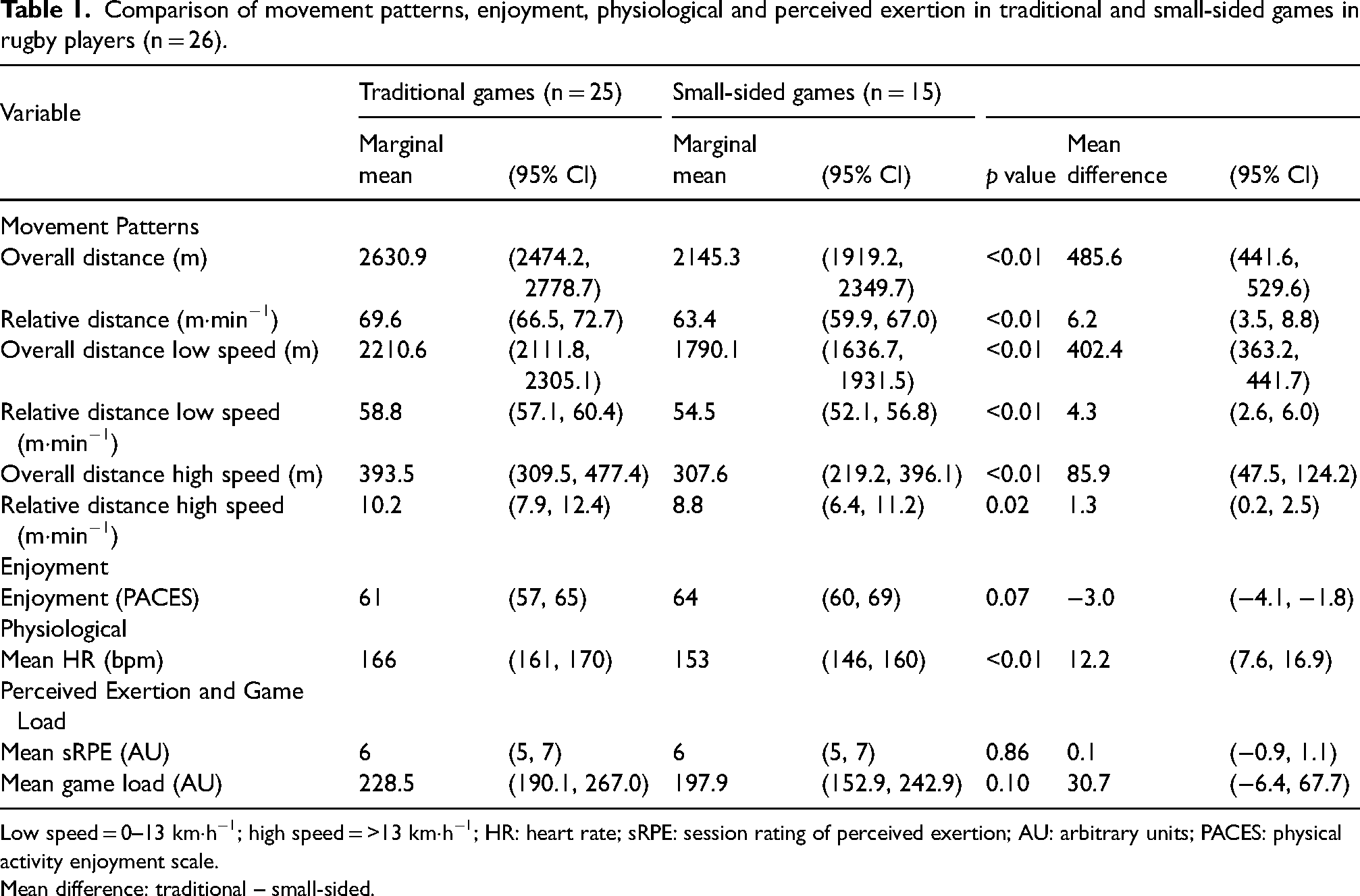
Total distance covered, distance covered at low speed and distance covered at high speed were higher for overall and relative variables in traditional compared to SSG (distance covered: overall p < 0.01, relative p < 0.01; distance at low speed: overall p < 0.01, relative p < 0.01; distance at high speed: overall p < 0.01, relative p = 0.02; Table 1).
Comparison of movement patterns, enjoyment, physiological and perceived exertion in traditional and small-sided games in rugby players (n = 26).
Low speed = 0–13 km·h−1; high speed = >13 km·h−1; HR: heart rate; sRPE: session rating of perceived exertion; AU: arbitrary units; PACES: physical activity enjoyment scale.
Mean difference: traditional – small-sided.
Mean HR was higher in traditional compared to SSG (p < 0.01; Table 1).
No differences were found between traditional and SSG for sRPE, mean game load and enjoyment (p = 0.86, p = 0.10, p = 0.07, respectively; Table 1).
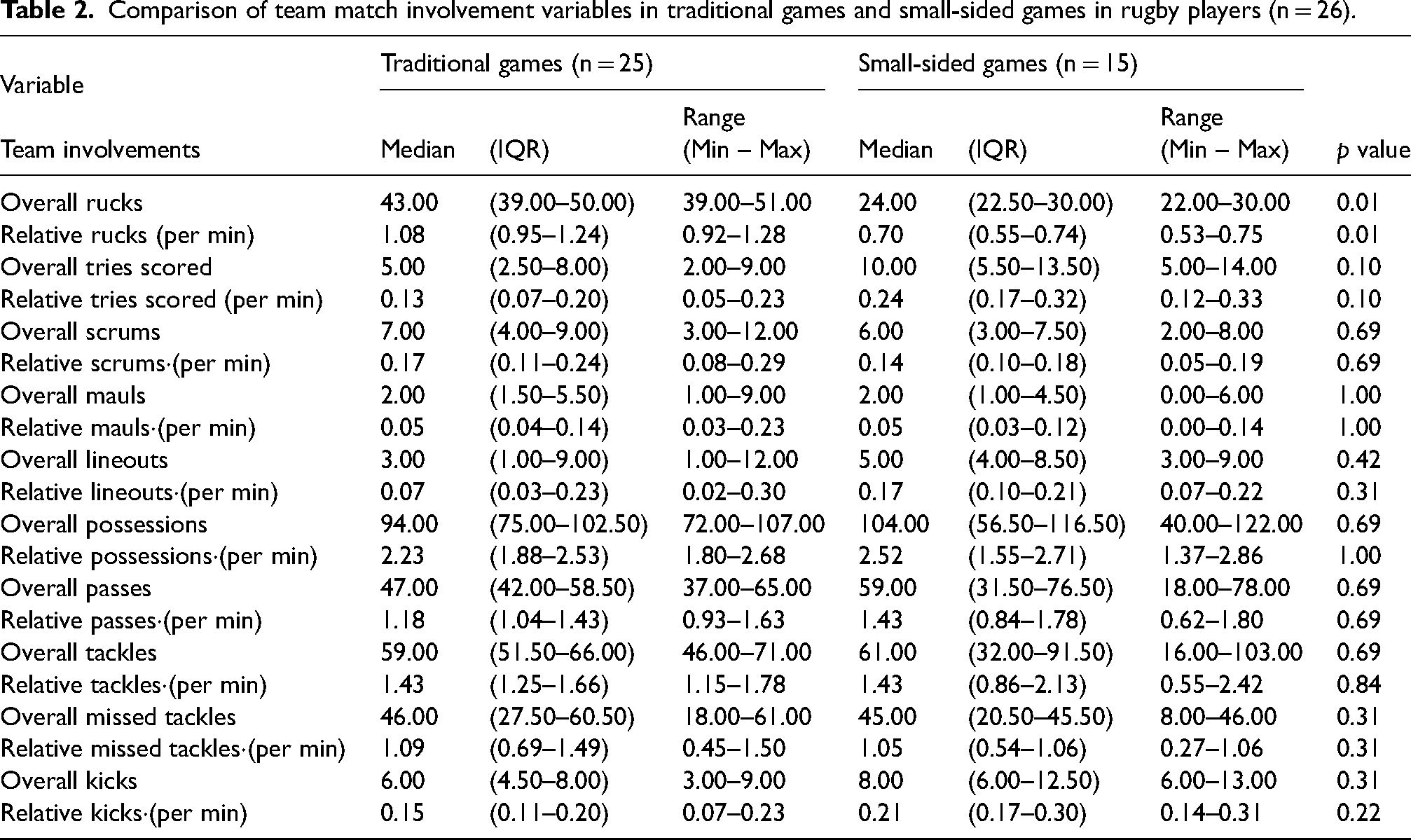
Table 2 shows descriptive statistics for overall and relative team match involvement variables in traditional and SSG. There were no differences between formats for all team involvement variables except the number of rucks was higher in traditional games (rucks: overall p = 0.01, relative p = 0.01).
Comparison of team match involvement variables in traditional games and small-sided games in rugby players (n = 26).
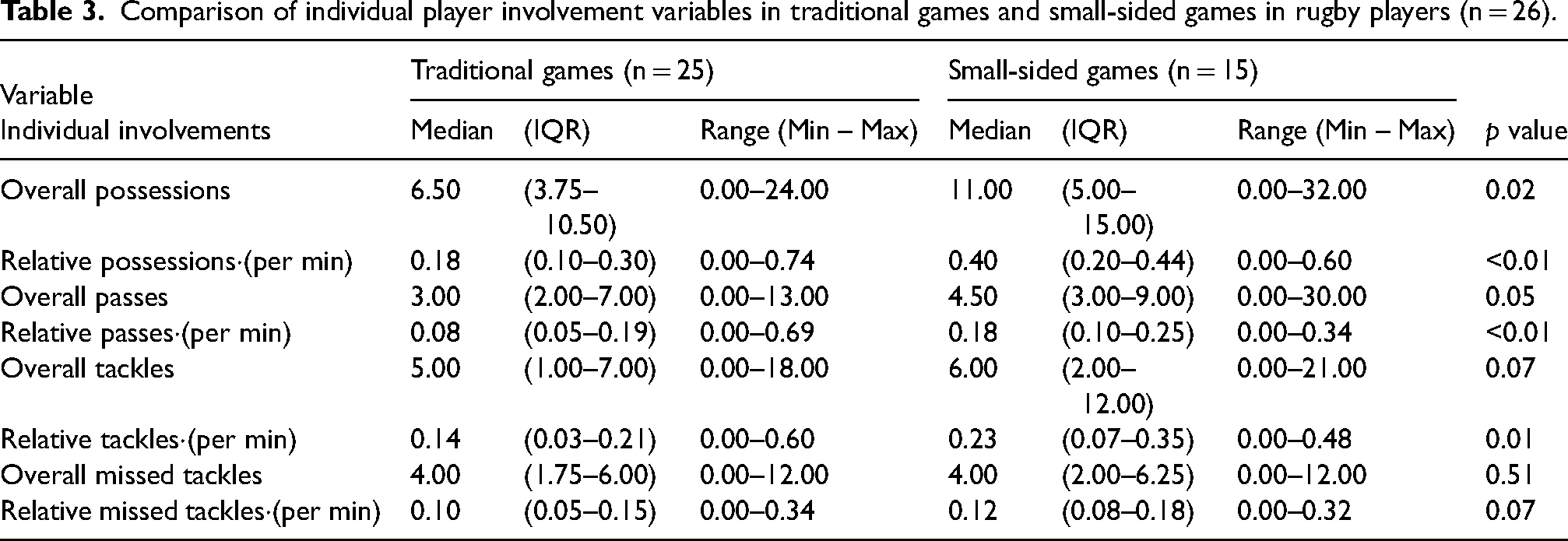
Overall and relative number of possessions per player were higher in SSG compared to traditional games (overall p = 0.02, relative p < 0.01; see Table 3). No difference was found in overall passes between game formats (p = 0.05); however relative passes were higher in SSG compared to traditional games (p < 0.01). There was no difference found in overall tackles between formats (p = 0.07); however, relative tackles were higher in SSG compared to traditional games (p = 0.01). No difference was found in overall and relative missed tackles (overall p = 0.51, relative p = 0.07).
Comparison of individual player involvement variables in traditional games and small-sided games in rugby players (n = 26).
Discussion
This is the first study to compare traditional format RU games to a modified SSG as a competition alternative aimed at improving PA and enjoyment in children's RU rather than as a training alternative in team sport, which has been the focus of previous studies. The main findings were that individuals covered greater distances (total, low and high speed) overall and relatively (per min) and had higher HR whilst playing traditional format RU. Despite covering greater distances, perceived exertion and game load was similar, and importantly, enjoyment was high for both game formats. However, individual player match involvements (overall and relative possessions and passes, and relative tackles) were higher in SSG.
Improving or enhancing PA and physical fitness is one of the many benefits from active play. Movement patterns (both overall match and relative), total distance covered, and distance covered at low and high speed, assessed by GPS were higher in traditional games compared to SSG. These findings are consistent with previous studies in children's soccer and hockey that found movement demands increase with an increased field size,22,23 which provides more playing space to cover compared to smaller fields. 10 This is in contrast to Henley-Martin et al., 17 where more overall distance was covered in hockey SSG compared with traditional games. However, there was a considerable difference in SSG field size between their study and ours (∼ 2500 vs. 1500 m2), making it likely that our players were less able to run more distance on our smaller field. Additionally, as relative movement pattern variables are often used as an indicator of game intensity,7,23 our results suggest that in comparison to SSG, traditional rugby games played on larger fields are potentially more suitable for improving children's PA and fitness due to increased overall and relative distances covered, particularly at high speeds. When considered alongside higher mean HR during traditional games compared with SSG, we would suggest that if the aim is to enhance PA and fitness using RU active play, traditional larger field sizes (despite higher players) are potentially more effective as opposed to smaller RU fields.
Despite the importance of enjoyment for encouraging PA participation in children,3,24 little research has examined the impact of SSG and traditional games on enjoyment, particularly in RU. Based on the similar PACES scores found between formats, player enjoyment was not affected by player numbers and field size, which goes against the hypothesis, but is consistent with previous studies. Toh et al. 16 found that in 10-year-old overweight boys playing soccer, enjoyment levels were similarly high despite changes in field size. Similarly, Henley-Martin et al. 17 found no difference in enjoyment in 10–12-year-old boys playing hockey in SSG and traditional games. Overall, the high scores and lack of difference found in enjoyment suggests that children find sport enjoyable regardless of the format, however we must acknowledge that whilst sport is compulsory in the schools we sampled from, we may have had participants that were playing rugby because they enjoy it. Alternatively, since enjoyment was measured at the end of the game, the outcome of the game (win or loss) may have impacted the enjoyment of players. In addition, it is possible that enjoyment ratings may have been different during the game, particularly as Gray, Sproule, and Wang 25 found more match involvements can potentially enhance enjoyment in children. Similar enjoyment in traditional and SSG suggest that both game formats are potentially beneficial for enhancing enjoyment and participation in RU and PA. Further research should include more qualitative investigation that ascertains factors that influence enjoyment in children when playing sport in SSG and traditional formats.
Player numbers and field size didn't significantly impact perceived exertion and game load despite the greater internal load (movement pattern and physiological) apparent in the traditional game. A previous study on hockey also reported no difference in perceived exertion in a similar age group, 17 therefore aligning with the sRPE findings in this study. However, it should be noted that the researchers also found no difference in mean HR, 17 possibly due to a lack of statistical difference found in distances covered between SSG and traditional children's hockey games. A possible reason for these incongruent findings between studies is the difference in field area was smaller for the hockey study (area difference 2514 m2) versus the current RU study (3900 m2) therefore performance and subsequent perceptual variables may have been similar when the difference in field size is less.
Of interest is the proposition that enhanced skill efficiency may motivate participation in sport thus leading to the benefits of increased levels of PA and therefore physical fitness. Greater involvements during active play may contribute to enhancing skill development due to more attempts at skills and subsequently increased enjoyment. 17 All team involvements (both overall and relative), except rucks, were statistically similar between SSG and traditional games. This finding matches what we saw during games, that these junior players lack spatial awareness, which caused them to bunch and play in a confined area regardless of the amount of space available. The bunching of players has been reported in 12-year-old experienced soccer players. 26 Furthermore, as rucks are a RU specific skill, typically dependent on tackles by either team, an increase in player numbers could potentially have allowed more players to form a contest over the ball carrier as more players were on the field. Median data suggests that individual involvements were higher in SSG, specifically absolute and relative possessions, lineouts, tries, passes and kicks. These results are consistent with previous studies that also found higher possessions per player in SSG for soccer 14 and hockey. 17 Nonetheless, the lack of statistical difference in team involvement variables and some improvements in SSG individual involvement suggests that there may be some extra opportunities for participation at the individual but not team level, which could offer greater opportunity for skill development and higher levels of enjoyment.
Specifically comparing scoring involvement variables (e.g., hockey = shots on goal and goals scored vs. RU = tries) both the current study and Henley-Martin et al. 17 reported higher median scoring involvements in SSG compared to traditional games. This suggests that with less players, there may be more potential opportunities for participation in scoring, which may improve enjoyment in match-play. Generally, differences between sporting codes and the nature of play may account for instances where there was incongruence between study's findings whereby traditional resulted in higher involvements. Comparing hockey to RU for example is impacted by the nature of play where RU is structured in a line that moves forward systematically, which does not change between SSG and traditional, whereas hockey is spread across the whole field with minimal limits on moving the ball and movement is made to make space to tactically achieve better, unopposed positions. This difference could potentially lead to greater involvements in hockey when player number is reduced.
Attempts to enhance the ecological validity of our study by testing children during a real competitive season resulted in some limitations. First, the different sample sizes in the two formats and the variation of player numbers in traditional games may have affected the results; however, we deemed that the ecological validity of the setting was more important at this early stage of research in this area than being able to control all factors. Related to this, the athletes came from several schools, meaning that small differences in coaching and athlete preparation may have impacted our movement pattern and involvement measures. However, the schools are operationally alike and have similar student populations, meaning this impact should be minimal. Second, competition organisers controlled the order of fixtures, with all SSG played before traditional games, which may have allowed players to learn and develop game understanding and skills, although this potentially occurs in each match of a season regardless of the format. Finally, despite mixed results in the literature around the impact of maturation and sex on physical and skill performance in children of the same age of those in our study (e.g., Gil et al., 27 Hermassi et al., 28 Lovell et al. 29 ), these factors may have impacted the movement patterns and involvement of our athletes. 30 However, at this age and in the location (Western Australia) where RU has relatively low participation, it is common for boys and girls of this age/development to play together.
Conclusion
In conclusion, our group is the first to assess small-sided RU games as a competition alternative to traditional children's RU aimed at enhancing PA and enjoyment. We found that traditional games increased movement distances and physiological responses, which may be more beneficial for improving PA and fitness compared to SSG, whilst individual player involvement data suggested greater player opportunities within SSG compared to traditional games, which may be more beneficial for improving opportunities for participation and skill development. Importantly enjoyment was high for both game formats, and perceived exertion and game load data were similar, which is important for encouraging children's participation in PA. The findings from this study may help to inform changes to children's RU formats in schools and wider community to enhance PA, enjoyment, and participation in the sport.
Footnotes
Declaration of conflicting interests
The authors declared no potential conflicts of interest with respect to the research, authorship, and/or publication of this article.
Funding
The authors received no financial support for the research, authorship, and/or publication of this article.
