Abstract
This study explored the relationship between differential ratings of perceived exertion (dRPE) and ratings of perceived exertion (RPE), and internal training load in a sample of collegiate ice hockey players. Twenty-six female (20 ± 1.66 yr, 169.1 ± 6.6 cm) varsity ice hockey players participated over seven weeks in the preseason and regular season. RPE, dRPE (i.e., breathlessness, lower limb exertion, and technical/cognitive demand), and practice duration were recorded each day following completion of on-ice training. RPE-breathlessness, RPE-lower limb exertion, and RPE-technical/cognitive explained approximately 75% of the variance seen in RPE. Differential RPE explained the most variance in RPE for goaltenders (R2 = 0.86) followed by defenders (R2 = 0.71) and forwards (R2 = 0.70). RPE-breathlessness showed the strongest relationship with RPE, regardless of playing position. On average, internal training load was greatest on days furthest from match days, and tapered as training day approached match days. Overall, dRPE explained a statistically significant amount of the variance captured by RPE, indicating that it captures relevant information beyond only RPE. Using RPE and dRPE to measure internal training load is a low-cost and feasible method that can be used to assist athlete load monitoring in a female collegiate varsity ice hockey setting.
Introduction
Practice in sport is believed to have the most significant impact on athlete development. 1 Indeed, there are consistent differences in accumulated practice volume (i.e., deliberate practice) between experts and non-experts. 2 However, training and practice must also purposefully vary in intensity and difficulty to optimize training and recovery. To appropriately monitor training, coaches and sport scientists use measurements of training load. 3 These include measures of external training load, the physical work performed by athletes, and internal load, the psychophysiological response to the external load of training. 4 With improvements in modern technology, the ability to monitor and analyze the external load of athletes has continued to improve. 5 Despite these advancements, relying solely on external load ignores the individualized experiences of each athlete, and fails to appreciate that athletes respond and react to their experiences in training differently based on their subjective perceptions. 6
As a way to combat this gap, one strategy is to incorporate athlete responses in the form of self-report ratings of their perceived exertion (RPE), which can be used as a proxy measurement for the internal training load of athletes.3,4 Multiplying RPE by session duration (e.g., a practice length) results in the creation of a session RPE (sRPE) and can be used as a means to monitor training volume and intensity.7,8 Training load monitoring using session RPE may allow for the examination of variation between athletes performing the same training. 4 For example, two athletes who experience the same 60-min training session may have session RPE values of 6000 compared with 3600 arbitrary units, indicating that the athletes perceived the training session in different ways. Monitoring these experiences over time allows coaches and sport scientists to identify how athletes respond to training, and therefore, should inform training periodization. Session RPE, and RPE generally, are gestalt measures, whereupon they aim to capture multiple components of exertion into a singular score.9,10 To account for the gestalt nature of RPE, the use of differential RPE (dRPE), consisting of subscales measuring perceived breathlessness, upper-body and leg muscle exertion, and technical/cognitive exertion, has been proposed.8,11 Differential RPE aims to provide a more nuanced and sensitive method to capture internal training load, similar to domains captured by the NASA Task Load Index11–13 which specifically looks at the workload demands based on six variables: mental, physical, temporal demands, frustration, effort, and performance.
While sports such as soccer, rugby, and Australian football have explored dRPE, no known published research has examined the relationship between dRPE and RPE in ice hockey.8,11,14 Ice hockey is a sport characterized by frequent short burst of high-intensity skating, followed by significant periods of recovery. 15 Furthermore, the external and internal training load of ice hockey athletes is differentiated by position, practice, and match play.16–18 As a result of these characteristics, ice hockey-specific research is necessary. As with other areas of sport science research, evidence to date has been focused on male participants,19,20 leaving the field ripe for female-specific investigations to avoid the problematic assumption of transference from male participant-findings, to female athletes. Further, limited research has examined internal training load specifically in collegiate women's ice hockey. 16 As such, the purpose of this study was threefold. First, to examine the relationship between RPE and dRPE in ice hockey to determine how correlated dRPE subscales are with global RPE. Secondly, to explore the stability of this relationship across positional groups, and thirdly, to examine the internal training load over seven microcycles (i.e., 7 weeks) in a women's collegiate ice hockey setting using sRPE and dRPE.
Materials and methods
Study population and design
Twenty-six female collegiate-level varsity ice hockey athletes from one institution were invited to participate in this study. These student-athletes complete their studies at the university level (i.e., U SPORTS level), while competing at one of the highest levels of ice hockey for females in Canada. Athletes were considered ineligible to participate if they were injured, and/or unable to fully participate in all aspects of training sessions. Of the participants who met these criteria, 26 athletes (20 ± 1.66 yr, 169.1 ± 6.6 cm; 15 forwards, 8 defenders, 3 goaltenders) signed the informed consent and agreed to participate in the study. The study received approval from the institutional research ethics committee (#17224).
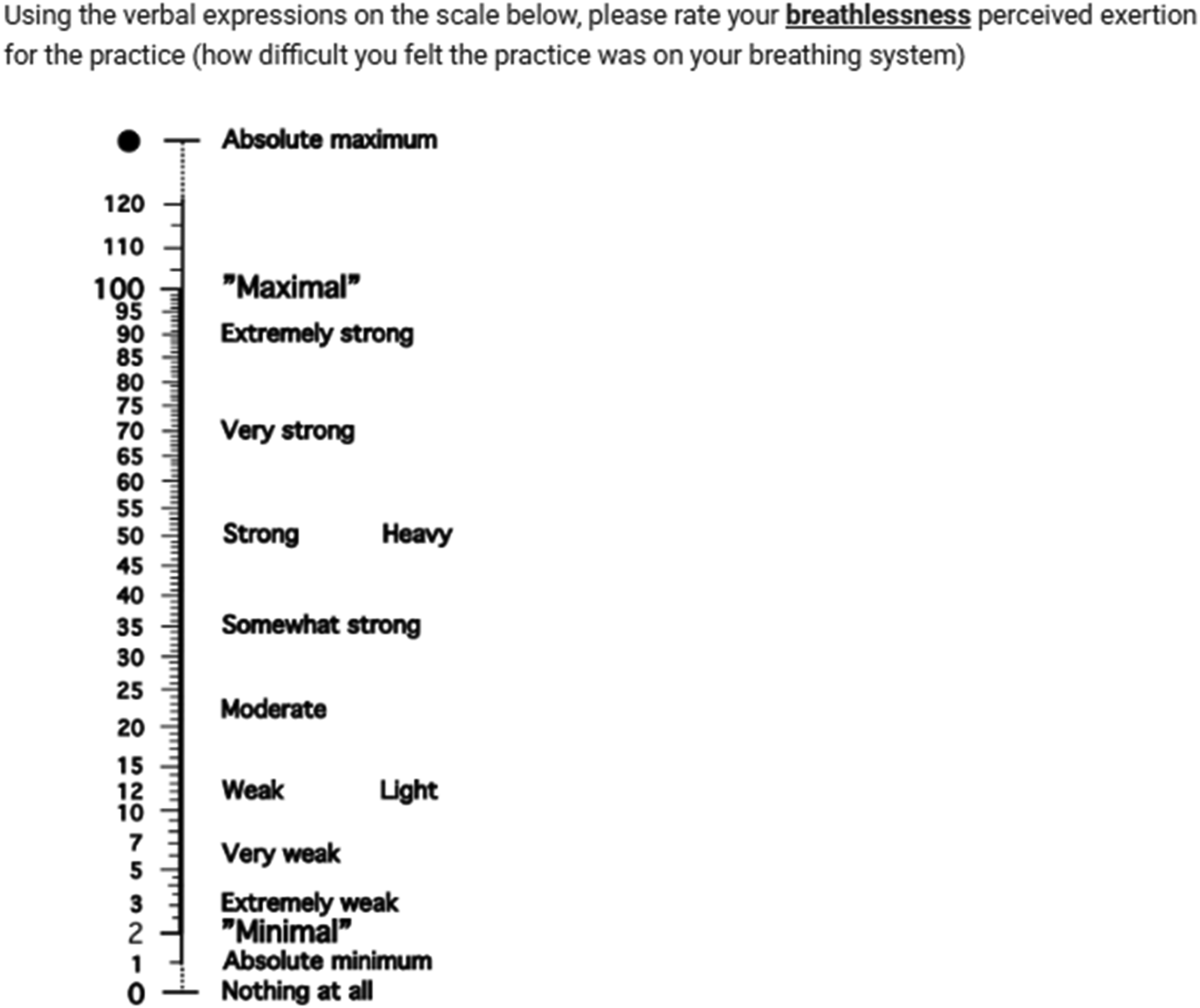
This study used an observational longitudinal design over a seven-week period during the pre-season and beginning of the regular season a women's collegiate varsity ice hockey team. This period of time was selected as it captured the requisite amount of data for analysis, and to avoid any potential or perceived distractions to the hockey team by the research team. Over this period, training load was recorded using the sRPE method, and included global RPE, leg muscle exertion (RPE-L), breathlessness (RPE-B), and technical/cognitive demand (RPE-T). These subscales were chosen based on the specific physiological and cognitive demands required of ice hockey athletes. 15 Players were able to familiarize themselves with these measures prior to the commencement of the study. After signing informed consent, athletes were provided with an education and familiarization session according to best practice recommendations. 21 In this sense, athletes were educated on the use of the Borg Category Ratio 100 (CR100) scale, and the use of memory anchoring. 22 Following the education session, players took part in a familiarization session, which included the completion of a team training session, and an opportunity to practice using the RPE and dRPE measures based on that training session. Athletes were able to freely ask questions about the scales during this session, as well as at any time during the study. One study author (BC) was present for the recording of all responses throughout the duration of the study.
Following team training, athletes were asked to record how difficult they perceived practice to be overall (global RPE), and across three dRPE measures (example in Appendix) using the CR 100 scale. 22 Ratings were recorded within 45 min following the end of the training session, and athletes were provided the opportunity to answer in a private space without observation from their peers. In all cases, athletes recorded RPE and dRPE scores based on all components of the practice, and did not respond for each individual drill. Athletes were not expected to provide responses on days in which they did not participate fully in practice (i.e., if they were late to practice, left prior to completion of practice, or were unable to participate in certain drills for any reason). Each score was then multiplied by the duration of training to calculate session training load across the four RPE variables. The duration of practice was captured by one of the authors (BC) and defined as the start of the first structured training drill, until the head coach ended practice with a final team meeting. Additionally, the duration of each individual drill or activity within each practice was recorded (determined by the athletes starting the drill, until the coach ended the drill).
Measures
The CR100 scale was used in this study due to its increased sensitivity compared to the CR10 scale.8,23 Specifically, respondents are provided with a wider range of response options, which has been shown to lead to less clustering around the verbal anchors of the scale. 24 The CR100 scale has been used across a number of sports and with youth and adult athletes, however, it has not been commonly used in studies on ice hockey.8,11,25,26 All scores were recorded using Google Forms on two tablets provided by the research team. An image of the CR100 scale was provided for each question on the form, allowing the athletes to reference the scale itself for each response. Each collection session required the athletes to select their name, their primary position (i.e., forward) for that training session, and four RPE scores (one for RPE, and each dRPE measure), resulting in a collection period that took less than one minute to complete per athlete.
Statistical analyses
All analyses were performed using R statistical computing software, 27 including the specific uses of the Tidyverse, lme4 and lmerTest packages.28–30 Prior to data analysis, assumptions of normality were investigated for all variables of interest. The distribution of these variables followed a normal distribution, and all variables are reported as means (M) and standard deviations (SD). Descriptive statistics were reported for all measures collected in the study. Team level training load was calculated using means and standard errors, and presented for each of the seven microcycles. There were two missing scores in the athlete sample, including one measure of RPE, and one measure of RPE-B. This resulted in 478/480 (99.6%) player records being complete, and 1918/1920 (99.9%) of all data collected being complete. Therefore, complete case analyses were utilized in our models due to the very small amount of missing data.
Mixed effects linear regression models were used to explore the relationship between RPE, and measures of dRPE. Models were fitted using a restricted maximum likelihood approach. To determine statistical significance, p-values were set at p < 0.05 which were derived using Satterthwaite's method. 31 Due to the nature of our repeated-measures design, mixed effects models permitted the ability to estimate the fixed (dRPE measure) effects, and random (within-player) effects. These models were created using the entire sample, as well as for positional groups (forwards, defenders, goaltenders). This modeling approach matches similar work examining RPE and dRPE (McLaren et al., 2017; Weston et al., 2015). Model examination revealed no violations of assumptions (e.g., normality of residuals, Q-Q plots) across any of the models. Additionally, a bootstrapping procedure of 1000 simulations was conducted as a sensitivity analysis for the team-level mixed effect model, but did not reveal any significant variance, indicating that the missing data in this study did not impact the results found using complete case analysis.
Results
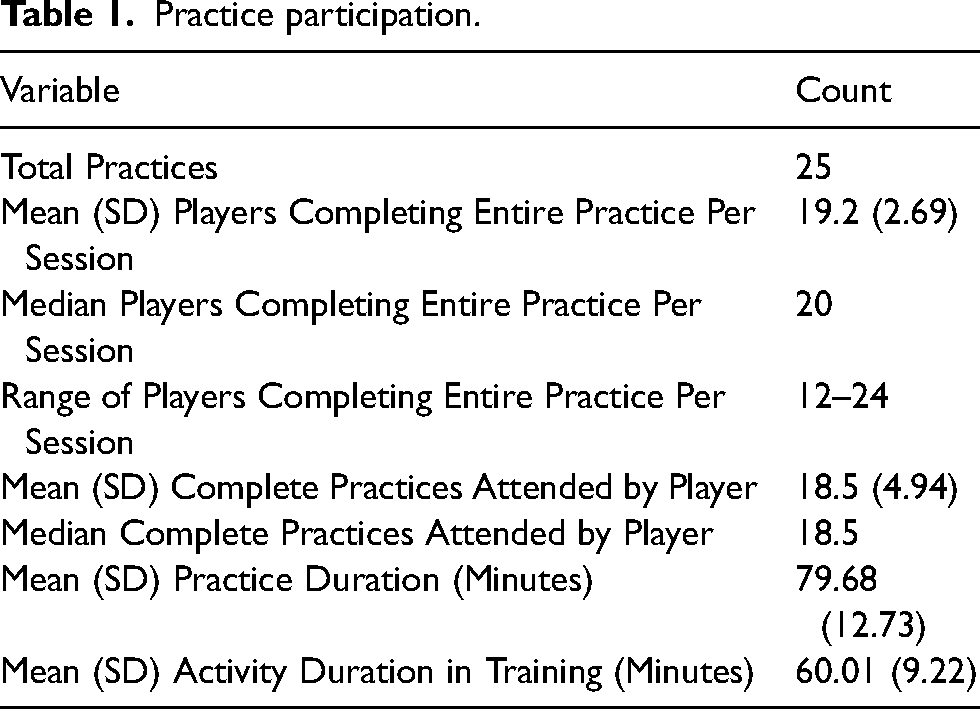
In total, 480 training session responses were recorded over the seven-week duration of the study, of which, 478 responses were complete and used in our analyses. A full representation of training sessions and responses are found in Table 1.
Practice participation.
Scores for each of the ratings of perceived exertion for the entire group, and by position can be found in Table 2. Forwards demonstrated the greatest mean scores across all measures, while goaltenders recorded the lowest mean scores.
Mean, (standard deviation), and range of dRPE scores by position.
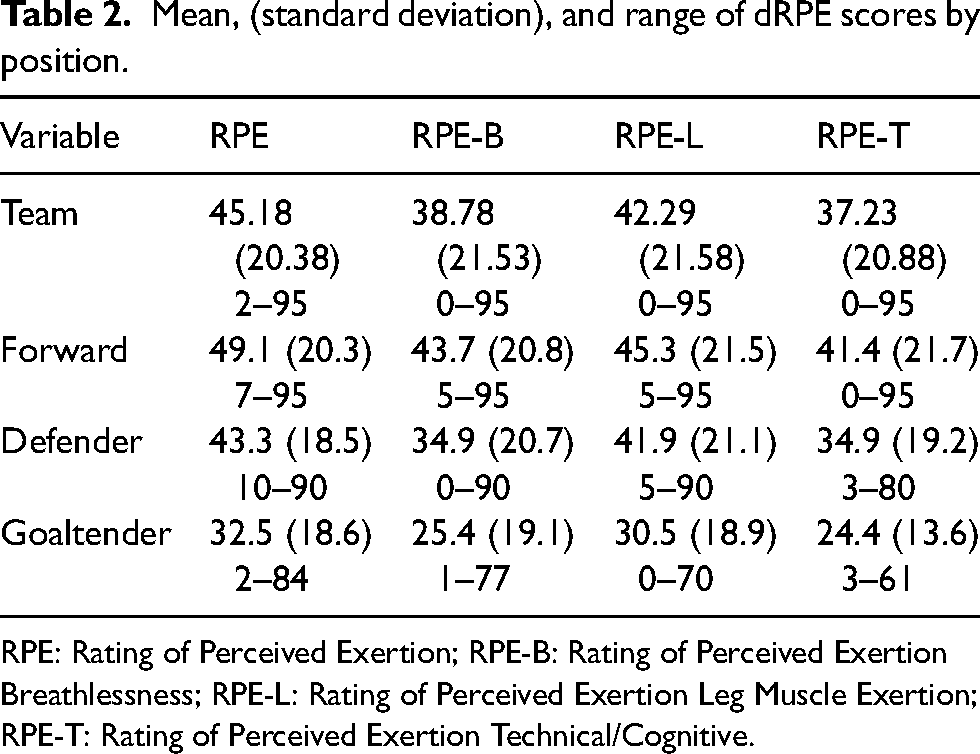
RPE: Rating of Perceived Exertion; RPE-B: Rating of Perceived Exertion Breathlessness; RPE-L: Rating of Perceived Exertion Leg Muscle Exertion; RPE-T: Rating of Perceived Exertion Technical/Cognitive.
Results from the mixed effects linear regression are found in Table 3. Measures of breathlessness, lower limb exertion, and technical/cognitive exertion accounted for 74.5% of the variance seen in RPE. Perceived breathlessness demonstrated the greatest impact on RPE, followed by lower limb exertion, then technical/cognitive demand. However, technical/cognitive demand was not statistically significant. When examining this relationship by position type, the variance in RPE explained by dRPE was greatest for goaltenders (R-squared: 0.86), followed by defenders (R-squared: 0.71), and forwards (R-squared: 0.70). Regardless of position, RPE-Breathlessness demonstrated the strongest relationship with RPE. RPE-technical/cognitive showed a very small, and statistically non-significant, positive relationship with RPE for both goaltenders and forwards, but showed a weak, statistically significant effect in defenders.
Results of mixed effects multiple models on RPE by dRPE.
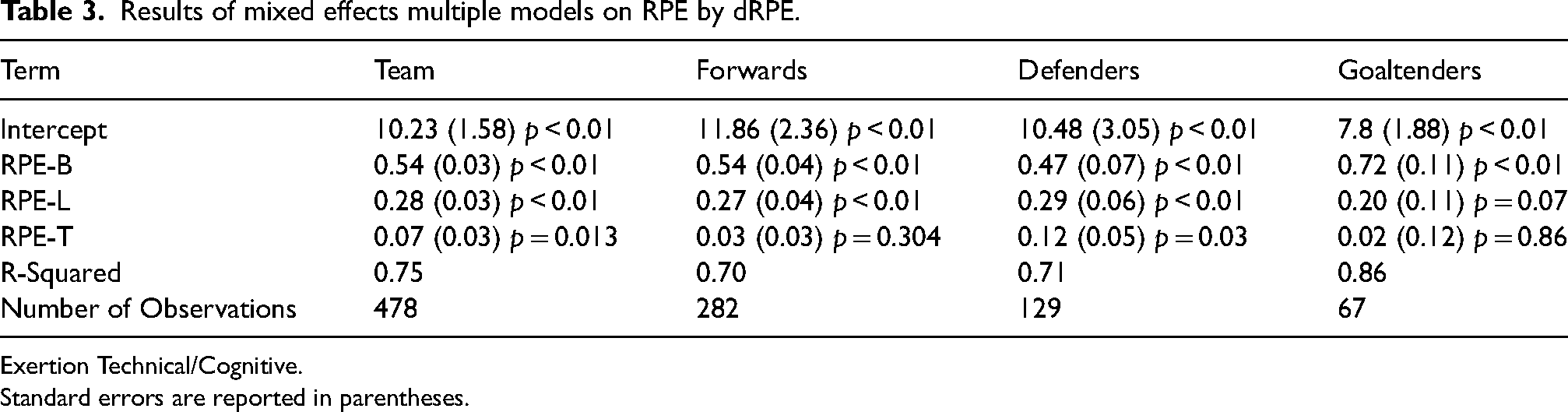
Exertion Technical/Cognitive.
Standard errors are reported in parentheses.
Training load
Seven microcycles were recorded over the duration of the study. Mean training load per training day was 3605.67 arbitrary units (SD = 1764.98), while the mean training load of activity time per training day was 2718.95 arbitrary units (SD = 1331.65). Mean training load per day by microcycle is visualized in Figure 1. Microcycle training loads did not follow similar structures during the pre-season or the regular season periods.
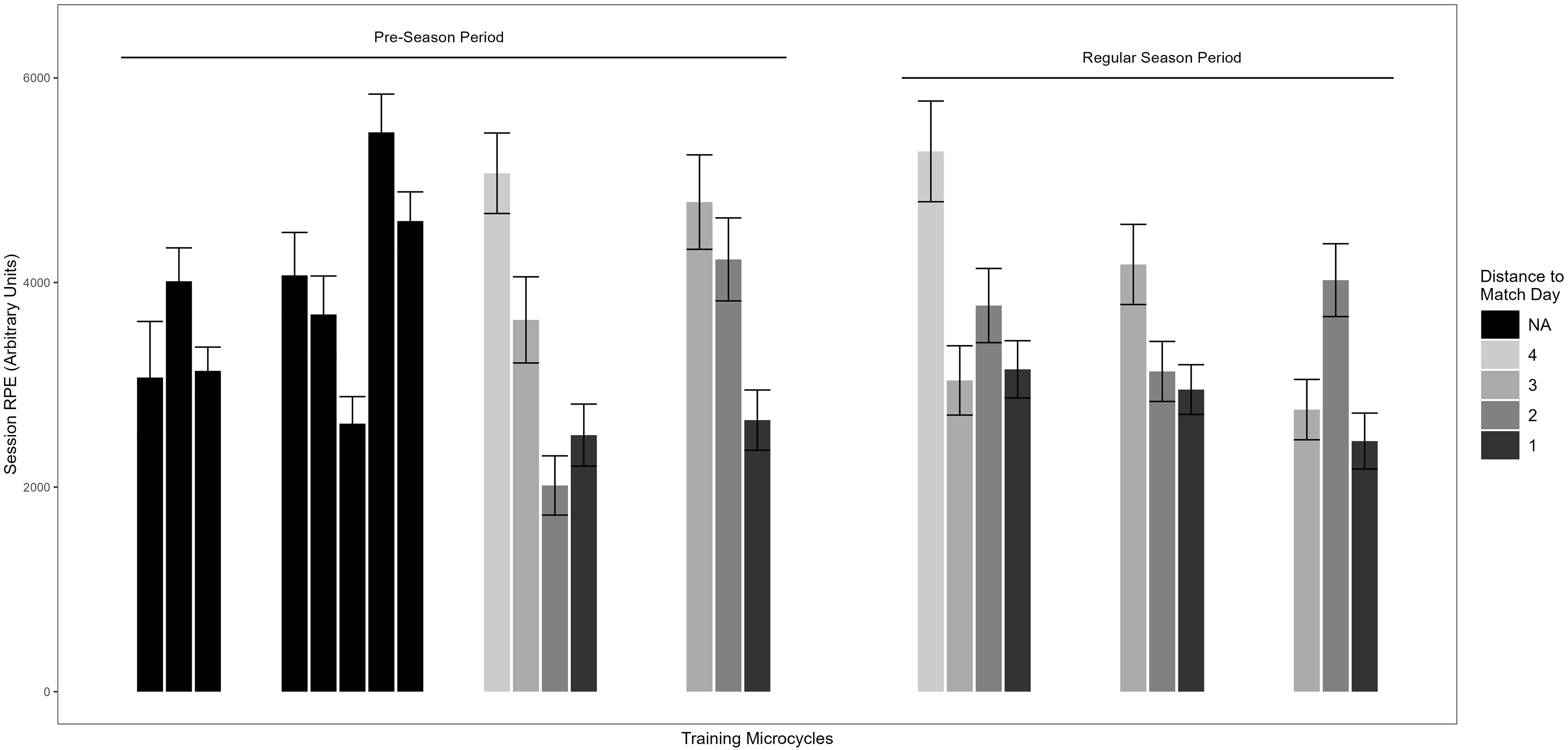
Internal training load over seven training microcycles.
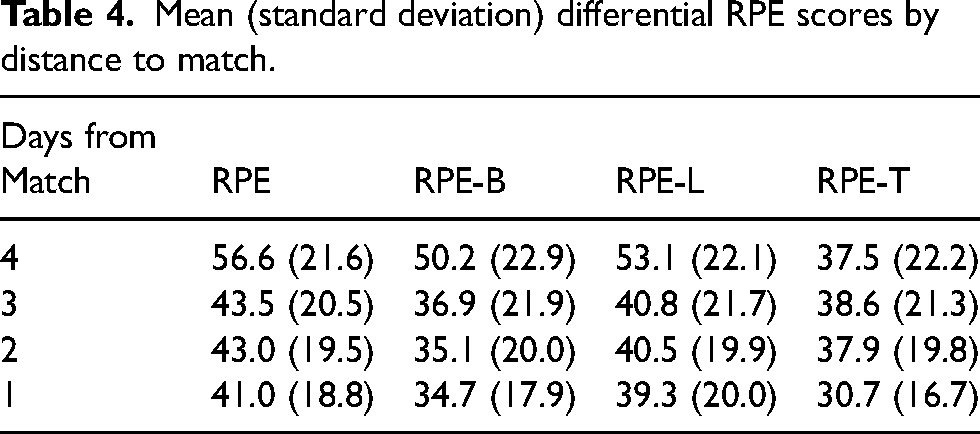
During microcycles with match play, training sessions had on average, greater training loads the further the training session was from a match (Figure 2). When using measures of differential RPE, all mean scores decreased as the training session approached match day (Table 4). Further, the variance in reported dRPE measures was similar regardless of distance to match day.
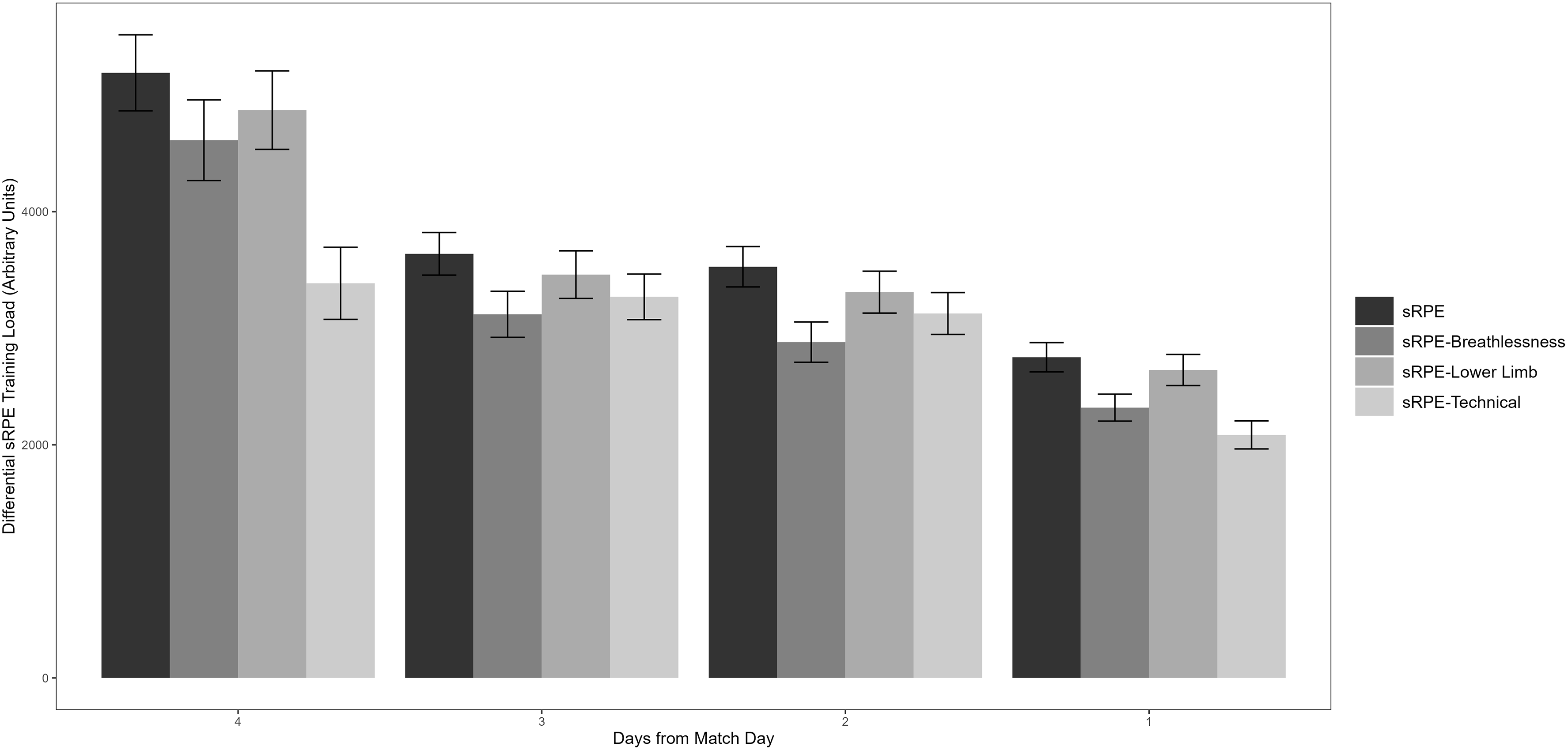
Differential RPE based training load (arbitrary units) by distance to match day.
Mean (standard deviation) differential RPE scores by distance to match.
Discussion
Ratings of perceived exertion serve as a low-cost and feasible method of monitoring internal training load in athletes. 32 Measuring the internal load of athletes plays a critical role in athlete monitoring, 4 and capturing more detailed and specific measures of internal training load using dRPE can provide further information for teams and athletes.8,11,14 Using mixed effects linear regression models in our study, we found that dRPE explained just under 75% of the variance seen in RPE scores from women's collegiate varsity ice hockey players. When analyzed by position, dRPE explained 70%, 71%, and 86% of the variance seen for forwards, defenders, and goaltenders, respectively. While the results from the position group models differed, RPE-B showed the strongest relationship with RPE for each position. This finding indicates that coaches may be able to manipulate the perceived difficulty of practice for all positions by modifying how types of practice impact the breathing system of hockey athletes. For example, this may be accomplished by increasing the work to rest ratio of drills. 33
To the best of our knowledge, previous studies in ice hockey have not examined the relationship between RPE and dRPE. That said, research from other sports, including male professional rugby, and male Australian football league have assessed the relationship between RPE and dRPE, finding that dRPE explained between 77 and 76 percent of the variance seen in RPE (McLaren et al., 2017; Weston et al., 2015). The results from our study, and other similar studies examining different sports, indicate that dRPE provides additional information that can be used to better understand practice difficulty, and provide greater insights than solely using RPE. Further, there appears to be a level of stability between the relationship between RPE and dRPE, as studies across different sports and athlete sex have revealed similar results (McLaren et al., 2017; Weston et al., 2015).
Our study also examined how different position groups experienced the perceived exertion of practice. Forwards recorded the highest scores across all four scales, followed by defenders, and goaltenders. Interestingly, goaltenders reported scores at least 25% lower than defenders, and at least 33% lower than forwards. Interestingly, goaltenders did not report having RPE-T scores greater than forwards or defenders. Given the importance of mental skills in goaltending, 34 coaches may need to be aware that goaltenders require sufficiently mentally challenging practices. Previous research in ice hockey has found that goaltenders experienced significantly higher internal training loads in matches, but not in practice, compared to forwards and defenders. 16 These findings indicate that goaltenders may not be adequately challenged in practice settings compared to the perceived demands experienced in matches. While our study did not include any measurements from games, future research is required to better understand how practice can be optimized to better meet the demands of match play for goaltenders.
This study took an observational approach to monitoring internal training load using the session RPE method, multiplying the reported RPE by the duration of practice (Foster, 1998). Across the seven microcycles monitored, differing patterns of training load were experienced by the athletes. Overall, athletes experienced the greatest mean training load on MD-4, and on average, the training load at practices decreased as practice was closer to match day (Figure 2). This finding is in line with previous work in collegiate women's hockey by Bigg et al. (2022a), who identified the same pattern in congested weeks where the team played more than one match. However, in a similar study in men's collegiate ice hockey, the decreasing training load pattern appeared in non-congested weeks (i.e., where only one match was played), rather than congested weeks. 17 This likely indicates that teams and coaches have slightly differing approaches to microcycle periodization at the collegiate ice hockey level. This may be reflective of coach pedagogy, as some evidence exists demonstrating how coaches at the professional level prioritize different forms of training compared with one another in ice hockey. 35 However, limited evidence exists discussing optimal training periodization for both physiological and skill development domains in the ice hockey literature.
Interestingly, when compared with training load, RPE and measures of dRPE had very similar values on MD-3, MD-2, and MD-1 (three, two, and one day before match day, respectively). Therefore, the differences in training load experienced by athletes between MD-3, MD-2, and MD-1 was determined more by duration in practice, rather than the perceived demands of the training session. For example, over the course of the study, mean RPE on MD-1 was 95% of the mean RPE of MD-2. However, the mean training load of MD-1 was 78% of the training load experienced on MD-2. This indicates that the athletes perceived the practices as having similar difficulty, and therefore, that the duration of the practice accounted for differences in training load between these days. Previous lab based research has demonstrated that exercise duration can affect RPE when intensity is sufficiently high. 36 Therefore, practice duration is another variable that coaches should be aware of due to its impact on internal training load in both parts of the sRPE formula.
Ultimately, there is no current published literature outlining what “optimal” training load monitoring looks like in ice hockey. While team sport training models that incorporate training load exist 37 there are significant limitations to the current understanding and application of how training load monitoring is being researched and applied.4,38–40 In its current state, training load monitoring may best be used to gather an understanding of the similarities and differences between the demands of training and demands of match play to better inform practice design. With a clearer understanding of match play demands, training load can also be used alongside skill acquisition frameworks, such as the skill acquisition periodization framework, 41 and the challenge-based framework 42 to optimize the practice environments.
Limitations
It is important to note that this study featured only one team, and further research is required to examine if these findings are generalizable. Future research should aim to include multiple teams and sites to bolster findings and improve generalizability. Additionally, it is possible that athletes may not truthfully respond, or may make typographic errors with any self-report measures. 43 To reduce this risk, we ensured that any individual participant responses would not be seen or made available to the coaching staff, and the lead author was present during all data collection to support participants with responses to attempt and minimize errors in responses. Finally, we did not capture other forms of training completed by the athletes (e.g., strength training) over the course of this study. However, athletes were instructed to record scores specifically relating to the on ice training session they had just completed. Overall, we believe that despite these limitations, this research helps add to the literature on women's ice hockey training, and the use and application of dRPE.
Conclusion
Ice hockey coaches aiming to modify the perceived difficulty of team training may benefit from first modifying how difficult practice will be on athletes breathing systems. This may be accomplished most efficiently by modifying the athlete's work to rest ratio, by either reducing the duration of exertion on a per repetition or drill basis, or by increasing the amount of recovery between reps and drills. Further, we used an observational approach to describe the training load demands experienced by this team through pre-season and into the regular season, using sRPE and dRPE. We identified that positional differences exist in a sample of collegiate women's ice hockey athletes, and highlighted that future considerations should be placed around ensuring that athletes of all positions are challenged appropriately during team training. Finally, further research is needed surrounding optimal training load design in ice hockey. This study identified that the relationship between dRPE and RPE was nearly identical to previous studies, indicating these measures likely have a stable relationship between sporting populations. Using RPE and dRPE is a low-cost and minimally invasive method that can be used to support athlete monitoring in ice hockey, and understanding and improving practice design and periodization.
Footnotes
Declaration of conflicting interests
The authors declared no potential conflicts of interest with respect to the research, authorship, and/or publication of this article.
Ethics approval statement
The research work in this project was performed in compliance with the regulations of Research Ethics Board/Animal Care Committee at Ontario Tech University under REB Certificate number 17224.
Funding
The authors received no financial support for the research, authorship, and/or publication of this article.

Appendix
The Borg centiMax scale (R) (CR100) ((C) Gunnar Borg & Elisabet Borg, 2001, 2002, Elisabet Borg,2007). The scale and full instruction can be obtained through BorgPerception www.borgperception.se