



Abstract
The aim of this study was to compare the butterfly swimming speed during the insweep phase of two distinct arm pull patterns. Ten national-level swimmers (5 males with 17.5 ± 0.8-years and 5 females with 16.8 ± 0.9-years) were analyzed while performing butterfly all-out trials based on two distinct arm-pull patterns (“bent” and “straight”). The “bent” arm-pull refers to the stroke kinematics they use to swim. The “straight” arm-pull refers to a more extended elbow than they used to swim. Based on discrete variables, swimming speed was faster in the “straight” than the “bent” arm-pull, but not significantly (p = 0.546). Non-significant differences were also noted for the remaining discrete variables. Conversely, Statistical Parametric Mapping (SPM, continuous analysis) identified significant differences in swimming speed between ∼42% and ∼60% (insweep phase and the beginning of the upsweep phase; p = 0.001), and ∼83% and ∼87% (halfway through the release and recovery, respectively; p = 0.043) of the stroke cycle. SPM was more sensitive in identifying differences in swimming speed between arm pulls. Swimmers were faster while performing the “straight” arm pull than with the “bent” arm pull, predominately based on a faster swimming speed during the insweep phase.
Introduction
Swimming is a time-based sport (i.e., accomplishing a given distance at the fastest time possible), thus, strongly dependent on speed. It is characterized by four swim strokes: front crawl, backstroke, breaststroke, and butterfly. Considering the sprinting events, the butterfly stroke is the second fastest.1,2 Notwithstanding, it receives less attention from researchers than the front crawl stroke, which is the fastest 3 and the most studied swim stroke.4,5
In butterfly, upper limb action accounts for 90% of swimming speed in boys and 80% in girls. 6 Thus, much focus is given to this phenomenon. Nonetheless, it should be mentioned that the butterfly kicks and the trunk's undulatory movement also play a key role in this swim stroke performance. 7 Upper limbs action was expanded as follows: (i) the hand entry is when the hands enter the water; (ii) the outsweep and catch is when the upper limbs sweep outward rather than backward and place the hands in a solid position to make the catch; (iii) the insweep is similar to front crawl, i.e., flexing the elbow and combining shoulder internal rotation, horizontal adduction, and extension to produce fast hand speeds and, therefore, great propulsive forces. 8 However, in the butterfly stroke, both arms are moving simultaneously and without rolling the body over the longitudinal axis; (iv) the upsweep is a strong backward push that also brings the hands toward the surface, and; (iv) the release and recovery is when the hands exit the water and recover above water to initiate a new stroke cycle. 8
Particularly, the insweep phase can also be described by a semicircular movement until the hands are below the body by turning the palms inward and bending the elbow further up to ∼90 to ∼100°. 9 It was argued that in this hourglass pattern: (i) the hands move during a longer distance than they would do if transferred straight back, and these perform sweeps in terms of changing directions throughout the underwater pull. This allows them to find still water, hence increasing thrust.8,9 However, as far as our understanding goes, there is a lack of evidence regarding elbow extension during the insweep phase. As aforementioned, this phase is responsible for the most significant thrust. 8 Consequently, the fastest swimming speeds are achieved at the end of the insweep or during the upsweep phase.10,11 It was argued that using sculling motions (S-stroke pattern with insweep) while swimming is more efficient than a straight pull stroke, as it generates higher lift forces with minimal energy loss. 12 On the other hand, others claimed that an S-stroke is unlikely to provide an advantage over a straight pull. 13 The authors argued that if the swimmer's arm speed remains the same regardless of the stroke type and that the drag coefficient of the arm and hand is equal to one, it can be presumed that the lift coefficient of the hand is also one (favoring the S-stroke). If the angle varies between 20° and 30°, the arm speed in the swimming direction will be reduced by approximately 6% to 13% in the S-stroke compared to a straight pull, leading to a 12% to 26% decrease in thrust. 13
At least in front crawl, it was indicated that arm pulls with excessive sculling (i.e., sweep with bent elbow) are less effective in producing thrust than when the hand is maintained in the direction of thrust. 14 The authors analyzed two pulling techniques (S-stroke and straight) in front crawl and backstroke. One was designed to focus on lift-based propulsion (S-stroke), while the other generated thrust primarily through drag forces (straight). Their analysis revealed that lift forces contributed significantly to thrust across all techniques, with lift-to-drag ratios ranging from 1.1 to 3.3. 14 However, the straight arm pull produced considerably higher thrust than the S-stroke. It was shown that lift-based techniques decreased drag contribution and overall thrust, indicating that pronounced sculling motions reduced the effectiveness of arm stroke propulsion. 14 Therefore, if the pattern of the insweep phase in butterfly is similar to the one performed in the front crawl arm pull,8,15 one can argue that increasing the elbow extension more than advised (avoiding excessive sculling) can lead to great thrust and fast swimming speeds. Indeed, it was claimed that elite swimming coaches and athletes have increasingly abandoned the S-stroke (sculling), mainly because swimmers using the straight arm pull consistently outperformed those relying on the S-stroke in competitions. 13
Notwithstanding, the literature lacks evidence about this topic in the butterfly swim stroke. Continuous time-series analysis, such as Statistical Parametric Mapping (SPM), can deliver more sensitive and precise insights about such differences compared to the traditional analysis based on discrete variables. SPM is a statistical procedure used primarily in neuroimaging to analyze brain imaging data 16 but has migrated to various applications such as swimming performance.17–19 Conversely to discrete variables (i.e., with no time dimension – 0D), continuous time-series analysis (i.e., with time dimension – 1D) allows one to examine how variables change over time, particularly within a stroke cycle as it happens in swimming. For example, for front crawl 18 and breaststroke, 17 it was possible to detect significant differences in swimming speed between age groups and competitive levels, respectively, and where within the stroke cycle. Thus, as with other swim strokes, one can argue that SPM can deliver more profound insights into this specific topic related to differences in butterfly swimming speed based on elbow flexion during the arm pull.
Therefore, the aim of this study was to compare swimming speed in the butterfly stroke, between two distinct arm pulls regarding the insweep phase of the stroke cycle: (i) “bent” – arm pull performed with the standard insweep), and; (ii) “straight” – arm pull performed with the elbow performing an extension more considerable than advised during the insweep phase). It was hypothesized that extending the elbow more than advised could lead to the fastest swimming speeds.
Methods
Participants
This study comprised 10 national-level swimmers (five males: 17.5 ± 0.8 years, 78.8 ± 6.5 kg of body mass, 185.2 ± 5.3 cm of height, and 187.6 ± 4.7 cm of arm span, and 580.0 ± 54.6 World Aquatic Points; five females: 16.8 ± 0.9 years, 65.1 ± 4.6 kg of body mass, 175.0 ± 2.5 cm of height, and 175.2 ± 4.8 cm of arm span, and 500.6 ± 73.8 World Aquatic Points). These swimmers regularly participated in national competitions and some in international ones (Tier 3 athletes). 20 They were under a talent identification program. As inclusion criteria, swimmers had to be experts in butterfly stroke, uninjured, and regularly trained for the six months before data collection. At the time of data collection, they were at the end of the second macrocycle (i.e., the season's peak performance, which corresponded to the preparation for a major national competition). All human research procedures were according to the Declaration of Helsinki, and the Polytechnic Ethics Board approved the research (P547664-R678573-D2082555, 27-03-2025).
Research design
Swimmers were asked to follow their usual nutrition and sleep habits, avoid caffeine consumption 12 h prior, and refrain from intense exercise (whether in the pool or gym) for two days before and on the day of testing. 21 The tests occurred in a 25-m indoor swimming pool (water temperature: 27.5 °C, air temperature: 26.0 °C, and relative humidity: 67%). Before data collection, the swimmers performed their competition warm-up routines on land and water. 22 The dry-land warm-up included dynamic stretching and mobility, elastic band exercises, core activation, plyometrics, and cardio activation. 23 The in-water warm-up involved the recommended swim distance of 1200 meters, including a short-distance race-pace set that is usual among swimmers. 24 Swimmers were instructed to perform all-out trials with the two distinct arm pulls regarding the insweep (i.e., “bent” and “straight” upper limb). The arm pull with the elbow bent is their swim mode. As for the straight arm pull, swimmers were instructed to perform the arm pull with the elbow more extended than they used to. This information was delivered by an experienced coach, using standard scripts, pictures, and film examples for full understanding. Afterwards, the swimmers trained in this arm pull motion on a swimming bench, i.e., practicing the entire butterfly stroke arm movement. The coach also delivered cues at this stage so swimmers could learn and interpret this motion. This was done the week before data collection in three dedicated sessions within their dry-land training program.
After an auditory signal, each swimmer performed two all-out trials of 25 meters in butterfly stroke (for each arm pull) with a wall push-off start. The trials of the “bent” and “straight” arm pull modes were randomized. They had a 30-min rest between trials to allow for a full recovery. The best trial for each arm pull (fastest swimming speed during the 25 meter all-out) was used for further analysis. The first trial of each mode was the best for all swimmers. Swimmers were instructed to perform non-breathing stroke cycles during the data collection period to avoid changes in stroke coordination or technique that could negatively affect swimming speed. 25 They were also advised to start swimming immediately after the wall push-off (i.e., without using the underwater phase) to reach the maximal speed sooner and to ensure that all swimmers perform this in the same condition. Afterwards, three consecutive stroke cycles in the mid-section of the swimming pool (i.e., clean swim) were measured for each arm pull. The average was used for further analysis. Speed was then analyzed as a discrete and continuous variable (SPM). Other discrete variables included speed fluctuation (dv), stroke frequency (SF), stroke length (SL), and stroke index (SI).
Data collection
For the speed and dv measurements, the string of a mechanical device (SpeedRT, ApLab, Rome, Italy) was attached to the swimmers’ waist. 26 This device calculated the displacement and speed of the swimmers (f = 100 Hz). Afterward, signal processing software imported the speed–time series (AcqKnowledge v.3.9.0, Biopac Systems, Santa Barbara, CA, USA). The signal was handled with a Butterworth 4th order low-pass filter (cut-off: 5 Hz) based on the analysis of the residual error vs. cut-off frequency output. 27 A video camera GoPro (Hero 7, San Mateo, CA, USA), synchronized with the mechanical device, filmed the swimmers in the sagittal plane to identify the hand's water entry to determine the stroke cycles. The beginning and end of each stroke cycle were set by the consecutive entry of both hands into the water. Swimming speed (in m/s) was retrieved from the software and dv was calculated as being the coefficient of variation (CV): CV = standard deviation/mean · 100 (in %). The SF (in Hz) was calculated by the number of cycles per unit of time (considering the footage recorded) from the time it took to complete one entire cycle. Afterward, the SL (in m) was calculated by dividing the swimming speed by SF. The SI (in m2/s) was calculated by multiplying the speed by the SL.
Data analysis
Descriptive statistics were calculated as mean ± one standard deviation. As a discrete variable, swimming speed and the remaining variables were analyzed with an independent samples t-test (α = 0.05). Cohen's d was chosen as an effect size index (ES) and deemed as: (i) trivial if 0 ≤ d < 0.20; (ii) small if 0.20 ≤ d < 0.60; (iii) moderate if 0.60 ≤ d < 1.20; (iv) large if 1.20 ≤ d < 2.00; (v) very large if 2.00 ≤ d < 4.00; (vi) nearly distinct if d ≥ 4.00. 28 Swimming speed was also analyzed using an independent samples t-test (SPM independent t-test) as a continuous variable. Before, each stroke cycle was normalized to its duration on an R routine. 29 SPM analyses were implemented using the open-source spm1d code on MatLab (v.M0.1, https://www.spm1d.org).
Results
Table 1 presents the descriptive statistics, based on discrete variables, of the swimming speed and remaining variables per arm pull (i.e., “bent” and “straight”). The swimming speed was faster in the “straight” than the “bent” arm pull. Through discrete variables analysis, this difference was not significant (p = 0.546) and had a small effect size (ES = 0.28). The dv was smaller in the “straight” arm pull than in the “bent” one but not significantly (p = 0.819) and with a trivial effect size (ES = 0.10). As for the SF, this was also faster in the “straight” than in the “bent” arm pull. This difference was also non-significant (p = 0.163) between arm pulls but with a moderate effect size (ES = 0.65) (Table 1). For the “bent” arm pull, the underwater phase accounted for 69.6 ± 2.9% and the release and recovery 30.4 ± 2.9%. As for the “straight” arm pull, the underwater phase accounted for 68.5 ± 3.3% and the release and recovery 31.5 ± 3.3%. The SL was shorter (p = 0.345; ES = 0.43), and SI was smaller (p = 0.881; ES = 0.07) in the “straight” than in the “bent”, but not significantly.
Descriptive statistics mean ± standard deviation (SD) of all discrete variables measured per arm-pull (“bent” vs. “straight”). Data regarding the comparison between the two arm-pulls is also presented.
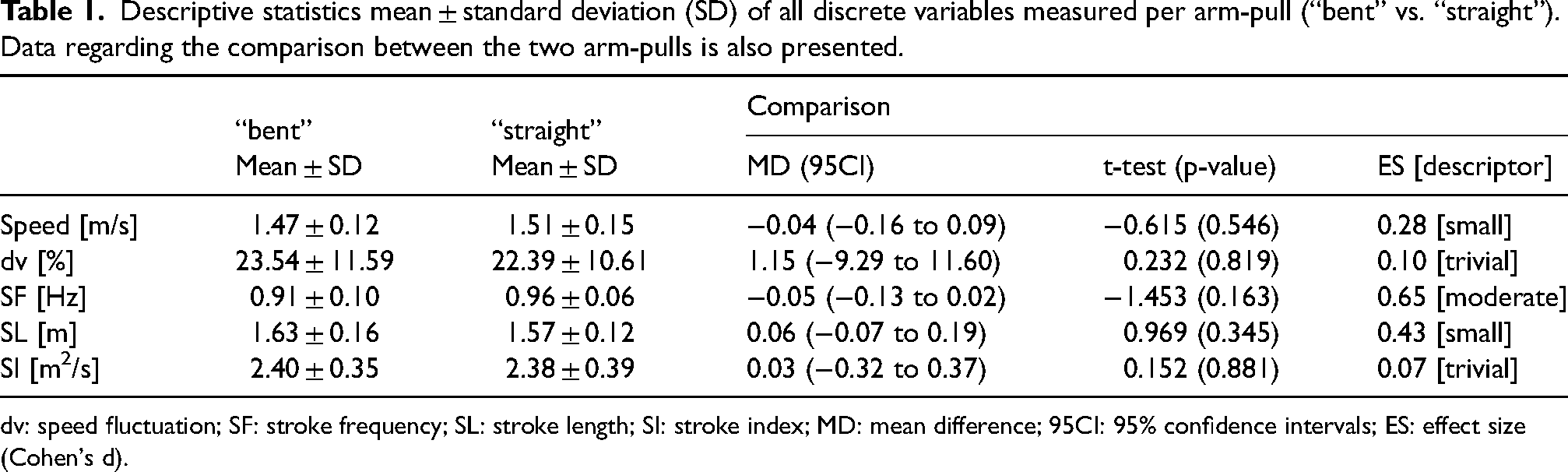
dv: speed fluctuation; SF: stroke frequency; SL: stroke length; SI: stroke index; MD: mean difference; 95CI: 95% confidence intervals; ES: effect size (Cohen's d).
Figure 1 presents the speed time-series per arm-pull (Panel A). The “bent” arm pull denoted a sharp increase in speed from the hands’ entry until the outsweep, followed by a decrease during the insweep, an increase during the upsweep, and a decrease after the release and recovery. As for the “straight” arm-pull, this denoted a less sharp increase in speed from the hands’ entry until the outsweep. However, swimmers were able to increase speed during the insweep phase, and started to lose speed from the upsweep until the release and recovery. Figure 1 also depicts the SPM independent samples t-test (Panel B). A significant difference between arm pulls was noted between ∼42% and ∼60% (p = 0.001), and between ∼83% and ∼87% (p = 0.043) of the stroke cycle (Panel B). These corresponded to the insweep phase and the beginning of the upsweep phase, and halfway through the release and recovery, respectively. The “straight” arm pull promoted the fastest and significant swimming speed between ∼42% and ∼60% of the stroke cycle. Conversely, the “bent” arm pull promoted the fastest and significant swimming speed halfway through the release and recovery phase.
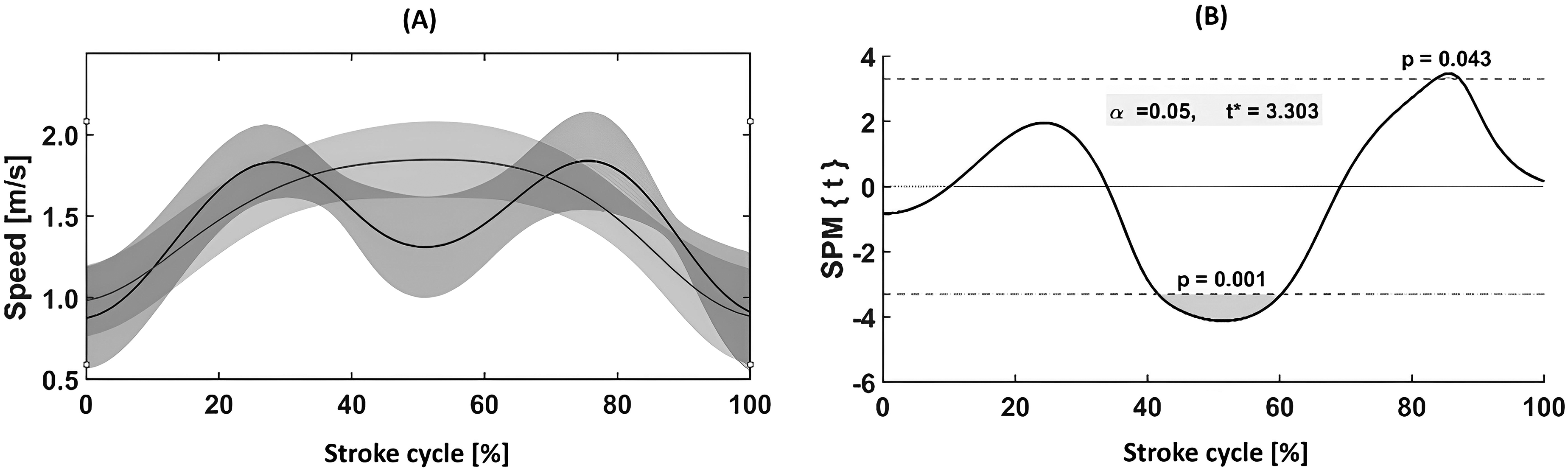
Panel A – illustration of the speed time-series of each arm pull with 95% confidence intervals. Black line: “bent” arm pull; Grey line: straight arm pull. Panel B – SPM independent t-test. SPM {t}: t-test for an independent sample. The grey area indicates significant differences. Dash lines represent the 95% confidence interval (95CI).
Discussion
The aim of this study was to compare the swimming speed in the butterfly stroke between two distinct arm pulls (“bent” vs. “straight”) regarding the insweep phase. Despite non-significant differences were noted between arm pulls, based on discrete variables, the “straight” arm pull presented the fastest swimming speed and SF, and the smallest dv. Conversely, based on SPM, significant differences in the swimming speed were noted between arm pulls in the insweep phase and the beginning of the upsweep phase, and halfway through the release and recovery.
Literature reports less evidence regarding the differences between the best and poorest butterfly swimmers compared to front-crawl.30,31 Such details can provide substantial information about how butterfly swimmers can improve. Overall, based on race analysis 3 and laboratory settings, 32 it was noted that the fastest butterfly swimmers present faster SF's and larger SL's than their less skilled counterparts. However, there is no information about the effects that changes in the pattern of the butterfly stroke could have on the swimmers’ swimming speed. The butterfly insweep phase is considered to be like the one performed in the front crawl, but simultaneously with both upper limbs, and without rolling the body over the longitudinal axis. 8 Overall, swimmers flex the elbow and combine shoulder internal rotation to produce fast hand speeds and, therefore, great propulsive forces.8,12
Based on the rationale of two distinct arm pulls in front-crawl, 14 we hypothesized that flexing less the elbow could lead to the fastest speeds in butterfly. Based on discrete variables, our data revealed that the “straight” arm pull promoted faster speeds than the “bent” one, but with non-significant differences. Still with non-significant differences, but the SF was faster (with a moderate ES) in the “straight” arm pull in comparison to the “bent”. By not flexing the elbow as much as indicated (standard pattern, i.e., “bent” arm pull), the hand path presents a shorter displacement during the arm pull. Thus, allowing the swimmers to present the fastest SF's and, consequently, a fast swimming speed.
As far as our understanding goes, there is no information in the literature about the application of SPM to understand better the underlying factors that excel butterflyers’ speed. To our knowledge, Sampaio and co-workers 33 used SPM to compare propulsive force between upper limbs in the butterfly stroke, and Fernandes and co-workers 34 analyzed the inter-cycle kinematic variation in different expertise levels. Conversely to what was found based on discrete variables, SPM denoted significant differences in swimming speed between arm pulls. The speed time-series denoted in the “bent” arm pull are somehow similar to the ones verified by others, with increases and decreases within the stroke cycle.10,11 As for the straight arm pull, this showed a profile where the swimmers increased speed progressively, reached a peak, and then decreased (being more similar to the straight arm pull performed in the front crawl stroke 14 ). The differences noted were mainly in the insweep phase and the beginning of the upsweep phase, but also halfway through the release and recovery. In the first case, the fastest speeds were achieved while performing the “straight” arm pull. At least in front crawl, it was indicated that arm pulls with excessive sculling (i.e., sweep with bent elbow – as it happens in butterfly) are less effective in producing thrust than when the hand is maintained in the direction of thrust. 14 It was even suggested that contrary to conventional knowledge, exaggerated sculling (aiming to exploit lift) reduces both the lift and drag contributions to thrust.13,14 Present findings seem to follow this rationale, as the “straight” arm pull promoted significantly fast speeds, particularly in the insweep phase. Indeed, it was claimed that within a sample of Olympic butterfly swimmers, some used less lift force, more drag force, and straighter back-pulling motions than others. 35 Thus, extending the elbow more than theoretically advised led to the fastest speeds.
Significant differences were also found between arm pulls halfway through the release and recovery, where the “bent” arm pull promoted fast swimming speeds. In this case, flexing the elbow more during the insweep phase may help the swimmers better recover the upper limbs to a new water entry, consequently losing less speed. A study by Schleihauf and co-workers, 35 showed that swimmers performing the butterfly stroke presented shorter hand depths, wider arm movements, and smaller elbow angles than their front crawl counterparts. Additionally, it has been reported that the outward movement of the hands from the narrow part of the hourglass pattern helps on the exit, promoting a continuous rounding out into the recovery. 8 The elbow flexion in this phase reduces the range of motion needed to complete the recovery. This decreases the torque required at the shoulder joint, lessening the strain on the shoulders and making the movement more fluid. 36 With slightly flexed elbows, the swimmer's arms are lifted in a more controlled and relaxed position, reducing the work on the shoulders and minimizing fatigue. This reduced torque can also have a meaningful effect on reducing shoulder injury risk in young swimmers. 37 Additionally, during the insweep, the trunk continues to rotate back as part of the pendulum action. 8 Thus, one can argue that extending the elbow more than advised may lead to a greater trunk inclination and, consequently, to a more significant drag due to a greater surface area. 38 This can indicate that when performing longer distances than sprinting events, the “bent” arm pull is more suitable.
Overall, regarding the entire stroke cycle and based on the average swimming speed, the “straight” arm pull allowed the swimmers to achieve faster speeds than the “bent” arm pull (standard pattern). It must be mentioned that these findings only refer to sprinting trials and non-breathing stroke cycles. Nonetheless, coaches are advised to experiment with which arm pull their swimmers can reach better performances. As main limitations, it can be considered (i) that the quantitative flexion of the elbow was not measured, and these assumptions are only for maximal trials (sprinting), and; (ii) the level of the swimmers and the small sample size. Therefore, future research should be conducted using 3D kinematic analysis of the body by comparing the two arm pulls and including a larger sample size and high-level swimmers to better understand this phenomenon. Also, differences between sexes should be tested to understand a hypothetical sex effect. Based on the present findings, one can also argue that differences in energy cost and fatigue between the two arm pulls at different race paces may occur. Thus, understanding the possible influence of a training period with the straight arm pull can also be considered.
Conclusion
Performing the “straight” arm pull delivered faster swimming speeds than the “bent” arm pull. These occurred predominately during the insweep phase. Conversely, the “bent” arm pull delivered a fast release and recovery. Coaches and practitioners should be advised to understand better the insweep phase of the butterfly swims stroke from a kinematic perspective.
Footnotes
Acknowledgments
This work is supported by national funds (FCT - Portuguese Foundation for Science and Technology) under the project UIDB/DTP/04045/2020.
Declaration of conflicting interests
The authors declared no potential conflicts of interest with respect to the research, authorship, and/or publication of this article.
Funding
The authors disclosed receipt of the following financial support for the research, authorship, and/or publication of this article: This work was supported by the Fundação para a Ciência e a Tecnologia, (grant number UIDB/DTP/04045/2020).
