



Abstract
Numerous calls have been made throughout coaching science literature for consideration of different methodological and theoretical approaches to underpin research design. Recommendations include the need for more ‘naturalistic’ 1 and ‘longitudinal’ 2, 3 approaches. One such approach is ethnography. The purpose of this scoping review was to provide an overview of peer-reviewed studies that used ethnography to investigate coaching behaviours that aim to enhance skill learning. The Preferred Reporting Items for Systematic Reviews and Meta-analysis extension for scoping reviews (PRISMA-ScR) 4 was used to guide this review. Electronic databases including APA PsycINFO, SPORTDiscus, SCOPUS, and PubMed were searched to identify eligible studies. From 1661 results, 9 studies were determined to meet the eligibility criteria. Findings indicated that the use of ethnography is increasing, however, the low number of studies suggest its uptake remains limited in coaching science. The embedded nature of ethnography creates an opportunity for researchers to gain in-depth and nuanced insights on coaching behaviours in situ. The included studies suggest that different methodological and theoretical approaches underpinning ethnography can help enhance our understanding of the coaching process. Specifically, the use of ethnography allows us to see how behaviours inform coaching practice, influence task design and oppurtunities for learning, and the responding behaviour and actions exhibited by athletes.
Introduction
Given the relative immaturity of coaching science as an academic area of research, 5 the initial focus of researchers involved identifying and understanding fundamental questions, such as what constitutes coaching, defining the role of the coach and qualities required to be an ‘effective coach’. 6 From this base, focus shifted to identifying behaviours that underpinned effective coaching, resulting in an emphasis on developing models of the coaching process. 7 Several reviews8–11 have reported that ‘coaching behaviours’ (i.e., what coaches say during practice) has attracted the most interest, with Gilbert and Trudel 9 suggesting this accounted for more than half (50.7%) of the total publications reviewed. More recently (between 2014–2020), research on coach behaviours has remained within the top two areas of interest, accounting for 30% of original research (behind coach development at 35%) published in the International Sports Coaching Journal 11 ; one of three journals specifically dedicated to sport coaching research. 12
It is not surprising that researchers are interested in what coaches say and do to support athletes during practice and competition. Coaches’ behaviours are said to ‘impact athletes’ behaviours, cognitions, and affective responses’, which strongly influences athletes’ learning and achievement. 13 (p43) At a behavioural level, coaching may be considered in terms of the antecedents (what occurs prior), the actual behaviour (what coaches say and/or do); and the consequences or what follows from the behaviour (athletes actions and/or responses). 13 Historically, the most common method of collecting data on coach behaviours, has been via the implementation of systematic observational tools. 9 These tools, provide a way to record (i.e., count) the actual behaviours demonstrated by coaches in the context (i.e., sport) or environment (i.e., practice or competition) in which they occur. 14 Whilst providing a significant contribution to the collective knowledge on coach behaviour, the practical application of systematic observational tools has not escaped criticism,1,2,9 they still appear to be of interest to researchers (see Cope et al.,2,14). Criticisms include failing to consider the nuances of the specific context or environment in which coaching behaviours occur and additionally that they only provide a simplistic and reductionist representation of coaching (i.e., frequency counts of observed coaching behaviours).1,9 Whilst this reductionist approach is understandable, it is also problematic as it fails to capture the interconnectedness and emergence of coaching behaviours. For example, systematic observational tools can be limited in their scope as they typically focus on the coach as the central and often sole focus point of data collection. By limiting the analysis to the behaviours performed by the coach, researchers may miss the opportunity to capture important information regarding the responses elicited by athletes. 15 Consequently, limited research has examined entire coach-athlete interactions, the context or environment interactions occur in, and the result that interactions may have on athlete learning. 13 Ultimately, this limits our understanding of the rationale behind specific coaching behaviours (i.e., why or when coaches use certain behaviours), how those behaviours contribute or add value to the coaching process and performance outcomes.
The lack of research examining specific contextual factors that influence the coaching process may have been driven by the fact that coaching has remained relatively unchanged for over 35 years. 16 An approach predominantly built on a behaviourist-cognitive theoretical basis. 16 Notably, even as recent as 2017, an ecological dynamics perspective was not considered by predominant coaching academics as one of the theoretical approaches that underpinned coaching practice. 16 However, the emergence of contemporary skill acquisition theories such as nonlinear pedagogy, which is based on the principles and ideas of ecological dynamics, is providing an impetus to challenge thinking and provide a framework for considering coaching behaviours in the context of coaching practice to support athlete learning and improve skilled performance. Ecological dynamics is also beginning to gain increased interest as an approach that can underpin coach learning and development.17,18
As highlighted, nonlinear pedagogy is based within an ecological dynamics framework, 19 founded on the idea of the direct connection between individuals and their environments. 20 Explicitly, ecological dynamics proposes the environment provides ‘affordances’, or possibilities for action, that are perceived by individuals. 21 Therefore, learning is based on an individuals’ ability to perceive information and effectively utilise affordances within the specific context of practice or competition environment. 21 When adopting a nonlinear pedagogy, coaches are encouraged to move away from one-way communication where the aim is to directly transfer information or knowledge about the environment to athletes and instead look to be a ‘facilitator’ of information to support the learning process. 22 For example, a coach who adopts the facilitator role can be observed encouraging athletes to explore the available affordances within their environment, which can be supported through the manipulation of various constraints.20,23 As a result, verbal interactions may focus more on inviting athlete exploration through the use of questioning, analogies, or prompts. This requires the coach and athlete to work collaboratively to co-design tasks to promote skill adaptability. 24 Aligning with other works that have adopted an athlete-centred approach (see Callary & Gearity 25 ), co-creation places the interaction between the athlete-environment at the front and centre of the learning process.
Framing coaching from an ecological dynamics approach emphasises the limitations of existing methodologies where coaching behaviours are observed and measured quantitatively using frequencies, rather than employing methods that capture the contextual and sociocultural richness that exists within coaching environments. Consequently, findings generated by systematic observations may provide limited understanding of coach-athlete interactions, how this influences or impacts the learning process (see Chow et al., 24 ) and may provide limited benefits in terms of helping to support coach development. We suggest that the time is ripe (and well overdue) for a deeper examination of how coaching behaviour attempts to enhance skill learning and move beyond the use of reductionist approaches such as systematic observational tools.
Our proposal is in line with recent calls for the consideration of alternative research methodologies to allow researchers to consider and capture the dynamic nature of coach-athlete-environment relationships.1,26 In response to these suggestions, there appears to have been a notable shift towards qualitative methodologies in coaching science literature. Hirsch et al., 11 reported 62.4% of original research published in the International Sport Coaching Journal between 2014–2020 used a qualitative research design. Qualitative research can be considered as a being a ‘social form of inquiry’ 27 (p.20) of the everyday or natural environment of individuals. This differentiates from quantitative research which focuses on statistical data and analysis. Qualitative research focuses on recording and presenting descriptive insights on a phenomenon in lieu of looking to test or answer a specific hypothesis, as a result there is a degree of subjectivity in qualitative research in that inferences are informed by social and personal experiences and perspectives. 27 Within work exploring coaching behaviours a variety of qualitative research approaches have been utilised, including narratives (e.g., Carless & Douglas 28 ), vignettes (e.g., Szedlak et al., 29 ) and critical research (e.g., Denison et al., 30 Gearity 31 ).
Overall, the shift towards qualitative approaches has proved valuable, making a significant contribution to enhancing our knowledge of coaching and coaching practice. Specifically, the use of qualitative methods presents a richness to data (e.g., evolution of coaches thinking) that is not often captured through quantitative methods such as systematic observational tools. However, we believe there is scope to further enhance the approaches used to study coach-athlete interactions that consider and capture contextual information from within the practice and/or competition environment. For example, up to now there has (largely) been a dependence on the use of single data collection methods, with interviews and questionnaires being the more prominent methods. 11 The use of interviews as a single method of data collection may present limited snapshots of data that could be said to echo the limitations of quantitative measures discussed previously. Additionally, using retrospective interviews may detrimentally impact on the participants’ ability to accurately recall lived experiences. 32 Further still, interviews by nature are typically de-contextualized as they lack the ability to capture aspects of the training and/or competition environment of coaches and athletes.
The limitations of single methods of data collection point to the need to consider multiple methods approaches1,9 and support recommendations for more naturalistic 1 and longitudinal research.2,3 Additionally, there is no single theory driving the use of methodological approaches that underpin research design in coaching science research.5,12,16 Recent recommendations suggest that such research could be used to inform learning initiatives14,33 and coach development and to better understand how the increasing emergence of online and digital technologies may influence coaching practice and interactions.22,34
One such approach that may address the limitations discussed is ethnography. 34 Ethnographic research methodologies are characterised by the immersive nature of the research design.35,36 Researchers are typically embedded within the everyday natural environment of a particular group or culture over a period of time.35,36 This presents researchers with an opportunity to experience and collect in-depth and detailed descriptions of the phenomenon of interest.35,36 An ethnographic research design combines several methods of data collection (e.g., interviews, observations, field notes), but most importantly, requires ‘direct contact’ 36 (p50) with participants (e.g., coaches) over a period of time in their environment.3,35 By embedding themselves in specific coaching contexts, researchers have the opportunity to experience the environment firsthand, allowing them to gain knowledge of the environment. 35 These key characteristics of an ethnographic research design may address previously highlighted limitations of other qualitative research methods, specifically in relation to capturing important contextual information of coaching behaviours as they occur. Importantly, ethnography may present an opportunity for researchers to gain insights and a much deeper understanding of the coach-athlete interactions as they occur in real-time across different environments. Further, it enables researchers to observe the entirety of coach-athlete interactions, enabling a more nuanced understanding of how those interactions emerge. 35 Given that coaches’ engagement in skill learning is non-linear and can emerge over short- medium-, or long-term timescales, 20 it is essential to accurately capture the ‘why’ and ‘when’ behind coach-athlete interactions in practicec and competition environments.
The first step of exploring the potential of ethnography as a research methodology is to review existing research and consider key aspects (e.g., theoretical/ methodological underpinnings) of research design, the nature of findings (richness) and the extent to which findings may help inform coach development and future research. Our findings will provide nuanced insights on how current research intersects the areas of coaching science, qualitative research, and skill learning. Therefore, the purpose of this study is to provide an overview of current ethnographic research that looks at coaches’ behaviours aimed at enhancing athletes’ skill learning. More specifically, we look to address the following questions: the volume of studies that have adopted ethnography; different contexts and environments (type/level of sports, and coaches); the way in which research was conducted (research design) and how coaching behaviours were examined; and how results contribute to our knowledge of coaching practice.
Method
This scoping review followed the Preferred Reporting Items for Systematic Reviews and Meta-analysis extension for scoping review guidelines. 4 Following guidelines by Peters et al., 37 we developed and registered a scoping review protocol on Open Science framework (https://osf.io/9khbu). To be eligible for inclusion, studies were required to have adopted ethnography as a research methodology to underpin the research design and focus on coaching behaviour aimed at enhancing athletes’ skill learning. Studies were required to have been published in a peer reviewed journal and be available as full-text versions in English. To provide further clarity on the inclusion criteria, JBIs ‘Population, Concept, Context’ framework to report eligibility criteria was adopted. 37
Concept
Studies must have adopted and implemented ethnography as the primary methodological approach to underpin the study design. Studies that referenced or reported the use of ‘ethnographic methods’ (i.e., observation) as only a part of their data collection, or studies that provided a snapshot (i.e., single data point) from a broader ethnography study, were not included.
Context
Studies must have been situated in the practice and/or competition environment of one or more sports. There were no limitations on the type of sport (e.g., swimming, tennis, football) or the level (i.e., professional, high performance, or community). However, studies that were situated within physical education contexts were not included.
Participants
A sports coach (or coaches) must have been the participant(s) in the study design. There was no limitation on coaches’ level of experience, qualifications, age, position (i.e., full time, part-time, or volunteer), gender, or nationality.
Search strategy and screening process
A preliminary search was conducted to help identify potential search terms to refine the overall search strategy. A preliminary search focused on ‘coach behaviour’ (and variations) as the main search term. However, this provided limited results, and the review team agreed to broaden the search strategy by focusing on ‘coach’ and ‘ethnography’ (and variations) as key search terms to capture as many relevant studies as possible.
Phase one
The first phase of the scoping review involved a search of electronic databases including APA PsycINFO, SPORTDiscus, SCOPUS, and PubMed. The search included the earliest available studies within each respective database, and the cut-off date was 6th November 2023. Studies were identified using the following search terms within the title, abstract, and/or keywords; Ethnograp* Or Ethnolo* Or Autoethnograp* AND coach*. Further subject terms and mesh terms were included where appropriate. For example, “Ethnology” OR “Ethnography” AND “Sports Coaching” OR “Coaching Psychology” OR “Coaching” OR “Sports Coaching” or “Sport and Exercise Measures” or MESH terms including “Ethnology [MESH]” OR “Anthropology, cultural [MESH]” were included.
Results retrieved from each database search (n = 1043) were exported from each respective database in a .csv file format and uploaded into Covidence (https://www.covidence.org/) to manage the screening and data extraction process. After uploading, Covidence identified and automatically removed duplicates (n = 218). Two reviewers (ST & IR) conducted the initial title and abstract review of studies, with any conflicts resolved by a third reviewer (RP). Additional duplicates identified at this stage were reported manually within Covidence and removed (n = 14, total n = 232). An in-depth review and screening of full-text studies (n = 70) was conducted by the first reviewer (ST). From this, 18 studies that potentially met the inclusion criteria were identified. The review team (ST, IR, & AG) reviewed each of these studies independently before meeting to discuss each article to refine the interpretation and application of the inclusion criteria prior to a consensus on inclusion being reached (n = 8). This approach allowed for a collaborative and iterative approach between the reviewers throughout the entire screening process. 38
Phase two
A secondary manual search was conducted by the first reviewer (ST) to identify additional studies. A manual search of reference lists (n = 531) from studies that had been identified through the screening process was completed. An additional targeted search of all thesis documents (n = 86) captured in the initial search that did not meet the eligibility criteria (not published in a peer reviewed journal) was conducted to identify any peer-reviewed publications that had emerged from these programs of work (i.e., published following the completion and submission of the theses). An additional 617 results were retrieved from the manual search and compiled using Microsoft excel. These results were manually compared to Phase 1 results to identify and remove duplicates (n = 93). Following a title and abstract review (n = 325), seven studies were identified for consideration. Full-text versions of these studies were provided to members of the review team (IR & AG) for independent review. Following discussion, a consensus was reached, with one additional study included in the final synthesis. The study was manually entered into Covidence for data extraction. Once completed, a total of nine studies were identified for inclusion and data extraction. The PRISMA flow diagram presented in Figure 1 was exported from Covidence and manually updated to include results from phase two manual search and screening process.
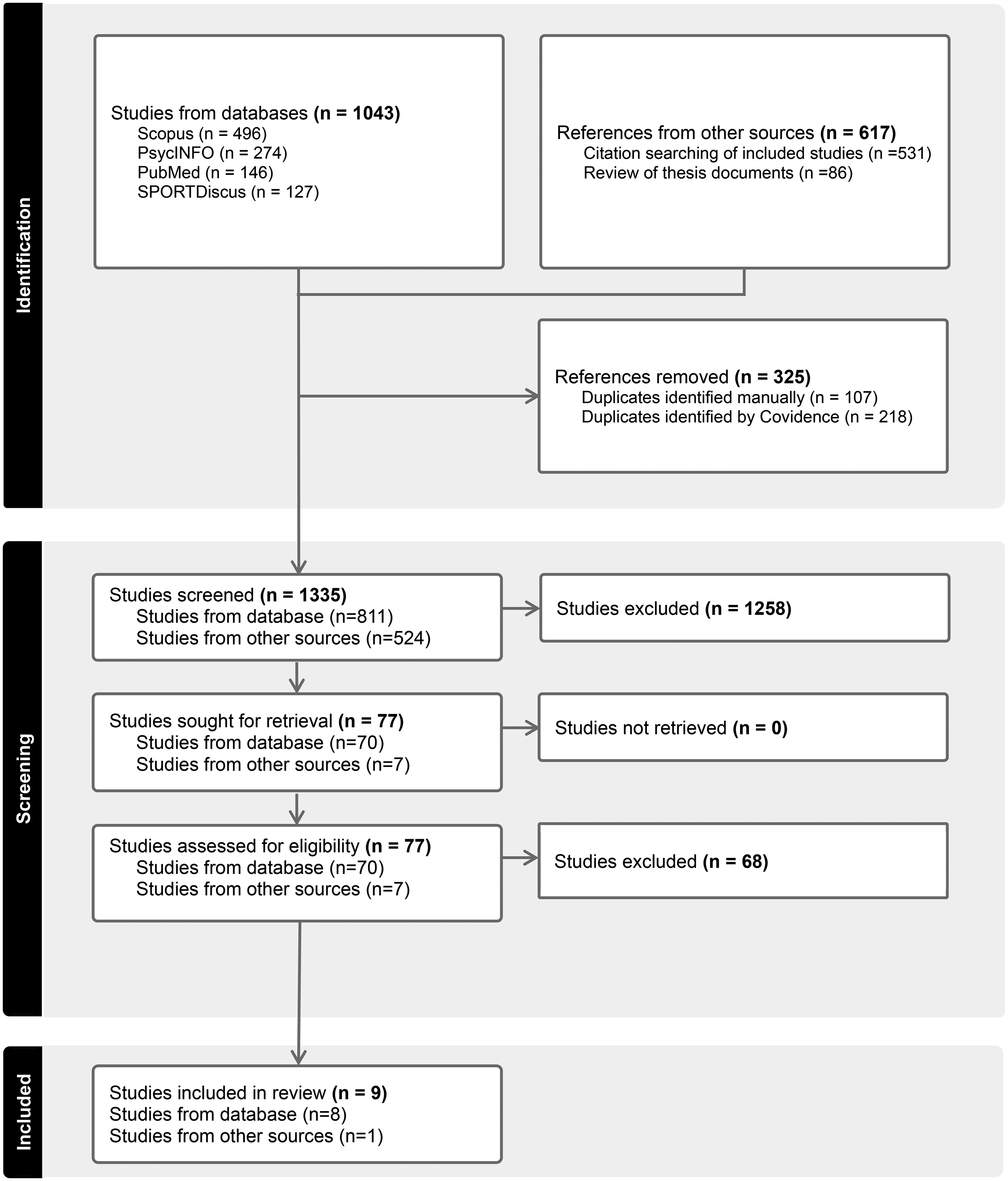
PRISMA flow diagram showing various stages of screening process.
Data extraction
Data extraction was completed using Covidence Extraction 2 tool in single-reviewer mode, which allowed the review team to develop a customised data extraction template. The template was piloted against two studies randomly selected from those included in the final synthesis. Once the pilot was completed, the template was reviewed and discussed with members of the review team, allowing for changes to be made prior to the extraction commencing. Data was reviewed and discussed by members of the review team throughout the extraction process to allow an iterative approach to be adopted.37,38 Typically for a scoping review, no formal synthesis or quality assessment of studies is completed.4,39,40 However, recent literature highlights the importance of methodological, theoretical, epistemological and ontological coherence underpinning qualitative research design. 41 Taking these insights into consideration, changes were made to the data extraction template. Sections for ethics/consent, research paradigm, rigour/trustworthiness were added, and how extracted data was recorded (i.e., text, table format, single choice or multiple-choice). The completed extraction was exported from Covidence and reviewed in Microsoft excel for analysis and presentation of results. Throughout this process, different members of the review team fulfilled the role of ‘critical friend’ to the first reviewer, discussing components of the data extraction as required. 40
Results
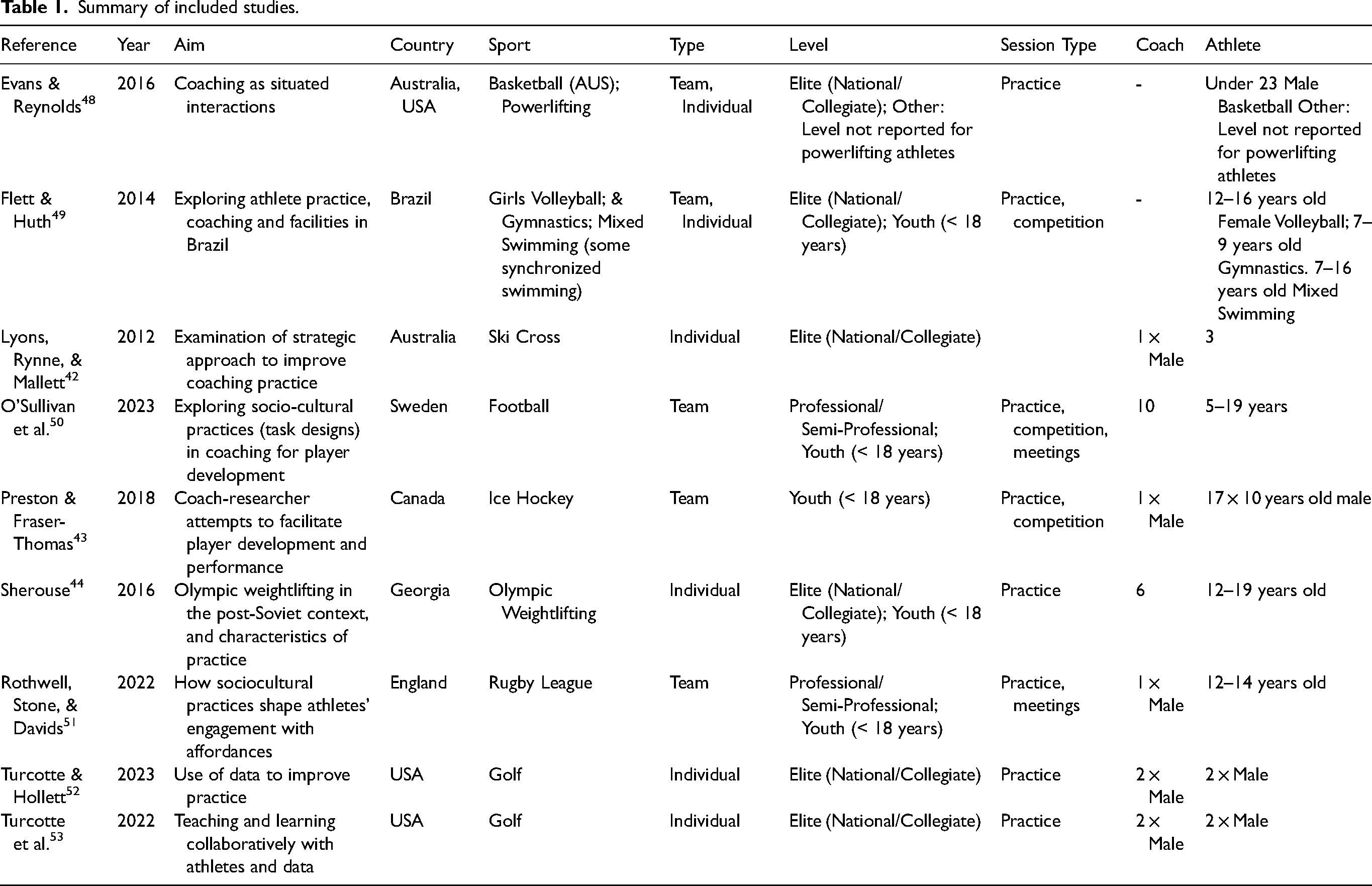
From the initial 1661 results (1336 once duplicates were removed), nine studies were deemed to meet the eligibility criteria set by the review team for inclusion in this scoping review. Table 1 provides a summary of the included studies characteristics.
Summary of included studies.
Three of the included studies,42–44 have been included in other peer-reviewed review articles.45–47
Publication details
Included studies were published over the last 11 years (2012–2023). Four (44%) published in sport specific journals (Frontiers in Sports and Active Living, International Journal of Coaching Science, The Sport Psychologist, Sport, Education and Society). From the nine studies, four (44%) were published in the last two years (2022–2023). These studies had at least one contributing author in common across two of the published studies.
Research aims
Commonalities in research aims were identified across the included studies, which led to the studies being separated into three categories. The first category included studies that predominantly provided descriptive insights of coaching behaviours. Specifically, three studies (33%) provided descriptive details on coaching practice in different sporting contexts.44,48,49 The second category included studies that predominately focused on the underpinning coaching philosophy and included two studies (22%) directly exploring specific approaches utilised by coaches to underpin their practice (e.g., positive youth development).42,43 The third and final category included studies that viewed and interpreted coaching through a specific theoretical lens, this included two (22%) studies that focused on the use of data between coaches and athletes to facilitate and support learning.52,53 The remaining two studies (22%) considered the broader socio-cultural impact on coaching and athlete learning.50,51
Study details
Sports context/environment
Studies were primarily from countries where English was the main language spoken; Australia (n = 2), United States of America (n = 3), Canada 1 (n = 1) and England (n = 1). Only one study was conducted across two countries (Australia and USA), and three studies were conducted in a non-English speaking country (Brazil, Sweden, Georgia). Seven of the included studies (78%) were situated within a single sports context. From these seven studies, four (43%) focused on team sports, with the remaining four studies (57%) focused on individual sports. Only two studies (22%) included more than one sport.48,49 All studies indicated that data was captured and/or recorded during or following practice sessions. Five studies (55%) reported the inclusion of additional environments (meetings and/or competition) within their respective sports context as part of the overall study design.
Coach details
Seven studies (78%) reported the number of coach participants, which ranged from one to ten. Only five studies (55%) reported the gender of coaches as male. Information regarding coaching experience/qualifications was reported in six studies (66%) and in several ways, including refence to formal university degrees, 49 sport specific qualifications such as licenses/certificates 50 or in terms of more generalised experience (i.e., time spent working in sport 42 ).
Athletes
All studies gave some indication of the level of the athletes. Of these studies, three (33%) included two levels of categorisation. For example, for Flett and Huth 49 athletes were categorised as both ‘Youth (<18)’ and as ‘Elite’. The gender of athletes was reported as male in four (44%) studies, with two (22%) including both male and female athletes. The age of athletes was provided by six (66%) studies, the remaining three studies (33%) did not report athlete age.
Support staff
Two of the studies made specific mention of assistant coaches in their study.43,51 Only two other studies made a brief mention of additional support staff (e.g., sport practitioners).49,50
Research design
All studies adopted ‘ethnography’ to underpin research design and/or methodology, however, different variations were reported across the included studies (see Table 2).
Summary of studies research methodology, theoretical and philosophical approach.
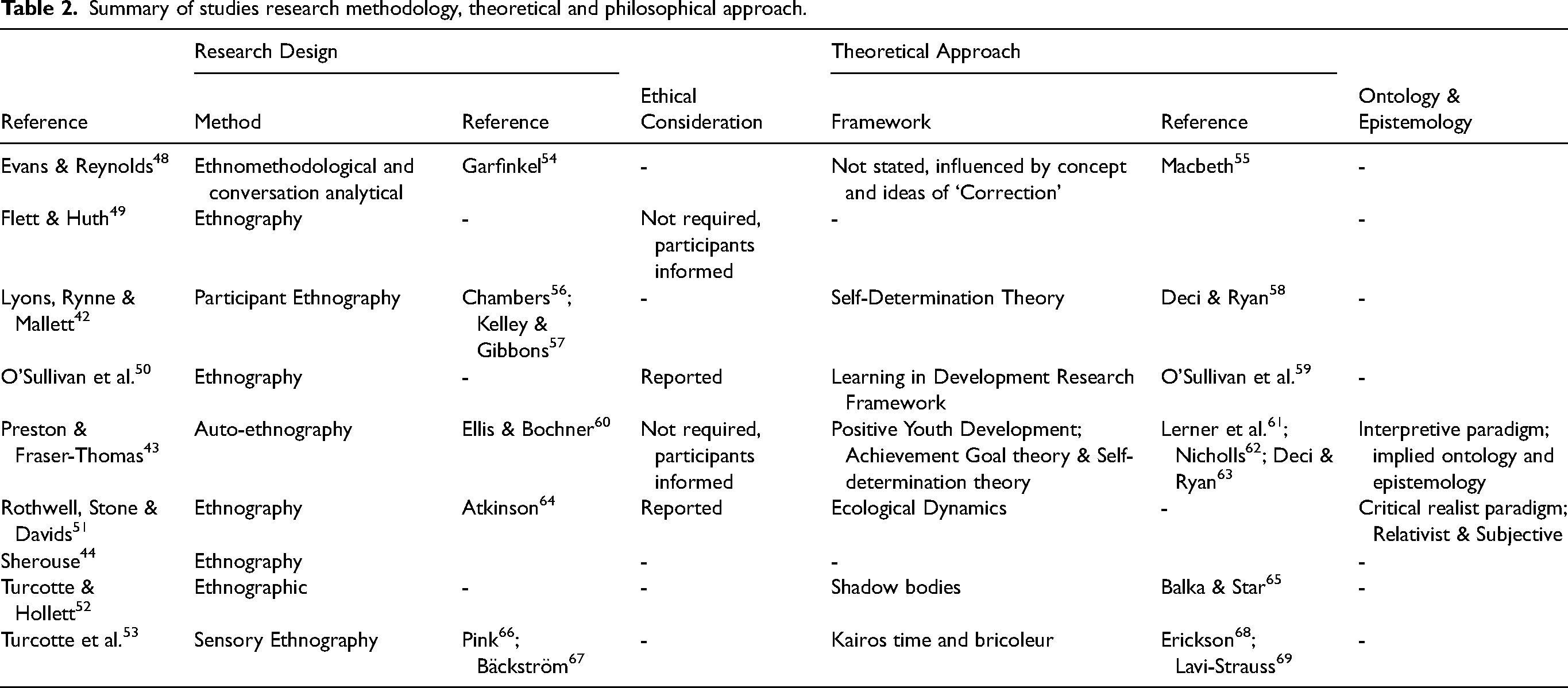
From the included studies, six (66%) reported a theoretical framework which underpinned their research design, with six different theoretical approaches reported including shadow bodies, 52 ecological dynamics, 51 Kairos time and Bricoleur, 53 self-determination theory, 42 positive youth development. 43 The learning in development research framework was adopted by O'Sullivan et al. 50 which was founded on ecological dynamics and skilled intentionality. Evans and Reynolds 48 determined that their study was influenced by ideas from Macbeth's 55 concept of ‘correction’. The remaining three studies (44%) did not report any reference to a theoretical approach. Regarding research paradigm and ontology/epistemology, only two studies (22%) made explicit declarations. Rothwell et al., 51 made specific reference to a relativist ontology and subjective epistemology, and we were able to extrapolate the research paradigm as critical realist. Preston and Fraser-Thomas 43 reported an interpretive paradigm without directly clarifying their specific ontology and epistemology. Four studies (44%) reported ethical considerations and/or requirements for their program of work. Out of these studies, two (22%) reported that their respective institutional review boards determined that approval and/or informed consent was not required. However, each study reported making a conscious effort to inform coaches, athletes, and/or parents of the study and what was occurring. The five remaining studies (55%) did not report ethics and/or informed consent requirements of participants.
Research methods and analysis
A variety of data collection methods were adopted across the nine included studies (see Table 3). Most studies (77%) used more than one method for data collection. The most common methods adopted were observations (n = 6) and interviews (and variations) including semi-structured and unstructured interviews, informal conversations, and data walks. Additional methods included field notes (n = 5), document analysis (n = 3, including athlete written responses and questionnaires), and the use of reflective journals (n = 2). Overall, the duration of data collection was reported for five (83%) of the studies. Duration varied from 5 days 49 to 3 years and 5 months. 50 The number of sessions observed during data collection varied in frequency, ranging from twice per month 52 up to weekly.43,44,48,51 Three studies (22%) did not clearly specify when or how often data collection occurred.42,49,50
Summary included studies methods, analysis, and reporting.
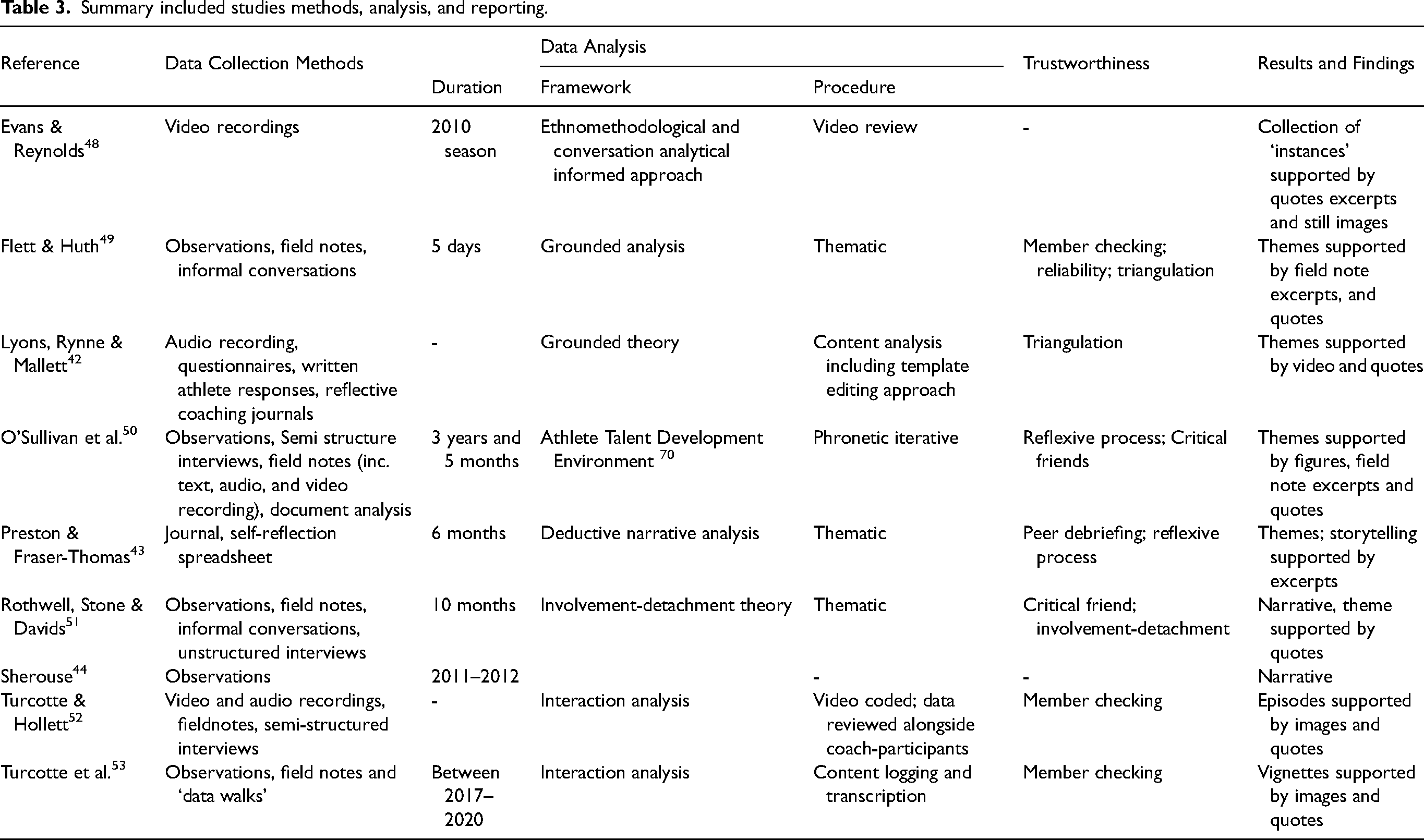
Eight of the studies (88%) outlined a framework that underpinned data collection and/or analysis, and six different approaches were reported, but grounded analysis/theory was the only one that was used more than once (n = 2). In parallel to the approach taken, eight (88%) of the studies provided additional information regarding the procedure followed for analysis, including thematic analysis (n = 4), content analysis/logging (n = 2), and phronetic iterative analysis (n = 1). The remaining study provided detail on a bespoke analysis approach, rather than adopting or implementing an existing or previously used approach. Six studies (66%) provided an indication of the process implemented to determine validity and/or rigour of their findings. These methods included member checking (n = 4), triangulation and reflexivity (n = 2), and reliability, peer debriefing, and critical friend detachment theory (n = 1). When presenting results and findings, all the included studies presented multiple forms of evidence, including excerpts from video, interviews, and field notes. Findings were presented as themes (n = 5), a narrative (n = 1), and through specific examples (n = 3) that were categorised as instances, episodes, or vignettes.
Discussion
Main discussion
This scoping review takes the first step in exploring the use and implementation of ethnography as a research methodology to underpin research design in peer-reviewed empirical studies within coaching science. Specifically, the review focussed on research that aimed to understand coaches’ behaviour to enhance athletes’ skill learning within practice or competition environments. Regardless of ethnography gaining recent attention in the fields of interest, only nine studies met the eligibility criteria for inclusion in this scoping review. The timing of publications of the included studies (2012–2023) aligns with the reported change that qualitative methodologies are becoming more prevalent and accepted within coaching science research. 41 Despite this, our results indicate that the uptake of ethnography is increasing (four relevant studies within the last three years) but remains limited. The limited uptake of peer-reviewed ethnographic research may reflect the challenges involved with long-term data collection and non-traditional designs. However, findings of this review echo those by Hirsch et al. 11 when reviewing empirical research in International Sport Coaching Journal (2014–2020). Hirsch et al., 11 who reported that whilst qualitative methods accounted for 62.38% of the studies, those that used ethnography accounted for only 2.97%.
Methodology
Findings from this review highlight numerous ways in which ethnographic research was conducted. While ethnography was presented as the research methodology across all studies, individual approaches included ethnomethodological and conversation analytic research inquiry, 48 sensory ethnography, 53 participant ethnography 42 and auto-ethnography. 43 Regardless of the approach adopted, there are several characteristics commonly associated with ethnography. Specifically, the researcher is immersed or embedded within the everyday ‘natural’ environment of a group and/or individuals over varying a time to gain an understanding of the phenomenon of interest. Of particular importance is that ethnography provides an opportunity for researchers to experience things from the perspective of the group and/or individuals involved. This is typically achieved by the researcher gaining access as either an observer, participant-observer, or as an in the case of autoethnography as participant-researcher. In these instances, the distinction lies in the degree of access granted to the researcher within the sporting context as it relates to the role they fulfill. More specifically, the observer role typically provides access for researchers to conduct observation (and/or recording) of sessions. Whereas, when the researcher adopts a participant-observer role they typically have a preexisting/predetermined role and actively contribute within the environment or may be a member within the group. However, there can be a significant degree of variation in which the participant-observer role presents, as seen from the included studies. For example, in O'Sullivan et al., 50 the role was identified as a practitioner-researcher in alignment with employment; Evans and Reynolds 48 were members of the community (team) under study; whereas in Lyons et al., 42 the participant-observer role was the coach, researcher and first author in alignment with a participant ethnography methodology. In a similar vein to this, Preston and Fraser-Thomas 43 also fulfilled the participant-researcher role, as the coach-researcher and first author. However, the autoethnography methodology adopted influenced the data collection methods, analysis, and presentation of findings.
Adopting ethnography as a research methodology provides researchers with flexibility in the data collection methods available. There are several data collection methods commonly used (e.g., interviews, observations) when conducting ethnographic research based on what is determined to be the most appropriate and relevant when considering research aims, theoretical framework, and philosophical position of the researchers. Whilst different theoretical frameworks were reported to underpin the research design of the included studies, not all studies presented one. The predominant theoretical approaches were based within ecological dynamics (e.g., learning development research framework) associated with skill acquisition and social-cognitive/developmental theories (e.g., positive youth development). Interestingly, the papers based on ecological dynamics were some of the more recently published studies, aligning with the timing of several position papers advocating for this approach to be more widely considered within coaching science (see Otte et al., 17 and Askew et al. 33 ). It is possible that our findings align with critiques that there is limited to no consensus on an overarching theoretical framework in coaching science literature. 16 Alternatively, our findings could suggest that research is starting stretch across disciplinary boundaries (e.g., pedagogy/coaching),41 opening avenues for alternative theoretical frameworks in which to view and consider coaching practice.
Surprisingly, only two of the included studies made explicit mention of the paradigm and/or the ontology and epistemological view of the researchers. Preston and Fraser-Thomas 43 reported an interpretive paradigm, but did not report their underlying ontology and epistemology. Rothwell et al., 51 reported adopting a relativist ontology and subjective epistemology. It is possible that the paradigms and ontologies/epistemologies for the remaining studies may have been able to be extrapolated by the review team, however, the omission of an explicit declaration became a reportable finding. Our findings align with those previously reported by Hirsch et al., 11 who reported only 56% of qualitative studies reported the research paradigm that guided their work. Historically, previous reviews may not have reported the inclusion of qualitative research paradigm, ontology, or epistemology. As a result, the limited number of qualitative studies that report the underpinning philosophical assumptions has gained recent attention, specifically there is a recognition that qualitative researchers consider the inclusion (i.e., explicit reference) of the philosophical assumptions that underpin their research design.8,41,71 Philosophical underpinning is important when considering the overall coherence of qualitative research. Specifically the interconnectedness and relationships between research aims, methodology, theoretical framework, and the research paradigms and how this influences the research design. 41 When not reported, it can be difficult for readers to understand the scope, strength, and rigour of the findings presented.
Findings
Results from the included studies fell into one of three categories including (1) Descriptive insights, (2) coaching philosophy, and (3) theoretical frameworks.
Descriptive insights
The first category included studies that presented findings based on descriptive insights on ‘coaching’ as part of the broader study conducted within the specific environments.44,48,49 For example, Flett and Huth 49 presented ‘coaching actions’ (i.e., coaches’ disposition and how they were teaching) which included feedback and the styles and techniques adopted by coaches. For each, examples were provided of not just what the coach did (e.g., feedback was “concise and informational” 49 (p.16)), but also how things were accomplished (coaches used “problems during drills as teachable moments” 49 (p.16)). For example, the authors would highlight how coaches used equipment to provide additional (extrinsic) feedback to athletes during skill execution, or how adjusting equipment acted as a constraint to make tasks more challenging. 49 Sherouse 44 provided excerpts of common motivational and technical ‘cues’ (including a description of what cues actually meant) used by coaches in weightlifting. In a similar approach, Evans and Reynolds 48 presented examples of the stream of interactions that occurred between coach and athletes that included line by line excerpts of verbal and non-verbal behaviours, supported by images (screen shots from recorded video) as they related what is describe as a three-part structure for ‘corrective sequences’. Specifically, the authors outline how ‘correction sequences’ are initiated by reconfiguring (movement) of the coach and/or athletes’ bodies and shifting gaze (attention/focus); errors are demonstrated using verbal and non-verbal information, (physical repositioning of athletes or recorded video) prior to coaches proposing a solution, including visual depiction of the correction to develop skills. This approach is proposed as an alternative [pedagogical] “method of instruction based on showing” as a substitute for ‘telling’ or direct instruction seen in other pedagogical approaches, where coaches are typically seen as the of purveyor of information to athletes. 52 (p.551)
Coaching philosophy
The second category included studies that considered the coaching philosophy that informed, or was implemented within, coaches’ respective sports context. Studies in this category featured the researcher (first author) as the coach and participant in the study. Preston and Fraser-Thomas 43 adopted an auto-ethnographic approach and presented findings based on Preston's coaching data. Similarly, Lyons et al., 42 presented findings based on Lyons’ dual participant-researcher role and coaching experience. Specifically, Lyons et al., 42 and Preston and Fraser-Thomas 43 sought to implement an autonomy-supportive approach, and coaching practice informed by positive youth development, respectively. Both approaches are underpinned by self-determination theory with positive youth development also including achievement goal theory. 62 Findings from both studies indicated the perceived benefits of implementing such an approach. For example, Lyons et al., 42 highlighted how participants acknowledged the “value of the general conversational nature of exchanges [between the coach and athletes] and the development and allowance for independence in the learning process” (p.366) when coaching was underpinned by autonomy supportive approach. Both studies presented challenges experienced by coaches when implementing these approaches. For example, Preston and Fraser-Thomas 43 reveal how creating oppurtunities for youth athletes to contribute to the decision-making process in relation to task design (i.e., rules) provided “too much choice without any structure”, ultimately impacting practice as “chaos and suboptimal development and performance were likely”(p.109) to be observed as a result. These authors further emphasise the importance of coaches modelling behaviours, aligned with the intended philosophical approach (positive youth development), as “…[coach] behaviours were almost instantaneously replicated by players.”(p.107) In this instance, coach behaviours included expressing frustration and a “few less-then-helpful comments” which were categorised as indirect criticism and led to “uncalled-for finger pointing”, which ultimately led to athletes bickering, expressing frustration and criticism between teammates. 43 (p.107) These findings provide an example of the disparity that can arise between coaches’ intended behaviours (i.e., in alignment with coaching philosophy), the actual coach behaviours that were displayed by the coach, and the consequences of those behaviours in situ. Preston and Fraser-Thomas 43 presented how behaviours impacted coaching practice, and how they evolved throughout the season based on the coaches’ learning and self-reflection. Specifically changes include the degree of choice provided to athletes within the drills/games during practice and the improvement in controlling and hostile coaching behaviours.
Theoretical frameworks
The third category included studies that used the lens of a theoretical framework to underpin research design and findings. Turcotte et al.,. 53 and Turcotte and Hollett 52 presented findings for two publications based on data from the same ethnographic study. Findings provided descriptions of coach-athlete interactions with a focus on the use of athletes’ personal data as a material affordance within coaching practice to support the ‘repair’ of the athlete's performance. In this instance, personal data includes quantitative (i.e., sport specific measures) and qualitative (i.e., body position during skill execution) data made available to the coach and athlete within the practice environment. Specifically, Turcotte and Hollett 52 reported how coaches supported learning through the embodied actions of athletes’ data. Findings included the use of environmental information (athletes’ shadow) to provide visual feedback, through physical manipulation/movement of the athletes’ body, or the use of training aids (balance boards) to help athletes ‘feel’ (intrinsic feedback) the action to facilitate the ‘repair’ (i.e., [correction] of the golf swing). Alternatively, Turcotte et al., 53 reported how coaches themselves provided embodied representations (i.e., shadow bodies) by recreating the lived experience of athletes’ data in a way that made the data accessible to support learning. Ultimately, the authors proposed this allowed for a more “collaborative exploration” of data between the coach and athlete within the learning environment, rather than data collection being a “solo endeavour of the coach”. 53 (p. 231) Similarly, the results reported by O'Sullivan et al., 50 were based on the implementation of an adapted version of the learning in development research framework, 59 suggest how broader socio-cultural aspects of football (i.e., form of life associated with results) influenced and acted as a constraint on coaches, resulting in over-constraining task design which inadvertently “deprived children [athletes] of opportunities for skill adaptation; a fundamental basis for motor learning.” 50 (p.10) Rothwell et al., 51 who also underpinned their research using ecological dynamics, considered the impact of socio-cultural practices of “masculinity and disciplined behaviour” as creating a ‘disparity’ between the game-sense approach advocated for the club and governing body and actual coaching delivery that occurred. The game sense approach was adopted to support athletes’ awareness (i.e., affordances available in practice and competition environments) and ultimately to improve athletes’ decision-making ability. However, findings indicated coaches often reverted to more traditional ways of operating including “disproportionate use of instruction, demonstrations, and feedback based on a putative, internalised, ‘technical’ model of player behaviour” 51 (p.119) limiting the opportunities for athletes to explore and engage with the available landscape of affordances and respond appropriately (i.e., decision making).
Athlete learning
Surprisingly, considering the influence of coaches’ behaviour on learning, 13 none of the included studies included a measurement or assessment of athlete learning. Overall, there were limited references or discussions that explicated whether learning had occurred, and equally limited information regarding whether performance had been improved. Of the studies that presented details on performance outcomes, Preston and Fraser-Thomas 43 discussed the change in overall winning percentage, finishing place within competitions, and anecdotal evidence from the coach about the professional and personal development observed of athletes. While not explicit, Lyons et al., 42 alluded to a potential connection between the implementation of autonomy supportive behaviours by the coach and performance outcomes in that they “… might be attributable, at least in part, to the implementation of an autonomy-supportive coaching approach.” (p.368) At the very least, one could say that performances were not adversely affected by the introduction of such an approach.” 42 (p.368) For Rothwell et al., 51 and O'Sullivan et al., 50 their findings discussed how the socio-cultural environments of each context influenced coaches’ task design and potentially limited athletes’ opportunity to identify and act upon affordances within their environment, and their ability for self-organisation, which intuitively would have potential implications for learning, but are not measured. Findings from this scoping review align with the review conducted by Pacheco et al.,72 who reported only one study in soccer that observed whether the skill learning strategies employed by coaches impacted competition outcomes. As learning is best viewed and measured over an extended period, the embedded and longitudinal nature of ethnography may mean it is an appropriate approach to better understand the links between coaching behaviors and athlete learning in line with periodised approaches to skill learning (see Farrow & Robertson;73 Otte et al.,74).
One final comment relates to the paucity of ethnographic research studies in coaching and skill learning. Given the significant advantages of using ethnography to provide in-depth and descriptive insights from within the practice or competition environment in which coaching practice and skill learning occurs, one wonders why such approaches have had limited uptake. Perhaps the key issue is that by definition ethnography requires ongoing access to coaching environments providing direct contact through ‘immersion’ or ‘being embedded’ within coaching environments over extended time periods in order to gain firsthand knowledge of coach-athlete interactions.35,36 This creates logistical and practical challenges in researchers gaining access to environments, both in relation to the willingness of sports to open up their environments for observation over long period of time and the consideration of ethnical requirements. This may limit the potential pool of researchers to those who can commit full-time over ‘long’ time periods, which is an important consideration for those interested in developing future research or programs of work that look to further enhance our understanding of coaching.
Conclusions
Findings from this review show the uptake of ethnography is increasing in coaching science research over the last two decades but remains limited. Overall, results from this scoping review indicate a trend by researchers towards attempts to develop an increased understanding of the rationale (i.e., the why) behind coaching behaviours as they occurred within their respective context (sport, country, level). Readers are presented with a deeper understanding of the influence of the broader socio-cultural environment or the philosophical approaches implemented or that inform coaching practice and the implications these may have on task design, learning, performance and the behaviour and actions of athletes. Specifically, by including the broader environment and considering coach-athlete interactions in their entirety, included studies present not only what coaches ‘do’ in their practice sessions, but also the consequences and/or outcomes. 13 Our findings support a shift in coaching being seen as something that ‘we do to athletes’ towards a contemporary athlete-centred approach where coaching is ‘done with athletes.’ In this view, coaches are seen as facilitators of learning, characterised by co-design and collaboration, favouring two-way communication to support athletes’ exploration and self-organisation. 20 These findings highlight the way in which ethnography may address calls within coaching literature for consideration of different methodological and theoretical approaches. This also may help to address the limitations of other qualitative research methods that predominantly rely on single methods of data collection. It is important for future researchers to recognise there is no set way or approach to conducting ethnographic research, highlighted by different methodological and theoretical approaches implemented within the included studies. Whilst varied approaches create oppurtunities for flexibility in data collection, it can create challenges in comparing and interpreting findings across different studies. Specifically, when considering the limited number of studies that make explicit reference to the research paradigm, ontology, and epistemology that underpins research design. Future researchers should consider presenting their philosophical assumptions to ensure that readers can fully interpret and understand research findings accordingly.
Footnotes
Declaration of conflicting interests
The authors declared no potential conflicts of interest with respect to the research, authorship, and/or publication of this article.
Ethics
There are no human participants in this article and informed consent is not required.
Funding
The lead author disclosed receipt of the following financial support for the research, authorship, and/or publication of this article: QUT/Australian Paralympic Committee (APC) Scholarship.
