



Abstract
As professional sports organizations increasingly prioritize individualized player development, specialist shooting coaches have increasingly been identified as important contributors to player development and on-court performance (as evidenced by recent statistics on National Basketball Association (NBA) teams hiring more shooting coaches). This applied case analysis reveals insights on the work of professional shooting coach, in alignment with contemporary motor learning theorizing and the ‘Periodization of Skill Training’ (‘PoST’) framework. Drawing on the theory of ecological dynamics, this study highlights the trajectory of personalized shooting development in response to evolving NBA performance dynamics, including the increasing reliance of players on three-point shooting. Through practical and conceptual basketball case examples of experiences of NBA shooting coaches, we look at how individual coaching interventions can support player adaptations to dynamic performance environments. Application of the ‘PoST’ framework in basketball shooting coaching provides a systematic and structured periodization and training approach to skill learning, highlighting the importance of movement coordination, adaptability, and performance training in player preparation and development.
Introduction
As teams in the National Basketball Association (NBA) continually look for competitive advantages over immediate competitors, coaching and support staff numbers continue to grow. In the past 15 years, the number of coaching roles in ‘Player Development’ has increased dramatically, further supported by players hiring individual skills trainers in personalized player development roles. 1 This trend of professional sports organizations recruiting and utilizing specialist role coaches to co-design and facilitate individualized learning environments for individual athletes and player sub-groups within teams is aligned with recent developments in other professional sports like soccer. 2
In basketball, over time, the constraints of NBA competition have evolved to further emphasize the value of shooting from distance, with three-point shooting attempts per game in the NBA significantly increasing from season to season over the past 40 years. 3 There are claims that, in the 2023–24 regular NBA season, long ball shooting has never been more important for a team's success. 4 In past generations, certain types of players would have been discouraged from shooting or developing their shooting simply due to their physical size or the specificity of their team role. In contrast, nowadays each player is not only encouraged to shoot from various distances, but also expected to develop their shooting skills. Teams now hire shooting-specific specialist coaches, with the remit to provide individual athletes (and teams) with the flexibility needed to functionally exploit, adjust and adapt to the dynamic constraints of competitive performance environments, to specifically contribute to team goals. 5 This feature of performance adaptation has been driven by role hybridization, where players are solicited to undertake multiple performance roles as a result of strategical innovations in team sports over the years. 6 To prepare athletes for such changing performance demands, teams are setting aside individual ‘skill development time’ outside of traditional team practice, with the goal of allowing specialty coaches to facilitate and enhance individual players’ skill sets.
Interpreting insights from the perspective of contemporary skill learning and performance theory in the emerging and unique context of coaching individualized basketball shooting (in the NBA and beyond), here we discuss a case study of a practical application of ideas in professional coaching practice. By considering various examples derived from NBA shooting coaching in individualized practice settings, we seek to contribute evidence of experiential knowledge supporting the work of individual development coaches and skill acquisition specialists, recently showcased by Otte, Yearby and Myszka. 7 Many specialist coaches display understanding of role-specific skills combined with academic knowledge of player learning and performance. Here, we showcase a pathway for basketball shooting coaches to apply the ‘Periodization of Skill Training’ (‘PoST’) framework, based on an ecological dynamics rationale, framing an athlete-environment-centered perspective. The specific aim of skills practice is to (de-)stabilize and support players’ self-organization, adaptive tendencies for shooting actions in dynamic game contexts, addressed in systematically-planned training interventions during in-season and off-season NBA training environments.
Brief overview of ecological dynamics, contemporary skill acquisition theory and the periodization of skill training framework in player development
Basketball is a dynamic team sport with constantly emerging in-game information (e.g., sudden opening or closing of passing or shooting opportunities). Considering these changing contexts, driven by player transactions with a performance environment in practice and competition, ecological dynamics is a theory of motor learning which provides a rationale for understanding performance, learning and development of athletes as ‘complex adaptive systems’. 8 The interconnectedness of an athlete's movement system provides self-organizing tendencies to be exploited in adapting skills to changing task constraints and environmental contexts. 9 Ecological dynamics advocates practice task designs that help players to couple perception and action, underpinning skillful performance.10,11 Practice at all levels should seek to develop the robust adaptability of players, supporting them to become attuned to key information sources to calibrate their performance actions over time. This is a fundamental basis of high-quality practice. 12 Skill adaptation in players is needed to address the ongoing changes in the dynamic performance context, which invite opportunities for action from performers.13–15 This key notion of skill adaptation for the development of well-attuned and calibrated perception-action couplings has previously been demonstrated in numerous dynamic performance contexts, such as volleyball, soccer and badminton.16–18 In this knowledge translation paper, we propose how an athlete-environment-centered perspective and constraints-led approach for specialist coaching – by shaping individual, environment and task constraints – may benefit understanding of skill adaptation in athletes in the context of basketball shooting.
There are several key components of skill adaptation which need to be applied to basketball shooting contexts. These include: have extensively focused on key skill adaptation training concepts in ecological dynamics, such as: i), practice variability and adaptation, ii), Bernstein's ‘degrees of freedom problem’, iii), representative learning design, and (iv), ‘repetition without repetition’. Understanding these seminal principles for skill learning is vital for athlete development and performance preparation in sport.9,12,13,19–21
i), Adaptation and variability in practice is important: The nature of skill adaptation is individualized (based on the needs of each learner whether child or adult, male or female, or those with divergent abilities and capacities) and contextualized (according to the unique constraints of a competitive environment).13,19,22 To enhance optimality of learning and support skill adaptation, coaches can help athletes harness variability in practice contexts. Early in learning, variability of practice conditions may be less intensive to allow beginners to develop stable coordination patterns (i.e., perception-action couplings), which they can rely on for negotiating performance environments.12,23 It is important to note that while the research conducted by Button et al. was conducted on free throw shooting, it is likely the principles apply to shooting under different task constraints, such as 3-point shooting. Decision making and problem solving should still be challenged but based on individual needs and contextualized to performance demands encountered early in learning.22,24,25 Later in learning, athletes within their practice environments need to be challenged to continuously re-calibrate their actions, as the competitive performance context changes.12,26 This happens a lot at elite performance levels due to intense scrutiny of performance analytics, 27 for tracking athlete behavior in various performance contexts on and off the court. In team sports, competitive success has been closely linked to performance adaptability (for an example in professional soccer 28 ).
ii), Resolving the ‘Degrees of Freedom’ problem: Athletes are highly interconnected complex adaptive systems, with a multitude of degrees of freedom (e.g., muscles, joints, limb segments). Available degrees of freedom in such systems provide a resource that can be exploited when forming functional coordination patterns to achieve an intended task goal (e.g., shoot at the basket from different locations on court). Inherent self-organizing tendencies in complex adaptive systems can support the rapid (re)organization of a functional movement pattern (e.g., shooting with the right hand, left hand, both hands), as performance contexts change. To exploit such system tendencies, coaches could infuse movement variability in practice designs to encourage learners at all levels to modify actions and exploit available degrees of freedom for controlling and regulating their coordination patterns. 29
iii), Representative learning design: Aligned with adaptive variability in performance, representativeness of practice designs has been recognized as a relevant principle of motor learning.30,31 For high quality skill adaptation, the concept of ‘representative learning design’ 32 is captured task constraints of practice which simulate those encountered in competitive performance environments. Research has established that learning designs that are more representative of competitive performance, support learners in finding affordances available and help them couple actions to key information sources during performance.24,33 Particularly, critical notions of functionality (i.e., athletes achieving performance goals in competition that derive from actions and constraints that have previously been encountered in practice, 12 action fidelity (i.e., the level of correspondence between athlete behavior emerging in training compared to performance contexts 33 ) and the manipulation of constraints for dialing up (and down) practice representativeness 9 have been widely supported as beneficial for athlete learning and performance preparation.
iv), ‘Repetition without repetition’: A significant and challenging principle of ecological dynamics for coaching (closely intertwined with previous concepts above) is that of skill adaptation which moves away from traditional ideas of technique and tactical repetition and rehearsal in practice. 34 Instead, practice is re-imagined as the repetitive solving of movement problems, set up as ‘repetition without repetition’. 20 This practice approach challenges learners to explore movement variability to adapt their actions to dynamic changes in context; especially, by learning to address the environment in different ways. 19 This aspect of skilled performance can be achieved by athletes continually adapting their posture, re-balancing their stance, employing counter-movements and changing their movement orientation in space to find a coordination solution to solve problems and challenges set by opponents, both tactical- and skill-focused. 6 Later, we discuss how basketball players may be challenged to address the environment in different ways to solve shooting performance problems.
Next, we outline how skill adaptation in training can be (re)organized over time, dependent on the competitive performance scheduling placed on individual players and a basketball team.
The skill training periodization framework for individual player development and specialist coaching
The original ‘Periodization of Skill Training’ (‘PoST’) framework by Otte and colleagues2,5 (Figure 1) presents a skill learning and performance framework for specialized role coaching contexts. It provides an ecological dynamics theoretical perspective on athlete development stages (based on Newell's 21 work in motor learning). The ‘PoST’ framework supports understanding of how individual athletes (within team structures) acquire skills, learning to adapt their actions based on the perception of information available in context. While the initial framework considered the context of specialized soccer goalkeeper training, various applications afterwards started to utilize the model in different coaching contexts, demonstrating its utility in sports such as Olympic paddlesports, 35 figure skating 36 and rugby union. 37 There is a need for more case examples of how a contemporary motor learning theory, like ecological dynamics, may actually impact on practice, especially at the elite level of performance. Some excellent examples exist in the literature, e.g., the analysis by Morris and colleagues 35 of transferring theoretical knowledge to training of canoe slalom athletes in preparation for the 2020 Tokyo Olympics. The current paper seeks to highlight how principles of ecological dynamics may be used by professional team sports players during preparation for performance in the NBA league. This application is also of special interest because of the well-known challenges of finding time for high-quality practice in NBA teams due to the demanding competitive schedule placed on the players during the season. Here, we focus on the universally important basketball skill of shooting, integrated within the dynamic context of the team sport.
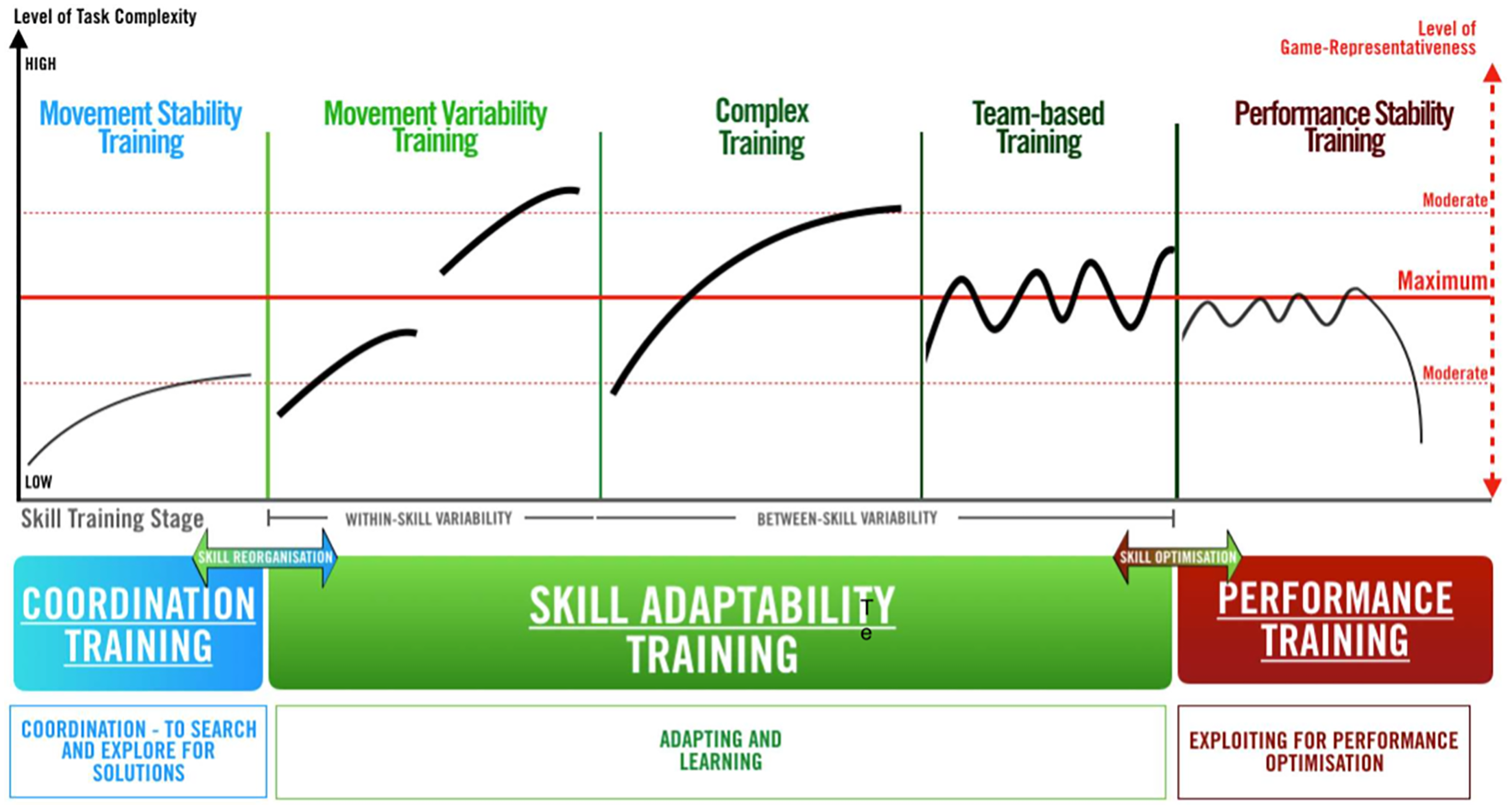
The original ‘Periodization of Skill Training’ (PoST) framework by Otte and colleagues (2019).
The ‘PoST’ framework introduces three skill learning stages for co-designing effective training environments (i.e., in Figure 1, Blue: Coordination Training, Green: Skill Adaptability Training (SAT), Red: Performance Training). These stages are related to various constraints and challenges, shaping the level of game-representativeness of training designs (i.e., the degree to which practice environments simulate the performance demands faced in competition) and the athletes’ perceived level of task complexity when placed in training environments.
2
Each training task should be assessed for low, medium or high levels of representativeness and complexity to optimally cater for individual athletes’ needs at specific stages of their development. Notions around the three skill development stages were described by Otte and colleagues,
5
(pp. 566–567), providing a thorough introduction and explanation: “First, training designs within the stage of ‘Coordination Training’ are focused on searching for and exploring coordination movements within the emerging training environment [, using] ecological coaching methods, such as the use of task simplification and guided discovery. Second, the stage of ‘Skill Adaptability Training’ has the aim of ‘enhancing the adaptability, functionality, and robustness of motor skills under perturbation of dynamic environments’. By using three distinct training sub-stages (i.e., ‘Movement Variability Training’; ‘Complex Training’ and ‘Team-based Training’), levels of game-representativeness and task complexity can be increased in layers. Third, the ‘Performance Training’ stage aims to ‘enhance the energy efficiency […] and optimization of team performances in preparation for impending competition.”
Transfer of the ‘PoST’ framework to individualized basketball shooting coaching
One goal of utilizing insights from the ‘PoST’ framework concerns systematic skill training periodization across different timescales, including during in-season NBA training juxtaposed with game schedules, as well as off-season individualized training planning. A major goal of applying the ‘PoST’ framework to specialist basketball coaching contexts is to guide shooting coaches on how shooters may (re-)coordinate actions, by (de)stabilizing and functionally adapting their movements, in order to gain more consistent shooting performance outcomes. Recent empirical research on basketball shooting biomechanics has demonstrated how different ball flight characteristics can affect the success rate of shooters. Specifically, two studies examining ball flight mechanics in basketball provide evidence of more and less functional movement solutions during shooting. The most recent study by Slegers and Love 38 explored terminal release curvature of the basketball's flight (i.e., the flight curve towards the basket), and found that players who could consistently organize their body segments to align the final release position controlled this distance of their shots more accurately. Similarly, an earlier study on spin axis rotation revealed that when shooters achieved a backspin axis close to parallel to the floor, they generated more lateral accuracy. 39 Collectively, these data suggest that a degree of movement stability of core biomechanical features — such as coordinated sequencing and positioning of the trunk, shoulders, and shooting arm—can help players become more accurate shooters. Importantly, these findings do not imply a single “ideal” or universal form for all players 40 but rather indicate that some solutions are consistently more functional from a dynamical systems perspective. In line with ecological dynamics, each individual's constraints (e.g., anthropometrics, strength, flexibility, perceptual-cognitive skills) will shape how a functional coordination pattern emerges. Thus, although shooters of varying skill levels may have different styles, common movement principles—such as minimizing lateral deviations during release or generating a stable spin axis—can enhance shooting efficiency. Players categorized as “weaker” or “average” shooters might therefore benefit from investigating how their present sequencing strategies create undesirable side-spin or curved trajectories and adapting to reduce these inefficiencies. As previous studies have shown, practice designs which support players to explore more functional body orientations and release mechanics can help them find individualized, yet biomechanically effective, shooting solutions.
With the aim of showcasing the ‘PoST’ framework's value for specialist basketball shooting coaching, next we highlight a breakdown of the various skill training stages to support basketball players’ individualized adaptation of shooting movements and transfer to representative game environments. This paper seeks to highlight an integrated use of all three development stages, while traditional approaches in NBA shooting practice often highlights coaches’ use of only one phase 41 (often less beneficial for development). Further, application of the original framework to the lead author's specialist coaching context in the NBA, along with his systematic training periodization approach is presented.
Individualized basketball shooting coaching - movement coordination/stabilization training
The goal of the first stage of Movement Coordination/Stabilization Training (MCST; connected to ‘Coordination Training’ of the original framework; see Figure 2) is to encourage skill adaptation in players, exploring more efficient, more individualized and functional movement patterns.
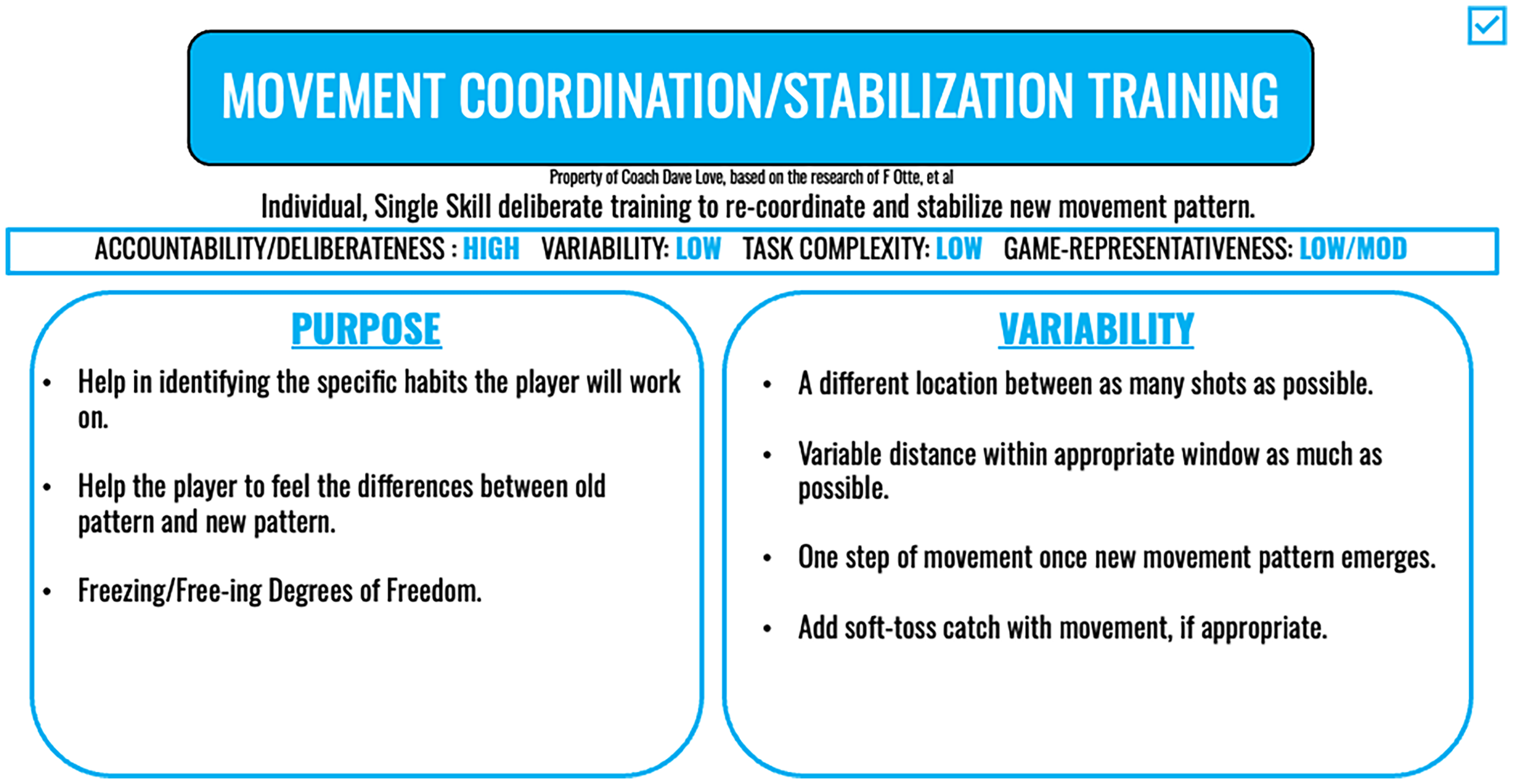
MCST emphasizes reducing game-representativeness, task complexity and variability in order to explore around a new movement solution. Constraints can be added to solicit more functional movement patterns.
In the context of basketball shooting, players tend to attempt to optimize shooting movements in challenging environments that may end up being ‘too challenging or high in complexity’ at first. A lack of shooting success and its possible negative impact on player motivation, then, may lead to these players curtailing their plans and returning to their ‘comfortable’ habits (in dynamical systems terminology slipping back into deeply stable attractor wells). To circumvent this regression, MCST uses constraints-based activities and initially simplified tasks where the athlete explores coordination of action involving fewer degrees of freedom to find a stable starting point before expanding variability of multi-articulation actions at a later stage. 21 In basketball practice, identification of movement ineffectivity emerges through a collaboration between various departments, such as the technical staff, performance analytics, video analysis, also considering biomechanical assessments.38,39 Specialist coaches, in consultation with the head coaches and performance analysts, collectively determine whether a given pattern hinders performance and warrants intervention. Constraints can be designed into tasks to solicit exploration around a new movement pattern that coaches consider may be more successful for the player. In essence, constraints challenge players to be (implicitly) ‘accountable’ to not reverting back to their old (less effective) movement solutions, which may cause players to seriously explore a new movement pattern. MCST may be lower in game-representativeness, but only to afford players stable opportunities to explore more functional movements. For example, a constraint that can be added to activities which focus on addressing a performance context may limit the number of steps that players may take with the ball to achieve a balanced posture immediately prior to shooting. This task constraint is particularly helpful for players, who find themselves slightly out of balance in games and restricted by an upright body postural orientation; this, perhaps due to traditional practices in excessively isolated (decomposed task) contexts. By only allowing players one step (i.e., reinforcing that both feet hit the floor at the same time), players are challenged to self-organize and find new ways to address the shooting context. This method usually guides them to discover that a wider stance and a more athletic (flexible yet dynamic) body posture allows them greater control for re-organizing their system degrees of freedom when preparing to shoot (see Figure 3).
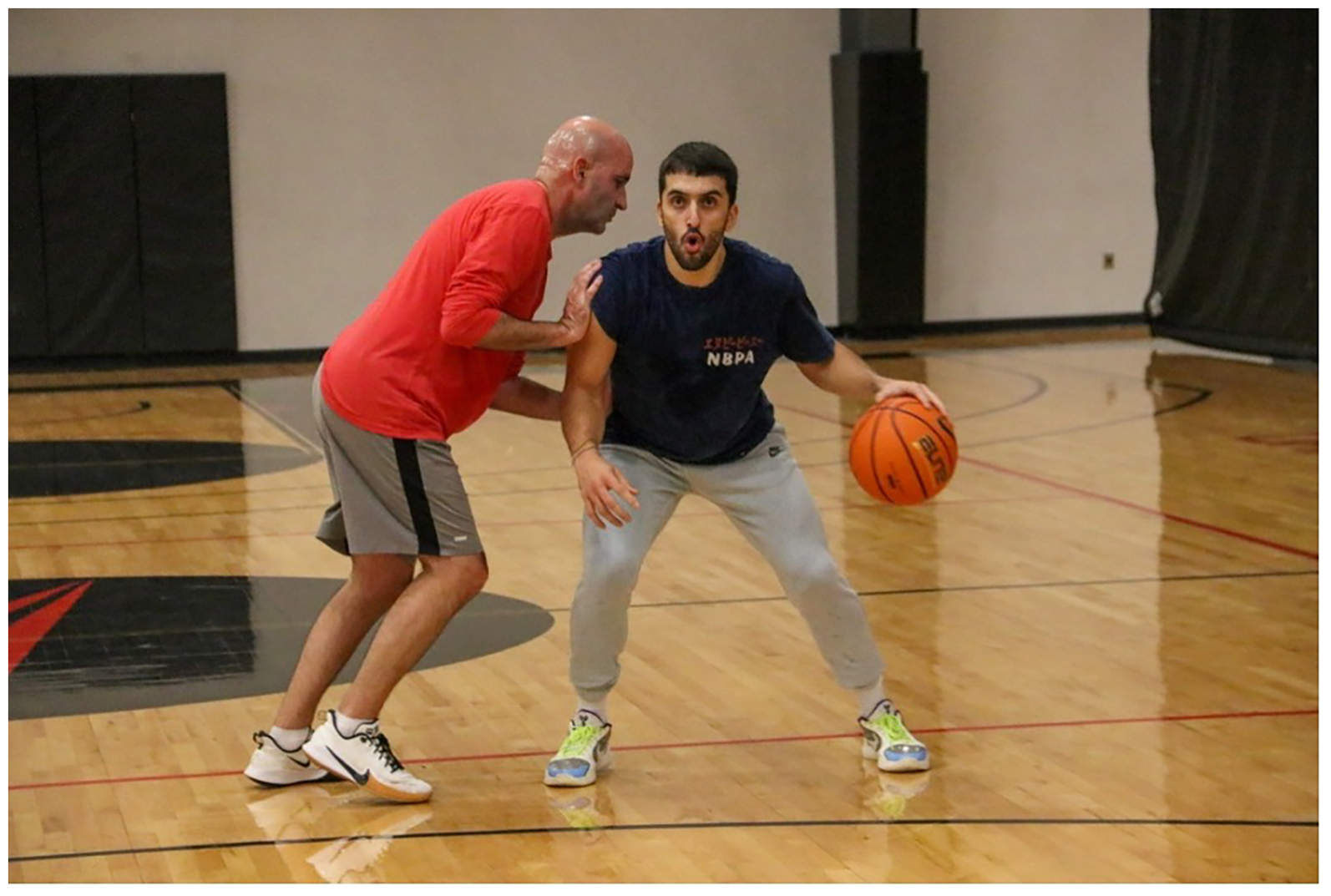
An example of a MCST exercise that forces exploration around a more athletic, balanced position. Here, the coach is preparing to push the player laterally, with the goal that the player will land on balance and be able to quickly shoot a stable shot. While the player is asked to land with both feet simultaneously here, this constraint is designed to encourage exploration of stable body orientation. Once the player has explored balanced positions, the constraint can be removed to allow self-organization. (image adopted from lead authors personal photos with all permission).
While aspects of this primary stage may resemble a traditional form shooting practice, there are important and subtle differences. This phase is deeply focused on exploring functional movement adaptations. Therefore, coaches may design practice to reduce task complexity and game-representativeness to help players get ‘comfortable’ with the key challenge of addressing new positions, postures, stances, orientations and movements. This experience can support basketballers in ‘learning to learn’, becoming more proficient at coordinating new movements, especially those coached extensively with traditional methodologies. While MCST temporarily lowers task complexity and representativeness to provide stability for exploration, coaches should constantly seek opportunities to gradually re-introduce holistic elements of representativeness to avoid overly sterile practice conditions. Coaches should seek to apply appropriate levels of challenge and facilitate micro-decision making and problem solving by inducing task complexity and game-representativeness.2,42 Patience, and a balanced view, are needed to maintain task constraints at a simple enough level (individualized), to prevent athletes regressing back into their previously stable (and potentially dysfunctional) movement patterns, simultaneously providing enough challenge to avoid unrealistic high percentage results and increase opportunities for skill transfer and learning. For example, in a form shooting activity called ‘Slow to Quick’, players are encouraged to change the way they address the environment by slowing down the initial lift of the ball from triple threat towards their set point. Although slowing the movement may reduce immediate task representativeness and over-use may impede transfer from practice, it can be used to provide immediate task stability for initiation of exploratory action for stimulating further skill adaptation. Therefore, it serves as a short-term strategy to help the athlete attune to environmental information and initiate the adoption of a more functional pattern before re-introducing typical game speeds. This approach to practice is important because destabilizing the old pattern (by altering movement tempo for example) is part of facilitating exploration toward a new coordination solution. 43 This exploratory focus in shooting practice may bring enhanced awareness of the feeling of a more functional position (i.e., exploring dynamic touch (haptic information) from the ball and proprioceptive information from the arm), before accelerating the ball up and out of that position prior to release. When the ball is positioned in a set point, coaches could add a constraint of players actively removing the guide hand from the ball, challenging shooters to self-organize positioning of their shooting hand into a more efficient orientation (i.e., illustrated in Figure 4). While this activity maintains body orientation and posture that players will naturally find themselves in during competition, simplifying the beginning of the shooting motion by slowing it down allows players time to explore perceptual information, seeking a more functional movement orientation of the arm and ball in space.
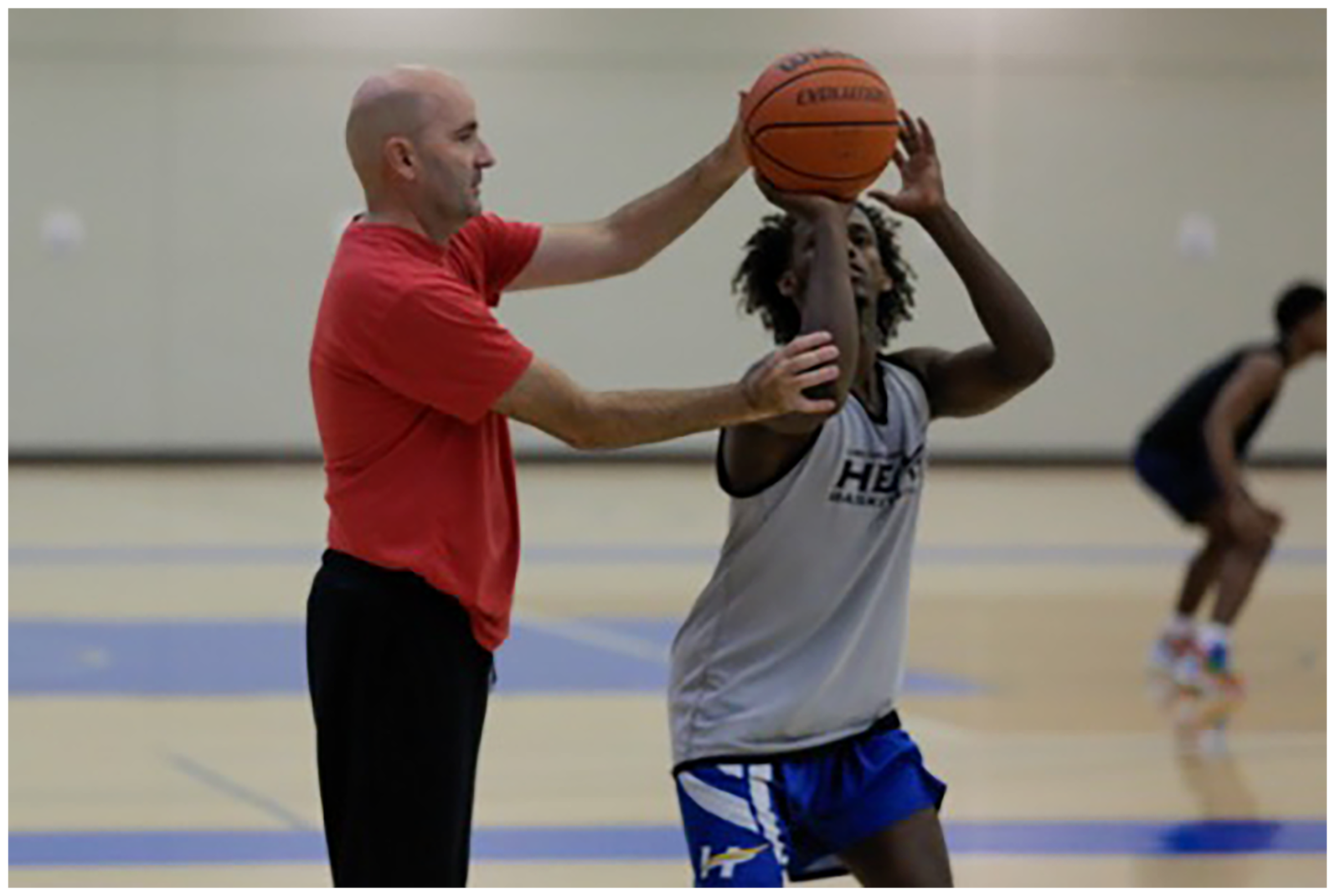
Here, the coach's hand placement constrains backward ball movement, encouraging the player to self-organize the shooting hand orientation. The player, not the coach, ultimately decides how to adjust. (image adopted from lead authors personal photos with all permission).
Individualized basketball shooting coaching - skill adaptability training
The SAT stage is a training phase that tends to be skipped by many basketball shooting coaches, in an effort to quickly apply new habits into game contexts. Many coaches may rather focus on the two ends of the spectrum – with more traditional form shooting, and then ‘game shots from game spots at game speed’-types of practice with no or very little link between a low game-representative practice activity and game environments. ‘Form shooting’ refers to simplified, low-intensity (physical) shooting task emphasizing single aspects of a shooting movement (e.g., hand position), while ‘game shots from game spots at game speed’ implies practicing shots from locations and situations that closely resemble competitive conditions. SAT provides an invaluable link that may further (in accordance with the original ‘PoST’ framework) be decomposed into three distinct phases.
SAT-Movement Variability (SAT-MV): This first sub-phase of practice seeks to support players learning to address the performance context in a new way by adapting novel, more functional patterns of single shooting motions under various kinds of challenges and perturbations faced in games (see Figure 5). Rather than prescribing a single ‘ideal’ shooting technique, the goal is to guide players to discover more efficient and functional movement patterns adjusted to their individual constraints. 2 Players are expected to apply coaches’ idealized movements in competitive performance where these ideal movements never emerge. A more functional aspect of skill performance is for players to learn how to change the way they address the performance context by adapting their actions. To circumvent the problematic line of traditional thinking, the SAT-MV phase supports players to adjust and adapt more flexibly to significant variations in context, preparing for types of challenges that will emerge in games, when coordinating specific basketball shooting motions. On a modified basis, and in individualized training contexts (with single players), players can focus on developing their individual shooting coordination pattern with a high volume of ‘repetition without repetition’, in a short period of time. Focusing on intra-movement shooting variability (i.e., defined as “variation in the execution of the same skill”; see Buszard 44 p.2), a coach (and support staff) may act as a constraining influence: passive defenders or teammates. For example, rather than always shooting shots in a controlled environment, with the player always in balance, activities in the SAT-MV phase can force players off balance. This helps them learn to address the competitive context by linking the solving of a performance problem to becoming (re)balanced and (re)oriented to their new, more functional shooting actions. Another simple example of SAT-MV would be a coach feeding the player dysfunctional or game-like passes. Rather than the player always getting a near perfect pass from a coach that leads them into coordination of an optimal movement template in an ideal shooting situation, the coach should feed the player passes that mimic ball reception challenges and problems they will face and must address in competition.
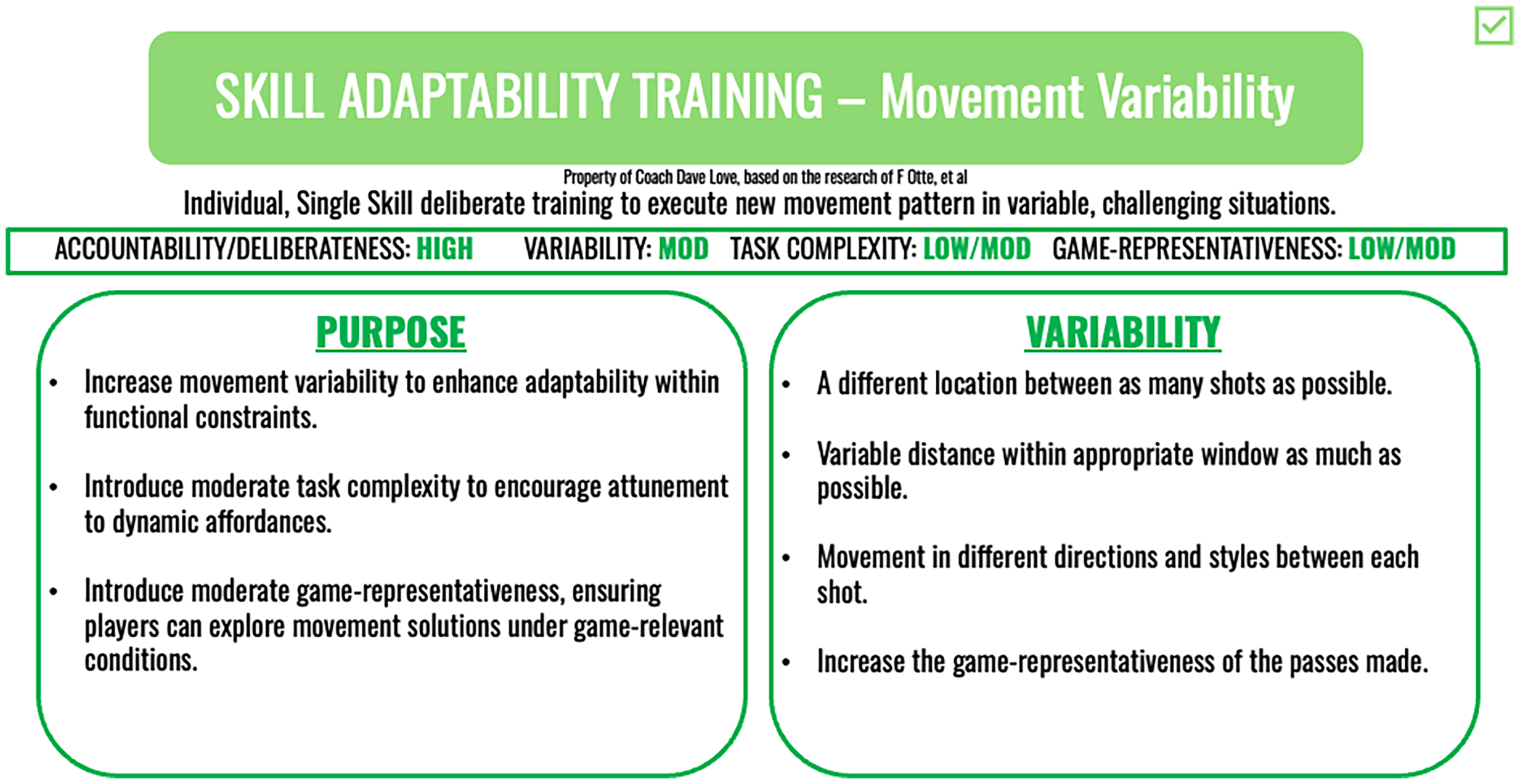
In SAT-MV, the coach will increase variability, task complexity, while maintaining game-representativeness to help players apply new actions in designs that require players to overcome challenges they may encounter in games.
SAT-Complex Training (SAT-CT): In the second sub-phase of SAT-Complex Training in Figure 6, we begin to add more players (or coaches and support staff) to the practice context, increasing task uncertainty and complexity (i.e., more information), but also enhancing game-representativeness. Additional players could act as more active teammates or defenders and can exert greater pressure to challenge the shooter under more dynamic and complex circumstances. Applying the principle of ‘repetition without repetition’, this phase starts emphasizing the need for representative game contexts, increased problem solving and inter-movement and inter-task solutions in practice (i.e., described as “switching of skills during practice 44 ). Coaches, here, could place players in game-realistic (representative) positions and encourage shooters to attune to information from movements of a teammate and/or a defender to coordinate functional performance solutions. In this sub-phase, the range of possible movement solutions may be limited in order encourage exploration around a field of shooting movement patterns in highly variable environments with moderate task complexity and game representativeness. Rather than opening up all scoring options in a performance landscape for players to explore in free play (see next skill development stages), coaches may constrain shooting options in a constricted field of the affordance landscape, to encourage players to seek and flexibly adapt between a limited selection of shooting movements (e.g., shooting an open shot or using a ‘headfake’ to get the defender off-balance, based on information perception of immediate defender and space). This type of practice design by coaches can help players learn to address a more limited field of competitive contexts, before being challenged by a wider performance landscape which may be overwhelming for some individuals. This phase could look different, depending on the shooter's ability. A weaker shooter in this stage may be working within a more constrained environment that allows more time to slow down the shooting motion, whereas an average shooter might be less constrained. This phase is so important because of the increased variability, while still targeting the adaptation of functional movement solutions. Constraining activities in this sub-phase allows players to get more time on task around the foundational patterns they are working to improve. For example, if a player is working to get their guide hand off the ball when shooting from distance, coaches may constrain scoring by de-emphasizing lay-ups or dunks through scoring point manipulations or constraining spatial degrees of freedom on court.
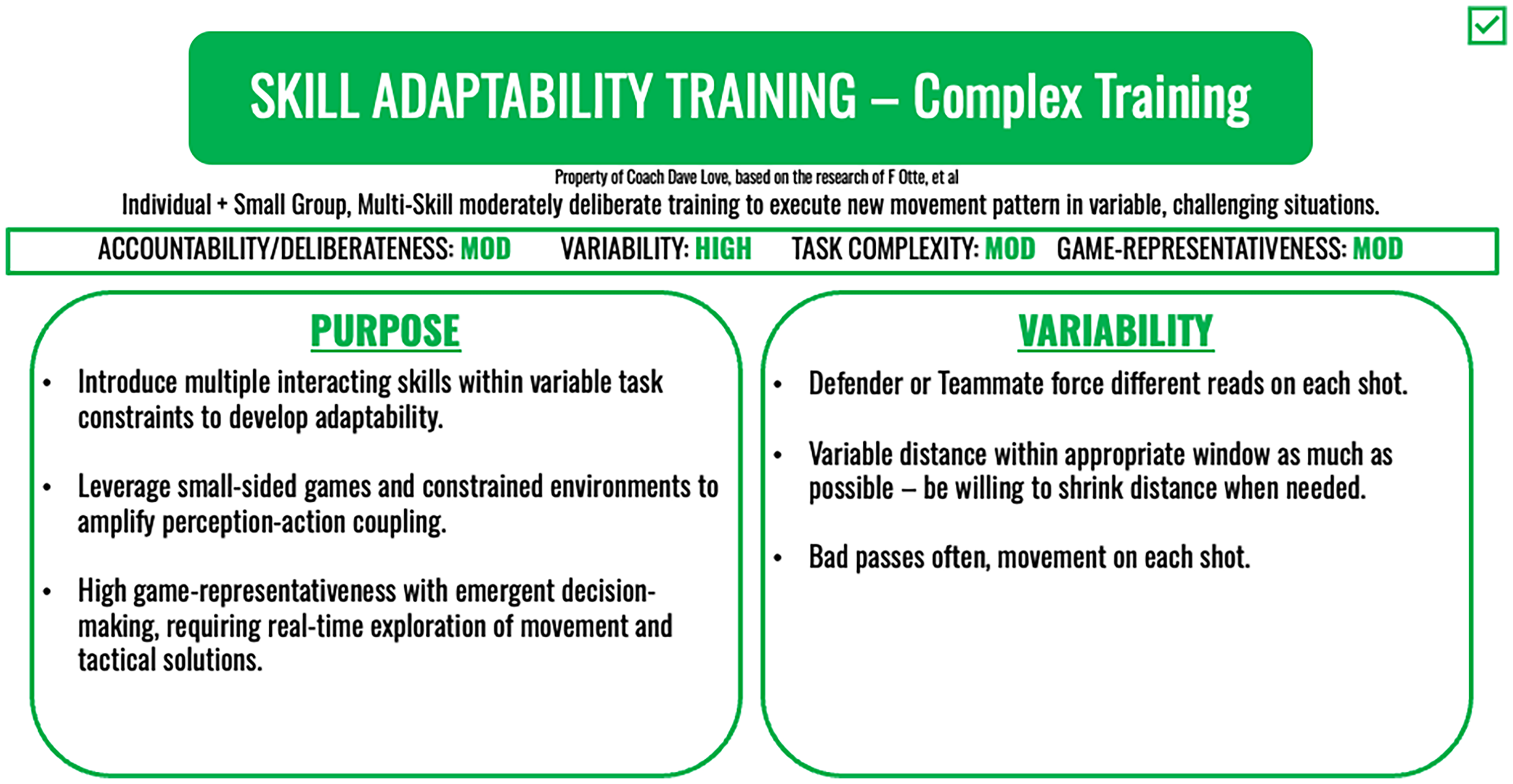
SAT-CT features a significant increase in game-representativeness and variability, while task complexity remains moderate. Because of increased challenge levels, coaches must allow for variability in movement coordination, tolerating players in exploring functionality of new movement solutions.
To exemplify, Figure 7 displays a practical example, considering a scenario in which the player uses a teammate's body position to block the defender (a ‘screen’) and then adopts a movement pattern (e.g., stepping out wide, known as a ‘flare cut’) to create shooting space. These movements illustrate how players can learn to respond adaptively to immediate defender positioning. This perception of information from the movements and re-positioning of their defender forces the shooter to address the performance context by adopting a more variable range of emergent postural orientations with the ball, meaning that cannot pre-determine their movement patterns in an idealized environment.
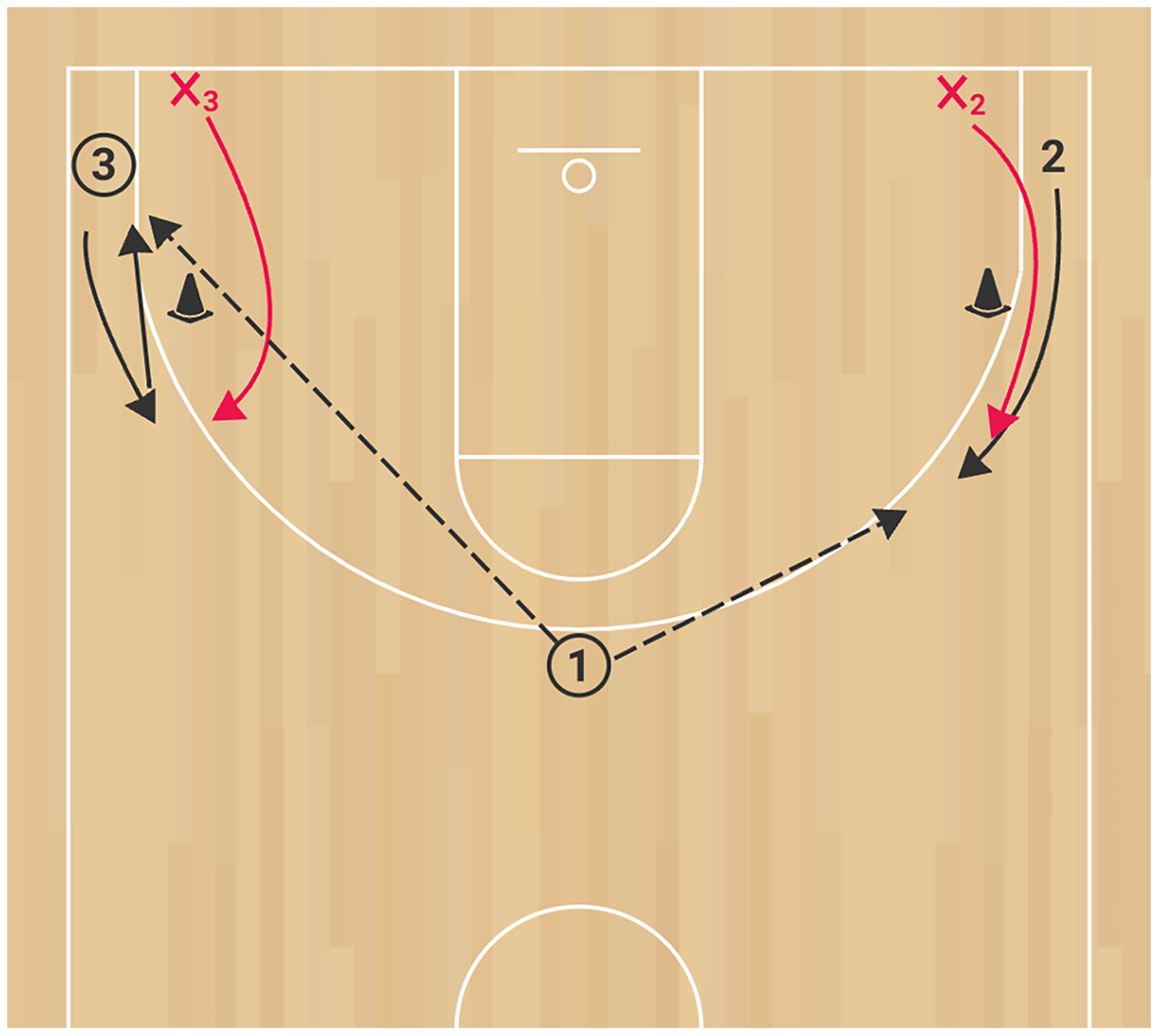
The task is designed to develop perception-action coupling by requiring the shooter (2) to attune to the positioning and movement of their defender (X2). The shooter starts in the corner, with their defender positioned slightly behind, affording more time to perceive and act. As the shooter moves past a stationary obstacle (represented by a cone, which can be replaced by a teammate), they must perceive the defender's strategy and adapt their movement accordingly. This obstacle, referred to as a “screen” in basketball, temporarily disrupts the defender's path, creating an opportunity for the shooter to gain separation. If the defender trails closely (right side), the shooter may cut tightly into open space to maintain an advantage. If the defender takes a shorter path under the screen (left side), the shooter may adjust by moving away to create separation. The key learning outcome is not only decision-making about where to cut but also the functional adaptation of the shooting movement to different spatial and defensive constraints. Rather than executing pre-scripted movements, players must explore various solutions and refine adaptable shooting mechanics within a representative learning environment.
3. SAT-Team Based Training (SAT-TBT): SAT-Team-based Training further expands on principles of former SAT-CT by increasing task uncertainty, adding more varied movement components and skills and more teammates/defenders (see Figure 8). The number of more available movement skills, integrated with availability of more affordances (perceived action opportunities), is incorporated into holistic activities, with high degrees of variability, task complexity and game-representativeness that approaches peak. These changes build on activities worked on during the Movement Coordination phase (Figure 2), not signifying that players can do whatever they wish, but rather that the coach's expectations become more realistically adjusted to performance demands. Greater freedom is provided for exploration around more efficient movement patterns players are working to organize, with attention paid to how the challenges of the game, its emerging environmental changes and pertubations may impact movement patterns. Coaches should continue to guide players’ attention towards intentionality of the goals and movement behaviors that need working on to improve. Intentionality, here, refers to the clarity of the training aims — i.e., players understand what specific functional movement solutions they are exploring and why in order to achieve a specific goal, guiding their attention and decision-making under complexity. It is important to note that Kelso 43 considered intentionality a most important source of information used by each individual in (re)organizing their actions. By constantly observing the training design and adjusting the level of game-representativeness and task complexity for a (small) number of trials, coaches may be able to facilitate and influence the training environment. These adjustments can guide players back towards the more functional movement patterns when they stray away from it, but the activity should return to higher levels of game-representativeness quickly. For example, Figure 9 displays a SSG that might be created where players play 3v3 on one side of the floor, initiated out of a common phase of play. Players may be reminded of the shooting action they were working to apply into this context. If a player displays a higher percentage of shots where they revert back to old habits, the coach can add a constraint to the activity to encourage them to explore a more desired movement, removing the contraint quickly. Where necessary, coaches can alternate between a constrained exercise and an unconstrained task to guide players to apply the new skill in this context.
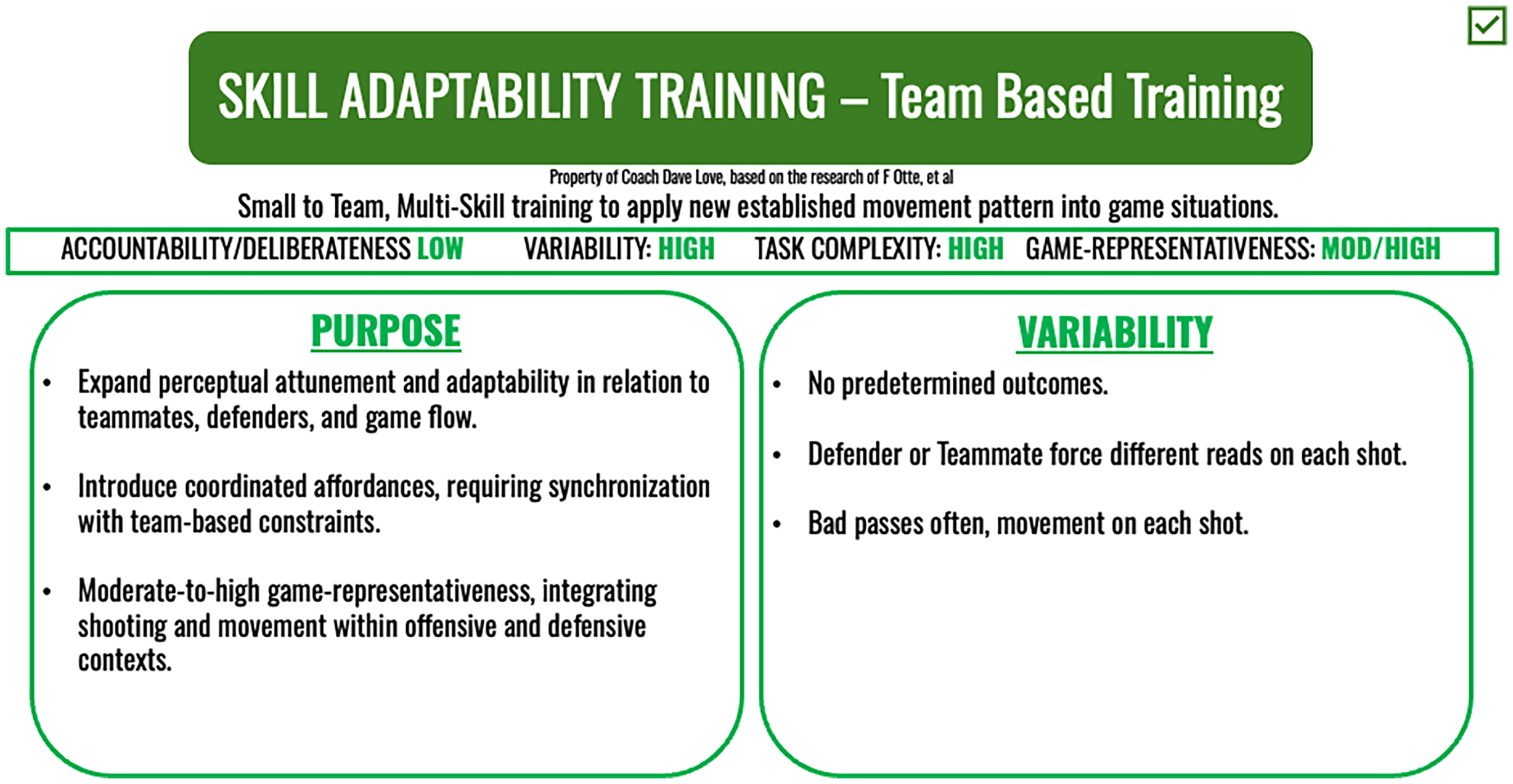
SAT- TBT: Game-representativeness and task complexity are increased with additions of more teammates and defenders, that afford more options of skills and tactical solutions. Predetermined outcomes should be eliminated, with coaches encouraging players to explore a variety of tactical solutions, with attention given to shooting form within those solutions.
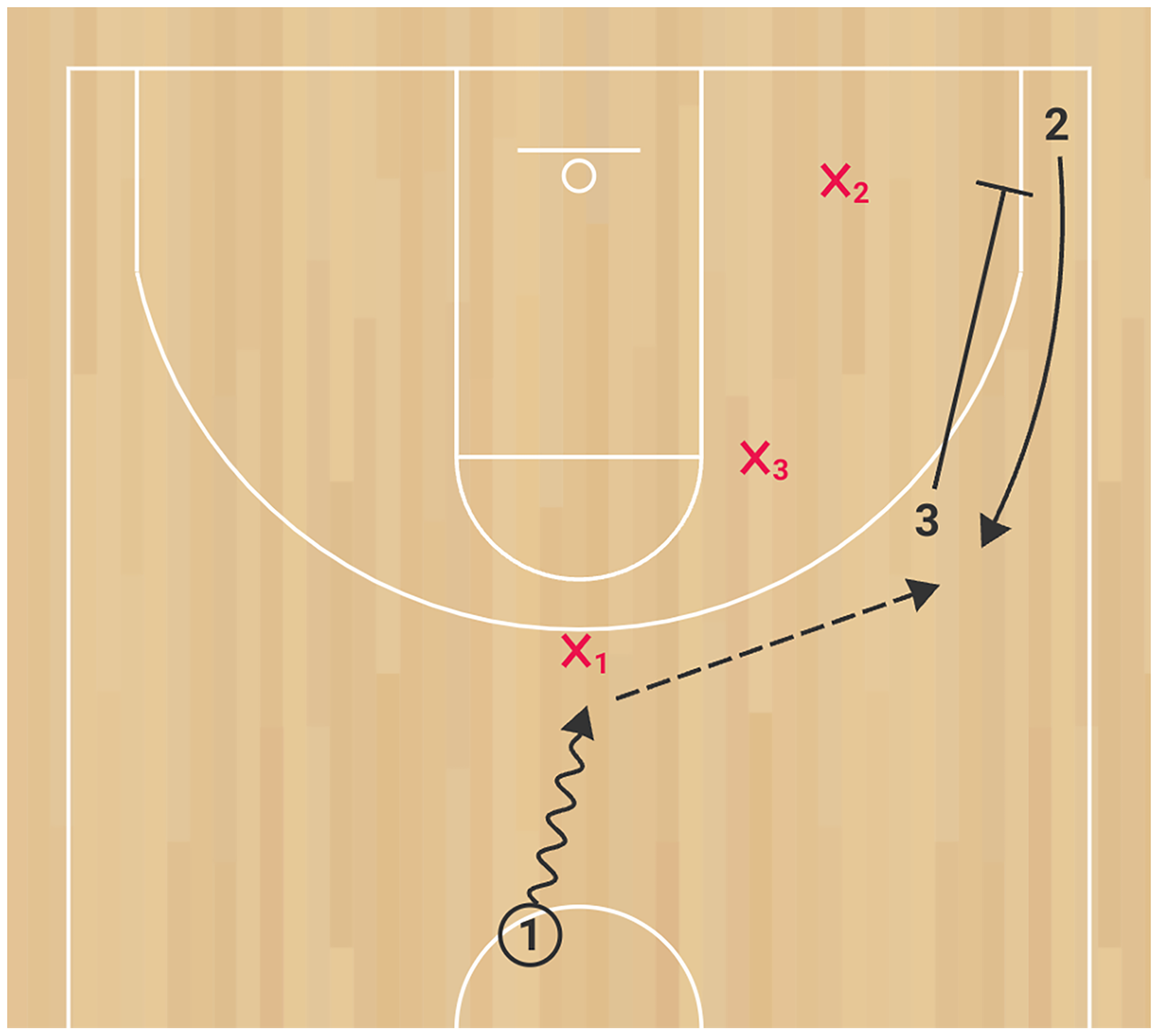
This task creates a dynamic environment in which players must perceive and act upon affordances within a small-sided game setting. The coach initiates the sequence by advancing the ball, while Players 2 and 3 position themselves on the perimeter. Player 3 sets a temporary obstacle (“screen”) to disrupt the defender's movement, allowing Player 2 to explore cutting options based on how the defenders (X1-X3) respond. Instead of following a pre-determined route, players engage in continuous tactical interactions—adjusting their movement patterns in response to defensive constraints. This includes dynamically interacting with their teammate to create opportunities, adjusting positioning, and exploring solutions to generate a high-quality shot. The goal is to integrate newly developed shooting. habits into a game-representative environment, ensuring adaptability under dynamic conditions.
Individualized basketball shooting coaching – performance training
Performance Training (PT; see Figure 10) features the most dramatic shift in terms of the training goals. In all previously described phases, there has been a focus on skill development, learning and adaptation. In the PT phase, the goal becomes specifically focused on preparing athletes for maximum return in competition. This phase of training comes in two parts. The first part being highly game-representative activities, featuring small doses of scrimmage with awareness brought to more tactical ideas for the collective group, rather than biomechanical ideals for skill performance in particular shooters. Immediately before competition, reducing variability and complexity may help players to consolidate recent adaptations and certainly feel confident in their action solutions. While not strictly required when applying the ‘PoST’ framework, pre-game routines often emphasize psychological readiness and comfort (e.g., Feltz & Chase, 1998). Confidence can influence performance,45,46 so incorporating simpler tasks before a game may help players feel more assured in their shooting capabilities. While scientific evidence on pre-game warm-up routines appears scarce, recent exploration of the topic in the context of professional football goalkeeping highlights the importance for specialist coaches to individualize the pre-game environment and, possibly focus on activities that increase individual player confidence levels. 47
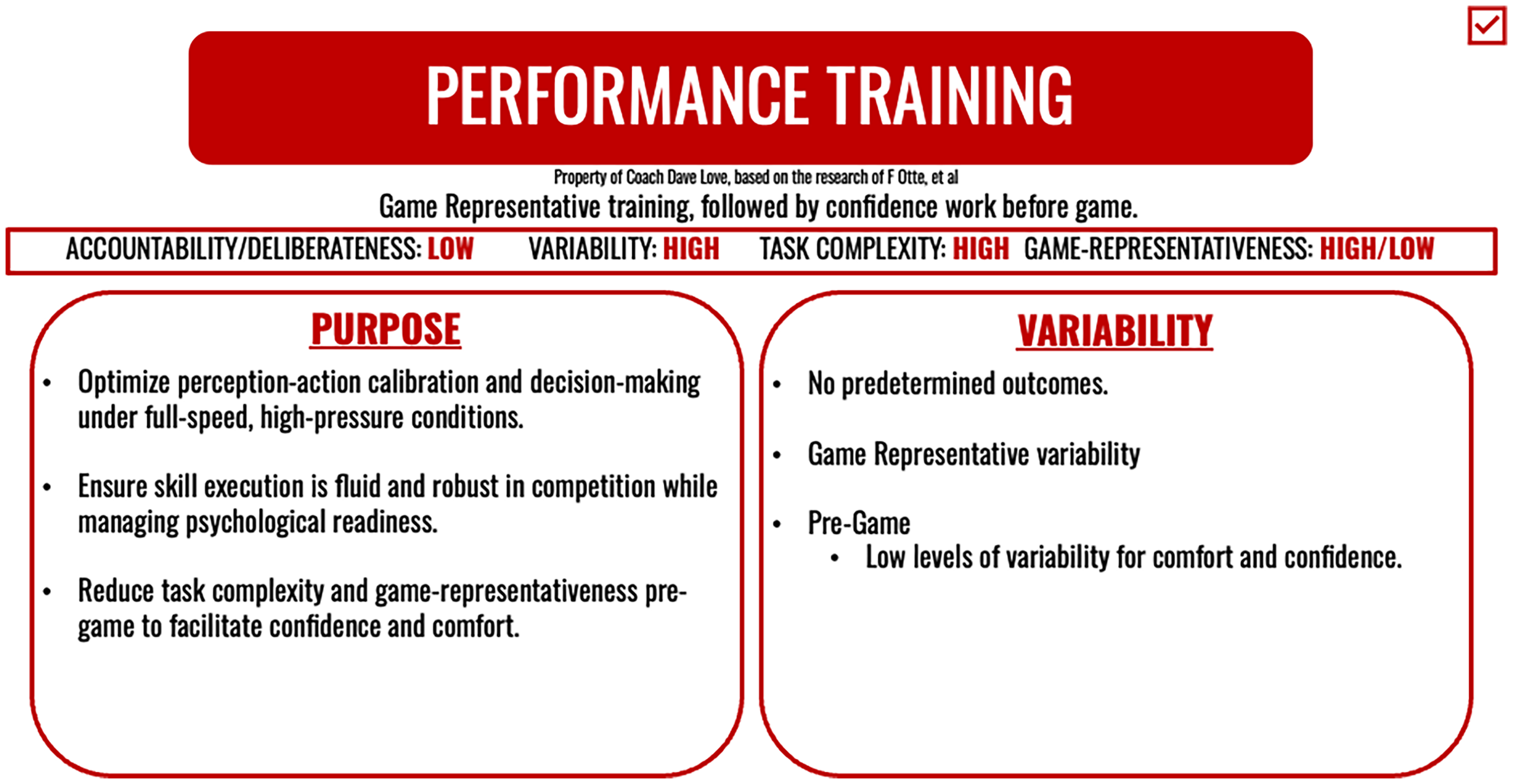
In PT development is no longer the main goal. For example, in the morning before games players can work through tactical solutions that are highly variable, high task complexity, and game-representative. But in the time immediately before a game will shift to low game-representative practice simply to build the confidence of the player before their performance.
Case example: systematic skill training periodization in NBA basketball shooting coaching
An NBA season is packed with competitive fixtures, usually involving each of the 30 teams in a total of 82 regular season games between October and April of the next year, excluding the following play-in tournament and playoff rounds. 48 The challenge of the demanding schedule for NBA basketball for coaches and players is that it makes development of new habits within the season rather difficult. For this reason, it is traditionally encouraged that players develop and refine new skills and habits in the off-season, away from the pressures to perform in competition and get results. Practice time in-season can be significantly limited due to frequent games, excessive travel, and limited access to practice facilities while traveling. For example, during the 2023/2024 NBA campaign the Dallas Mavericks played back-to-back away games in New Orleans, Washington and Milwaukee within the time span between November 12th to 18th, 2023. 47 To further describe this extensive game travel week, for four NBA league games the team had to fly across two time zones and cover around 4667 kilometers or 2901 miles (i.e., Dallas to New Orleans ∼ 711 km/ 442 miles, New Orleans to Washington DC ∼ 1553 km/ 965 m, Washington to Milwaukee ∼ 1023 km/ 636 m, Milwaukee to Dallas ∼ 1380 km/ 858miles). These constraints place an emphasis on making larger changes or building new unfamiliar habits in the off-season. In-season, the focus can be on implementing smaller adjustments and consolidating habits. From a training periodization perspective, the reduction in excessive game schedule and travel challenges during the off-season (i.e., usually between May and September for most teams), means that players have clear periods to focus effectively and efficiently on their individual growth and skill development. They can be deliberate about finding appropriate times within the season to continue to reinforce new habits.
Importantly, while there appear to be clear differences for training times and focus between in-season and off-season schedules (as detailed in the next sections), concepts drawn from the ‘PoST’ framework apply to all skill levels, abilities of players and at various times of the season. Since player learning and development are closely interconnected processes, within any performance training phase there is space for skill learning, and vice versa (see Otte, Davids et al., 49 for a conceptual discussion of this notion). However, execution of the framework will vary considerably from player to player, and from context to context. Coaches need to gain a thorough understanding of each given performance context and each player's development stage to tailor-fit adequate coaching interventions and training environments towards individual players and teams.
Off-season skill training periodization for basketball shooting coaching
The off-season schedule allows teams to experience full training weeks or multiple days before (pre-season friendly) games that provide greater opportunities for skill and tactical exploration, compared to regular NBA season games. To showcase the application of the ‘PoST’ framework to individualized basketball shooting coaching, Figure 11 presents an example of skill training periodization plan for NBA players classified as ‘weaker’, compared to more ‘proficient’ shooters (based on performance analytics data). For the purposes of this paper, a ‘weaker’ shooter might be considered as someone with a lower three-point field-goal percentage (<30%) and/or limited success in game-like shooting conditions, while a ‘proficient’ shooter may be considered to maintain a higher percentage (>36%) and display consistency under varying task constraints.
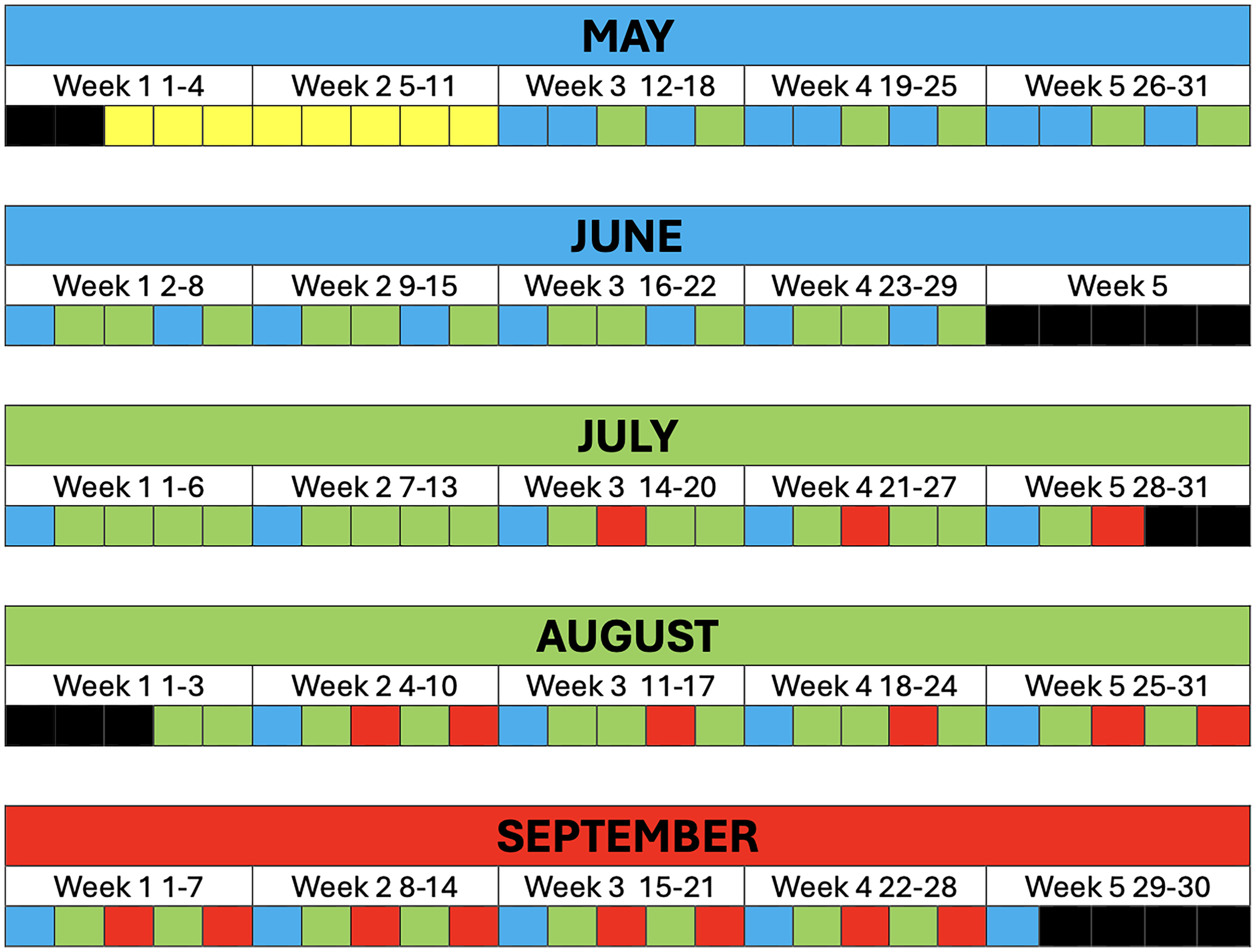
Exemplary schedule of an off-season NBA player skill training periodization plan for a ‘weaker’ shooter. Time in the early off-season affords the opportunity to re-coordinate ineffective movement patterns, but practice should become more game-representative, higher in task complexity, and variable as the habits improve and the season nears. Blue fields here refer to training in the Movement Coordination/ Stabilization Training stage, green fields in either of the three Skill Adaptability Training sub-stages and red fields in Performance Training stage.
The process begins with coaches and players determining goals for the off-season. The group should co-decide which players need to dramatically improve at which skills, and what habits might be holding the player back in performance. Developing a new skill involves a nonlinear process and takes time. Consideration should also be given to how far removed a player is from becoming more proficient at a skill. While any level of shooters would arguably benefit from the ‘PoST’ framework's methodology, its application would look different. Coaches need to understand the differences in planning and how to take advantage of different times and stages. While Figure 11 highlights an off-season periodization plan for a ‘weaker’ shooter, with a focus on changing how the player holds the ball and releases it from their hand, the movement organization for more proficient shooters would emphasize how to become more stable in a particularly challenging situation. In detail, ‘weaker’ shooters might struggle with important movement characteristics (like consistently trying to shoot when off-balance, or not being able to get the guide hand off the ball effectively) in most simple shooting situations. This requires a different training plan, initially focusing more on the movement coordination phase. In comparison, an elite shooter might have a minute tendency in one specific challenging situation. Therefore, time spent in the MCST Phase in the off-season might be of much greater relevance for ‘weaker’ shooters, looking quite different from that of the elite shooter.
The off-season training provides numerous opportunities to strengthen new habits by using a blend of MCST and SAT (i.e., particularly, the blue and green stages in the ‘PoST’ framework). Time away from pressures and contexts of competitive performance, where outcomes and results matter most, provides a chance to explore, with greater accountability, around more functional shooting actions. The term “Greater accountability” in this paper means that players are intentionally, and more directly, confronted with task constraints that require them to explore for new solutions, rather than being allowed to habitually revert to old, inefficient patterns in performance preparation. As the player shows increased proficiency in the adapted motor pattern, the coach can begin to introduce more game representative practice featured in other phases. Coaches should not wait for mastery of one phase before moving on to the next in a linear fashion. Rather, as players show development in new actions, coaches should introduce greater challenge in other phases, possibly returning to early phases in a nonlinear fashion to further stabilize new motor patterns. These different seasonal phases may guide a knowledgeable coach on high quality opportunities to practice in different ways, with varied intended outcomes (e.g., developmental and competition-oriented emphases). The phases are provided to inform the intentions of the coach and player during their practice sessions, acting as a guide for application of adapted movement patterns into game-like environments, effectively helping players and coaches ‘ramp up’ the specialization of training as the season approaches. Using the ‘PoST’ framework, coaches can assess which forms of practice will most benefit specific players at specific times. The framework provides coaches a template to build a customized, long-term performance development plan, while guiding the coach in the purpose of each type of practice.
In-season skill training periodization for basketball shooting coaching
During the NBA season, game days will feature the types of practice used in Performance Training. Highly game-representative practice with attention given to collective system, tactical ideas and plays, followed by low task-complexity and low game-representative work to consolidate ideas and build confidence just before the game.
On days leading up to games in-season, players and coaches are challenged to find a balance between refining more efficient, functional movements and patterns, in challenging, game-representative environments (i.e., Green: SAT phase). This approach involves balancing the need to refine more efficient movement solutions against the desire to introduce enough variability and task representativeness to ensure transfer of learning. This dynamic bridge between practicing and refining more efficient, functional performance behaviors, in ‘challenging’ and game-representative contexts, is the type of practice design that often may get missed or discredited by players and coaches alike. Importantly, the differentiation between ‘weaker’ and more ‘proficient’ shooters may still remain for coaches to consider when designing learning environments in season. In an in-season schedule full of competitive NBA games, Figure 12 presents a periodization plan focused on displaying the balance that coaches could find when differentiating between phases for performance preparation (i.e., PT in red) and skill development (i.e., SAT in green and MCST in blue in Figure 12).
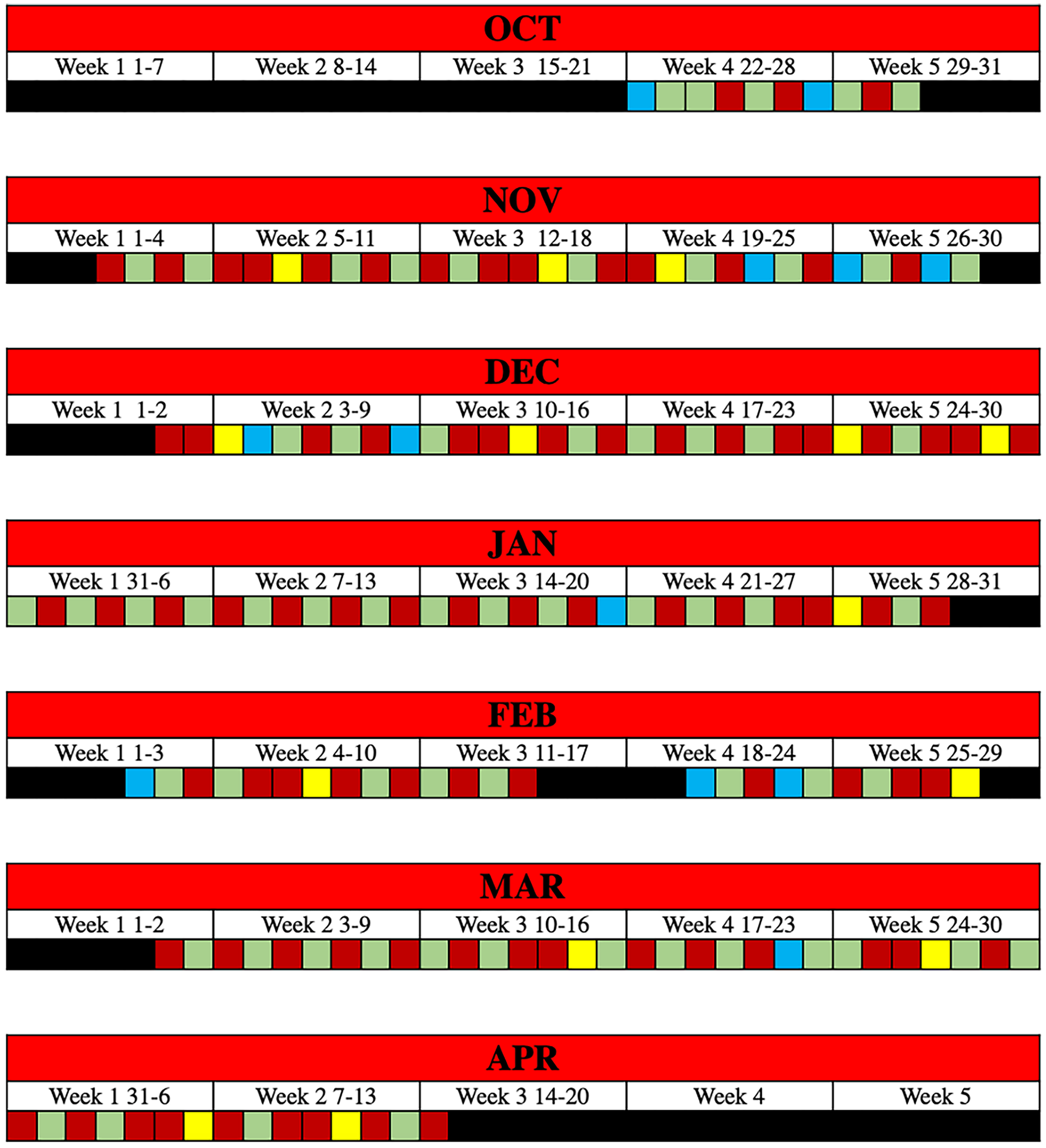
Exemplary schedule of an in-season NBA player skill training periodization plan. Red days are game days. Yellow days are scheduled days off. Blue fields here refer to training in the Movement Coordination/ Stabilization Training (MCST) stage, green fields in either of the three Skill Adaptability (SA) Training sub-stages and red fields in Performance Training (PT) stage. When there are multiple days before a game, MCST should be featured, whereas days before a game should be bridged with SA training in some form. The exact form of SA will be dependent on many factors like the number of players available, load management constraints, and performance of each player. With weaker shooters, effort should be made to find opportunities to revisit MCST training, which is a particular need for them, challenging to find effective times for in the typical NBA season.
Finally, the ‘PoST’ framework should act as a guide for experienced coaches to look ahead at the team's game schedule and determine effective times available for each type of practice. Starting with the dates of games and the known off-days, a coach can plan practice activities, continuously ramping up to games, while refining skills when there is more time. Simply “getting shots up” or mindless repetition in practice is a key avoidance. Each day, depending how it falls relative to the next game, offers an opportunity to explore different types of practice. Even when only a few minutes become available for individual skill development when a team is on the road, rather than simply falling back into mindless blocked practice, the framework can provide a systematic plan to take advantage of that time.
Concluding remarks and future outlook
In conclusion, the current landscape of NBA shooting practice often lacks depth and variety, with many coaches either focusing predominantly on a single skill development stage (as observed in the Periodization of Skill Training (‘PoST’) framework by and colleagues (2019)) or neglecting critical phases altogether. The ‘PoST’ framework provides a systematic and evidence-based, time-focused, skill adaptation and performance-preparation approach that can guide coaches in creating more effective, individualized training environments. While the framework is not rigid, it offers a foundational structure from which coaches can tailor their training plans and coaching interventions to fit the specific needs of each player, considering time-to-competition as a major constraint. By understanding the purpose of each skill development stage and leveraging a balance of coordination, adaptability, and performance training, coaches can better prepare players to transfer new skills into competitive game settings. As the NBA and its shooting coaching continues to evolve, the integration of specialized, player-centered approaches like the ‘PoST’ framework will be influential for developing shooting proficiency and ensuring long-term team success.
Footnotes
Declaration of conflicting interests
The authors declared no potential conflicts of interest with respect to the research, authorship, and/or publication of this article.
Funding
The authors received no financial support for the research, authorship, and/or publication of this article.
