




Abstract
Played-form activities in soccer are customized variants of the original game, configured to emphasize important informational and task constraints in the way players perform in practice. Parameters of play such as the shape and dimensions of the playing area, number of participants involved, and conditions of play are key properties that activities are designed from. These properties impact on the specific practice contexts in which players are challenged to perceive information, make decisions and perform actions, during competitive performance preparation and player development. There are countless possible configurations of played-form activities that can provide development or training opportunities for players to improve performance. Although there are no standard guidelines for designing such practice tasks, here we propose how a theoretical rationale like ecological dynamics can frame the configuration of activities, modelled on typical formats, specific task constraints and key developmental needs. In this article, these formats are depicted with reference to common coaching licence curriculum needs and scientific literature. This insight paper presents a continuum of played-form activities, exemplifying characteristics of different practice designs in soccer. This integration of knowledge provides a valid continuum of play practice designs, based on an extent of specific opportunities for actions in different phases of play. Our insights suggest how coaches and trainers in team sports could gain a deep understanding of how specific played-form activity configurations impact on skill adaptation in players, providing opportunities for coaches to function as learning facilitators.
Training for development and performance preparation in team sports such as soccer through played-form activities is getting widely discussed and increasingly recommended in sport organizations at all ages and skill levels.1,2 Evidence suggests that merely constructing training interventions around performance analytics, based on data science reports, is not enough to improve athlete and team performance. 3 Practice made of diverse variants of the original game, namely ‘played-form practice’, is needed to increase skill adaptation and transferability of game actions, mainly from training to competition.4,5
The played form of sport practice is the object of study in the literature in various modalities and is also referred to as ‘playing-form’6,7 or ‘game-based’8–10 approaches to practice. This type of activity encompasses small-sided and conditioned games (SSCGs) since it features opposition as a core element of practice. More specifically, played-form practice contains elements, features and informational properties of the full game format, but may be configured to specifically contextualise the backdrop for athlete development, performance preparation and team organization.2,11 Such type of practice of sport like soccer is therefore encouraged through recommendations in the scientific literature2,12,13 to feed the pursuit of both development and achievement altogether 14 with motivating but also relevant opportunities of actions.
As suggested in the expression ‘context is everything’, the context in which participants are inserted is a determining variable to consider. Played-form activities precisely simulate properties of competitive games in customised settings (i.e. contexts) designed to provide many opportunities for the emergence of focused actions or sequences of play. Played-form practice has therefore become a significant methodology for coaching athletes in sports like soccer, because of these properties.15,16 It can provide rich opportunities to use perception, cognition and actions during learning, whilst challenging players to engage in decision-making, problem-solving and co-positioning. 13 It can, therefore, be considered as a powerful approach to player development if adapted coherently for individual needs.
Like all relevant pedagogical approaches, played-form activities have a substantial theoretical foundation for their implementation, including a framework grounded on the interaction between the individual and the environment, as defined in the perspective of ecological dynamics in team sports. 17 A rationale based on such framework has been used to explain how played-form activities can enrich practice environments to develop athletes and prepare them for performance (e.g. Travassos et al. 18 , Vilar et al. 19 and Passos and Davids 20 ). Such rationale connects with the fundaments of constraint-led approach since its concepts and principles also promote the manipulation of the parameters of the context and the task. 21 Highlighting the value of ecological practice designs is particularly useful to coaches for understanding where learning occurs, especially when considering all facets of an action in the play, from its purpose to its execution. Ecological dynamics are also insightful for designing activity configurations, which provide opportunities for players to resolve generic or specific challenges in play, in the form of situations. An ecological dynamics framework, thus, provides to practitioners with a powerful theoretical rationale to empower coaching and support technical staffs to work with athletes in contextualised games and play activities to enrich performance skills and expertise.1,17,22,23
Played-form activity ‘formats’ have been reported in the literature from an ecological framework as part of a continuum in soccer player development or training for performance. 2 As we note later, various formats can be distinguished in a suggested spectrum of practice designs from skill-based to full match activities. Some key characteristics of typical configurations can be found in the literature11,24,25 although limited production offers a comprehensive comparison of the characteristics of common formats of play in the form of a continuum. In the process of practising, it is expected to customize played-form activity configurations and manipulate their characteristics to reach specific objectives for which guidelines are not standardized. Clear references in the landscape of possible combinations can guide coaches through soccer-specific training session planning, informing key adaptations in activities. Such formats can also be used to substantiate a thematic assigned to a training session or programme, in terms of the specific affordances or possibilities of play it is designed to offer to the players.
The purpose of this paper is, therefore: (a) to consider typical formats of played-form activities, often organized as contextualized games, that can be utilized in soccer training sessions; (b) to analyse their purpose and key parameters from the perspective of ecological dynamics; and (c) to emphasize how and why they may be useful to players, coaches and support staffs. Core elements and structures of play are subsequently presented in five distinctive formats as part of a soccer-specific practice continuum. For practical purposes, the presentation narrative frames the composition of activities as commonly outlined in soccer federations’ coaching licences’ curricula (e.g. C, B, A and Youth licences).
Context as a frame
Context has been proposed as significant in providing coherence and meaning to all human behaviours generally 26 and to positive outcomes in the practice of a sport. 27 This insight is particularly important in learning, development and preparation for performance in team sports, because it frames emerging cognitions, perceptions and actions of players when encountering a range of affordances (i.e. opportunities for action) 28 and constraints.29,30 In the play, soccer players need to be able to read and respond in different performance contexts and adapt their actions to achieve their performance intentions (e.g. intercept a pass to an opponent, create a shooting opportunity, manipulate the ball past defenders in tight spaces and keep an opposition shot out of the goal). From an ecological perspective, a well-designed practice context is one that simulates the information available in a competitive performance environment for athletes to explore. Such context offers the opportunity to perform coherent and meaningful actions in pursuit of an intended outcome. Activities soliciting the mind such as cognitive drills and well calibrated played-form activities do contribute to the development of the aforementioned abilities, and thus count as essential to practice of soccer.31,32 This approach to practice implies that coaches become learning designers 23 who facilitate dynamic landscapes of affordances for players to use in building the way they play.
Context, therefore, provides a vital background for framing performers’ actions in the play. First and foremost, the practice of soccer, like other team sports, benefits from activities that match the varying, dynamic and unpredictable nature of play, resulting from performance dynamics which change moment-by-moment. 33 In the same way, game play needs to represent an environment that changes continuously and quickly, depending on the way it is designed and overseen, through the resulting player adaptations in response. 34 As highlighted in the principles of non-linear pedagogy, representativeness of the task and of the context is key to practice and skill acquisition, especially in the design of modified games. 35
Contexts are shaped for actions to emerge in a session or programme, commonly introduced by coaches as a ‘thematic’ for the session.16,36 A thematic can be general or specific depending on the degree of details included in its formulation. For instance, a thematic can be as general as ‘making yourself available to receive a pass’. Task constraints can be manipulated in practice designs to specify the time and space in which such actions may emerge from players. For example, game play may be contextualised to emerge ‘in the final third, during counterattacks, in front of your own goal’. Thematics, therefore, substantiate contextual power for coaches and players to direct their intentional focus towards key actions in specific moments or phases of play. In ecological dynamics terms, they can ‘guide players intentions’ 22 in seeking available affordances threaded throughout the design of practice events and configurations of played-form activities. Representativeness in played-form practice could be judged as achieved when the landscape of affordances emphasizes the chosen thematic, or more precisely when these affordances make relevant skills performed and repeated, and that transfer of corresponding actions to unrestricted forms of play (i.e. competitive games) occurs.35,37
Framing the context of action requires articulation of the inherent nature of the play activity and the thematic assigned to it for learning. Hence, when purposefully designed for a given thematic, the configuration and characteristics of activities must not only stay faithful to the nature of the played-form activity but must also give players opportunities to achieve intended goals and objectives that are targeted. 38 With such aims in mind, the practice design process must include specifying information variables (sources used by players to regulate their actions) for affordances which emerge as directly relevant to performance. Such relevance can be heightened in contextualised activities when designed according to the needs of individual players and the team.
Configuration of activities
Thanks to their inherently mouldable nature, played-form activities reflect varying contexts of play and are purposefully designed to emphasize the chosen thematic. Contexts of play can be purposefully modified or manipulated to provide opportunities for players to adapt their performance behaviours. Played-form activities can be modified, by changing their structure and organization without taking away their principled intentionality: to overcome opposition to score or to prevent the opposition from scoring. The existence of the key task constraints of opposition 39 and scoring targets (e.g. goals and gates) 40 are, therefore, non-negotiable to the design of played-form activities for practice to keep the highest degree of representativeness. Other task constraints are equally important, including: the structural organisation of the game, dimension and shape of the playing area and numbers of participants involved. Altogether, these important task characteristics provide the necessary performance contexts for participants to adapt their perception, cognition and actions in a playable activity. There, however, exist activities designed upon a selection of these parameters, such as possession games (i.e. without targets to shoot at), that do feature opposition within a delimited area of play; this short review of key parameters merely the importance of representativeness of practice based on the key elements composing the context of play and leaves room for customization.
The game's structural organisation comprises a most influential source of information, like the shape of the playing area and scoring target locations,41,42 which define where players have to transition in exploration of attacking and defending actions. According to the cited reviews, this information also indicates what teams should aim to do and where (through challenges shaping their intentionality), whenever they gain or lose possession of the ball. For instance, one team could be challenged to score in a specific target, whereas the other team could be rewarded for gaining possession of the ball in different areas of the pitch. The structure is highly customizable, but it should maintain a recognizable ‘performance logic’ (based around principles of play 43 ) for the players even if the constraints that challenge their intentions vary between the teams and from time to time.
The delimited area of play and the number of players are also important task constraints (customizable parameters) to begin working with when customizing played-form activities.41,42 Playing areas can be configured into different shapes and the number of players can be even or uneven between competing teams, which can influence the course of player interactions that emerge.44,45 Dimensions (e.g. width, length and shape) of the playing area and the number of participants involved will impact the space available to perform requisite actions to score points, individually and collectively. Dimensions and numbers of players translate to the time afforded to participants to perceive information and make decisions, 46 in a space of play they are challenged to manage. 47 In addition to the structure of the game, these two parameters provide a useful baseline for coaches and support staff to create activity configurations with specific parameters for teaching, learning, or training how to play.
Practice contexts can thus be customized through manipulating key features of the environment, such as the stakes of a competition or the surface on which a game is being played 48 or through the re-configuration of play during which information is perceived and decisions are made. 49 Modifying a performance context for training purposes usually narrows down to changing game-specific parameters because they are key variables which directly influence the behaviour of participants.11,25,40,50 As reviewed earlier, the key parameters for designing played-form activities thus comprise the number of players as well as the properties of the delimited area of play. 25
Coaches may scale and shape practice activities utilizing these parameters, with the specific aim to match the current needs of players, based on skill levels, experience and proximity to competition. 51 Designing played-form activities in the format of open-ended practices, analytical exercises and conditioned games became a competency assessed in higher-end coaching licenses for which, to our knowledge, international sport federations offer different supporting guidelines. There is a lack of international documents offering a standardized framework to help technical staff working with games. Without a practical consensus on the use of played-form activities for practice, training methodologies practically remain the remit of the local coach or to the local organization that oversees coaching. Quality and efficacy of training may vary consequently, depending greatly on the experience and knowledge of resources in place. Here, we advocate ecological dynamics as a theoretical framework which could underpin application principles for designing played-form activities.
Intentions provide direction and purpose for players
Played-form activities are framed portions of the game that ignite sought responses as opposed to pinpointing single actions in unrestricted contexts of play.52,53 As noted, any activities should consistently include intentions for players in the form of goals, challenges and problems to solve. Coaches can also guide the intentions of players through simulating the properties of a full-sided formal game in the use of a mini pitch with one goal on each side with simple task restrictions. Game-like activities can also differ from their original structure by changing the shape of the playing area and the location of scoring targets, when using hexagonal-shaped or ‘rounders’ areas of play with targets on the outskirts. This configuration can, for instance, channel intended actions inwards and outwards or around a scoring area (see Figure 1). Activities with different shapes can broaden the span of actions and behaviours that emerge and support exploration of performance solutions in the game, precisely because emergent actions are not restricted to the original format structure.
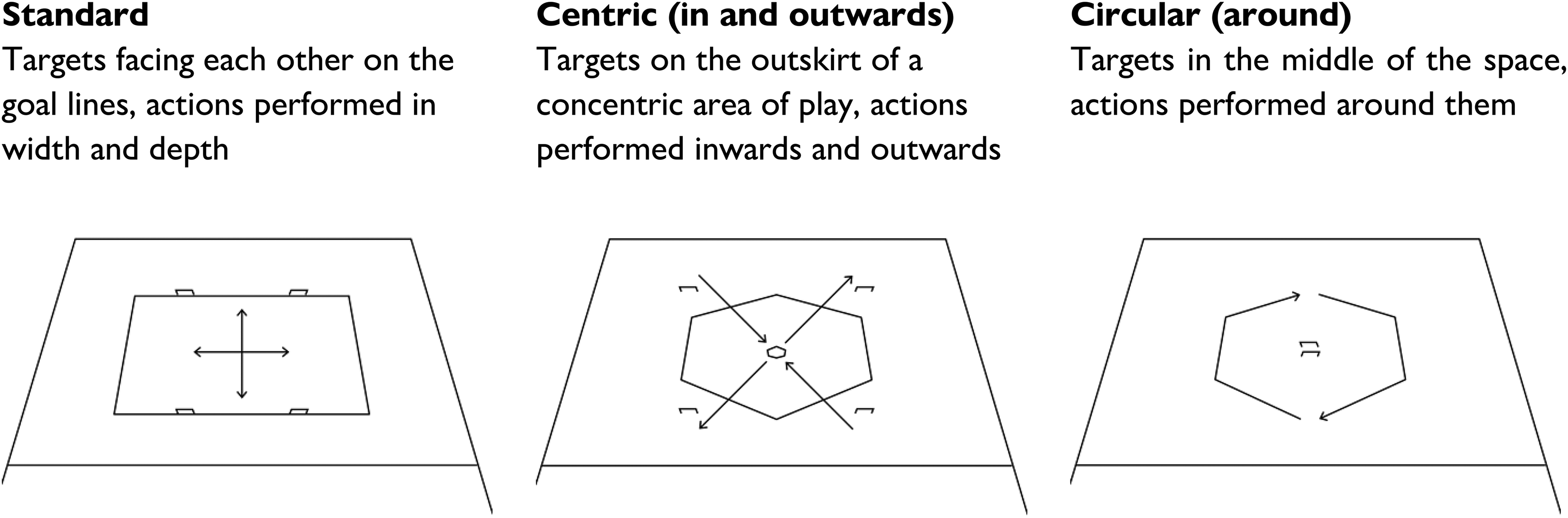
Comparison between aimed directions of actions.
Players can be encouraged to self-organize (i.e. reposition themselves to achieve a collective organization) and self-regulate (i.e. manage behaviour and reactions to feelings and surroundings) according to their intentions and competences to reach scoring targets. 54 It has, however, been shown that older (more experienced) players explore wider locations of playing areas more than younger players. 55 Standard game formats configured to encourage players to perform actions in wider areas may not work as well with younger or less experienced players, even if the playing area shape is set to emphasize width.
There is a clear interest in exploring more diverging spaces and directions in configurations such as centric or circular formats with younger players because the configuration of space naturally sends them to wider areas. On the other hand, centric and circular formats diverge so much from the original structure of the game that it can drag players away from their intended collective organization – specifically in preparation for competition – because of its lack of representative design. Activities with diverging directions of actions must then be utilized coherently, for instance, as a step in challenging discovery of innovative actions (e.g. with developing athletes) rather than as preparation immediately before competition.
Space and time
Considering the ideas of Bernstein 56 in human movement science, on reducing variability in system degrees of freedom, it is clear that developing athletes will tend to resort to performance solutions and movements they know best (greater stability) when under pressure. When experiencing new challenging performance contexts, self-efficacy often restricts decision-making and action regulation 57 to the point it affects the usual performance of players, sometimes negatively. In training contexts, challenging circumstances are mostly created under affordance constraints of less space and time to make decisions and perform actions, or to solve the same problems playing with uneven numbers. As explained next, playing area dimensions and participant numbers involved in games are task constraints that affect time and space. 58 They should, therefore, be calculated to create specific distance values between participants as a key affordance that invites players to solve problems in certain ways.59,60
In small-scaled configurations of playing areas, players are afforded less time and space to perform stable actions (what they usually do), disrupting maintenance of self-efficacy, for example by keeping possession of the ball. This challenge can result in shortening their direct involvement with the ball to avoid being tackled or to make mistakes that cause loss of ball possession. On the other hand, larger spaces created by bigger playing areas tend to stimulate more movements off the ball as opposed to actions on the ball. 61 Activities should then be configured to provoke intentionality in behaviours, acknowledging that efficacy in play requires time to adapt and attune to new movement tempos and space before achieving intended outcomes.
The space and time designed into an activity configuration make different affordances available, such as distances that emerge between players. Shorter distances between players alter the affordances emerging in the performance landscape. For example, they could result in increases in speed of ball circulation or decreases in the difficulty to reach other players with a pass 62 because all players are positioned within shorter ranges for passing with easier techniques. Speed and difficulty also challenge cognition, perception and actions in achieving performance goals like passing, dribbling, intercepting the ball and coordinating actions together in play. 63 Distances between players that are too short for a specific group can make play impracticable for reaching the aimed level of performance behaviours because of too much participant density to afford intended actions. This is problematic for player development if it leads them to not take risks or play too simply (e.g. always relying on one touch actions to keep possession when they can take multiple touches on the ball to have a greater impact in the play).
Managing complexity and difficulty of practice contexts
Task complexity and difficulty of contexts of play are significant to players in terms of lived experience, decision-making and preparation. They must be calibrated according to the experience and skill level of players. 13 More complex contexts are depicted by quality and quantity of information, which result in the current case from their configuration. Overwhelming information can lead to more confusion and less success, especially if there is competition between augmented information from the coach and that which emerges during player interactions. 54 Complex situations can also provoke reinvestment strategies in players, making them think more and decide less, 64 and inhibit athletes from enhancing their capacity to self-regulate and maintain the flow of performance. 65 In occurrence, task complexity is based on the number of possibilities for actions and the number of opponents.
The difficulty of an activity differs from its complexity: a greater difficulty for players’ skill acquisition and talent development is rather engendered by frequent use of practice designs that provide fewer affordances as possibilities for action in play. Activities can therefore be designed to decrease the number of available action possibilities, guiding players towards specific performance solutions 66 in an affordance landscape, or to challenge them in achieving specific contents, thematics, or outcomes in the play. Thus, a complex situation then shouldn’t be described as difficult since the two concepts reflect different characteristics and their calculation. 67 For example, the use of neutral players in game designs could help develop sub-elite players since it increases complexity, because there are more players and therefore more information, and decreases difficulty, making available more possibilities for actions. Using this type of activity design, players at all skill levels could be challenged in adapting their performance solutions to changing contexts.
To summarize the implication of complexity, we use the example of experienced players who can take advantage of more affordances (i.e. possibilities for action) made available in the play. They can do so because they have the skillset (i.e. effectivities 28 ) to undertake more of these possibilities in a given time lapse 68 whereas less advanced players could feel overwhelmed by the quantity of information in the play. On the other hand, difficulty, provoked by limited opportunities, brings challenges which result in more failed actions in less advanced players, and consequently in their team. As a result, where experienced players create more solutions even when there are less possibilities, less experienced players need more time and space to afford actions. Hence, adapted landscapes of affordances in terms of complexity and difficulty give the opportunity to explore or challenge their abilities.
Played-form activity formats and their core characteristics
Played-form practice is relevant if it is a faithful simulation of the contexts of play and if it offers fields of affordances 69 available for players to use to develop competitive performance throughout the continuous roll-out of actions. Any opportunity to practice should, therefore, involve decision-making and problem-solving inside such a context, and for performance of the act of playing, 4 also with most of the inherent requirements in terms of fast adaptations to emerging events. 70 The flow of the act of playing in the context of the thematic will always vary according to the presentation of the context of play (i.e. the chosen configuration of activity). Well-designed played-form practice can maintain the context and act of playing relevant to the development of the individuals involved.
There exist many possible presentations of the context of play and fields of affordances, which correspond to typical activity formats. These formats act as configuration ‘presets’ and coherent arrangements for: (a) shape and size of the playing area; 41 (b) the type and location of scoring targets; 42 and (c) the location on the pitch where the game configuration is organised. 71 Arrangements of these parameters provide different performance contexts where learning and training can occur efficiently. Because of their increasing scale, typical formats draw a continuum of five activity categories that portray ‘preset’ configurations of the aforementioned core parameters. Following the ecological perspective of practice design, these formats are classified according to the possibilities for action that they provide,2,72 and on the degree of representativeness of the specific task design in which they feature.
As listed in Table 1, open-ended practice activities feature short sequences of play, which may be more or less dynamic (including active or passive defenders or mannequins), and include basic problems to solve, challenges to face and simple decisions to make; SSCGs are small games with different configurations of play, sometimes resulting in disproportional spaces to challenge players and less representative organization, compared to the full game; analytical games are custom configurations delimited to isolate a specific sub-phase of play, located in a specific area of the pitch; conditioned games are proportional games with configurations similar to the full game; the full game is the original game practiced in a training environment and which may feature the competitive rules of performance environments (e.g. maintaining the offside law).
Continuum of the formats, from less to more game-related specificity.
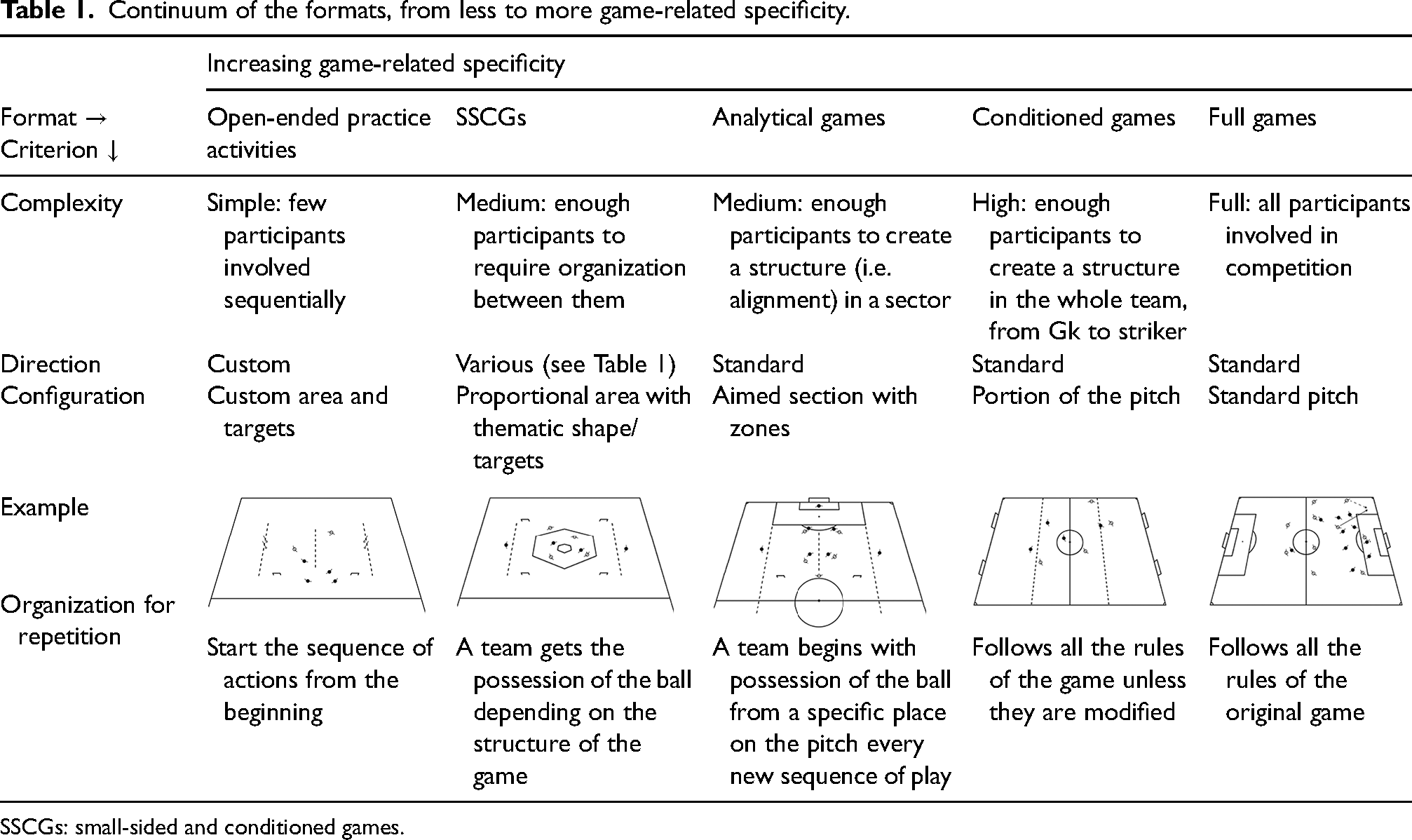
SSCGs: small-sided and conditioned games.
Played-form practice features many affordances by default. Particular formats, however, tend to emphasise specific fields of affordances because they have their own typical configuration. Played drills set simple situations of play and offer fewer affordances with a smaller bandwidth for search and exploration of solutions in the play. Search solicits skillsets (e.g. technical and cognitive) altogether since it demands to change execution simultaneously whilst articulating all cognitive mechanisms to determine the best action to perform. This often discriminates skills levels according to the complexity of the solutions to find.73,74 The bandwidth for search of solutions in SSCGs is greater than in other played formats. This highlights the narrow aspect of drill-like or 1v1s activities whereas SSCGs feature more affordances available because they are more adaptable to divergent shapes, configurations and organizations. As formats change in scale at the end of the continuum (see Figure 2), conditioned games still frame targeted affordances and as opposed to the realism of the full game format, channel important contextual information such as the thematic.

Key characteristics of the context of play across the continuum.
The representativeness of the situations created in activities from analytical games onwards inherently directs the intentions and the collective organization, and consequently restricts the range of actions and responsibilities to fit in a delimited context on the pitch. More directed intentions mean less opportunities to explore divergent affordances in the play since they are constricted by the intentions to pursue in the activity. Activities that remind more the original game drive an even more specific act of playing because it instills judgment in decisions through the way directed intentions serve to manage the space of play. Such specificity narrows unpredictability and act, by itself, as another core condition that influences the management of risk in every decision. 75 This is how every format throughout the continuum imply key adaptations in the decisional mechanisms and tactical behaviours yet in the practice environment.
Formats and their configuration thus result in different implications for practice even if they are all driven by the aim to repeat (the solving of a performance problem) without repeating (the same technique).56,76 These changes make the purpose of formats more suitable for exploration at the beginning of the continuum, and for preparation at its end. In line with key guidelines in coaching licences, differences in purpose between formats is a take home message coaches can keep in mind to contextualize practice by emphasizing the implication of their configuration.
All formats are thus relevant to enhancing performance but are only useful to a specific extent in the process of player development and preparation for performance, depending on the competence and experience of the players. 13 Coherent activities are expected to provide an adapted range of affordances, making available possibilities for players to undertake specific actions framed by the thematic. 77 Played-form practice should, therefore, be interpreted as activities coherently designed, structured and coached to contextualise demands and opportunities for actions to emerge under competitive performance conditions. 37 This is the way specifically contextualised activities feed athlete learning, development and training during a single session, programme, cycle or season.
Formats also reflect different intentions, emerging from the compatibility between their arranged core parameters and the reason for their usage. The idea of a specific intention assigned to each format becomes clear if the field of affordances and their arrangement are valid for the intended actions and training loads. 78 Formats finally gather the configurations that will most likely result in positive influences on player performance behaviours, making activities more motivating or ‘playable’ as suggested by Hopper. 79
The closer configurations resemble the full game, the more players it involves, and thus the more complex that precise context of play becomes. In addition, actions in such contexts of practice are also directed by collective organizational schemes, both implied by the thematic and the subscription to the aimed game model. 54 Thus, the configuration instills the specificity of the purpose of the activity, to ultimately target carefully delimited sectors of the team and phases of play.
Formatted activities should thus be loosely planned throughout a training session, each activity having their own contribution to practice, but gradually leading towards the targeted thematic of the session. For example, a session for practising defensive delaying and covering can use some or all of the activities presented in Figure 3. For narrative purposes, less information is presented in the examples for formats to be clearly reflected. These examples also exemplify a typical training session composed of four activities, played sequentially.
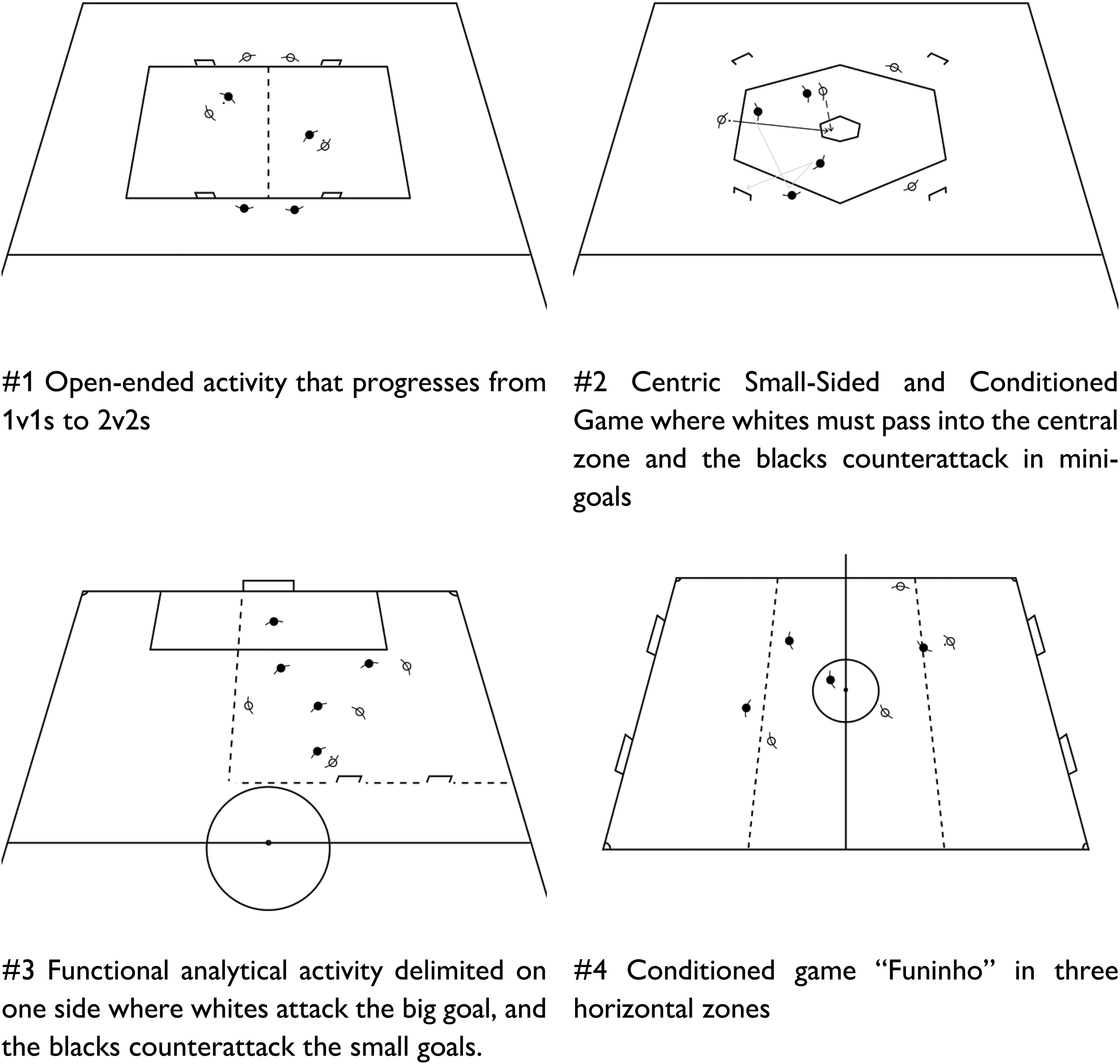
Examples of played-form activities utilized to train defensive actions in 4v4 situations.
Practice design based on the formats in Table 1 reflects a valid approach to practising, as long as activities are coherently designed to offer valid contexts for performing intended actions. Simply, activities must provide valid opportunities to stimulate development and preparation that players can explore in play.70,72 The format continuum precisely provides a pedagogical logic for designing valid practice activities because its flexible framework can be utilized as an adaptable reference in terms of context of play. Whilst it is a viable investment for coaches and players to design the play around coherence, 2 representativeness80,81 and playability as suggested by Hopper, 79 formats have the advantage of clearly directing players towards performance contexts with everything that they imply (i.e. making decisions, engaging with challenges, solving problems, perceiving relevant information and regulating emotions and actions).
As previously noted, Nikolai Bernstein 56 advocated that practice should be conceived as a form of ‘repetition without repetition’, aimed towards solving a movement problem and eschewing rote learning of a movement technique. This form of repetition, featured in SSCGs, analytical games and conditioned games, also particularly reflect opportunities for coaches to inspire innovative solutions, and for players to debate and propose performance responses which emerge in different contexts. Such adaptations should be interpreted as interventions that benefit player development because they involve participants in co-designing activities, 82 aligned with active thinking whilst playing. Such a constructivist approach has been notably encouraged for application in various contexts, including youth and elite levels of soccer.83–85
Played-form activities may therefore be considered as the minimal viable context for coaches to highlight challenges and provide problems for players. When designed coherently, they also become the best platform for insights, advice and guidance to improve performance. 13 Each format should however be based on a way to play13,38 (i.e. a game model shared between all teammates) to help achieve teaching, learning and/or training objectives, all viewed through a lens that provides a narrower or wider view of performance behaviours required to perform in competition. The planning and programming of format-based activities across a cycle (i.e. week and month) must however consider changes in the responses from players in the play to keep making practice head towards development and/or performance.
Implications
It is reported in the literature that the usage of played-form (versus drill-based) varies between organizations and communities of practice, 86 still preferring activities with focus on execution before problem-solving.6–8,87 These are derived from coaches gaining their knowledge from experience and emulation of peers or coaches they had themselves in the past.8,87 Despite increasing recommendations in favour of played-from activities made in the literature, the implementation of such approach on a larger scale seems to proceed slowly. Whilst soccer federations and similar organization offer coaching education opportunities, it is worth noting here that coaches have also reported that their club or local governing body can also have an impact on practice design, 8 which could help the adoption of played-form practice. This reinforces that coaches should resort in a wider span of resources to enhance their knowledge about the use, impact and implications of played-form activities. The insights presented in this paper were precisely presented with the aim to clarify the advantages and challenges of played-form practice, and provide evidence and references that empower coaches in its adoption, including the design of activities and their animation.
In sum, designing played-form activities reflects an important challenge faced in coaching, since it must ensure coherence from the diagnostic of a problem to the operationalization of the played activity. For coaches to translate a diagnostic into played-form exercises, they essentially should do as suggested in Figure 4 and begin from the respective age's full game (e.g. 5v5, 7v7, 9v9 and 11v11) and ‘dissect’ the play into smaller parts. Beginning from an action or sequence of play in the full game is an ideal reference point to work with. Although experts judge the impact of a dynamic play activity on specific components of performance,78,88 played-form activity allows coaches to frame specific actions or sequences as encountered in competition, formulate it in a thematic, and guide their emergence in the play. The context included in the formulation of the thematic signposts the composition of smaller formats of the play. Thematic, formats and customizable parameters reflect the information coaches can work with to design from scratch.
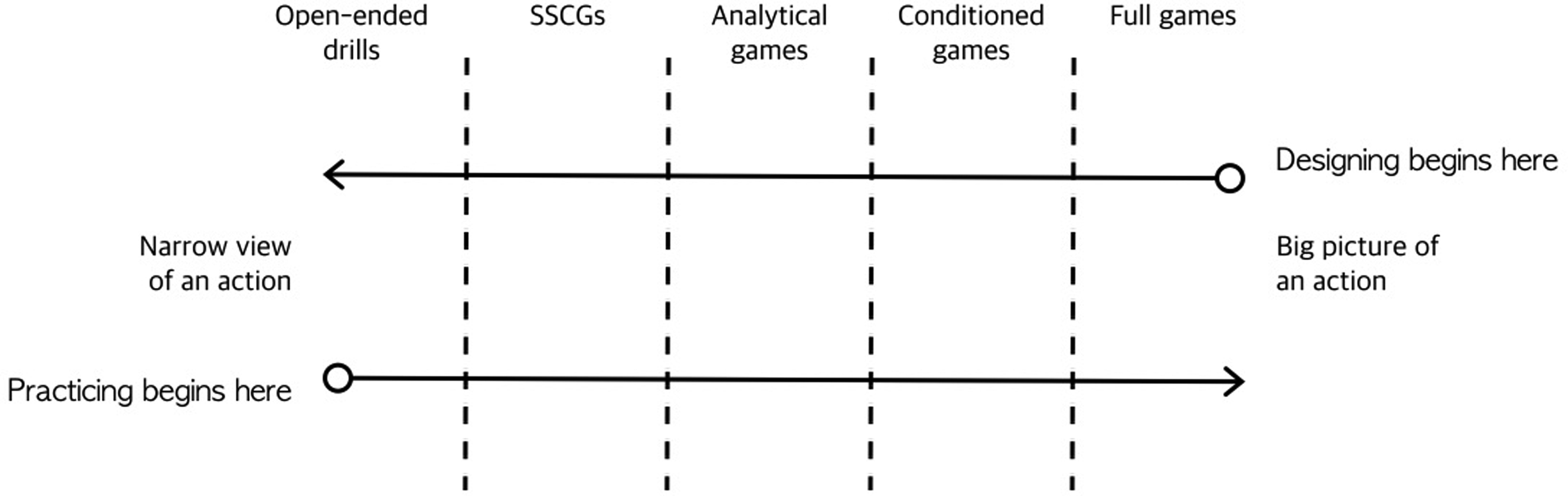
Comparison between the process of designing and practising.
Ultimately, any played-form activity configuration has a clear and direct influence on the possibilities that arise in play and provide, to some extent, meaningful contexts for players in the way that actions become transferable to unrestricted contexts of play and performance. Formats, therefore, frame degrees of complexity, difficulty, specificity and completeness throughout the arrangement of their task parameters. The manipulation of constraints and its resulting influence of the degrees mentioned earlier consequently influence the intention to pursue as well as the purpose of the activities. As presented in Table 2, formats must therefore be animated and coached to fulfil their purpose through possibilities for action that they provide.
Purposes of formats and their implications in terms of coaching.
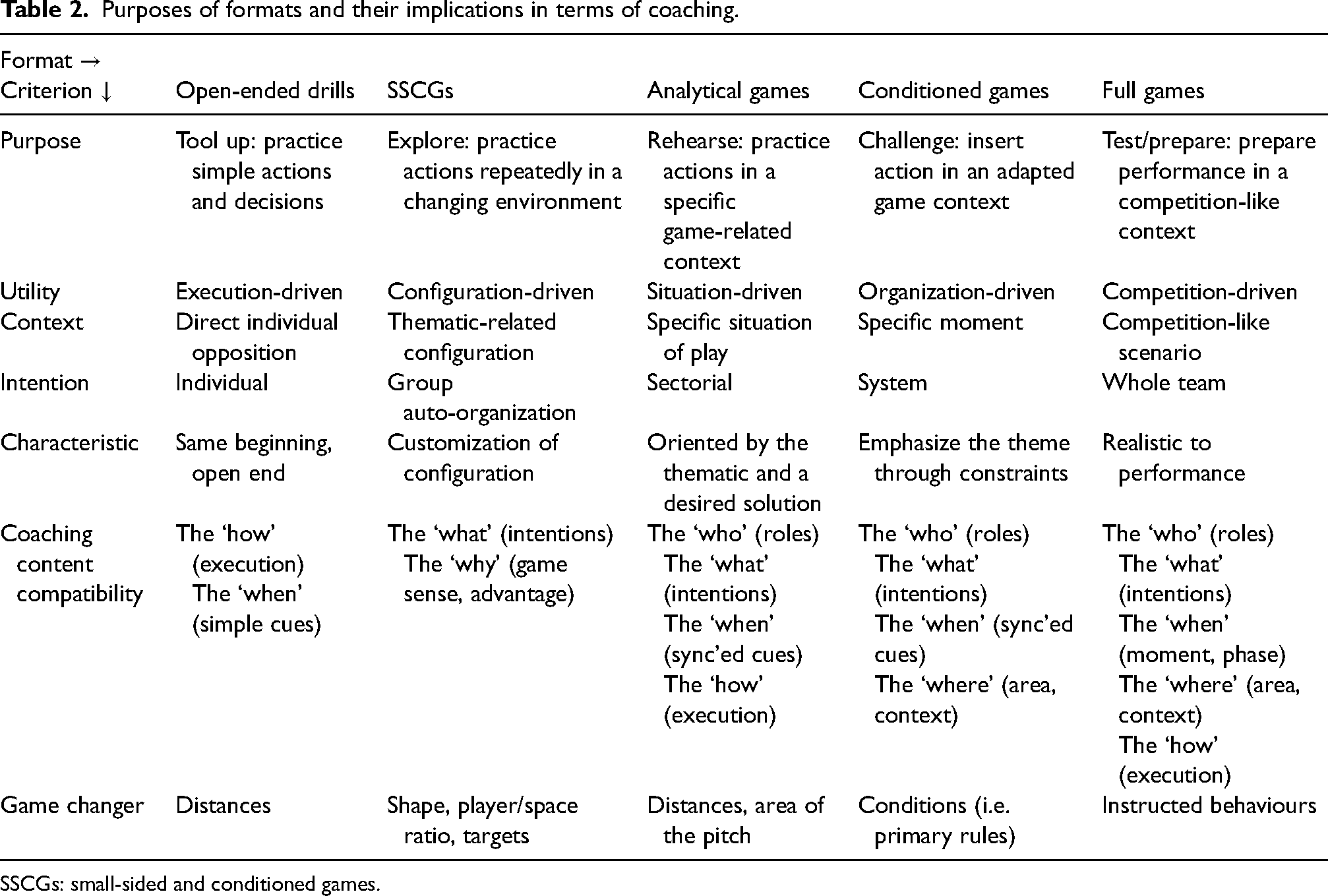
SSCGs: small-sided and conditioned games.
Designing and animating played-form practice can therefore refer to clear and practical guidelines to implement in the practice of coaching. By ‘practice of coaching’, we also stress that coaches are themselves responsible of practising the tasks embedded throughout the process of designing and animating played-form practice. These processes involve reading the play, manipulating parameters and intervening along in every activity they offer their group. The advantage of referring to a comprehensive and flexible framework that is the continuum of formats is to navigate between contexts, their characteristics and the specific opportunities they provide. Again, such navigation demands practice and analysis of one's own coaching to detect where diagnostic and design could be improved in the next occasion, customized for the participants and the aimed way to play.
Conclusion
A continuum of formats of played-form activities is presented in this insights paper, intended as a significant categorization for contextualising configuration of play, which are commonly utilized by technical staff as instruments for teaching, learning and training soccer. The continuum articulates game play formats from less to greater specificity, differing in scale and extent, to suit the needs of players at different skill levels. Each format provides players with the opportunity to practice at different performance levels, both from divergent configurations of activity, contextualised by varying structure, parameters, organisation, intentions and rules. Formats are an adaptable presentation of play in the form of many possible activities, initiated as valid ‘presets’ amongst countless possible configurations. They reflect clear and practical guidelines for coaching, which have clear possibilities for adaptations and innovations based on initial configurations of play, considering the responsive involvement of players to intervene in the play and suggest adaptations.
A continuum of practice activities reflects a valid, science-based contribution to the literature and national curricula which may be of practical usage for coaches in their designing process, and for national and international sport federations to create advice and guidance on player development and performance preparation.
Footnotes
Declaration of Conflicting Interests
The author(s) declared no potential conflicts of interest with respect to the research, authorship and/or publication of this article.
Funding
The author(s) received no financial support for the research, authorship and/or publication of this article.
