



Abstract
Humans are not immune to cognitive biases in judgment and decision-making. However, little is known about cognitive biases (i.e., a departure from rationality in judgements and decision-making) involved in athlete-team selection by coaches or specialist selectors, which can have a major impact on the team's success. To provide further insight, our research explores the extent to which coaches/selectors perceive they are susceptible to cognitive bias. Twelve national-level coaches/selectors were interviewed (semi-structured) under an interpretive phenomenological research design. Using reflective thematic analysis of the data, we offer three main findings. First, coaches/selectors are susceptible to multi-causal cognitive biases in athlete-team selection. Second, the driving force behind such biases is a phenomenon known as “conflict in cognitive dissonance”. Third, such suboptimal behaviour is perpetuated by the coaches’/selectors’ “oversight of cognitive biases”. We offer a number of policy recommendations that promote effective and unbiased selection processes in sports (and more broadly in society), enhancing equity as well as performance excellence.
Introduction
Judgment and decision-making (JDM) is ever-present in all aspects of sport. 1 For example, players make decisions about where to be located at any point in the game, referees evaluate the legitimacy of players’ actions, and executives make decisions about sponsorship and broadcasting relationships. Individually and collectively, these and many other decisions significantly impact success or failure in sport. 2 JDM by coaches and selectors has far-reaching implications for professional sports teams given the athletes they select are the principal determinant of successful versus unsuccessful outcomes.3,4 Due to the high stakes in elite-level sport, it is unsurprising that athlete-team selection is a highly scrutinized activity.5,6
Team selection in sports is the final stage of talent development 7 and is an important part of the sports management process for various reasons. First, athlete-team selection decisions are key to the success of the coach 8 and their team. 7 Second, selection decisions also impact athletes’ mental health9,10 and self-identity. 11 Third, selection decisions can negatively affect the perceived integrity of the selectors, the selection process, and the wider organization. 12 Finally, selection disputes can also become lengthy legal battles.12,13 Therefore, there is great value in an effective and rational decision-making process for athlete-team selection.
Despite this, humans are not always rational. They tend to be subject to bounded rationality, 14 and susceptible to cognitive biases. 15 Cognitive biases occur when an individual systematically deviates from rational thinking due to unconscious mental shortcuts and ineffective processes.16,17 These biases lead to potentially costly decision-making errors.15,18–20 Individuals’ susceptibility to cognitive biases can be differentiated21,22 in many contexts23–25 across a range of professions. 26
Within the professional sports domain, existing literature has examined how expert intuition, athlete maturity, decision-making style, subjective judgements (e.g., overall impressions of athletes), self-trust, lack of structure in the selection process and player's coachability have impacted athlete-team JDM.7,27–30 While previous literature in sports has looked into cognitive biases in JDM, the context of athlete-team selection by coaches/selectors has not been directly studied from the perspective of naturalistic decision-makers. Further, how these decision-makers recognize—or fail to recognize—their own biases remain largely unexplored, thus presenting two pertinent research gaps.
Specifically, athlete-team selection is beset by high-levels of uncertainty so understanding JDM and the associated cognitive biases is critical as such biases can have major adverse effects on the success or failure of sports teams, individual athletes, and various stakeholders, including fans, sponsors, community members, broadcasters, and governing bodies. Therefore, this study advances prior research by empirically examining how cognitive biases affect coaches’/selectors’ JDM processes. It also extends the literature by focusing on elite-level team sports, offering insights into real-world decision-making under uncertainty—a context that has received limited scholarly attention.
The next section provides further theoretical background, postulates the research questions implied by the gaps in the literature, and offers an overview of the three-higher themes we identify in our interviews of twelve national-level selectors. In particular, we uncover: (i) susceptibility of selectors to multi-causal cognitive biases, (ii) a conflict in cognitive dissonance, and (iii) oversight of cognitive biases. Our discussion below makes it apparent that the themes have important implications for policy and practice in athlete selection.
Further theoretical background, research questions and overview of our findings
In psychology, decision-making is a cognitive process that involves making a selection from several possible alternatives. 31 A variety of factors make individuals susceptible to cognitive biases. 17 These include cognitive capacities, 22 personal experiences and expertise,32,33 emotions, 34 as well as mood and memory.35,36
Cognitive capacity has a clear-directional association and is a crucial, overarching factor in susceptibility to cognitive biases. 21 Consequently, someone with a relatively lower cognitive capacity is likely to employ mental shortcuts, known as heuristics in JDM. 37 When the decision-maker relies upon a heuristic approach, they may underappreciate relevant information or fail to consider alternatives, leading to biased JDM. 38 Moreover, individuals’ cognitive capacity is related to their propensity toward cognitive dissonance.39,40 Specifically, when individuals hold two contradictory beliefs at once, they feel cognitive discomfort in JDM, leading to finding mental shortcuts.
Memory is also a significant influence; if the retrieved information is salient (vivid memories) the decision-maker may stick with such vivid memories in the JDM process even if they lack relevance. 41
There is complexity in terms of an individual's expertise and susceptibility to cognitive biases. On one hand, it can reduce it; research in cognitive psychology suggests that experienced performers display fewer cognitive biases than novice individuals.32,33 This could be attributed to expertise developed through extensive experience and training, 42 allowing individuals to recognize patterns 43 and subsequently develop strategies to overcome certain biases. For example, experts in conflict management may develop selective attention, use of schemata, and reliance on heuristics based on past experiences. 44
On the other hand, experts are susceptible to certain cognitive biases,45–47 including overconfidence, confirmation, and the ‘blind spot’ bias. It was observed that experienced individuals were more prone to exhibiting cognitive biases in their decision-making compared to their less experienced counterparts. This indicates, in line with Kahneman's quote above, that even those with expertise or extensive experience in a specific field may not be immune to cognitive biases.46,48,49
Based on the existing literature and identified research gaps, our examination has been guided by three research questions that we believe enable to formulate practical suggestions to selectors and policymakers. In particular: 1) What is the nature of cognitive biases that prevail in athlete-team selection? 2) Why do cognitive biases exist in athlete-team selection? 3) How do cognitive biases persist in athlete-team selection? The following section provides further theoretic background behind these questions (for interested readers). To answer these questions, we interviewed twelve national-level selectors (semi-structured) using an interpretive phenomenological research design. Careful reflective thematic analysis of the data reveals that athlete-team selection processes may be more nuanced than previously recognized. Three higher-order themes were identified.
First, we find susceptibility of coaches and selectors to multi-causal cognitive biases. 21 This finding underscores the fact that even highly trained professionals may be influenced by excessive information, entrenched beliefs, and prior experiences/expectations. Further, findings show that even mong experts’ reality may be distorted, which may occur in high-stakes decisions that may jeopardize team success. As the Nobel Laureate Daniel Kahneman 50 noted, “The illusion that we understand the past fosters overconfidence in our ability to predict the future.”
Second, a conflict in cognitive dissonance39,40 emerges and adds a deeper layer of complexity. That is, selectors struggle with the discomfort between their memories, perceptions of fairness and the reality of their choices. This internal conflict can subconsciously lead selectors to deviate from fully objective and fair decisions that benefit the athlete and the team.
Third, we observe signs of an oversight of cognitive biases,51,52 akin to a blind spot. In this case, selectors fail to recognize their own biases, which makes them resistant to corrective interventions. This phenomenon reinforces inferior decision-making and outcomes.
We argue that recognizing and mitigating these biases is not just beneficial
More broadly, education curricula across all levels should focus on raising awareness of potential JDM biases and providing students with ways to overcome them. The importance of this seems to have grown over time given the well-known effect of social media's algorithms towards reinforcing ones’ biases and social polarization (see e.g., 53 or 54 ).
Methodology
Given our aim is to explore the coaches’/selectors’ susceptibility to cognitive biases in athlete-team selection, this study is philosophically grounded in relativist ontology and social constructionist epistemology. 55 Relativism posits that psychosocial realities are subjective and consist of multiple socially constructed interpretations. 56 Social constructionism emphasizes that individuals create meaning through their experiences and interactions with the world. 57 This philosophical orientation aligns closely with phenomenological analysis, which seeks to understand a phenomenon by exploring the lived experiences of participants. The primary goal of phenomenological research design is to describe and interpret these experiences (Smith, 2014), 58 making it an appropriate approach for our research agenda.
Phenomenology is generally divided into two main branches: descriptive (transcendental) and interpretive (hermeneutic) phenomenology. 59 While both share Husserl's epistemological foundations, they differ in their focus, outcomes, goals, and the role of the researcher's prior knowledge. 60 For our study, Interpretative Phenomenological Analysis (IPA) was chosen because it complements the study's relativist ontology and social constructionist epistemology. IPA emphasizes a deeper understanding of the examined phenomena 61 and requires the researcher to engage in a hermeneutic circle, a dynamic process of moving between the whole and its parts to construct meaning. 62 This iterative process involves reading the data, forming preliminary interpretations, reflective writing, and revisiting the text with refined insights. 63 Through these cycles, researchers develop a nuanced understanding of the participants’ lived experiences, integrating their pre-understandings into the findings to guide the research in meaningful ways.56,64
IPA is particularly well-suited for investigating JDM processes because team selection is deeply personal and shaped by cognitive and emotional factors, including intuition, bias, and judgment. 65 By capturing the subjective essence of these thought processes, IPA provides rich and detailed insights into coaches’ experiences, uncovering nuances that only they can articulate. Furthermore, it allows researchers to explore how subjective and contextual factors influence cognitive processes in selection decisions. As our discussion below shows, IPA's interpretative lens can uncover deeper meanings and patterns in coaches’ narratives, including heuristics and cognitive biases, which may not be explicitly expressed but play a significant role in their decision-making.
Participants and procedures
Participants were recruited using a purposive sampling as it enabled us to select participants with rich, relevant experience of athlete-team selection. As this study adopts IPA, it is essential to interview coaches/selectors with extensive experience who can provide detailed perspectives.
To qualify, participants had to be current or former members of a team selection panel that selected athletes to represent Australia at the Olympics or Paralympics in the last five years. A second requirement was that their selection policy did not rely exclusively on a sole objective criterion (e.g., a finishing position at one specific selection event).
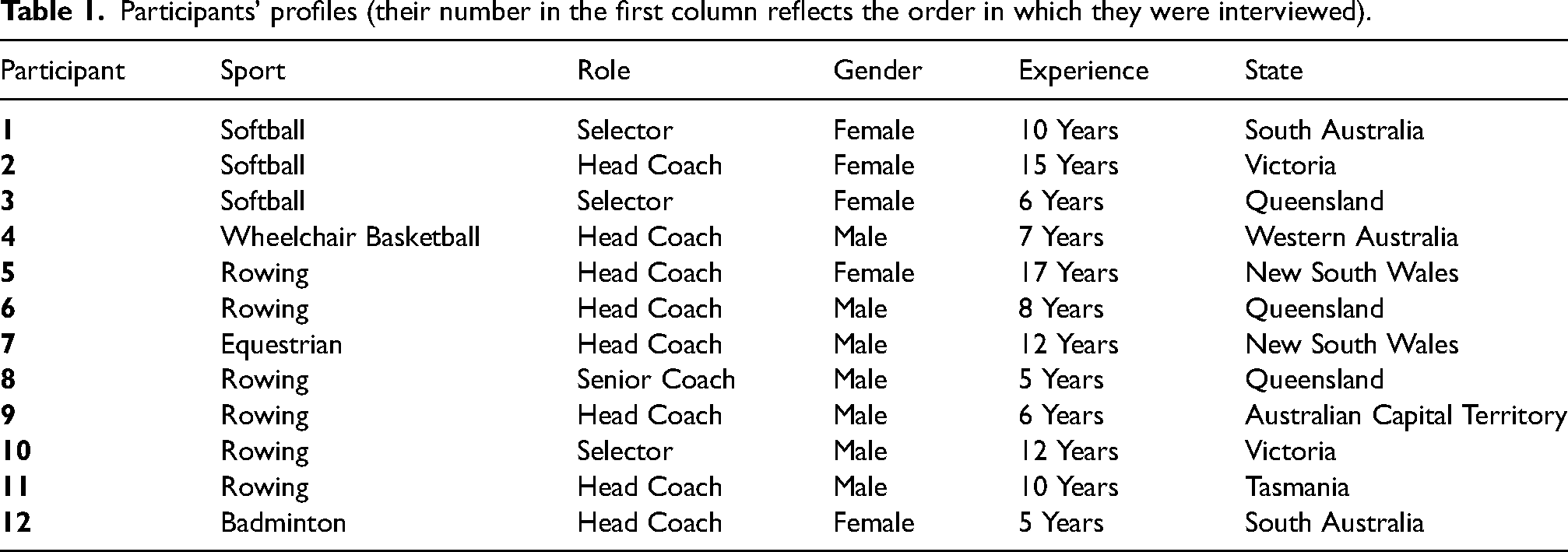
The twelve participants represented five different sports: Softball (n = 3), Rowing (n = 6), Equestrian (n = 1), Wheelchair Basketball (n = 1), and Badminton (n = 1). While the sample may seem modest, it is double in size of the minimum requirement (of six participants) for reflective thematic analysis. 66 It should also be kept in mind that these were selectors at the highest level of Australian sport. Our participants possessed an average of nine years of top-level selection experience, ranging from five to seventeen years. The sample is balanced in terms of gender (5 females and 7 males), as well as geographically – only one of the 8 Australian States and Territories is not represented. The profile of the participants is summarized in Table 1 below.
Invitations to participate were disseminated to national team selectors through the CEO or national high-performance manager of each organization. Employing online interviews as a qualitative data collection method67,68 proved convenient for both the researchers and the participants. The interviews were recorded using Microsoft Teams, initially as video files, with an average duration of 45 min, ranging from 20 to 75 min.
Interview guide
Interviews were conducted using semi-structured interviews enabling the researchers to adequately capture participants’ experiences, but allowing topics to diverge slightly or further probing to occur as required. 69 The interviews commenced with three introductory questions: a) “Could you explain your career journey?”; b) “How would you describe your role as a selector?”; c) “What are your responsibilities as a selector?”. The purpose of the introductory questions was to explore the participants’ background and how they perceived their selection responsibilities as well as building rapport with participants. The interview questions are detailed in Table 2 below.
Participants’ profiles (their number in the first column reflects the order in which they were interviewed).
Semi-Structured interview questions.
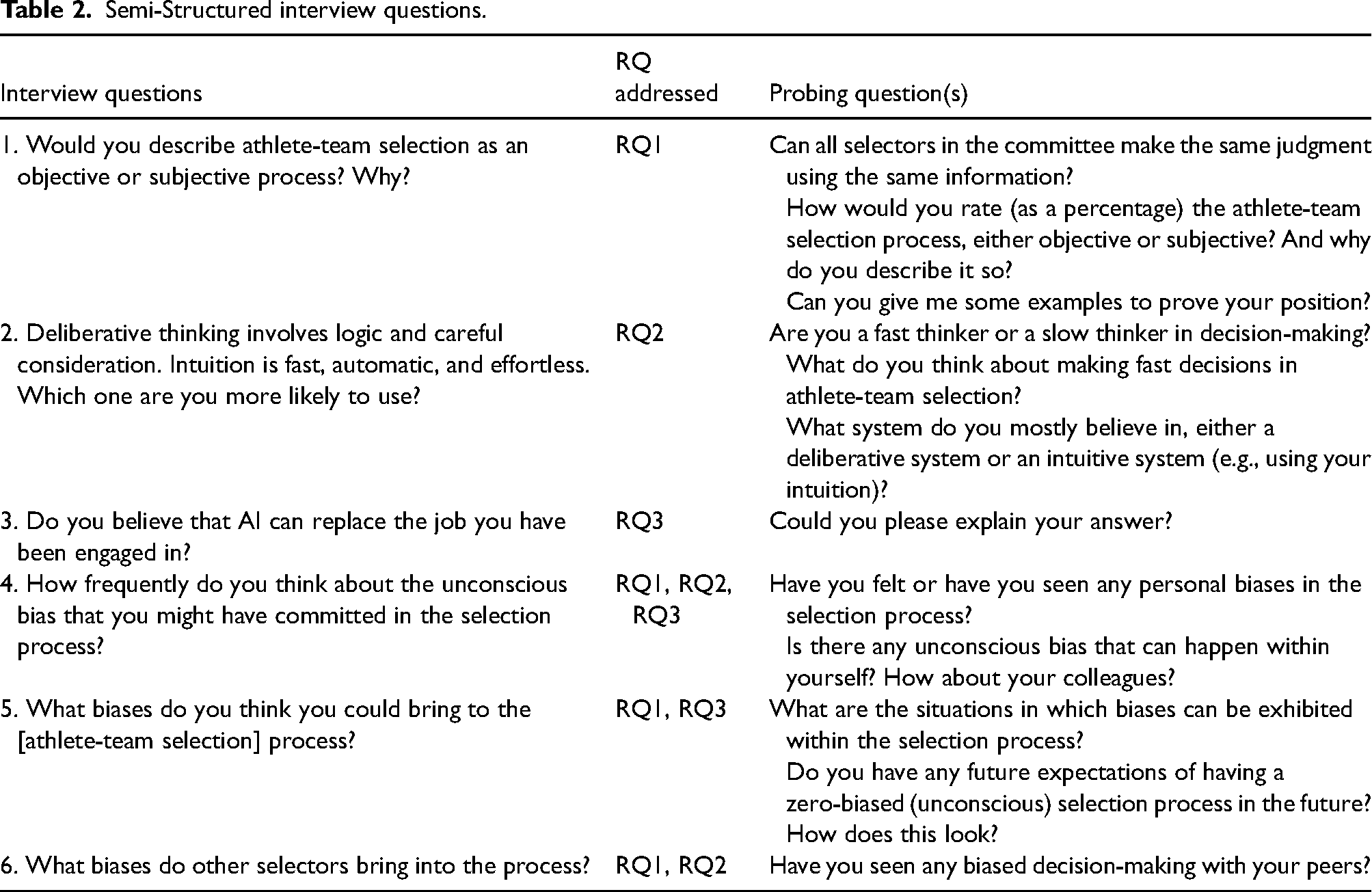
Anticipating a degree of unfamiliarity with the term “cognitive biases,” the interview questions refrained from using this term, at least until later in the interview. The questions were carefully crafted to reflect our three research questions (RQ):
RQ1) What is the nature of cognitive biases that prevail in athlete-team selection? RQ2) Why do cognitive biases exist in athlete-team selection? RQ3) How do cognitive biases persist in athlete-team selection?
As shown in Table 2, each interview question maps into one or more of the RQs (or associated probing questions). Therefore, the selectors’ responses were analysed in their entirety, including various interconnections. All the interview questions, in combination with follow-up probing questions, facilitated a deeper conversation to gather rich data and uncover how participants evaluate human involvement in the athlete-team selection process.
Positionality and reflexivity
The primary investigator is Sri Lankan. Playing multiple sports, he witnessed firsthand many selection anomalies. His education in economics emphasized efficiency and rational behaviour, which may explain why he thinks that selectors should get it right more often than they get it wrong.
The second author has 30 years of sport management academic experience in both Australia and New Zealand. His professional experience includes working as a director of national sport organizations, a responsibility that included broad oversight of high-performance programmes including the approval of selection of national teams selection criteria. This background makes him empathetic to the subjectivity and complexity of team selection.
The third author's academic expertise in corporate social responsibility of sport organizations encourages him to consider ethical and social dimensions of athlete-team selection. This perspective is sometimes at the expense of performance-based criteria.
The fourth author's research has covered many relevant areas, including highly technical analyses of people's/firms’ strategic behaviour using novel game theoretic frameworks. A native of the Czech Republic, he has also written sports economics papers that identified some behavioural anomalies in soccer and ice-hockey (proposing reforms to their rules that alleviate these anomalies).
We acknowledge that our individual and collective experiences may in principle introduce certain biases into the conducted research. Nonetheless, working in such a diverse team helped us see and mitigate our possible biases with the view of providing impartial insights into athlete-team selection.
Data analysis
Reflective thematic analysis is a theoretically flexible method for analysing qualitative data at both the latent (i.e., interpretive) and semantic (i.e., surface) levels. 66 To enhance the rigour of the reflective thematic analysis, member-checking was employed to strengthen credibility. Authors received summaries of the identified themes to verify that the findings accurately represented the participants’ perspectives. This process reinforced the trustworthiness of the thematic structure and subsequent interpretations. Reflective thematic analysis identified three higher-order themes (key constructs), each addressing a respective research question. Each of them has 2–3 lower-order themes.
The initial step of data familiarization was performed by closely listening to the interview recordings multiple times before generating automated transcriptions. All transcriptions were thoroughly cross-referenced with the audio/video records to ensure accuracy, with the author making familiarity notes during this process.
In the second step, open codes were inductively developed 70 as initial codes, systematically covering all transcriptions. These codes were largely semantic, and mostly latent, capturing participants’ underlying thoughts. Memo-taking and additional annotations tracked the narrative's development throughout the data.
After reviewing the codes, relevant themes were generated. At this stage, the first author developed the codes, which were subsequently reviewed by the rest of the research team. Based on their feedback, the first author refined the codes to create code families and higher-order codes, ultimately leading to theme development. All the developed themes were carefully reviewed by the other authors, ensuring alignment with the study's objectives.
The aim here was to ensure that the themes were well-supported by the participants’ accounts and also grounded in relevant theoretical frameworks. 71 The thematic map, developed as the fifth step, coherently addressed the research questions, and further refinements of the themes took place.
Findings
Reflective thematic analysis identified three higher-order themes (key constructs), each addressing a respective research question. Each of these themes have 2–3 lower-order themes. They are first listed below in the form of numbered bullet points, and then summarized graphically (including their interconnections) in the form of a thematic map, see Figure 1. The subsequent paragraphs then provide further details of each theme.
sustained presence of multi-causal cognitive biases (linked to RQ1)
biases driven by excessive information biases driven by existing beliefs biases driven by experience conflict in cognitive dissonance (linked to RQ2)
sense of memory cognitive discomfort anchoring to fairness oversight of cognitive biases (linked to RQ3)
blind-spot bias misconception of cognitive biases
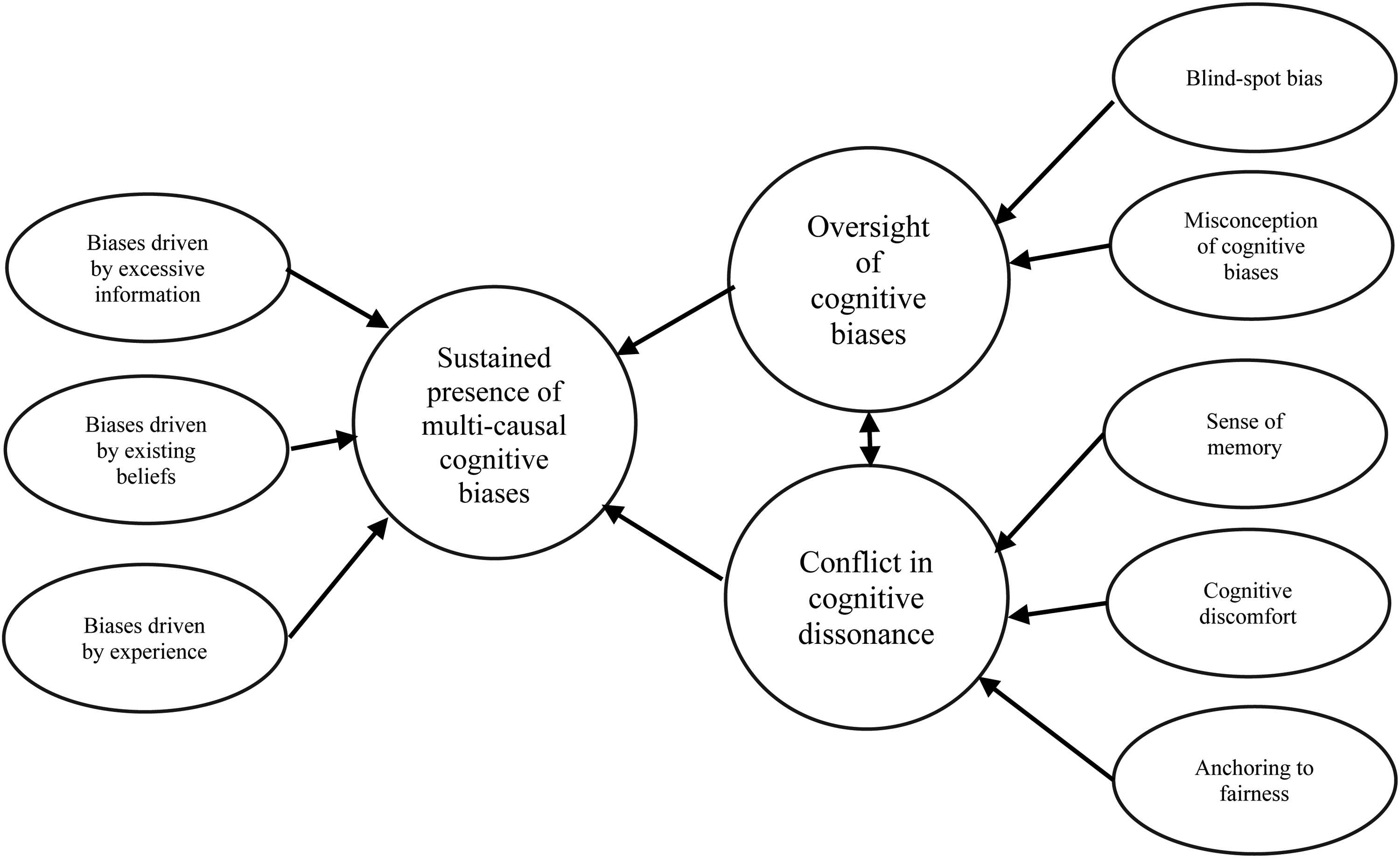
Thematic map - susceptibility to cognitive biases in athlete-team selection.
Sustained presence of multi-causal cognitive biases
The interview data reveals that coaches/selectors may not be fully rational in their decision-making processes, as they themselves acknowledged. Coaches and selectors consistently identified several key factors they rely on in their day-to-day practice of making selection decisions. These factors include the information available to them, their personal beliefs as sports professionals, and their cumulative experience.
From the perspective of cognitive psychology, these factors have theoretical foundations that potentially explain the emergence of cognitive biases in JDM. It should however be acknowledged that it is challenging to attribute their cognitively biased decisions to a single cause; they tend to be multi-causal in nature.
Based on a careful analysis of the participant responses, we categorized the first higher-order theme “Sustained Presence of Multi-Causal Cognitive Biases” into three lower-order themes. They are discussed in the following sub-sections.
Biases driven by excessive information
Coaches appreciate having more information at their disposal when making selection decisions. Some of this information is provided by other officials specifically tasked with collecting objective data. However, explained, they often rely on additional contextual information. Examples include the specifics of the game in which the players performed, the various strengths/weaknesses of the opposing team etc. Oftentimes this additional information is rational and beneficial in assessing the quality of the athlete. For example:
“Having information like stats is great … when you look at averaged statistics [a player] can look like they're playing really well, but they might get all of their best performances against the lower-end pitches that aren't that good.” (Participant 3, softball)
However, the use of this additional information may lead coaches to override their initial judgments based on objective data, and factor in their biases. For example, one participant advocated using his knowledge about a player's (in)ability to perform in high-stakes games:
“We've got an outstanding athlete in training and there's a question mark over there [regarding] their performance in the big game.” (Participant 10, rowing)
While such use of selector's experience may be warranted, excessive reliance on intuition and gut feeling may introduce cognitive biases in JDM. For example, the familiarity heuristic, where coaches and selectors tend to favour familiar options over unfamiliar ones. Specifically, if coaches or selectors have accumulated more information about one player compared to others, they tend to simplify their decision-making by selecting the more familiar player over less familiar ones. This can be demonstrated by one participant's response:
“… If you've had a player before and you have experience and you have seen what they can do …. They can do it compared to someone that you have not seen before.” (Participant 4, wheelchair basketball)
The quote demonstrates that increased information availability can lead coaches or selectors to deviate from rational decision-making. As a result, they are more likely to trust and favour known players over relatively unknown ones in athlete-team selection. This confirmation-seeking behaviour reinforces their existing beliefs, making them less likely to deviate from their initial perspectives.
Biases driven by experience
Our interviews strongly implied that experience of the selectors plays a critical role in their JDM. This is even more the case when there is no standardized method to evaluate athletes. To document, the equestrian selector stated:
There's no standard measure for that. It's the experience …. People in the sport we might say that horse lacks scope… (Participant 7, equestrian)
This quote highlights the participant's belief that selecting the right player-horse combination lacks a standardized measure, and is instead guided by experience. This reliance on subjective judgment rather than objective criteria can introduce biases where personal perceptions and prior experiences shape evaluations in ways that are inconsistent or difficult to validate systematically. Moreover, this participant further explained that they are sometimes questioned by others who ask, “How do you know?” His view was that this commonly reflects the implicit nature of the selection decisions that have been shaped by patterns observed through past experiences. As such, there is room for individual biases to affect selection choices, including overconfidence bias and hindsight bias (i.e., perceive events as more predictable after they have occurred). In particular, as individuals gain extensive experience and develop a deeper understanding of certain tasks or domains, they often feel overly confident in their expertise. Such overconfidence likely results in an overestimation of the accuracy or reliability of their judgments, often overlooking relevant pieces of information. For example:
“We went with one player and I regret that I should have gone for another player, well, yeah, so again from that experience […] There was a certain area that I probably didn't pay as much attention to[…].” (Participant 2, softball)
As indicated in this quote, experience serves as a learning process that influences future decisions, a tendency known as hindsight bias. Such bias, while enabling a deeper comprehension and confidence in their expertise may result in inferior choices and subpar performance.
Biases driven by existing belief
Unsurprisingly, people's beliefs, values and principles affect their choices. The following quote provides an example of this: “OK, so first of all, you need to work your principles. So, the stronger the individual, the stronger the team.” (Participant 10, rowing).
It seems plausible that the participant's perspective focusing on the individual's performance may limit their consideration of other crucial factors contributing to overall team success, such as team spirit, experience, and players’ leadership qualities. This reflects a susceptibility to cognitive biases, as coaches/selectors are cognitively bounded by their beliefs, leading to biased decision-making. While this may not be an issue per se, it becomes problematic when the beliefs and preconceived notions are not fully grounded in reality. Individuals then use various mental shortcuts leading to oversimplified and incorrect conclusions. For example, selectors could exclude capable players based on a personal predetermined ‘ideology’.
Anchoring heuristic and confirmation bias are two types of such behaviour. Anchoring heuristics is a cognitive bias whereby people rely too heavily on the first piece of information encountered (the “anchor”) when making decisions or judgments. For example, participant 10's belief regarding a stronger individual contributing to a stronger team can act as the anchor. It may overshadow other, more relevant pieces of information, and/or make people less willing to adjust their biased beliefs despite contradictory evidence.
Similarly, confirmation bias is an (undesirable) tendency to seek, interpret, and recall information in ways that support our pre-existing beliefs. Statements such as “It is important we have to capture what we believe. (Participant 1, softball)” indicates a tendency towards confirmation bias.
Conflict in cognitive dissonance
The higher-order theme of “conflict in cognitive dissonance” refers to the mental discomfort experienced by coaches/selectors when they encounter inconsistencies or contradictions between their beliefs and what they are supposed to do. This theme provides a conceptual explanation for cognitive biases in athlete-team selection to be of a persistent nature. These contradictions may arise from reliance on the memory of players’ abilities (sense of memory) while simultaneously anchoring their decisions on objective criteria to ensure fairness and transparency (anchoring to fairness). This duality may create cognitive discomfort, which selectors tend to alleviate by relying on mental shortcuts (the above-discussed heuristics).
Sense of memory
This concept refers to coaches’ and selectors’ ability to recall performance-related information about players, which plays a significant role in shaping athlete-team selection decisions. For instance, Participant 8 (rowing) talked about the influence of memories and argued that on their basis “we start to believe which athletes are performing well and so on.” This selector further explained how strong memories of players’ past performances led them to perceive them “to be a key person” who deserve “extra opportunities” (e.g., additional trials). This may suggest that once players are perceived as good, a positive memory is formed, prompting coaches/selectors to provide these players with extra (possibly too many) chances and with little divergence.
Participant 2 (softball) also spoke to the impact of memory, explaining how vivid memories contribute to mental categorization. She stated, “There was one player … she, in my mind, was in the tank. She was a tall, athletic, strong player…”
The participant's narrative illustrates how coaches/selectors may recall their memories during the decision-making process. The vividness of their memory is highlight by the use of specific physical characteristics of the player. While it arguably enhances memory recall in selection decisions, it arguably leaves room for biases to be present.
This mental categorization enables coaches/selectors to focus more on particular players, potentially at the expense of overlooking valuable information about others. From a cognitive psychology perspective, such preconceived identification rooted in vivid memories encourages biased decision-making.
Anchoring to fairness
In our interviews, coaches/selectors have generally recognized the importance of transparency in the athlete-team selection process. That is, in cases where they realize their perceptions are subjective, they tend to question the fairness and integrity of their judgments. This anchoring behaviour towards fairness is particularly indicative among experienced coaches/selectors. For example, participant 12 (badminton) explained that while she may have personal preferences in certain situations, she must adhere strictly to the selection criteria to ensure fairness and transparency in the selection process. She stated: “Because on my gut feeling, I would have picked another team, but from the selection criteria, we have to stick with this”.
It was reassuring to see that coaches and selectors tend to gravitate towards a more collective and objective decision-making process. “Being fair” seems a kind of non-numerical anchor that coaches/selectors attempt to use in athlete-team selection, also to build trust in the process. Participant 1 (softball) emphasized the importance of transparency and fairness toward achieving this goal (“…they know that we're not just picking our favourites”.)
The effort of these coaches/selectors to make the athlete-team selection process as fair as possible, even when their instincts conflict with this effort, may lead to cognitive discomfort.
Cognitive discomfort
Coaches/selectors feel unsettled whenever there is conflict between: 1) What they know and believe, and 2) What they must do in their job. For example, one participant lamented that the imposed selection criteria were absent of qualitative measures:
“I wasn't quite happy with [the policy] because it is very results based. It's very objective … I wanted to put in some, you know, qualitative data … how we see the players on a ground level like performance at training, attitude, behaviour; all these things are really important to me that we were missing in the selection policy…I was not happy with the team we selected because it's not the team I wanted.” (Participant 12, badminton)
This shows that in some cases there may be an overreliance on quantitative selection criteria, and that particular coaches/selectors feel that a more holistic perspective consisting of both quantitative and qualitative selection criteria provides a more accurate account of player performance. In these cases, coaches/selectors demonstrate their cognitive discomfort. This can have deleterious effects on the athlete-team selection process as when individuals encounter discomfort in cognition over an extended period, they try to reduce internal conflict by adopting a heuristic approach. Collectively, this uncomfortable situation prompts coaches/selectors to make relatively quicker and potentially erroneous decisions in an attempt to alleviate cognitive discomfort.
Oversight of cognitive biases
When coaches/selectors were encouraged to discuss cognitive biases, it became evident that there was a lack of awareness among them. While they generally recognized cognitive biases, these were often interpreted narrowly, primarily as motivational or racial/gender biases (e.g., one participant asked “Are you talking about like race or gender or that sort of thing?”). According to the analysis of the interview transcripts, this lack of awareness is often shaped by misconceptions about the nature and scope of cognitive biases (Misconception of Cognitive Biases), as well as an inability to recognize their own biases while easily identifying those in others (Blind Spot Bias). In particular, misunderstandings about what constitutes a cognitive bias influenced the participants’ ability to recognize its presence in decision-making. Additionally, their limited awareness extended to blind spot bias, where they were more likely to perceive biases in others while overlooking their own.
Misconception of cognitive biases
It can be deduced that coaches and selectors generally lack widespread recognition of the concept of cognitive biases. Instead, they may confuse them with motivational biases such as personal interest (physical appearance of players, playing styles, etc.) and relationship-oriented (gender, relatives, and friendship). For example, one selector stated in regards to cognitive biases:
“Of course, it does, it happens in every game, and one would hope that you would never have an unconscious bias. I probably find that I'm harder on the state players from the state that I play in.” (Participant 3, softball).
Blind-Spot bias
This term indicates that humans are less capable of recognizing their own biases than they are of recognizing biases of others. Coaches/selectors in our sample were no exceptions. For instance, one participant commented:
“Of course, I've never seen that in myself, but I see it in others. Yeah, I think selectors would have that, especially based on past performances […] So I am sure there is some unconscious bias in there.” (Participant 10, rowing)
Furthermore, coaches/selectors frequently discussed examples of bias in athlete-team selection as occurring in others rather than acknowledging such tendencies in themselves. For instance, one participant stated:
“Coaches or selectors that are involved with the process who maybe work with a particular athlete in the preparation phase. You know, they have a connection […]. I've definitely seen bias.” (Participant 8, rowing)
This reflects a form of self-blindness, where participants are unaware of their own biases but can readily identify biased behaviour in others (“I have definitely seen bias”) and those biases are relationship-oriented (“who maybe work with a particular athlete in the preparation phase”). This awareness gap and blindness of self-bias likely contribute to the persistence of cognitive biases in athlete-team selection
To this end, the blind-spot bias can be seen as a form of self-serving bias or illusion of objectivity. This is a kind of cognitive distortion where coaches/selectors believe they are less prone to cognitive biases than others, essentially evaluating their judgment as being more rational and objective than it is.
Discussion
The objective of the study was to explore coaches’/selectors’ susceptibility to cognitive biases in athlete-team selection. Our findings provide three key contributions that deepen our understanding of this phenomenon. These can be linked to our three research questions. First, the signs of sustained presence of multi-causal cognitive biases we report provide a conceptual answer to our first research question: What is the nature of cognitive biases that prevail in athlete-team selection? Furthermore, our findings indicate that participants (coaches/selectors) in this context tend to be influenced by excessive information, which contributes to the development of cognitive biases. Generally, an inability to process a large volume of information is theoretically consistent with the capacity-based framework, 72 the concept of bounded rationality, 14 and heuristics and biases. 15
The interviews identified existing beliefs of coaches/selectors as a potential driver of cognitive biases. This finding is broadly in line with the neuro-evolutionary frameworks that explain how human brains work for cognitively biased decision-making in information processing throughout the neurological mechanism. 72 These biases include confirmation and anchoring bias. 73
In the existing sports literature, coaches’ and scouts’ subjective involvement in evaluating players, particularly in talent identification, has been confirmed. 28 For instance, the “coach's eye” concept 7 often leads to decisions based on gut feelings, 74 fostering a subjective decision-making environment. 29 While previous research has emphasized the subjectivity in selection decisions, the role of cognitive biases in this context remains underexamined. Our findings thus contribute to the sports literature, particularly in JDM, by enhancing our understanding of the nature and causes of cognitive biases that may influence athlete-team selection.
Secondly, conflict in cognitive dissonance emerged as the conceptual answer to our research question: Why do cognitive biases exist in athlete-team selection? The findings revealed that coaches/selectors in this context experience cognitive dissonance due to the interplay between their “sense of memory” and their “anchoring to fairness” in decision-making. This dissonance arises as they attempt to reconcile their intuitive judgments, based on vivid memories of players, with their commitment to adhering to fair and transparent selection criteria.
Previous studies in the sports literature have touched on the notion of cognitive dissonance but in different contexts. For example, Hart 75 discussed cognitive dissonance in ski mountaineering to explain the psychological challenges faced during a traverse, though not as a source of cognitive biases. Our research extends the application of cognitive dissonance by positioning it as a contributing factor to the emergence of biases in athlete-team selection.
We offer novel insights by identifying coaches’/selectors’ cognitive discomfort as a possible product of both the sense of memory and the mental anchoring to fairness. This dual mechanism offers a fresh perspective in the sports literature, particularly within the domains of cognitive biases and JDM.
Future studies in this area could examine the extent to which cognitive discomfort influences decision-making outcomes and biases in alternative sporting contexts. Moreover, fostering open discourse with coaches and selectors about their experiences of cognitive discomfort could illuminate additional factors contributing to decision-making biases. Such conversations may provide valuable guidance for developing more robust and equitable athlete-selection practices.
Finally, oversight of cognitive biases emerged as a conceptual answer to our final research question: “How do cognitive biases persist in athlete-team selection?” This theme provides important insights into the persistence of cognitive biases in JDM by revealing a dual challenge: the inability of individuals to recognize their own biases and the presence of misconceptions about cognitive biases among coaches/selectors.
The cognitive psychology literature extensively documents the bias blind spot—the tendency for individuals to identify biases in others while failing to recognize their own.51,52,76 This phenomenon has been linked to the persistence of cognitive biases in decision-making processes. 77 The findings of our study are consistent with this theoretical understanding and provide two lower-order themes (delusion in recognition of cognitive biases and misconception of cognitive biases).
This misconception suggests that while coaches/selectors may be aware of the existence of biases conceptually, their understanding is often incomplete or inaccurate, which could exacerbate the persistence of biases in practice. This finding highlights a gap in the current sports JDM literature, where much of the focus has been on bias recognition (metacognition) without addressing the implications of misconceptions about biases.
To address these potential challenges, our study highlights the need for targeted awareness programmes for coaches/selectors to improve their understanding and management of cognitive biases. We discuss them in the next section.
Conclusion and practical implications
Astrophysicist Carl Sagan once said: “If we are not aware of our biases, they will work on us without our consent”. The aim of the paper was to help prevent from this scenario in the sports arena, exploring coaches’/selectors’ susceptibility to cognitive biases in athlete-team selection. Our study provides valuable insights into how cognitive biases may influence selection processes in professional sports, identifying three overarching constructs (higher-order themes) that deepen our understanding of this susceptibility in sports.
Consequently, we have identified several practical and policy-based recommendations that could mitigate biases in the elite-sport team-selection area, and improve outcomes for athletes, coaches and the stakeholders alike. First, integrating cognitive bias training into curricula (both coaching and educational more broadly) can foster self-awareness and unbiased decision-making strategies. This could include mandatory workshops for selectors containing practical exercises that simulate selection scenarios and highlight personal biases in action. Moreover, promoting reflective practice that helps to improve decision-making skills in a professional capacity 78 would encourage coaches/selectors to regularly review and refine their decision-making processes. For example, mandatory reflective writing about how their selection decisions are made, and how these can be improved, would be an effective training option.
Second, the development of structured decision-making frameworks for selectors is strongly advocated. 79 Implementing checklists and decision matrices in athlete selection can help ensure appropriate decision-making delays, reducing reliance on coaches’/selectors’ gut feelings or intuition. 80 These tools compel selectors to articulate the rationale behind their choices, encouraging reflection on objective data alongside subjective impressions, ultimately leading to more transparent and informed decisions.
Third, peer-review processes and feedback loops could arguably alleviate biases. 81 Here, previous selection decisions would be evaluated by fellow coaches/selectors, and constructive feedback would help to create a culture of deeper reflection and accountability. This would foster continuous learning and improvement on the part of the selectors. It is important in elite sports that the lines of communication with those that make critical athlete-team selection decisions are open and that an environment of support, education and feedback is fostered. 82 Furthermore, by giving athletes a greater voice in the process, transparency is improved and alternate strategies to lead to more effective performance are generated. 83
Fourth, diversity in selection panels in terms of experience, background, and perspective would be beneficial Previous research has shown that diversity, when it comes to selection panels, provides a more balanced environment, thus promoting holistic decision-making. 84
To design these four policies effectively, and account for the complexities of elite-sport selection, further research is highly desirable. Confronting potential biases head-on seems imperative for fairness and integrity reasons, and policymakers need a deeper understanding of the various factors at play and their interconnections.
Footnotes
Declaration of conflicting interests
The authors declared no potential conflicts of interest with respect to the research, authorship, and/or publication of this article.
Funding
The authors received no financial support for the research, authorship, and/or publication of this article.
