



Abstract
As an athlete develops through their respective talent pathway, those who are continually retained will eventually reach a critical transition point, whereby successful selection will commonly result in a part-time to full-time performance programme transition. Though such offerings remain sport-dependent, these transitions are typically accompanied by substantial increases in training demands, which further add to the risk of injury and overreaching. Given the significance of such junctures, investigating the preparedness of athletes to endure these changes warrants further research. Semi-structured interviews were undertaken to examine the experiences of those involved in such pathway transitions, speaking with four national performance pathway athletes who had recently moved from part-time to full-time programmes and five national performance pathway coaches. Interview responses were analysed deductively, using the holistic athletic career model and reflexive thematic analysis. The findings indicated that (un)successful athlete transitions were dependent on physical factors (load management and recovery provisions), psychosocial factors (dealing with adversity, social pressures, and external influence) and access to resources (support services and resource barriers). Practical implications included the need for key stakeholders to i) ensure a moderation of load is applied for transitioning athletes, ii) provide support and guidance to equip the athletes to deal with psychosocial strain, and iii) educate athletes on the benefits of resources to aid recovery provisions and fatigue management. These insights are valuable, as they can help inform coaches, key stakeholders, and National Governing Bodies to support athletes better in the future.
Keywords
Introduction
Models of talent identification and development are commonplace within professional sport, helping clubs and governing bodies to identify and develop world-class athletes.1,2 The talent development process typically starts with young athletes (perceived as potentially talented) being afforded professional development provisions within each sport's respective talent development pathway.3,4 Navigating the talent pathway includes overcoming several significant hurdles, both external (e.g. educational transitions) and internal to the sport (i.e. ongoing reselection and deselection). These challenges outline the broader holistic considerations for talent transitions, as outlined by Wylleman, 5 which encompasses not only athletic demands but also the psychological, psychosocial and vocational factors that influence athlete development and talent pathway progression. With a focus on within sport transitions, from childhood/adolescence, the talent pathway is commonly represented as a part-time programme, partly due to beliefs around the appropriate development of young athletes,6,7 and the limited availability and access to such athletes due to educational commitments and alike. As talent pathway athletes reach late adolescence/early adulthood, and following rigorous selection processes, those athletes fortunate enough to attain scholarships or professional contracts will commonly undertake a transition into full-time training programmes, typically described as the junior-to-senior transition.8,9 Such transition could be identified as significant, given the dramatic increases in physical and psychosocial demands,9,10 potentially derailing or accelerating an athlete's development. Therefore, this area is worthy of further exploration, as the experiences of pathway transitions from both athletes’ and coaches’ perspectives are relatively unknown. Thus, such insight can better inform key stakeholders in the future, helping provide additional support to athletes transitioning across pathways.
In consideration of physical training volumes, various sports have demonstrated processes to systematically expose athletes to higher quantities of training load as they age.11,12 In the context of this paper, load has been aligned with Soligard et al.'s. 13 definition as the cumulative amount of stress placed on an individual from single or multiple training sessions. Applying incremental increases to training load can facilitate an adaptation to tolerate future training volumes, ultimately bridging the gap between part-time and full-time training frequency and duration expectations. However, without these planned progressions of load, dramatic rises in volume increase injury occurrence. 11 Indeed, when observing training loads in football14,15 and handball, 16 dramatic changes of load (i.e. spikes) and excessive training volumes (particularly during transitions) have been associated with higher injury potential. Ultimately, load management is a critical factor for consideration, whereby sufficient volume must be provided to increase performance, yet, simultaneously managing load for recovery and injury mitigation.
Whilst the physical consequence of excessive training load can be detrimental, it is apparent that psychosocial and academic vocational demands might also be similarly impactful. For example, several studies17–19 investigating athlete transitions from youth/junior to senior environments have established varying degrees of consensus in four main areas of difficulty: i) physical tolerance (i.e. adapting to the new workload and having to constantly work hard to prove oneself); ii) psychological strain (i.e. establishing a new athletic identity within a new environment); iii) social struggles (i.e. having to prove oneself to peers, likewise external stress from spouses and family); and iv) vocational influence (i.e. demands from higher education and pressures associated to higher education culture).
Social issues may also arise from athletes transitioning into a new environment. For instance, various authors9,18,20 have reported on how athletes may be required to change lead coaches when transitioning from part-time to full-time programmes. Consequently, such transitions likely result in the formation of a new coach-athlete relationship, which could bring about new stresses, routines, and expectations that can greatly influence (un)successful athlete transitions. Additionally, the quality of such relations can impact athletes deeply. 21 For example, research has highlighted how dissatisfaction towards new coaches can negatively influence performance and, in some instances, contribute to early sporting retirement. 22
A consequence of increased physical, psychological, and social demands is the probable need for short-term survival. ‘Survival’ can be summarised as the ability to endure overstimulation without encountering injury or overreaching.23,24 Survivorship has typically been investigated within youth athlete selection, usually accounting for maturational variation, e.g. late maturing athletes, who are physically disadvantaged compared to average and early maturing athletes, being consistently overstimulated, subsequently having to ‘survive’ training and annual selection processes.23,25 Moreover, it seems appropriate to consider survivorship as an element athletes may endure when transitioning across performance pathways due to the steep adaptations required to handle new training volumes (i.e. physical demands) and associated psychosocial stressors.
Given the abovementioned physical, psychosocial and vocational considerations, this study looked to elements of the holistic athletic career model26,27 as a theoretical framework. According to the holistic athletic career model, athlete development is affected across six interrelated areas (athletic, academic, psychological, psychosocial, financial and legal). The holistic athletic career model has previously been used to study dual-career development28–30 and well-being. 31 Thus, providing a robust, holistic and novel approach with which the present study sought to understand the multidimensional nature of pathway transitions from athletes’ and coaches’ perspectives.
More specifically, this study sought to use the holistic athletic career model to investigate the processes believed to be employed by coaches when exposing athletes to increasing training demands and loads, and the retrospective experiences of national performance pathway athletes having recently undertaken such pathway transitions. The aims of the study were: i) to explore the experiences of pathway transitions from both athletes’ and coaches’ perspectives, and ii) to identify key considerations that may influence both positive and negative transition outcomes. The attainment of such insights will prove beneficial as to whether current provisions are sufficient, as well as highlighting potential pinch points and future resources which may better aid athletes’ transitions across performance pathways.
Methodology
This research was guided by interpretivist onto-epistemological assumptions, as it explored data to interpret the phenomenon of interest. As such, this work assumed that the experiences of athletes and coaches were neither singular nor objective, but rather embedded within their social, political, cultural and economic contexts.32,33 Moreover, as interpretive researchers, we recognised the influence of our own social reality, and so in this work, we interpreted participant responses through a process of sense-making and speculative reasoning, putting forward ‘a truth’ rather than ‘the truth’ to the reader. 34
Consistent with these metaphysical beliefs, the research used a qualitative methodology, ensuring onto-epistemological alignment. Specifically, this research employed semi-structured interviews to collect data, developing a breadth and depth of understanding. Institutional ethical approval was granted prior to data collection commencing (attained from Loughborough College). Informed consent was obtained through an information sheet explaining the research process and giving participants time to consider the information before deciding to participate.
Sampling and participants
Participants were purposively selected. This approach was adopted to ensure that all participants were ‘information rich’ in relation to the phenomenon in question.32,35 In this instance, prerequisites included participants being coaches/athletes actively engaged within a national high-performance pathway and undertaking a full-time training programme (or the equivalent in training demands, e.g. dual-career athletes). Whilst dual-career athletes are more typically associated with partnership programmes that allow for both educational and sporting endeavours, such structures appear relatively new and require further development/adoption within European nations (compared to America, where they are more established). 36 Hence, the athletes in the present study did not have the fortune of such partnerships and, instead, trained with (and were expected to match the training schedules of) full-time professional athletes whilst also completing a university degree (with the fortune of some flexibility from the university) as a means to access such training.
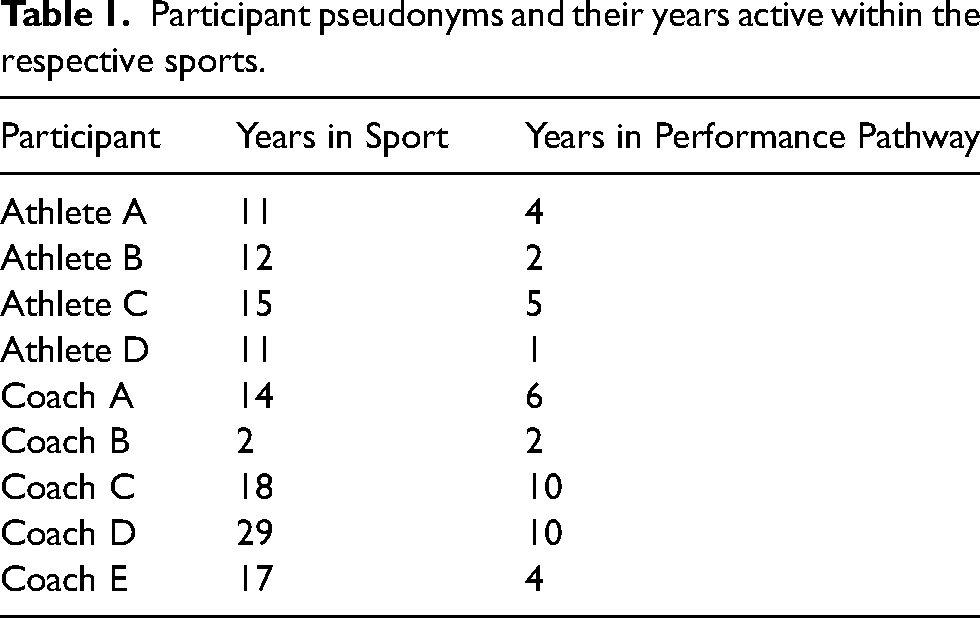
Personal connections were used to recruit eligible coaches/athletes, and the funders of this study, the Talented Athlete Scholarship Scheme (TASS), also reached out to their partners. Participants came from a diverse range of sports, with coaches (n = 5; years in role = 6 ± 4yrs) active in athletics (sprinting and throwing), cricket, football and rugby, and the athletes (n = 4; years in part-time training = 9 ± 1yrs, years in the performance pathway = 3 ± 2yrs) competing in athletics, rugby, sailing and swimming. The sample size was chosen as this allowed the researchers to conduct what we considered a manageable number of interviews within the timeframe put forward by the funders, whilst allowing for sufficient conceptual depth. 37 Furthermore, following guidance from Malterud, Siersma, & Guassora 38 informational power was considered sufficient, given the study's clear aims, the specific eligibility criteria required to participate in the present research (sample specificity), the precise focus of the interview schedule (quality of dialogue), and the analytical approach adopted. To help safeguard the identification of participants, anonymisation was implemented throughout (see Table 1).
Participant pseudonyms and their years active within the respective sports.
Methods
The present study employed semi-structured interviews, which were conducted via Microsoft Teams. This method of data gathering was chosen, as it allowed the researchers to scrutinise participants’ subjective experiences, 32 aligning with the research aims and the researcher's onto-epistemological assumptions. Due to the required inputs from both athletes and coaches, two interview schedules were created. Although each interview schedule followed a similar line of questioning, the vocabulary used was adjusted to account for the participant's perspective. Interview schedules were developed, ensuring open questions were applied, including relevant prompts to attain a deeper understanding of responses. To improve the quality of each interview schedule, these were reviewed by a critical friend (PhD qualified researcher within the subject area) who commented on the clarity, flow, and focus of the questions asked. Following this process, minor refinements were made (see Appendix 1 for complete interview schedules). The duration of the interviews ranged from 18 to 37 min, although the shortest interview was somewhat of an anomaly, with the average interview lasting 31 min.
Data analysis
All interviews were transcribed verbatim before being uploaded to a qualitative analysis software (QSR NVivo 14). Following this, a deductive approach was applied using the holistic athletic career model, grounded in Braun and Clarke's reflexive thematic analysis to gather and derive insight from participant experiences.39,40 Reflexive thematic analysis consisted of six phases: (1) all data being read in an immersive manner, (2) coding the raw data, (3) constructing themes, (4) developing and reviewing themes, (5) refining, defining and naming themes and (6) production of results and discussion.39,40
To ensure the credibility and trustworthiness of the analysis process, the lead researcher (RK) engaged in dialogue with the second author (ZP), who was not immersed in the initial generation of codes and themes, giving voice to their interpretations. 41 For example, RK read and reread the transcripts to understand each participant's subjective experience. RK then reflected after reading each transcript, outlining thoughts about each individual's ‘story’. Following this, RK coded the data, using the holistic athletic career model as a framework. Finally, he presented the themes generated from the codes to ZP, whose comments on their coherence, credibility and significance helped in the co-construction. These interactions encouraged reflexivity, challenging the construction of knowledge by exploring multiple and alternative explanations of the data, prompting the researchers to question and query their own context-bound assumptions. Thus, this process allowed the research team to reflect and think deeply about the data, prioritising the experiences of the sample and ensuring the data analysis were plausible and defendable. From this process, three co-constructed themes were presented: (1) Physical Considerations, (2) Psychosocial Considerations, and (3) Access to Resources.
Results and discussion
The following section integrates the results and discussion. This approach offers a more comprehensive interpretation of the findings by presenting and contextualising these simultaneously.
Physical considerations
Fatigue management was observed as a clear requirement of a successful athlete transition, echoed by all the participants in varying manners. In particular, fatigue management was highlighted in two main areas: load management and recovery provisions. Athletes were particularly encouraged by the efforts from their coaches to moderate their loads upon transition, whereby Athlete A said: “I’d probably say the intensity of the gym went up, and I would say the first couple of months had a bit of an effect on my performances because I was knackered! But the coaches knew that, and the coaches communicated to each other, so it wasn’t like, why are you being so bad today? They understood that we were getting battered in the gym.”
Similarly, Athlete C stated: “They controlled, like, all my S&C programmes, so they’d obviously not overdo it on them. They kind of, like, introduced me into those sessions quite gradually, so I wasn’t, like, overloading. And then, from a technical perspective, it was just kind of, like, adding another day in gradually.”
Such approaches were equally acknowledged and shared by the coaches, with Coach A stating: “So, what we’ve got to really factor in is, is making sure that basically, we can increase that level of exposure gradually when they’re ready for it. And I think that's really important during transitions.”
Whilst limited research has investigated training demand variations during athlete transitions, based on the responses in this study, the work was able to establish an average increase in weekly training frequency from 4 ± 1 sessions to 6 ± 2 sessions. In addition to training frequency, athletes consistently remarked on how a week's accumulation of session load had equally increased. Athlete B expands upon the typical frequencies of sessions and distances undertaken in both part-time and now full-time programmes: “[Previously] we trained twice a week, and then it depends but two or three gym sessions at like 7 am in the morning. [Now] it's four or five sessions a day, we’ve got a skills block, we’ve got a units block, proper training, team meeting, gym, and that's three days a week as well as games.”
Likewise, when Athlete D was asked about their part-time training, they responded with: “Maybe three to four hours a week [in the sport] and the gym. That was probably about four or five sessions per week, for up to an hour”.
When asked how this compared to their full-time training, their response highlights a significant increase in both frequency and duration: “It's like four days a week on average, but four hour sessions. So yeah, quite a big increase”.
Whilst the present research was unable to capture exact comparisons of load undertaken between training programmes, it is apparent that weekly training load and frequency increased by approximately 64% following transitions. The findings align with similar investigations within football, 42 tennis, 12 cross-country skiers 43 and biathlon 44 which also established an increase in the frequency and intensity of sessions following transitions. More specifically, biathlon noted that seasonal training volume and frequency was 48% and 51% greater following a junior-to-senior transition, respectively. Moreover, previous research has highlighted how excessive loads and loading ‘spikes’ are associated with an increased risk of injury,14,15 underlining why graduated exposure is perhaps most practical to optimise performance and reduce injury potential. As such, it is encouraging that in this study, many of the athletes’ training loads were gradually being increased over time, rather than sudden jumps in load expectations (creating a loading spike), helping transitioning athletes acclimatise.
However, a lack of consideration to modify loads for athletes making pathway transitions was postulated to result in negative outcomes. For example, Coach C said: “Look, if you’re making them jump straight in at the deep end, that’ll cause injury. I think it's difficult to be able to define, because everything is new to them, but it's about pitching training at the right level. Yes, you need to test them, but you’ve got to avoid injury as well.”
Likewise, Coach E expanded by commenting on the wider issues related to excessive load following programme transitions: “With no adjustment to load, you’re going to be looking at injury or lack of enjoyment in what they’re doing. But then again, does [an athlete's] injury come from not only fatigue of their body, but mentally they’re just fatigued. So, they’ll probably execute an action that they might not have thought too much about. You know, they’ve gone to turn, getting their foot caught because they’re tired, which then causes an injury. I think it's their exhaustion that's going to cause it, not just physical exhaustion, but mental exhaustion.”
Such responses follow a logical assumption that sudden exposure to excessive training loads may result in injury or declines in performance. These notions are supported by wider literature that generally advocates the safeguarding of transitioning athletes from immediate high-load exposure, due to fears of burnout and injury.12,45,46
On recovery provisions, all of the athletes and four of the five coaches remarked on the requirement for necessary recovery interventions, ranging from nutrition advice/support, monitoring of sleep and active recovery provisions (to list a few). For example, Athlete B stated how sleep had been an important factor for their recovery: “I just made a conscious effort to sleep more, rather than being on my phone at night. Sleep helps so much with your recovery and just destressing. I sound lazy, I know, but there's science behind it (laughs).”
Likewise, Athlete D further highlights how nutrition was essential for their recovery by saying: “I started to take my nutrition much more seriously, and that started to help with my recovery and energy levels. I thought that I was eating healthy, but the timings of the nutrition and getting all that synced up around the sport and training, that was the issue. I guess once I’d figured that out, it was quite a big gain in terms of recovery”.
Similarly, Coach C commented on the recovery provisions athletes can utilise to aid recovery: “So, I think in the main, it's making sure that there's some sort of daily maintenance, trying to encourage them to do prehab work. And you know, the first thing to do when they wake up, just spend half an hour going through some self-myofascial release stuff, some mobility stuff, maybe some core or some prehab type work that they need to do.”
Given the high accumulation of load endured within full-time programmes (as discussed above), the need for recovery provisions is greater to aid adaptation and mitigate excessive fatigue. Indeed, a body of knowledge currently exists that supports recovery provisions as a means with which to enhance performance and reduce injury potential, with examples investigating nutrition, 47 sleep,48,49 and active recovery.48,49 However, caution must be raised towards which provisions are provided, given interventions such as self-myofascial release techniques lack consensus in their contributions towards recovery.50,51 Likewise, a recent review 52 reported how post-exercise stretching and mobilisation have demonstrated minimal impact on recovery, emphasising a focus on ‘other’ recovery methods. Nonetheless, by undertaking provisions that are preventative to injury and proactively encourage recovery, athletes are likely more able to deal with the physical demands placed on them when entering full-time programmes.
Conversely, poor load and recovery management were reported as potential barriers to successful athlete transitions. In particular, non-functional overreaching (i.e. the increased exposure to excessive fatigue, heightened risk of injury and lack of recovery) was established as a significant consequence of poor transition management. Concerns towards the lasting effects of fatigue were highlighted by the athletes, with Athlete B stating: “Obviously, fatigue was a big thing early on, so maybe I couldn’t give 100% in every session. I mean, mentally, it was pretty tough just to balance my life and stuff (laughs). I really had to get organised to manage the stress and just stay on top of everything, and even then, I was still chasing my tail.”
Similarly, Athlete D spoke of their experience: “I could almost get through the training, get through the gym, and be knackered, but kind of be alright. Then I would sit behind a desk and try and do some work and be like…I’m frazzled. I’ve got absolutely nothing left.”
Non-functional overreaching embodies both the physical and mental aspects of training, defined as physical and emotional exhaustion for more than two-weeks but less than six-months.
53
Physically, an accumulation of overload (via volume and/or intensity of sessions) and a lack of sufficient recovery and adaptation will ultimately result in an athlete's performance being negatively impacted.
54
Indeed, until sufficient rest and recovery are provided, it is likely that performance will remain or regress further into a deficit. In support of such findings, research in handball identified that the intensive training undertaken within the talent identification pathway commonly resulted in injury or overreaching.
16
Moreover, coaches should be mindful of not just the physical but also the mental and emotional strain placed upon athletes during the transition period
55
and the long-term impact this can have both on performance and general well-being. This was further acknowledged by Athlete D, who said: “I think most athletes, when they are given the chance to go full-time, they will sort of lap it up. They can’t wait to get going, and it becomes their everything. Of course, that can cause injury, but the pressure of it all as well, that can cause people to spiral out of control. I guess it's about being smart with it and thinking about the bigger picture”.
During athlete transitions, regardless of the provisions afforded, it is evident that athletes are required to endure a period of ‘survival’ to acclimatise to the higher training demands. This consistent overstimulation embodies both physical and psychological stress. Yet, the intensity of survival varies depending upon the acknowledgement and management of load. Therefore, it is critical that coaches, key stakeholders and NGBs provide appropriate load management to transitioning athletes (including the graduated exposure to training loads upon initial transitions). Likewise, athletes should be educated on the benefits of recovery provisions and understand the need to take ownership of such recovery sessions during their personal time. Moreover, in addressing both components (load management and recovery provisions), optimising fatigue management will likely reduce the risk of injury and non-functional overreaching, enhancing athlete transitions across performance pathways.
Psychosocial strain
It is apparent that many athletes will be required to overcome varying levels of pressure and moments of adversity during training and competition.17,56,57 Athlete A conveyed their awareness of such stresses in saying: “You're going to have ups and downs. Don't expect it to be like an upward curve all the time, and just manage around that. Because coaches do put a lot of pressure on us. Like, if you don't get these [performances], or whatever, the coach might bomb you off to a different squad, and everything that comes with that.”
Likewise, a comment from Athlete B emphasises a realisation of consequence when operating within a performance environment, previously not acknowledged, or considered prior to their transition: “On the talent pathway, you can kind of get away with what you want; it's more about fun. Obviously, you want to win, but there's nothing really riding on it, if you know what I mean? But, say when I’m playing internationally now, it's more serious, there's more expectations, there are actual consequences if you don’t put in the work or you’re playing badly.”
This was further acknowledged by the coaches, where Coach D states how some academy environments embrace challenges to enhance athlete development: “I mean, ultimately, if you want to be convinced of somebody's coping within a professional environment, your academy environment, which is the stepping stone, it has to be challenging. It has to test the players and put them under some pressure.”
This finding is similar to that reported by Rye et al., 55 Finn and McKenna 18 and Andronikos et al., 17 where participants highlighted psychosocial strain as an area that athletes are required to endure/overcome in order to successfully transition across pathways. Whilst adversity may be typically viewed as more pertinent ‘bumps in the road’, 58 such as injury or deselection, being able to ‘cope’ with pressure should not be overlooked and is arguably an underpinning skill required in overcoming adversity. 59 Given this, coaches, key stakeholders, and NGBs should look to equip athletes with the tools to enhance coping skills and confront adverse situations. Indeed, existing research has emphasised why intentional challenge and subsequent skill development may be beneficial to athletes, helping them overcome potential barriers in the future.58,60 Therefore, coaches should make significant efforts to educate and equip athletes with the skills required to endure such challenges. Moreover, coaches should also acknowledge the organic stress/pressure placed upon athletes during transitions. For these reasons, coaches should resist considering deselection or disparaging early performances, recognising that this is likely to add further stress. Instead, coaches should acknowledge that an athlete's abilities are likely to improve once they are familiar with the new environment and its demands.
Athletes also noted transitions placed high amounts of strain on social and vocational lives. This was echoed by all of the athletes (emphasising varying areas of strain) and acknowledged by coaches as a potential pinch point. For example, Athlete B, highlights the strain placed on their education: “It was a hard transition! I think mainly, in terms of the hours around lectures, so on the part-time pathway, they kind of factor in lectures and stuff, and they make it work around them, so that was easy. But, when you go full-time, they don’t really factor that in. It's kinda like the sport is your job, not being a student. So, that was pretty tough.”
Likewise, Athlete C demonstrates both vocational and social strain: “I think my body kind of adapted to it quite quickly because I was only sixteen, so I feel like if you throw anything at a sixteen-year-old, at least physically, they're going to be fine. But mentally, it is hard because you’ve got a lot of things going on when you are that age. School starts getting serious, relationships start being a thing, stuff like that, you kind of miss out on those, because it's all to do with what you prioritise.”
Awareness of such issues was further acknowledged by the coaches, with Coach B stating: “Our programme starts at sixteen years old, and I mean that comes alongside some pretty big life events. Moving away from home, puberty, wanting to be out and about. Then you’ve got peer pressure and everything. Of course, it's about balance; they’ve got to be dedicated, but if they’re miserable, is that going to work out? Probably not, so it's just understanding what's good for them at that moment.”
Indeed, when athletes transition, their social circles outside of the sport may be negatively impacted, as more time may be spent on training, recovering, and competing, thus potentially ‘missing out’ on some social experiences. Vocationally, athletes may also limit themselves in terms of education and employment, prioritising training and competition instead. 61 Whilst such a level of dedication has been described as a necessity for performance athletes, given that it is, in most cases, positively associated with sporting success,62,63 coaches should be mindful that such sacrifices can significantly impact and strain athletes, both in the immediacy and later in life, and thus some ‘balance’ or compromises in this regard may be beneficial.
Social pressures may also arise as a catalyst from within the new sporting environment. Socially, players may now be required to interact with a very different set of personalities, given the wider reaching age bands of professional sport, compared to the more age-restricted academy setting - but also the associated lifestyle differences of a professional sports person. Coach D provides such insights on social pressures: “When a young player is suddenly getting paid to play, but you know that they're living circumstances and their life circumstances are very different to the rest of the playing squad… you can't expect them to be in the same place psychosocially and from a personality point of view. Even up to, say, the age of twenty/twenty-one, there needs to be a degree of mentoring and care provided.”
Therefore, coaches should find a combination of support and challenge, ensuring that their relationship with the athlete is one of caring, helping them develop wider skills beyond those concerned solely with sporting performance.5,8 Likewise, the encouragement and utilisation of support services, such as lifestyle advisors and psychologists, will further support and aid such experiences during transitions. 5
External influences have also been noted as contributing factors to stress.18,64,65 For example, parents with unrealistic expectations and high pressures to perform may cultivate athletes to hold a fear of failure and reduced motivation, potentially inhibiting athlete progression.64,65 Whereas parents with appropriate support, such as praise and encouragement, have been related to positive outcomes.66,67 This may suggest why all the coaches in this study reported the importance of understanding their athletes beyond the sporting setting (e.g. understanding family situations and external demands, to list a few). For example, Coach B said: “When looking at the top coaches in the sport, away from the pitch and tactics and stuff, it's the social side. That is what they do really well. Like, they know what's going on in people's families, they know what's going on behind the scenes, and I think if you, as a coach, can kind of develop those relationships in a positive way by just having good communication skills and taking on board the information. That can only be a good thing, right?”
In support of above, a similar stance was outlined by Coach D in saying: “Yeah, like my number one bit of advice is always to get to know the whole player, get to know the whole person. You know, so you don’t treat them as just another player or just another one off the conveyor belt. It's that relationship, the trust comes first above everything. Find out about their life circumstances, family circumstances, education circumstances, work out who they are, how they operate.”
In summary, psychosocial stress is likely to be significant when athletes progress from part-time to full-time programmes. Additionally, as an athlete transitions across performance pathways, their identity will likely evolve, 22 which may include negative feelings towards ‘missing out’ on social and vocational experiences/opportunities. In a similar vein, athletes will require support and mentorship to navigate the new/different psychosocial demands of senior sport.5,55 Thus, we encourage coaches to find a balance between support and challenge where possible, caring for the athletes’ interests beyond purely sports performance.
Access to resources
When both athletes and coaches were asked to report on the qualities of successful athlete transitions, many reported on the usefulness of additional support services and professional expertise (e.g. psychologists and nutritionists) in adapting to increased training demands and expectations. For example, Athlete B stated: “Yeah, so we have strength and conditioning coaches, so they do the gym, and then we have a nutritionist who we can book meetings with if we need to.”
Echoing the above, Athlete C outlines the benefits of such resources: “In my situation we had access to the nutritionist, the psychologist, we had physios and everything because obviously when you’re making that transition, obviously you’re training more, so you kind of need that extra support. It can just help you get up to speed.”
Whilst it is perhaps unsurprising that access to additional support services and expertise were seen as beneficial to successful athlete transitions, as per existing literature,17,68,69 it does further illustrate the importance of a multidisciplinary approach. Moreover, previous research has also highlighted how skills, such as psychological ones, can be further ingrained across a range of tasks and environments inherently provided across a multidisciplinary team. 70 Indeed, multidisciplinary support can allow for wider-reaching development and support of the athlete, with an agreed and united approach to ensure progress is attained. 68
Although many sports can access a diverse range of services and expertise, others may be limited with provisions afforded due to the resources available to them, presenting a possible barrier to athlete progression.
17
This was highlighted by Coach A: “Recovery or fatigue tracking is not something we can actually do. And that's genuinely due to resources. We just don’t have the money or the manpower. So, we’re limited in what we can do, to be honest.”
Although a lack of resources may be somewhat of an impasse, we propose that coaches and stakeholders get creative, finding alternative, and cost-effective methods to overcome such hurdles. For example, in the instance of fatigue tracking, collecting individual player rate of perceived exertion (sRPE) 71 may prove beneficial in the absence of global positioning system (GPS) tracking 72 (we refer readers to a simplistic guide for utilising sessional RPE developed by Turner et al. 71 ). Additionally, utilising local institutions (e.g. universities) may also prove worthwhile, whereby access to resources are readily available in the forms of equipment (e.g. GPS or heart rate tracking) and personnel (e.g. students and qualified professionals) as a few examples. Furthermore, such offerings are usually two-fold, as whilst such support may provide athletes with previously unobtainable services, institutions may benefit from academic research outputs and professional development opportunities.
In summary, athletes are encouraged to take advantage of the provisions made available to them, and likewise, coaches and key stakeholders should encourage these (with time availability agreed upon). Given that such resources have a high probability of directly impacting the success or failure of the prior points (psychological strain and physical considerations), highlighting the level of importance support services and professional expertise may have.
Conclusion
The present study was able to highlight three areas of foci (physical considerations, psychosocial strain and access to resources) that were identified as crucial in relation to pathway transitions. Physical considerations encompass the acknowledgement of prior load tolerance abilities, the applied management of fatigue (via an incremental increase of training load) and the utilisation of interventions to aid recovery. Conversely, the lack of awareness of current load tolerance, poor fatigue management (i.e. the lack of load moderation) and/or absence of recovery provisions were identified as barriers to successful athlete transitions. Indeed, the present study found a 64% increase in training frequency following transitions, highlighting the vast differences between pathway demands and demonstrating the need for wider support (i.e. load management and recovery provisions). In regard to psychosocial strain, it was discussed that pathway transitions may offer unique challenges (e.g. social exclusion and pressure). As such, coaches should be mindful of this, tailoring their approach accordingly by ensuring that athletes are equipped to handle such scenarios. Likewise, coaches, key stakeholders, and NGBs should contemplate an athlete's holistic development, doing their best to provide access to additional expertise while ensuring the coach-athlete relationship is caring.
The findings of the present study offer some reflections and practical applications for coaches and sporting organisations to consider. First is the need to be aware of current vs future load tolerance. For instance, coaches should be mindful towards the substantial increases in load when transitioning through the talent pathway, as previously reported9,12,46,73 and established within this research. To enhance load tolerance, it is advisable that coaches offer graduated programmes when approaching and following a talent pathway transition. Secondly, the research established the need for recovery provisions to benefit the increased load endured. Therefore, coaches and key stakeholders should ensure athletes are aware of recovery provisions offered or provide education on the benefits of provisions the athlete can self-manage (i.e. sports therapy provisions, nutrition, etc.). Lastly, clubs and organisations should be aware of the benefits/pitfalls of access/absence of wider supporting provisions and resources. Having access to psychologists, nutritionists, and sports scientists (amongst others) has been demonstrated to benefit performance as well as athletes’ general well-being, more so as a necessity than a nicety. In turn, access to support contributes to the resolution of the need for recovery provisions, which consequently aids the resolution of the initial point, the need to manage the training load (highlighting a potential domino effect).
As with all research, the current findings must be considered in light of the methodological limitations of this study. For instance, the work was limited to interviews of athletes who had successfully transitioned into their respective full-time performance pathways. The absence of inputs from athletes who failed to transition successfully into the performance pathway, who would then ultimately be withdrawn from their full-time programmes, may have highlighted other areas for discussion with respect to pathway transitions. Additional considerations of the present study are the sample's representativeness in relation to other sports, athletes, and coaches more broadly. Indeed, the relatively small sample size could be seen as a limitation, impacting on the generalisations this research can make. Despite this, the work might have the potential to produce naturalistic generalisations. That is, the findings may resemble, or ring true, to the experiences of those working in similar contexts. 74 As such, this research may offer important initial steps for many coaches, key stakeholders, and NGBs to consider, recognising that specific sports will offer unique challenges that require further investigation. Therefore, this study has helped shed light on the barriers to, and the qualities of successful pathway transitions, whilst raising some critical questions about how coaches, support staff, and NGBs can better aid athlete transitions in the future.75–78
Supplemental Material
sj-docx-1-spo-10.1177_17479541251334740 - Supplemental material for Athletes’ transitions from part-time to full-time performance programmes: Athletes’ and coaches’ perceptions
Supplemental material, sj-docx-1-spo-10.1177_17479541251334740 for Athletes’ transitions from part-time to full-time performance programmes: Athletes’ and coaches’ perceptions by Rich J Kite and Zac Parris in International Journal of Sports Science & Coaching
Footnotes
Ethical considerations
Institutional ethical approval was obtained from Loughborough College.
Consent to participate
Written consent was obtained from all participants prior to data collection.
Consent for publication
Participants are made aware that data will be used for publication (within consent).
Declaration of conflicting interests
The authors declared no potential conflicts of interest with respect to the research, authorship, and/or publication of this article.
Funding
The authors disclosed receipt of the following financial support for the research, authorship, and/or publication of this article: This work was supported by the Talented Athlete Scholarship Scheme,

Supplemental material
Supplemental material for this article is available online.
References
Supplementary Material
Please find the following supplemental material available below.
For Open Access articles published under a Creative Commons License, all supplemental material carries the same license as the article it is associated with.
For non-Open Access articles published, all supplemental material carries a non-exclusive license, and permission requests for re-use of supplemental material or any part of supplemental material shall be sent directly to the copyright owner as specified in the copyright notice associated with the article.
