




Abstract
Despite a globally recognised need for inclusive diversity among sport workforces, women are underrepresented in the inherently stressful profession of sports coaching. This study aimed to work with women sports coaches to answer the following research questions: 1) What demographic and contract-related factors are associated with job stressors? 2) What associations exist between job stressors, strain, and psychological wellbeing (PWB) at work? Women coaches (n = 217) volunteered to complete the revised version of An Organizational Stress Screening Tool (ASSET). Path analyses identified several groups of coaches (head coaches, “other” coaches, disabled coaches) who experienced more job stressors related to their coaching work. They also highlighted the importance of workload stressors and their detrimental relationship with psychological and physical strain but positive relationship with sense of purpose (i.e., eudaimonic wellbeing). Collectively, these findings offer the first assessment of women coaches’ job stressors, strain, and PWB, and offer insight to factors that may influence coaches’ engagement with the profession. They also highlight intervention foci for national governing bodies that are seeking to protect the health and wellbeing of the women coaches within their workforce.
It is widely acknowledged that work-related stress has implications for individuals’ psychological wellbeing (PWB). Stressors, which can be defined as environmental demands and are often encountered at work, are the starting point of stress interactions. 1 Strain can be considered an outcome of such interactions that is characterised by physical (e.g., headaches) and psychological (e.g., indecisiveness) health symptoms.1–3 In the current study, PWB is conceptualised as a construct that is distinct from but related to strain because it is more than simply an absence of psychological ill-health. PWB is seen here to include both hedonic (i.e., subjective feelings of happiness, positive affect) and eudaimonic (i.e., sense of purpose, meaning) components.2,4
Based on interactional perspectives of stress, 5 Cartwright and Cooper 1 proposed the ASSET model of work-related stress to understand relationships between job stressors, health, PWB, and job outcomes. This model proposes that job stressors directly influence health, PWB, and strain, and those who have used the model in empirical research 6 have demonstrated that academic and non-academic higher education employees, for example, experience poorer PWB as a result of job stressors and that enhanced PWB is associated with greater physical wellbeing. The findings of other research in non-sport domains suggest that contract-related factors (e.g., perceived job insecurity) contribute to unfavourable health outcomes (e.g., anxiety, emotional exhaustion) for women in retail, 7 that high demands at work are positively related to poor general health for part-time but not full-time women workers in various labour markets, 8 and that roles and contractual status (i.e., part- versus full-time) influence EU-27 employees’ experiences at work. 9
Despite its importance for PWB and productivity at work, work-related stress has been afforded minimal academic attention in the context of sports coaching. This is surprising given the high labour turnover in the coaching profession, the often temporary and irregular nature of coaching work, and the plethora of stressors that coaches may experience.10,11 Work-related stress may be particularly relevant to women coaches because these individuals can encounter unique stressors relating to work-family conflict;12,13 undervaluation, exclusion, and increased scrutiny; 14 and lack of job security. 15
The impact of job stressors on women coaches’ experiences of strain and PWB is yet to be explored. This is despite calls for research on women coaches’ PWB, 16 and widespread sample biases in sport and coaching psychology that favour elite male coaches. This project was designed to address these voids by studying job stressors, physical and psychological strain, and PWB among women coaches in the United Kingdom (UK). Specifically, this study answered the following two research questions: 1) What demographic and contract-related factors are associated with job stressors among women sports coaches? 2) What associations exist between job stressors, strain, and PWB at work among women sports coaches? The findings will enhance understanding of women coaches’ experiences at work and will offer insight to factors that could influence their engagement with the profession.
Method
Participants
The sample consisted of 217 coaches aged between 18 and 65+ years (Mage = 36.69, SD = 11.99) who had a range of coaching experience (0-2 – 20+ years; Mexperience = 9.21, SD = 6.36). a Coaches represented 45 different individual and team sports and many worked in more than one sport. They were employed on either a full-time (n = 71), part-time (n = 114), or temporary contract (n = 20) basis (12 coaches did not report their employment status). The sample consisted of 109 head coaches, 54 assistant coaches, 19 player-coaches, and 35 “other” coaches who occupied different roles (e.g., “school coach,” “multiple coaching roles”). Most coaches (n = 118, 51.4%) reported that they were contracted to work less than 16 hours per week (Mhours = 22.44, SD = 14.36).
Procedures
Following approval from a University research ethics committee, details of this study were disseminated to women coaches working in the UK via National Governing Bodies (NGBs) and social media. This initial contact included full information relating to the nature and purpose of the study. Women coaches subsequently volunteered to take part and completed a multi-section online questionnaire that took approximately 30 minutes.
Questionnaire: the revised ASSET
Due to the focus of this study on coaches’ job stressors, strain, and PWB at work, and the lack of a sport specific measure of such, the revised version of the ASSET was used.1,2 The original ASSET has been validated in empirical literature 17 and has been shown to have good predictive validity. 18 The revised ASSET has the added benefit of measuring PWB in a way that more accurately reflects contemporary conceptualisations.19,20
Demographic and contract-related information
The first section of the revised ASSET was customised to collect demographic (e.g., age, disability) and contract-related information (e.g., coaching role, contractual status) relevant to the research questions. All of the demographic data were self-reported in absence of definitions for each response category. This means that the data reflect coaches’ own perceptions of whether they were employed on a full- or part-time basis, for example, and whether they considered themselves to be a head or assistant coach. At the beginning of the questionnaire, coaches were asked to respond honestly to each of the questions.
Job stressors
The revised ASSET includes 37 items relating to six subscales of stressors that participants may experience at work (workload, control, work relationships, job security and change, resources and communication, job conditions). The commercial nature of the revised ASSET prevents disclosure of the full list of items. However, the workload subscale, for example, included items relating to work-life balance and overload while items in the job conditions subscale referred to performance monitoring, risk of physical violence, and working conditions. The six job stressor subscales are refined from, but very similar to, previous iterations of the ASSET 1 that have been validated in occupational stress research.6,17,18 Each item is measured on a six-point scale (strongly disagree to strongly agree); higher scores indicate more experiences related to that type of stressor.
Strain
This section of the revised ASSET asks participants about symptoms of physical and psychological strain and their frequency over a three-month period. Two subscales assess physical (e.g., headaches; six items) and psychological (e.g., difficulty making decisions; 11 items) symptoms of strain. Both subscales used a four-point scale (never to often); higher scores indicate greater levels of symptoms. These subscales appear in the original ASSET 1 and have typically been referred to as “physical health” and “PWB” in previous research. 6 The revised ASSET’s relabelling of these subscales to physical and psychological strain is consistent with contemporary understanding of wellbeing 20 and with face validity of the items themselves.
Psychological wellbeing at work
This section of the revised ASSET measures coaches’ experiences of positive affect (i.e., hedonic wellbeing) and sense of purpose (i.e., eudaimonic wellbeing). Seven adjective items (e.g., alert, inspired, happy) assessed positive affect at work over the last three months and were measured on a five-point scale (very slightly or not at all to very much). Four items related to sense of purpose (e.g., “My job goals and objectives are clear”) were scored on a six-point scale (strongly disagree to strongly agree). Higher scores represent greater PWB at work. Conceptualising and measuring PWB as distinct from a lack of psychological symptoms of strain is supported by empirical literature and theory. 19
Data analyses
Reliabilities of and correlations between revised ASSET subscales
Cronbach’s α was computed for each component of the revised ASSET (i.e., job stressors, strain, and PWB) to ensure that these were reliable in our sample of women sports coaches. We also examined zero-order correlations between these variables to ensure they functioned as intended and to confirm that there was sufficient differentiation between the PWB and strain subscales (i.e., no correlations above .9, which would indicate over 80% shared variance). High inter-correlations would indicate that these subscales were likely measuring the same underlying construct and thus offered no unique value. 21
Associations between demographic factors, contract-related factors, and job stressors
To examine associations between demographic factors, contract-related factors, and job stressors, we constructed a simple path analysis model using MPlus (version 7.4). 22 We modelled demographic (i.e., age, disability, dependents, relationship status, ethnicity) and contract-related factors (i.e., coaching role [e.g., assistant coach], contractual status [i.e., full-time]) as simultaneous predictors of all job stressors; the error terms of the job stressor subscales were permitted to covary. Multicategorical predictors were dummy coded (see Table 2 for details of reference categories). Modelling the job stressors as dependent variables allowed the removal of their associations with one another from the analysis. In addition, modelling the demographic and contract-related factors as independent variables simultaneously allowed consideration of the unique contribution of each factor to women’s experiences of job stressors, which is important given the likely overlap between different contract-related variables (e.g., women who are head coaches are also more likely to be employed on a full-time basis). The model made no assumptions about the distribution of independent variables 22 and was estimated using full information maximum likelihood estimation with bootstrapped standard errors to account for missing data b and for potentially non-normal data on the dependent variables.21,23 Bootstrapped 95% confidence intervals were used to determine whether relationships in the model were significant.
Associations between job stressors, strain, and psychological wellbeing
We ran a second path model to assess relationships between job stressors, strain, and PWB. Job stressors were modelled as simultaneous predictors of the four strain and PWB outcomes: psychological strain, physical strain, positive affect, and sense of purpose. The error terms of these dependent variables were permitted to covary. Demographic and contractual variables were included as covariates because many of these factors (e.g., marital status) have been shown to predict wellbeing. 4 This model therefore identifies the unique associations between job stressors, strain, and PWB over and above shared associations with demographic and contractual factors.
Results
Reliabilities of and correlations between revised ASSET subscales
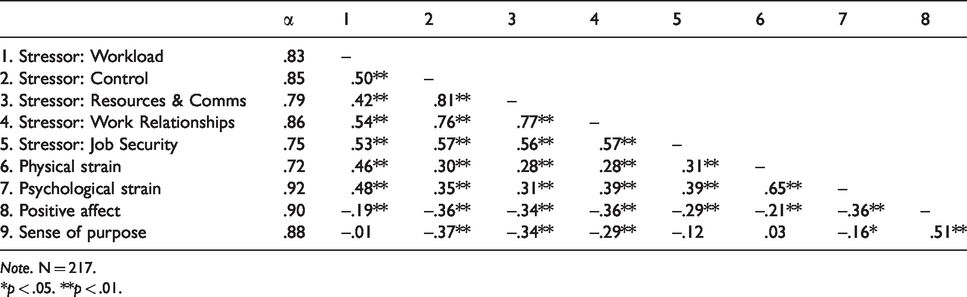
Reliabilities (Cronbach’s α) and zero-order correlations and are shown in Table 1. With the exception of job conditions (α = .50), each subscale showed good reliability (α > .70). Low reliability indicates that the items within that subscale do not represent a single construct and, thus, that treating them as such in the analyses is inappropriate. 24 The items relating to job conditions do not, therefore, feature in our subsequent analyses. This subscale has also shown weaker reliability than the other stressor subscales in previous research. 6 Correlations between the job stressor subscales were typically moderate (rs = .42–.57), justifying the simultaneous assessment of them in the following analyses. Exceptions to this moderate association were the stronger correlations between three subscales: resources and communication, control, and work relationships (rs = .76–.81).
Zero-order correlation matrix plus reliabilities for stressors, strain, and wellbeing.
Note. N = 217.
*p < .05. **p < .01.
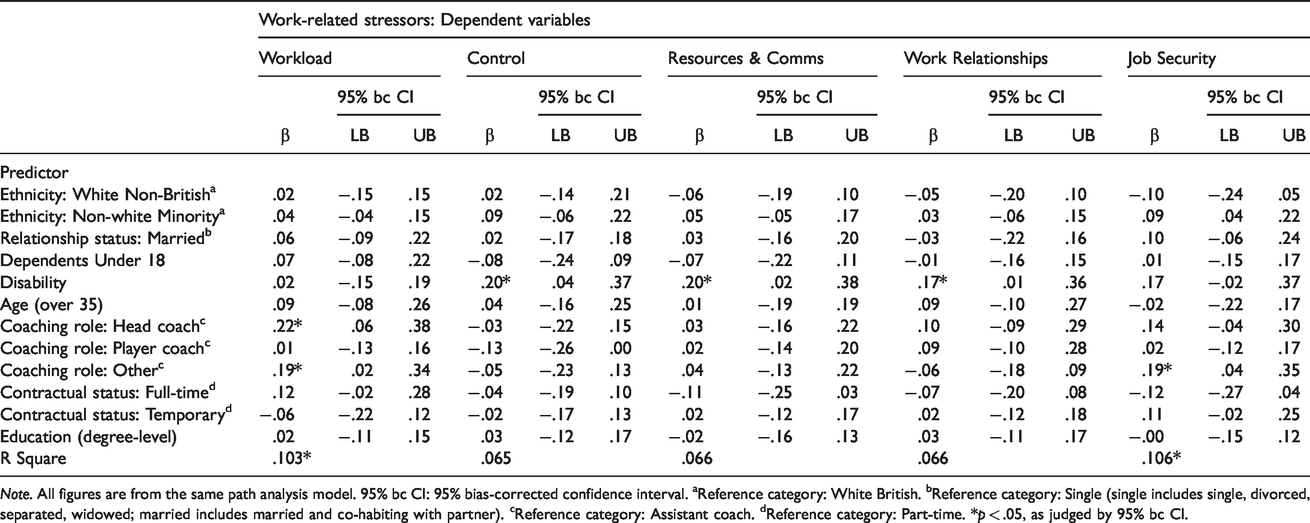
Relationships of demographic and contract-related factors to work-related stressors.
Note. All figures are from the same path analysis model. 95% bc CI: 95% bias-corrected confidence interval. aReference category: White British. bReference category: Single (single includes single, divorced, separated, widowed; married includes married and co-habiting with partner). cReference category: Assistant coach. dReference category: Part-time. *p < .05, as judged by 95% bc CI.
Among the strain and PWB subscales, physical and psychological strain were more strongly correlated with one another (r = .65) than with the PWB subscales. The same was true for positive affect and sense of purpose (r = .51). Psychological strain was modestly to moderately correlated with the two PWB subscales (positive affect r = −.36; sense of purpose r = −.16), indicating that these are indeed related but distinct constructs that should be treated as such in subsequent analyses.
Associations between demographic factors, contract-related factors, and job stressors
Standardised estimates and 95% bias-corrected confidence intervals can be seen for all paths in Table 2. Head coaches and “other” coaches experienced more stressors related to workload than assistant coaches. Disabled coaches (n = 16) experienced more stressors related to control, resources and communication, and work relationships. “Other” coaches experienced more stressors relating to job security when compared to the reference category of assistant coach. Demographic and contract-related factors explained between 6.6% and 10.6% of the variance in the job stressor subscales; these factors explained a significant portion of variance for workload (10.3%) and job security stressors (10.6%).
Associations between job stressors, strain, and psychological wellbeing
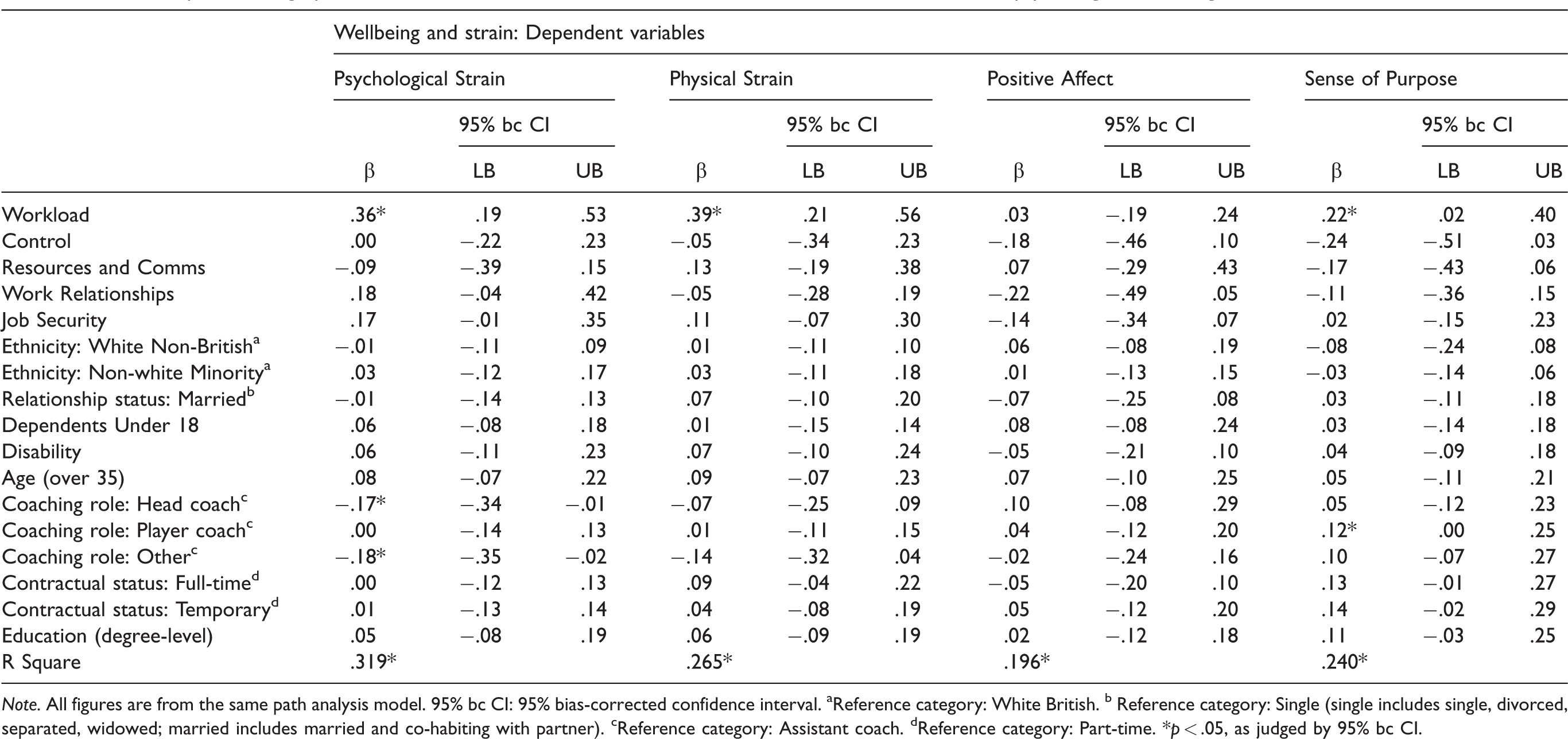
Standardised estimates and 95% bias-corrected confidence intervals can be seen for all paths in Table 3. Workload stressors were positively associated with physical and psychological strain; women who reported more workload stressors also reported greater strain. However, being a head or “other” coach (versus an assistant coach) was associated with less psychological strain. None of the demographic, contractual, or stressor variables were associated with positive affect at work. Workload stressors were positively associated with sense of purpose at work; women who experienced more workload stressors also reported greater sense of purpose. Being a player coach (versus an assistant coach) was also associated with greater sense of purpose.
Relationships of demographic factors, contract-related factors, and work-related stressors to strain and psychological wellbeing.
Note. All figures are from the same path analysis model. 95% bc CI: 95% bias-corrected confidence interval. aReference category: White British. b Reference category: Single (single includes single, divorced, separated, widowed; married includes married and co-habiting with partner). cReference category: Assistant coach. dReference category: Part-time. *p < .05, as judged by 95% bc CI.
Discussion and conclusion
The findings of this project offer enhanced understanding of the demographic and contract-related factors that are associated with job stressors among women sports coaches, and of the associations between job stressors, strain, and PWB at work. Head coaches, “other” coaches, and disabled coaches experienced more job stressors than assistant coaches. This highlights the influential role of contract-related factors on coaches’ experiences at work and suggests a need for NGBs to tailor stress management interventions for subgroups of their workforces. NGBs could, for example, focus on cognitive-behavioural based stress management interventions (e.g., cognitive restructuring 25 ) with head coaches, “other” coaches, and disabled coaches to enhance PWB and on psychoeducational activities with assistant coaches to maintain PWB. Workload stressors seem particularly important from the findings presented here, both in terms of the volume of these stressors experienced by coaches and their impact on strain and PWB. Collectively, the findings illuminate some of the factors (e.g., stressors, degrees of physical and psychological strain) that could influence women coaches’ engagement with, and dropout from, the coaching profession.
One noteworthy finding is that disabled coaches were more likely to experience stressors relating to work relationships, control, and resources and communication. This cluster of closely related stressors may signify, for these women, experiences of isolation. This is noteworthy because other researchers 26 have highlighted the importance of work relationships for PWB and because effective relationships in sport can facilitate processes (e.g., dyadic coping) that buffer the negative outcomes of stressors. 27 Our findings extend previous research that has shown opportunities for women coaches to build work relationships to be limited, 14 and highlight the need for NGBs to consider ways to optimise work relationships among coaches. This could be achieved via formal mentoring and sponsorship systems. 28 We note that our sample included relatively few coaches who reported a disability (n = 16); future research with this group of coaches will be necessary to further explore how these stressors are experienced and how they can be mitigated.
With reference to associations between job stressors, strain, and PWB, workload stressors were associated with greater physical and psychological strain but also with greater sense of purpose. The first part of this finding is noteworthy when considered alongside documented links between strain and burnout 29 and known associations between burnout and dropout from coaching. 30 Taken together, these findings may help to explain why women are underrepresented in senior coaching positions. 31 If women coaches do not have a manageable workload and, therefore, cannot achieve a balance between work and personal commitments, they are likely to experience feelings of guilt, 13 emotional exhaustion, 12 and anxiety. 7 Given that these feelings are not conducive to success at home or at work, it is plausible that workload stressors go some way toward explaining why women may cease to engage with coaching and, thus, not reach senior levels of the profession. This suggestion raises the question of why more men than women do reach senior coaching positions 31 despite also having commitments both at work and home, and arguably contributing to domestic responsibilities more now than ever before. Some researchers have suggested that the gender differences in dropout from or progression in coaching may be due to sport’s society of hegemonic masculinity 32 and or the structural factors of opportunity, power, and proportion that women are particularly susceptible to. 33
The finding of a positive association between workload stressors and sense of purpose (i.e., eudaimonic wellbeing) brings to the fore one reason why women should strive to reach head coaching positions. Despite the apparent presence of increased workload stressors in head coach roles, it is possible based on our findings that an optimal level of workload stressors in head coach roles could enhance eudaimonic wellbeing. Caution must, however, be exercised by head coaches to avoid overload that results in strain and burnout. Indeed, women coaches may be enticed into taking on additional workload in pursuit of an enhanced sense of purpose at work but are at risk of experiencing physical and psychological strain as a result of doing so. To mitigate this risk, NGBs and policy makers should consider interventions that focus directly on optimising coach workload 34 and on educating coaches about both the risks and benefits of workload stressors. Of particular note here is the duty of care that NGBs have for coaches, and the joint responsibility of both organisations and coaches to effectively manage stressors that can be experienced in the workplace. Primary level stress management interventions that aim to adapt the environment to reduce stressors (e.g., via review of working conditions) are primarily the responsibility of NGBs whilst secondary level stress management (e.g., one-to-one sport psychology support) can be driven by coaches themselves. Coaches and employers can also work together to facilitate candid discussions about workload, particularly when an individual is moving up from an assistant to a head coach role. From research and practical perspectives, the findings relating to strain and PWB emphasise the importance of conceptualising these two constructs as distinct but related.
When interpreting the findings of this study, it should be noted that our data offer insight to an underexplored sample (i.e., women coaches working at all levels of the UK workforce) but that the cross-sectional study design captured a snapshot of women’s experiences. Researchers would do well to address this limitation by using prospective and longitudinal study designs in future research. Qualitative research methods will also be useful to gather more in-depth information and to answer questions about how and why the findings presented here may occur. It is notable, for example, that demographic and contractual factors explain only a small proportion of the variance in job-related stressors (6–11%). As such, qualitative work may be able to identify and explain other factors that influence coaches’ experiences. In addition, while our focus on women coaches offers unique insight to an underrepresented group, researchers should consider replicating this study with male coaches to facilitate balanced understanding of the target phenomena.
Our findings identify several groups of coaches (head coaches, “other” coaches, and disabled coaches) who may experience more job stressors in their coaching work. Additionally, the findings discern the importance of workload stressors and their detrimental relationship with psychological and physical strain but helpful relationship with sense of purpose. Collectively, these findings suggest areas of intervention for NGBs seeking to protect the health and wellbeing of the women coaches within their workforce.
Footnotes
Declaration of conflicting interests
The author(s) declared no potential conflicts of interest with respect to the research, authorship, and/or publication of this article.
Funding
The author(s) disclosed receipt of the following financial support for the research, authorship, and/or publication of this article: This research was supported by a grant from the Research Cluster Grant Scheme at Leeds Beckett University.
