



Abstract
Keywords
Introduction
The practice of soccer is one of the most widespread by the population, making this sport one of the most practiced worldwide. 1 The game is distinguished by its intermittent exercise nature, encompassing a spectrum of low-to-moderate running activities, as well as high-intensity to maximal actions from the athlete, including sprints, jumps, changes of direction, accelerations, decelerations, and other actions. This variety of actions places a high mechanical and metabolic stress on the body.2,3
As players must be fully prepared to sustain the demands of the game, a multitude of factors work in complement to the training process. One key element, among others, is sports nutrition, which helps players maintain a balanced nutritional and energetic state, ensuring they are adequately prepared to sustain the demands of the game. As such, sports nutrition is now considered a key factor not only in supporting players’ performance, but also in facilitating faster and more complete recoveries, increasing their physical availability for training and competition, and reducing the risk of injury. 4 Due to the increasing intensity of physical demands in recent years,5,6 several nutritional recommendations have been published to inform best practices among football practitioners.7–9
In addition to the typical physical demands of sports, it is essential to consider the age-specific factors when dealing with young players. During this period of life, the basal metabolism is one of the highest in the life cycle due to the added cost of growth and development. 10 We know that an insufficient intake of calories can delay the maturation, growth and development of healthy bone mass. 11 Also, we should bear in mind that due to the demands of the sport, it is important to assure all nutrients requirements are fulfill by a healthy diet. 12 Within this theme, it is important to highlight the impact that external pressures from coaches, colleagues, parents and the media have on the behavior of young people, considering the vulnerability to these pressures present in these age groups. 13 All these factors can contribute even more to the presence of maladjusted eating behaviors, which can lead to problems such as a decline in sports performance and, in an even more serious context, to health problems that last into adulthood.14,15
In this sense, and even considering differences in methodologies, it is common to see a discrepancy between energy intake and carbohydrate intake with the needs of different types of day throughout the season, namely training days, match days and rest days.16,17 It should also be noted that the greatest differences were observed on match days and the most intense training days. On the other hand, protein intake doesn't seem to be a problem in these age groups, meeting the proposed recommendations. Even so, there is room for improvement, considering that the distribution of protein throughout the day does not follow the best pattern, thus not optimizing its effects.18,19
In particular, the adjustment between energy intake and energy expenditure is essential in order to avoid the development of low energy availability (LEA), and eventually the emergence of symptoms related to a situation of Relative Energy Deficiency in sport (REDs). 20 The development of LEA is multifactorial, and its diagnosis may be hindered for this reason. Even so, it is unanimously accepted that its consequences can have a huge impact on multiple body systems, with an impact on sports performance and the athlete's health. 21 For this reason, early diagnosis is essential, as well as the identification of risk factors in this mismatch between energy needs and energy expenditure in athletes. 22 In addition, there is an increasing prevalence in young athletes, which requires greater attention considering that the negative effects on health of REDs will be even greater in these age groups. 23
Monitoring the physical load to which athletes are exposed during training can reduce the risk of injury and illness. Additionally, understanding the typical efforts performed can improve the possibilities for adjusting compensatory strategies, ultimately maximizing the player's performance. 24 Considering the increase stress young soccer players endure in their day to day life, the energy demands of the exercise, and adding the increase energy requirements to growth and development, this monitorization is even more important. 25 Among other technologies, Global Positioning Systems (GPS) devices have become a daily instrument in football, used in both training sessions and matches. This device allows for the quantification and qualification of the locomotor and mechanical demands imposed on players, providing a better understanding of the impact of the training plan on each player's individual response. 26 This approach facilitates the characterization of weekly periodization and load variations from week to week, 27 also considering that there is a good correlation between the external load parameters associated with sports performance with the more objective data from physiological monitoring and the more subjective data on the athlete's well-being. 28
Nutritional periodization, including weekly intake characterization, is a critical tool for achieving athletic success in the field of nutrition. It enables athletes to adapt their energy and nutrient intake to individual needs for each training session and align with specific weekly objectives. 29 For soccer, there are already several models of nutritional periodization, namely in the intake of carbohydrates, which adjust to the specific type of microcycle, 30 but they are mainly focused on adult soccer players.
Furthermore, and with regard to nutritional recommendations and external load during a football microcycle, there are some studies in adult athletes that provide theoretical frameworks for an optimal nutrient intake in relation with training load across the microcycle.30,31 However, when making carbohydrate intake recommendations based on the external load distributions of a microcycle in football evaluated in short-term studies it is not possible to see the implication for performance and medium to long-term health of a periodized nutritional approach relative to a more constant intake approach.
While some studies have examined dietary intake and training load separately in young soccer players, our study is the first to explore both aspects simultaneously. This dual focus is crucial because current recommendations for younger populations advise against nutritional periodization due to the risk of low energy availability. 32 However, there is a significant gap in the literature regarding whether periodization over a microcycle could actually mitigate this risk rather than exacerbate it. Therefore, our study aims to fill this gap by: 1) characterizing and analyzing food intake and typical external load in a group of young soccer players over a normal microcycle; and 2) correlating energy and macronutrient intake with external training load parameters.
Materials and methods
Study design
An observational, analytical cross-sectional study was conducted. All participants, or their parents or legal guardians were informed about the nature, aim and risks of the study before obtaining a written informed consent. All athletes were aware that participation was voluntary and that they could withdraw from the study at any time.
This study was approved by the Ethics Committee of the Institute Polytechnic of Viana do Castelo (37A/2022) and followed the recommendations from the Declaration of Helsinki. 33
Context
This study took place across one-week mid-season competitive phase in november 2022. We considered a typical week for this team, consisting of one day off (MD + 1) after match 1, followed by one recovery training session (MD + 2) and another day off (MD + 3). Leading to match 2 (MD), three physical and tactical training sessions were conducted (MD + 4; MD-3;MD-2), with a day off before MD.
Nutritional intake was assessed every day, and external training load was registered on all days except rest days.
Subjects
We employed a non-probabilistic convenience sampling strategy. The eligibility criteria were: (i) players must participate in all training sessions across the microcycle; (ii) players must keep a complete food diary for all days of the microcycle. The exclusion criteria were: (i) any injury preventing normal participation in training and games; (ii) ingestion of medications for health reasons; (iii) having a meal plan with dietary restrictions.
Twenty-four male soccer players (17.54 ± 0.50 years) from the same team participating in the highest competition of their age group were invited to participate in this study. The players competitive level corresponded to tier 3 (highly trained) of the Participants Classification Framework. 34 These athletes train 4 times a week (70 min per session) and play at least one game a week during the competitive phase of the season. Throughout the microcycle, players performed training sessions based on general improvements in physical condition, technical and tactical content development, on the improvement of technical skill, and recovery. Generally, training sessions had a warm-up, a principal part, and a cooldown.
After applying the eligibility criteria, 18 players were included in the final analysis (Figure 1).
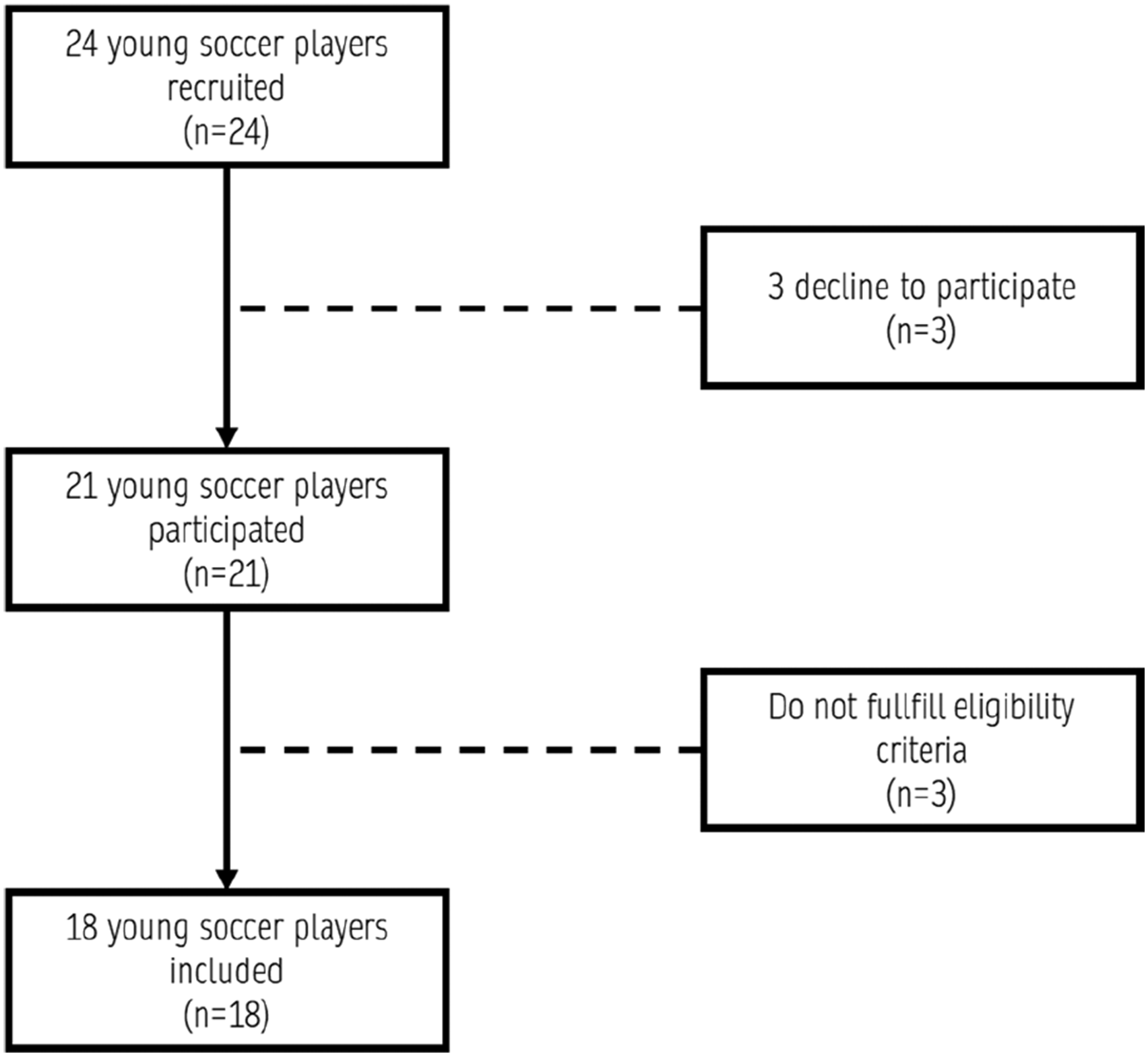
Flow diagram of the subjects.
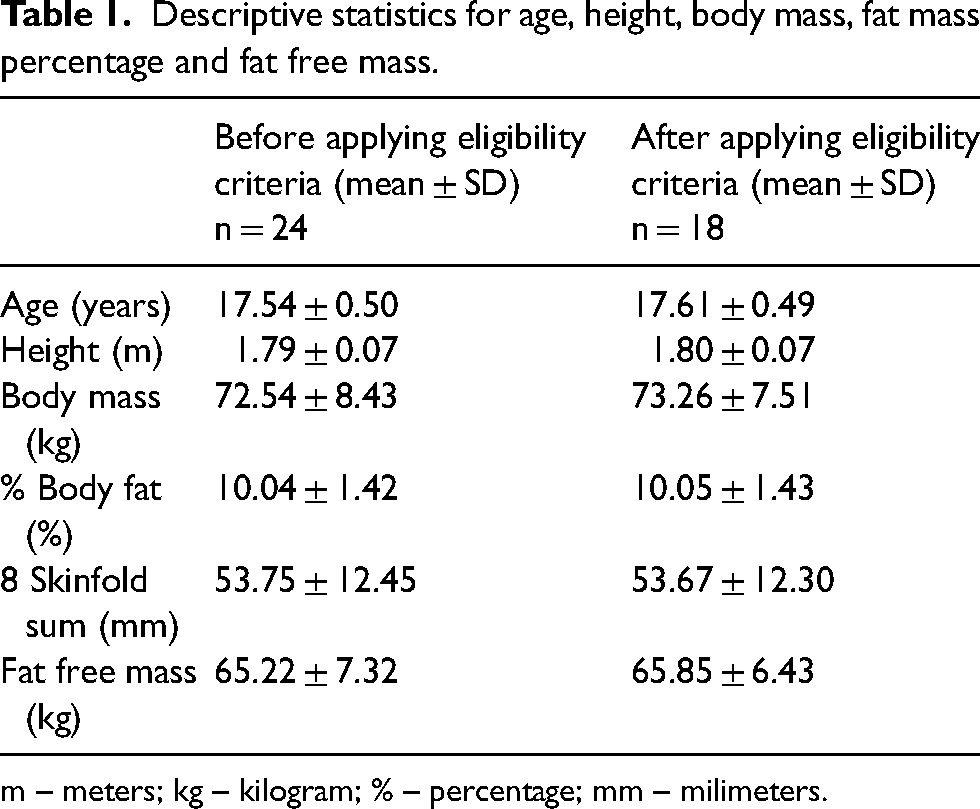
Descriptive statistics for age, height, body mass, fat mass percentage and muscle mass are summarized in Table 1.
Descriptive statistics for age, height, body mass, fat mass percentage and fat free mass.
m – meters; kg – kilogram; % – percentage; mm – milimeters.
Procedures
Anthropometry
Height, body mass and skinfolds were obtained by a level I-accredited and experienced technician at the beginning of the study, following the International Society for the Advancement of Kinanthropometry recommendations. 35 Athletes were assessed in their underwear without footwear and socks. Their height and body mass were measured by means accurate to within 0.1 cm and 0.1 kg, respectively, and were computed based on the arithmetic average of the measurements. Height was measured with an anthropometer (SECA 206) to 0.1 cm accuracy, and body mass was measured with an electronic scale (Prozis scale) to 0.1 kg accuracy.
Eight skinfolds (triceps, subscapular, biceps, suprailiac, abdominal, supraspinal, thigh and calf) were assessed twice with a Harpenden skinfold caliper (British Indicators, Ltd, London, UK) with 0.1 mm accuracy. For each athlete, double anthropometric measurements were obtained, and the mean of the two measures was used to calculate the sum of the eight skinfolds (Σ8skf).
After that, the percentage body fat (%BF) was calculated using the equation developed by Munguia-Izquierdo et al. 36 and with the value obtained for %BF, the fat free mass (FFM) was calculated.
Dietary intake
Participants daily dietary intake was registered for nine consecutive days (four rest days, four training days and one match day) in a self-recorded manner, using a food diary, during an in-season period (November 2022) (Figure 2).

Typical microcyle during the competitive phase.
Before the beginning of the record period, a nutritionist explained the instructions to fill out the food diary. Participants were asked to report all the foods, fluids, and supplements they consumed throughout the entire period. They were instructed to register all the relevant information about the types and portion sizes of every meal and beverage they consume. Whenever possible, they were trained to report the amounts in grams (g) or portions according to the package detail, and to use household measures when this information was not available. To ensure the maximum possible accuracy, the food diaries were collected on a daily basis by the nutritionist and if necessary, the players were asked to answer further questions on the spot. Additionally, players were also instructed to take pictures and make them available to the nutritionist, so they could be used in the analysis of the food records.
After the end of this period, all the food diary records were checked and coded by the same nutritionist to ensure equal analysis of all the food diaries. From this analysis, the main outputs extracted were overall total absolute, and relative to body mass, intakes of energy (kcal), carbohydrates (CHO), protein and fats.
During this period, no nutritional intervention was implemented by the club in order to not influence food choices.
Training and match load
Players used a portable global positioning system (GPS) device incorporated into each player's jersey on the upper back. This device operates at a sampling frequency of 10 Hz (Vector device, Catapult Sports), which is already a proven reliable, valid, and time-effective equipment. 37 Each player used the same device across the whole season, and in that sense during the study period this allow to decrease variability. After every training session and the match, the data was downloaded to a PC console (Openfield, Catapult Sports) and analyzed using the software package (Openfield Cloud, Catapult Sports). The data analyzed were the total distance covered (TDC), the player load (PL), acceleration above 2 meters per second square (ACC2 m), acceleration above 3 meters per second square (ACC3 m), deacceleration below 2 meters per second square (DCC2 m), deacceleration below 3 meters per second square (DCC3 m), total distance covered between 4.4 and 5.5 meters per second (TDC4.4–5.5), total distance covered above 5.5 meters per second (TDC + 5.5), maximal speed (maxS), and metabolic power (MP).
Energy availability
In order to estimate energy availability, exercise energy expenditure was calculated using the body mass (BM) of each player and the Meta-energy parameter obtained by the GPS device, that give us the kcal per kg for the session.
After obtaining this value, we used the Loucks et al.
38
equation to calculate the energy availability for the entire period:
Sample size
For a small effect size of
Statistical procedures
The statistics are presented in the form of mean and standard deviation (SD). Within-week comparisons for macro nutrients intake and training load measures was tested using a repeated measures ANOVA followed by a Bonferroni post hoc test. The statistical procedures were chosen after confirmation of normality and homogeneity of the sample by using the Shapiro-Wilk (p > 0.05) and Levene's test (p > 0.05). Statistical procedures were executed on the SPSS (version 28.0.0.0, IBM, Chicago, USA) for a p < 0.05.
Results
Figure 3 presents the descriptive statistics and the within-player variation of the calories and macro-nutrient intake by the players over a training microcycle. Table 2 presents the means and standard deviations for both the macro-nutritional information and training load variables across the microcycle. The CV of total distance over the week is about 30.1%, while the total distance standardized to minutes is 18.1%. Similarly, the CV of player load over the week is about 33.9%, while the player load standardized to minutes is 19.6%. Finally, the CV of meta energy over the week was 29.2%.
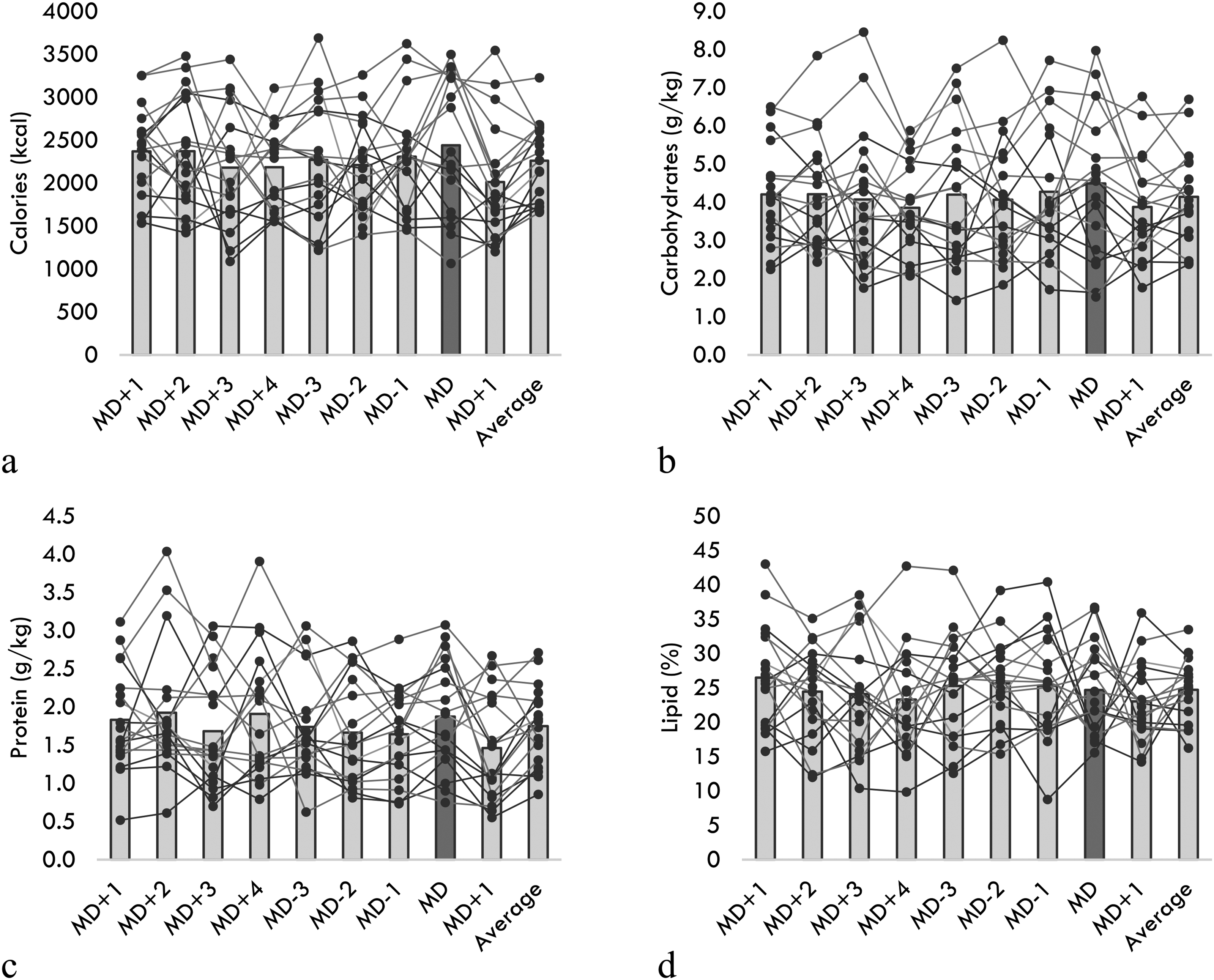
Descriptive statistics and the within-player variation of the calories and macro-nutrient intake by the players over a training micro-cycle. MD: match day.
Means ± standard deviations for both the macro-nutritional information and training load variables across the microcycle.
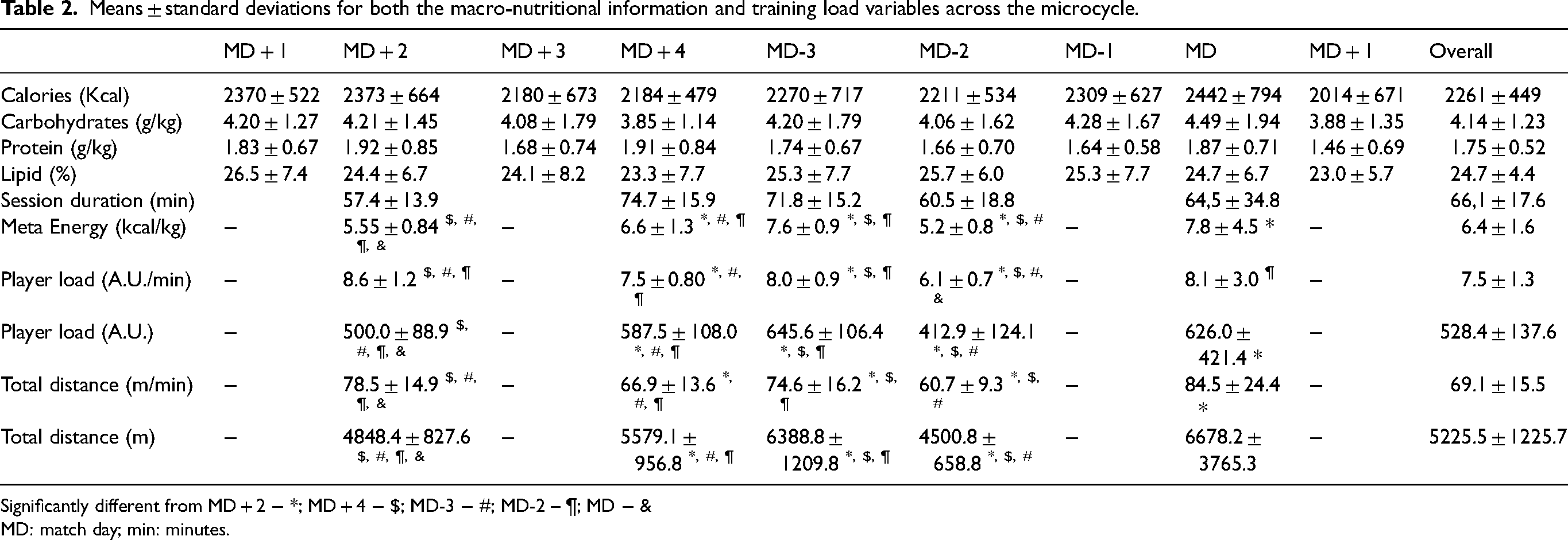
Significantly different from MD + 2 − *; MD + 4 − $; MD-3 − #; MD-2 – ¶; MD − &
MD: match day; min: minutes.
Repeated measures ANOVA revealed no significant within-week variations of carbohydrate intake (F = 0.635; p = 0.747;
Mean and standard deviation of within-player variation in macro-nutritional intake on MD + 1.
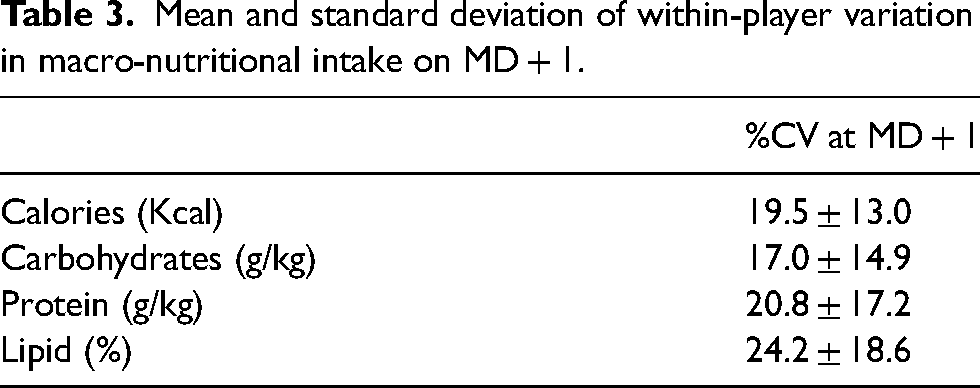
Additionally, it is observed that for the microcycle in question the value of energy availability (30.89 ± 11.54 kcal.kg FFM−1) is very close to the value below which the athlete will be in low energy availability, namely 30 kcal.kg FFM−1.
Even though, looking at Figure 4 and analysing the energy availability along the week, we verify an average CV along the week of 27.6%, suggesting a great variability on this parameter along the microcycle. In this matter, it is possible to observe that for the training days, energy availability mean is always below the low energy availability threshold.
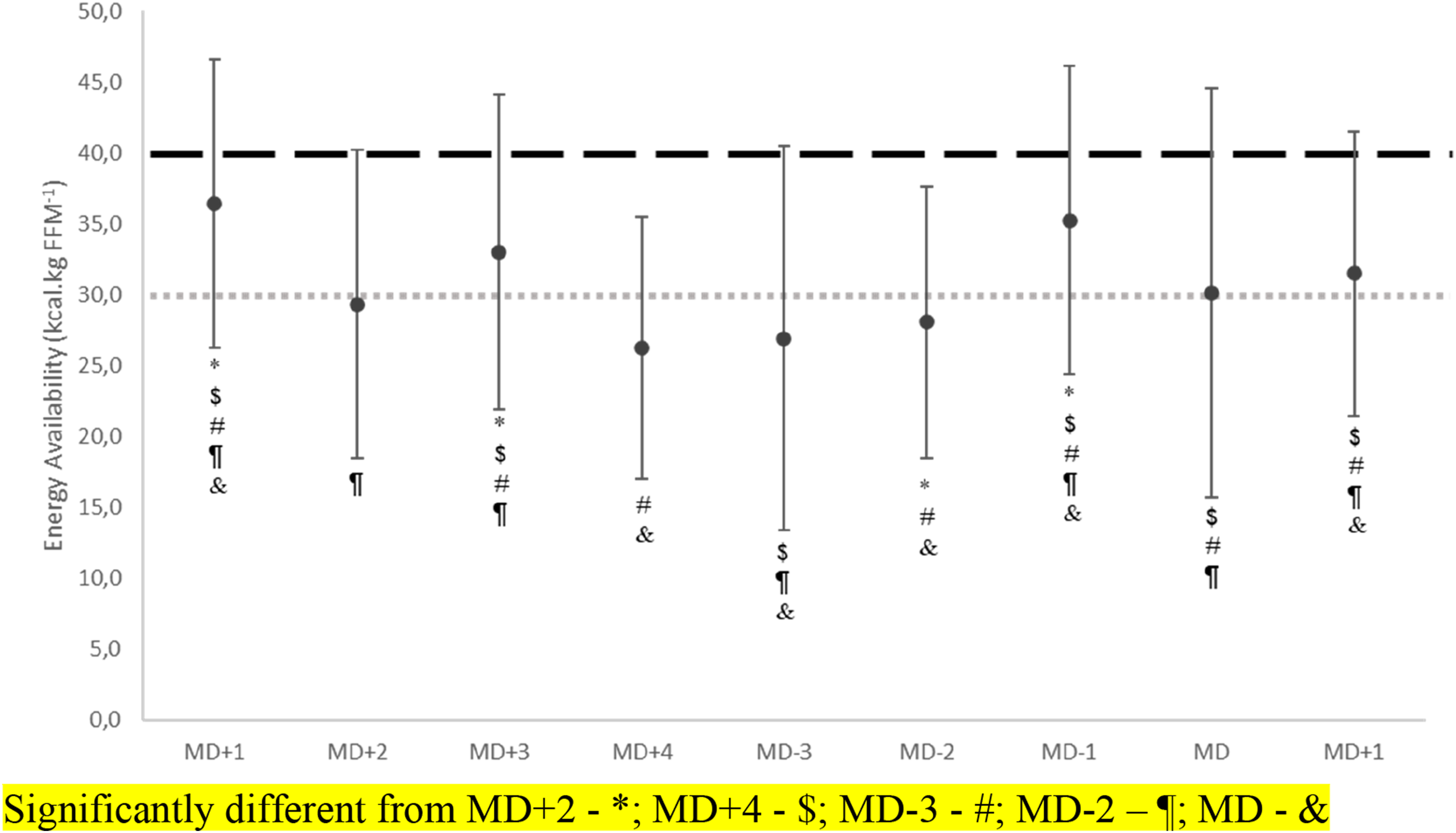
Descriptive statistics of energy availability over the weekly microcycle. Gray dotted line – low energy availability limit; Black dashed line– moderate energy availability limit.
When we consider a normal microcycle, it is usually observed that the most physically demanding days for the players are usually those that take place on MD + 4 and MD-3, and the last training day, on MD-2, is usually the one with the lowest physical load. By comparing the training load metrics between the different training sessions and the match day, this pattern can also be observed in our sample.
The highest average total distance covered by the athletes in the microcycle was on MD, with a mean value of 6678 meters. When considering only the training sessions of the microcycle, the highest average total distance was covered in the third training session (MD-3), with a mean value of 6388 meters, while the shortest distance was observed in the fourth session (MD-2), with a mean value of 4501 meters. Additionally, the highest average distance covered per minute was observed on MD + 2, during the first training session, with a mean value of 79 meters per minute, while the smallest was on MD-2, with a mean value of 61 meters per minute. On match day (MD), the highest value for the entire microcycle was observed, with a mean value of 85 meters per minute.
Regarding player load, the highest average was recorded in the third session (MD-3), with a mean value of 646 arbitrary units (A.U.), and the smallest was in the fourth session (MD-2), with a mean value of 413 A.U. It is noteworthy that on match day (MD), the player load was 626 A.U., which was not the highest in the microcycle. However, the highest player load standardized to the minute was observed on MD + 2 (1st session) and MD, with a mean value of 9 A.U. per minute, while the smallest was on MD-2 (4th session), with a mean value of 6 A.U. per minute.
Similarly, the highest average meta energy for the microcycle was observed on match day (MD), with a mean value of 7.8 kcal/kg. When considering only the training sessions, the highest average meta energy was recorded on MD-3 (3rd session), with a mean value of 7.6 kcal/kg, while the smallest was on MD-2 (4th session), with a mean value of 5.2 kcal/kg.
Repeated measures ANOVA revealed significant differences between training days on total distance (F = 5.039; p = 0.001;
Discussion
Adequate nutrition is fundamental for optimizing the performance of athletes, particularly football players.4,7,8 Considering the implications for development and maturation in young athletes, 11 the implementation of appropriate nutritional strategies in these age groups becomes even more urgent. In this study, we aimed to characterize and analyze food intake and typical external load in a group of young soccer players over a normal microcycle and correlate energy and macronutrient intake with external training load parameters. Our main findings showed that the players’ diet was relatively consistent throughout the week, without periodization across the microcycle. In contrast, training load measures varied significantly across the week.
When considering the only study that provide a direct insight about energy needs for academy soccer players, 32 with a total energy expenditure (TEE) of 3586 ± 487 kcal.day−1, it is possible to perceive that the players in our study fall short in this recommendation, with an energy intake of only 2292 ± 623 kcal.day−1 (ranging from 1064 to 3690 kcal). In fact, when considering all the studies performed in similar populations, almost all the participants had an energy intake superior to ours,32,39–44 except one 18 that presented a slight lower energy intake. When analyzing the characteristics of the diet assessment from the other studies, it is possible to notice that none of the studies mentioned assess food diaries across the same duration as ours, with only three being conducted during 7 days. 41 This is an important characteristic, since 7 days seem to be, not only, the time necessary to assess energy intake with some degree of certainty, 45 but also, the most representative of a non-congested microcycle, like in the case of the present team. Regarding energy intake across the week, our results revealed that the coefficient of variation (CV) of calorie intake was 5.75% for the players’ average. Despite small differences in total values of energy intake, the lowest average value was observed on MD + 1 (the day after the match), and the highest average value was on match day. Considering that daily energy expenditure varies throughout the week due to the demands of physical training and specific objectives for each day, there is some basis for thinking that energy intake should be adjusted to what is required for each day, as can be seen in the consensus on periodisation throughout the week for footballers by Abreu et al. 8 Additionally, considering the importance of adequate energy intake to meet physical needs and proper development at these ages, evidence points to lower than adequate intakes among young players. 46 Therefore, an intake that accounts for the variability of energy needs throughout the week may be more successful in maintaining an adequate energy balance.
Although there are already macronutrients recommendations with consideration to the needed periodization across the microcycle to senior players,7,8 for young soccer players, we can only extrapolate from what seems a reasonable suggestion. 47 The recommendation for football players to consume 3 to 8 grams of carbohydrates per kilogram of body weight per day is designed to support the physical demands of training and playing. Carbohydrates are crucial for high-intensity and explosive actions, which are essential for football performance. This range accounts for lower needs on rest days and higher needs on intense days, such as match days. With an average intake of 4.17 ± 1.57 g/kg/day of carbohydrates across the microcycle, the participants in our study are at the lower end of the optimal range. This suggests that players may not be meeting their carbohydrate demands on high-intensity days. When looking at the data published to this regard, it is possible to find some studies where relative intake of CHO are higher32,39,41–44 and one study where the intake was lower than the one in our study. 18 A curious study by Garrido et al., 40 compared the intakes of young soccer players with different meal approaches: buffet style and menu style. In this regard, when looking at the CHO intake, we notice a higher ingestion in relation to our study for the players with a menu style intervention while the players with a buffet style intervention had a slight lower intake in comparation with our participants. Nevertheless, all the studies showed that young soccer players do not meet CHO recommendations and that they could benefit of increasing their daily CHO intakes in order to achieve daily targets, and conversely considering periodization across the week. Even considering that the highest average value for the relative intake of CHO was on the MD, it is visible a small CV of carbohydrate intake, being only 4.8% for the players’ average over the week, with the smallest average value observed on MD + 4 and MD + 1. Carbohydrates are essential for physical performance as they are the main energy substrate in high-intensity actions. 48 Considering that one of the main limiting factors leading to greater fatigue in football is the depletion of glycogen reserves, 49 an adequate intake of carbohydrates for the work being done will allow the athlete to perform better and ensure better recovery from the effort. 50
With regard to protein intake, and when comparing the intake of the participants in our study, we observed a relative intake of 1.78 ± 0.71 g.kg−1.day−1. When analysing this value against the recommendation that exists for young football practitioners, 51 which is defined as being between 1.2–1.6 g.kg−1.day−1, it is possible to see that with regard to protein the recommendations are fully reached and can even be seen as exceeding. In fact, as far as protein is concerned, all the studies analysed seem to indicate that protein intake does not fall short of requirements,40–43 and in several cases the recommended protein intake for these ages is far exceeded.18,32,39,44 In relation to the distribution across the week, the CV of protein intake was 8.7% for the players’ average, with the smallest average value observed on the MD + 1 and the highest average value observed on the MD and MD + 4. Considering the fundamental role of protein intake in protein turnover, adequate intake is essential if the associated processes are to be optimised. 52 Processes such as hypertrophy and recovery from exercise-induced muscle damage could be compromised if protein intake is not sufficient. 53 It should therefore be noted that, despite the variability observed, protein intake is sufficient throughout the microcycle.
A low-fat diet in this age group can compromise health by reducing the absorption of fat-soluble vitamins and glycogen storage in the muscle. 54 Although many times disregard as an important nutrient for athletes, considering its importance as an important source of energy, when restriction is applied to fat intake it can lead to growth and development impairment in young athletes. 55 Nonetheless, fat intake recommendations are usually based in a percentage of the total energy expenditure and for young athletes it referes to a range between 20–35% of total energy intake, in line with dietary reference values to the general population.47,56 Considering this recommendation, in our study we observe an intake corresponding to 24.91 ± 7.15% of the total energy intake, well within the recommendation. In Bettonviel et al. (2016) it was reported a similar finding regarding fat intake, but most of the studies presented values higher than ours,41,44 and in some cases they where well above the maximum value recommended.39,42 Naughton et al. (2016) 18 do not present the value of fat intake expressed in % of the total energy intake, with only the value in g.kg−1.day−1 presented. Comparing the value found in their study, namely 0.9 ± 0.3 g.kg−1.day−1, with the relative fat intake of the participants in our study, 0.89 ± 0.4 g.kg−1.day−1, we notice they are also similar between them. On the same page, Hannon et al. 32 reported a value of 1.8 ± 0.4 g.kg−1.day−1, far higher than the one found by us. Similarly to the CHO intake, the CV of lipid intake was 5% for the players’ average over the week, with the smallest average value observed on the MD + 1 after the registered match and the highest average value on MD-2. Regarding fat intake, although it was not specifically assessed in this study, understanding the profile of fatty acids consumed by the athletes would be valuable. The positive impact of omega-3 fatty acids on athletes’ health and performance is well known. 57 Given that the athletes’ total fat intake is within the normal range, increasing their intake of omega-3 fatty acids could be beneficial. 58
Throughout the week, the players’ energy and nutrient intake showed no significant variations, indicating a consistent diet and suggesting a lack of meal plan periodization. This can have an impact on energy availability. Low energy availability (LEA) is a condition that can put at risk the health, performance and development of the athlete, especially during critical periods of growth such as adolescence. 59 There is a perception that this problem has a high prevalence in various sports, and although there is knowledge that it can affect athletes of both sexes, studies in male athletes, namely in soccer, are non existent or, at the very minimum, scarce. 60 In this sense, when analysing the energy availability throughout the micro-cycle, it is observed that it is below the desired level. Namely, in the days that athletes are involved in exercise, whether it is in training or in match, the energy availability is inferior to the limit of 30 kcal.kg FFM−1, situation that leaves them in a situation of LEA. Although off days are relatively better, the effects of LEA can be harmful to the athletes’ development and health, being a crucial aspect to highlight when educating athletes about the importance of nutritional periodization throughout the microcycle.
Analysing the results for training load measures, from the CV it is possible to see that for total distance covered over the week is about 30.1%. This suggests that there is a high degree of variability in the distance covered by the athletes over the course of the week, relative to their average distance covered. Similarly, the CV for player load over the week is about 33.9%, indicating that there is a high degree of variability in the players’ exertion levels over the course of the week, relative to their average exertion level. However, when we standardize this metrics to minutes, the CV values decrease to 18.1% and 19.6%, respectively. This indicates that there is less variability in the distance covered and player load when they are standardized to minutes. In relation to meta energy, we observe that the CV of meta energy over the week was 29.2%. This result suggests that there is moderate variability in the energy expenditure in exercise across the weekly micro-cycle for young soccer players. Considering the differences found in the training load variables, we see that they contrast with the absence of variability in energy intake and carbohydrate intake. As mentioned above, maintaining an adequate energy balance and carbohydrate intake that supports the physical needs of training is essential. What these data show is that there is room to improve the dietary pattern of these athletes, making it more adapted to daily demands and thus allowing them to develop in a more balanced and optimized way.
Overall, these results suggest that there is considerable variability in the training load measures over the weekly microcycle, particularly when not standardized to minutes. This variability may have important implications for training planning and monitoring. Considering the differences found in the training load variables, we see that they contrast with the absence of variability in energy intake and carbohydrate intake. As mentioned above, maintaining an adequate energy balance and carbohydrate intake that supports the physical needs of training is essential. What these data show is that there is room to improve the dietary pattern of these athletes, making it more adapted to daily demands and thus allowing them to develop in a more balanced and optimized way. Particularly, in relation to energy expenditure in exercise, it suggests that it may be important to educate athletes in order to achieve a recommended value of energy availability in all days across the week.
The results also showed that the highest average total distance, highest player load and highest meta energy observed across the microcycle was on MD, with the highest value for player load observed in the 3rd session of the microcycle and the highest value for player load standardized to minutes observed in the 1st session of the week. The smallest value for all metrics was obtained in the final session of the week, corresponding to MD-2. Although there is limited evidence on training load for young soccer players, when comparing with data from the available studies we find no significant differences. For the total distance we see that MD presents also the highest value in Hannon et al., 61 and to the best of our knowledge this is the only study in young soccer players similar to our study. If we look at senior soccer players, 30 we can also find the same results, allowing us to extrapolate that at least MD is the most intense day of the microcycle.
Periodising the training load throughout the week is now seen as essential by coaches and technical staff, and monitoring it is crucial to promoting the physical adaptations that will allow the athlete to perform at their best at the time of competition. 62 By monitoring the load throughout the week, it is possible to establish nutrition protocols that will allow the desired adaptations at each moment, as well as faster and more complete recoveries, contributing to greater availability and physical readiness on the part of the athlete. 63
Limitations
There are some limitations in our study, and in that stance our findings should be interpreted with those limitations in mind. Our study did not measure or estimate the energy needs of the participants, which is a limitation in the analysis of the results obtained, as it is not possible to evaluate the relationship between estimated energy expenditure and energy consumption. Also, when evaluating nutritional intake, there are known limitations related to misreported intake. Nevertheless, we try to minimize those errors, following the best practices for this kind of assessment, 64 such as using a 9-day food record and a daily follow up of the players to address any doubts or difficulties. Additionally, we ask the players to take photos of most of the meals so there can be a validation of the food record. Another limitation is the fact that often players change their habitual food intake in response to the assessment. For that reason, some caution needs to be taken when generalizing to other players, teams and even periods of the season.
Conclusion
Overall, the results of the dietary intake of the young footballers in our sample show that although protein and fat intake follow the recommendations, carbohydrate intake falls short of best practice. This has implications not only for training adaptations, but also for the athlete's physical and mental availability for the physical demands of training and playing, as well as recovery from the physical effort throughout the week. These findings could have important implications for optimizing the training and dietary regimens of athletes to improve their performance. By establishing energy and carbohydrate intake objectives adjusted to the daily training load, professionals who support these teams can outline strategies to improve athletes’ eating behavior, allowing them to reach the desired values for each day. In the future, it is important to address the need for periodization of energy and carbohydrate intake, as well as to study the impact of low energy availability on certain days of the week concerning performance and health in this age group. Addressing this topic could provide insights that lead to more effective nutritional strategies for young athletes, ultimately enhancing their health and performance.
Footnotes
Acknowledgements
The authors appreciate all those who contributed to this study.
Author's contributions
Conceptualization, C.L., F.M.C., M.C., J.M.C.C. methodology, C.L., F.M.C., J.L., P.R. data collection, C.L., J.L, D.C., P.R., analysis, C.L., F.M.C. and P.R., writing—original draft preparation, C.L., F.M.C., and M.C., writing—review and editing, F.M.C., M.C. and J.M.C.C. Supervision, F.M.C, M.C and JMCC. All authors have read and agreed to the published version of the manuscript.
Availability of data and materials
The data that support the findings of this study are available from the corresponding author, C.L., upon reasonable request.
Declaration of conflicting interests
The authors declared no potential conflicts of interest with respect to the research, authorship, and/or publication of this article.
Ethics approval and consent to participate
The study was conducted according to the guidelines of the Declaration of Helsinki and approved by the Research Ethics Committee of the Scientific Council of Instituto Politécnico de Viana do Castelo – Escola Superior de Desporto e Lazer approved with the code number CTC-ESDL-CE037–2022. All participants, or their parents or legal guardians were informed about the nature, aim, risks of the study and, subsequently, provided written informed consent. All athletes were aware that participation was voluntary and that they could withdraw from the study at any time.
Funding
The authors received no financial support for the research, authorship, and/or publication of this article.
