



Abstract
The aim of this study was to compare activity and technical demands of match-play at various levels of competition in female elite-junior Australian Football talent pathways. A retrospective, observational design was used. Global positioning system and technical involvement data were collected from 18 Under 19 Coates Talent League (CTL: n = 684), 10 Under 16 National Championships (U16NC: n = 257) and eight Under 18 National Championships (U18NC: n = 171) teams during 120 matches in the 2023 playing season. Total distance (TD) is lower at U16NC level than CTL and U18NC competitions (small effects). Relative distance (RD) and high-speed running (HSR) distance were different with age, and playing level, with CTL and U16NC demands lower than U18NC (small–moderate effects). The total number of technical involvements in U16NC and U18NC were comparable, but generally higher than CTL. Disposal efficiency was the best technical differentiator between playing levels, with both CTL and U16NC (small effects) being significantly lower than U18NC competition. Findings suggest that demands differ as players progress through the talent pathway. The increase in technical efficiency is likely a contributor to the increase in activity demands. Coaches at all levels of the female talent pathway should be aware of match-play demands to effectively prepare players for current and future competition. Technical efficiency seems to be a key differentiator for higher level selection, particularly the ability to dispose of the football effectively. This should be a coaching priority within the talent pathway.
Introduction
Australian Football is a popular sport in Australia, with the Australian Football League (AFL) and Australian Football League Women's (AFLW) being the respective male and female professional competitions in the country. Both the AFL and AFLW facilitate a talent pathway featuring several state-based talent leagues with the primary aim to develop players for transition into their respective elite-senior competitions. The Talent League, also known as the Coates Talent League (CTL) under naming rights, is one talent pathway competition that operates alongside the AFL and AFLW at an under-16 and under-19 (U16 and U19) level (Appendix 1). Originally involving teams from Victoria only, AFLW academy sides from Queensland, New South Wales, Northern Territory and Tasmania now also compete. The 12 Victorian teams participate in 14 matches each, while the others only participate in a limited number of matches (2–4) each season. In 2023, 44/64 1 and 37/53 2 players drafted to the AFL and AFLW respectively came from the CTL, making it the premier youth development league in the country.
In addition to the CTL, each year the top U16 and U18 players from each state also compete in a mid-year National Championships tournament. The U18 National Championships (U18NC) comprises one or two teams from six states and territories: South Australia, Queensland, Western Australia, Victoria Metro, Victoria Country, and the Allies (combined team from the Northern Territory, New South Wales, Australian Capital Territory and Tasmania). Each team competes in three matches. 3 The U16 National Development Championships (U16NC) comprises 10 teams: Western Australia, South Australia, Northern Territory, Tasmania, Victoria Metro, Victoria Country, and academy teams from the Sydney Swans, Greater Western Sydney Giants, Gold Coast Suns and Brisbane Lions. Each of these teams competes in two matches. 3 If a player was to transition along the talent pathway, they would first play CTL at an U16 level before representing their state at U16NC. CTL at an U19 level would then follow, before U18NC selection that would be the highest level of play prior to the AFLW Draft.
Many talent pathway players that are drafted to AFL or AFLW teams will often be required to play matches in their first year contracted. To ensure they can compete at the level required, it is important that around the time of being drafted, they are as physically and technically prepared as possible for the match-play demands of the competition into which they are drafted. The use of micro-technology to quantify player activity during matches is now commonplace with the AFL, AFLW, and the talent pathway competitions.4–7 Metrics commonly collected and reported on are Total Distance (TD; m), Relative distance (RD; m·min−1), time spent on the ground, and the number of efforts undertaken, or distance covered exceeding various acceleration and velocity thresholds. 8 Technical in-game involvement data are collected during all talent pathway and professional matches, allowing the technical demands to be quantified as a player progresses along the talent pathway.
While the activity and technical demands of elite-junior and elite-senior male Australian Football are now well-understood, the female equivalents have received far less attention in the literature. Nevertheless, the available AFLW literature does report average playing time to be 45–60 min, with players covering 4998 to 7234 m or 95 to 128 m·min−1, 741 to 1893 m of high-speed running (HSR: ≥ 14.4 km·h−1 or 4 m·s−1) distance, and 107 to 238 m of very high-speed running (VHSR: ≥ 20 km·h−1 or 5.6 m·s−1) distance during AFLW match-play.
The average technical demands of AFLW match-play per player have been reported as: 5 to 14 disposals (1.9 to 4.5 handballs and 3.4 to 6.9 kicks), 1.0 to 2.8 marks, 1.5 to 3.5 tackles, 1.0 to 2.9 inside and rebound 50's, and 5.5 to 10.4 total possessions.4,5,9,10 Despite the physical and technical demands of match-play being available for AFLW competition, no studies to date have reported on the physical and technical demands of match-play throughout the female elite-junior talent pathway. Therefore, the aim of this study was to report and compare the match activity and technical demands of elite-junior female Australian Football, specifically the CTL, U16NC, and U18NC.
Materials and methods
Research design
A retrospective, observational study design was used to 1) establish the physical activity and technical demands during elite-junior match-play, and 2) determine the variables associated with performance. Elite-junior data were collected from the CTL (U19 competition exclusively), U16NC, and U18NC during matches played in 2023. Physical activity variables were collected using 10 Hz GPS units (S4/S5, Vector; Catapult Innovations, Melbourne Australia) whereas technical data were collected and processed by Champion Data (Melbourne Australia). Metrics analysed were selected based on the previous literature within AFL, male CTL and AFLW.4,8
Subjects
GPS-derived match activity data were collected in the CTL from 388 players representing 18 teams during 83 matches (1520 appearances). U16NC data were collected from 67 players representing 3 teams during 3 matches (87 appearances). U18NC data were collected from 126 players representing 5 teams during 9 matches (284 appearances).
Match-play technical involvement data were collected in the CTL from 684 players from 18 teams during 101 matches (4451 appearances). U16NC data were collected from 257 players from 10 teams during 10 matches (468 appearances). U18NC data were collected from 171 players from 8 teams during 9 matches (414 appearances). Ethics approval was granted by the La Trobe University Research Ethics Committee (HEC20254). All players and their parents/guardians were aware of the associated routine data collection as part of these talent competitions. As such, a waiver of individual consent was granted for this study.
Procedures
Players wore commercially available 10 Hz GPS units (Vector; Catapult Innovations, Melbourne, VIC, Australia) during competitive matches. Global positioning system technology, and specifically Catapult systems, have been shown to be both valid and reliable for quantifying locomotive activity in team sports.11,12 Player activity data were trimmed to include only time on field and downloaded using proprietary software (Openfield version 3.4.1; Catapult Innovations). Technical involvement data were provided by Champion Data, the AFL's external statistics provider. Technical involvements were recorded for every player in every game with a player summary provided for each competition level. The interrater reliability of technical involvements reported by Champion Data have been deemed as acceptable. 13
Player activity was quantified using TD, RD, PlayerLoad, acceleration density, and efforts exceeding various velocity and acceleration thresholds (high-speed running distance [HSR]: ≥ 4 m·s−1, very high speed running [VHSR]: ≥ 6 m·s−1, accelerations/decelerations ≥2 m·s−2). The selected velocity and acceleration thresholds were standardised across the talent pathway for comparative purposes. PlayerLoad is a proprietary measure (Catapult Innovations; Melbourne, VIC, Australia) representing the square root of the summation of vector accelerations divided by 100, and is expressed in arbitrary units (AU). It is an attempt to represent the “total activity” undertaken by a player. 14 Acceleration density is the product of absolute (positive) acceleration/deceleration values divided by the specified duration of time.
Statistical analysis
Analyses were performed using JASP (version 0.17.1.0; JASP Team, jasp-stats.org). Data were checked for normality (Shapiro-Wilk). An alpha level of p ≤ 0.05 was used to determine significance. One-way analyses of variance (ANOVAs) were performed with all activity and technical variables defined as the dependent variable, and playing level defined as the independent factor. Main effect interactions are reported using partial eta-squared (η2p) values, classified as trivial: η2p < 0.01, small: η2p 0.01 to <0.06, medium: η2p 0.06 to <0.14, and large: η2p ≥ 0.14. Tukey's post-hoc comparisons were then used to follow up playing level differences independently. The magnitude of difference was reported using Cohen's d effect sizes, and interpreted as trivial (<0.2), small (0.2–0.6), moderate (>0.6–1.2), large (>1.2–2.0), and very large (>2.0). 15
Results
The activity demands of CTL, the U16NC, and U18NC match-play are presented in Figure 1. U16NC had significantly lower total distance demands than CTL (d = 0.34) and U18NC (d = 0.54). Relative distance (trivial to moderate effects, d = 0.15 to 0.87), HSR (trivial to moderate effects, d = 0.11 to 0.87) and VHSR distance (trivial to moderate effects, d = 0.10 to 0.81) were different with age and the level of play. The CTL had significantly lower acceleration demands than both the U16NC (small effect, d = 0.44) and the U18NC (moderate effect, d = 0.61). When pooled together, the activity demands of CTL and U16NC represent 94% and 89% of the demands experienced in U18NC competition.
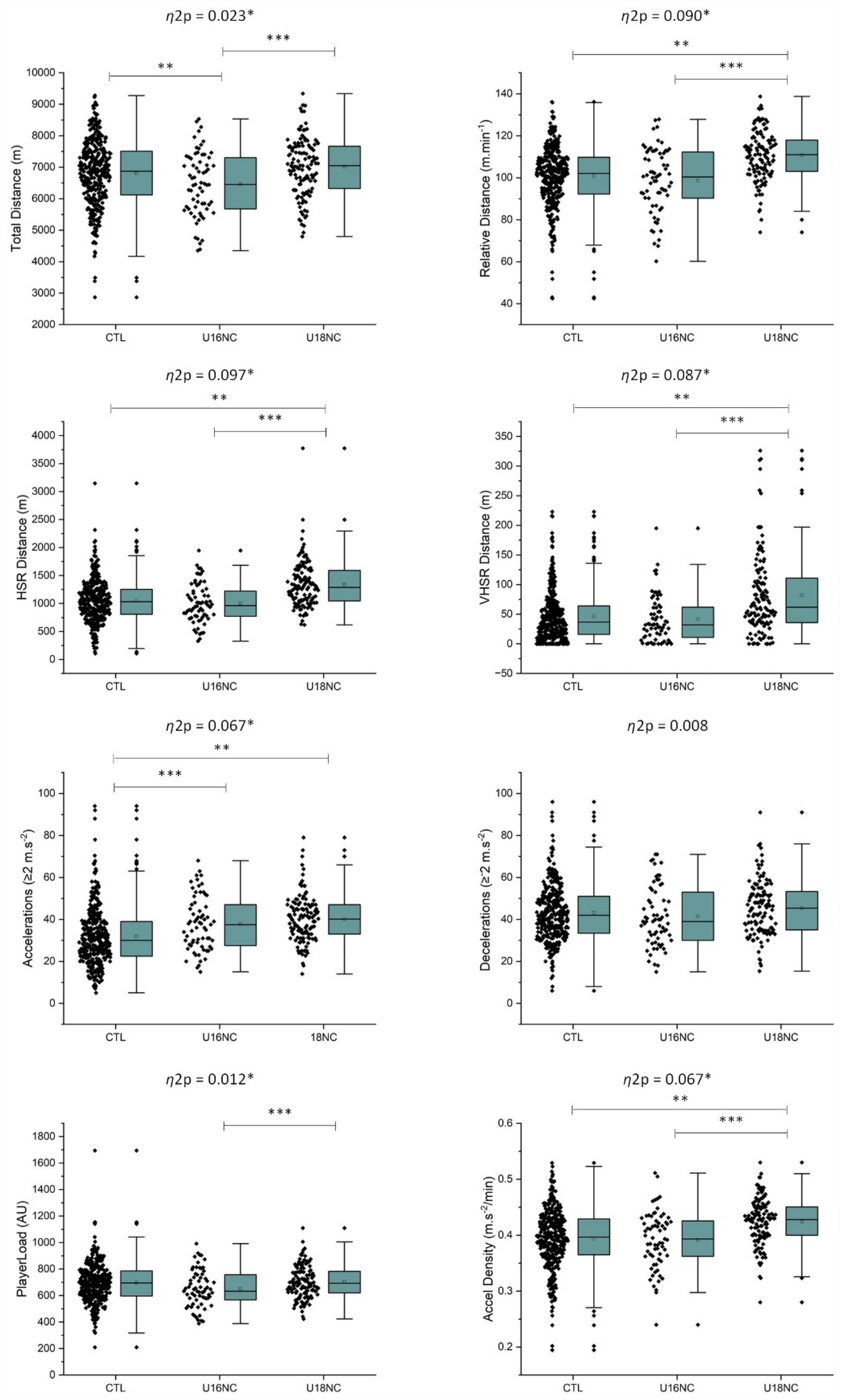
Female match-play activity profile for U16 Nationals, Coates Talent League, and U18 Nationals Australian Rules football. CTL = Coates Talent League, U16NC = Under 16 Nationals, U18NC = Under 18 Nationals, HSR = high-speed running, VHSR = very high-speed running, * statistical significance, ** significantly different from CTL, *** significantly different from U16. p = ≤0.05.
Technical demands and disposal efficiency are presented in Figure 2. Apart from disposal efficiency (small effect, d = 0.29), the technical demands of U16NC and U18NC were comparable (trivial effects, d = 0.03 to 0.16). Both U16 and U18 competition though, had greater possession, disposal and marking demands than CTL competition (trivial to small effects, d = 0.19 to 0.48). The CTL had the poorest disposal efficiency, followed by the U16NC and lastly the U18NC. When technical involvements were pooled together (possessions and pressure acts), CTL had fewer technical involvements than both U16NC (96%) and U18NC (93%).
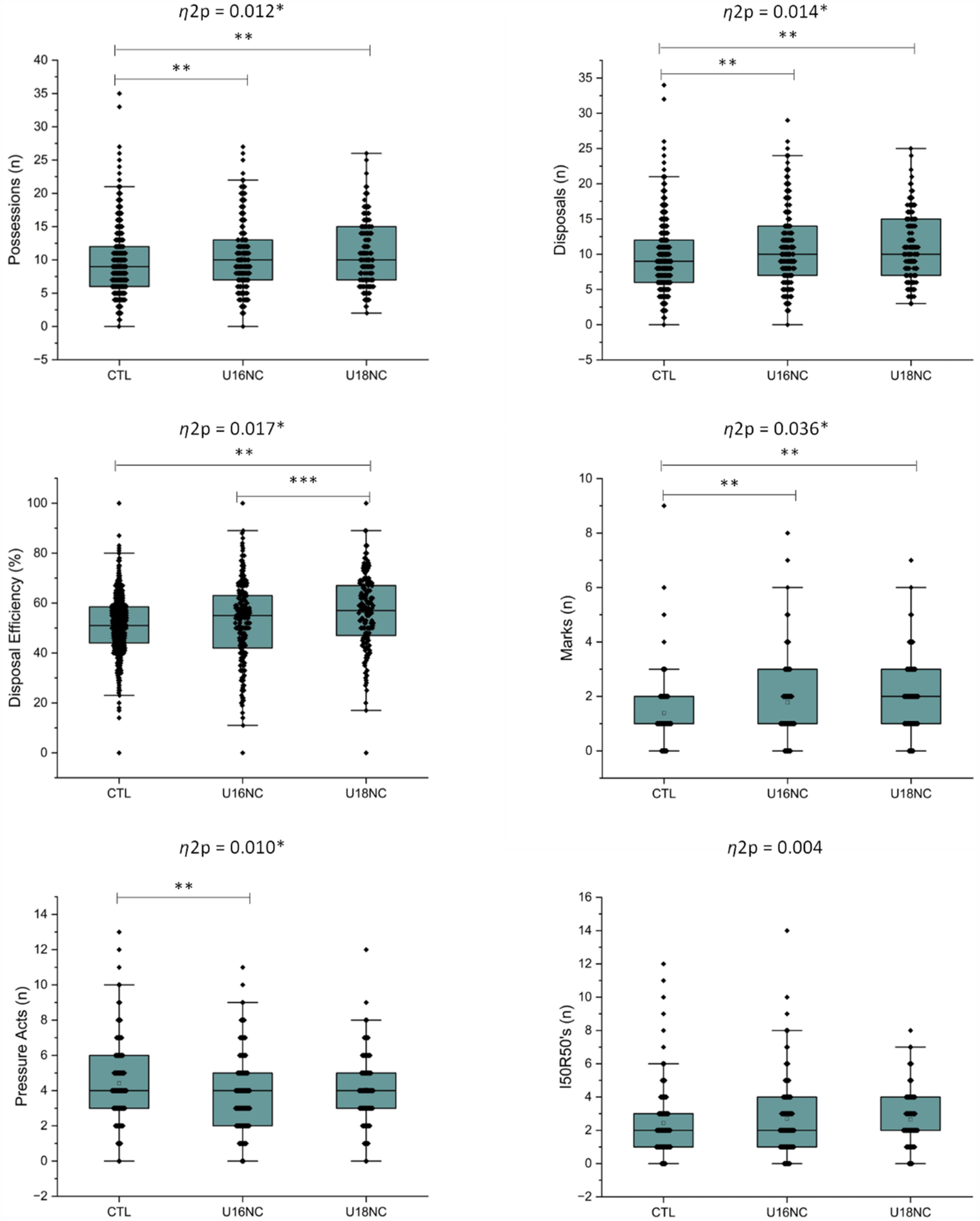
Female match-play technical profile for U16 Nationals, Coates Talent League, and U18 Nationals Australian Rules football. CTL = Coates Talent League, U16NC = Under 16 Nationals, U18NC = Under 18 Nationals, I50R50's = Inside 50's and Rebound 50's, * statistical significance, ** significantly different from CTL, *** significantly different from U16. p = ≤0.05.
Discussion
This is the first study to quantify and compare player activity and technical demands in elite-junior female Australian Football at different levels of competition. Results suggest that the relative activity demands of match-play increase with age and playing level (U16NC followed by CTL and U18NC), as do the HSR demands. When comparing technical demands (number of involvements), offence-related involvements during CTL match-play are fewer than those experienced in the U16NC and U18NC.
As expected, the greatest difference in activity demands were between U16NC and U18NC, with the latter being the more demanding. There were only three U18NC activity variables that did not exceed those experienced in CTL, namely TD, decelerations, and PlayerLoad. The CTL generally displayed greater activity demands than the U16NC yet was not as demanding as the U18NC. Collectively, these findings suggest that as players progress through the talent pathway with age or state selection honours, they will be required to undertake running volumes, and compete at an intensity they might not have been exposed to previously. Practitioners along the talent pathway can use this information to ensure that players selected for National Championship representation have been exposed to the appropriate activity demands in their respective CTL environments prior to competition.
Offence-related technical involvement demands were lower in the CTL than U16NC and U18NC. Conversely, pressure acts were greater in the CTL than the U16NC. These findings suggest that players competing in the U16NC and U18NC may be more offensively proficient than their CTL counterparts, while the CTL competition itself may be more contested in nature. It is therefore likely that technical skill might be more related to competition level than age in elite-junior female Australian Football. This suggestion is supported by previous research which showed elite-senior and high-level junior players performed better in kicking and handballing tests than both junior and senior non-elite players. 16 Greater offence-related technical involvements (disposals, possessions and disposal efficiency) have been associated with better team performance (score margin, match outcome and ladder position), suggesting that these skills are an important selection consideration for representative competition.9,17 Together, these findings provide sufficient justification for the non-negotiable prioritisation of technical skill development throughout the talent pathway. This will likely indirectly increase the flow and relative running demands of match-play to positively support the physical development of players.
When comparing the match-play activity demands of the talent pathway to the AFLW, the most notable differences were the RD and VHSR demands. Players in the AFLW cover 117m·min−1 on average, compared to 111 m·min−1 in the U18NC, while VHSR distances are reported to be two to three times higher (107–238 m) in the AFLW than those experienced in elite-junior (48–85 m) competition.4,17,18 Other activity variables (TD, HSR and PlayerLoad) are similar between elite-junior and AFLW competition levels.4,5,18 These findings oppose those that are reported in the male talent pathway, where the relative activity demands do not differ between the CTL and AFL.4,5,18
The technical demands of both U16NC and U18NC match-play exceed those of CTL, and those reported within the AFLW literature.5,9,19 However, while they might perform more technical involvements, data suggests that elite-juniors are less skilled, with lower disposal efficiency than their AFLW counterparts (elite-juniors: 51–56%; AFLW: 59%). 9 These findings provide evidence of organic technical development as players progress through the talent pathway, and that the most skilled players are generally drafted. Coaches should therefore continue to emphasise the technical element of the game in their training to provide their players with the best possible chance of continued success.
Contextually, both activity and technical demands must be considered together. Activity demands are likely to be impacted by the collective level of technical skill on display in the match. More specifically, if the technical efficiency is lower (e.g., CTL vs U18NC), the ball is transitioned less effectively, creating more errors, decreasing the overall flow and in turn, the relative distance demands. Further, players are afforded less opportunity to reach HSR and VHSR thresholds due to an increased number of contests and stoppages. The authors believe that if the talent pathway continues to prioritise technical skill development, it is not inconceivable to expect that the relative activity demands could more closely align between the female talent pathway and the AFLW, as seen in the male equivalents. Regardless, with demand increases already reported in the AFLW literature, 6 future research must remain in line with the current growth and evolution of the female game.
The applied nature of this research presents several limitations. First, as this is large-scale, league-wide data that were collected by individual teams and archived by the AFL, it is assumed that all data have been collected in the same manner across teams and competitions. That is, GPS devices turned on with sufficient time for satellite lock, quarter durations were accurate, and that where possible, the same player wore the same unit over the course of the season. Similarly, it is assumed that technical involvements were all coded using the same essential criteria. Second, it must be acknowledged that there is a substantial performance gap that exists between teams, particularly in the CTL competition. Score margins can be large in some games which is likely to affect both activity and technical demands of both teams differently to more competitive matches. Thirdly, while comparisons were made to the elite-senior AFLW within this study, it must be acknowledged that there are various senior sub-elite competitions that exist under the AFLW, such as the Victorian Football League - Women's (VFLW). These demands were not considered in this study as they are not considered part of the elite talent pathway, however, could be considered in future demand research. Finally, it was outside the scope of this study to examine the peak or positional demands of match-play, two areas that would allow more specific training to be prescribed when being applied in practice.
Relative distance and HSR distance are the most notable variables that increase as players progress along the female talent pathway. Regardless of age, technical efficiency improves, and players have more technical involvements when the during National Championships match-play, when compared to the CTL. As players progress into the AFLW, the activity demands increase, while the number of technical involvements decreases. This is most likely due to being able to transition the ball more efficiently, over greater distances. These findings can be used to aid the prescription of training within the talent pathway. Evidence also suggests that the female talent pathway is still developing, and resources such as this literature, in conjunction with high-level coaching, could help fast-track a reduction in the gap between elite-junior and elite-senior female Australian Rules football, as has happened in the male game. 9
Practical applications
The relative demands of match-play differ within the elite-junior female pathway. To ensure adequate physical preparation of players, CTL coaches can use the presented demands to aid in the prescription of their training. In the absence of the required technical efficiency, the relative activity demands of the National Championships (111 m·min−1) and AFLW (117 m·min−1) could be periodically introduced through planned manipulation of structured conditioning and drills.
Offence-related technical involvement demands (both volume and efficiency) are greater in the National Championships compared to the CTL. Technical efficiency is also the primary differentiator between elite-junior and AFLW match-play. To improve a player's potential for representative selection or draft success, coaches should focus on improving these qualities, noting that an increase in technical efficiency will likely also facilitate an increase in the relative intensity of their match-play.
Footnotes
Acknowledgements
This research was supported by both the Bendigo Tertiary Education Anniversary Foundation and Holsworth Research Initiative, and the AFL. The authors would like to thank Matthew Glossop and Paul Sealey from the AFL for their support with collating data from the Talent Pathway system.
Author contribution
Consent to participate
This is an approved retrospective study, all participant information was de-identified and consent waived. Participant data will not be shared with third parties.
Data availability
Data will not be made available as it is owned by the AFL and Champion Data.
Declaration of conflicting interests
The authors declared no potential conflicts of interest with respect to the research, authorship, and/or publication of this article.
Ethical considerations
This study received ethical approval from the La Trobe University Research Ethics Committee (HEC20254).
Funding
The authors received no financial support for the research, authorship, and/or publication of this article.

Appendix 1. Female Australian Rules football participation and talent pathways. Adapted from Haycraft et al. (2017). 20