



Abstract
Introduction
Neuromuscular fatigue (NMF; i.e., a temporary reduction to the maximal force- generating capacity of muscle) is commonly implicated in the aetiology of injury risk in young football players.1,2 Indeed, a recent four-year prospective study reported that U-18 and U-19 year old academy football players had the highest injury burden of all academy age groups and that NMF was a causal factor for 64%, 49% and 27% of hamstring, adductor and quadricep injuries in U-18 academy football players 2 respectively. The link between NMF and muscle injury risk might relate to fatigue-induced impairments in force production, reduced eccentric strength, and compromised muscle stiffness regulation, which collectively, might increase susceptibility to strain and tissue damage. 3 Indeed, fatigued muscle might be less able to tolerate high-force muscle contractions and mechanical load, increasing the risk of strain injury, particularly during high-intensity match actions. Consequently, neuromuscular performance tests including the countermovement jump (CMJ) and isometric posterior chain (IPCS) and adductor (IADS) strength tests are commonly used to track the neuromuscular status of players around games across the competitive season. Interventions can then be put in place (i.e., to reduce training and match loads) in order to help mitigate injury risk, with ‘normal’ training loads resuming following the return to baseline performance levels.
Improving the physical capacities that relate to football match demands (i.e., speed, strength and endurance) might improve match play physical performance potential and, in-turn, player ‘readiness’ (i.e., denoting the interplay between player ‘fitness’ and ‘fatigue’4,5). Conceptually, this might help to reduce the relative burden of match play and consequently, the magnitude of match induced NMF.4,5 Indeed, two previous investigations reported that greater endurance (i.e., Yo-YoIR1 performance) and strength (i.e., isometric mid-thigh pull; IMTP performance) capacities were associated with higher match loads and reduced match induced NMF in academy rugby league players.6,7 Though rugby league and football share similar high-intensity intermittent running demands, rugby league typically involves more frequent collisions and prolonged periods of high-force isometric and quasi-isometric actions (i.e., during tackling and contact scenarios), which might result in different NMF responses compared to football. In contrast, academy football match play typically involves a larger volume of acceleration, deceleration, high-speed and change of direction activity, resulting in a large exposure to high intensity eccentric muscle actions. While endurance and strength have been shown to mitigate match-induced NMF in rugby league,6,7 the extent to which these physical qualities influence NMF in academy football remains unclear. To date, only Constantine and colleagues 8 have reported that the greater match running distances achieved by ‘stronger’ (IPCS) U-18 academy football players were accompanied by greater and longer-lasting periods of NMF; attributed to the accrual of additional muscle damage.
Despite there being some research evidence available to describe the moderating effect that strength exerts on match induced NMF in U-18 academy football players, 8 the moderating effects of speed, explosive strength, reactive strength, and endurance capacities have received no research attention in this age group. These physical qualities represent key determinants of performance in football and conceptually, could moderate NMF responses. For example, speed and explosive strength underpin high-intensity football actions including accelerating, sprinting and change of direction, which contribute substantially to neuromuscular strain. Reactive strength, (i.e., the athlete's ability to efficiently utilise the stretch-shortening cycle (SSC)), may influence the extent to which players can tolerate mechanical loads associated with these match actions. Additionally, it is well established that endurance capacity is fundamental for sustaining high-intensity efforts across a full match. 9 Consequently, it might help to mitigate NMF by virtue of improving metabolic efficiency and recovery between high-intensity efforts.
Understanding how physical capacities interact with match-induced NMF in academy football players is particularly important owing to the fatigue related injury risk in this population.1,2 Unlike collision based sports examined before, (i.e., rugby league6,7), where contact is proposed to contribute to fatigue, football-related NMF is likely driven more by the cumulative effects of repeated explosive efforts and eccentric muscle loading. 10 Therefore, investigating how speed, explosive strength, reactive strength, and endurance capacities relate to NMF may provide new insights into how academy players can better tolerate match demands and mitigate injury risk and performance decrements across the competitive season.
Given the particular injury risk faced by U-18 academy football players and the influence that NMF can exert on exacerbating this relationship,1,2 the purpose of this investigation was to identify and examine new hypotheses relating to the moderating effects that speed, strength, and endurance capacities might exert on match-induced NMF in English Premier League (EPL) U-18 academy players. These insights might help coaches and practitioners to prioritise the development of physical qualities that best mitigate the fatiguing effects of match play.
Methods
Match induced neuromuscular fatigue testing
Fourteen elite-level (i.e., tier 5 as per the Participant Classification Framework 11 ) U-18 players (age = 17.0 ± 0.7; height = 1.82 ± 0.07 m; body mass = 73.5 ± 7.6 kg) from one EPL academy team attended two testing sessions around 8 competitive league home games that were evenly distributed (i.e., 2 games per season quarter) across the 2023–2024 season. Sample size was determined by the available squad size and the number of player – match observations. While no a-priori power analysis was conducted owing to these practical limitations, the research design aimed to enhance statistical sensitivity by employing a repeated measures design across a single homogenous cohort. Consequently, both effect sizes (ES) and confidence intervals are reported in our results to aid interpretation of the findings (given the sample size constraint). Match load was measured using sports global positioning system (GPS) and micro electrical mechanical sensor (MEMS) devices (Statsports APEX, Belfast, Northern Ireland, UK), sampling at 18 Hz (GPS) and 952 Hz (tri-axial accelerometer). All games kicked off at 11:00 AM and testing was conducted at: 1) 09:00 the day before match day (MD), (i.e., MD-1), and 2) 09:00 two-days post-match (MD + 2). These time points were chosen based on our previous findings that match induced changes to the chosen NMF measures peaked at 48 h post-match in a similar cohort. 10 On each test day players completed three CMJ, IADS and IPCS tests according to methods described previously.10,12 Variable selection for these tests was based on our previous research examining the reliability 12 and responsiveness 10 of these tests to match play in a similar cohort. Accordingly, chosen test variables were jump height (JH) for the CMJ and peak force (PF) for IADS and IPCS. All data were collected during single-game weeks and no data were analysed from games in which extra time was played. Data from players who played > 75 min were included in the analysis (mean ± SD = 85.8 ± 8.7 min). The match duration threshold was based on the combined need to ensure sufficient match exposure to induce NMF whilst maximising the total number of player-match observations. Indeed, our previous work, and other scientific literature indicate that NMF is typically observed when elite level academy football players exceed ∼75 min of match play.10,13,14 Ethical approval (application number: 2021-21_230) was provided by the *Insert institution name following peer review*, Human Research Ethics Committee and written informed consent and parental consent were obtained from all players and a parent / legal guardian.
Physical capacity testing
Explosive strength (CMJ jump height), reactive strength (30 cm drop jump (DJ)), speed (10 m and 30 m linear speed), maximal strength (IMTP) and endurance (1 km Time Trial (TT)) capacities were measured at 4 time points evenly distributed across one competitive season under replicable conditions: 1) at the beginning of pre-season, 2) at the end of pre-season, 3), half-way through the competitive season and 4) at the end of the competitive season. At each time point, three test efforts were completed for CMJ, DJ, linear speed and IMTP and one test effort was completed for 1 kM TT. Jump, speed and strength measures were conducted in an environmentally controlled performance centre and the 1 km TT was conducted on an outdoor grass pitch at the team's training facility.
Within-participant variability for the physical performance tests was calculated using the coefficient of variation (CV) according to the following equation
15
:

Average within-participant CV's for CMJ jump height, DJ RSI, IMTP, 10 m linear speed and 30 m linear speed across the experimental period were 2.85%, 6.58%, 2.37%, 1.33% and 0.85% respectively.
For all test dates, testing started at 10:30 AM the day after a recovery day, five days after the most recent game (i.e., MD-2). All players had routinely performed these tests for at least one full competitive season and were therefore considered to be highly familiar with all protocols. Prior to testing, players performed a standardised 8-min warm-up following a RAMP protocol: ∼4-min of low-intensity running and gross-motor warm-up exercises and ∼4-min of dynamic mobility and sprint mechanics exercises. Physical capacity test methods are explained in order of their administration below. 5 min of recovery were allocated between each performance test type.
Explosive strength
Explosive strength was assessed using CMJ and bilateral 30 cm drop jump (DJ) tests according to EPL academy testing recommendations. CMJ testing and force plate calibration procedures for all jump measures are described previously.10,12 Drop jump testing was performed from a 30 cm box onto dual force plates (ForceDecks FD4000, Vald Performance, Brisbane, AU), sampling at 1000 Hz according to methods described previously.
16
Force-time curves were analysed automatically using proprietary software (ForceDecks Version 2.0.8000, Vald Performance, Brisbane, AU). Players performed three DJs, separated by ∼30 s during which they were cued to ‘step off of the box using their preferred foot’, to ‘land with both feet on the force plates at the same time’ and to ‘minimise ground contact time and jump as high as possible’.
16
Players were required to keep their hands on their hips for the entirety of each jump. All jump testing was conducted by the same experienced practitioner. In cases where a measurement error was observed (i.e., ‘jumping’ or ‘stepping down’ from the box, ‘tucking’ or ‘piking’ the legs during the flight phase, or if they did not land on the force plates), data were omitted, and the player was asked to perform another repetition. Variables of interest for the CMJ and DJ were JH (flight time) and modified reactive strength index (RSI), respectively. Modified RSI was calculated using the using the equation
17
:

Speed
Speed was assessed using 10 m and 30 m linear speed tests according to EPL academy testing recommendations. Accordingly, testing was conducted indoors, on a FIFA approved artificial pitch, with speed gates (Brower TCi Timing System, Draper, USA) fixed at a height of 0.9 m. Prior to testing players completed three progressive submaximal and one maximal 20 m warm up sprints. After three minutes of recovery, players performed three maximal 30 m test sprints separated by 3-min of recovery. Players used a two-point start with their preferred foot positioned forwards behind a start line. Players were cued to ‘sprint maximally through the three speed gates’ which were positioned at 1) a zero line (1 m in front of a start line) 2) 10 m in front of the zero line and 3) 30 m in front of the zero line. Players were cued to avoid using a countermovement and self-selected when to initiate each sprint. Variables of interest were the fastest times (s) attained from the three maximal efforts for both the 10 m and 30 m tests.
Strength
Strength was measured using the IMTP according to methods described previously. 18 Players performed three submaximal 4 s IMTP efforts progressing from 60% to 90% of perceived maximal effort followed by three maximal ‘test’ efforts with one minute of recovery allocated in between. Testing was conducted in a bespoke, fixed isometric strength testing rig (Blk Box Fitness, Newtownabbey, UK), with embedded dual force plates (ForceDecks FD4000, Vald Performance, Brisbane, AU), sampling at 1000 Hz. Acceptable posture was defined as adopting a knee angle between 120–145°, and a hip angle between 140–150° whilst maintaining the trunk in an upright position, confirmed using a goniometer (Physio Parts, Twickenham, UK). 18 Players used an overhand clean grip, with the hands ‘fixed’ to the bar using pulling straps (Eleiko, Halmstad, Sweden). 18 Prior to testing, players were asked to adopt a rigid torso whilst avoiding pretension or countermovement and were cued to ‘push your feet into the ground and pull on the bar as fast and as hard as possible’. Players were given a countdown of ‘3, 2, 1, pull’ and were cued to ‘pull, pull, pull, pull’ across the 4 s test and then to ‘relax’. 18 The best relative peak vertical force (N/kg) attained from the 3 test efforts was calculated automatically from force-time curves using proprietary software (ForceDecks Version 2.0.8000, Vald Performance, Brisbane, AU).
Endurance
Endurance was measured using a 1 km TT according to methods described previously,19,20 and as recommended by the English national Football Association. 19 Players completed ten 100 m shuttle runs between a zero and a 100 m line, which were marked out by cones, and were cued to complete the target distance as quickly as possible. Two test administrators were positioned at each line to ensure that all players completed the correct distance for each shuttle. Total time required to complete the test (s) was recorded.19,20
Data analysis
The match induced change for each NMF test between MD-1 and MD + 2 was calculated for each player - match observation. The average change for each NMF test across the experimental period was then calculated for each player. The average match induced change for each NMF test was then associated with the in-season average result for each physical capacity test for each player. This enabled examination of the relationship between match induced change to each NMF test and performance in each physical capacity test.
Statistical analysis
All statistical analysis was conducted in R version 4.3.3 (R Foundation for Statistical Computing, Vienna, Austria). Normality of data were examined using Shapiro-Wilk tests and by visual examination of Q-Q plots. The linear relationship between the mean match induced change for each NMF measure (i.e., CMJ, IPCS and IADS) and the season average physical capacity measure (i.e., CMJ, DJ, 10 m speed, 30 m speed and 1 km TT) was examined using Pearson's R (r) correlation coefficients if assumptions of linearity and homoscedasticity were met, and by Spearman Rank correlation coefficients (rho) if assumptions of normality were violated (i.e., Shapiro-Wilk: p > 0.05). Significance was set at p < 0.05. The ES of relationships were interpreted as: r or rho < 0.1 = trivial; 0.1–0.3 = small; 0.3–0.5 = moderate; and >0.5 = large. 21
Results
Descriptive statistics
Average match duration, total distance, high metabolic load distance and sprint distance across the experimental period were 97.9 min, 10,291 m, 2073 m and 264 m.
Descriptive statistics for the match induced changes to NMF tests and physical capacity tests are shown in Tables 1 and 2, below.
Descriptive statistics for match induced NMF test measure changes between MD-1 and MD + 2.
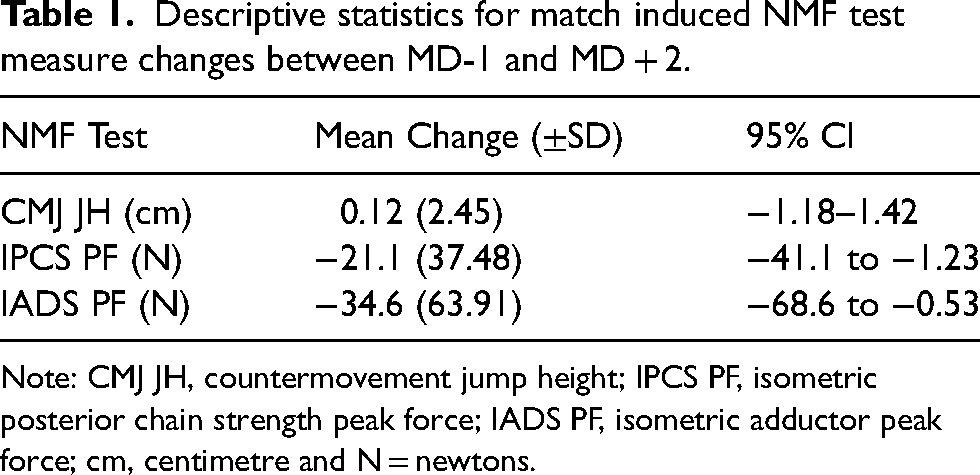
Note: CMJ JH, countermovement jump height; IPCS PF, isometric posterior chain strength peak force; IADS PF, isometric adductor peak force; cm, centimetre and N = newtons.
Descriptive statistics for physical capacity test measures.
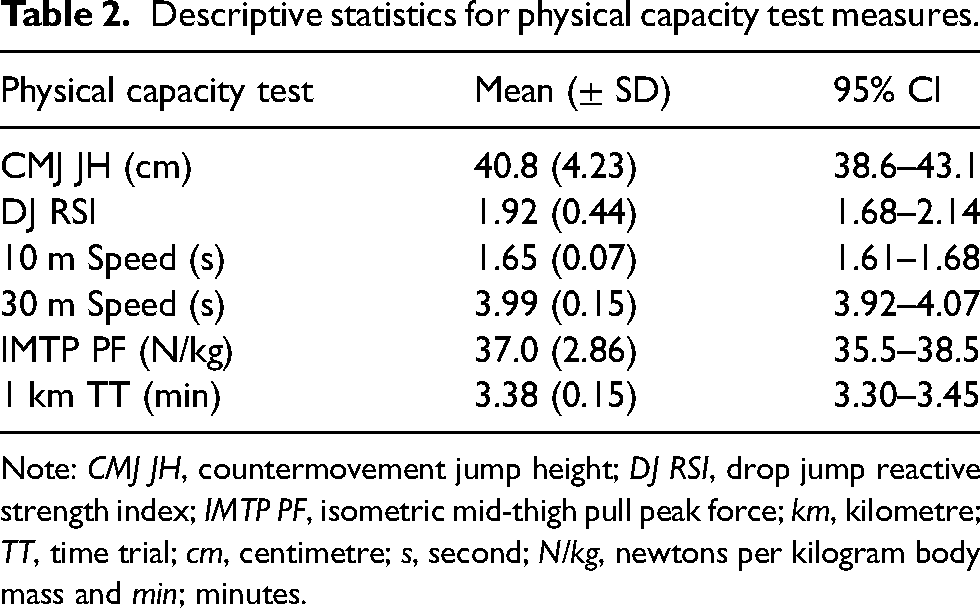
Note: CMJ JH, countermovement jump height; DJ RSI, drop jump reactive strength index; IMTP PF, isometric mid-thigh pull peak force; km, kilometre; TT, time trial; cm, centimetre; s, second; N/kg, newtons per kilogram body mass and min; minutes.
The relationships between match induced changes to CMJ JH, IADS PF, IPCS PF and each physical capacity test are shown in Figures 1–3, below. Change to CMJ JH shared non-significant, moderate positive relationships with DJ RSI and IMPT (Figure 1). Change to IADS PF shared non-significant small negative relationships with 10 m Speed, 30 m Speed, CMJ JH and DJ RSI (Figure 2). Change to IPCS PF shared non-significant small negative relationships with 10 m Speed and 1 km TT (Figure 3). All other relationships were neither statistically significant or practically important, (i.e., ES = trivial), (Figures 1–3).
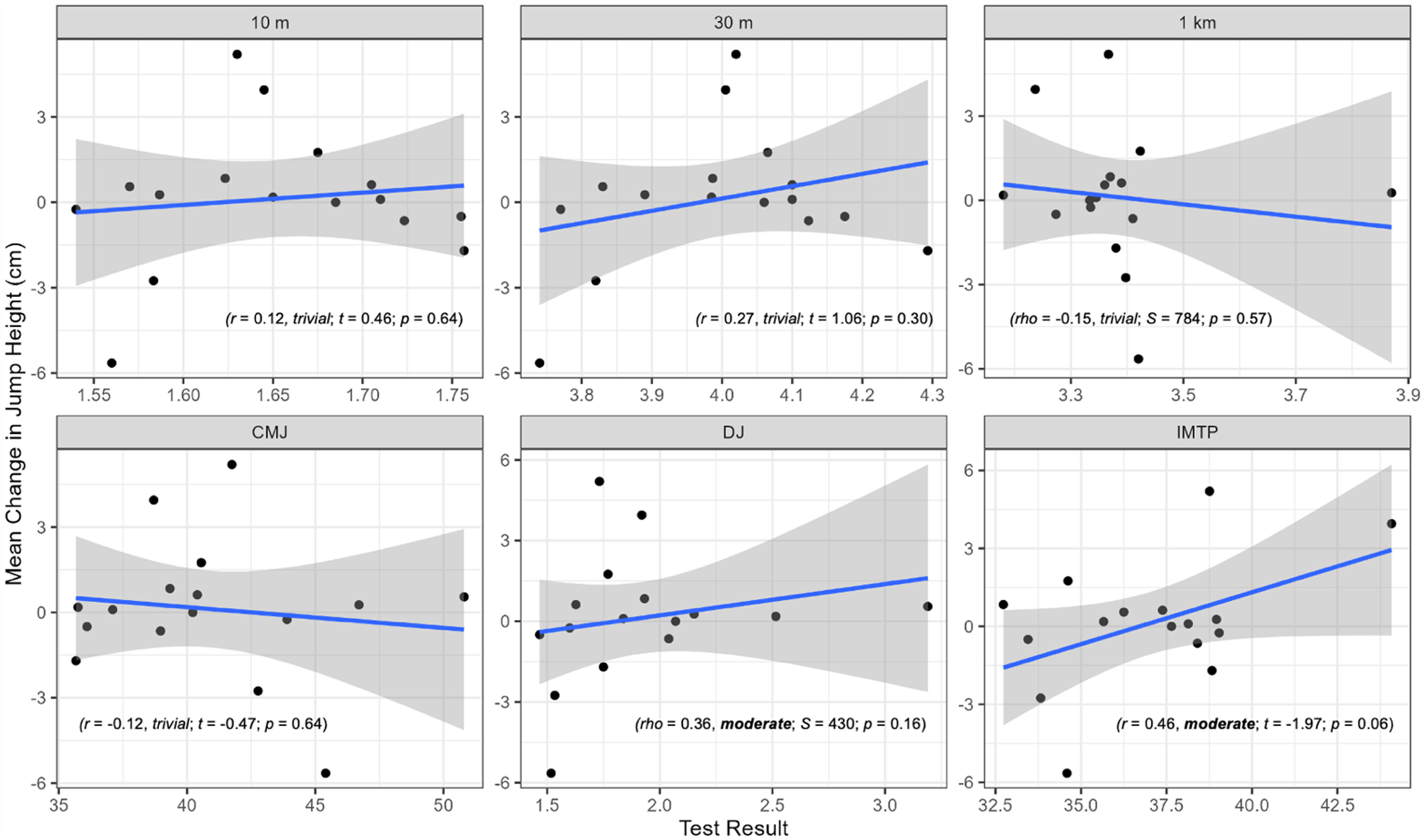
Linear relationships between match induced change to CMJ JH and physical capacity test performances: CMJ JH (cm), DJ RSI (m/s), 10 m speed (s), 30 m speed (s), IMTP PF (N) and 1 km TT (min). Pearson's R correlations are presented as r value, effect size, t value and p value. Spearman's Rank correlations are presented as rho value, effect size, S value and p value. The grey area depicts the upper and lower 95% confidence intervals (CI).
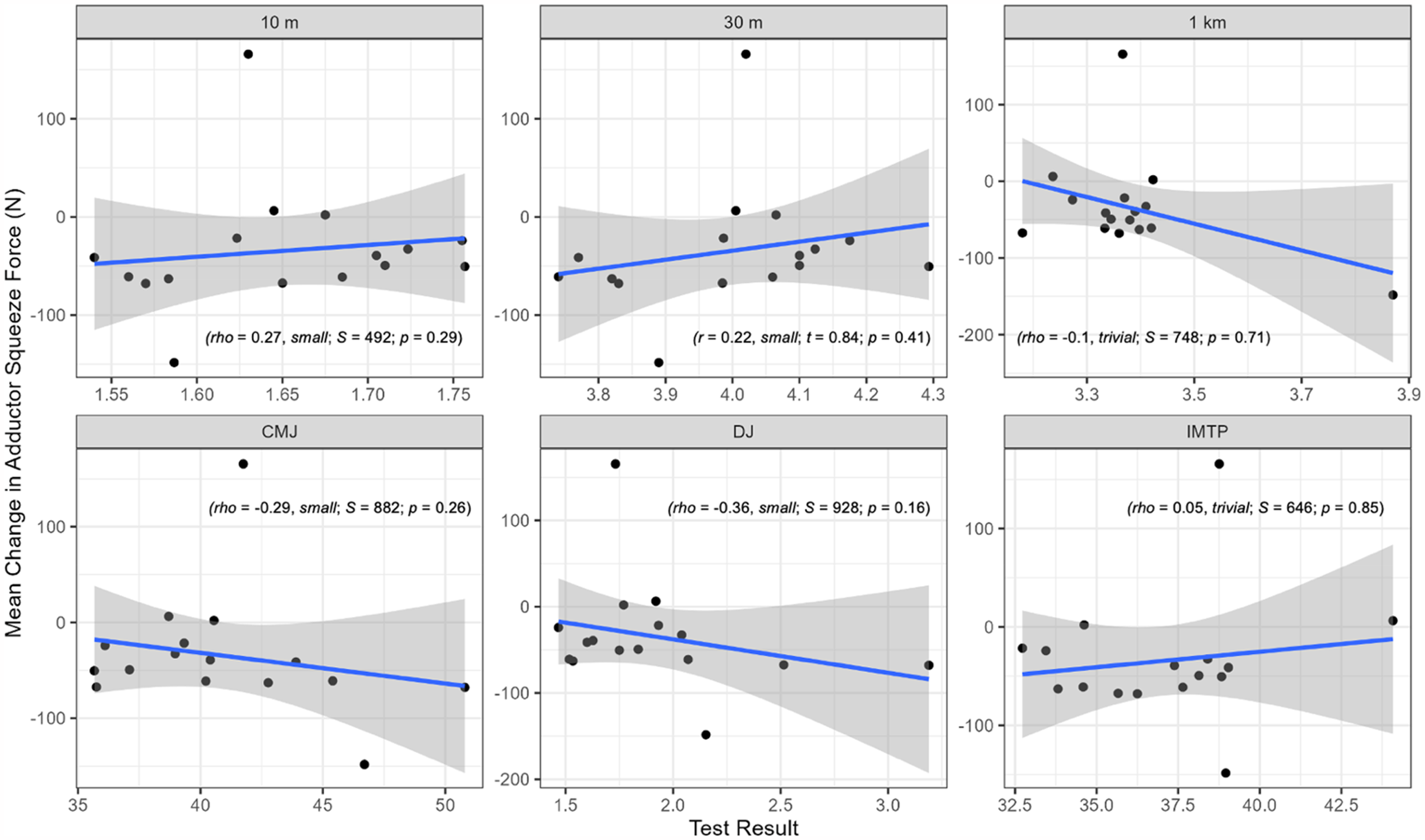
Linear relationships between match induced change to IADS PF and physical capacity test performances: CMJ JH (cm), DJ RSI (m/s), 10 m speed (s), 30 m speed (s), IMTP PF (N) and 1 km TT (min). Pearson's R correlations are presented as r value, effect size, t value and p value. Spearman's Rank correlations are presented as rho value, effect size, S value and p value. The grey area depicts the upper and lower 95% confidence intervals (CI).
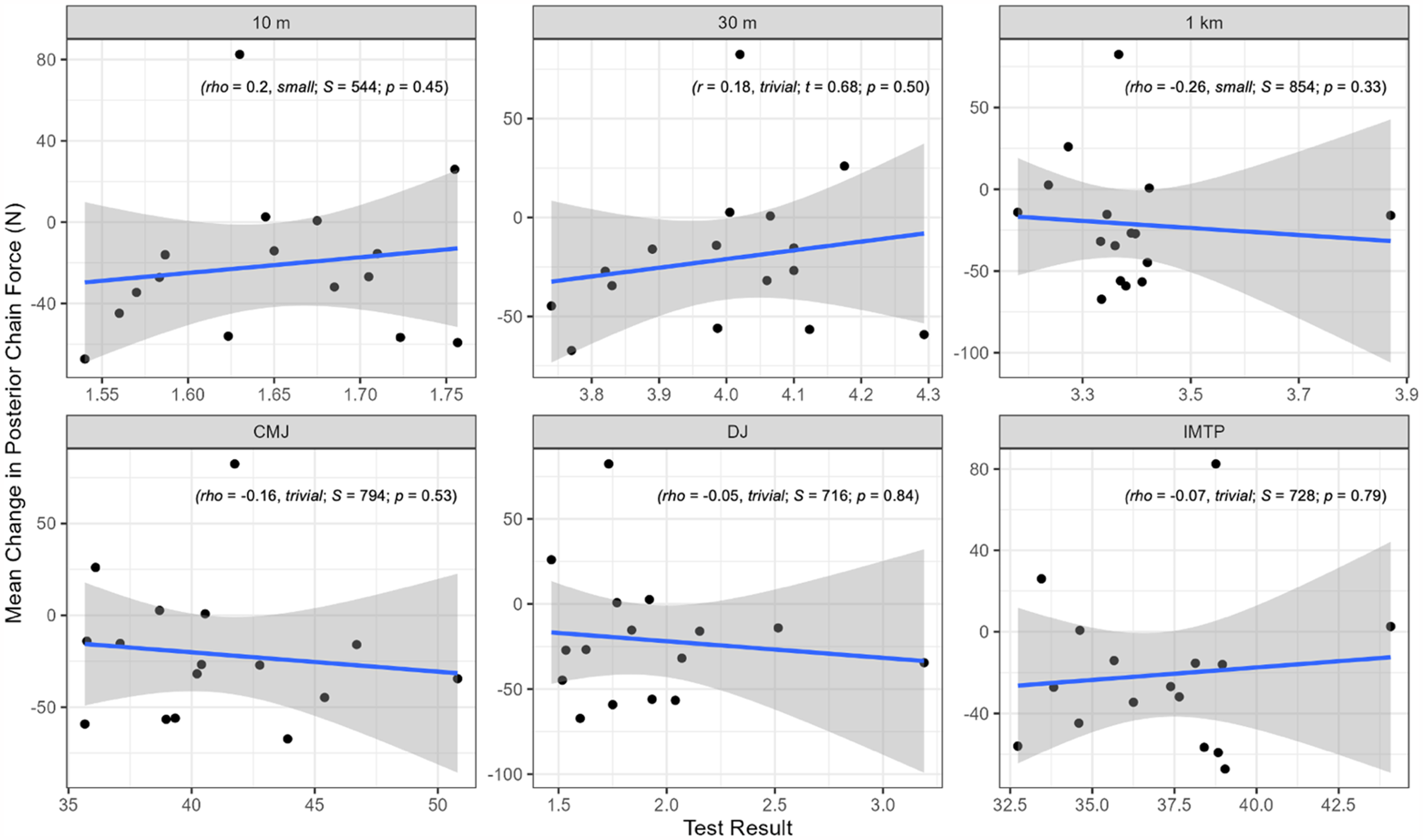
Linear relationships between match induced change to IPCS PF and physical capacity test performances: CMJ JH (cm), DJ RSI (m/s), 10 m Speed (s), 30 m Speed (s), IMTP PF (N) and 1 km TT (min). Pearson's R correlations are presented as r value, effect size, t value and p value. Spearman's Rank correlations are presented as rho value, effect size, S value and p value. The grey area depicts the upper and lower 95% confidence intervals (CI).
Discussion
The purpose of this case report was to identify new hypotheses relating to the moderating effects of speed, strength, and endurance capacities on match-induced neuromuscular fatigue (NMF) in English Premier League (EPL) U-18 academy players. All interactions were not statistically significant; therefore, relationships should be interpreted in conjunction with the ES and 95% CI presented in Figures 1–3. Overall, our most important findings are that maximal (IMTP) (p = 0.06) and reactive (DJ RSI) (p = 0.16) strength qualities shared moderate positive relationships with match-induced changes to CMJ JH (Figure 1). These observations generate important hypotheses relating to the potential role that maximal and reactive strength might play in mitigating NMF in academy football players and warrant further investigation.
Our finding that maximal strength shared a moderate positive relationship with match-induced NMF (Figure 1) is consistent with previous research in young Rugby League6,7 and senior professional football 22 players. Indeed, Johnson and colleagues reported that greater maximal strength (i.e., 3RM back squat) was associated with higher match loads and reduced match induced muscle damage6,7 and NMF (CMJ peak power) 6 in elite level young Rugby League players. It was proposed that strength training adaptations (i.e., muscle fibre type distribution, calpain activity and / or force generating capacity 23 ) provide protective effects against match induced muscle damage and NMF. Importantly, similar effects were also observed by Owen and colleagues, 22 who reported that ‘stronger’ (3RM back squat) senior professional male football players exhibited less match-induced muscle damage than ‘weaker’ players at 48 h post-match. Overall, this finding supports a hypothesis that maximal strength might serve to ‘mechanically protect’ young football players against NMF. Current evidence indicates that this might occur by virtue of mitigating the mechanical fatigue consequences of match play. 13
A potential explanation for this relationship relates to the role that strength adaptations might exert on enhancing fatigue resistance. For example, strength training can induce important changes to muscle fibre composition, potentially favouring a greater proportion of Type IIa fibres, which exhibit a higher oxidative capacity compared to more fatigable Type IIb fibres. 24 Consequently, we speculate that this adaptation might serve to improve force-generating capacity and resistance to NMF during match play. Additionally, it is also possible that ‘stronger’ players also exhibit greater tendon stiffness and fascicle length, which might contribute to improve efficiency in force transmission and by virtue of this, reduce eccentric-induced muscle damage, giving rise to NMF.25,26
It is feasible that neural adaptations associated with strength, power and speed training could play a role in mitigating NMF and serve to pretext against NMF. For example, increased motor unit recruitment efficiency and rate coding might enable stronger players to maintain force output with lower relative burden and reduce the extent of NMF accumulated during match-play. 27 Moreover, enhanced co-contraction of the stabilising musculature might serve to improve joint stability and by virtue of this, also help to mitigate NMF induced by high-intensity match actions. 28 Future studies examining these relationships might examine muscle fibre composition, neuromuscular efficiency, and muscle-tendon unit adaptations to confirm these mechanisms.
Interestingly, our findings also suggest that reactive strength (DJ RSI) might exert a moderate beneficial effect on match induced change to CMJ JH (p = 0.16), (Figure 1). Though no previous research has examined this relationship, conceptually this finding might be explained by training induced improvements to energy conservation (i.e., greater utilisation of elastic- as opposed to metabolic- energy during high-intensity match activities) and the resultant reduction to match induced muscle damage (i.e., owing to the reduced relative mechanical stress of high intensity match activities) expected with improved SSC efficiency. 14 Indeed, improved SSC efficiency might enable greater utilisation of stored elastic energy in the muscle-tendon unit and reduce reliance on metabolically demanding contractile work. 25 Additionally, improved SSC function is associated with increased tendon stiffness, which in-turn, might enhance the ability to store and release elastic energy. 29 Conceptually, these mechanisms might go some way to explain this relationship, by improving mechanical efficiency and reducing the relative mechanical stress imposed on the lower limb musculature during high-intensity match actions, helping to mitigate NMF.
A further explanation for this relationship might relate to the beneficial role that improved SSC function might exert on muscle fibre strain, by altering the muscle-tendon interaction characteristics. For example, with greater tendon compliance, a more substantial proportion of muscle and tendon length change might occur in the tendon as opposed to muscle fibres, which might serve to reduce the degree of match-induced eccentric muscle damage. 30 Indeed, this mechanism might be particularly relevant during high-force eccentric match actions that likely contribute most substantially to NMF. 31 Additionally, enhanced motor unit synchronisation and pre-activation strategies, might also facilitate improved force transmission and joint stabilisation during explosive actions, 32 reducing the need for compensatory muscle activity and excessive co-contraction, which could otherwise accelerate NMF.
The extent to which reactive strength qualities might help to mitigate NMF in specific musculature remains an important question. We speculate that enhancing SSC function might serve to optimise force attenuation and energy return during dynamic movements, and on this basis suggest that it is possible that reactive strength might exert more profound protective effects on muscle groups that are more dependent on elastic energy storage (i.e., the quadriceps and calf-Achilles complex), as opposed to those that are likely to be more susceptible to match-induced eccentric damage, (i.e., the hamstrings). Of note, the quadricep musculature plays an important role in force attenuation during landing and deceleration tasks in football. 29 Therefore, greater SSC efficiency, characterised by enhanced tendon stiffness and neuromuscular pre-activation, might help to reduce fibre strain and metabolic cost during repeated high-intensity movements. 25 Indeed, this might go some way to explain why players with superior reactive strength could exhibit less match-induced CMJ impairment. Overall, the relationship shared between DJ RSI and match induced changes to CMJ JH generates a further hypothesis that reactive strength qualities might also serve to mitigate match induced NMF in EPL U-18 academy football players. Future research examining the interplay between SSC efficiency, match loads, and neuromuscular performance are required to confirm these hypotheses.
Compared to the anterior chain musculature, the posterior chain and adductor muscles experience particularly high eccentric loading during sprinting and change of direction tasks during match play. Given their role in deceleration and force transfer, these muscle groups might be particularly prone to muscle damage and (consequently), NMF. 28 Since the protective benefits of reactive strength are primarily linked to elastic energy return rather than eccentric force attenuation, it is possible that fatigue in the posterior chain and adductor musculature is less influenced by reactive strength and more dependent on maximal and eccentric strength characteristics. Indeed, this may help explain our finding that 10 m (p = 0.29) and 30 m (p = 0.41) linear speed shared small negative relationships with match-induced changes in IADS PF (Figure 2) and IPCS PF (10 m; p = 0.45) (Figure 3), suggesting that players with greater maximal sprint capacities exhibited greater match-induced NMF. It is feasible that faster players might rely more heavily on hamstring-driven sprint mechanics, which could make them more susceptible to fatigue in muscle groups with a high proportion of Type II fibres. This relationship may also reflect other innate and training-induced differences between faster and slower players. For example, faster players are likely to possess a greater distribution of Type IIa and Type IIb muscle fibres, which, while advantageous for high-force and high-velocity match actions, might be more susceptible to muscle damage and fatigue22,28 Consequently, it is possible that match-induced NMF is more pronounced in readily fatigable muscle groups associated with faster-, compared to slower- players. However, caution should be exercised when interpreting these exploratory findings.
Limitations
Consistent with similar hypothesis generating case reports,6,7,22 our results are underpowered and based on a limited sample size and number of player-match observations. This relates to the well-established challenges of conducting research in elite-level professional football environments owing to factors including player injury, illness, suspension, and team selection, described previously. 22 Consequently, the results herein should be considered with caution and as hypothesis generating only. Indeed, we stress the need for further research drawing upon larger data sets to both confirm the hypotheses proposed and examine their underpinning mechanisms. We acknowledge the presence of individual data points across Figures 1–3 that may appear as outliers in our analyses. Given our limited sample size, these data points likely influenced the observed relationships. While we did not exclude individual data points due to the exploratory nature of this study, future research with larger datasets should investigate whether these findings are consistent when accounting for potential outliers and individual variability. We also acknowledge that other potentially important confounding variables that might relate to the development of NMF (i.e., variability of prior training load, recovery strategies and the effect of playing position) were not considered in our analysis and stress that these limitations should be considered when interpreting our hypothesis-generating results.
Conclusion
Our exploratory findings generate important hypotheses relating to the beneficial moderating roles that maximal strength, reactive strength, and endurance capacities might serve in protecting young football players against match-induced NMF. Additionally, we observed a small positive relationship between 1 km TT performance and match-induced IPCS changes and that greater maximal sprint speeds were associated with increased perturbations to adductor and posterior chain performance, which might be explained by greater fatiguability in faster players. This finding suggests that ‘fast’ players might benefit from improving aspects of endurance capacity and by virtue of this, fatigue resistance, a hypothesis that warrants further exploration. For example, it is possible that enhanced anaerobic capacity might allow faster players to sustain higher concentric power outputs for longer periods of match play, which could mitigate reliance on inefficient eccentric braking strategies that might otherwise contribute to the development of muscle damage and NMF. Evidently, establishing how endurance characteristics might interact with the interplay between speed and NMF in football is important. Consequently, future research should examine the balance between speed and endurance development in fast players to maximize performance and minimise NMF decrements. Finally, the diversity of relationships observed in the individual data points (Figures 1–3) confirms the necessity for individual player monitoring in practice and the potential for CMJ JH and DJ RSI (in particular) to identify players who might be at risk of developing NMF.
The data that support the findings of this study are available from the corresponding author upon reasonable request.
