



Abstract
This study examines how perturbations in badminton singles are created. Therefore, we analyzed the shots that create an advantage for one player, the so-called Impulse. We explore four aspects, including the quality—Positive vs. Negative—of the Impulse, the technique used, the Shot Number, and the conversion rate, all according to the factors of Gender and Age. Our sample comprises 60 matches spanning U15, U19, and Elite levels, with an equal distribution between Men's and Women's matches. Results indicate that Impulses were 64.8% Negative and 35.2% Positive, with no significant Gender or Age differences. Positive Impulses mainly comprise Net shots (Women: 30.1%, Men: 29.8%, Elite: 31.4%, U19: 27.6%, U15: 30.8%), while Negative Impulses predominantly involve Lobs (Women: 26.3%, Men: 29.5%, Elite: 26.0%, U19: 27.4%, U15: 30.3%). In contrast to male players, poor Clears play an essential role in losing a rally in Women's badminton (Women: 21.3%, Men: 13.1%). Temporally, Impulses occur later in Men's and Elite matches than in Women's and Youth's matches (Women: 6.8 (± 5.8), Men: 8.9 (± 8.2), Elite: 10.2 (± 8.8), U19: 7.4 (± 6.3), U15: 5.7 (± 4.8)). For Positive Impulses the conversion rate to point gain is 70.7%, for Negative Impulses the conversion rate to point loss is 86.7%. We conclude that success in badminton singles seems more reliant on avoiding bad shots than executing good ones. Gender and Age differences in shot techniques and timing of Impulses likely stem from the different physical abilities of Men and Elite players compared to the other examined categories.
Keywords
Introduction
Badminton, a sport that has its modern roots in the mid-nineteenth century in British India, 1 is often referred to as the fastest racquet sport in the world.2,3 It is hugely popular around the world, especially in Asian countries. In Indonesia, it is referred to as the country's national sport. 4 Kwan et al. 5 reported that “[…] according to the International Badminton Federation, an estimated 200 million people around the globe play the game […]”. As it has been a permanent part of the Olympic Games for over 30 years, 6 the question of how to win a match has become increasingly attractive for practitioners and scientific literature.
The scientific literature on badminton covers different aspects of the game. These range from the biomechanical aspects, 7 analyses of typical injuries, 8 physical requirements, 3 perception analyses, 9 psychological aspects, 10 physical examinations of the playground equipment, 11 and temporal aspects of the game, such as rally and match duration.12–14 Differences regarding gender and age were studied regarding physiological characteristics, 15 temporal aspects of a match, 16 injuries, 17 and development in the world ranking. 18
Regarding tactical match analysis in badminton, existing studies primarily focus on the first shot(s) or the last shot of a rally. Carboch and Smocek 19 analyzed serve and return situations, which are particularly important in doubles, using data regarding the serve technique—forehand/backhand—, serve laterality—right/left—, serve placement—short/long—, as well as the return shot type—net/lob/drive/drop/smash/clear. Approaches focusing on evaluating the last shot of a rally—a direct winner/error analysis—have also been highlighted. While Abián et al. 12 described the shot types and their frequency distribution, Laffaye et al. 14 only focused on the distribution of winners, forced error, and unforced error without a closer look at the shot type. A distribution of 36% direct winners, 23% forced errors, and 41% unforced errors was reported in this study. The main reason for focusing on only a few shots per rally is that badminton matches consist of hundreds of shots, 13 which makes it very costly to consider every shot. However, there are approaches which try to solve this problem by automatic data collection based on video footage and AI methods. 20 It should also not go unmentioned that another field of tactical analysis in badminton especially treats the match and rally duration. E.g., the aforementioned works of Abián et al. 12 and Laffaye et al., 14 and Abian-Vicen et al., 13 deal with this topic.
Until now, no research has dealt with how perturbations are created in badminton. Often, the decisive shot may not come as the final shot of a rally, given that the inherent “design” of badminton, including shuttle properties, court dimensions, and net height, does not facilitate easy scoring with a single well-executed shot. 21 Therefore, players with similar skill levels must try to gain an advantage during the rally while preventing opponents from gaining the advantage. This can be achieved, for example, by playing well-placed and fast shots to the borders of the pitch. The resulting advantage can convert into a point in subsequent shots or be countered by effective defensive plays from the opponent. We argue that creating such advantages and preventing disadvantageous shots is the most crucial factor for winning badminton.
Based on this idea, Hammes and Link 21 introduced a method for analyzing badminton matches using Dynamic Systems Theory and Perturbations. The authors modeled a badminton rally as a closed dynamic system with the end states (attractor) of a point gain of Team A or Team B. A perturbation in this dynamic system was described as “[…] the shot, which creates the advantage—in other words, changes the dynamic system from the balanced state to a state of instability […]” and in consequence may lead to a scoring opportunity. Similar approaches can be found in football, 22 squash,23,24 and tennis.25,26 The study proposed an observational system for describing perturbations, associated attributes, and operational definitions. It proved that perturbations could be identified with a satisfying inter-rater reliability and showed that an analysis based on perturbations leads to entirely different results compared to a last-shot analysis (e.g., the technique of direct winners were mostly smashes, whereas short net shots created the initial advantage).
While the existing paper of Hammes and Link 21 focuses on the methodological issue of detecting perturbations, the present paper uses this method for performance analysis and explores how perturbations are created in badminton according to gender and age. We organize our paper along four questions: (i) “Are perturbations caused mainly by particularly good shots or rather by bad shots or inaccuracies?”, (ii) “Which shot techniques are primarily associated with a perturbation?”, (iii) “How is the temporal distribution of perturbations?” and (iv) “How is the conversion rate after a perturbation—is the point gained or lost, does the (dis)advantage still exist, or is the rally back in a balanced state?”. The results can help to understand the factors for winning badminton rallies. It can draw insights for training and tactical preparation in competition.
Method
Sample
In line with the objectives of our study, we applied a non-participative observational approach. The data collected relates to 60 matches between August 2022 and May 2023. Twenty matches, each from the Under-15 (U15), the Under-19 (U19), and the Elite level categories were analyzed, with each category divided 50% into Women's and Men's singles. All analyzed players can be classified as at least among the continental to world elite in their respective Age groups. Since each player agreed to videotape matches upon signing their player license, special approval from an ethics committee was not required for this study. Nevertheless, all procedures performed in the study were in strict accordance with the Declaration of Helsinki as well as with the ethical standards of the local ethics committee.
Performance variables
On an operational level, the concept of perturbations was applied to the so-called Keyplay Model. The term Keyplay is a sequence of actions that describe the transition of the rally from a balanced state to a state of instability. A Keyplay consists of up to four consecutive actions: 1) Impulse, 2) Follow-up, 3) Survival, and 4) Convert (details can be found in Hammes and Link 21 ). This study focuses on the Impulse only, which refers to the shot that causes the perturbation and is always the first shot of a Keyplay. With a Survival shot, the defending player tries to re-balance the rally. The Convert shot follows the Impulse, is always carried out by the attacking player and tries to convert the advantageous situation into a point gain. While these three actions represent shots within the Keyplay Model, the Follow-Up does not refer to a shot but a covering behavior, which should create a promising spatiotemporal constellation for the attacking player over the opponent. Most rallies must contain at least one Impulse, the shot that creates instability or directly leads to a point. Multiple Impulses can also occur within a single rally, as they do not automatically convert to scoring a point.
The Impulse can be either Positive, meaning that a particularly good shot creates instability, or Negative, where a particularly bad shot is the perturbation. 21 Hammes and Link 21 addressed the challenge of identifying an Impulse as a subjective assessment of an analyst by providing a set of rules that help to consistently interpret different situations by different analysts. One part of it is the sustainability of instability: the advantage for one player must still be present at least two shots after a potential Impulse (if the rally has not ended until then and the point is already gained based on the Impulse). A precise Net shot with spin from a balanced situation is a suitable example of an often-occurring Positive Impulse, as the opponent then has few options and often plays a high, slow Lob that is too short and possibly can be converted into a point gain. In contrast, a Clear or a Lob from a balanced situation that is too short gives the opponent an advantage and illustrates a Negative Impulse in a good way. This differentiation between a shot that is too short and a shot that is long enough is defined in the ruleset by the landing position of the opponent. When it is behind the double service line, the shot is considered long enough. In contrast, it is considered too short when the landing position of the opponent is on the double service line or in front of it. More information on operationalization can be found in the previously published methods paper. 21
For the Impulse, we collected the shot technique—Net, Lob, Defense, Drive, Clear, Drop, Smash, and Other—, the time when the Impulse happened—Shot Number—and the situation three shots after the Impulse—Point gained/lost, Advantage/Disadvantage still exists, or Advantage not used/Disadvantage survived—as performance variables. The temporal variable Shot Number is always counted regardless of who is playing it, i.e., Player A starts with Shot 1, Player B plays Shot Number 2, and so on.
The videos used include publicly available recordings from bwf.tv and badmintoneurope.tv and own recordings, which were analyzed using Dartfish software. The agreement between two raters of detecting an Impulse with a tolerance of +/- one shot was reported with J(R1, R2) = .80. 21 Based on the commonly identified Impulses, the exact identification of the Impulse, positive or negative, showed a moderate agreement (κ = .70). It was argued that “[…] despite a comparatively small uncertainty of rating, the analysis results will still have merit.” 21
Statistical analysis
To examine the incidence of Positive and Negative Impulses (i), we used all Impulses of the matches in the previously described dataset as statistical units. Here, we examined the groups Total, Gender and Age. While the group Total was compared to an equal distribution, for the group Gender, the examined categories were Men and Women, whereas for the group Age, the examined categories were Elite, U19 (Under-19), and U15 (Under-15). When analyzing the shot technique of Impulses (ii), the temporal distribution of Impulses (iii), and the conversion rate of Impulses (iv), we divided the Impulses into Positive and Negative as statistical units. For each question, we examined the group's Positive/Negative, Gender and Age.
The distributions (in %) of Positive and Negative Impulses (i), shot techniques—Net, Lob, Defense, Drive, Clear, Drop, Smash, and Other—(ii), and characteristics of conversion rates—Point gained/lost, Advantage still exists, or Advantage not used/rebalanced—(iv) were calculated for each category to report relative values. For each category, the temporal distribution of Impulses (iii) is reported by calculating the mean and the median of the Shot Numbers that occurred.
To test the significance of differences (p < .05) in the group Total (i), a χ2 test and χ2 post-hoc tests against an equal distribution were used. The same tests were used to test the significance of categories according to Positive/Negative, Gender and Age (i, ii, and iv). Cramer's V was used to describe the effect size of significant differences. The significant differences in the temporal distribution of the Impulses (iii) were tested using a Mann-Whitney U-test for Positive/Negative and Gender and a Kruskal-Wallis-test with Dunn-Bonferroni post-hoc tests for Age. Here, the effect sizes are described by Rank-Biseral Correlation (r) and Eta-Squared (η2) measure. All calculations were done using Python (Version 3.10.2) and MS Excel.
Results
Incidence of Positive and Negative Impulses
The sample includes 5774 Impulses and 5231 rallies (1.1 impulses per rally by mean). The share of Positive Impulses is significantly lower (35.2%) compared to Negative Impulses (64.8%; χ2 = 258.9, p < .01, v = .15; Figure 1 A). There are no significant differences according to the factors Gender (Figure 1 B) and Age (Figure 1 C).
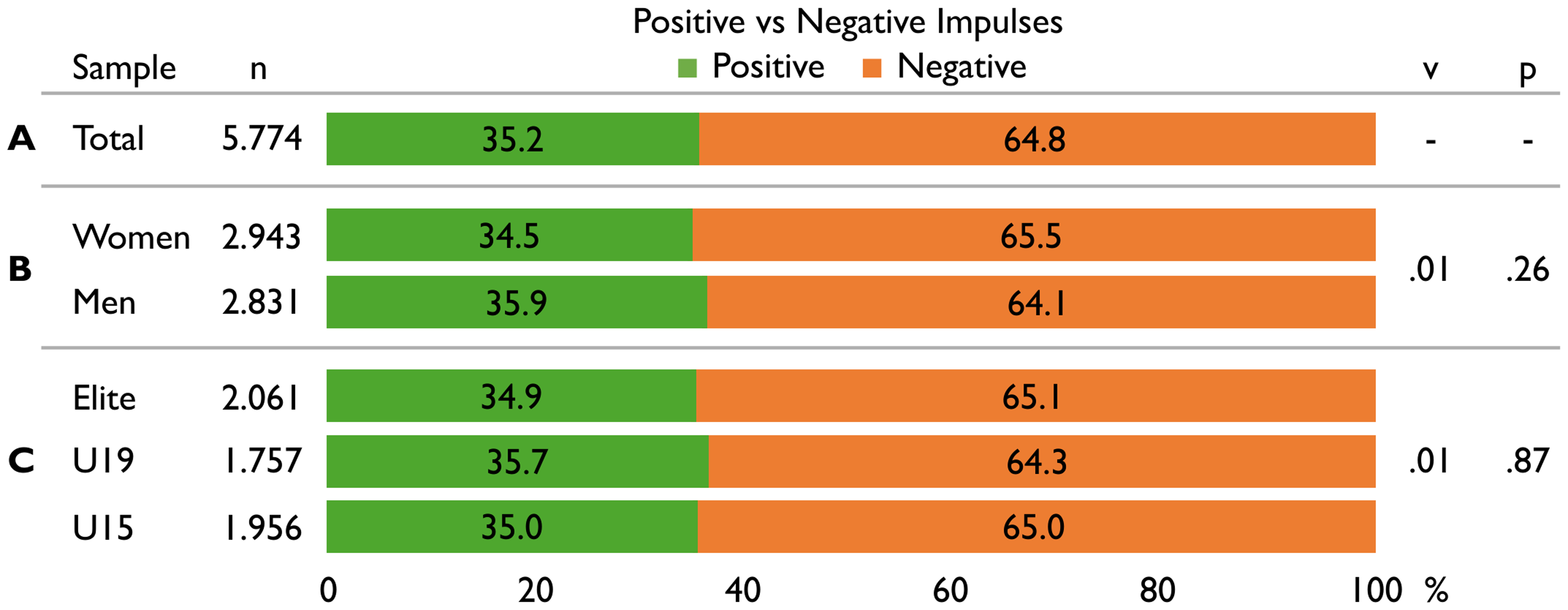
Incidence of Positive and Negative impulses in Total (A) and according to Gender (B) and Age (C). Across all categories Negative Impulses are significantly predominant (between 64.1% to 65.5%) over Positive (between 34.5% to 35.9%).
Shot technique of Impulses
The share of shot techniques in Positive Impulses show a significant difference compared to Negative Impulses (Figure 2 A). Most Positive Impulses are carried out with a Net shot (30.0%; χ2 = 186.3, p < .01, v = .21), Negative Impulses arise mostly from Lobs (27.9%; χ2 = 274.4, p < .01, v = .19).
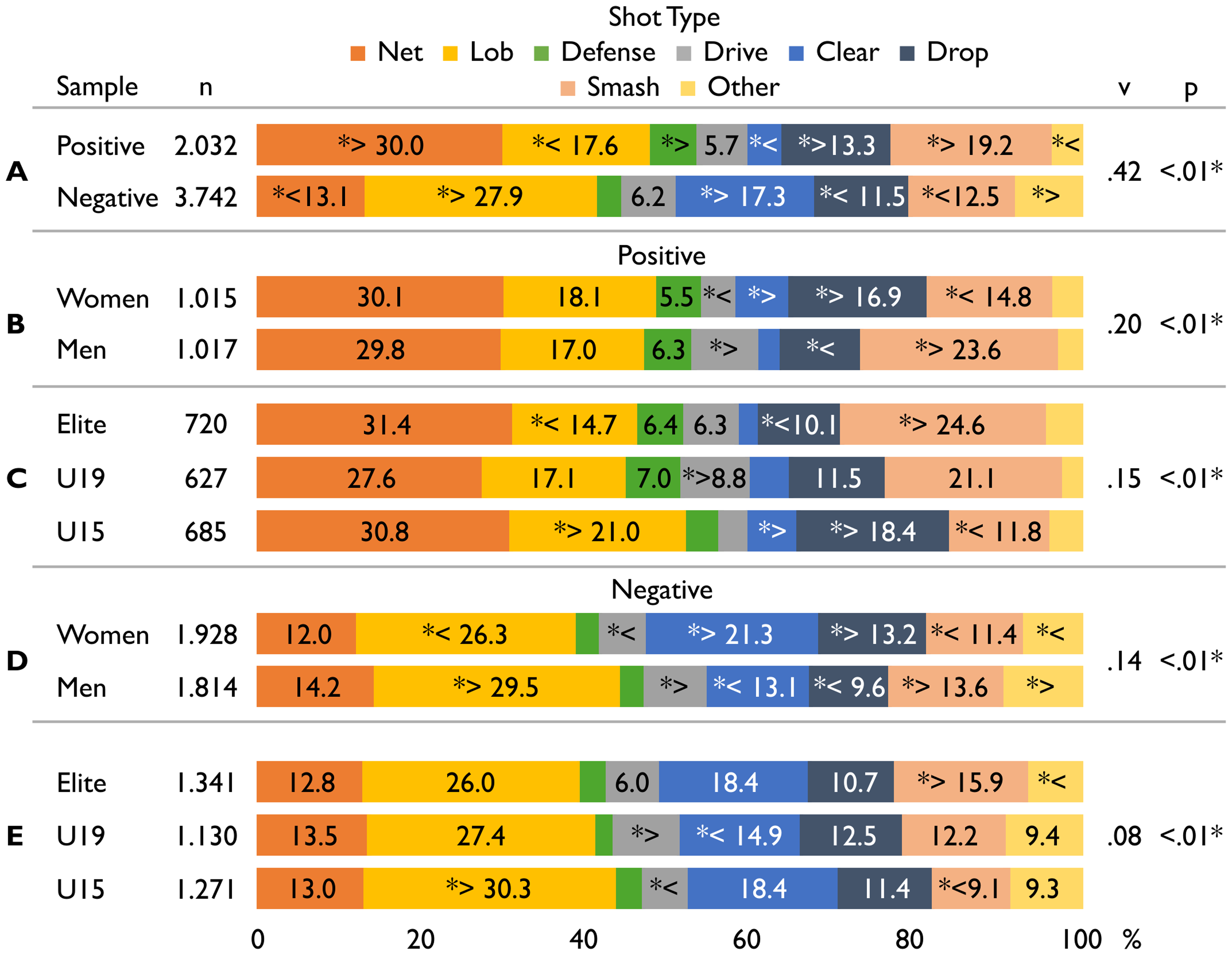
Shot types compared between Positive and Negative Impulses (A) and according to Gender (B and D) and Age (C and E). * indicates significant results. Based on post-hoc tests, the upward (*>) and downward (*<) deviations of specific shot types from their comparison category are shown. Positive Impulses mainly comprise Net shots (30.0%), while Negative Impulses predominantly involve Lobs (27.9%).
For Positive Impulses, Men and Women show significant differences in the shot techniques Drive and Smash, which have a larger share in the Men's category, and Clear and Drop, which are more observed in the Women's category (Figure 2 B). In the Age categories, significant differences are observed for the different shot techniques, namely, in Lob, Clear, and Drop, a significant deviation upwards in the U15 category and a significant deviation downwards in Elite category; in Defense, a significant deviation downwards in the U15 category; in Drive, a significant deviation upwards in the U19 category and a significant deviation downwards in U15 category; and in Smash, a significant deviation upwards in the Elite category and a significant deviation downwards in U15 category (Figure 2 C).
Looking at the Negative Impulses with regard to the factor Gender, we detect significant differences in the techniques Lob, Drive, Smash, and Other, which happen significantly less in the Women's than in the Men's category; as well as in Clear and Drop, which occur significantly more in the Women's category (Figure 2 D). When we compare the Age categories, significant deviations are observed in the techniques Lob, a significant deviation upwards in the U15 category; Drive, a significant deviation upwards in the U19 category and a significant deviation downwards in the U15 category; Clear, a significant deviation downwards in the U19 category; Smash, a significant deviation upwards in the Elite category and downwards in U15 category; and Other, a significant deviation downwards in the Elite category (Figure 2 E).
Temporal distribution of Impulses
The temporal distribution of Impulses is visualized using Shot Numbers. In total, Positive Impulses occurred at Shot Number of 7.6 (± 7.0), which is similar to the occurrence of Negative Impulses (7.9 ± 7.2; Figure 3 A). The Women's category shows a mean value of 6.8 (± 5.8), while the Men's category shows a mean value of 8.9 (± 8.2), which is significantly higher (Figure 3 B). In the Elite category, a mean value of 10.2 (± 8.8) occurs, which is significantly higher than in the U19 (7.4 ± 6.3) and U15 (5.7 ± 4.8) categories (Figure 3 C).
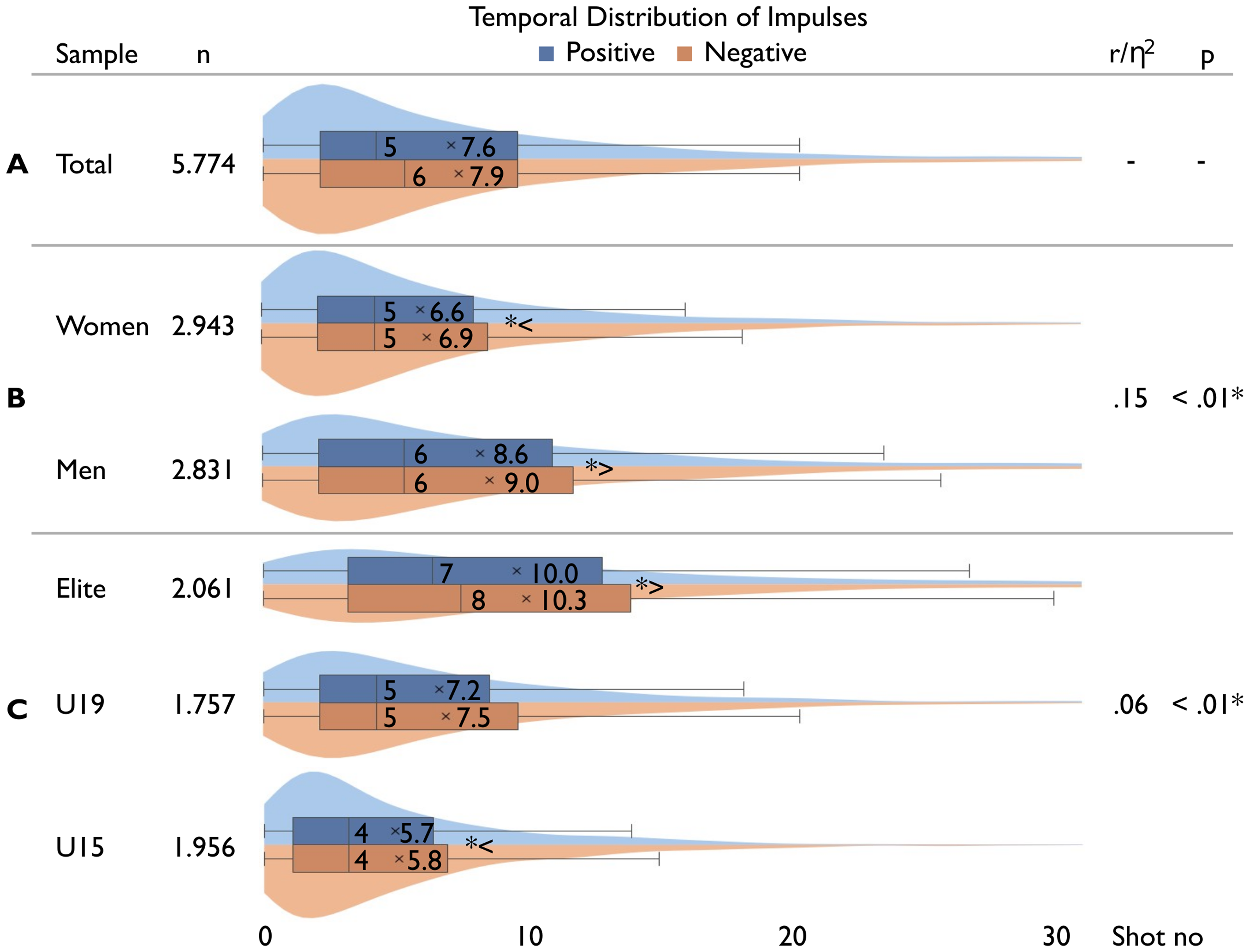
Temporal distribution of Impulses in Total (A) and according to Gender (B) and Age (C). * indicates significant results. Based on post-hoc tests, the upward (*>) and downward (*<) deviations of the temporal distribution from their comparison category are shown. No significant differences are observed when comparing Positive and Negative Impulses. Impulses occur significantly later in Men's and Elite matches than in Women's and Youth's matches (Women: 6.8 (± 5.8), Men: 8.9 (± 8.2), Elite: 10.2 (± 8.8), U19: 7.4 (± 6.3), U15: 5.7 (± 4.8)).
Conversion rate of Impulses
We evaluate the situation three shots after an Impulse to get a conversion rate. Positive Impulses are significantly less often won within these three shots (70.7%) than Negative Impulses are lost (86.7%; Figure 4 A). No significant difference is detected between categories regarding Positive Impulses (Figure 4 B and C). Regarding Negative Impulses, no significant differences are detected with respect to Gender (Figure 4 D). With respect to Age, there is a significant downward deviation in the Elite category in the share of Points lost and a significant upward deviation that the disadvantageous situation still exists. The opposite is observed in the U19 category, where a significant deviation upwards is detected in Points lost, and a significant deviation downwards in Disadvantage still exists (Figure 4 E).
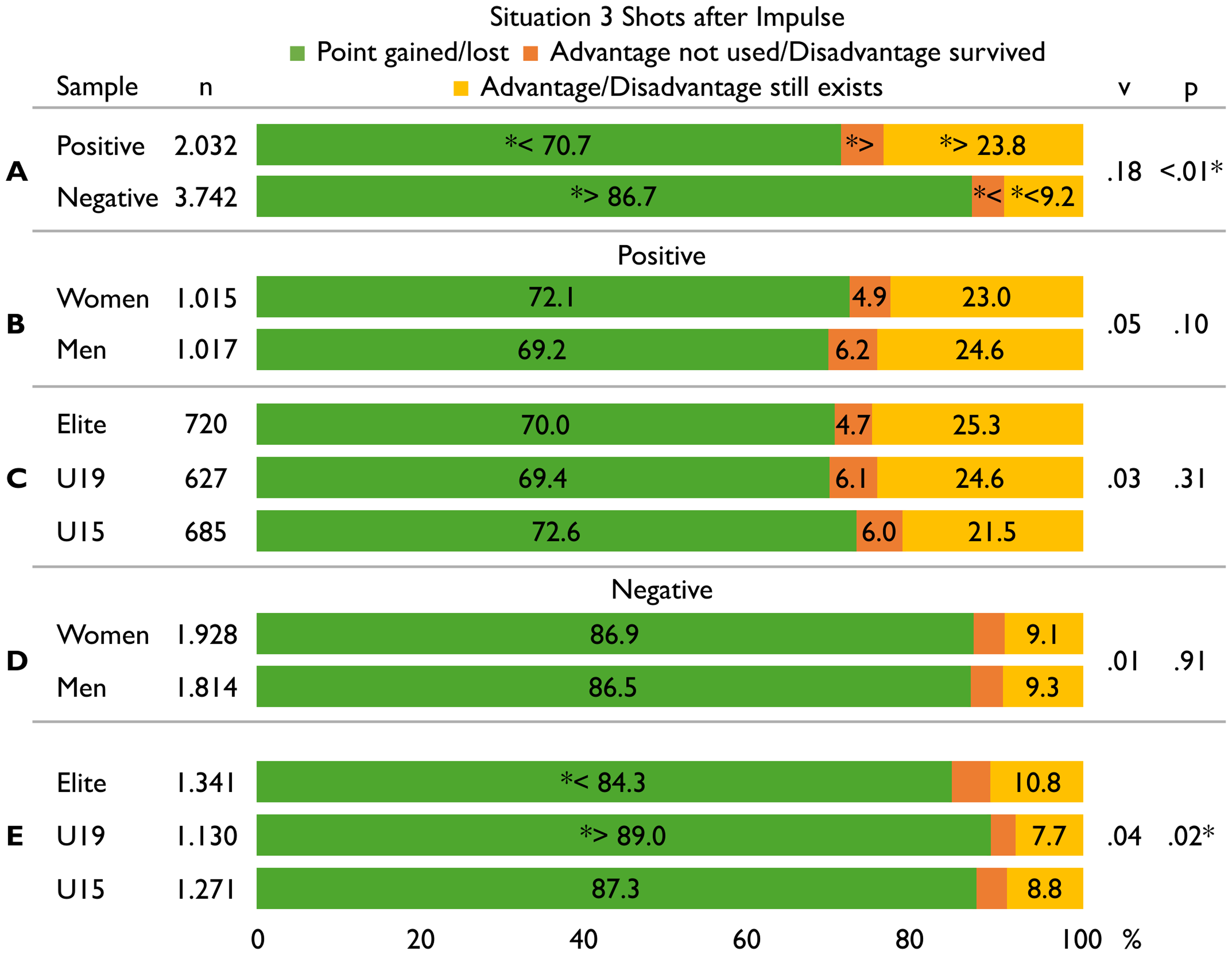
Conversion rates compared between Positive and Negative impulses (A) and according to Gender (B and D) and Age (C and E). * indicates significant results. Based on post-hoc tests, the upward (*>) and downward (*<) deviations of conversion rates from their comparison category are shown. Mostly, the Point is gained/lost three shots after an Impulse (70.7% and 86.7%). In the Elite category there is a significantly lower share of Point lost following a Negative Impulse (Elite: 84.3%, U19: 59.0%, U15: 87.3%) compared to the other categories, while there is a significantly higher share of Disadvantage still exists (Elite: 10.8%, U19: 7.7%, U15: 8.8%).
Discussion
This work aimed to identify how perturbations, or on an operational level, Impulses, are created in badminton according to Gender and Age. Therefore, we used the previously developed method that determines the Impulses of a rally with satisfying inter-rater reliability. 21 The incidence of Positive and Negative Impulses (i) shows that the share of Negative Impulses in each examined group was between 64.1% and 65.5%. Generally, the results show that avoiding bad shots is more important than executing particularly good ones. We primarily attribute this tendency to the characteristics of the shuttlecock compared to other balls. A shuttlecock can reach a very high top speed but slows down quickly because of its high aerodynamic drag, reaching the opponent's side slower than other balls. 27 This effect makes it more challenging to create an advantage over the opponent than, for example, in tennis or volleyball. The results of no significant differences between Gender and Age categories may be surprising for practitioners as one would assume that with increasing skill levels, there should be more Positive Impulses as the technical and physical abilities of the player's abilities in shot-making increase. We argue that this is nullified because of the rising skill level of both opponents, so the game remains the same regarding good and bad gameplay that leads to a point.
When examining the results of the shot techniques in Positive Impulses (ii), in each described category, Net shots were the most represented, ranging from 27.6% to 31.4%. This is an interesting result of the present study, as existing literature still needs to highlight the importance of accurate Net shots to win a point. When examining the differences between the categories, we observe a significantly higher share of Clear and Drop shots in the Women's category than in the Men's category and an additional higher share of Lob shots in the U15 category compared to the U19 and Elite category. In our opinion, the possibility of creating advantages with these types of shots can be traced back to the different physical abilities, especially in speed, of the named categories compared to their counterparts, 28 as with rising abilities, it is easier to defend the opponent's shots. Conversely, the Men's category shows more Smash and Drive shots than the Women's. A similar pattern can be observed in the comparison between the Elite, U19, and U15 categories. Here, the share of Smash shots is significantly higher in the Elite category. However, the share of Drive shots is higher in the U19 category. We argue that different abilities in power or technique in these categories compared to their counterparts lead to more powerful and forceful gameplay.
The Lob shot is the most detected Negative Impulse in each category, ranging from 26.0% to 30.3%. Our interpretation is that inaccurate Lob shots create such a disadvantage because the opponent's court position is highly advantageous, where there is not enough time to return to a balanced position to await the next shot. One could compare the results of Lobs to those of Clears, as both techniques create long shots. The more differentiated and, on average, lower share of Clears in Negative Impulses can originate from the fact that a Clear is longer in the air, giving more time to return to a balanced position even if it is inaccurate. The differences in the distribution of the shot techniques between the categories interestingly show similar patterns to those detected before for Positive Impulses. While the share of Clear and Drop shots are again higher in the Women's category than in the Men's category, the share of Smash, Drive, and here also Lob shots are higher in the Men's category. We argue that this similar pattern is detected because the players know, explicitly or implicitly, that they can create scoring opportunities with the respective shot techniques. Therefore, they are taking higher risks here, creating more inaccurate shots or errors. The same explanation can be introduced to the higher share of Smash shots in Negative Impulses in the Elite category compared to the other two. The court coverage of Elite players is better than in the other categories, a positive impact can be made mainly by the most powerful shot, the Smash, accepting that the higher taken risk leads to more inaccurate shots and errors.
Regarding the temporal distribution of Impulses (iii), it is noted that the mean Shot Number of the Impulse is higher in the Men's than in the Women's category as well as it increases from U15 to U19 to the Elite category, which is in line with findings of rally length. 29 We assume that the longer time needed to create a perturbation originates in increasing physical abilities, which makes it easier to cover and defend the whole court, implying that higher physical performance in badminton leads to more considerable advantages for defending than attacking actions. This finding is different from other rebound sports, e.g., beach volleyball, where it is essential to score from sideouts, which is an attacking advantage. 30 Positive Impulses tend to happen slightly later in the rally than Negative Impulses. This can be observed in all categories, though the differences are not statistically significant. One possible explanation for this could be that the players wait a little longer for inaccuracies or errors by the opponent before taking the initiative themselves.
When comparing the conversion rates of Impulses (iv) the point is mainly gained or lost after three shots across all categories (at least 69.2%). This shows that an advantage based on the defined Keyplay method is usually converted into a point win or loss. While Positive Impulses are converted to a point gain between 69.2% to 72.6%, the corresponding share of point losses following Negative Impulses is significantly higher (at least 84.3%). This finding is mainly driven by the number of unforced errors, which represent a Negative Impulse with no following shot. They happen in 46% of rallies, which is similar to findings in previous studies e.g., Laffaye et al. 14 A significant difference exists in the Negative Impulses between the Elite and Youth (U15 and U19) categories. In the Elite category, the share of Points lost three shots after the Impulse is significantly lower than in the compared categories. At the same time, the share of created Disadvantage still exists for Elite category is significantly higher. These results support our previous assumption: Defending skills improve more than attacking skills when the skill level increases.
This work is limited since it is debatable whether the picture we present based on Impulses is sufficient to make statements about winning and losing a badminton match. Comprehensive data collection of every shot followed by game pattern recognition, e.g., based on Markov Chains or machine learning algorithms, could provide a more comprehensive picture. The main problem of such approaches is that data collection of every shot is time-consuming and cannot be used in practice. However, this challenge may be solved soon as automatic data collection in badminton has progressed in recent years e.g., Hsu et al. 20 Nevertheless, we consider the Keyplay method as essential in explaining how to win badminton matches, as it focuses on the critical shots within a rally. These shots should always be highlighted, even if there is data about all shots. We argue that this method provides an essential basis for a comprehensive match analysis—which is already used by the German national team—even if there are other frameworks which can be used in parallel.
Further limitations might be seen in the objectivity of shot type collection. Some practitioners might argue that the transitions between two types of shots, e.g., between Drop and Smash, are fluid—from Slow Drop to Fast Drop to Half Smash to Smash—and not always clearly recognizable. Despite having cases where it is debatable which shot technique was used, the collected data should be sufficient to still have meaningful results.
Conclusion
Based on our data on Impulses, we conclude that avoiding bad shots is more important to winning badminton singles than creating an advantage by playing very good shots. Inaccurate Lobs influence the point gain in favor of the opponent in most cases for all examined categories. In Women's badminton, poor Clears also play an essential role in losing a rally. Net shots are most promising for all examined categories to create an advantage. Players with potentially higher physical skills—Men in comparison with Women and Elite in comparison with Youth categories—create more advantages with Smash shots. In contrast, Women's and Youth players rely more on Drops. Higher physical skills lead to a higher stability of rallies and later Impulses. These findings define a physical and tactical norm for badminton according to Gender and Age and can be used to determine training goals.
Footnotes
Acknowledgments

Author contribution
FH contributed to the study's conception, design, and statistical analysis and wrote the manuscript. DL contributed to the conception and design of the study. All authors contributed to the manuscript revision, read, and approved it for publication.
Conflict of interest
The authors declare that the research was conducted without any commercial or financial relationships that could be construed as a potential conflict of interest.
Data availability
The datasets generated and analyzed during the current study are available from the corresponding author upon reasonable request.
Funding
The authors disclosed receipt of the following financial support for the research, authorship, and/or publication of this article: This work was supported by the Bundesinstitut für Sportwissenschaft, (grant number 071602/24, 071603/23).