



Abstract
Background
In Australia, there are fewer women in tennis coaching roles. Identifying the barriers (and supports) for women in sport coaching roles is necessary to inform the development of strategies that will address this underrepresentation of women in such roles.
Aim
This study aimed to examine the experiences of women in tennis coaching roles in Australia.
Methods
Semi-structured interviews were conducted with 26 women coaches (Mage = 45.5 ± 11.6 years) purposefully sampled from Tennis Australia ‘coach members’. An inductive thematic analysis was conducted. The investigation was underpinned by the ecological systems theory.
Findings
Five themes were drawn from the analysis of the interview transcripts: (a) stereotypically male profession, (b) career instability and longevity, (c) family/work-life tension, (d) organisational support and (e) career advancement opportunities.
Conclusion
This study provides important insight into strategies that may assist in addressing the gender disparity that exists in the sport coaching profession. Specifically, increased provision of support (e.g. organisational support), guidance in relation to pursuing a coaching career, developmental opportunities and financial support will be important to attracting and retaining women in coaching roles.
Introduction
Globally, women coaches are a statistical minority in most sports. In Australia, for example, less than one-third (27.0%) of tennis coaches are women (Tennis Australia, written communication, November 2022). The Australian Governing body of tennis has further reported that in the past 5 years, there has been little increase (4.0%) in women coaches, despite ongoing efforts to address the underrepresentation of women in this sport. It is widely acknowledged that there are many benefits of women in sport leadership positions (e.g. coaching roles),1,2 most notably, their capacity to act as visible role models for women and young girls. Given the importance of women coaches in sport, it is essential to understand the factors that may support or inhibit their engagement with the tennis coaching profession.
A growing body of research provides important insight into the barriers and supports to women's participation in sport coaching roles. For example, Clarkson et al. 3 reported that key barriers for women in football head coaching roles were: (a) gender stereotyping, (b) having to prove oneself, (c) lack of confidence, (d) work-life conflicts and (e) limited career mobility. Kamphoff 4 further cited that token status, marginalisation, low salary and difficulties establishing respect were challenges for women NCAA Division I coaches, while receiving adequate support (e.g. organisational, spouse/partner) was key to the retention of such coaches. Furthermore, it is well substantiated that socio-cultural barriers remain an ongoing challenge for women sport coaches. 2 Solanas et al. 5 found that women coaches in Spain are subject to many challenges linked to the male dominance in sporting cultures, including discrimination, marginalisation (e.g. limited to coaching children) and sexist hiring practices. In an examination of U.S women coaches Barnes and Adams 6 similarly concluded that sexism and misogyny must be addressed to reduce gender inequalities in the profession. Notably, however, in the context of the tennis sporting code, to our knowledge, only one existing study has examined the experiences of tennis coaches (in the U.K), with a focus on organisational and socio-cultural influences. 7 More specifically, Jones et al. 7 reported barriers related to the performance narrative (e.g. sacrifice, dedication), negative perceptions of a coaching career (e.g. considered a failed player) and lack of a structured coaching pathway. To date, research is yet to examine the potentially multi-faceted barriers (and supports) that underpin Australian women's experiences in tennis coaching roles, critical given the gender disparity that continues to pervade the coaching profession in this context (Tennis Australia, written communication, November 2022).
The barriers (and supports) that shape women's experiences in coaching roles are complex and multidimensional. The ecological systems theory, 6 a framework that recognises that behaviour is underpinned by the interplay of individual, interpersonal, organisational and socio-cultural influences, and thus, is invaluable to understanding women's experiences in the sport coaching profession, as shown by LaVoi and Dutove. 2 As such, the present study will utilise the ecological systems theory to gain a comprehensive insight into the barriers and supports that underlie the experiences of Australian women tennis coaches.
The tennis coaching landscape in Australia continues to be dominated by males (Tennis Australia, written communication, November 2022). To date, however, research is yet to examine the barriers and supports for women sport coaches in Australia. This is important given global cultural, economic and social disparities for women in sport coaching. The current lack of knowledge of relating to women tennis coaches in Australia has also limited efforts to address the underrepresentation of women in sport coaching roles in the Australian context. Given the importance of women coaches in sport, the present study will provide an important extension to the existing research by examining the experiences of Australian women in the tennis coaching profession, and this examination with be underpinned by the ecological systems theory.
Method
Design
The data presented in this study were collected as part of a larger project that investigated the barriers (and supports) for women tennis coaches. This study draws on qualitative data from semi-structured interviews conducted with participants recruited from Tennis Australia coach members via email contact. Ethical approval was obtained from the University's Human Research Ethics Committee (approval no. 2662).
Participants
Twenty-six women tennis coaches volunteered to be interviewed and all were interviewed. The women tennis coaches ranged in age from 26 to 72 years (M = 45.5, SD = 11.6). The participants were all current Tennis Australia (TA) coach members with an average of 23 years of coaching experience (range = 10–43 years). The sample incorporated participants with a variety of coaching roles including head coach (n = 8), coaching business owner (n = 10), assistant coach (n = 3), TA employee (n = 2) and coach educator (n = 3). Over half (54.0%) of participants held a TA Club Professional coaching qualification, fewer held the following qualifications: TA Community Coaching (3.8%), TA Junior Development (19.2%), TA Master Club Professional (11.5%) and TA High Performance (11.5%). Participants coached players from beginner to high-performance levels in metropolitan and rural areas across Australia. The majority of participants were married (58.0%) and had children (65.4%).
Procedures
Semi-structured interviews were conducted via Zoom/Microsoft Teams or phone by Author 2 and ranged in length from 30 to 80 min. A semi-structured interview guide was utilised to ensure that all participants were asked similar questions and allowed the researcher to further explore participants’ experiences with follow-up questions. 8 The interview schedule devised for the purpose of this research focused on: (a) participants’ coaching journey (e.g. coaching background, early experiences, aspirations); (b) the barriers and facilitators participants had experienced throughout their coaching career and (c) participants’ perspectives in relation to the changes that are necessary to attract and support women in the tennis coaching industry. Example questions included: ‘Can you tell me about what made you decide to become a coach?’, ‘What are the barriers you have experienced in relation to coaching in tennis?’ and ‘If you could change anything about the current tennis coaching landscape or environment what would it be?’ The questions were co-designed between the researchers and the representatives from the governing body of tennis in Australia (Tennis Australia). All interviews were audio-recorded and professionally transcribed verbatim.
Data analysis
An inductive thematic analysis was conducted following the approach recommended by Braun and Clark. 9 The authors acknowledge their subjectivity as an analytic resource 10 in the context that they were constantly reflective about their extensive experience in community sport, involvement as players, coaches and as sport parents. 11 We acknowledge that researchers bring theoretical assumptions about data to the analysis therefore the analysis is not neutral, 12 rather our inductive analysis was grounded in the data. 13 Initially, familiarisation of the data (i.e. repeatedly reading the transcribed interviews to search for meaning and patterns) was followed by the systematic generation of codes. Authors 1, 2 and 3 independently coded one transcript to cross-check codes and establish coding consistency. There were minimal disagreements, however any differences were resolved by the three authors having a conversation and agreeing on the way forward. Given there were minimal disagreements, one transcript was sufficient to establish coding consistency. All data were then manually coded by Author 2, and a coding list was assembled with coded excerpts from the transcripts. Next, similar codes were organised into preliminary themes; for example, the codes ‘gender norms’, ‘preferential hiring practices’ and ‘gendered respect’ were grouped as ‘stereotypically male profession’. The codes and then themes were reviewed by all authors to ensure they were consistent and representative of the data. 14 This process resulted in the identification of final themes. The themes provided an understanding of the context and environment in which the participants were impacted.8,15
Results and discussion
Five main themes were drawn from the analysis of the interview transcripts: (a) stereotypically male profession, (b) career instability and longevity, (c) family/work-life tension, (d) organisational support and (e) career advancement opportunities. Each of these themes has several sub-themes which will be explored in the discussion below. These themes and subthemes have been mapped against the ecological systems theory model as shown in Figure 1.
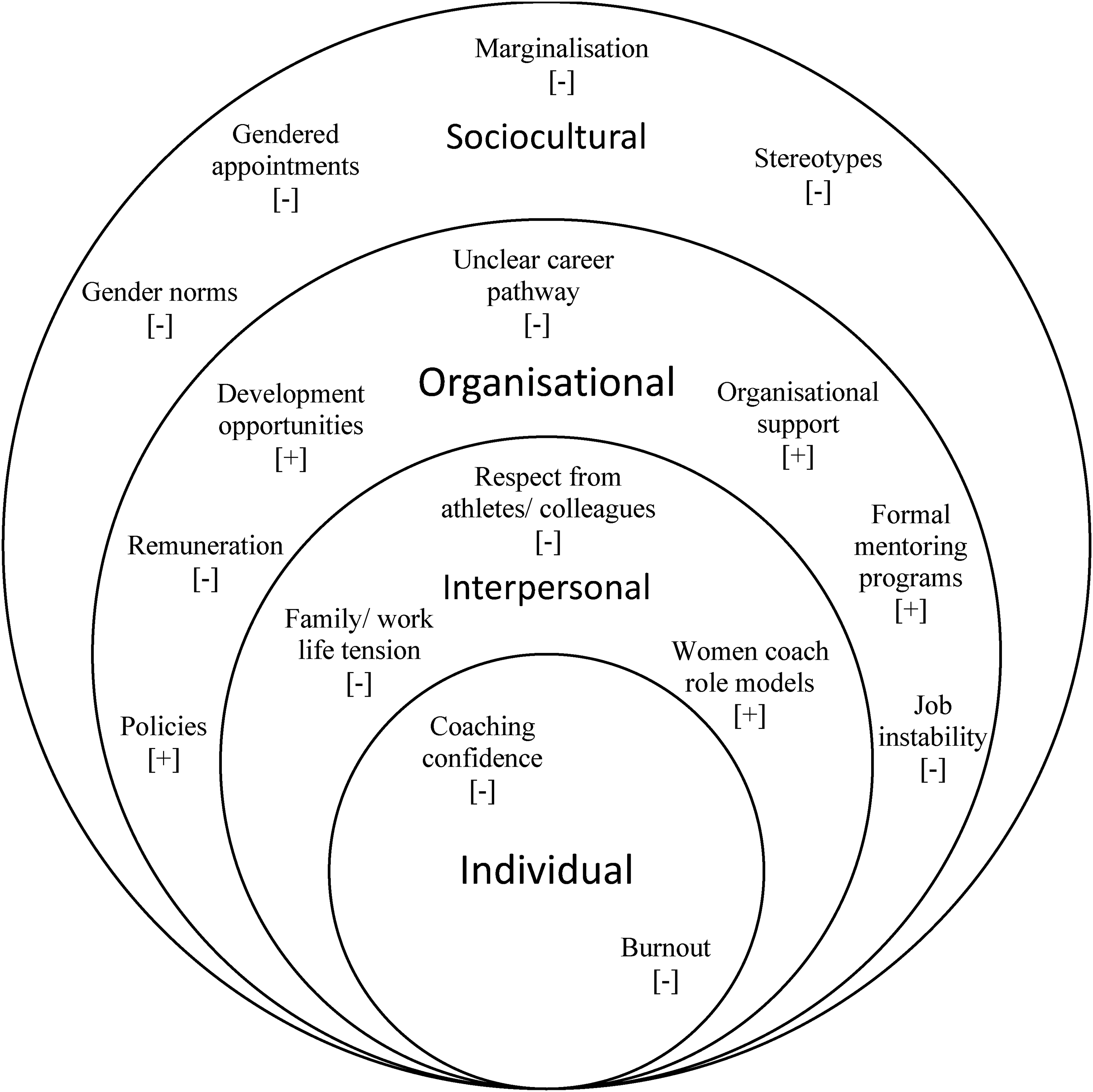
Barriers (and supports) for women tennis coaches in Australia according to the ecological system theory.
Stereotypically male profession
The participants all recognised coaching as a male-dominated profession, with many considering it to be a ‘boys’ club’. Notably, oppressive hiring practices were suggested to be an ever-present issue. As noted by the following participant, women perceive gender to be the reason they have been unsuccessful in being appointed as a head coach: There's been a few times I’ve applied for a job, and the job has gone to a 20 something male. So, head coach jobs you question whether it's who's the right person for the job? Or is it because I’m a women? I’m a mother? Is it perceived that I can’t do the job because I have those responsibilities? (Participant no. 23)
The participants consistently identified that gender stereotypes are a key barrier for women in the coaching profession. For example, participants reported that ‘there is always this assumption that you are not as good as the male coach next to you because you’re a female’ (Participant no. 18) and ‘there is a perceived idea that if they are a young male coach, they are going to be better, more capable, more knowledgeable’ (Participant no. 23). Previous research has also suggested that it is common for women coaches’ ability, game knowledge, qualifications, commitment and ‘toughness’ in handling difficult situations to be questioned.
16
Other research has noted male athletes as more likely to be concerned with women coaches’ knowledge of the game, and women players are likely to have stronger belief in women coaches’ competence.
17
In this study, participants recognised in the coaching of male players that male coaches are perceived as the norm, and therefore, women are largely limited to coaching women players. Representative of participants thoughts: If a male had to choose between a male coach and a female coach, I reckon probably 8 times out of 10 they’d go the male coach just thinking that there's the perception that he's going to be better than she is, he's stronger, he can hit better with me, that sort of stuff. That would be the main barrier I would think. (Participant no. 7)
Participants reported that there is a mentality that women cannot coach performance players and are often exclusively provided opportunities to coach younger children as they are viewed as a maternal figure that is nurturing and empathetic. This is recognised to limit the career advancement of women in the coaching profession. Notably, several participants indicated that the lack of visibility of women coaching males and/or performance players perpetuates these gender norms in the sport: I think that with younger kids it's that we’re expected to be good in that kind of field. And then when it comes to higher level players, I think it all comes visually as well. You see on the tennis on TV how 90% of the time it's a male coach in the corner. And so that is what players are going to look for as well. (Participant no. 18)
As such, developing strategies that normalise women in sport and sport coaching roles is critical to attracting and retaining this demographic in such roles. For example, increased exposure to women coach role models is recognised as one such way to establish greater diversity in sporting environments and encourage women to pursue a coaching career. 5
Another prominent issue for the participants was a perceived lack of respect they received relative to their male counterparts. Specifically in this study, participants reported that while respect is given to male coaches, it was believed that women coaches must prove their competency to earn respect. One participant states ‘the respect from athletes has to be earned more than given as it is with a male…I almost feel like they’re embarrassed to have a female coach’ (Participant no. 21).
This is consistent with existing findings pertaining to barriers for women in the coaching profession. 2 For example, in a sample of NCAA Division-I women coaches, Thompson et al. 18 found that 23.0% reported being disrespected by their colleagues due to their gender. Similarly, Norman et al., 19 identified that ‘gendered respect’ was an important barrier for British elite-level women coaches, with these coaches having to work significantly harder to gain the respect male coaches are afforded.
Finally, our findings suggest that participant's perceptions that coaching is typically a ‘male's role’ has important implications for women's confidence in their coaching capabilities: Confidence to believe they belong, that it really is just confidence in their own ability and their value to the organisation and to coaching. Having the confidence to know that you’re doing a good job and you are worthy, and you belong in this environment. We’re not as confident and we just see it as a male's role in our eyes. (Participant no. 11)
Many participants in the current study identified that women perceive that they lack confidence in their capacity to coach, and this was cited as an important barrier to the retention of women in the profession. This fits with existing evidence suggesting that low coaching self-efficacy (i.e. one's beliefs in their capacity to coach) is inversely associated with intentions to become a head coach, player/team performance and satisfaction and attrition intentions.20–22 Efforts to dismantle issues (e.g. preferential hiring practices, stereotypes, norms) that may perpetuate the coaching role as masculine and undermine women's coaching confidence will be essential to reducing the gender disparity in this profession.
Career instability and longevity
The coaching profession was not seen as providing a secure income, and this was an important barrier cited by the women coaches. Previous research has identified lower salaries, poorer working conditions and job insecurities as inequities facing women coaches.2,13 The participants reported that coaching roles are often akin to casual-based work and may not provide sick leave, maternity leave or superannuation,
1
and thus provide little financial security. Inclement weather or client cancellations also inhibit the receipt of consistent income. For example: Providing security, it's just one of those things that you’ve got to offer. I don’t know any other job that you don’t get paid, you’re guaranteed five hours work on a Friday, it rains, you get nothing. So how do you pay your bills? If someone doesn’t turn up, you don’t get paid. There is no security. (Participant no. 22)
When you shift into the stage of life for me, you’re wanting to get a better car, wanting to save up for a house or having to pay your own bills or rent or whatever that may be doesn’t offer that security, well it didn’t for me. It's very weather dependent so if it was raining you didn’t get paid. If you were sick and there was no sick leave because they were pretty much casual. (Participant no. 10)
Relatedly, the underrepresentation of women in the coaching profession could, in part, be attributed to women's perceptions pertaining to the viability of a stable coaching career. Participants stated that ‘we have so many people keen to do it and it's only when they start, and they don’t see it as a viable career to say in, and we lose them’ (Participant no. 10) and ‘a lot of people don’t see it as a career, they just see it as a little part-time job’ (Participant no. 2). The provision of financial security in the coaching profession may be key to changing the discourse surrounding coaching as a career: I have made that choice that I wanted to keep my teaching career. It's just that stability you get with the hours are better, you’ve got the super, you get the health, and you get that the job stability… Coaching, it's never going to be your main job because there's not enough money or hours to kind of make a living. So, I think that's why a lot of people will go into a different profession because you have to be very good at what you do over a long period of time to make money from tennis coaching. (Participant no. 13)
Family/work-life tension
Many of the participants reported that the unfavourable work hours (non-traditional, long and irregular hours), heavy demands (developing programs, administration, attending competition) and extensive travel required of a coach are not conducive to having a family, and thus are important barriers to attracting and retaining women in the coaching profession: Coaching, it's not very family friendly, that's for sure, because a lot of the hours are you’re out until 7:00–8:00 o’clock at night doing private lessons and things. That's not conducive for women who have children or want to have a family. So, most women don’t get into coaching because most of them get married and have children. And it's not family friendly that's for sure. (Participant no. 20)
If you want to be a travelling coach, you have to be on the road, like 20–30 weeks. Running a business, you have to be on the court until 9 pm. If you’re running a business, you’ve got to be the presence, the leader, and you then go, hang on a minute who's going to be at home with the kids? (Participant no. 17)
The lifestyle inherent to the coaching profession was consistently recognised as challenging, and for one participant, it was a key reason for leaving a coaching role: I had to give up my life, I missed milestones in my family's lives, in my friends’ lives, because I was travelling with other people's children. I had to give up too much of my own life…And you know Boxing Day, I was on court. Christmas Day, sometimes I was on court. And being able to have the choice to say no, that's not who I want to be anymore was my reason. (Participant no. 15)
This is in line with existing research suggesting that work–family conflict is a pertinent barrier for women in the coaching profession, and is shown to predict greater intentions to leave one's profession and decreased job satisfaction and performance. 23
Additionally, in the present study, family/work tensions were recognised to take an emotional toll on participants with several citing experiencing burnout. Perhaps not surprisingly, the recommendation that sporting environments provide more family-friendly support to meet the needs of women coaches with families exists in the literature. 17
Organisational support
A lack of organisational support was identified as an important barrier to coaching success. This is consistent with previous research (e.g. Kilty
24
). In this study, women coaches perceived lack of support from the governing body. Participants also reported difficulties connecting with other women coaches, and this was attributed to women being competitive towards one another as they are all vying for the same limited positions: Women supporting women can be a barrier. It's almost like you’ll be lucky to get one position, so we’re all going for that same position… There's been, just like when you’re a player, a bit of bitchiness, a bit of jealousy, a bit of why is she getting this, and why am I not? (Participant no. 21)
Participant responses indicated that mentoring was desired to foster the provision of support. Mentoring, particularly formal mentoring opportunities provided by organisations and sporting bodies, were recognised as important to highlighting coaching pathways and providing women with the guidance, knowledge, skills and confidence to thrive in a coaching role. Participants suggested that more formalised opportunities for mentoring at all levels, would be beneficial. Additionally, many participants cited the importance of networking opportunities for women coaches, to foster a sense of connectedness and belonging, in an environment dominated by males. Participants in regional areas identified that distance further limits the accessibility of networking and other support opportunities. Therefore, greater networking opportunities that are accessible to all women coaches (metropolitan and regional) are needed in this sport. For example: I just think it's that connectivity, and we can do it so much better after COVID. We can definitely do it online and get more people involved. I think it's just part of making them feel they belong to something, they’re valued. (Participant no. 2)
Career advancement opportunities
Participants highly valued the career development opportunities (workshops, courses). Participants did, however, indicate a desire for increased development opportunities. More specifically, participants consistently reported the need for more women-only development opportunities to establish an environment wherein women feel neither uncomfortable nor intimidated. Several existing studies similarly suggest that women coaches prefer women-only coach education.25–27 If it's female only, they feel they can speak up and participate more freely, and they don’t feel judged. So, whereas when there are males in the course, they find that the males and more dominant and they tend to stand back and not include themselves as much. (Participant no. 2)
Participants also suggested that introducing development opportunities to women at a younger age is important in providing exposure to a coaching career, and potentially attracting more women into the coaching profession. Relatedly, there was consensus that the coaching pathway is unclear with participants reporting that the developmental pathway for a coach needs to be clearer (e.g. the steps in a coaching career and how a coach can progress). Greater education in relation to the long-term coaching pathway and career development is therefore needed. Participants identified the importance of providing women with increased opportunities (e.g. traineeships) to engage in coaching roles across all competitive levels. Typical of participants sentiments is this quote: I think I’d like to see more, potentially more workshops, more opportunities for females to learn and develop. Because I know that every time you have these workshops, it's actually all the female coaches, a lot of the female coaches that are coming out, because they do want to improve themselves and they do like to learn and continuingly improve themselves and the quality of their coaching. (Participant no. 21)
Conclusion
This study provides evidence to indicate that the barriers and supports for Australian women in tennis coaching roles span the individual (e.g. coaching confidence), interpersonal (e.g. insufficient support), organisational (e.g. job instability/ security) and socio-cultural levels (e.g. gender norms) of the ecological systems theory. We recognise that as in much of the extant literature (e.g. Jones et al. 7 ), our sample comprised experienced coaches (Mexperience = 23.0 years), who have persisted in the face of many barriers (and few supports). Future research could usefully shed light on the experiences of women sport coaches at different career stages (e.g. women athletes transitioning into coaching roles). Nevertheless, the findings from this study provide support for, and build on, the existing research conducted across different contexts (e.g. countries, sports) in relation to the barriers that underpin the ongoing challenges with the recruitment, retention and development of women sport coaches.2,27–31 More specifically, our findings indicate that there continues to be significantly more barriers than supports for women in the sport coaching profession. This is in line with conclusions drawn by LaVoi and Dutove 2 in a narrative review synthesising the barriers and facilitators for women sport coaches, conducted a decade prior. Additionally, many of the multilevel barriers and supports identified in the present study have been similarly documented in other research conducted internationally3,32,33 and across different sporting codes (e.g. NCAA18,34,35). Ongoing efforts to target such barriers (e.g. gender norms, insufficient organisational support, family/work tension) are critical to attracting and retaining women in the sport coaching profession. As shown in this study and existing research, 2 such strategies and policies should be underpinned by theoretical frameworks (e.g. ecological systems theory) that acknowledge the complex interplay of multi-level factors that influence women coaches experiences. Accordingly, we propose several recommendations (spanning the levels of the ecological systems theory) that will be critical to devising strategies that address the underrepresentation of women in sport coaching roles broadly.
Recommendations
Increase the provision of support (e.g. governing bodies, colleagues) to create a sense of belonging and connectedness, and to assist coaches to successfully navigate the heavy and competing demands of the role (particularly for those with families).
Personal contact from governing body representatives; Implementation of formal mentoring programs and Regular networking opportunities (including online networking opportunities for those in regional areas).
Increase the visibility of women sport coach role models to normalise women in sport coaching roles.
Provide guidance in relation to pursuing coaching as a profession, career advancement and the long-term career pathway.
Increase developmental opportunities (e.g. workshops) that may enhance the skills and knowledge of women coaches and thereby instill greater confidence in their coaching abilities. Greater frequency of women-only developmental opportunities could provide women coaches with environments to learn and grow that are less intimidating or threatening.
Policies and practices that accommodate for women coaches with families (e.g. flexible working hours, paid maternity leave, assistance with childcare).
Increase financial support (e.g. salary payments, sick leave) to maximise retention of women in the coaching industry and ensure it is recognised as a viable career.
Footnotes
Declaration of conflicting interests
The author(s) declared no potential conflicts of interest with respect to the research, authorship, and/or publication of this article.
Funding
The author(s) disclosed receipt of the following financial support for the research, authorship, and/or publication of this article: This work was supported by the Tennis Australia.
