




Abstract
Sport science is a popular area for university study and a sought-after field for employment. Employment opportunities in elite sport are few, thus a surplus of sport science university graduates seek employment often in community-level sport exists. Community sports coaches can be a gateway to the employment of sport science professionals, however coaches’ attitudes toward the use and value of sport science, and how this may translate to employment opportunities, is not well understood. This study reports the attitudes of ten community-level Australian football coaches, obtaining an in-depth understanding of their perceptions of a sport scientist's role, their value of the sport science field, current use of sport scientists within their club, sport scientist training and qualifications, and the feasibility of employing a sport scientist. Inductive semi-structured one-on-one interviews were conducted via an online platform using an open-ended interview schedule developed from a detailed literature review, determining key foci for inclusion. Coaches viewed the role of a sport scientist in community-level football to be broad, acknowledging that sport scientists can perform specialist roles. Coaches highly valued the profession overall and frequently used and endorsed the use of sport scientists in their sport. However, a commonly occurring theme was that sport science was not seen as particularly cost-effective at a community-level. This theme stemmed from the overarching perceived financial barrier coaches reported as limiting their ability to employ or effectively utilise a sport scientist in their club. The findings highlight key limitations to the employment of sport scientists in community-level sports.
Introduction
While sport science is growing as an established profession worldwide, there remains conjecture as to what the role of a sport scientist is, and the benefits this role can provide to athletes and practitioners. In the UK, the British Association for Sport and Exercise Science outlines “Sport science tends to refer to the application of sport and exercise science principles within high performance sport, where the application of science is concerned with maximising the performance of an athlete or team”, 1 which interestingly focuses on high performance sport. In the US, Sport Scientists have recently been defined by the National Strength and Conditioning Association as a generalist, working across the breadth of scientific disciplines, or a specialist practitioner, with training or applied experiences predominantly within one or more scientific disciplines relevant to sport science and sports performance”. 2 Gleason et al. 3 expand on this by discussing the range of sport scientist roles specific to a US context. Sport Scientists are defined by Exercise and Sport Science Australia (ESSA) as professionals who “provide expert advice and support to athletes and coaches to help them understand and enhance sports performance; adopting evidence-based, quality-assured practice to evaluate and develop effective strategies or interventions in training and/or competition”. 4 A key element of the Australian sport scientist definition is the advice and support they provide to coaches in addition to athletes, highlighting the importance of this relationship between sport scientist and coach. Despite this defined scope of practice, there remains some confusion within the sporting community, such as from coaches, as to what the sport scientist role entails. 3 Furthermore, sport scientists are often seen as ‘generalists’ who work across a range of disciplines/domains in Australia. 5 Many Australian sport scientists begin studying with the intention of working in elite sport, but there is an oversupply of sport science graduates for the limited elite employment opportunities. 6 Therefore, more work is required to understand how to best build the growing sport scientist workforce in Australia beyond elite sporting systems.
Exercise and sport science-related degrees are offered at over 30 Australian universities, with a strong emphasis on exercise-related areas of study. 7 For example, the five most common core units delivered in Australian exercise and sport science degrees are; exercise physiology; biomechanics; research methods and data analysis; exercise prescription and delivery; and exercise and sport psychology. 7 The emphasis on exercise-related content areas can be partly attributed to growing accreditation requirements by governing bodies such as ESSA, 5 but are also a strong focus in the exercise science and sport science tertiary curriculum. Although these areas receive a strong focus in the university environment, it is unclear how important specific content areas are in applied sport environments outside of the formal University learning programme, particularly at a non-elite sporting level. Furthermore, the most common and fast-growing employment area for students studying exercise and sport science is to become an Accredited Exercise Physiologist (AEP). 8 This common career destination as an AEP differs to the initial expectations of students looking to work in elite sport, 5 which can often require postgraduate studies and not have the same amount of opportunities.
Sport coaches are one of the most important ‘gatekeepers’ in sport scientists effectively applying their knowledge. Martindale and Nash 9 qualitatively explored the perceptions towards sport science of coaches from a range of sports and skill levels in the United Kingdom. Key findings from this research indicated there was variability in the level of importance coaches perceived sport science to be, although there was no relationship of this perception with skill level. In professional football, there are several perceived barriers from coaches as to how sport science can best be integrated, such as conservativism, lack of financial resources, and lack of sport-specific knowledge and application by sport scientists. 10 While these factors may exist in elite settings, it is unclear whether the same, or different factors exist in non-elite sport. In an Australian context, non-elite or amateur sport is often termed ‘community sport’, where there is less time and financial resources available and there is a reliance on volunteer roles and community fund raising. Knowledge at this level can provide an understanding as to how sport scientists can best apply their skills in community sport and to also assist with broadening employment opportunities for sport science graduates given the limits on resources.
Kubayi, Coopoo and Toriola 11 surveyed South African coaches from various performance levels and sports, with results indicating coaches perceived the areas of injury prevention and recovery, and fitness/conditioning to be of high importance. Further, Bruce, Bellesini 6 explored the perceptions of both practitioners and academics on key sport scientist attributes in Australia. For example, this research identified sport scientists to consider the following areas significantly more important than did academics, including analysing demands of the sport/capabilities of the athlete, athlete recovery practices, knowledge of relevant anti-doping codes, injury rehabilitation, and providing nutrition/supplement advice. This highlights the importance of understanding how practitioners perceive sport scientists, particularly in under-utilised areas such as community sport.
To gain work experience in sport science, a large amount of volunteering has been reported by many graduates, and this is often attributed to career progression. 8 When ranking the importance of different practitioners to athletes such as physiotherapists, strength and conditioning, nutritionists, and sport psychologists, Australian coaches ranked sport scientists as adding the least amount of value to their athletes. 12 This perceived lack of value, and the limited knowledge as to how sport scientists can best add value to these programmes may contribute to the high volunteering rates reported. Furthermore, exercise and sport scientist graduates invest significantly in their education, with the majority of graduates surveyed having completed, or currently completing a postgraduate qualification. 8 Therefore, it is important for the role of the sport scientist to be valued by the industry and maximise career progression.
Many community sporting organisations in Australia are predominantly run by volunteers, with prominent volunteering roles being coaches, team managers and administrators. 13 This can provide challenges, where the resources available to help athletes perform at a high level may be limited. 11 In particular, coaches report to have limited support (both funding and time) to undergo professional development particularly at community level, 14 and sport scientists may provide added value to coaches and address certain knowledge gaps that may exist in their practice. Community sport is a key foundation area for sport scientists to build their skills, but there is limited scientific understanding as to how sport science can be implemented in community sport and the perceptions of key stakeholders such as coaches. Developing a deeper understanding of this issue will help create more structured professional development for sport scientists. 15 Furthermore, there is a need for greater understanding of ‘generalist’ sport science roles in non-elite sport environments such as community sport. 6
Therefore, this project aims to understand coaches’ perception of the role and value of sport scientists and its’ application to community Australian Football programmes. Community Australian Football coaches were chosen for this study as their clubs often possess the financial resources to employ sport science staff, albeit in a casual or part-time capacity.
Methods
Grounded theory was selected, as it is useful for producing understanding shaped by the perceptions of the participants being studied. 16 A social constructivist approach was adopted, 17 whereby emphasis is placed on understanding the complexities of participants’ perceptions and knowledge as well as the role of the researcher and the social context in theory generation. This variant of grounded theory was deemed appropriate as the purpose of this study was to explore participant's personal understanding of the applied context and the associated influences that may affect employment opportunities for sport science graduates. A constant comparative analysis approach was used to allow for emerging concepts to be informed, shaped and reshaped by the variety of conditions encountered, resulting in complex theory which closely reflects the data, 18 and ensures the validity of findings.19,20
Participants
A non-probability purposive sampling strategy was adopted which focused on the 10 Senior Australian Football coaches at Victorian community Australian football clubs. Senior coaches are those possessing a high-level of experience and coaching expertise, including substantial breadth in their experience and duration of experience. These individuals lead and coordinate the senior player programme, involving high-level players, and are involved in the coaching of athletes and the management and recruitment of coaching and support staff. Consequently, these individuals fulfil an integral role in deciding the coaching staff structure, and the potential recruitment and application of sport science staff. All participants (n = 10) were contacted via email regarding involvement in the study. Participants were male, aged 30–65 years, with at least two years of coaching experience involved in Australian Football at the community level. The experience of participants ranged from 7 to 25 years in total coaching experience, and all participants had coached at a senior-community level. Selecting participants without coaching experience at an elite level and exposure to professional sport scientists, minimised any bias in their knowledge of sport scientists at a higher level. Two participants had completed entry-level coaching qualifications, two coaches had completed a degree in physical education and one had qualifications in sport management.
Procedure
This was a qualitative study, with data collected using in-depth semi-structured interviews. The study protocol was approved by the Federation University Australia Ethics Committee (B21-123). Written informed consent was obtained from all participants before their involvement in the study. Following a returned response, an interview time was scheduled at the convenience of the participants. Due to the geographical spread of participants, data collection was conducted via teleconferencing rather than face-to-face. As such, the videoconferencing platform, Zoom (Zoom Video Communications Inc., San Jose, California) was selected for use as this platform offers benefits to both researchers and participants. 21
The interview schedule was created inductively, clarifying the topics to be covered and offering flexibility in the questioning. In particular, the interview questions were developed to be open and broad, allowing the researchers to gain an unbiased insight into the participants’ understanding and experience of applied sport science, its usefulness, and barriers to effective dissemination within the participant's vocational area. As such, the interview was structured with three main foci, with questions emanated from previous literature in the sport science employment area.6,10,12,22 The interview schedule included questions such as; What is a sport scientist?; Do you know what a sport scientist does?; Where would a sport scientist fit within your club structure?; What work would a sport scientist do in your club?; and What qualification do sport scientists require to work within community level sport? Prior to the data collection period, pilot interviews were conducted to highlight any issues with the interview structure and flow. Following this piloting period, several questions were removed due to duplication of participant answers. All participants were provided with the interview schedule prior to the interview and were encouraged to review the questions and make any notes that may assist them when responding to the questions during the scheduled interview. All interviews were conducted by AK and LB and audio recorded using the record function available on the Zoom platform. This recording was automatically saved to a secure server and was only available to the lead researcher, and the two coders. Interviews lasted approximately 50 minutes.
Data analysis
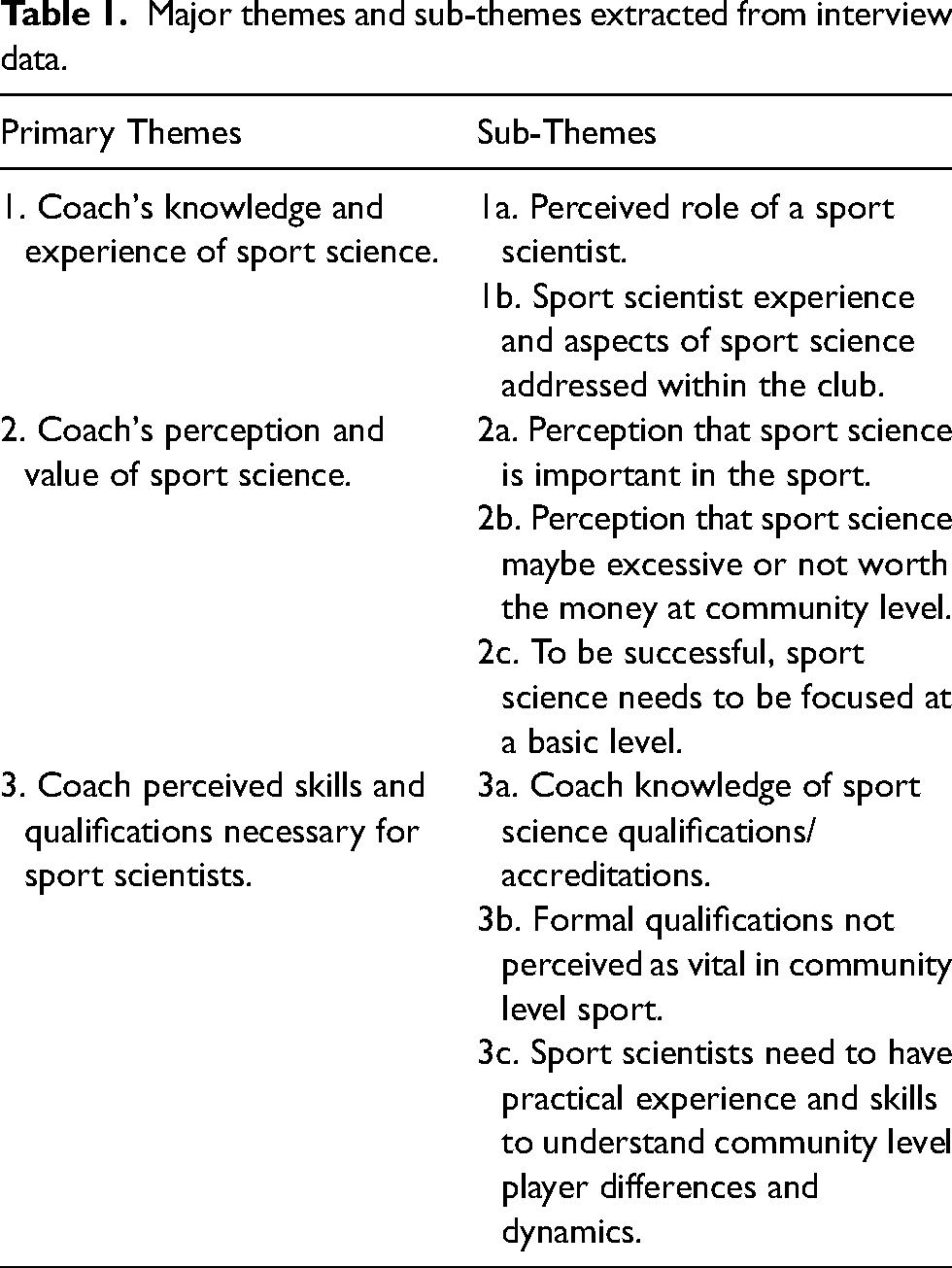
All data were transcribed verbatim and imported into the NVivo qualitative data analysis software (QSR International, Melbourne, Australia) and subjected to constant comparative analysis. 23 Consequently, data analysis began, adopting open and axial coding, while data collection was ongoing. Open coding was adopted to make sense of concepts and their associated properties and dimensions 24 with data being disassembled, during this process, enabling similarities and differences to be considered and for concept development to begin. Open coding was undertaken by two researchers (AK and LB) independently. Once each had completely analysed the data set, they brought their own discrete pieces of data and associated labels together and explored the similarities and differences between their interpretations. 25 This peer debriefing process was the first step in ensuring credibility was constant in our analysis. Following discussion between these two researchers (i.e., AK and LB), their agreed interpretation of the data codes was presented to the rest of the research team. This enabled further questioning and expanded discussion of data interpretation through an extended peer-briefing process. In undertaking this step, we sought to further ensure credibility and provide dependability in our analysis whilst simultaneously allowing the axial coding process to begin. Here, connections and relationships between data were established.24,26 The axial coding process enabled data reassembly and allowed for better, more meaningful, and stronger descriptions of the value and application of sport scientists within community Australian Football programmes. In undertaking such a comprehensive data analysis process, involving all members of the research team, it was possible to ensure a high degree of rigour. Raw data (i.e., meaningful quotes) were coded and led to the identification of three primary themes and eight sub-themes considered important to describe community Australian football coaches’ perceptions of the value and application of sport scientists within their programmes. To facilitate interpretation of the results participants were assigned pseudonyms.
Results and discussion
The following common major themes were extracted from the interview data (Table 1) and have been presented in separate sections. These major themes relate to 1) Coaches’ knowledge of a sport scientist role within a community sport setting; 2) Coaches’ perception and value of the sport science field; and 3) The importance of formal qualifications and practical experience required by an employed sport scientist. Within each of these major themes, related sub-themes have also been identified to illustrate the key points discussed by the interviewed coaches.
Major themes and sub-themes extracted from interview data.
Primary theme 1: coach's knowledge and experience of sport science
This first theme uncovered coaches’ knowledge of the discipline of sport science and what they perceived a sport scientist's role to involve. Coaches also discussed any experiences with employing sport scientists within their club and how their skills were utilised.
1a. Perceived role of a Sport Scientist
The definition of a sport scientist provided by ESSA, the governing body that accredits Australian tertiary qualifications in exercise and sport science, includes a broad description of a role relating to an expert skill set in various areas targeted to enhance athlete performance through evidence-based practice.
27
A similarly broad definition of what a sport scientist can contribute to in community-level Australian football was also described by many of the interviewed coaches. Coaches described a sport scientist as a role that could assist with athlete preparation and periodisation of training, to a role in ensuring adequate recovery and training for injury rehabilitation. It was evident that coaches understood that a sport scientist could specialise in various aspects of a sport, such as injury rehabilitation, and therefore take on a very specific position within the club or have a role in ‘filling the gaps’ of the coaching team, and thus have impact to player's/team performance, more broadly. This supports the notion described by Bruce, Bellesini
6
suggesting that sport scientist roles can often be viewed as ‘generalists’, rather than specialists, and job opportunities for sport scientists of a multi-disciplinary nature were perceived to become more prominent in the future. “I'd like to think I know what a sport scientist does, but it seems like a bit of an umbrella term. I'm probably drawing on my experience from the guys that did sport science at uni and they'd do their base subjects and then they'd have an option to go into maybe rehab, some would drift into and do a Dip Ed in teaching. Then others would go into maybe a sporting club where they could be doing a variety of things, could be anything from statistics to rehab in the sporting club to organizing fitness sessions. So, to answer it, I think they probably wear a lot of hats. That's only to name a few. Yeah, just off the top of my head, but a sport scientist would be … in a football club, I imagine would be a very wide-reaching position.” ( “Well, I guess a sport scientist, again, is involved with preparation of athletes, rehab, and the prehab stuff. Understanding how to prepare people to play their chosen sport, understanding what training or what physical preparation they need to do to perform their best. And taking into account what their sport is, what their position is, what they actually need to do physically to compete, I guess, in short.” “Applying latest technology in terms of rehab or fitness or running. And then obviously using technology to improve feedback is probably the three things I think if a person would bring that to your club, you're going to improve…”
Some coaches highlighted the importance of a sport scientist's role in ensuring that the most up-to-date practices were being used within the club and to challenge some of the more traditional views and methods that coaches may implement within their team. This perception also aligns with the ESSA definition of a sport scientist and demonstrates that coaches are aware that they can use sport scientists as a means to stay connected with current evidence-based practices and technologies to enhance their players’ performance. When exploring the combined views of academic and applied sport scientists, Bruce, Bellesini
6
report that both groups highlighted knowledge of contemporary sport specific research and best practice to be the most important technical skill for their role. “So, I'm always checking in with people like [sport scientists], just to check the load management in terms of what's happening with the running at training. I think the days are gone where you just run sort of 10Ks and that's enough. I know that there's a lot more science behind it, which I'm actually not across. So whenever I am implementing any running into the training session, I like to just keep tabs and bounce it off a few of those professionals or guys that have a bit more of an idea than what I do.” “And I think working alongside them is probably the hardest thing, because generally you've got two different trains of thought. I'm quite lucky that you see on a daily basis the changing attitudes, but there's a lot of coaches all over in the community who would still be pumping out 1Ks and 15 hundreds and fartlek stuff… seeing what changes all the time, you keep your foot on the pulse on how it all changes, but working alongside the coach to challenge those views, and whether you're changing that really is on how good that relationship is.”
1b. Sport Scientist experience and aspects of sport science addressed within the club
Across the interviewees, it appeared that the use of sport scientists within the clubs was varied, perhaps reflecting why coaches described a sport scientist's role as being diverse. For the coaches who reported having personnel in their club specifically employed to provide sport science services, these personnel were employed to complement the skills of the coaching team on matters such as running programmes, injury prevention and rehabilitation, as well as player loading. “Yeah, this year we've gone through [name of provider], so they've written a program for us, and then we've got access to an employee twice a week. And then during the season, he'll still be looking at conditioning, warm-up rehab with us. So, we're fortunate in that regard. It does cost quite a bit of money, but because we are one of the more financial clubs, we thought we put a fair bit of time into that area.” “I think there's two sides to it…I suppose, preparation and prevention. So, in terms of preparing the players, conditioning them and like even little things now, we do conditioning stuff to prevent getting hamstring injuries. We do a lot of core and stabilization work and stuff like that to eliminate players getting those types of injuries down the track. So, the preparation in terms of making sure that, we've got a program in place, there's a periodization of it. What do our load sessions look like, all that type of stuff and how are we loading up players?
… And then the back part of that is the rehab side of players coming back from injuries and all that sort of stuff… So my head trainer sits on selection and has the overall say on players playing, not playing. Which is probably a big thing for local footy because coaches want to win and stuff like that. There's players that I might want to play and he'll determine that, not me.”
Several coaches reported not specifically employing a sport scientist, but instead used their own knowledge and skills of sport science to guide them, as well as capitalising on informal discussions with players or associates who had previous sport science experience, then applying the information gained to their coaching practices. Coaches from the latter discussed being confident in their own sport science skills, or had experience in a related field, such as physical education (PE), thus viewed the need to employ a sport scientist, specifically, as not required. This may indicate that whilst the discipline of sport science was valued by coaches, there was an undervaluing of sport scientist technical skills as a standalone profession, particularly in the context where coaches had qualifications in their related field. As Stevens, Lawrence
8
have demonstrated, a large proportion of sport science graduates complete both undergraduate studies and postgraduate qualifications, therefore, to have their substantial skillset viewed by coaches as not necessary within community-level sport, of which represents a significant pool for potential employment opportunities, is concerning for the profession. “Like at [club name] a young guy coming through and doing a sport science degree and we talk quite regularly about the types of running and all that kind of stuff. So, I wouldn't say I'd go out searching for it, because I think I've got a reasonable grasp on where we are in terms of physical preparation for footy. But in saying that if someone came and challenged me and had a really good conversation with me, I'm not against walking away thinking there's elements of that we can learn from.” “Yeah, I haven't [got a sport scientist]. In terms of what we've done with the fitness side of things is look, there was a guy that I know who is a PT trainer. He provided a running program over the preseason. He has done that for the last couple of years. We established a pre-training routine and gain routine that the boys can run themselves now, which we set up together. But it's more, look it, out there, it's probably just more I suppose the competition, but also just getting good people. It is hard. And look, I just think at that level, we are getting by, if that makes sense, without having a fitness person as such.”
Two coaches highlighted related points, but in different ways, regarding the integration of sport science in their coaching approaches. The first explained that employing a sport scientist added another layer of complexity to their coaching that was not necessary, including having to communicate with an additional individual to plan the training sessions, and therefore had moved to an online model to implement sport science principles where the additional liaising was not required. Whereas the second coach described the difficulty of finding appropriately qualified personnel that they could trust with the role of sport scientist outside of their existing club structure, thus kept the sport science components relatively in-house amongst the members of the coaching team and existing club committee members, rather than employing qualified personnel accordingly. As evidenced by Bruce, Bellesini,
6
this underscores the importance of effective communication and other interpersonal skills in creating positive and professional relationships with others in the sport science environment to build trust between the sport scientist, the coach and the athlete, and to assist with knowledge translation. This also highlights the importance of building effective working relationships within an interdisciplinary team of professionals for the betterment of athletes, which has been illustrated by Martindale and Nash
9
as often being problematic or not considered appropriate in a sport setting. “Well, yes, we have previously, but now we've moved to the online model…I think for me, it's been really easy, and I haven't had to have a program online set up. I haven't had to liaise with somebody else, if that makes sense. I just go look on the app and go, “This is the running that they've planned for us for here,” or whatever conditioning it is. And then I can just include that in my training plan. So, to be honest, it's probably been easier to have something mapped out than it is to liaise with somebody else. Because you got to make the phone call, “What do you want to do? Send me through stuff.” And then I plan training around that, whereas I can plan training three weeks ahead because I can look on the app and go…” “For a start, we didn't really trust anyone [outside the club], to be honest, so he and I did everything. We had this guy, [name], who set everything up, but then we handled the structure side of it. …Then as that's moved on, some of the [club] committee men have then come out and said, “Hey, we want to coach as well.” So, yes, we've now set up like a VFL sort of structure. We're the head coaches, but we also have line coaches. In fact, I coached the midfield, we've got another guy, [name], coaches the forwards, [name] coaches the back line, we've got a reserves coach.”
Primary theme 2: coach's perception and value of sport science
The key finding highlighted in this theme was that coaches, overall, perceived value and importance in applying principles of sport science for improving player performance and enhancing the success of their team. However, coaches highlighted several conditions that were paramount to make employing a sport scientist, specifically, to fulfil a role in their team staff worth their while. These were primarily focused on financial investment/cost and perceived value for money, as well as whether the sport science principles implemented were going to be relevant to the level of performance of the playing group.
2a. Coach perception that sport science is important in the sport
Among the interviewees there was a predominant view that being able to implement sport science principles was meaningful to enhance player and team outcomes. Similar to the findings of Bruce, Bellesini,
6
which demonstrated the importance placed on technical skills that require application of knowledge, many coaches in the present study placed significant importance on ensuring the various needs of players were being met and that having access to individuals with knowledge and skills in sport science can be useful to facilitate in areas where the specific expertise of the coach may be lacking. “The biggest value at community level would be increased return of players from injury or better rehab from injury and better structured programs. Working alongside the coach to challenge their training principles and what's right and wrong.” “…the side of my coaching that needed and still needs to be improved is the fitness side of things, brushing up on the rehab, making sure that players are warmed up and ready to go. And not just moving forward, not just letting anybody organize a warmup, making sure that it is from somebody with the experience and the knowledge to be able to make sure the guys have confidence in their body to get stuck into an hour and 15-min training session with contact.” “They would be part of the coaching group, just like your back line coach or your forward line coach, etc. Your forward line coach looks after the forward group, the structure, the system and everything like that. Essentially, it's just like that. The S&C coach would look after the conditioning of the players. The coaching group would essentially work on game plan stuff and system and all that type of stuff and the S&Cs making sure that they get to the round one and they're fit and they can execute what we're trying to get them to do.”
One coach initially reported not seeing value in sport science in community level football, having the viewpoint that a role within the coaching team specifically dedicated to sport science was wasteful and the role not seen as vast enough to warrant it as a standalone position, rather viewing it as a role more suited to someone unqualified, such as a student. This viewpoint may indicate this type of sport science work is suited to students gaining volunteering experience for career progression, such as through work-integrated learning,
8
but also aligns with the common expectation that sport scientists need to undertake some voluntary work to gain experience in the industry before any paid employment can be obtained.
6
“At our level, to be honest, no. If there was a kid at university on his third year and wanted to be there for his hours or whatever. We're always looking for kids and help in a small club. If there was a university student that wanted to be our sport scientist on his third year, I think we'd employ them. We'd have them for their hours and probably pay them. Obviously not what you'd pay a fully-qualified, but in our position, yeah, if someone was there and they were committed, and had done some study, I think we'd take them on-board.”
However, upon elaboration it became clear from the same coach that, whilst in their current coaching set-up the work of a sport scientist is dispersed across the team or farmed out to a student studying in the area, the idea of having specific personnel qualified in the sport science discipline would actually be welcomed, with this finding similar to that identified in research conducted with UK coaches.
9
“I guess, at our level, more support and access to people would be awesome. And I think it's that gap between clubs prioritizing an exercise-sport scientist to come into our club and they go, “How much?” And you go, “This much.” And they're like, “Oh, probably not.” I think that's probably the biggest gap. Finding a middle place with that would probably be the biggest challenge. And if there was an exercise scientist that was willing to be at my footy club tomorrow night, I'm all ears, if that makes sense. I'm happy to have them there. Yeah, so that's probably the biggest gap, I think. Country clubs prioritizing finance over employing someone in that capacity.”
The primary barrier to employing sport science-qualified people in this club was cost, a deterrent that was echoed by many interviewed coaches and this is explored in more detail in the following section.
2b. Sport science not cost effective at community-level
Financial burden was overwhelmingly reported by coaches to be a limiting factor for employing a dedicated sport scientist in the club. It was apparent that coaches were torn between the idea of wanting to work with sport science professionals, who may have an understanding of the latest evidence-based practices and expertise to assist with making their clubs more successful, but to justify why the club should invest money on a role in the area was difficult.
Conversely to the initial opinion of most coaches that sport science was perceived as valuable to enhance club performance, when considering the cost of sport science services, several coaches later made comparisons with elite football, to highlight the point that there was no such necessity for sport science evident in community-level football. Coaches described that whilst the need for dedicated sport science personnel at elite level is understandable given that football in an elite context is career-based, for community level players on the other hand, who have other life commitments other than football and play the game for reasons more of enjoyment, the priority for community-level players to improve their game through sport science was not comparable. The limited payoff for the financial burden associated with employing a sport scientist at community sporting level, in comparison to elite sport, is in line with previous research.9,10 “Look, a sport scientist, having time and with playing group, if you look at an AFL environment, that's a perfect environment for a sport scientist. Because you can have dedicated time slot over the duration of the week to be the task. At a local level, it's really, difficult. Getting them to three nights is tough. Getting full numbers two nights is tough. And then introducing a slot, whether it's a 15-min slot or a half hour slot for that type of stuff is, I find it difficult. I would, even though I understand the benefit. It's sort of weighing up the opportunity cost, I suppose.” “It's the level of footy where I'm at. I think it comes down to why the boys at that football club? For them, it's just about mateship, playing footy. It's not a business to them, you know what I mean? Therefore, the need to have a sport scientist involved in a football club, I think would be a wasted resource. You're better to use that getting footy coaches, that's going to help them with their football rather than their fitness.”
2c. Sport science requires player buy-in and relevance for it to be a success
The perception that sport science may not be worthwhile in community-level football, as described in the previous section, corresponded to other important factors determining the need for sport science specialists. Firstly, the fact that to be useful at community-level, sport science needed to have player buy-in, and a belief from players that it would be of benefit to them directly. Several coaches discussed previous experiences where some players, particularly those players of a younger demographic, eagerly adopted the sport science advice given from the relevant staff, as they saw how it could assist them. However, other players perceived little relevance to how the advice would improve their game and, therefore, were not as willing to adopt unnecessary measures for improvements that may never occur. Kubayi, Coopoo and Toriola
11
highlight the importance of communicating knowledge effectively in an accessible manner, which may be beneficial for gaining player buy-in. “They need to see the outcome. I know that we spoke about that you can't just produce the outcome very quickly, but if they can see an improvement and numbers. There's a percentage of players that straight out the top not interested, doesn't bother me. But the key players that bought into it could see the benefit, they could see the results.” “There's certainly some benefit around education too, within the play in group. But again, it's up to the individual, you'll find the older players will go, “Yeah, I've heard it all before.” Where you'll get more of the aspiring young guys who still want to play VFL footy and they're only 18 or 19. That'll really soak it up and want to listen and learn and get the most out of it.”
Having player buy-in was also closely linked to the second determining factor described by several coaches that unless the principles of sport science employed were pitched at a level seen as relevant/understandable to community-level players, as well as taking into consideration the broad dynamics of those in the team, then value from the principles would not be seen across enough of the playing group. Thus, the coach would not perceive it worthwhile investing in sport science personnel of whom are promoting principles that are only benefiting a few individuals. This finding supports the notion that practitioners consider it important for sport scientists to be able to contextualise specific goals that improve performance for both individuals and groups.6,9 “But then [the sport scientist] wanted to do a few different little programs and he wanted to do this and then do that. And I said, “We'll lose them. They won't turn up.” I said, “I know we want to treat them like semi-professional, but they're not.” So, this is all great, and I can see the absolute benefit of it, but we just need to keep it real for premier C amateur players that during the day they're either sitting behind a desk counting numbers or they're digging holes, fixing wires and stuff. They're not doing…Some of them are, but they're not going to get it done.” “But I would be using science to improve performance, trying to dumb down the ability of, we've got all this great equipment and this is going to improve performance or how do you do that in an environment where you don't have the great equipment…How can those same principles be brought across to a community level where you might have a gym that has very little equipment or access to fairly simple technology. How can we grab what we know at this top end and make it usable in the middle sector so that it becomes more effective, because at this stage it's not effective because what [sport scientists] get taught is here, and then they come back and try and apply it here where the parameters are completely different.”
The overarching theme that collectively underpinned the points raised by most coaches as to whether employing a sport scientist was worthwhile came down to cost-effectiveness. The majority of interviewees made comments around at least one of the following points that; if finances were plentiful, or they could see the benefits significantly outweighing costs; or that they could acquire useful assistance at little to no cost (i.e., from a student studying sport science), then the decision to employ a sport scientist would be far more justified. This supports the findings of Stevens, McConnell
12
in that financial cost is among the biggest barrier coaches perceive to employing a sport scientist. “Yeah. Financial side of it is a limitation, definitely. Do I spend X amount on someone that can do that or do I do another assistant coach that can help me with game day and all that sort of stuff… Look, at the moment and purely because of funds. If this sport scientist has no footy background, very difficult in my view, they'd need to have some sort of experience - So, that's where I'd say…I mean, look, I could definitely utilise one [sport scientist], but it'd be, one cost and then two, how much experience have they got and how can we incorporate them into the thing. I'm coming up with pretty much our physical sort of stuff, our running at the moment.” “And the ability to be able to bring more technology and knowledge in again is price. Access is one thing and usability is probably the biggest thing, but then obviously price plays a part in that. We've got GPS monitors and all that kind of stuff, but the time it takes to break that information down and all that kind of stuff then you start to weigh up, “Hang on. Well, where's its value set and where's its time sit?” And then that becomes the biggest battle…Yeah. So am I going to get enough worthwhile information out of it that the player and the club is going to say that's beneficial for them, investment in time. And that's probably where the biggest gap sits at the moment is if you've got unlimited funds and unlimited resources, as in someone can cut up film, break stuff down, edit it, tag it, then that's great. But there's very few in the community sector that have that time and that resource.” “If you did have to go through that process and then the remuneration side of things, just trying to find that balance, it's probably a new concept, but one that's definitely worth investigating, but then just wondering if the football club is able to make it worth their while as well… And it's with everything, trying to find that work versus whether there's the value for money in it. And whether you could find somebody willing to do it for whatever is on the table.” “Money. Yeah. Being able to afford to pay them. That's why we generally end up getting less qualified university students, as in they're still at university. They're not a fully qualified…or less experienced university students is probably the better answer.”
Primary theme 3. Coach Perceived Skills and Qualifications Necessary for Sport Scientists
The third theme demonstrated the understanding of coaches towards how individuals can become formally qualified as a sport scientist. As well as the formal qualification, the theme also highlighted the importance that coaches placed on sport scientists to have strong practical experience and the ability to appropriately cater for the highly varied player abilities found at the community level. They tended to place more importance on the practical experience that the personnel they would employ must have and were not as focused on ensuring a formal qualification had been obtained. This may suggest a shift to more work-integrated learning throughout exercise and sport science programmes. 7
3a. Coach knowledge of how to become qualified/accreditations
As illustrated in the previous themes, several coaches had alerted to the use of university students studying sport science to assist at their club in the past, demonstrating that many coaches were aware that tertiary-level qualifications in the field exist. Other coaches, despite not knowing the intricacies of the relevant degrees, knew that individuals who had completed a university education in exercise and sport science could be sought out to assist in clubs and acknowledged that to become qualified as a sport scientist, the completion of a university qualification was largely the pathway to work in the industry. This may perpetuate the unfortunate reality that sport scientists complete a large amount of volunteering throughout their early career journey, even when their degree has been completed.
8
“If someone said that they got a bachelor of exercise science, I'd know where to look and I'd have a general understanding that we could apply their knowledge to at our level.” “I know that during their education at university, they'd be offered a lot of placements and they complete a lot of hours of placement in different settings. So, some at schools, some at clubs, sporting clubs, then some probably not really not necessarily related to sports at all, just wherever they can get the hours up from my conversations with sport science students.” “Not really. I know of people who are doing them, but in terms of the intricacies of them, no, I don't. Like what they learn and all that sort of stuff, no, I'm not fully aware of it. But yeah, I do know people who have studied it and are studying it.” “So, the ones I know…I don't know if it's called human movement anymore, but out there. And then, the exercise rehabilitation, exercise physiology. So those particular degrees in terms of looking at the specifics of training and so forth, they're the ones that probably I'm aware of.”
3b. Formal qualifications not as vital at community level sport
For most coaches, it appeared to be common knowledge that a relevant degree was a step towards obtaining a career as a sport scientist, and this was discussed as being especially the case for those wanting to work in elite-level sport. “Well, from my understanding with a lot of these sport scientists, I mean, a lot of them are wanting to get themselves into elite programs, whether it's footy or basketball or cricket, whatever it might be. I know that's a dream, but yeah, it bloody hard to come by. I know a lot of them end up doing a lot of their own personal training, that sort of stuff, to fill the gap. But yeah, I mean that's my understanding of a lot of them, it's trying to become involved in that high end sort of professional, elite sporting programs, whatever that might be.”
Coaches explained that whilst they would consider a sport science qualification highly when employing a sport scientist, the importance of having completed a formal university degree in sport science to work in community-level sport, however, was not necessarily seen by coaches as a necessity. “The theory would be great, when you’re checking out into the real world and get them working and strategizing and applying, for me that's like obviously they need to know their stuff. So, the degree is important, but marking I'll be looking at is where's he applied his knowledge? What's been the feedback on how he's applied his knowledge? And that would have a huge influence on whether you buy in or not.” “I think inside of a local club is probably a couple of elements of what I would look for. Obviously, I would look for [sport science degree]. I would look for some formal qualification for sure, because you need to have the knowledge base underneath you.” “So, we had somebody at East Point, I don't think that he actually ended up finishing his university degree, but in terms of his passion, his knowledge for fitness and health and his ability to commit to a football club and a group of players, he would be probably a standout example of somebody who I wouldn't think would need a qualification. But having said that if I was to bring somebody into the footy club, I'd like to think that a sport science degree … yeah, they would have at least a three year sport science degree behind them, but he is probably one exemption to that rule, exception to the rule.”
Instead, many coaches highlighted the importance of ensuring that a sport scientist could demonstrate that they had acquired meaningful experience and previously work in the field to develop practical skills that could be capitalised upon within the football club. This furthers the recommendations of Gleason, Suchomel
28
that a range of direct experience in sport through playing and coaching, support roles are invaluable for successful integration of sport scientists into clubs, whether that be at community or elite level. “Even now the old human movement sort of course, and stuff like that, I'd probably look for something a little bit more targeted to strength and conditioning, I reckon. Then I'd probably look at coupling that up with what physical experience have they actually done? I coached Yarraville years ago and I had an exercise sport science student who was doing some placement or something like that, work with us. Who'd never had any experience.” “What they did before, where have they done their pracs? Where have they done their work? It has been a range of facilities, has been a range of environments, has it been elite and crappy? Like in the end for me obviously one, the person's important. Two, where they get trained, I couldn't actually care less. Can they apply their knowledge? And have they been in lots of environments where, you know what, they're going to have to think on their feet and learn.” “Well, I think they get given good background knowledge. Yeah, I think they get the good knowledge, but they need experience. In the end, they experience, which really just means they've got to volunteer somewhere to get that experience. If they think that just going to uni's going to do it, it's not. You've got to be willing to give up most of your weekends, which generally means giving up a lot of your own sport.”
3c. Sport scientists need practical experience and skills to understand community level player differences and dynamics
Without seeking to diminish the value of a degree in sport science, coaches emphasised that to work effectively in community-level football, sport science personnel needed to have complemented their formal qualifications with relatively extensive practical experience. This relates to the complex interplay that occurs between sport scientists developing their skills through practical experience, alongside their knowledge gained in tertiary studies.
29
This was described by interviewees to possibly include having worked and volunteered in roles within numerous sports or levels of play to have experienced a range of contexts, from which the sport scientist may have been able to implement various sport science principles. Furthermore, a small number of coaches explained that for any remuneration to be offered to an employed sport scientist, the level of experience and application of skill must be matched accordingly. This finding supports those from Stevens, Lawrence
8
showing that in order to successfully progress a career as a sport scientist and ensure they are highly competitive for employment, one must be willing to complete substantial amounts of volunteer work to gain experience and differentiate themselves from other graduates. “Yeah, obviously there's the entry sort of degree, whether that be sport science and so forth. But I think if they've done extra, either study or experience within a certain field, I think that's something that we've looked for. Prior to [name of provider], we had someone who's had a running background and been involved in Stawell Gifts and so forth. So, we're looking at people who've had experience in a sporting field.” “I do think they need to get experience somewhere. If it was me, I'd want experience at an elite club and I'd just want to go in and have someone teach me everything and then go and implement it somewhere else. But if I couldn't get that, if I couldn't get the Roosters job, maybe I could get experience at Redan or something like that. That would be fine. But I would've thought the best way to do it would be to just go and listen to someone for a year and then take it over the following year, sort of. I don't know whether someone who's inexperienced would be much use.”
A sub-theme that was commonly reported to explain why practical experience was so highly regarded by coaches was because sport scientists working at community-level needed to be able to effectively adapt their practices to accommodate the broad range of differences and player dynamics. Players at this level were described by coaches to possess varied levels of fitness and skill, but perhaps more importantly, factors such as player's occupation and their passion to commit to training and game days, were all aspects that required careful consideration across the whole coaching/sport science staff to maximise player outcomes. This accentuates the key attributes of a sport scientist to be adaptable and cater for individual athlete needs.6,9 “It was probably more textbook stuff that, if you're a professional athlete and you're there all the time and stuff like that, you could translate it into like a Collingwood or something like that. But dealing with part-time athletes that are there two days a week that work all day and all that sort of stuff, like 35-degree day, you've been on the tools all day and you rock up at six o'clock at training. We need to take that into consideration with our loads and all that type of stuff.” “Any job, it doesn't matter what you're doing, it all comes down to experience. You get to deal with the person off the street or the elite athlete or somewhere in between. It all helps. It all helps. So that's what we would offer, is just dealing with a novice, an amateur. The challenges the body has at that level with essentially three hours, max, training a week and then playing. Compared to 24/7 and you've got Pilates and you've got this, you've got that, you've got that.” “…[the sport scientist] had that camaraderie with the playing group and the relationship with the individuals where he was able to know whether he could push them further or whether they needed to have a bit of rest. So that's probably one of the other things they need to do as well. They actually need to be one of the playing group or if not a leadership figure within the playing group.”
Conclusions
This study sought to increase the understanding of coaches’ perceptions of sport science and the value of the profession for use in community-level Australian football. From the interviewed coaches, it was evident that they defined the role of a sport scientist to be both broad enough to meet a range of outcomes in the club, but to also have the potential to take on a more specialised role, focusing on a key aspect of athlete or team performance/development. Coaches related their definition of a sport scientist to how they could be utilised best at various playing levels, and as such, likened a specialist sport scientist as more useful at an elite level, whilst a sport scientist with the ability to fill in the gaps of the coaching team would be more beneficial in community level football. From an employment perspective, it would appear that a sport scientist could make substantial contributions to several areas if they were a member of staff in an Australian community sport club setting, provided they possessed a varied skillset that was developed throughout a sport science degree. This has implications for the way in which universities structure their work integrated learning (WIL) to ensure that graduates have acquired the necessary industry experience that enables them to be employed in community-level sport at the completion of their degree.
It appeared that coaches’ definition of a sport scientist was also reflected in how they had worked with individuals in the profession in the past, with some coaches explaining that their employed sport scientist would be used to complement the coaching teams’ skillset and would assist with ensuring that football clubs are employing contemporary approaches to enhance player performance and wellbeing for the betterment of the team and club. Some coaches explained that they had their own knowledge of sport science and that the need for a designated individual was not required or that having a standalone sport scientist would add unnecessary complexity that would complicate their coaching team. This finding is concerning given the scarcity of sport science jobs and also perhaps highlights the greater need for coaches at community level to embrace the idea of working within an interdisciplinary team, as well as implement strategies to increase communication within the club that could facilitate their ability to employ sport science professionals to optimise their team's playing outcomes. Changing a coach's mindset that the job can be done by unqualified individuals is a starting point, however these perceptions of coaches, as potential employers, should also be considered more broadly by accrediting bodies, such as ESSA and be reflected in the courses they accredit to ensure that university degrees are demanding students obtain adequate and relevant industry experience that is reflective of the graduate job opportunities.
Overall, coaches shared the view that sport science was of value to the sport and that there was a lot to gain from having a sport scientist on staff. However, there were several key factors that ultimately determined whether employing a sport scientist was considered feasible. These factors predominantly focused on the financial cost or the perceived value for money that was associated with employing a sport scientist, which may also be dependent on the individual's specific skillset and the experience they could bring to the club. Again, coaches felt that at a community level, the cost vs benefit to the club would not make employing a sport scientist worthwhile. This was further highlighted by coaches, with many describing that for a sport scientist to add value to their club, they would need to possess the knowledge and skills, as well as have gained practical experience that was specific to working with community level athletes. Coaches explained that recreational athletes playing in community-level football, will not necessarily benefit from approaches used with elite athletes. Thus, an employed sport scientist would need to be in tune with the intricacies and demands of community level footballers, both within and outside of the sport, to ensure some benefit is gained from the sport science services provided. Furthermore, from a cost-effectiveness standpoint, several coaches also discussed that paid sport science services would be expected to have a broad reach to the playing group and not only benefit a small number of players. Therefore, an understanding of the different player dynamics within a team was an essential skill. In Australian community sport, financial resources can be limited, which poses difficulties for creating employment opportunities for sport science graduates. Whilst the responsibility for suitable sport scientist training across various levels of sport (e.g., elite and community sport) should be with universities, the establishment of job pathways for graduates could be enhanced through the collaboration with universities and their accrediting bodies (e.g., ESSA), as well as with industry partners, such as national sporting organisations. This may include the development of employment opportunities, such as paid internships or paid post-graduate positions. An employment programme could also be designed within the industry that looks to incentivise community sporting associations to employ sport scientists as a means to promote increase sport participation through increased membership, as well as increased player wellbeing and performance for existing members.
The need to get the most cost-effective use of a sport scientist also corresponded to coaches’ views about a sport scientist's qualification. They highlighted that, while they were aware that to become a qualified sport scientist an individual would need to complete a university degree, coaches would rather employ an individual with a lot of practical sport science experience from having worked in the field, rather than someone with a formal university sport science qualification with little industry-related experience. Again, this work-related experience would enable an employed sport scientist to apply more meaningful and adaptable approaches within the community team setting, thus benefitting more players. There was some awareness from coaches that for a sport scientist to gain their tertiary qualification, as a student they need to gain industry experience by undertaking a considerable amount of volunteer work. It was the expectation of several coaches that this would be required for not only gaining their formal qualification, but also as a rite of passage if an individual (qualified or not) was to be considered for employment as a sport scientist. With most coaches explaining that if they had unlimited funds or a more plentiful budget, they would definitely employ a sport scientist in their club, it was clear that the burden of cost was a limiting factor for employment opportunities in community-level football clubs for sport scientists. Again, a more collaborative approach to link the training of sport scientists to meaningful employment pathways in the sport industry, with a focus on removing the barriers to community-level sport employment is required and must involve engaging universities, accrediting bodies and key funding stakeholders. There is a clear perception of value for the profession in community sport, which cannot be capitalised upon until some barriers are addressed.
While this study has provided a depth of understanding of coach's perceived use and value of sport science professionals in community level sport, there are some limitations to the study. Firstly, the small sample size may limit the generalisability of results across other cohorts of Australian football coaches. Additionally, coaches were limited to the one sport of Australian football and only coaches of male teams were included. When applying these findings to women's football and/or other sports with similar financial resources of community level Australian football, it may be assumed that the burden of cost would also be viewed by coaches as a barrier to employing a sport scientist. Lastly, we acknowledge that the findings of this study are based on the knowledge and perceptions of the participants, which are inherently influenced by the semi-professional context in which they operate. Consequently, certain key aspects of sport science that are integral to roles in high-performance environments may not have been addressed in this study. This limitation highlights the need for future research to explore the perceptions and knowledge of coaches and practitioners working in high-performance sport. Such investigations would provide a more comprehensive understanding of the employment opportunities and requirements for Exercise and Sport Science graduates in Australia. Furthermore, it is recommended that future research investigate coaches’ opinions of sport science in other sports and levels of competition to obtain a more comprehensive understanding.
Footnotes
Declaration of conflicting interests
The authors declared no potential conflicts of interest with respect to the research, authorship, and/or publication of this article.
Funding
This research did not receive funding.
Funding
The authors received no financial support for the research, authorship, and/or publication of this article.
