




Abstract
Physical performance is an important determinant of elite youth soccer player development and can influence successful transition through the professional phase of the talent development pathway. In response to previous research highlighting key stakeholders’ perceptions that successful transitions within the club pathway are influenced by sprinting capacity and explosive power; this study objectively quantified the predictive value of sprint distance and high intensity acceleration and deceleration efforts on the early transition of elite, professional youth soccer players from U18 to U21, and U21 to first team squads of a Scottish Premier League club. Early transition was defined as a player progressing to the next age group (i.e., U18 to U21) prior to reaching the chronological age limits of his current squad. Retrospective physical performance data of thirty-seven players from training and competitive matches across two seasons were analysed. Results suggest that early transition is less likely for players progressing from the U21 to the first team relative to players progressing from U18 to U21. Relative sprint distance resulted in a 52% probability of early transition (OR = 0.52) with relative aggregated high intensity acceleration and deceleration efforts reflecting an increased probability of early transition (OR = 1.70) for elite youth soccer players within the club. This novel study provides a unique insight to the complexities and context-specific nature of youth soccer player development and transition. This paper challenges the subjective perceptions of key stakeholders using objective physical data of youth players who have transitioned to advanced squads.
Introduction
The transition of elite youth soccer players during the professional phase of the talent development pathway (e.g., U18 to U21) is highly complex and multidimensional. 1 Players are required to demonstrate high levels of performance to earn transition opportunities in preparation for first team soccer. 2 In the United Kingdom (UK), youth players typically transition to an older age group following the completion of a league season. 3 This is a natural transition event and based on youth players meeting expected developmental milestones throughout the season. Conversely, players who do not reach expected milestones risk deselection. 4 In addition, it is not uncommon for players who demonstrate superior competence within their peer group to transition earlier.5–7 Early transition opportunities stimulate development by promoting players to an environment that will challenge all performance domains.6,8 This provides talented youth players with the opportunity to train with and compete against players who are at an advanced stage in their cognitive, technical, and biological development.3,9 This approach ensures the progression of exceptionally talented youth players while minimising the possibility of developmental stagnation or plateau 10 Performance indicators including technical ability, tactical understanding, physical attributes, and psycho-social traits are evaluated by key academy stakeholders to inform decision-making on player transition.11,12 Research on the potential predictive value of these performance metrics may provide a novel insight to early youth player transition.
McGuigan et al. 13 investigated key stakeholder (e.g., coaches, sports scientists, head of academy) perceptions of transition within an elite level club. The findings suggested that stakeholders considered sprint ability and high intensity acceleration and deceleration efforts to be key physical performance facilitators of successful transition at the club. We acknowledge that soccer performance domains are inextricably linked and that to isolate physical metrics in the pursuit of identifying robust predictors of successful performance and transition would not be possible. However, there is merit in exploring the potential value of specific physical performance metrics, as highlighted in McGuigan et al. 13 as part of the wider performance domain.
The physical demands of modern soccer have significantly increased over the last decade. 14 Specifically, high intensity (HI) efforts such as sprinting, acceleration, and deceleration are critically important to individual performance within a team structure. 15 Several factors influence physical demands including calibre of opposition, tactical approach, and playing position. 16 For example, full backs and wide forwards usually cover the greatest high-speed running and sprint distances during matches. 17 Central midfielders typically cover the greatest total distance with strikers accruing the highest acceleration and deceleration efforts.18,19 In response to the increased physical demands of elite first team soccer, youth players need to meet these demands as they transition towards senior soccer.1,2 Most youth players aged between 16–18 years old will have experienced their most rapid period of growth, commonly known as peak height velocity (PHV) and peak weight velocity (PWV) and are expected to develop their physical performance to meet first team requirements. 20
High intensity efforts have been indicated as discriminatory performance factors between elite and sub-elite soccer players.
14
For example, elite players in the top ranked European leagues were found to cover 28% greater high-speed running (19 km
Importantly, sprinting, and HI acceleration and deceleration efforts have been found to typically accompany or precede key match events such as scoring or assisting a goal31–33 with attacking players being required to increase their physical output to create goal scoring opportunities. 34 As scoring goals is ultimately the deciding factor on the overall match outcome, these findings are not unexpected. 35 Despite the importance of such performance metrics on goal and match outcomes, it is less clear whether similar HI actions can predict successful early transition. Therefore, novel research projects examining the potential predictive value of HI actions such as sprint distance and acceleration and deceleration efforts are required.
To our knowledge, an examination to determine whether there is predictive value of physical performance metrics on early transition opportunities in the latter stages of the talent development pathway has not been conducted. In addition, there is a lack of empirical confirmation of the subjective perceptions of coaches on early transition. This is despite subjective and qualitative evidence suggesting the final phase in this pathway is the most challenging to overcome.17,36 Whilst physical performance and technical ability in isolation cannot predict successful transition or performance, there is merit in exploring aspects of this domain to create discussion in elite youth soccer environments.
Therefore, the aim of this novel study was to investigate the potential predictive value of sprint distance and HI acceleration and deceleration efforts on early transition opportunities of elite youth soccer players in the professional phase of an elite academy system (U18 and U21).
Methods
Subjects and data collection
Retrospective physical load data of 43 elite youth soccer players from U18 and U21 squads at a Scottish Premier League club were collected across 2 seasons (season 2021/22 and season 2022/23). Players were aged between 16 and 19 years old and had full-time professional contracts with the club. Those who were at the club for the entirety of season 2021/22 and season 2022/23, and completed an early transition, a natural transition, or remained with their age group (squad) were included in the study (see Table 1). Early transition was defined as progressing from a squad (U18 or U21) in-season or prior to a player's chronological age determining their transition to an advanced squad; natural transition was defined as a player who had completed a season with one squad and was no longer eligible to play for that squad due to his chronological age; players remained with their squad if they completed a season with that squad but were still eligible to play with that age group. This criterion resulted in the withdrawal of 6 players data sets from the analysis process for reasons including long term injuries (n = 3), going on loan (n = 1), or joining the club after the data collection process had commenced (n = 2). In total 37 players data sets were downloaded from the club's internal database for analyses.
Descriptive table of fundamental transition outcomes.
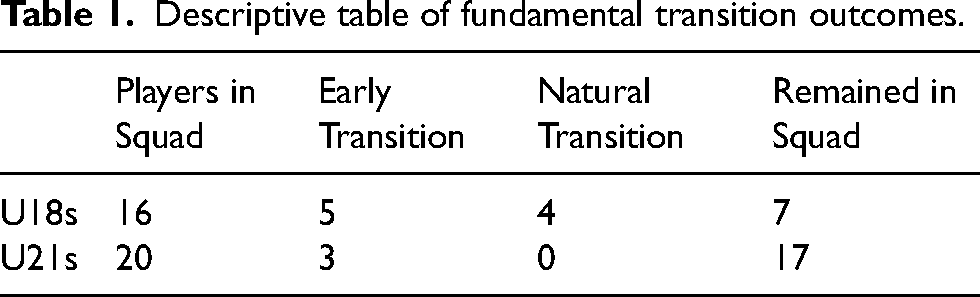
A successful transition from U18 to U21 was considered when a player made 5 competitive appearances for the team and trained the full week in the lead up to each game. Following this, coaching staff were consulted on whether they considered the player to be part of the U21 squad. A positive response resulted in the players (n = 5) being considered as successfully transitioning to the U21. Successful transition from U21 to the first team was considered when a player became an established member of the first team training group (n = 3) and was included in 5 match day squads.
Table 2 provides positional information of the players who successfully transitioned early over the 2-season period.
Descriptive overview of playing position of early transition players.

External physical load data was collected via wearable Global Positioning Satellite (GPS) technology (Catapult, Melbourne, Australia, 10 Hz). Catapult GPS technology contains a tri-axial accelerometer, tri-axial gyroscope, and magnetometer to track locomotor and rotational movements of individual athletes across frontal, sagittal, and transverse planes. 37 This technology has shown to provide valid and reliable data on athletic locomotion including sprint efforts and HI acceleration and deceleration efforts38,39 when worn in a fixed position on the athlete's upper back, between the scapulae. 40
Study design
A cross-sectional, descriptive, quantitative research design was implemented to investigate multivariate relationships between playing squad, relative sprint distance, and relative aggregated high-intensity acceleration and deceleration efforts with transition opportunities.
Data handling
All training and match physical performance data for seasons 2021/22 and 2022/23 were collated and organised using designated Microsoft Excel spreadsheets. Players were categorised according to their playing squad prior to transition (U18 or U21). External physical metrics for each training session and match including total distance (km), high speed running (m; 19.1 km.h−1–24.9 km.h−1), maximum speed (km.h−1), sprint distance (m; > 24.9 km.h−1), metres per minute (m/min), high intensity acceleration efforts (>3 m.s−2) and high intensity deceleration efforts (>-3 m.s-2). Based on the aims of the study, sprint distance (m; > 24.9 km.h−1), HI acceleration efforts (>3 m.s−2, minimum dwell of 1 s) and deceleration efforts (>-3 m.s−2, minimum dwell of 1 s) were selected for analysis. The remaining physical performance metrics were removed from the data collection process. Descriptive statistics of the physical performance data grouped by squad are reported in Table 2.
As player data was collected from a single elite academy, sample size was limited (n = 37). Relative values (z-scores) for sprint distance and HI acceleration and deceleration efforts were calculated as opposed to absolute values. This is a common approach in predictive models and facilitated interpretation of the model outputs. HI acceleration and deceleration efforts were aggregated prior to being converted to z-scores to reduce the degrees of freedom in the analysis. Aggregation of HI acceleration and deceleration efforts was also considered appropriate given that both metrics are difficult to decouple in a football context and will deviate trivially over the course of a season. These were then used as predictors in the model alongside playing squad and relative sprint distance. HSR was removed from the analyses due to multi-collinearity and given that SD was the key metric identified by stakeholders in McGuigan et al. 41
The anonymised dataset used in this study as well as the R statistical analysis code script can be accessed at Open Science Framework (OSF) using the following link: https://osf.io/c4gz9/?view_only = 7af845ff977447cb9730b3fde417e8a9
Statistical analysis
All statistical analyses and results were conducted in R language for statistical computing using the ggeffects, lme4, nnet, sjPlot and tidyverse packages. Model assumptions were checked using the DHARMa package (version 4.2.1).
Data was analysed using a generalised linear regression model. Transition was treated as a binary outcome variable (successful vs unsuccessful). A binominal error distribution was applied with a logit-link function to predict the odds associated in transitioning to advanced squads (U18 to U21, U21 to first team) considering the following predictors: playing squad as a categorical variable with two levels (U18 and U21), relative sprint distance (Z-score), and relative aggregated high-intensity acceleration and deceleration (Z-score) both as continuous variables.
Odds ratios (OR) are presented alongside confidence intervals to aid interpretation of the findings. Assumptions of model linearity, tests for homogeneity of residuals, under and overdispersion, outliers, and zero inflation were performed using a simulation-based approach. This highlighted the violation of homogeneity of residuals, which was corrected by adopting a simulated bootstrapping method (n = 5000) to generate robust estimates. The level of significance was set to p < 0.05. Due to the context-specific nature of the study and the limited sample size, we refrain from interpreting the odds and odds ratios using a dichotomous approach using p-values. Instead, we adopt an estimation-based approach which accounts for uncertainty as expressed by confidence intervals. Thus, our interpretation of the results and discursive narrative is built around the complexity and contextual factors which impact predictive value of physical metrics.
Results
Table 3 presents Z-scores of relative physical performances relating to aggregated HI acceleration and deceleration efforts and sprint distance for both U18 and U21 squads. Data is representative of in-season training and matches from across seasons 2022/23 and 2023/24.
Descriptive statistics of relative physical performance.
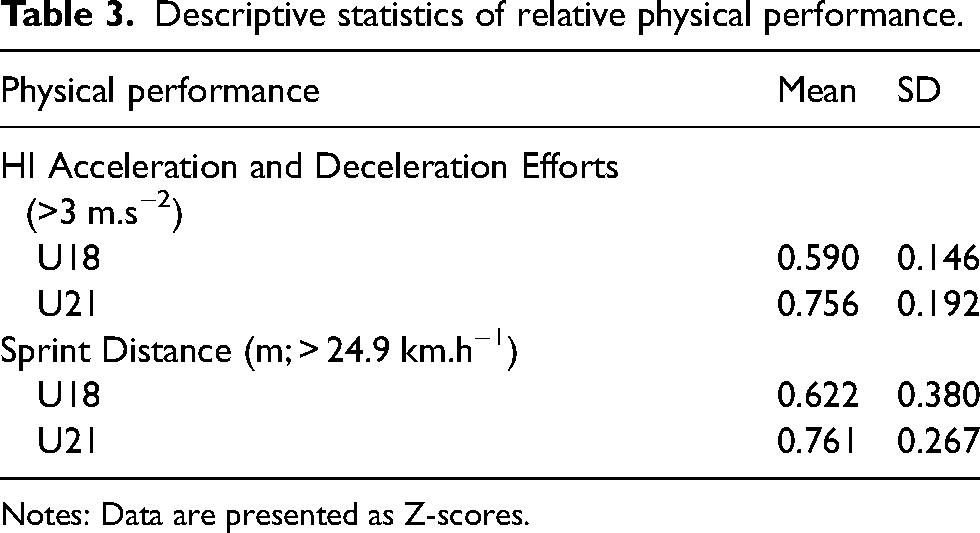
Notes: Data are presented as Z-scores.
Playing squad was a non-significant predictor of successful early transition from U18 to U21 (P = 0.053), with an Odds Ratio (OR) of 0.38 reflecting a 38% probability of successful early transition to the U21 squad (see Table 4). An OR of 0.60 reflects a 60% probability of successful transition from U21 to first team relative to U18 to U21 success. Therefore, of the 38% of players who are successful in transitioning to the U21, 60% are likely to transition to the first team squad. Thus, probability of successful early transition is reduced as players get closer to the first team.
Logistic model outputs.
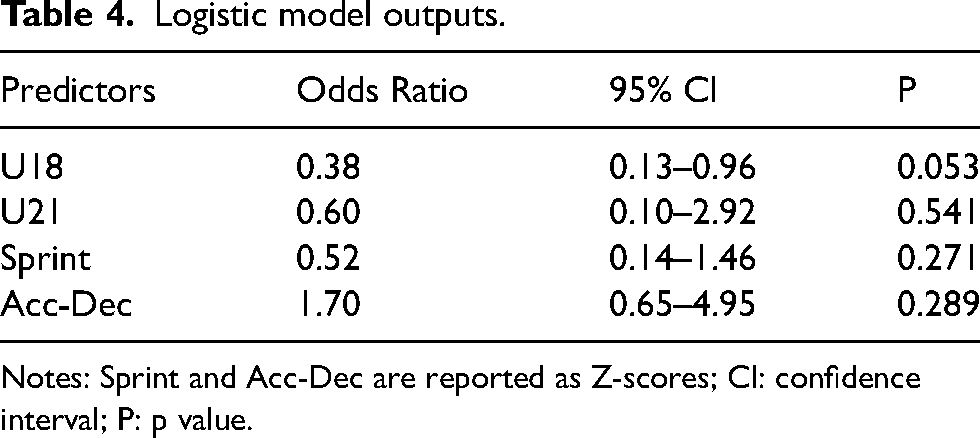
Notes: Sprint and Acc-Dec are reported as Z-scores; CI: confidence interval; P: p value.
Relative sprint distance was a non-significant predictor of successful transition across all squads (P = 0.271). Odd ratios indicate a probability of early transition equal to 52% (only 1 out of 2 players will be successful) for an increase of 1 standard deviation (Z-score of 1) from the mean. As such, considering the multiplicative effect of predictor on the outcome of interest in logistic predictive models, players demonstrating exceptional sprint outcomes, for example more than 3 standard deviations from the mean relative sprint distance (e.g., Z-score of >3) would have an increased probability of a successful early transition. Conversely, a decrease in SD from the mean would result in a reduced probability of successful early transition. Figure 1 presents a visual depiction of the probability of early transition between squads relative to sprint distance z-scores.
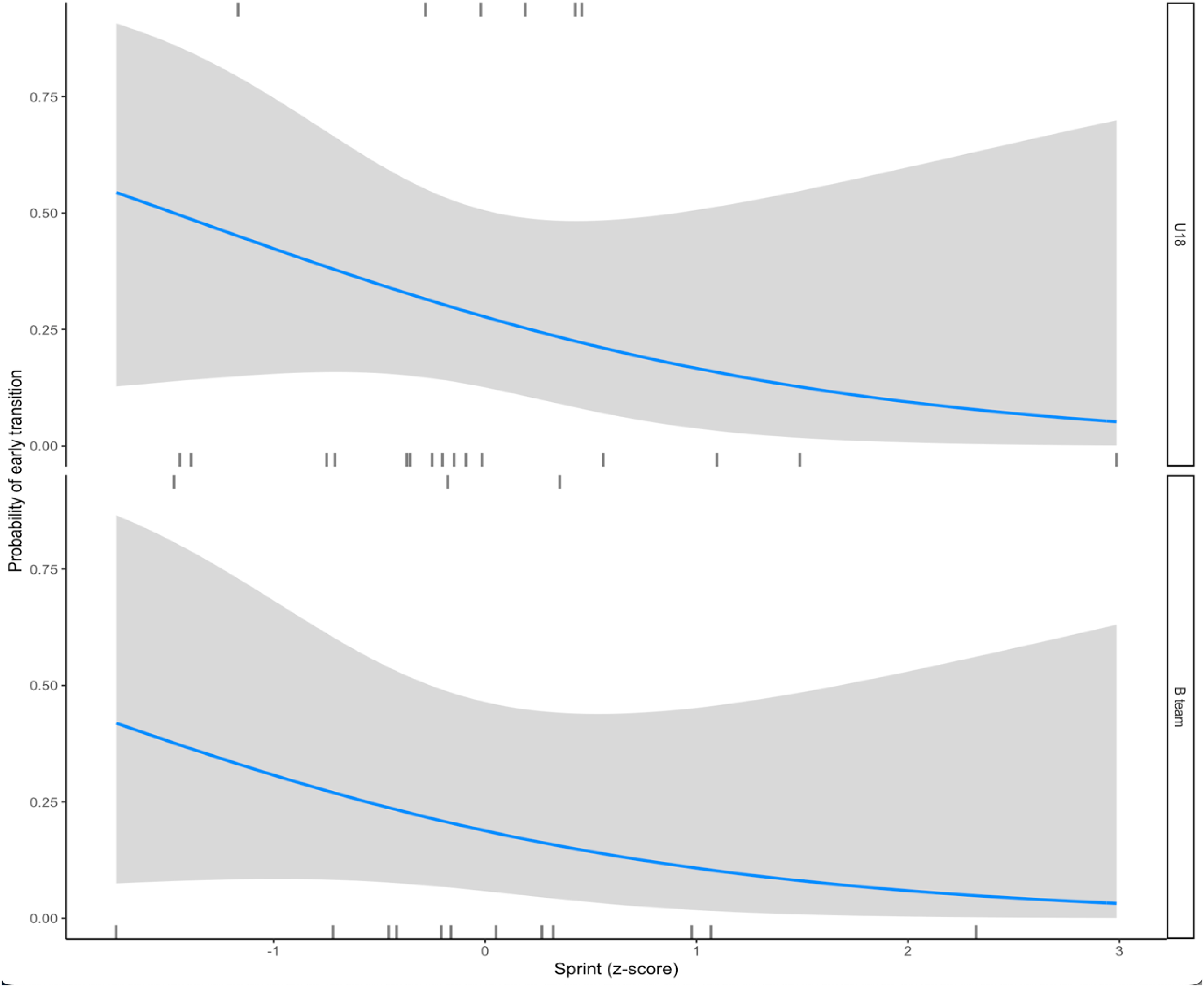
Probability of early transition: relative sprint distance Z-scores note: Figure 1 presents a visual depiction of the probability (and predictive intervals) of successful early transition from U18 to U21 (B Team), and U21 (B Team) to first team.
Relative aggregated HI acceleration and deceleration was a non-significant predictor of successful transition across all squads (P = 0.289). While statistical significance was not reached, an OR of 1.70 for players 1 standard deviation from the squad mean indicates a stronger probability of early transition to an advanced playing squad. However, players would need to demonstrate exceptional HI acceleration and deceleration ability, for example more than three standard deviations from the mean relative aggregated HI acceleration and deceleration efforts (e.g., Z-score of >3) to increase the probability of making an early transition successfully. Figure 2 presents a visual depiction of the probability of early transition between squads relative to aggregated high intensity acceleration and deceleration z-scores.
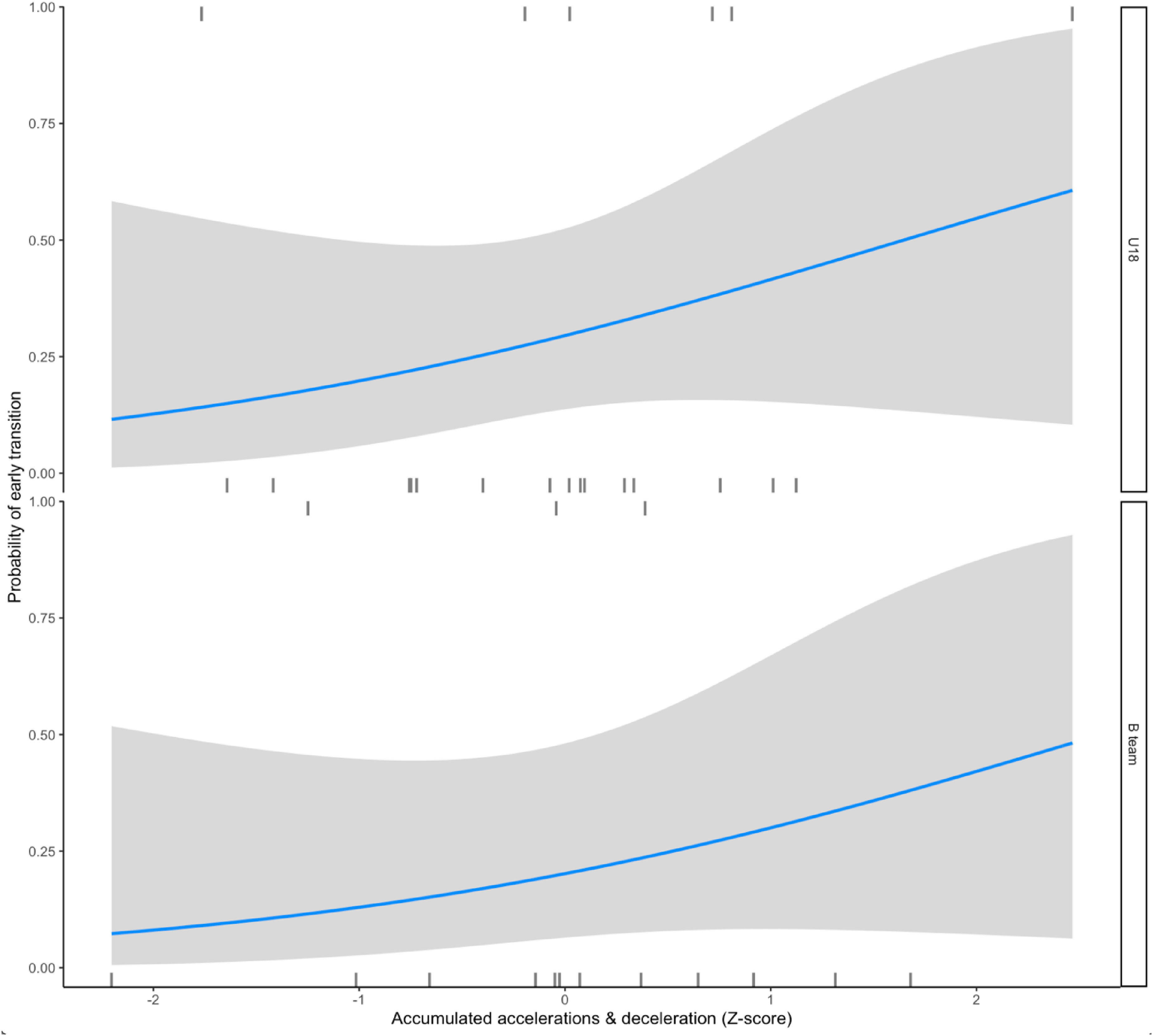
Probability of early transition: relative accumulated HI accelerations & decelerations note: Figure 1 presents a visual depiction of the probability (and predictive intervals) of successful early transition from U18 to U21 (B team), and U21 (B team) to first team.
Discussion
The aim of this novel study was to investigate the predictive role of playing squad, relative sprint distance, and relative aggregated HI acceleration and deceleration efforts on early transition opportunities for youth players in the professional phase of an elite soccer academy in the UK. These metrics were selected following the findings of McGuigan et al. 13 which suggested stakeholders valued sprint ability and HI acceleration and deceleration efforts highly for the early transitioning youth soccer players within the wider performance domain. To our knowledge, an examination the predictive value of physical performance metrics has not been conducted before. The results highlight the complex nature of youth soccer player development and indicate contrasting predictive values between sprint distance and HI aggregated acceleration and deceleration actions. Sprint distance had a reduced probability of successful early transition to an advanced squad when compared with HI acceleration and deceleration efforts over a 2-season period (2021/22 and 2022/23). The results of the current study support the need for elite youth players to demonstrate exceptional levels of sprint ability and HI acceleration and deceleration efforts to enhance successful early transition probability. However, as highlighted in McGuigan et al., 13 physical performance is one aspect of a multi-factorial and interconnected web of performance and development domains. As such, the results of the current study require deeper investigation to rationalise the predictive value of two HI metrics which are widely regarded as important determinants of soccer performance.
Our findings indicate that early transition opportunities reduce as players progress to the latter stages of academy soccer. While anecdotal evidence to support such findings may exist, to our knowledge our empirical approach provides an objective perspective of this critical stage of the talent development pathway. The U18 squad represented the reference point in the predictive model, and analysis established a 38% probability of early transition to the U21 from U18 squad. As players move along the developmental pathway, the probability of early transition from U21 to the first team reduces further as indicated by the odd ratios of the predictive analysis. This confirms that as players get older and progress towards the first team, their window of opportunity reduces. These findings broadly reflect current talent development and youth to senior transition literature.1,2,41 Multiple factors influence and impact youth player transition and can be linked to an environmental shift from development focused provision to performance and results-driven soccer. 42
Elite soccer clubs regularly compete for domestic and continental honours. Success in these endeavours brings prestige and financial reward, which enhance reputation and endorse clubs’ status as major competitors at the elite level of the game. 43 Additional positive consequences of successful campaigns include lucrative sponsorship opportunities, broadcasting coverage, and importantly, player trading and recruitment prospects. 44 Therefore, it is expected that head coaches, support staff, and sporting directors of elite clubs will prioritise first team results ahead of development of young players. 45 At first team level, the standard of player and opposition is significantly higher, within squad competition between players is greater, and senior players who have performed consistently at an elite level are advantaged due to their experience and status. 11 This is problematic for elite level youth players at the highest ranked clubs in Europe, however, it is a barrier they must overcome to establish themselves within hyper-competitive first team squads. 41 Therefore, youth players must demonstrate exceptional ability to successfully transition through the academy system and into the first team. 40
Soccer clubs have adopted several strategies to provide players with the optimal opportunity to progress through each academy transition event.46,47 For example, talent identification and development strategies have attempted to mitigate the risks associated with player development including the relative age effect (RAE). 48 This ensures later physically and cognitively developing young players are given adequate time to demonstrate their ability and are not ‘prematurely’ deselected from academy programmes. 49 However, as players progress to full time scholarship or professional contracts, it is typical for coaches and decision makers to analyse and critique development of youth players from a performance lens to prepare them for transition to first team soccer. 50 The final step from U21 to first team represents the most challenging transition of their journey. 40 Recent research has aimed to establish potential methods to aid the transition process from 18 years onwards in elite level soccer academies. Royensdal and colleagues 41 suggested aligning first team playing style and strategy with that of the academy teams’ to enhance the transition from a tactical perspective and this philosophy is also applied at the club involved in this study. In addition, clubs have incorporated the role of a ‘transition coach’ to work specifically with young players in the early-transition and post-transition phase to first team soccer. 51 The club in this study have recently created a role which specifically focuses on the development and transition of elite youth players in the U18 and U21. The outcome of this analysis is the first to quantify the probability of making the transition and corroborates the theory that the probability of successfully transitioning reduces as players get closer to the first team. We acknowledge that these findings are specific to the structures, philosophies, and culture of a single club and may not reflect that of other elite level clubs. However, the approach used in this study may be replicated by other elite level clubs to establish probability of successful early transition between age groups.
Players who covered sprint distance equivalent to 1 standard deviation greater than the squad mean were found to have a 52% probability of early transition. The relatively modest predictive value of this metric may appear surprising given the extensive evidence indicating sprint ability as a key performance indicator in elite soccer performance. 30 The results suggest that players would be required to cover sprint distance at least 2 standard deviations from the squad mean to increase the probability of successful early transition. Sprinting is a high intensity action and a discriminant metric between elite and sub-elite level players. 52 As such, soccer players at the elite level are required to demonstrate exceptional maximal speeds, sprint endurance, and repeated sprint ability to cover greater volumes of sprint distance. 53 Relatedly, aspiring youth soccer players also need to demonstrate an ability to produce high intensity efforts repeatedly during training and matches to enhance transition opportunities. 13 In addition, sprint distance is a key metric which is used to assess player performance at academy and first team level. 14 Sports science and physical performance practitioners implement periodised programmes to develop sprint ability and expose players (academy and first team) to maximal efforts within weekly training micro cycles. 54
It is important to consider the contextual factors when interpreting potential predictive value of sprint distance on early transition. Firstly, the findings are representative of a context-specific investigation of 2 squads in the professional phase of an elite academy which significantly limited the sample size (n = 37). Of the 37 players whose data sets were analysed, 8 successfully transitioned from their peer group squad. As such, this increased the probability of uncertain findings as reflected by the wide confidence intervals of the prediction model outputs (Table 3). However, it is important to acknowledge the ecological robustness of the study which is entirely reflective of a soccer academy pathway. The limited sample size in this study and the number of successful transitions was expected, such is the nature of elite soccer academies. The originality of the study offers a unique and authentic representation of a single club academy investigation which stakeholders and practitioners may reference and contextualise against their own academy players.
Finally, it is important to reaffirm that youth soccer player transition is a highly complex, multifaceted event. 55 Successful transition is the sum of multiple, inter-connected performance domains and the path to success for youth soccer players is unique and inimitable. 11 Tactical understanding, technical ability, and psycho-social factors all influence youth soccer player development alongside physical prowess, with each domain consisting of several sub-domains which form the 4 corners of performance (e.g., technical – passing, first touch, dribbling). 56 Despite the emphasis placed by the coaching staff on their subjective perceptions on sprint capacity and explosive power 40 interrogating the influence of sprint distance in isolation from the other determinants of player performance should be treated with caution. It is plausible for this cohort, that players who demonstrated exceptional sprint distance across 2 seasons perhaps lacked other performance metrics that coaches valued higher. For example, for transitions between U18 and the U21, coaches may have regarded technical ability, first touch and passing as the key metrics by which to grant players transition. Alternatively, for players making the transition from U21 to the first team, an in-depth understanding of tactical principles and strategy is potentially what set the successful transition group apart from their peers.1,57 Also, it is possible that the positions of each transitioning player impacted their overall sprint distance across each season. Sprint distances will vary among playing squads and will reflect playing position and individual player ability. 58 Modric et al. 59 found that full backs and forward players in the wide areas cover the greatest distances at high speed when compared to that of central defenders. This is directly influenced by tactical principles, popular amongst many of the elite clubs in Europe, which requires full backs to attack and defend in equal measure and wide players to be aggressive when entering the final third of the pitch and make recovery runs during defensive transitions. 58 Of the 8 players who transitioned successfully between season 2021/22 and 2022/23, 6 played in positions that occupied the centre of the pitch (central defender (n = 3) and central midfielder (n = 3)). Given that sprint demands are greater for players in wide or attacking positions, this may provide further understanding as to why sprint distance for this cohort was considered a weaker predictor for successful transition when compared to HI acceleration and deceleration efforts. 60 Also, sprint distance has been shown to have a high variability between players during matches and training which increases the difficulty in ascertaining generalisable conclusions.61,62 Conversely, other performance metrics including strength, acceleration, passing ability, and positional understanding may have been more desirable for key decision makers during this period.
As sprint actions typically precede goal scoring events in elite soccer 32 and high levels of sprint distance are correlated with positive match outcomes, 16 it would be unreasonable and imprudent to suggest that sprint ability is not a critical aspect of youth soccer player performance and development. However, in this study, alternative aspects of soccer performance may have been considered more important for successful transition. For example, sprint actions are related to goal scoring events and perhaps play a lesser role in other parts of the game. 14 This enhances the notion that youth soccer player transition and development require a nuanced evaluation prior to generalisable conclusions being drawn. 1
Exceptional HI acceleration and deceleration efforts (e.g., > 3 standard deviations from the mean) increased the probability of early transition opportunities. HI acceleration and deceleration efforts in modern soccer has significantly increased in recent years. 63 The factors associated with this increase are also attributable to the evolution of the game from a tactical and strategic perspective.27,64 It is common for elite clubs to adopt an aggressive, high pressing style of play when out of possession. 63 In addition, some clubs adopt a counter pressing approach which requires players to accelerate at high intensities repeatedly to immediately regain possession of the ball following a defensive transition.65,66 The club involved in this study adopt this approach across all squads from the first team and throughout the academy. Such tactics requires players to accelerate from standing, walking, or running locomotion's to rapidly close the space between themselves and their opponent. 67 High-intensity acceleration efforts commonly precede a high-intensity deceleration effort as players engage in 1v1 duels or manipulate an opponent's direction of travel with the ball through physical contact and body position. 34
The importance of such efforts was highlighted in recent work by Martinez-Hernandez et al. 32 They found HI deceleration efforts to be the second most common action to precede a goal after linear sprinting. This enhances the notion that these HI efforts are of critical importance to individual performance and match outcomes 33 As such, these HI efforts should be developed at youth level in preparation for transition to the senior squad. 2 Despite aggregated HI accelerations and decelerations having a greater predictive value than relative sprint distance, we posit that youth players would still be required to exceed squad averages. This would increase the probability of a successful transition and better equip them for the demands of first team soccer.2,34 In addition, the prevalence of sprinting, acceleration, and deceleration efforts before and during goal scoring events increases the value of these physical metrics. 16 However, as previously discussed, there are many influencing factors and domains that determine transition of elite youth soccer players. 55 Therefore, youth players will be required to demonstrate excellence in all aspects of their performance and development to increase likelihood of transition. 68
Practical implications
The results of this project provide a context-specific account of the predictive role of HI physical efforts and transition opportunities in an elite soccer academy. The findings of this study support the need for an effective multidisciplinary approach to player development and transition such is the multifactorial nature of the domain. From a physical perspective, whilst our findings suggest variance in the predictive value of performance metrics like sprinting and HI acceleration and deceleration efforts in a specific context, we posit that these aspects of soccer performance are highly important for elite youth soccer player development and performance. As such, practitioners should be cognizant of such nuances and variances within professional and elite soccer academies and aim to maximise all aspects of youth player development, including physical, technical, and psycho-social domains to optimally prepare players for early transition opportunities. In addition, this work may be of interest to practitioners who work with clubs that adopt a similar high pressing tactical approach which requires players to repeatedly demonstrate exceptional sprint, acceleration, and deceleration abilities.
Limitations
This study investigated a context-specific cohort from the academy of an elite level soccer club across 2 seasons (2021/22 and 2022/23). The single club focus adopted in this study limited the number of participants (n = 37). Therefore, the possibility of generating generalisable results with confidence is reduced. A study of this nature with a larger sample size involving various academies of a similar elite level and playing philosophy may lead to more generalisable findings.
The probability, however, of identifying multiple clubs with an identical playing and training philosophy is unlikely. Therefore, delimiting the study design to a single club was the optimal approach for our research question. Consequently, the purpose of the study was not to produce generalisable findings, but instead to investigate the probability of transition within one elite academy based on 3 predictor variables (playing squad, relative sprint distance, and relative aggregated HI acceleration and deceleration efforts) in response to McGuigan et al. 13 Also, it is important to consider the context and nuanced nature of elite youth player transition in the professional phase (16 years +) of the development pathway. Elite youth soccer player transition is a complex domain with predictors likely to vary and be influenced by club philosophy, playing style, player recruitment strategies, and resources. As such, it is unclear whether aiming for generalisability in this context is a valuable endeavour. The lack of significance does not diminish the findings, but instead promotes deeper interpretation and investigation to accurately portray a broader narrative which can be attributed to the results.
In addition, relative sprint distance and relative aggregated HI acceleration and deceleration efforts were investigated as they were key physical aspects of performance that were highlighted in previous research. 13 Extending these parameters to conduct a wider investigation with a large sample size may provide a broader insight to the physical determinants of youth player transition. Also, these results or metrics may not be representative of the key performance indicators of similar aged cohorts within other elite soccer clubs and academies.
Conclusion
This study investigated early transition opportunities of youth soccer players in the professional phase of an elite academy based on playing squad, relative sprint distance, and relative aggregated HI acceleration and deceleration efforts. Results suggest that early transition opportunities diminish as players progress from U18 to U21. In addition, youth players from U18 and U21 squads who demonstrated exceptional sprint ability were found to have a reduced probability of early transition. Conversely, relative aggregated HI acceleration and deceleration efforts substantially enhanced their probability of transition. Whilst physical performance in isolation cannot predict successful soccer performance, it is a critical performance domain in which players are required to demonstrate high levels of competence.
In summary, physical performance metrics like sprint distance and HI acceleration and deceleration efforts are important factors of youth player development and performance. However, elite physical performance cannot be considered a strong predictor of transition in isolation. Physical performance must be integrated with multiple domain-specific metrics including technical, tactical, and psycho-social to illicit holistic high performance and enable players to adapt to various challenges following transition.
Footnotes
Declaration of conflicting interests
The authors declared no potential conflicts of interest with respect to the research, authorship, and/or publication of this article.
Funding
The authors received no financial support for the research, authorship, and/or publication of this article.
