




Abstract
Several sports tournaments contain a round-robin group stage where the teams are assigned to groups subject to some constraints. Hence, the organisers usually use a computer-assisted random draw to avoid any dead end, a situation when the teams still to be drawn cannot be assigned to the remaining empty slots. This procedure is known to be unfair: the feasible allocations are not equally likely, that is, the draw does not have a uniform distribution. We quantify the implied unfairness of the 2018 FIFA World Cup draw and evaluate its effect on the probability of qualification for the knockout stage for each national team. The official draw order of Pot 1, Pot 2, Pot 3, Pot 4 turns out to be a significantly better option than the 23 other draw orders with respect to the unwanted distortions. Nonetheless, the non-uniform draw distorts the probability of qualification by more than one percentage point for two countries. Our results call attention to the non-negligible role of draw order and make it possible for policymakers to decide whether using fairer draw mechanisms is justified.
“Any one who considers arithmetical methods of producing random digits is, of course, in a state of sin.” 1 (John von Neumann: Various techniques used in connection with random digits)
Introduction
The mechanism design literature usually focuses on theoretical requirements like efficiency, fairness, and incentive compatibility.1–3 On the other hand, institutions—like governing bodies in major sports—often emphasise simplicity and transparency, which calls for a comprehensive review of how the procedures that exist in the real world perform with respect to the above properties.
Many sports tournaments involve a group stage where the teams are assigned to groups subject to some constraints.4,5 These constraints are imposed “to issue a schedule that is fair for the participating teams, fulfils the expectations of commercial partners and ensures with a high degree of probability that the fixture can take place as scheduled”. 6 Examples include the FIBA Basketball World Cup, 7 the FIFA World Cup, 8 the European Qualifiers for the FIFA World Cup, 6 the UEFA Euro qualifying, 9 and the UEFA Nations League. 10 Draw restrictions are also used in club-level tournaments such as the UEFA Champions League and the UEFA Europa League. 11
Until 2014, the FIFA World Cup draw divided the teams into pots mainly according to their geographic area, which caused serious unfairness in certain years such as in 1990, 12 2006, 13 and 2014. 14 In particular, the top teams had different chances of being placed in a group with difficult opponents. Consequently, 15 has recommended three options to create balanced and geographically diverse groups, which has inspired FIFA to change the draw procedure used in the 2018 and 2022 FIFA World Cups.16,17
However, this mechanism, based on a computer-assisted random draw to avoid any dead end (a situation when the teams still to be drawn cannot be assigned to the remaining empty slots), is not uniformly distributed: the valid assignments are not equally likely to occur. 18 Hence, 18 propose two unbiased mechanisms that use balls and bowls, making them suitable for a televised draw. On the other hand, they require random simulations, which might threaten transparency.
Therefore, the organiser faces a dilemma: retain the existing but biased method or switch to a correct but less transparent mechanism. In order to understand this trade-off and choose the better option, it is inevitable to explore the extent of the bias, as well as its potential sporting effects. While these issues have been recently analysed in the UEFA Champions League, 19 they have not been addressed in the case of the FIFA World Cup, the most prominent football tournament around the world.
The current work aims to fill this research gap by analysing the unique mechanism used in practice by sports federations to draw groups (containing at least three teams) with constraints through the example of the 2018 FIFA World Cup. This case study has been chosen since the 2022 FIFA World Cup draw has contained an inherent bias due to the uncertainty in the set of teams qualified, 17 and the teams qualifying for the 2026 FIFA World Cup are naturally unknown at the time of writing.
We also call attention to the role of draw order: the order of the pots in the group draw turns out to have a non-negligible sporting effect. This is a somewhat surprising finding because the fairness of the UEFA Champions League Round of 16 draw essentially does not depend on whether the group winners or the runners-up are drawn first.19,20 On the other hand, no clear recommendation is given for the optimal draw order in general due to the huge complexity of the calculations; according to Csató 21 Section 5.1, computing the probabilities for six teams drawn from three pots is barely possible—and the 2018 FIFA World Cup contains 32 teams and eight pots. Therefore, several more case studies would be needed to find a general pattern if it exists.
Our topic is hugely relevant to governing bodies in sports. In an ideal environment, the rules governing a sport prevent any player or team from gaining an unfair advantage.3,22 But the sequential draw method of FIFA may threaten fairness, while the alternative solutions remain more complex and less transparent. 18 Therefore, policymakers could maintain the balance between fairness and integrity only by investigating different fairness indicators. 23
The paper starts with presenting a concise review of related literature, followed by describing the theoretical background of the FIFA World Cup group draw. The numerical results for the 2018 FIFA World Cup draw are discussed in two parts. First, the departure of the draw procedure from a uniformly distributed random choice among all feasible allocations is quantified for all the 24 possible draw orders of the four pots. This is important because the modification of the draw order (relabelling of the pots) does not require any reform in the existing principles of the draw. Second, the bias of the draw procedure is evaluated with respect to the probability of qualification for the knockout stage. That is essential since the ultimate price to pay for the sake of public interest and transparency is the distortion of the final outcome: if the effects on the chances of the teams remain marginal and insignificant, then there is no need to choose a more complex and less transparent draw procedure.
Related literature
Several scientific works analyse the FIFA World Cup draw. Before the 2018 edition, the host nation and the strongest teams were assigned to different groups, while the remaining teams were drawn randomly with maximising geographic separation: countries from the same continent (except for Europe) could not have played in the same group and at most two European teams could have been in any group.
In the case of the 1990 FIFA World Cup, 12 shows that the draw was not mathematically fair. For example, West Germany would have been up against a South American team with a probability of 4/5 instead of 1/2—as it should have been—due to the incorrect consideration of the constraints. Similarly, the host Germany was likely to play in a difficult group in 2006, but other seeded teams, such as Italy, were not. 13
Guyon 14 identifies severe shortcomings of the mechanism used for the 2014 FIFA World Cup draw such as imbalance (the eight groups are at different competitive levels), unfairness (certain teams have a greater chance of ending up in a tough group), and non-uniform distribution (the feasible allocations are not equally likely). Indeed, there has been a substantial competitive imbalance between the historical FIFA World Cup groups. 24
Guyon 15 presents alternative proposals to retain the practicalities of the FIFA World Cup draw but improve its outcome. One of them can be compared to the flawed FIFA rule at https://www.nytimes.com/interactive/2014/06/03/upshot/world-cup-draw-simulation.html.
Laliena and López 5 develop two uniformly distributed designs for group draw with geographical restrictions that produce groups having similar or equal competitive levels. Cea et al. 25 analyse the deficiencies of the 2014 FIFA World Cup draw and provide a mixed integer linear programming model to create the groups. The suggested method takes draw restrictions into account and aims to balance “quality” across the groups.
Roberts and Rosenthal 18 consider the challenge of finding a group draw mechanism that follows the uniform distribution over all valid assignments but is also entertaining, practical, and transparent. The authors suggest two procedures for achieving this aim by using balls and bowls in a way, which is suitable for a nice television show—but, in contrast to the proposals of Guyon, 15 they use computer draws at some stage which may threaten transparency. Both algorithms can be tried interactively at http://probability.ca/fdraw/.
Other studies deal with the UEFA Champions League where a constrained draw mechanism has been used in the Round of 16 between the 2003/04 and 2023/24 seasons. However, this method is distinct from the FIFA World Cup draw procedure. 21 Wallace and Haigh 26 verify that the possible assignments are not equally likely and highlight the connection of the UEFA draw mechanism to Hall’s marriage theorem, see also Haigh 27 Section 3.6. Kiesl 28 computes the bias in the 2012/13 season and outlines some fair—but uninteresting to watch—methods. According to Klößner and Becker, 20 the draw system inherently implies different probabilities for certain assignments, which are translated into more than ten thousand Euros in expected revenue due to the substantial amount of prize money. Finally, 19 reveal how the UEFA draw procedure affects expected assignments and address the normative question of whether a fairer randomisation mechanism exists. The current design is verified to come quantitatively close to a constrained best in fairness terms.
Theoretical background
A permutation of a set is a rearrangement of its elements. In the FIFA World Cup draw, the initial permutation of the teams is provided by a random draw. In an unrestricted group draw, the teams can be assigned to the groups in this permutation. However, in the presence of draw conditions, it is not obvious to find the permutation of the teams that corresponds to the feasible allocation implied by the draw procedure of FIFA.
This mechanism is defined as follows: “when a draw condition applies or is anticipated to apply, the team drawn is allocated to the first available group in alphabetical order” 6 . In other words, the team drawn is assigned to the first empty slot except if all permutations of the remaining teams violate at least one draw condition.
Assume that there are The sequence of permutations implied by the draw procedure of FIFA, 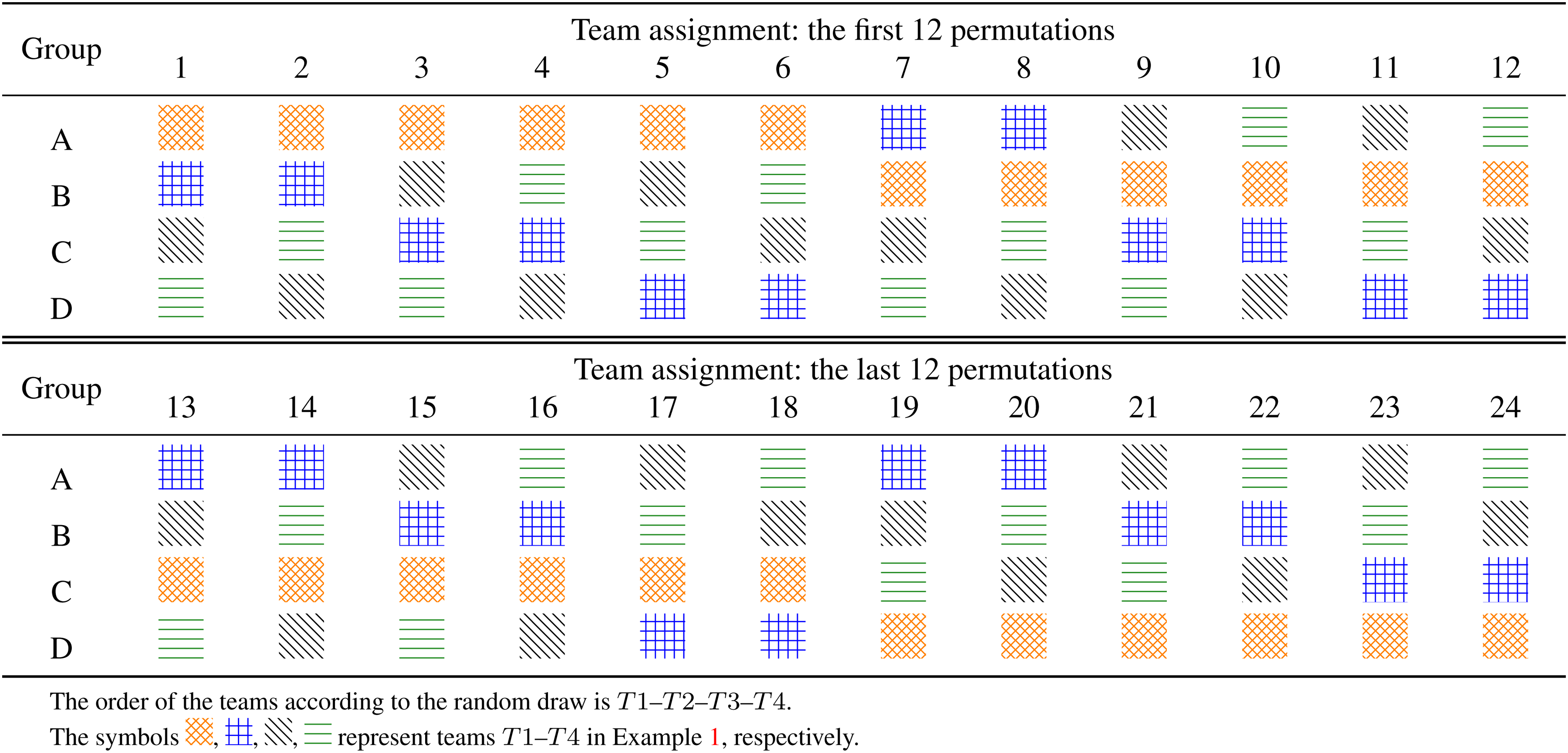
Let us consider two illustrative cases, where the restrictions are implied by the assignment of teams drawn from the previous pot(s):
If team The draw procedure of FIFA works as follows:
Team Team Team Team If teams The draw procedure of FIFA works as follows:
No constraint prohibits directly the assignment of team Team Team Team
The official video of the 2018 FIFA World Cup group draw is available at https://www.youtube.com/watch?v=jDkn83FwioA.
Generating all permutations of a sequence of values is a famous problem in computer science. 29 The classic lexicographic algorithm goes back to Narayaṇa Paṇḍita, an Indian mathematician from the 14th century. 30 The sequence corresponding to the FIFA World Cup draw procedure is called representation via swaps 31 and has been presented first in Myrvold and Ruskey 32 according to our knowledge. In particular, Figure 1 is analogous to Arndt 31 Figure 10.1-E.
The description of the 2018 FIFA World Cup draw
33
does not give an exact algorithm to obtain the implied feasible allocation of the teams into groups for a given random permutation of the teams. The scheme of an appropriate computer program is presented in Figure 2. Pot
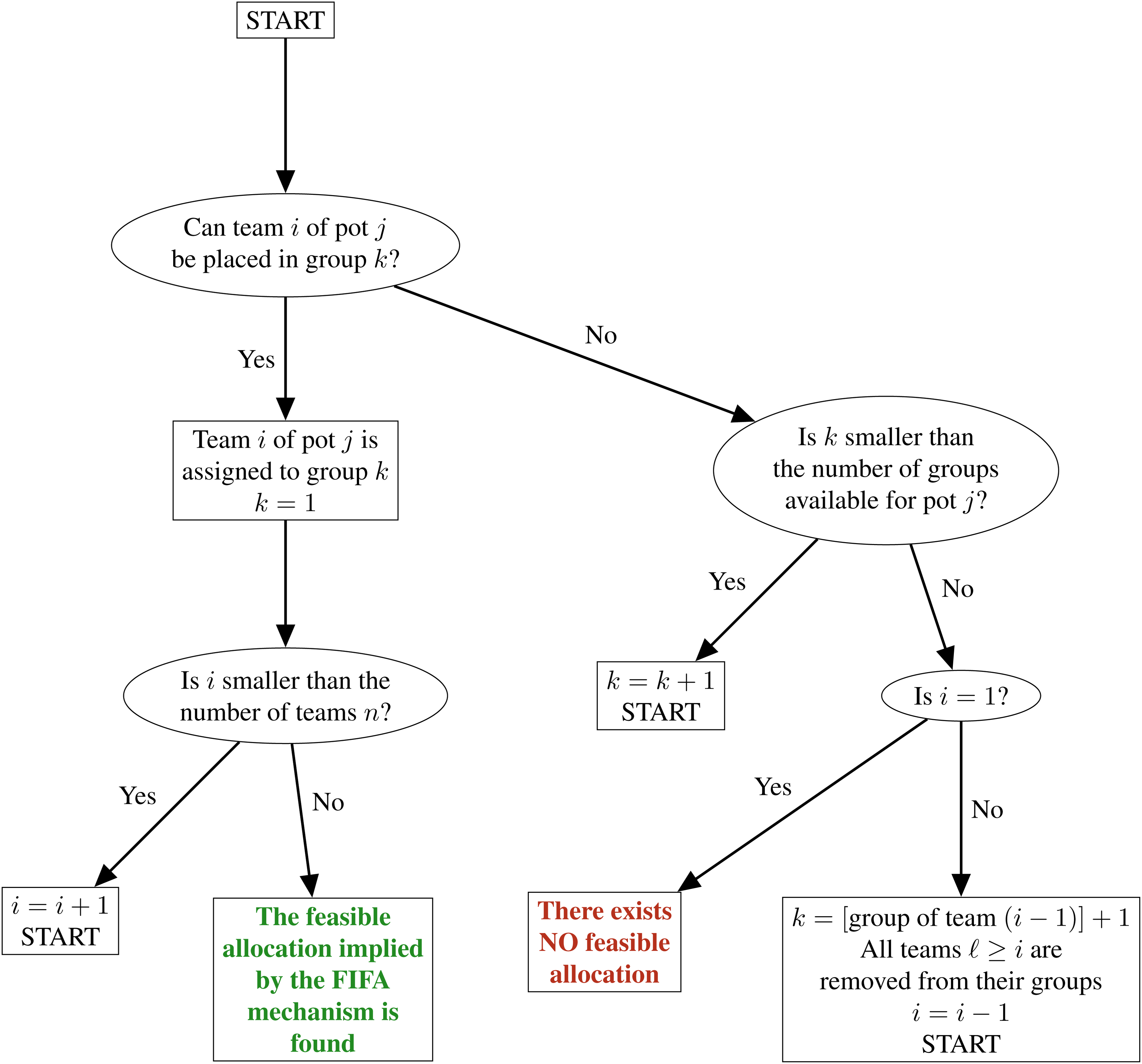
A backtracking algorithm for restricted group draw that finds the feasible allocation corresponding to a given order of the teams.
Backtracking can be familiar from the problem of scheduling round-robin tournaments, where an unlucky assignment of games to slots can result in a schedule that cannot be completed.34,35 Backtracking is also widely used to solve puzzles such as the eight queens puzzle, crosswords, or Sudoku. For draw procedures under draw constraints, backtracking has been suggested first in Guyon. 15
The (un)fairness of the 2018 FIFA World Cup draw
For the 2018 FIFA World Cup draw, pots were constructed based on the October 2017 FIFA World Ranking such that Pot
The draw sequence started with Pot 1 and ended with Pot 4. Each pot was emptied before the next was drawn and some draw conditions were applied
33
:
Russia was automatically placed in Group A. No group could have more than one team from any continental confederation except for UEFA (AFC, CAF, CONMEBOL, CONCACAF). Each group should have contained at least one but no more than two European teams.
The composition of the pots is shown in Table 1.
Seeding pots in the 2018 FIFA World Cup.
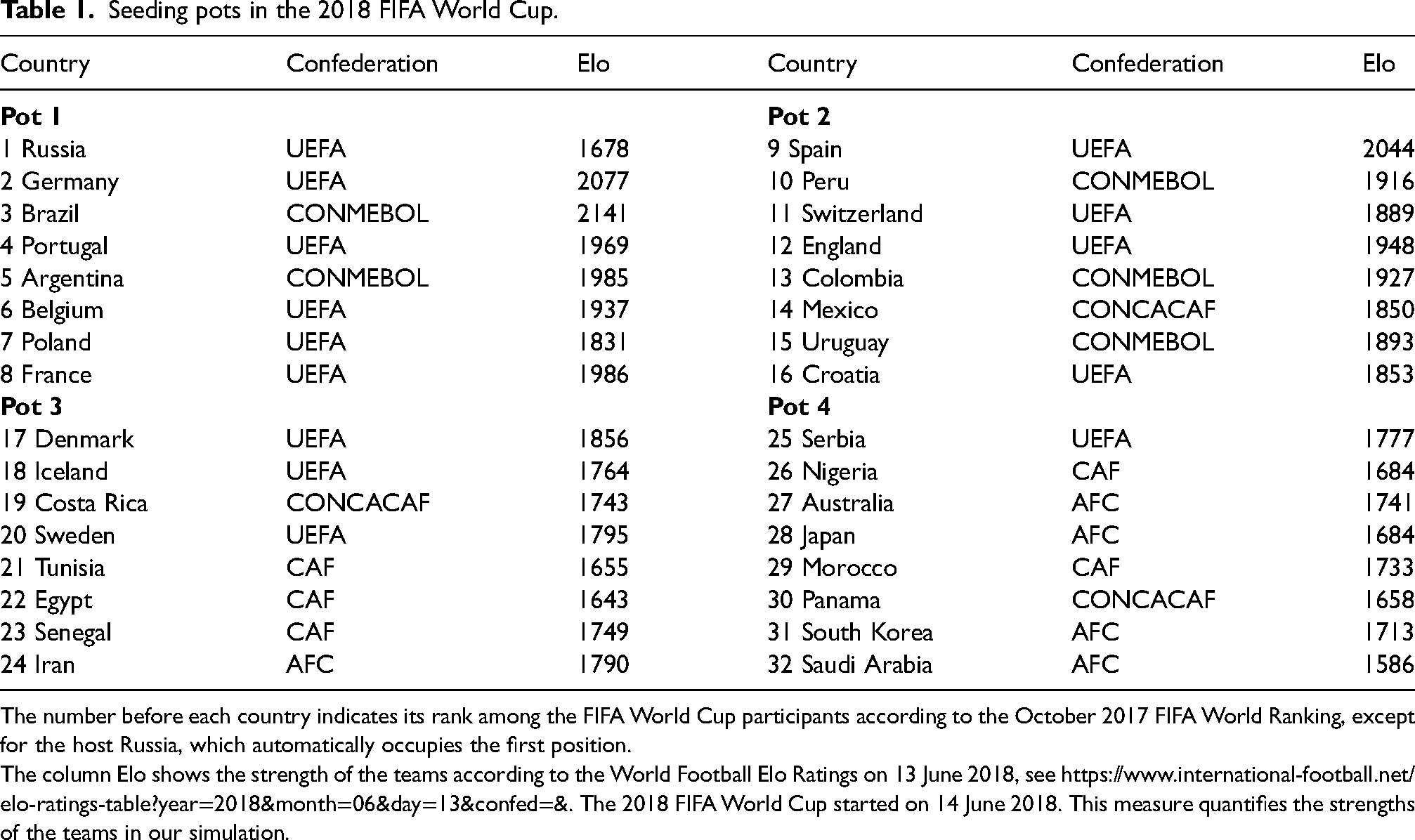
The number before each country indicates its rank among the FIFA World Cup participants according to the October 2017 FIFA World Ranking, except for the host Russia, which automatically occupies the first position.
The column Elo shows the strength of the teams according to the World Football Elo Ratings on 13 June 2018, see https://www.international-football.net/elo-ratings-table?year=2018&month=06&day=13&confed=&. The 2018 FIFA World Cup started on 14 June 2018. This measure quantifies the strengths of the teams in our simulation.
The effect of draw order
According to Roberts and Rosenthal
18
Section 2, the FIFA World Cup draw procedure is unfair since some feasible allocations might occur with a higher probability. In addition, the pre-assignment of Russia to Group A introduces a powerful bias because the draw mechanism is not independent of group labels. Russia has a 12.5% probability of playing against an arbitrarily chosen country from Pot 2 because no draw constraints can apply. However, since there are one CONCACAF, three CONMEBOL, and four UEFA members in Pot 2, the two CONMEBOL teams from Pot 1 (Brazil and Argentina) play against a given European team from Pot 2 with a probability of 0.2 since they have five possible opponents from Pot 2. The remaining five UEFA teams in Pot 1 are identical concerning the draw constraints, thus, they have a chance of
However, an appropriate relabelling of the pots may bring the FIFA World Cup draw closer to the uniform distribution. Therefore, all possible draw orders of the pots are examined such that the pre-assignment of Russia to Group A is retained. Since the teams can be drawn in
The rejection mechanism (or rejection sampler)
The distortions compared to the rejection mechanism 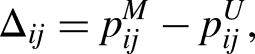
The most extreme and aggregated distortions are presented in Table 2. For example, the probability that Denmark (17) (or the equivalent team of Sweden (18) or Iceland (20)) and Serbia (25) play in the same group is more than doubled by the FIFA draw mechanism with the traditional draw order 1-2-3-4. On the other hand, the likelihood of assigning Russia (1) and Serbia to the same group is decreased by 4.68 percentage points, while the likelihood of assigning Mexico (14) and Serbia to the same group is increased by 10.29 percentage points.
The deviations of different draw mechanisms in the 2018 FIFA World Cup.
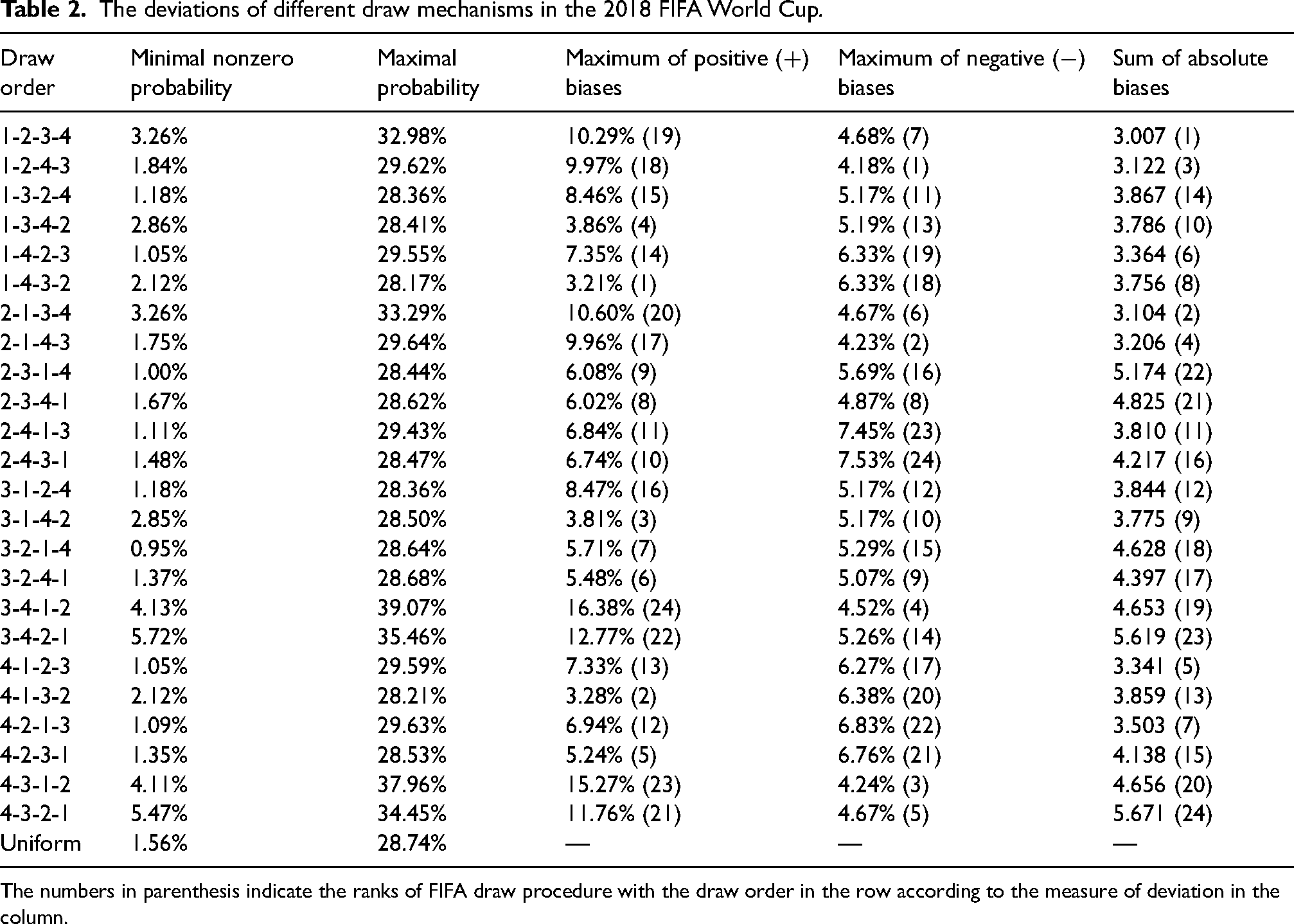
The numbers in parenthesis indicate the ranks of FIFA draw procedure with the draw order in the row according to the measure of deviation in the column.
The standard error of 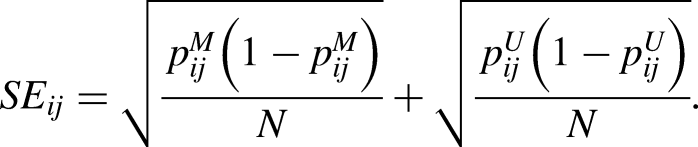
The last column of Table 2 compares the 24 draw orders by adding the values of 
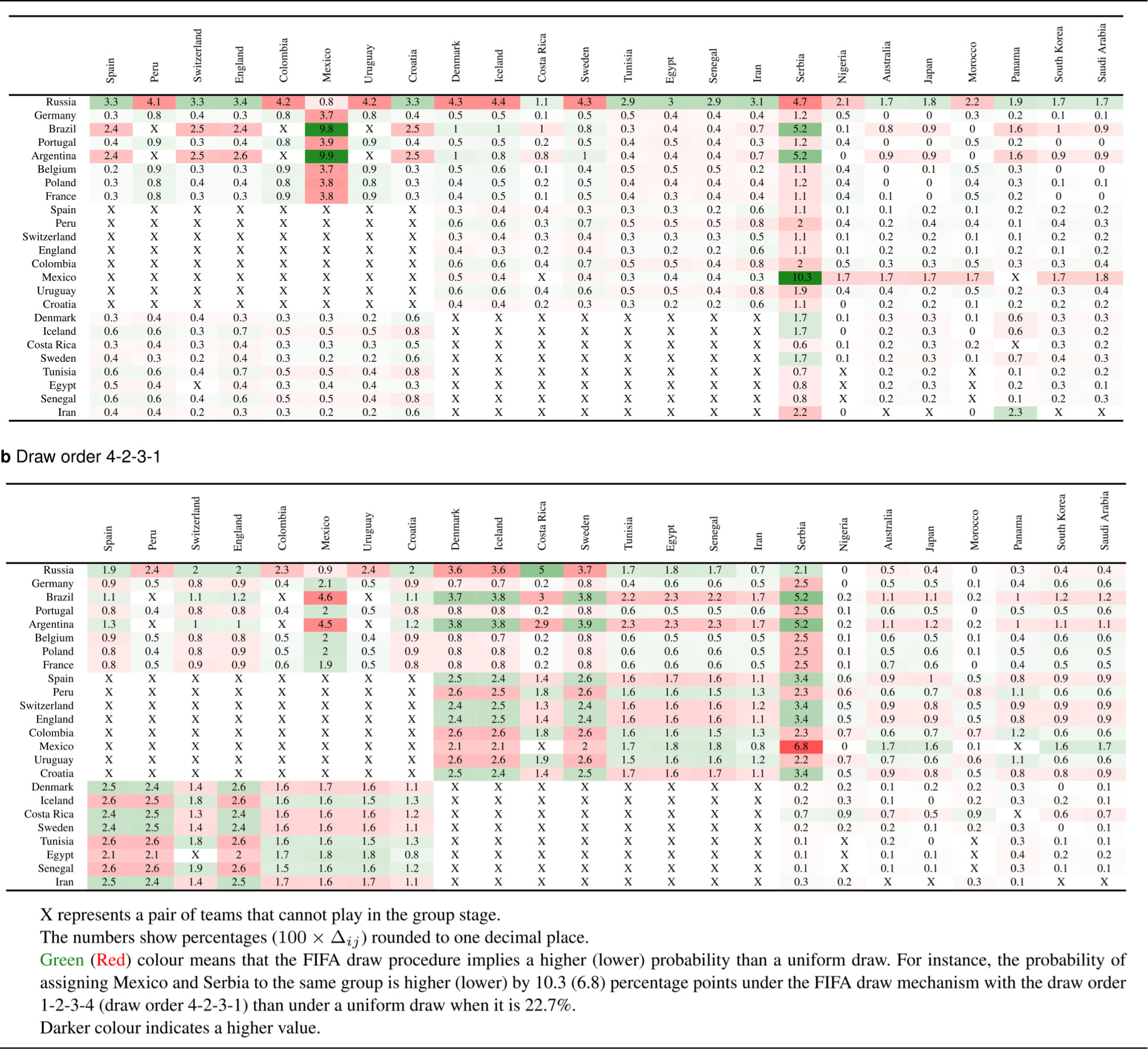
Table 3 presents fairness distortions for two fundamentally different draw orders. Clearly, Russia and Mexico pose challenges for both of them. However, the official mechanism (draw order 1-2-3-4) is clearly better for the country pairs from Pot 1 and Pot 2, as well as from Pot 1 and Pot 3, which is favourable as these teams have the highest chance to qualify for the Round of 16.
Fairness distortions for selected draw orders in the 2018 FIFA World Cup.
The distortions are also worth studying by taking the average of absolute or squared biases for all country pairs that involve a given national team. For the sake of simplicity, four draw orders are analysed in detail: the official 1-2-3-4, one that improves both the minimal nonzero and maximal probabilities with a slight change (1-2-4-3), one that is less biased for Mexico (1-3-2-4), and a fundamentally different draw order (4-2-3-1).
Figure 3 compares the means of the biases for the 32 countries. The official draw procedure is far from the fair rejection mechanism
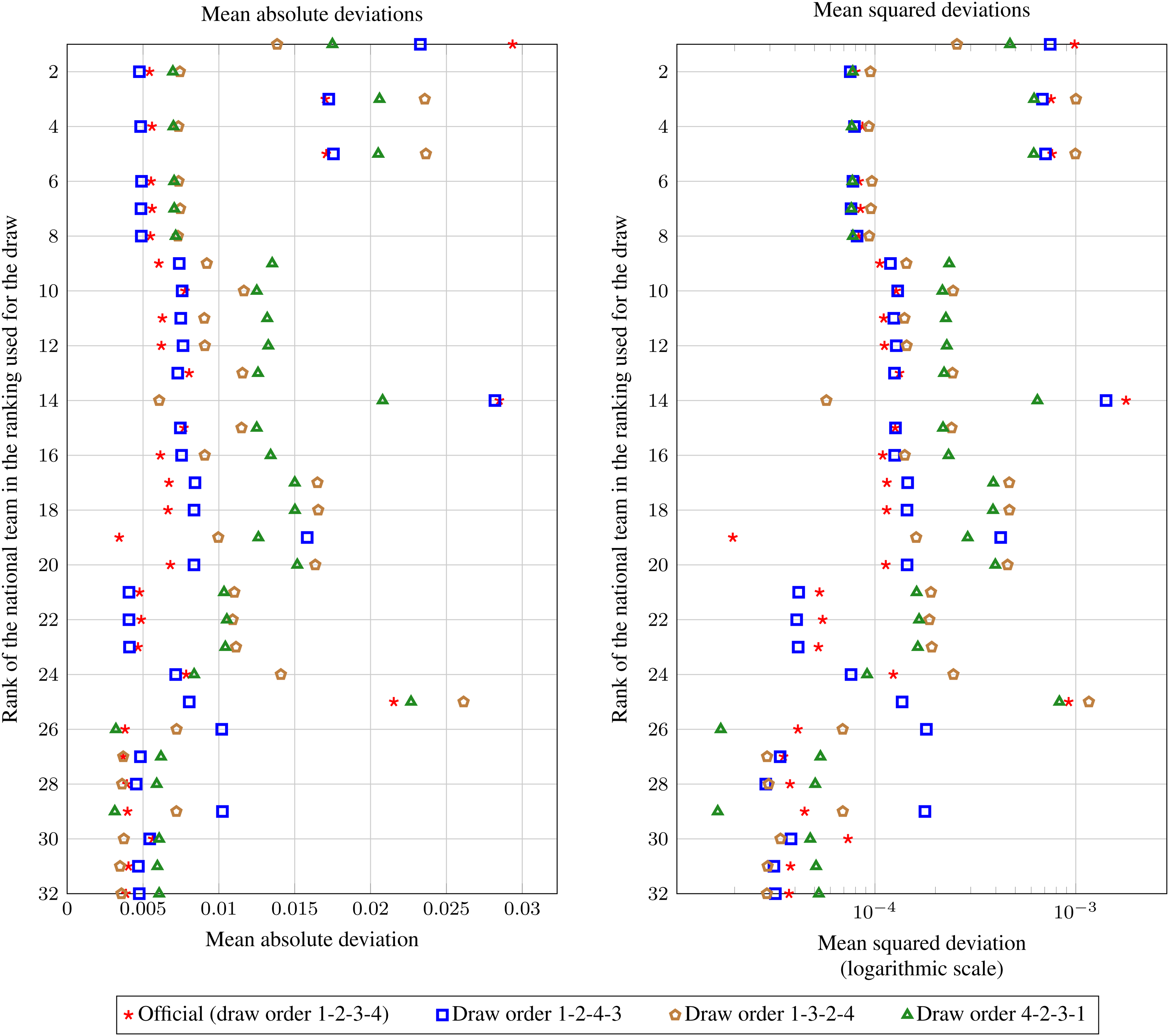
The average biases of different draw procedures for the national teams in the 2018 FIFA World Cup.
The consequences of non-uniform distribution
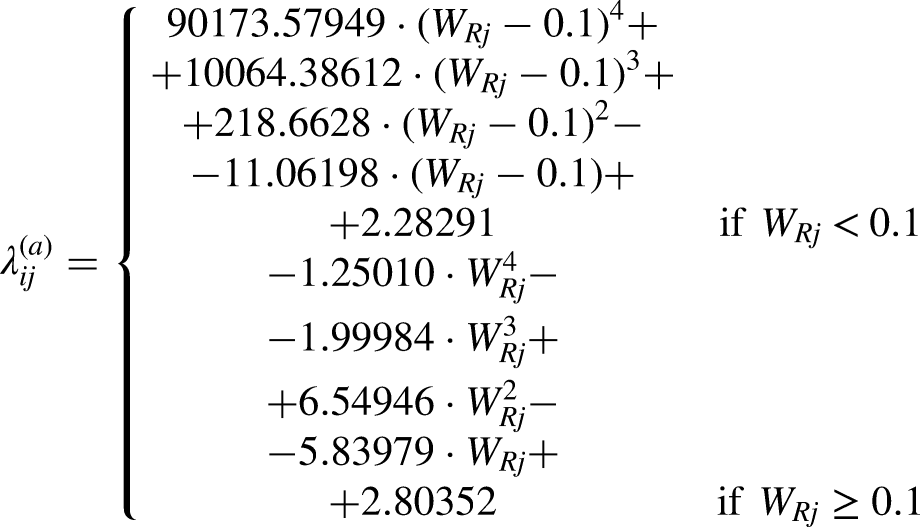
In the 2018 FIFA World Cup, the top two teams from each group have advanced to the Round of 16. Therefore, the distortions of the draw procedure are important primarily if they affect the probability of qualification for the knockout stage. To that end, the simulation methodology of Football rankings 37 is used. This models the number of goals scored in a match by Poisson distribution: the expected number of goals is a quartic polynomial of win expectancy as estimated by a least squares regression based on more than 29 thousand home-away games and almost 10 thousand games played on neutral ground between national football teams. 37 Win expectancy depends on the strengths of the teams according to a well-established metric,38,39 the World Football Elo ratings (http://eloratings.net/about), and the field of the match, which is neutral except for Russia, the host.
In particular, the probability that team 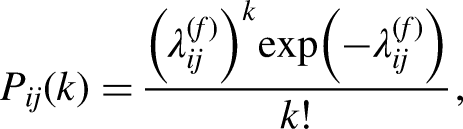
World Football Elo ratings determine the win expectancy 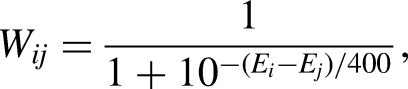
Football rankings
37
estimates how 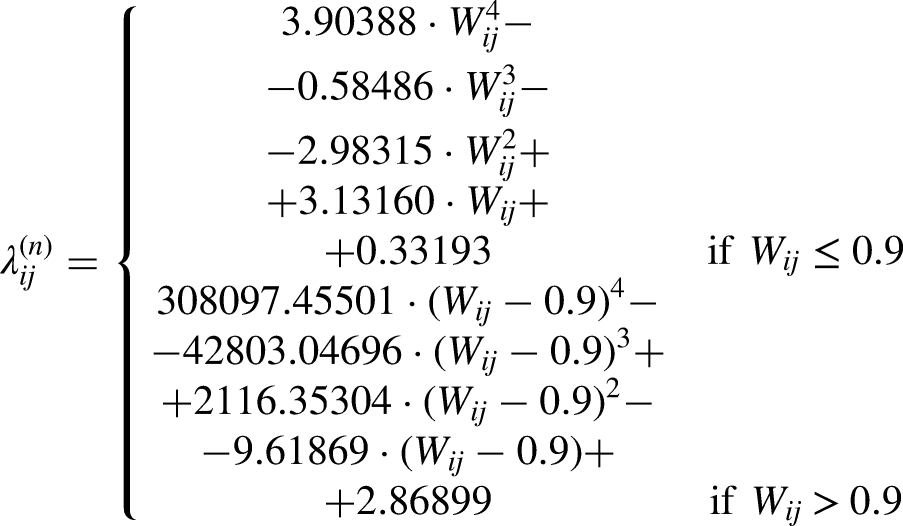
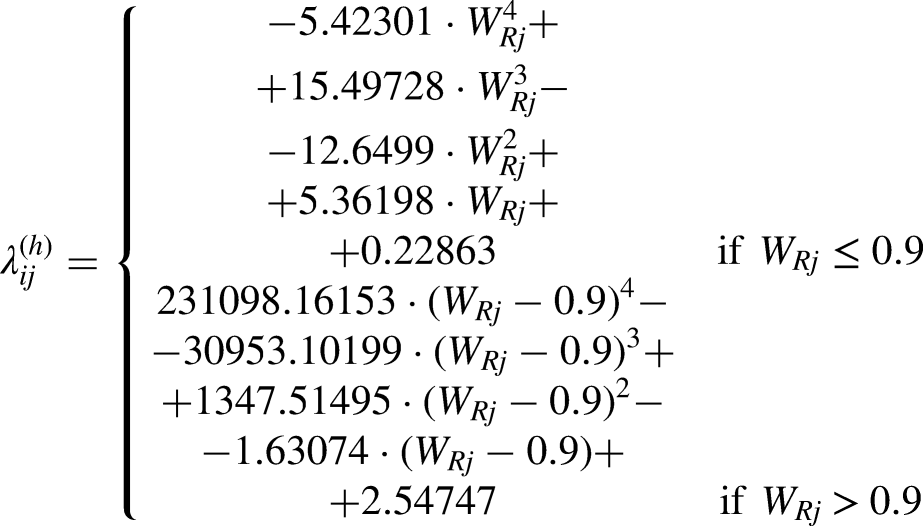
Last but not least, a ranking should be established based on the results of group matches. According to the rules of the 2018 FIFA World Cup, the first tie-breaking criteria are as follows 43 Article 20.6: (1) higher number of points obtained in all group matches; (2) superior goal difference in all group matches; (3) higher number of goals scored in all group matches. In contrast to the official regulation, if some teams are still tied after considering (1)–(3), their ranking is decided by drawing of lots in our simulation.
Thus, a simulation run consists of the following steps for any draw mechanism (uniform or FIFA World Cup draw procedure with a given draw order):
The eight groups are drawn according to the draw mechanism used (1 million times); The outcomes of all group matches are generated (10 times for each simulated draw); The group rankings are determined.
The results for any team are the number of times it finishes on the first and the second place in its group, which are at most 10 million, respectively.
Figure 4 shows how the FIFA World Cup draw mechanism distorts the chances of winning the group and being the runner-up. The official rule (draw order 1-2-3-4) increases the probability of winning the group by more than 1 percentage point for the four UEFA teams in Pot 2 (Spain [9], Switzerland [11], England [12], Croatia [16]) mostly at the expense of Mexico (14) and Serbia (25). Fortunately, these effects are somewhat mitigated by taking the likelihood of obtaining the second position into account. While the draw order 1-2-4-3 does not differ much from the traditional order of 1-2-3-4, the draw order 1-3-2-4 strongly reduces the distortions in the case of the above countries except for Serbia. Among the four draw orders, 4-2-3-1 is the less favourable for the weakest European team in Pot 2 (Croatia [16]) and the three UEFA members in Pot 3 (Denmark [17], Iceland [18], Sweden [20]).
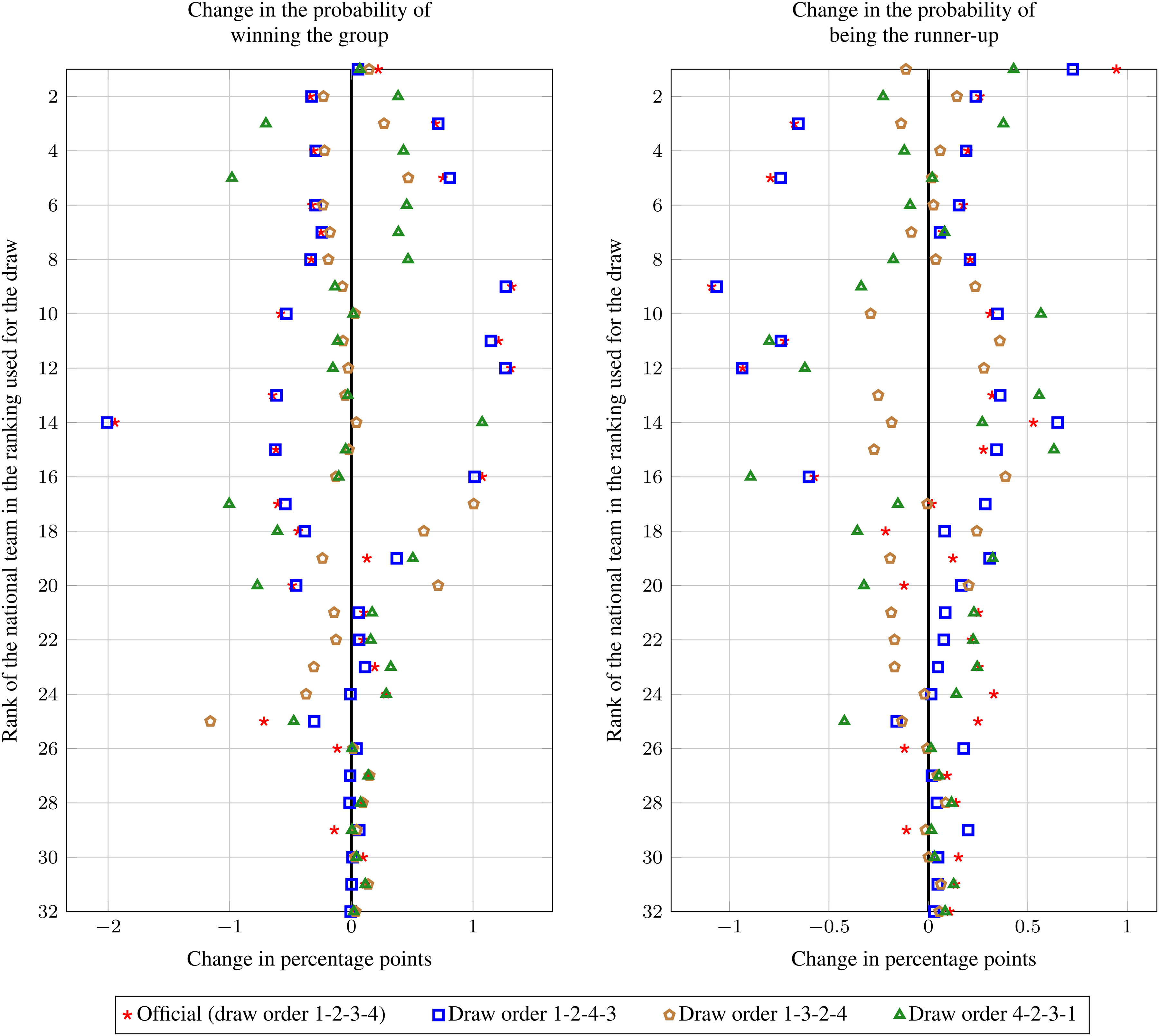
The effect of different draw procedures on being the group winner and the runner-up in the 2018 FIFA World Cup.
The probabilities of being the group winner or the runner-up are aggregated in Figure 5. The draw order 1-2-4-3 is somewhat better than the official 1-2-3-4: despite the increased impact on Costa Rica, it is less unfair for Russia, Croatia, Denmark, Iceland, and Sweden. The draw order 1-3-2-4 can be chosen if the bias for Mexico should be reduced, however, that is achieved at the expense of Serbia. The draw order 4-2-3-1 is not worth implementing because of the high distortions for several countries. These observations are reinforced by the summary statistics provided in Table 4.
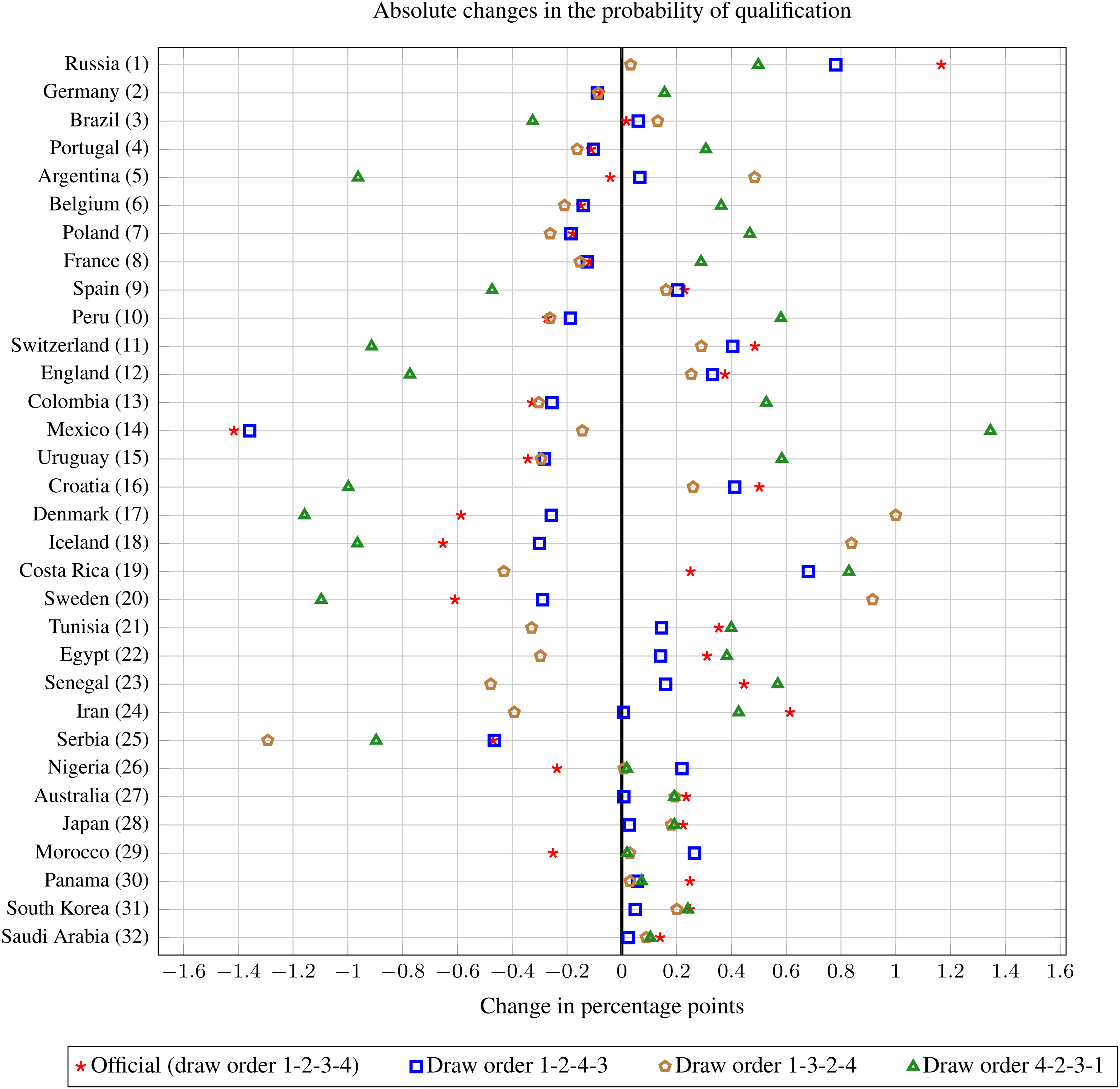
The absolute effect of different draw procedures on the probability of qualification for the knockout stage in the 2018 FIFA World Cup.
Summary statistics on the absolute changes of qualifying probabilities by four draw procedures in the 2018 FIFA World Cup.
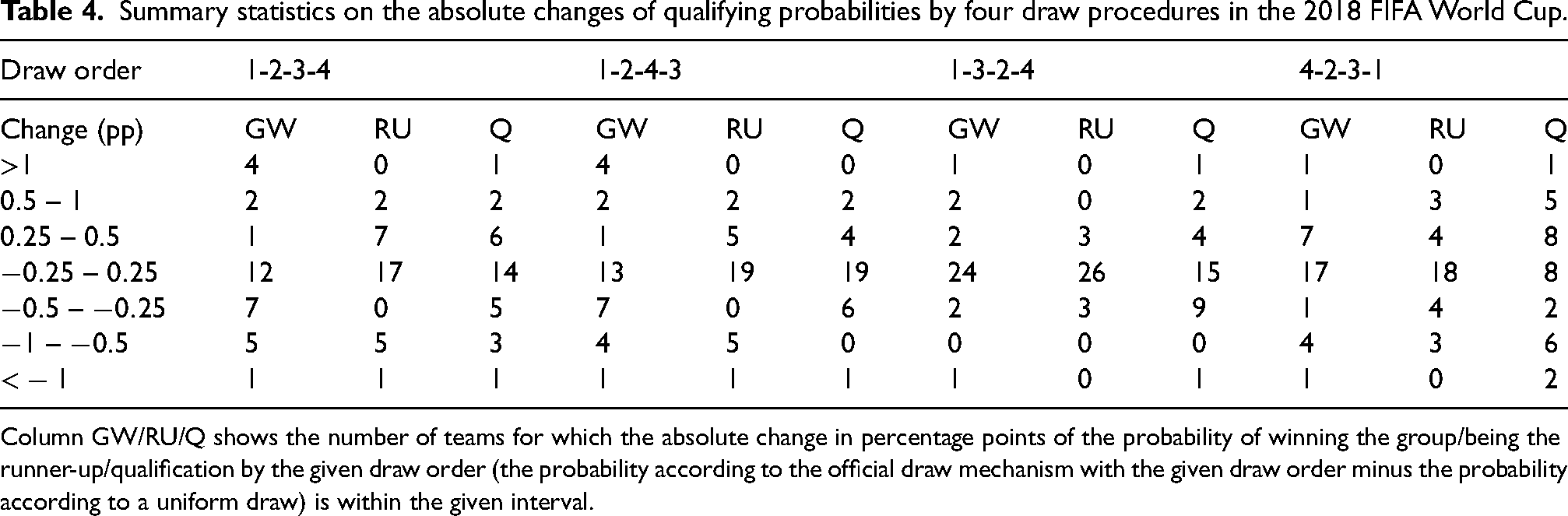
Column GW/RU/Q shows the number of teams for which the absolute change in percentage points of the probability of winning the group/being the runner-up/qualification by the given draw order (the probability according to the official draw mechanism with the given draw order minus the probability according to a uniform draw) is within the given interval.
Finally, Figure 6 uncovers the relative changes in the probability of qualification for the knockout stage as the same absolute distortions can be more costly for the weaker teams. In this respect, the draw order 1-2-4-3 can be a reasonable alternative to the official 1-2-3-4 as it is less biased for almost all teams except for Costa Rica as shown by Table 5. The other two draw orders are especially unfavourable for Serbia and the three UEFA (draw order 4-2-3-1) or the three CAF (draw order 1-3-2-4) teams in Pot 3.
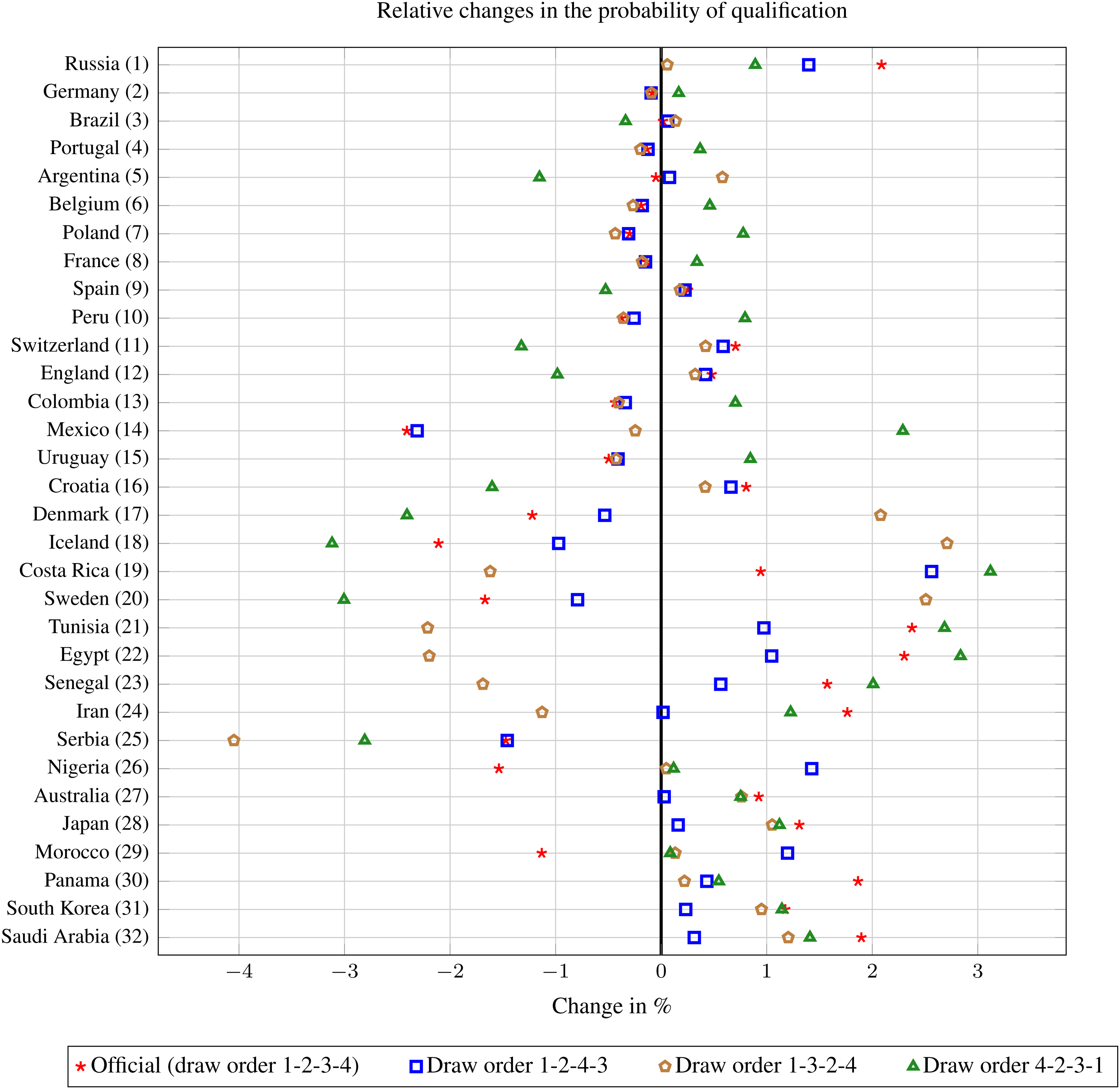
The relative effect of different draw procedures on the probability of qualification for the knockout stage in the 2018 FIFA World Cup.
Summary statistics on the relative changes of qualifying probabilities by four draw procedures in the 2018 FIFA World Cup.
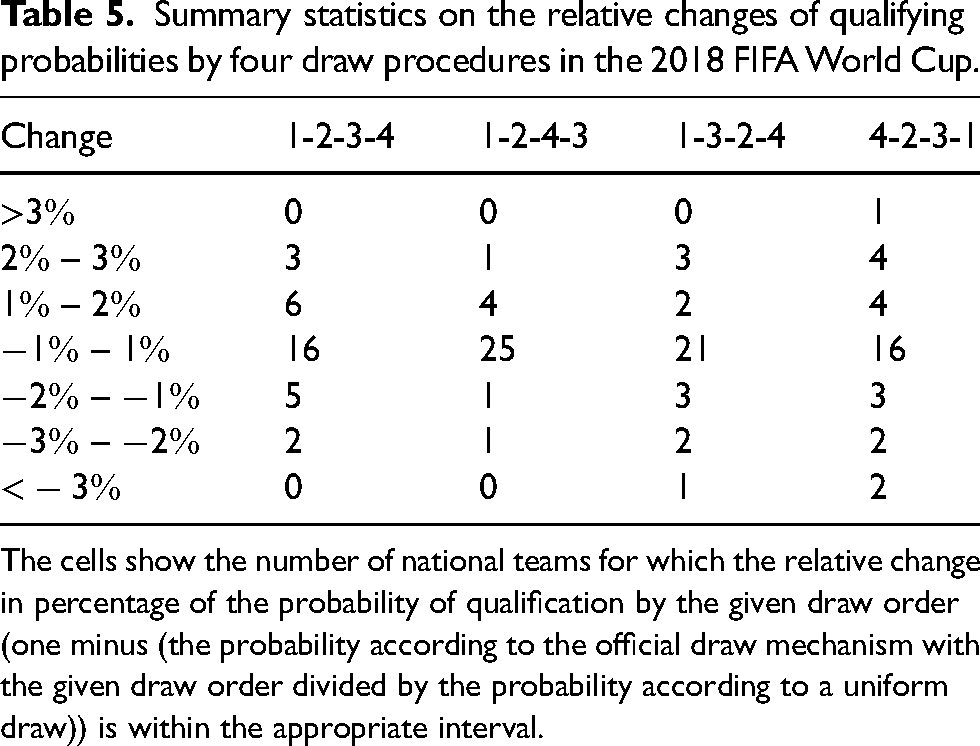
The cells show the number of national teams for which the relative change in percentage of the probability of qualification by the given draw order (one minus (the probability according to the official draw mechanism with the given draw order divided by the probability according to a uniform draw)) is within the appropriate interval.
Based on the arguments above, the official draw order of Pot 1, Pot 2, Pot 3, Pot 4 has been a lucky choice for the 2018 FIFA World Cup draw. But a change in the continental allocation of the teams playing in the FIFA World Cup may lead to a highly unfair draw in the future if the current draw procedure is applied.
Discussion
Our paper has analysed the unfairness of the 2018 FIFA World Cup draw. First, the connection of the standard constrained group draw procedure—used by the FIBA, FIFA, and UEFA—to permutation generation has been presented. Second, we have examined how this procedure departs from a random draw among all feasible allocations and considered all alternatives by relabelling the pots. The official draw order (Pot 1, Pot 2, Pot 3, Pot 4) has turned out to be an optimal choice among the 24 alternative rules with respect to natural measures of fairness.
Even though constrained group draw is currently used only in basketball and football, draw constraints offer the unique solution to maximise the number of intercontinental games in a group stage. This can be advantageous in several tournaments; for instance, the 2023 World Men’s Handball Championship contained eight groups, one with two of the three African teams, and another with two of the four South American teams. 22 Any governing body will likely adopt the procedure of FIFA if they introduce draw constraints.
We think there is at least some scope to modify the current draw order because the draw of certain sports tournaments has not been started with the strongest teams:
The lowest-ranked teams were drawn first in the 2020/21
44
and 2022/23
45
UEFA Nations League, as well as in the 2019 World Men’s Handball Championship
46
; The runners-up were drawn first in the UEFA Champions League Round of 16,19,20 and the unseeded teams were drawn first in the UEFA Europa League Round of 32
11
; The unusual draw order of Pot 4, Pot 3, Pot 1, Pot 2 was followed in the draw of the 2021 World Men’s Handball Championship.
47
According to our findings, the non-uniform draw distorts the probability of qualification for eight (two) countries by more than 0.5 (1) percentage points (see Table 4). Although the bias has not exceeded 1.5 percentage points for any national team in the case of the 2018 FIFA World Cup, it has exceeded 2% for Russia, Mexico, Iceland, Tunisia, and Egypt in relative terms. To conclude, it is the responsibility of policymakers to decide whether these values justify the consideration of fairer draw mechanisms such as the algorithms proposed by Guyon
15
and Roberts and Rosenthal.
18
Supplemental Material
sj-py-1-spo-10.1177_17479541241300219 - Supplemental material for The fairness of the group draw for the FIFA World Cup
Supplemental material, sj-py-1-spo-10.1177_17479541241300219 for The fairness of the group draw for the FIFA World Cup by László Csató in International Journal of Sports Science & Coaching
Supplemental Material
sj-py-2-spo-10.1177_17479541241300219 - Supplemental material for The fairness of the group draw for the FIFA World Cup
Supplemental material, sj-py-2-spo-10.1177_17479541241300219 for The fairness of the group draw for the FIFA World Cup by László Csató in International Journal of Sports Science & Coaching
Supplemental Material
sj-py-3-spo-10.1177_17479541241300219 - Supplemental material for The fairness of the group draw for the FIFA World Cup
Supplemental material, sj-py-3-spo-10.1177_17479541241300219 for The fairness of the group draw for the FIFA World Cup by László Csató in International Journal of Sports Science & Coaching
Footnotes
Acknowledgements
This paper could not have been written without my father (also called László Csató), who has primarily coded the simulations in Python.
We are grateful to Julien Guyon for inspiration, and to Julien Guyon, Jeffrey S. Rosenthal, and Lajos Rónyai for useful advice.
The comments of the reviewers Martin Becker, Florian Felice, and Michael A. Lapré have greatly improved the presentation of the results.
Eleven colleagues and anonymous reviewers provided valuable remarks and suggestions on earlier drafts.

Declaration of conflicting interests
The author(s) declared no potential conflicts of interest with respect to the research, authorship and/or publication of this article.
Funding
The research was supported by the National Research, Development and Innovation Office under Grant FK 145838, and by the János Bolyai Research Scholarship of the Hungarian Academy of Sciences.
Supplemental material
Three Python 3.0 files are provided for the simulation experiment.
The first (FIFA_World_Cup_draw_32_teams_uniform_full.py) implements a uniform draw by the rejection mechanism.
The second (FIFA_World_Cup_draw_32_teams_uniform_full.py) implements the official FIFA World Cup draw. Draw order can be modified by changing the order of the four pots in the function draw_32_teams (lines 374–397).
The third (FIFA_WC_2018_Functions) contains some auxiliary functions that are imported in the other two files but should not be run.
Notes
References
Supplementary Material
Please find the following supplemental material available below.
For Open Access articles published under a Creative Commons License, all supplemental material carries the same license as the article it is associated with.
For non-Open Access articles published, all supplemental material carries a non-exclusive license, and permission requests for re-use of supplemental material or any part of supplemental material shall be sent directly to the copyright owner as specified in the copyright notice associated with the article.
