



Abstract
Evidence suggests that youth talent identification and development systems (TIDS) are lacking in quality due to various complex and multifaceted factors specific to youth players. Given the importance of consistently identifying and developing high-achieving players, soccer organizations and coaches rely heavily on effective and productive youth TIDS. This study explored the perspectives of youth coaches in Canada to: (1) enhance the capacity of youth soccer organizations and coaches to make informed decisions about TIDS, (2) maximize the advancement of youth players, (3) identify approaches, practices, and priorities for developing youth players to compete at higher levels. Using a qualitative research approach, semi-structured interviews were conducted with 16 National Licensed coaches from professional youth academy or Canada's Youth National Teams. A thematic analysis identified three central themes: (1) Views on TIDS are specific to organizations and coaches, (2) More inclusive and sustainable TIDS are necessary for success, and (3) Exposure to holistic talent development environments is essential. The findings emphasized informed decisions to establish coherent, effective, and player-centered systems through professionalized organizations and coaches, a collective philosophy with clear standards, and prioritization of players’ needs. Inclusive environments increase access to opportunities and resources that motivate players with diverse backgrounds and talents, supporting longterm engagement. An equity-based lens expands the player pool through equitable and sustainable opportunities for all players. A holistic approach to promoting psychosocial well-being and personal development is necessary for meaningful experiences within TIDS. Flexible, differentiated, and empowering approaches are needed for playercentered pathways that meet players’ evolving needs.
Introduction
The emphasis on talent identification and development systems (TIDS) in youth soccer has grown substantially, capturing the attention of coaches at all levels of the sport. This shift in focus could be viewed as an acknowledgment that effective TIDS is a long-term, sustainable way to produce high-performing senior teams that are imbued with a clear playing philosophy and perhaps most importantly, a positive culture.1–3 In a youth sporting realm, a quality TIDS is pivotal for sustaining participation, realizing one's athletic potential, and advancing through the system, which may, for a select few, include a career as a professional athlete.4,5 Given the increased significance placed on quality and productive TIDS in youth soccer, organizations and coaches should consider various factors to produce more talented players. While the implementation of various theories like deliberate practice6–8 and deliberate play7,9 have been tied to nurturing talent, little evidence has established a correlation between a youth player's achievements to that of a senior player. 10
Within multidimensional team sports like soccer, talent and potential predictors are laden with subjectivity and a lack of consensus, making decisions misguided.11–13 Furthermore, an overwhelming body of evidence supports the limited predictive quality of youth TIDS due to the performance advantages gained from accelerated biological maturity, 12 the relative age effect, 14 and staggered behavioral development.15,16 Social agents such as supportive relationships from coaches, peers, and parents, motivation level, access to facilities, coaching staff, equipment, as well as external demands (e.g., education and career) further complicate TIDS. 17 These influences may also change multiple times, differ in occurrence, timing, and intensity, 10 and often inadvertently cause the deselection and exclusion of many youth players who, under more inclusive conditions, could reach their potential.15,18
Research focusing on youth soccer TIDS has predominantly centered on discerning the skills, qualities, or performance indicators that define proficiency.13,19,20 While performance indicators are routinely used as the primary criteria to identify talent,12,21,22 there is significant value placed upon nurturing youth soccer players through more holistically focused, player-centred talent development programs.1–3 These types of programs require careful, individualized guidance from coaches at every step of the player's journey, ensuring that all players are provided with the best opportunity for success and sustained engagement in soccer.
Empirical studies recognizing the non-linear nature of youth development have advocated incorporating a holistic-ecological approach into TIDS. According to previous literature, developing supportive relationships, fostering psychosocial competencies, adhering to principles of development, and creating robust organizational culture are identified as common features that encompass quality environments for talent development. 23 It was also reported that effective talent development environments have a clear and consistent philosophy, objectives, and methods, as well as comprehensive and coherent guidance and support for players. 24 Such environments also emphasize age-appropriate design over immediate results and establish systems facilitating development through flexible, individualized programs focused on autonomy, motivation, and establishing goals.16,20,24,25 Additionally, comprehensive research into the principles informing player development and coaching practice in top European soccer nations recognized the crucial role of holistic performance models. 24 This study highlighted the unequivocal importance of a holistic approach to produce a contextualized schematic that incorporates quality principles tailored to the demand of players and their development stage in soccer. 26
In Canada, youth sport has shifted toward a professionalized model27,28 focused on sustainable excellence and long-term plans for athlete development, guided by sport policy 29 and strategy 30 that emphasize elite player development, competitive performance, and optimal training environments.31,32 Youth soccer in Canada is governed by organizations at multiple levels, such as national bodies for high-performance programs, provincial organizations for regional development, and community organizations for grassroots programs. While professional clubs drive youth player development in other countries, Canadian soccer is largely governed by non-profit, volunteer-based organizations at the local level. The effectiveness of Canada's youth soccer TIDS has often been questioned for its inability to yield large cohorts of globally recognizable players who participate in top soccer leagues and the lack of sustained success on the international stage for National Teams encompassing both senior and youth levels, and across genders. 33 Given the unique context of Canadian youth soccer, investigating coaches’ perspectives from various organizations on improving Canadian TIDS can provide a knowledge base for talent identification and development environments in other countries.
Since youth TIDS could provide a foundation for future performance and success, 34 this study aimed to explore youth the perspectives of soccer coaches in Canada on how to make TIDS more effective, adequate, and equitable in developing youth players. To examine this, the following questions were addressed: (1) How can youth soccer organizations and coaches improve their ability and knowledge to make informed decisions about their TIDS? (2) What specific strategies can be implemented within TIDS to maximize the advancement of as many youth players as possible? (3) What approaches, practices, or priorities can consistently and positively impact the pathway of more youth soccer players to achieve the level of an elite senior performer? The findings of this study will provide insights, practical knowledge, and solutions for coaches across multiple youth sports domains, as the complexities, influences, and challenges encountered in identifying and nurturing young players are not unique to soccer and are shared across various other sports. 34 Ultimately, the findings could optimize talent identification and development practices and foster an increase in the number of players emerging from the Canadian youth soccer context.
Methods
The study employed a qualitative methodology involving semi-structured interviews and thematic analysis to provide detailed descriptions of complex social phenomena surrounding TIDS and to answer the research questions based on participants’ in-depth perspectives and experiences.35,36 Interviews conducted with National Licensed Canadian youth soccer coaches operating at exceptional youth community clubs, a professional team's youth academy, or Canada Youth National Teams (n = 16) were analyzed to explore the coach perspectives about optimizing the TIDS for all players in Canada. The perspectives of youth coaches held paramount importance in answering the research questions, considering their roles as principal decision-makers and executing policies that reverberate throughout the TIDS.
A purposive sampling approach was employed to enlist a cohort of suitable and diverse participants through a snowball sampling technique, defined by inclusion criteria. 36 These criteria included: (1) minimum five years of coaching experience in a player development role (e.g., full-time coach, technical director, player development manager, etc.); (2) overseeing the day-to-day operations of talent identification and development programs catering to players within the under 13 to under 17 age range; (3) certified with a Canada Soccer Advanced Coaching License (e.g., National A, National B, and Pro-License) or its foreign equivalent (i.e., UEFA A, UEFA B, and UEFA Pro-License).
Participants
After securing institutional ethics approval (Protocol #: HE2021-0238), a cohort of sixteen coaches was recruited, representing four Canadian regions: Atlantic (Newfoundland and Labrador, Nova Scotia, Prince Edward Island, and New Brunswick) (n = 3), Central (Quebec and Ontario) (n = 4), Prairie (Manitoba and Saskatchewan) (n = 4), and Western (Alberta and British Columbia) (n = 5). The selection of participants was also carefully guided by the pursuit of diverse representation and gender inclusivity. Although the study featured a limited number of women coaches (n = 3), several men coaches engaged primarily with girls and women players. Participants’ information was gathered through a demographic survey, with an overview provided in Table 1.
Participant demographic survey (n = 16).
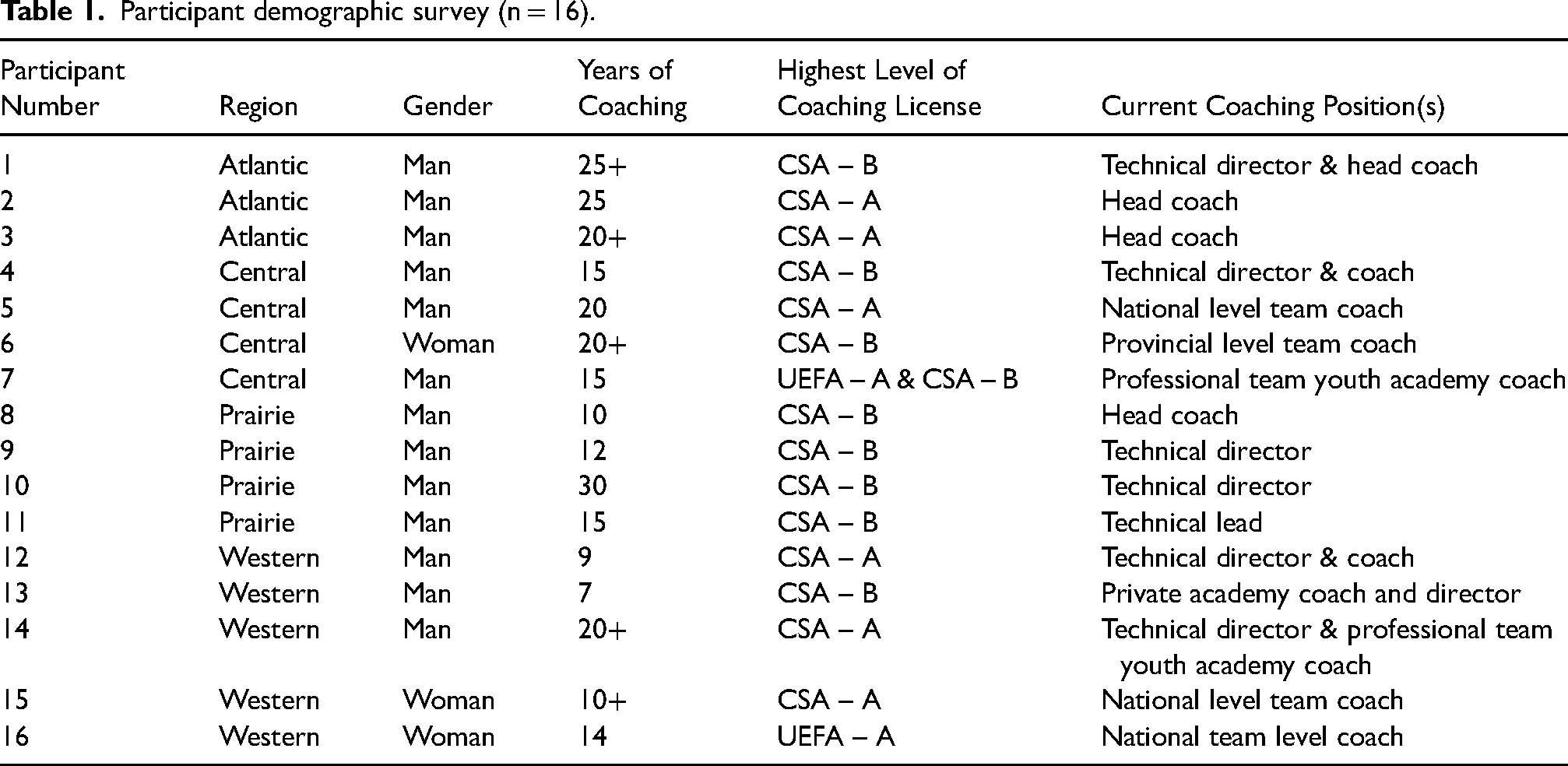
Of note, participants brought diverse coaching experiences, some having coached in other countries (n = 6). The cohort also reflected a range of community sizes, and the coaching landscape of participants was multifaceted, spanning from the youth national team level (n = 4) to national elite player development program (n = 5) and academy teams for professional clubs (n = 4) in Canada. Additionally, several participants held positions as technical directors or technical leads for community clubs or provincial sports organizations. Six participants primarily coached girls, seven concentrated exclusively on boys, while three participants’ responsibilities extended to both boy's and girls’ groups.
Data collection and analysis
Semi-structured interviews were used for data collection, and data analysis occurred cyclically until a data saturation stage was reached. 36 An interview guide, aimed at enhancing the development of talented young soccer players in Canada, was developed with questions probing the participants’ awareness of TIDS within Canadian youth soccer contexts, their first-hand experiences within TIDS, and their insights regarding challenges and potential solutions.
This involved identifying and labeling significant patterns and insights from the interview data that were relevant to the research questions.35–37 Through a line-by-line reading of the interview transcripts to achieve familiarity with the content and context, codes and concepts were identified based on recurrent patterns related to participants’ awareness of TIDS, coaching experiences, and insights into challenges and solutions.35,36 These codes identified overarching and dominant themes that were presented in the findings with pertinent quotes that substantiated key points in the data. Themes were further validated by checking their alignment with the interview transcripts and participants quotes.35–37 A member check was also used to confirm the accuracy and authenticity of the data.35–37
Results
The data was collected through one-on-one interviews with participants that ranged from one hour to three hours in length, with an average duration of 90 min. The data analysis generated three prominent themes that summarize the participants’ perspectives: (1) Views on TIDS are specific to organizations and coaches, (2) More inclusive and sustainable TIDS are necessary for success, and (3) Exposure to holistic talent development environments is essential. To emphasize and explain the findings in further detail, each theme generated three sub-themes by categorizing similar patterns and insights that support main themes, providing a structured framework to examine the research questions. Quotations from the interviews with participants are provided to exemplify the perspectives and experiences of the participants.
Views on TIDS are specific to organizations and coaches
Different perspectives about talent and potential
Participants identified various attributes and traits as potential indicators for youth soccer players. The more consistent responses included attributes such as “ball control and manipulation,” “passing and shooting creativity,” “game understanding,” and “speed and quickness with or without the ball”. Cognitive attributes such as “self-regulation”, “resilience”, and “attitudes towards coaches, peers, and opponents” were regularly mentioned. While there appeared to be a lack of consistency amongst responses, there seemed to be an increased value toward cognitive abilities. Many participants noted a player's ability to quickly recognize tactical problems during gameplay and execute the correct technical skills to solve them. Participant 9 stated that current coaching pedagogy prioritized decision-making over technical ability: “we prioritize the decision-making ahead of the technical ability because we believe that smarter players are better players. … I think the game is becoming more based on cognitive, mental, and psychological decision making, and processing speed.” Participant 4 also echoed it by stating that: “Talent is the decision-making process, how fast the player makes decisions. … The player sees the pass and then the coaches help the player to a point where they can execute the skill. That is the way I like to evaluate talent.”
Participants’ opinions on whether talent was innate or developed were split. For example, some believed players were “born with natural gifts, abilities, and talents,” while others believed talent was “dependent on the hours spent training and developing talent.” For example, Participant 15 connected talent and performance at the current development stage. This participant stated that “a talented player could execute their skills on demand consistently above their development stage.” Participant 14 shared this belief, highlighting that talent was “based on the impact that players had on games and their teammates’ performance, not individual technical skills.” These statements indicate that coaches have diverse views on talent, viewing it as dependent on how a player adapts to their circumstances rather than solely on the quality of their technical or physical skills.
Disjointed TIDS philosophies and priorities
It was evident that organizations and coaches across the Canadian youth soccer landscape had significantly disjointed philosophies and priorities about TIDS. For instance, Participant 1 highlighted the role of a community club as prioritizing participation, not necessarily player performance. This coach stated that a community club “creates experiences and conditions to learn, improve, and enjoy playing…. It helps players gain appropriate experiences to motivate players to continue playing as opposed to developing ability at a current point in time.” While this coach felt that a focus on quality experiences was essential, other coaches working with teams at the same level expressed that it was still important to promote performance development since this setting could be a gateway to other levels of soccer.
Participants provided contrasting descriptions of high-performance or elite settings using terminology such as “challenging,” “demanding,” “learn to win,” “high standards,” “appropriate training volume, frequency, and intensity,” and “competition”. Players in these environments were selected purposefully to fit positional needs, the club's preferred playing style, or a desired player profile. Participant 5 described their criteria when scouting talent: “At the national level, we look at what level the player is playing. Is the player playing consistent minutes at a good level? At that level, are they getting out of their comfort zone? You might look at how the player responds to a coach or teammates in a new environment where the tactics or their role might differ. Can the player survive a difficult, new environment? Can they demonstrate the right competencies on and off the pitch?”
Although more criteria are used to select players for high-performance or specialized programming, it seemed that these programs were targeted towards youth players who had already reached a predefined performance level, rather than those who wanted to specialize in the sport or place greater emphasis on soccer in their lives, thereby limiting the pool of players from which to select.
It was consistently noted that the priorities of youth soccer organizations often conflicted with evidence-based youth development principles. Participants suggested that organizations and coaches operated with a business mindset, frequently exaggerating their offerings to attract players and boost recruitment or registration numbers. This implied that TIDS was greatly influenced by adult priorities rather than being youth centered. Participant 15 described how this negatively impacted youth by stating that: “There are many retention issues from competition being introduced too early. Often this happens because adults place adult priorities on children's sporting experience… Adults can bring all the negative aspects of competition. When we emphasize standings, winning, we give less playing time because adults want to win a championship.”
This theme was prevalent among participants who suggested that politics and money often deflected attention from the player's needs. Participants further explained that a win-at-all-costs philosophy imposed by adults consistently contributed to deselection, exclusion, and poor mental health outcomes in youth.
Fostering psychosocial development
Participants associated psychosocial competencies, such as “responsibility”, maturity”, “reliability”, and “work ethic”, as keys to successfully navigating TIDS. The pressurized nature of youth TIDS necessitated the need for youth to manage failure and setbacks across their journey. Participant 3 felt “it will be essential to build skills sets [such as] mental toughness, self-regulation, and resilience [related to] how the players respond to adversities and challenges.” This participant further stated that: “Team sports, in general, offer quite a significant benefit to young people in terms of their development as people outside of their sport. …They learn the importance of hard work, discipline, commitment, teamwork, and leadership and how it can help them later in life.”
Participant 16 further emphasized “self-reflection skills” for players to improve and maintain high standards. Such skills supported participants’ desire for a more holistic approach to TIDS.
Another important aspect of TIDS emphasized in the interviews was the impact of relationships. Participants articulated how healthy relationships between players, peers, coaches, and parents/caregivers greatly influenced motivation and performance. Participant 1 stated, “the biggest influence on TIDS is social connection. If the player feels socially comfortable in their group, they will continue to play and are keener to learn.” Likewise, Participant 3 made a further connection, “confidence and comfort go together to allow a player to be socially settled. Being comfortable in their environment due to good relationships helps them with their confidence and performance. More confident and comfortable athletes just perform better.” These statements highlight how organizations and coaches need to consider how TID environments create social connections, and social exclusion.
More inclusive and sustainable TIDS are necessary for success
Inclusive selection and evaluation strategies
One reason why participants felt that TIDS decisions lacked accuracy was due to resource scarcity. Participant 14 explained that professional clubs and youth national teams had more program support from sport scientists that allows for a more accurate TIDS. In contrast, it was widely reported by participants that most Canadian youth soccer organizations, regardless of size, left TIDS decisions to parents or volunteers with limited expertise. This created inaccuracy in selection and evaluation processes at key stages of TIDS. Participant 8 also thought this inaccuracy from systemic disparity created a culture of deselection and exclusion: “Short try-outs are pressurized that doesn’t represent [the players’] ability… if [the players] have a bad performance, they are then put in a lower division where there is little organization and no coaching or development opportunities…. Most will quit, and their potential is lost.”
To address such systemic inequity issues, participants recommended that selection and evaluation processes be “multi-layered” and utilize full-time, paid staff over a minimum eight-to-ten-week trial period. Participant 15 highlighted the need for “a more holistic approach to player evaluations” for a more holistic representation of where the player is at that time, stating that: “There is now a more holistic approach to checking where [the players] are at. … The coaches run sessions, then they would have staff watch them in games and training. … By the time the evaluations happened, you had a good understanding of the player's trends and who the key performances were.”
These processes would be more comprehensive and provide a more accurate picture of talent. Participant 7 offered insights into how comprehensive a youth selection and evaluation could be for youth players: “Our scouts use 8-2 criteria* (*talent identification criteria encompassing physical, mental, technical/tactical, and social-emotional domains) to rank players performance and to create individual development plans…. After every league match, opposition coaches rank the top three players…, Technical Directors make blind recommendations and assessments to the clubs and provincial programs.”
While detailed in nature, this statement also connected back to the issue of resource scarcity and how some organizations and coaches have accessed more resources inequitably.
Delaying selection and labeling
There was agreement that early talent identification could be problematic for youth players. Participants stated that it caused diminished drive, work ethic, and a sense of entitlement. For example, Participant 2 expressed how early talent identification creates unrealistic performance pressures that most youth are not ready to handle. Those players become frustrated and quit when they realize that there is no opportunity at a higher level. Participant 10 further emphasized how youth players are left severely dejected by the game due to adult behavior, stating that: “I have seen lot of youth severely dejected by adults. The kids have their heads down; the game has been taken away from them. TIDS has so much pressure from top to bottom that kids must bear the brunt of. Adults at TIDS create environment where all they literally can do is fail.”
Across all levels of the TIDS, programs create unrealistic expectations, placing undue pressure on young players who must bear the brunt of it.
Despite the consensus about limiting early selection and labeling, there was no agreement when to begin. For instance, Participant 13 felt talent selection should occur “two years after [the player's] first growth spurt or at an age when specialization begins.” In contrast, Participant 1 suggested that selection should be delayed until the Under-17 age category, the last youth age group in Canada, as it would keep more players engaged in the sport without significantly impacting the number of players advancing to high-performance teams. The practicality of this was questioned by other participants who felt that the “Under 13–14 age” category was ideal so that players could be grouped with others with the same commitment and mindset. Regardless, it was obvious that Canadian clubs routinely selected talent pools or formed travel teams as early as nine or ten years old. This stemmed from the belief that players would miss out on development opportunities and that organizations’ revenues for recruitment would be adversely affected if they chose not to have such programming.
Social exclusion and TIDS
Participants articulated a strong opinion that late developers faced significant exclusionary obstacles. It was evident that organizations and coaches preferred physically developed, naturally athletic youth players for competition purposes. Participants felt that this approach meant that late developers “received less attention and focus” and were often subjugated to “lower, less organized training and play” further stunting their growth. Participant 6 highlighted how problematic this trend was throughout the TIDS: “There is no tolerance for late developers. Decisions are made quickly about whether a player is good or not…. Coaches will invest in who they think are good and ignore others. Those who are ignored drop out…. System-wide improvements on how decisions occur would prevent mass exclusion
This recognition acknowledges that a “win-at-all-costs” approach has a detrimental impact on TIDS, leading to exclusion, deselection, and dropout.
Birthplace and residency were another prominent exclusionary factor. It was acknowledged that players selected for youth national teams were predominately from three major Canadian cities (Toronto, Ontario; Montreal, Quebec; and Vancouver, British Columbia). It was also recognized that these programs selected mostly local players. Participant 8 described a selection bias against players from smaller provinces and programs: When you look at any youth national teams and you count the number of environments identified, the players are coming from three or four centers playing in one of three or four leagues on one of a dozen clubs or organizations…. There is a lack of acknowledgment of talent outside what are deemed important centers.
Some participants argued that players in smaller provinces or communities lacked exposure to appropriate levels of competition for selection to advanced levels. When asked if there was a selection bias in the youth national team programs, participants coaching at that level believed it was their responsibility to select the players who competed at the highest levels and trained at the best talent development environments. Participant 5 argued that the only quality talent development environments in Canada worthy of selection were those supported by professional soccer teams: “Currently, only the MLS [Major League Soccer] academies tick the boxes of an optimal training environment because they play the highest-level competition…. When I scout, [those teams] play against top Mexican and European clubs that are high-level matches for a 15–17-year-old player. So, it is evident that being in those programs is an advantage and explains why most youth national team players come from those environments.”
This perspective may be understandable at this level but selecting players from only a few environments limits talent identification opportunities and demotivates players from pursuing talent development through the TIDS.
Exposure to holistic talent development environments is essential
Appropriate challenges, at the right times, for all abilities
The participants noticed clear physical, cognitive, and social advantages to those born earlier in the year. Participant 3 noted that youth players should be “challenged when they are physically and socially ready and not when they reach a certain age.” Participant 4 echoed this statement by stressing the need for “competing at a higher level” with “a higher age group.” In doing so, coaches can “see how [players] deal with tighter spaces and pressure [and] if the players thrive…, [which] could help them move to the next level.” While both statements support the need for players to move up an age group when they are ready, participants also underscored how important it was to provide late developers with an option to play at a younger age group. This was highlighted by Participant 15, who expressed that strict age groups where a barrier to development because it did not allow the flexibility to place players appropriately: “Age groups cater to a handful of players. The systems we have in place do not allow for any room to be as flexible as we should be. Having strict and rigid age categories is a barrier and a hindrance to the overall development of players. Having more flexibility would go a long way. If a player is a late developer, the player should be allowed to play a year down with the younger players.”
These comments recognize the need for individualized TIDS to provide players with appropriate challenges, motivating them to improve.
While challenge was deemed important by the participants, some felt that youth sporting culture would not allow for policy implementation. Participant 1 perceived that resistance would come from adults who felt, “their child would be stigmatized from being singled out or treated poorly. They do not see it as an opportunity or benefit to [youth players]. The older, more physically mature group will always be perceived as the better group.” Such comments again point to adult agendas, impacting the delivery of evidence-informed best practice and policy for youth players in Canada.
Supporting social-emotional development as an outcome
The participants were clear that pressurized environments could pose a mental health risk for youth. Participant 2 noted the importance of access to supports to cope with stressors: “When there are trophies to win, teams to be made, and scholarships or pro-contracts available to the players…[coaches] forget about the player's needs…. These pressures put on young people must be managed appropriately by at home, by parents, and by coaches.”
Regarding increased pressures, Participant 10 provided a more prominent statement that many organizations and coaches failed to be honest with young players about the realities of TIDS: “One day you are told you are not good enough. You are not in the coaches’ plans and then you face being cut alone. A youth player can experience mental trauma from this…. The player is often given a false sense of hope and not informed of the realities of the sport.”
Such comments point to programming that focuses solely on results while ignoring the personal development. Participants emphasized using more player-centered approaches that ensure youth develop citizenship and life skills, which are key for all areas of life. Participant 14 accentuated the need to focus on these areas throughout a TIDS: We work with people, not players…. It's important to develop qualities and create experiences transferable to other areas in their lives. Good people, leaders, learners, goal-setters, and communicators can be successful in life.
These thoughts recognize that most youth will not reach the highest level of the game but stress how TIDS provide opportunities to develop skills that will aid in other areas of life.
System-wide inequities limit TIDS
Participants believed that significant inequities made TIDS inaccessible for youth entering a high-performance setting. One primary reason discussed was that resource scarcity resulted in centralization to the most populous areas, both nationally and provincially. Participant 3 pointed out that “the best training happens in prominent centers because that is where the facilities, population, and coaches are…. Decision-making recognized this would create a challenge for rural kids, but it is still better than a decentralized program.” While the provincial association may make these decisions based on what they believe is best for their context, it creates a significant accessibility gap for players. This presumably is why talent pools are restricted or why youth players move away from home early, sometimes to other countries, in search of opportunities. Participant 11 also discussed how this made it difficult to accommodate the needs of all players: “Depending on your stage and age, everything ends up in large centers. Sometimes communities are eight hours away and that creates challenges around finances and attendance. It is difficult for organizations to accommodate all the players in such a situation.”
Participant 13 noted that in Europe, there were many options close to a player's residence if they were released from a club or wanted to pursue a new opportunity. Whereas, Canada, had few TIDS entry points and less re-entry points. Most participants felt that moving away from home at an early age before optimal social and behavioral development, was unhealthy and potentially harmful for youth players. This creates a difficult decision for the player and their family to pursue advancement in soccer or not.
The “pay-for-play” model created another inequity issue across TIDS, with estimated cost of participating with a competitive soccer team was $5000-$20,000 per year including additional travel and equipment costs. Participant 3 noted that the Canadian sport system disadvantaged those without access to financial resources and that also impacted how clubs designed programming. According to the participant, “there are significant operating costs, and in almost all cases, good competition required expensive travel. High performance soccer is more for the kids who can pay, not the players who deserve to be there.” Participant 7 also underscored the impact of socio-economic status on TIDS: “‘Model clubs’ have high costs for strength and conditioning, nutrition, psychological testing, four or more training sessions per week, and competitions they enter. … Youth [from low socio-economic communities] do not have a chance to pay for the provincial program or academies in Canada. There are private academies in Canada that charge $18,000 a year with a promise of a scholarship or contract, which is unaffordable for most players’ families. So, money clearly disadvantages a lot of Canadian youth.”
These comments illustrate how the central tenets of talent development environments are generally inaccessible due to cost and that organizations and coaches face a dilemma of offering players the best environment in the most sustainable way.
Discussion
Given the complexity of youth soccer systems in Canada governed by multi-faceted organizations, this study aimed to gain insights from coaches at various organizational levels on improving TIDS, focusing on increasing the number of players for long-term athlete development and sustainable success in sports. From the research findings, three central priorities emerged: (1) enhancing knowledge, capacity, and systemic cohesion within TIDS, (2) enhancing TIDS by combating social exclusion and inequities, and (3) enhancing TIDS by more exposures to holistic talent development environments. The findings emphasized the need for more inclusive and effective TIDS by promoting stakeholder professionalism, inclusivity for all players, and player-driven decision making, to provide youth players with meaningful experiences and equitable opportunities.
Enhancing knowledge, capacity, and systemic cohesion within TIDS
The findings indicated that decisions made within TIDS were dependent on the subjectivity of disparate organizations and coaches who had different priorities, many of which were not necessarily player-centered environments that appropriately accommodate youth players. The accuracy of decisions was questioned since TIDS was often led by parents or volunteers lacking professional knowledge (i.e., details of the game, understanding of youth development, effective coaching strategies).38–40 The imperative role embodied by skilled and committed coaches in player development is widely recognized. 26 Coaches should engage players physically, cognitively, and emotionally while guiding the development of skills, tactics, and moral ethics.15,41 Their role often intersects with that of a teacher, disciplinarian, parent, or psychologist, 41 meaning everything they plan, say, and do influence players. 15
Additionally, literature has stressed the need for individuals working with youth players to understand normal growth, maturation, and development when implementing programming.11,15,16,40,42 These factors significantly influence self-concept, self-esteem, body image, and perceived competence of players, which should be considered when making informed decisions.15,42,43 The findings signaled a need to further professionalize organizations with highly skilled coaches who are committed to creating environments that contribute to psycho-social well-being, positive learning environments, and promote long-term participation.44,45 This is consistent with research advocating for the advancement of coaching education to enhance understanding of youth development principles and importance of the coach's role in promoting developmental outcomes among youth players.11,46 In addition, coordination between coaches and parents in TIDS can enhance parents’ knowledge about player's developmental characteristics and required skill sets at all levels of talent identification and development, which further contribute to more informed and affective decisions.2,47,48
Top soccer nations have shown coherency and a shared philosophy around player development.2,46,49,50 A coherent delivery system with a collective philosophy is characterized by clearly defined core values, expectations, and behavior standards that represent optimal development conditions for youth players.19,49 The participants’ responses described the presence of a TIDS that was disjointed and prioritized adult expectations and values that did not align with the priorities of positive youth development. While a flexible, multi-layered system was particularly important in regard to TIDS, the need for establishing a coherent framework positively associated with long term performance, participation, and personal development is required. Future research could compare TIDS across regions or countries to identify best practices by examining key elements that support effective talent development and long-term player engagement. Additionally, harmonizing policies at local, regional, and national levels is needed to promote a cohesive TIDS framework.
Enhancing TIDS by combating social exclusion and inequity
In terms of opportunity for Canadian youth soccer players, the findings highlighted how the TIDS caused social exclusion. The respondents identified several barriers to participation in youth sport, including lower socio-economic status, gender bias, lack of ability, delayed physical development, and limited access to resources. These factors have also been widely recognized in the literature as negatively impacting youth sport participation.51–55 Most notably, access to talent identification and development opportunities were concentrated among youth players in three major Canadian cities who benefit from the centralization of key resources. 11 Given that soccer has consistently ranked as one of the highest participatory sports in Canada, the sport has underutilized a potentially large talent pool, relying on a small cohort of players who are able to participate fully in the system. The lack of appropriate challenges and the failure to provide quality environments with adequate levels of challenge for young players in smaller cities further impact talent identification and development at the local level, which increases youth player dropout rates.11,55 Building system capacity through investments from an equity-based lens would increase opportunities across the TIDS.
Additionally, the talent pool is further minimized at a local level when coaches do not consider the individualistic nature of development and focus their attention solely on players who are physically and socially mature than their peers.11,56,57 Development is a long-term outcome, adhering to a philosophy of keeping the TIDS inclusive would keep players engaged and motivated.11,14,19 Creating inclusive environments sustains participation and increases the likelihood that more individuals will reach their potential, thereby exponentially expanding the talent pool. An equity-based approach to allocating resources (e.g., infrastructure, coaching, and programming) for underserved areas is required to promote an equitable and inclusive TIDS, which can expand player pool. Players’ voices on barriers and how these barriers intersect based on their social identities and circumstances should also be addressed in future studies to provide insights into mitigating exclusion and increasing access to TIDS for all players.
Enhancing TIDS by more exposures to holistic talent development environments
The participants described the importance of competitive but supportive learning environments, free from adult-driven expectations and pressures. At the same time, it was acknowledged that talent development environments should emphasize the psychosocial well-being of players and promote personal skills useful in all aspects of life.19,22,45,58 While studies suggest that healthy competition can positively drive performance, excessive pressure can harm mental health and confidence, hindering sustained sport participation.16,27 Instead, fostering supportive environments where athletes are valued beyond their current performance level can enhance resiliency, self-regulation, and interpersonal skills, reducing burnout and performance anxiety.42,59 Considering the non-linear, complex nature of TIDS, organizations and coaches consider flexible, adaptive, differentiated approaches, and encourage pro-social behaviors as important factors in TIDS. 46 Unsurprisingly, there were few quality entry and re-entry points into TIDS in Canadian soccer, which certainly contributed to an ineffective TIDS. This calls for system-wide improvements to create more accessible and supportive player-centered pathways.2,45,49
A great deal of emerging research has cited the need for more holistic and meaningful experiences for youth involved in sport through positive social interactions, appropriate challenges, motor competency, fun, and personally relevant learning.1–3,20,60,61 To this end, coaches need to engage with democratic and reflexive pedagogies that promote meaningful experiences among youth players. With the nature of TIDS shifting to more highly pressurized environments induced by adult demands and expectations, it is important to stress the relationship that meaningful experiences have with fun. Fun and enjoyment continue to be the main motivator for youth to participate in sport, regardless of gender, age, or playing level.62,63 With the traditional views about fun and enjoyment being full of misconceptions, it is important to unpack these factors as a determinant of promoting meaningful experience for youth athletes. Therefore, organizations and coaches should consistently empower youth players to advocate for themselves, allowing for a deeper understanding of their motivations and needs. 64 This will enable tailored support at every stage of their soccer journey. 64 Subsequent research should examine how player advocacy for their needs and motivations impacts their experiences in TIDS, influencing their ongoing engagement, psychosocial well-being, and skill development. Additionally, there is a need for professional development programs for coaches that emphasize practical knowledge on creating flexible and supportive talent development environments tailored to players’ diverse needs.
Practical implications
The findings have significant practical and policy implications. Given the lack of expertise in talent identification and development, and the diverse priorities among organizations and coaches in youth sports, increasing stakeholders’ knowledge of TIDS and its emphasis on long-term holistic development is crucial. Currently, talent identification and development often focus solely on a select few top-performing players, which is misguided and may overlook other talented individuals. Given the complexities and individualized nature of youth athlete development, organizations should create inclusive environments that offer meaningful, equitable, and sustainable experiences for all youth players. Furthermore, youth sport organizations and the national association must consider investments through an equity lens to increase access to quality environments for all players, thereby promoting social equity in TIDS.
Conclusion
A strong foundation of TIDS is integral to achieving sustained success at the top levels of sport. An analysis of the coaches’ perspectives suggests that the Canadian TIDS is disjointed and exclusionary. Despite the multifaceted and complex nature of TIDS, a developmentally appropriate and inclusive sports delivery system can provide a tailored environment to maximize youth potential. To achieve this, systemic and cultural changes are necessary to enhance talent identification opportunities and foster positive development journeys, keeping players engaged in the sport and providing Canada with a richer talent pool.
The research findings drawing from coaches with experiences and knowledge in TIDS contribute to existing literature by yielding insight into elements of TIDS that can be considered in multiple sport contexts to enhance youth athlete development. This study also has several limitations, such as diversity in participants due to access to coaches available for interviews. A significant gender gap due to the limited number of women coaches who met the inclusion criteria made it difficult to include gender specific perspectives in the study. Similarly, it was difficult to recruit coaches from Northern Canada due to the lack of coaches in the region that met the inclusion criteria. In addition, the participants’ responses were subjective, influenced by their own experiences, biases, and views. Further investigations into the lived experiences of young players in TIDS and the challenges they face are recommended. Additionally, future studies need to examine TIDS structures and how to best utilize resources from an equity lens. Continued exploration of the impact of youth-centered and inclusive environments on promoting personal development and meaningful experiences within TIDS is also needed.
Supplemental Material
sj-docx-1-spo-10.1177_17479541241296454 - Supplemental material for Nurturing holistic talent, addressing systemic inequity: Canadian coaches’ insights on optimizing youth soccer talent identification and development
Supplemental material, sj-docx-1-spo-10.1177_17479541241296454 for Nurturing holistic talent, addressing systemic inequity: Canadian coaches’ insights on optimizing youth soccer talent identification and development by Stephen Howell, Younghoon Lee and Kyoung June Yi in International Journal of Sports Science & Coaching
Footnotes
Acknowledgements
The authors express sincere thanks to Dr Sarah Teetzel, Dr Vanessa Martinez Lagunas, and Ms. Shelley Harms for their critical comments and constructive feedback throughout the entire research process. The corresponding and second authors were affiliated with the Faculty of Kinesiology and Recreation Management at the University of Manitoba during some stages of the research process.
Declaration of conflicting interests
The authors declared no potential conflicts of interest with respect to the research, authorship, and/or publication of this article.
Funding
The authors received no financial support for the research, authorship, and/or publication of this article.

Supplemental material
Supplemental material for this article is available online.
References
Supplementary Material
Please find the following supplemental material available below.
For Open Access articles published under a Creative Commons License, all supplemental material carries the same license as the article it is associated with.
For non-Open Access articles published, all supplemental material carries a non-exclusive license, and permission requests for re-use of supplemental material or any part of supplemental material shall be sent directly to the copyright owner as specified in the copyright notice associated with the article.
