




Abstract
Athletes – particularly gymnasts – are inevitably confronted with pressure during competitions. To ensure that athletes can perform their tasks despite experiencing pressure, it is essential to safely expose them to competition-like experiences during training. Therefore, we collaborated with two gymnastics coaches in developing a pressure protocol for elite-level youth gymnasts (n = 16) to assess whether psychological states that are typically experienced during competitions can be evoked during training. Our results show that cognitive anxiety, somatic anxiety, and mental effort were increased significantly, while self-confidence and performance indicated declines, albeit not significant, when training with a pressure protocol compared to regular training. Furthermore, none of these variables differed between the pressure training and competition. The current results inspire confidence that coaches may utilize pressure protocols to successfully introduce competition-like psychological states during training to help athletes perform better despite experiencing pressure and anxiety.
Introduction
When athletes engage in competitive sports, they inevitably encounter pressure that can hinder their potential performance. For example, during competitions, athletes such as gymnasts may experience pressures related to perform well in front of a jury.1,2 These pressures can cause athletes to experience anxiety, which in turn, may have several detrimental effects on skill execution and performance.3–6 Because these elements are inherent to sports and cannot be removed, it seems essential that coaches can explicitly prepare their athletes to be able to execute their skills during competitions despite experiencing pressure and anxiety. 7 Recently, Ellis and Ward have developed and tested a protocol for training penalty shooting in football with increased pressure. 8 Their results show that such a pressure protocol may indeed be used to increase stress responses in training commonly associated with pressure during competition. The aim of the current study is to test the psychological and performance changes in gymnasts when undergoing a pressure protocol during training. Furthermore, we examine whether the expected changes in psychological states (i.e., cognitive anxiety, somatic anxiety, mental effort, and self-confidence) induced by the pressure protocol mimic the experience of an actual competition.
Effects of performance anxiety
According to the integrated model of anxiety and perceptual-motor performance,9,10 pressure can cause athletes to experience anxiety when the perceived demands of the situation exceed the athlete's capacity to cope successfully. 11 The emerging anxiety consists of two (interacting) elements. First, cognitive anxiety reflects the thoughts and mental processes, such as doubting one's own abilities to perform a task well. 12 Second, somatic anxiety describes the physiological changes associated with anxiety including sweating or increasing heart rates. 12 While the effect of these anxious states can be compensated for to some degree through exerting extra (mental) effort, high levels of anxiety may still cause athletes to switch their attention from task-relevant to irrelevant and threat-related stimuli,9,10 while optimal performance actually requires optimal attention to the task. This shift in attention commonly results in performance outcomes that are below one's potential, often referred to as choking under pressure. 13 In other words, anxiety may induce shifts in attention that lead to diminished skill execution. For example, previous research has shown that anxiety may cause gymnasts to experience more difficulties with their sense of balance and movement coordination.14,15
For gymnasts specifically, anxiety may emerge from several sources of pressure. Besides the performance pressures that are typically associated with competitions, gymnasts are additionally confronted (a) with tasks for which performance may drop in a split-second from perfect to failure such as with a fall from the balance beam or missing the bar after a flight element in the uneven bars, and (b) with evaluative pressures. 1 As for the latter, the performance of gymnasts is evaluated by an impartial jury, rather than being directly coupled to specific outcome measures like scoring goals in football. Given that these pressures cannot be removed from competing in gymnastics, it seems essential that coaches become able to help their athletes learn how to direct their attention to the task-relevant stimuli to prevent performance declines despite feeling anxious. 7 Thus, instead of teaching stress management skills to avoid feelings of anxiety altogether, learning how to perform despite these feelings may be more advantageous, especially in sports where different types of pressures are fairly common and anxiety may not be completely negatable.16–18
Pressure training
In order to train athletes to perform despite feelings of stress or anxiety, recent research has pointed to the use of pressure training (PT). 7 PT follows a long-standing notion in sports psychology that athletes need to be exposed to the same pressures that typically occur during a competition within the training environment. 19 Note, however, that PT does not justify the arbitrary use of pressure during practice. In contrast, PT focuses on the safe exposure that fosters learning or personal growth under controlled conditions and should therefore be structured in a way that avoids overloading the athletes.20,21 In other words, PT should ideally prepare athletes for the realistic competition environment through various methods and not go beyond. For example, competition simulations can be used to mimic the actual competition including typical routines like warm-ups before performing, while planned disruptions (e.g., a bad referee call) can be used to simulate specific elements of the competition. 7 In gymnastics, a competition simulation would, for instance, involve the presence of a jury and other spectators as well as only allowing a fixed number of attempts during training and so forth. In the domain of (association) football, Ellis and Ward recently developed and investigated a pressure protocol to simulate actual penalty shootouts during football training. 8 Specifically, the players were (among other things) required to walk up to the penalty spot from the midline and engage in a direct competition with another team. These simulations increased both the perceived anxiety as well as physiological arousal. 8 Therefore, such pressure protocols seem to be effective tools for coaches in changing both psychological and physiological states that may be more in line with what athletes experience during competitions.
The current study
The primary aim of the current study is to assess the psychological and performance changes in gymnasts when implementing a pressure protocol during training. Following the predictions of the integrated model of anxiety and perceptual-motor performance and the previous findings by Ellis and Ward, we expect that the pressure protocol will increase anxiety while reducing self-confidence and performance.8–10 As mental effort is often increased when people are anxious and may be used to mitigate negative effects of anxiety,8,9,22 we also measured mental effort. We hypothesize that cognitive anxiety, somatic anxiety, and mental effort are significantly higher, while self-confidence and performance are significantly lower during training with a pressure protocol compared to regular training without such protocol.
Additionally, we explored whether the changes induced by the pressure protocol mimic the same changes that occur during competition. That is, we examined whether the training with the pressure protocol creates similar psychological states that are experienced when competing in real-life events. Finding similarities between pressure training and a real competition could reinforce the usefulness of the pressure protocols to prepare athletes for competitions as they learn to execute skills under realistic circumstances.16–18
Method
Participants
The sample consisted of 16 female elite youth gymnasts from The Netherlands between the ages of 9 and 16 (M = 11.69 years, SD = 2.39) with an average experience of 5.86 years (SD = 2.87). Given the age of the participants, we also asked the parents to provide consent in addition to the participants’ consent. Note that the pressure protocol was developed and applied in collaboration with the head and assistant coach of the participants. Therefore, the recruitment was limited to the athletes that train under these coaches.
Design and procedure
The study's procedure was approved by an institutional ethics board. The study consisted of three measurements for each participant during which the athletes performed the same routine on the balance beam. First, the participants conducted their routine during a regular training session with one jury member evaluating the athlete's performance while being out of view (i.e., low pressure). Second, we assessed the routine while a pressure protocol was implemented (i.e., high pressure). The pressure protocol was created in close collaboration with the participants’ head and assistant coach and consisted of 1) a visible jury that judged the performance and had to be addressed before and after the routine just as during competition, 2) a 90-s waiting time before the routine could be started similar to competition, 3) the presence of an audience including family members of the participants, fellow gymnasts, and individuals visiting the site. Note that one half of the participants first engaged in the low-pressure condition followed by the high-pressure condition and the other half followed the reversed order. Independent of the order, both measurements were taken within the same training session. For all participants, the final measurement was a routine completed during the upcoming competition, which took place three weeks after the first measurement. After each routine, the athletes were asked to immediately fill in a questionnaire assessing the key constructs (see Measures).
Measures
Data analysis
Our hypothesis states that cognitive anxiety, somatic anxiety, and mental effort are significantly higher, while self-confidence and performance are significantly lower during trainings with a pressure protocol compared to regular training. Furthermore, we explored whether the PT did not differ from the competition on these measures. To test the hypothesis, we conducted repeated measures ANOVAs (three test conditions: low-pressure, high-pressure, competition) with post-hoc comparisons (including Bonferroni corrections) for cognitive anxiety, somatic anxiety, self-confidence, and mental effort. Given that the performance indicators were not available for the competition, we conducted a paired-samples t-test for the jury scores and a chi-square test for the number of falls.
Results
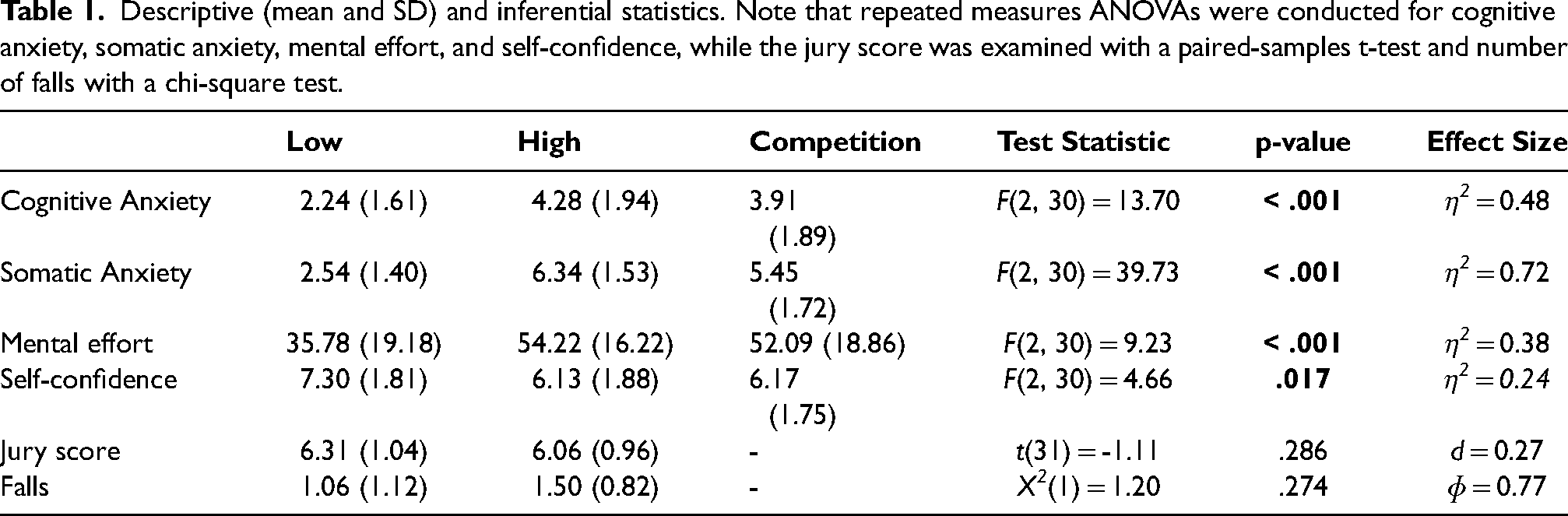
The repeated measures ANOVAs yielded a significant main effect for cognitive anxiety, somatic anxiety, mental effort, and self-confidence (ps < .02, see Table 1). Partially in line with our hypothesis, the contrasts showed a significant difference between the low-pressure and the high-pressure condition for cognitive anxiety, somatic anxiety, and mental effort (ps < .001) while that for self-confidence just failed to reach significance (p = .06). The comparisons between the low-pressure condition and the competition showed significant differences for all measures (ps < .036). Finally, the contrasts yielded no significant differences between high-pressure condition and the competition for any variable (ps > .23). Finally, in contrast with our expectations, neither the jury scores (p = .286) nor the number of falls (p = .274) differed significantly between the low- and high-pressure conditions. Thus, our hypothesis is partially confirmed by the (marginally) significant changes in cognitive anxiety, somatic anxiety, mental effort, and self-confidence in the expected directions while the performance indicators did not differ significantly between low and high pressure. Furthermore, scores on anxiety, mental effort and self-confidence in the high-pressure condition did not differ from those during competition.
Descriptive (mean and SD) and inferential statistics. Note that repeated measures ANOVAs were conducted for cognitive anxiety, somatic anxiety, mental effort, and self-confidence, while the jury score was examined with a paired-samples t-test and number of falls with a chi-square test.
Discussion
The aim of the current study was to assess the psychological and performance changes in gymnasts during pressure training (PT) compared to their regular training. Therefore, we implemented a pressure protocol during the training of young, female elite gymnasts and compared their psychological and performance changes to both their regular training as well as competition. Specifically, we expected that the gymnasts would display higher cognitive anxiety, somatic anxiety, and mental effort, while they would show declines in self-confidence and performance.8–10 Furthermore, we explored whether the changes induced by the PT differed from the psychological states and performance during an actual competition.
Our results confirmed the expected changes in cognitive anxiety, somatic anxiety, and mental effort. That is, we found that PT induced significantly higher scores of anxiety and mental effort compared to regular training, complemented with lower scores on self-confidence, although this latter difference failed to reach significance. Performance did not differ significantly between low- and high-pressure conditions. Interestingly, no differences were detected between the PT and the actual competition implying that PT seems to be effective in inducing competition-like psychological states. Thus, PT seems to be a useful tool that can be applied by coaches during training and that may help gymnasts to learn to execute their skills well despite experiencing anxiety. 7 However, it should be noted that a single practice session that induces competition-like psychological states may not be sufficient for preparing athletes. To enhance its effectiveness, PT should be accompanied by structured reflection sessions where athletes and coaches discuss the purpose and experiences of the training.21,25 Furthermore, there is currently little insight into the ideal periodization and frequency. Still, repeated PT sessions with alterations to the specific content are likely necessary to have the desired effect.7,26
The lack of consistent findings on changes in performance may be due to the fact that individual athletes show idiosyncratic behavioral responses to increasing stressors.27,28 That is, some athletes may peak under relatively low levels of pressure while others may require (much) higher levels of pressure to reach their optimal level of functioning. Thus, individual athletes may have increased, decreased, or remained unchanged with regards to their performance level leading to no significant changes on the group-level. However, it should be noted that the aim of the PT in this study was to induce competition-like psychological states by exposing the athletes to circumstances that are common during all competitions (e.g., presence of a jury). Hence, implementing pressure protocols may not only be useful in preparing athletes for pressures experienced in competition, but also identify those who perform well under these circumstances and execute their skills despite experiencing anxiety. In fact, PT may also help them become even better under pressure. At the same time, PT may not always have to fully simulate competition-like states, but it can also be scaled to scaffold especially struggling athletes to gradually improve performing under pressure over time (i.e., behavioral vaccination). 20
Limitations
The current study has four limitations that need to be addressed in future studies. First, the sample of this study consists of a relatively small and very select group of young, female elite gymnasts. While this group allows for specific conclusions about this very demographic, it provides little insight into the effectiveness of PT for their male counterparts or adolescent and adult populations. Therefore, we recommend future studies to employ larger and more diverse samples to replicate the findings. Second, our measurements rely on a single, retrospective assessment. Because adapting to stressors is a dynamic process that unfolds over time,29–32 repeated assessments of the changing psychological states may provide additional insights of how the pressure protocols induce changes in anxiety, mental effort, and self-confidence (for an empirical example, see Den Hartigh et al.). 33 Third, despite the significant changes on the employed measurements, the scores of the participants centered around the midpoint of the visual analogue scales for both the pressure protocol and the competition. While this distribution is similar to other pressure protocol studies (cf. Ellis & Ward, Table 1) 8 as well as studies that placed participants under objectively very high levels of stress (e.g., police offers being attacked with a shock knife during self-defense training, Renden et al.), 34 it raises the question whether particularly intense competition moments like the finals of a tournament can be adequately represented. Thus, it needs to be tested whether a) key competition moments induce more anxiety and mental effort and b) training at lower levels may suffice for preparing athletes even for high levels of competition pressures. Finally, PT can be applied in different ways. 7 While the main strength of this study is that we focused on context-specific competition simulations, similar to the study of Ellis and Ward, 8 future studies may explore other planned disruptions such as performing with additional distractors (e.g., loud noise) or a disrupted pre-competition routine to evoke similar effects and to diversify the options for PT in gymnastics. 21
Conclusion
The primary aim of the current study was to assess the psychological and performance changes in gymnasts when implementing a pressure protocol during training. Our results suggest that PT protocols can indeed increase psychological responses as anxiety and mental effort relative to regular training even so that similar levels were achieved as the levels experienced during actual competition. Knowing that training with increased anxiety may actually help athletes perform better with anxiety,16–18 the current results inspire confidence that pressure protocols may be successfully introduced in training to help athletes perform better during competition despite experiencing pressure and anxiety.
Footnotes
Acknowledgements
We would like to thank Annabelle Schmidt and Kate Sarisska for their support and enthusiasm in developing and conducting this study.
Data availability
The data will be made available upon reasonable request.
Declaration of conflicting interests
The authors declared no potential conflicts of interest with respect to the research, authorship, and/or publication of this article.
Funding
The authors received no financial support for the research, authorship, and/or publication of this article.
