




Abstract
The aim of this study was to compare the external load accumulated by players belonging to three teams of the same professional club in the compensatory training session, training the day after the match, expressing this both in absolute values and in values relative to the match demands. Fifty-one soccer players from three different categories (professional team [PRO] n= 16 players; reserve team [RES]= 15 players; and second reserve team [RES2]= 20 players) were monitored by micro-electromechanical systems devices in compensatory training sessions. Large and very large differences between teams were shown in the variables most related to volume (duration, player load, total distance, acceleration load and distance at >14 km h−1), while the variables most related to intensity show trivial and small differences between teams (distance at >21 and >24 km h−1, and number of accelerations and decelerations). Our main finding agreed with our hypothesis, showing that most of the external load variables range between 30–90% of the official match load, most of the external load variables being in ranges close to 50–60% of the match demands, reaching a higher percentage in the variables related to the accelerations and decelerations actions.
Keywords
Introduction
In recent years, knowledge about the external loads to which players are subjected during the micro-cycle has increased significantly, both in professional football and in teams of young soccer athletes. 1 In this sense, it has been demonstrated by different authors that match play represents an important part of the weekly external load of the player, very different from the rest of the training sessions that make up the competitive microcycle.2,3 These differences increase when comparing between demarcations or between different participations in competition, i.e., starting players, substitutes and those who do not play.4,5 Thus, the players who accumulate fewer minutes in the official matches are the players with the least weekly activity, especially in actions carried out at high speed and sprint, and to a greater extent, in weeks with high competitive density.5–7 Therefore, finding a way to stimulate players who do not participate in the official match, or who accumulate few minutes in the official match, is a current concern of practitioners and researchers.
Different research studies have been carried out analyzing the external load patterns depending on the day of the micro-cycle, and including in the analysis the compensatory training session carried out by the players who participated with fewer minutes in the official match. Specifically, Martín-García et al. 8 found that the MD+1 (match-day plus one, that is, the session after the match-day) compensatory training session exceeds 50% of the external load relative to the match demands in different external load variables such as total distance covered, average metabolic power, and especially in the number of accelerations and decelerations (>3 m·s−2), with values of 80% of the match demands. However, in the distance covered at high-speed running (>19.8 km·h−1) and sprinting (>25.2 km·h−1), the values reach values slightly higher than 20% of the match demands. In this sense, a recent research study shows how the compensatory training sessions carried out in a professional soccer team do not replicate the demands of the starting players in the match in any of the external load variables analyzed, showing the greatest differences in the distance covered in sprinting (>24.0 km·h−1). 9
Furthermore, the comparison of the external loads of different teams within a professional football structure is also generating some interest in the scientific literature, comparing the external loads accumulated in sessions and micro-cycles by different teams, although they partially overlap.8,9 Thus, Kavanagh et al. 10 recently found how the players’ weekly accumulated external load was higher in weeks of 1 game in the first team compared to the reserve team. However, Houtmeyers et al. 11 described that while weekly external loads at low velocity were higher for elite youth players, intensity and load variation will increase when these players are able to promote professional soccer. Knowledge of these external load dynamics could favor the progression of players through different teams, as well as the presence of players belonging to one team in training sessions of another team.
However, there is not much information regarding the activity carried out by the players in this type of session, and even less about the loading patterns of different teams within the same professional football club. Therefore, the aim of this study was to compare the external load accumulated by players belonging to three teams of the same professional club in the compensatory training session, expressing this both in absolute values and in values relative to the match demands.
Methods
Research design
The study was conducted in the 2019–2020 competitive season and were analyzed 191 individual files from sessions of three football teams belonging to the same professional club. The analyzed training sessions were known as "compensatory" sessions, that is, conducted the day after an official match. These sessions featured activities designed to mimic the demands of the competition, involving outfield players who did not start or played less than 60 min in the previous match.
Participants
This study enrolled 51 players from three different categories of the same professional soccer club: first team or professional team (PRO, n= 16, age: 24.5 ±3.5 yr; height: 180.6 ±6.7 cm; weight: 75.1 ±5.7 kg), reserve team (RES, n= 15, age: 21.3 ±1.1 yr; height: 179.5 ±7.1 cm; weight: 72.5 ±6.4 kg) and second reserve team (RES2, n= 20, age: 19.7 ±0.9 yr; height: 177.9 ±5.1 cm; weight: 70.7 ±6.3 kg). Goalkeepers were excluded from the analyses due to their specific role and training. The PRO played in the Spanish first Division (La Liga), RES played in the Spanish third division and RES2 in the Spanish fourth division. Data arose as a condition of the players’ employment whereby they were assessed on daily bases; thus, no authorization was required from an institutional ethics committee. 12 Nevertheless, this study conformed to the Declaration of Helsinki and players provided informed consent before participating, and the identities of the players were anonymized.
Measures
All compensatory training sessions were monitored using micro-electromechanical systems (MEMS) devices. A total of ten MEMS variables have been measured both in the compensatory training session and during official matches. The variables analyzed were the total duration (min), total distance covered (TD, m), distance covered at moderate speed running (TD14: >14 km·h−1, m), distance covered at high speed running (TD18: >18 km·h−1, m), distance covered at very high speed running (TD21: >21 km·h−1, m), distance covered at sprinting (TD24: >24 km·h−1, m), the acceleration load (aLoad, AU), and the number of moderate and high-intensity accelerations (ACC: >2 m·s−2, n) and decelerations (DEC: <-2 m·s−2, n), all of them obtained via GPS technology. From accelerometers, just the player load (PL, AU) was recorded. The intensity thresholds used have been established based on previous studies. 13 Based from the MEMs device suggested values, the velocity dwell time (i.e., minimum effort duration) was 0.5 s, the acceleration dwell time was 0.l second and the minimum acceleration interval duration was 0.8 s. The configuration of the devices, although not usually stated in the studies, is key to interpret the data correctly. 14
The variable aLoad is calculated by summing all accelerations and decelerations in positive, and this variable provided an indication of the total acceleration requirements of the athlete, irrespective of velocity. Previous research studies have shown an inter-unit coefficient of variation of 2–3% 15 and these are lower than typically seen between devices using the traditional effort detection based approach to acceleration assessment. PL is an indicator based on the combined accelerations made in three planes of movement. Previous research on this indicator had reported high intra and inter-device reliability, 16 and it had been shown to be a valid way of monitoring training load in soccer players. 17
Procedures
The study was conducted in the first half of 2019–2020 competitive season. Data collection was carried out during the season, in competitive micro-cycles, keeping environmental conditions such as temperature and humidity similar in all records. The training sessions analyzed were so-called 'compensatory' training sessions, i.e., conducted on the day after the official match. The training sessions were composed of contents that try to replicate the demands of the competition in which the outfield players who did not start or played less than 60 min in the previous match participated. The data were collected by experienced physical preparation managers. The weekly training routines and competitive matches were the usual ones of the competitive training micro-cycles carried out during the whole season. The external training load was collected using MEMS devices (Vector S7 for PRO and RES and Vector X7 for RES2, both by Catapult). The players were familiar with the use of MEMS, as it is part of their daily routine for training load monitoring. The MEMS device was fitted to the upper back (i.e., between the shoulder blades) of each player using an adjustable neoprene harness. After each training session, the data was extracted to a computer and analyzed using Catapult OpenField v2.4. The number of satellites used to infer Global Positioning System signal quality was 10.9 ±0.3, horizontal dilution of precision (HDOP) was 0.8 ±0.1 and the aver-age of the Global Navigation Satellite System (GNSS) was 84.9 ±5.1%. A total of 189 individual MEMS files from compensatory training session data were analyzed, with the following distribution per team: PRO=80, RES=52 and RES2=57 files, with an average 3.6 ±2.2 (min= 1 and max= 9) observations per player.
Furthermore, the external load of the match completed by each player was calculated to compare with the demand of the compensatory training session. The match demand was estimated to the players who did not complete a match in the study period: a) for players who played less than 70 min the average external load of full matches of the player's position was taken into account and b) for players who played more than 70 min the external load was used to calculate the external load they would have in 94 min of the game.
The value of each compensatory training session was expressed in absolute values and relative to the mean external load registered during official matches: (mean training session external load×100) / mean official-match external load.
Statistical analysis
The data is summarized including the mean, standard deviation, and range (minimum and maximum) in both absolute and relative (to the match) values. Differences between teams were assessed utilizing one-way ANOVA. Effect sizes (ES) were also calculated using Cohen's d (d) and the magnitude of the ES was interpreted as follows: trivial <0.2, small >0.2, moderate >0.6, large >1.2, and very large >2.0. 18 The software JASP version 0.18.1 (JASP Team, 2023) for Windows was utilized for all statistical analyses. The level of significance was set at p<0.05.
Results
Table 1 shows the mean, ± standard deviation, minimum and maximum values (in brackets) of the absolute variables of the external training load on the compensatory days for each team (PRO, RES and RES2).
Mean, standard deviation, minimum and maximum (in brackets) of the absolute variables of the training load on the compensatory days for each team.
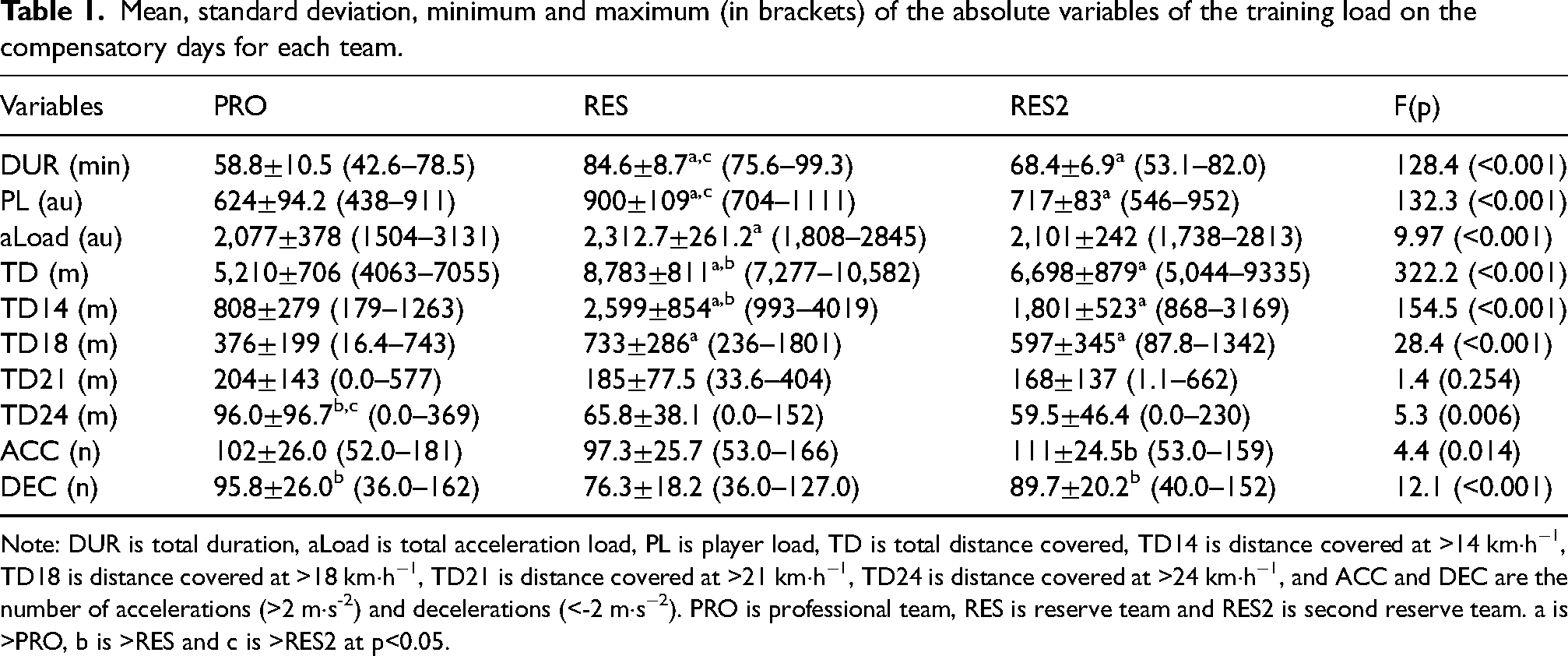
Note: DUR is total duration, aLoad is total acceleration load, PL is player load, TD is total distance covered, TD14 is distance covered at >14 km·h−1, TD18 is distance covered at >18 km·h−1, TD21 is distance covered at >21 km·h−1, TD24 is distance covered at >24 km·h−1, and ACC and DEC are the number of accelerations (>2 m·s-2) and decelerations (<-2 m·s−2). PRO is professional team, RES is reserve team and RES2 is second reserve team. a is >PRO, b is >RES and c is >RES2 at p<0.05.
Figure 1 shows the size of the differences from the effect size (Cohen's d) in the comparison between teams (PRO vs. RES, PRO vs. RES2 and RES vs. RES2) for each training variable both in absolute values and relative to the competition.
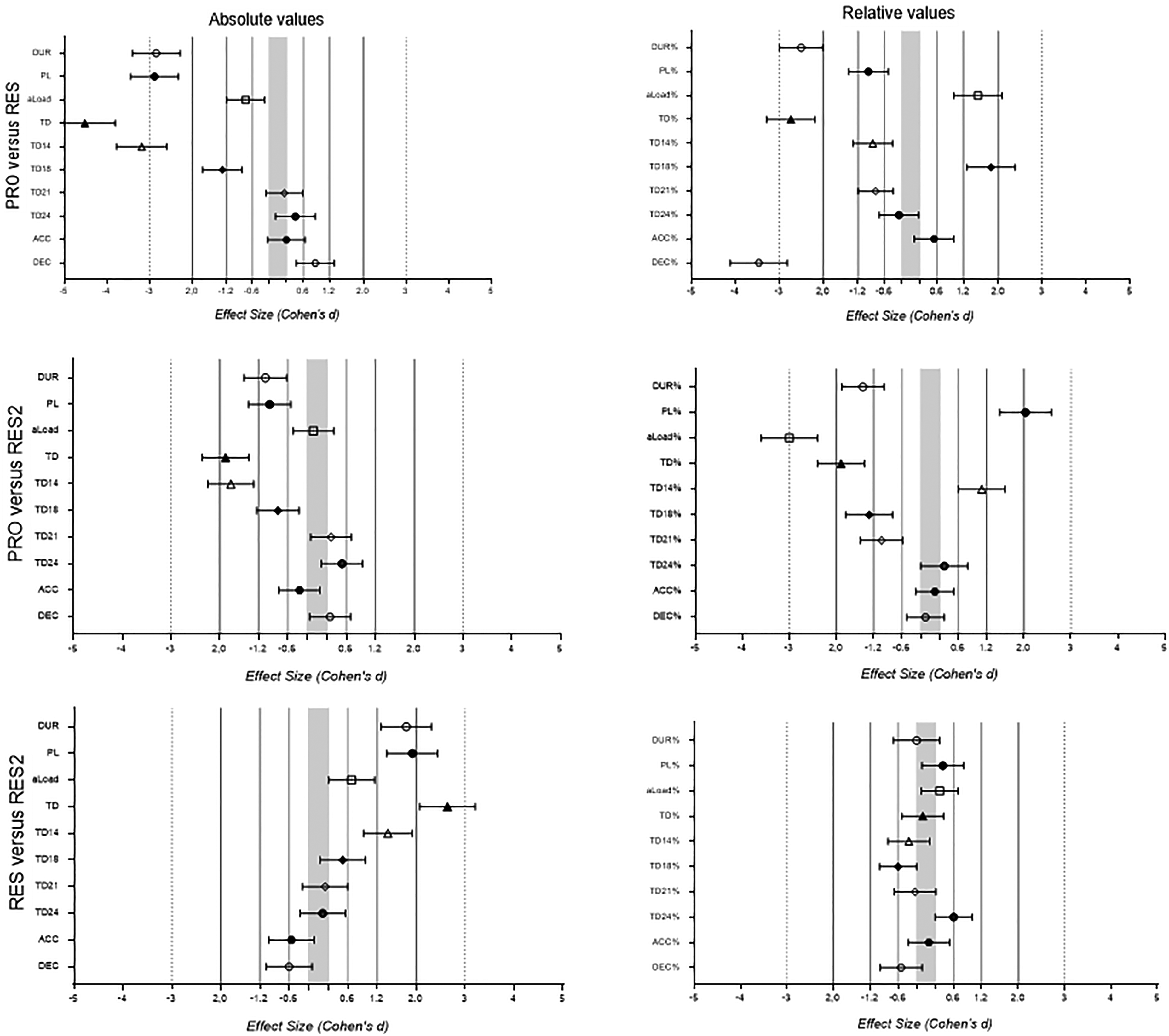
Effect size (Cohen's d) of the differences between teams (PRO vs RES, PRO vs RES2 and RES vs RES2) for each training variable in absolute (left) and relative values (right). Note: DUR is total duration, aLoad is total acceleration load PL is player load, TD is total distance covered, TD14 is distance covered at >14 km·h−1, TD18 is distance covered at >18 km·h−1, TD21 is distance covered at >21 km·h−1, TD24 is distance covered at >24 km·h−1, and ACC and DEC are the number of accelerations (>2 m·s−2) and decelerations (<-2 m·s−2), in absolute values and with % in relative values to the match. PRO is professional team, RES reserve team and RES2 s reserve team.
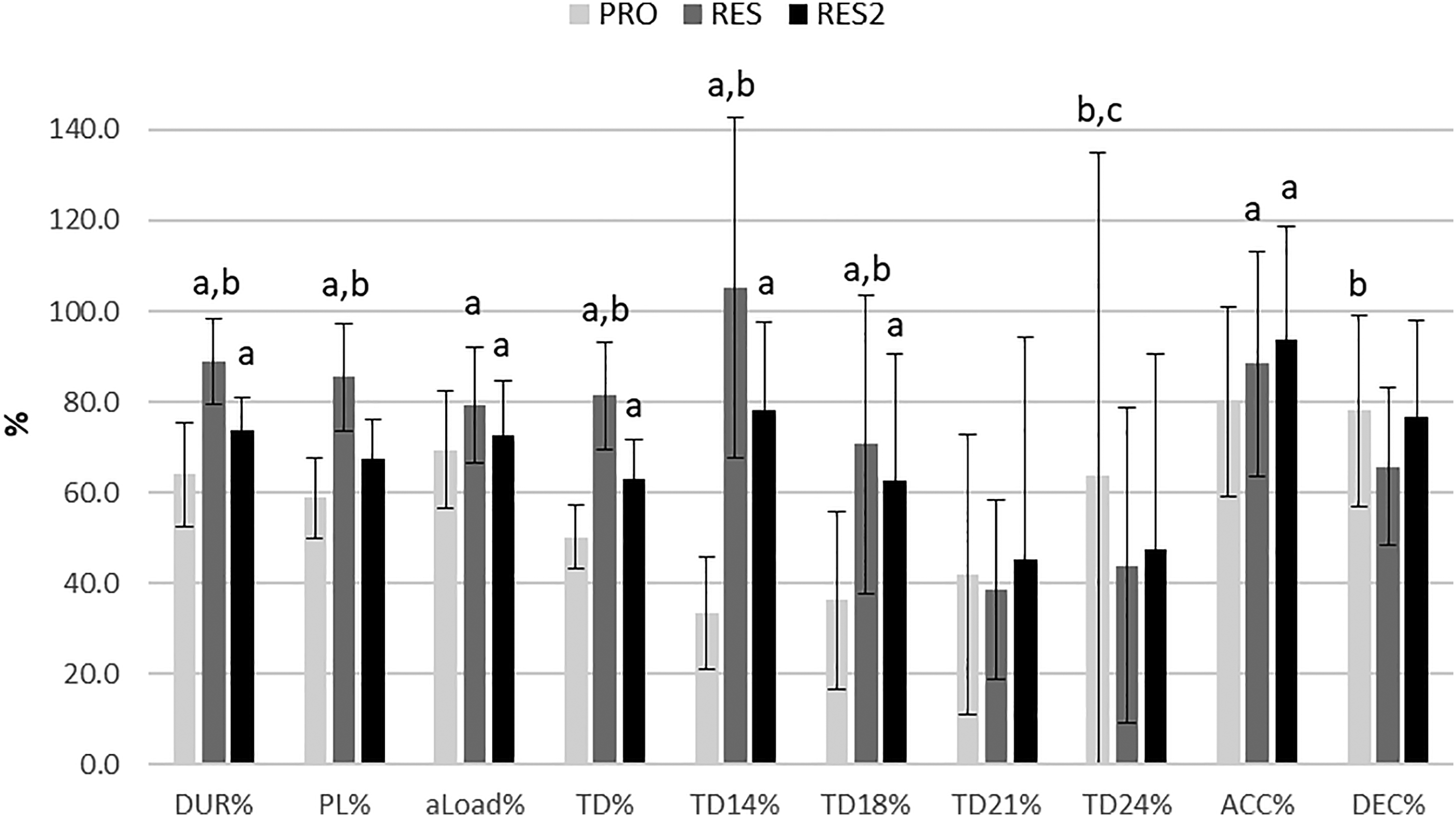
Mean and standard deviation of the relative variables (%) with respect to the training load competition on the compensatory days for each team.
Figure 2 shows the mean values, standard deviation, minimum and maximum (in brackets) of the relative values (%) with respect to the official match load on the compensatory training sessions for each team analyzed. In the variables DUR%, PL%, TD% and TD14% there were differences between all teams (p<0.05). In the variable ACCLoad% RES and RES2 > PRO, in the variable TD18% RES > RES2 > PRO, in the variable ACC% RES and RES2 > PRO, and in the variable DEC% PRO > RES (p<0.05).
The effect sizes (Cohen's d) of the differences between the teams for each of the match-related training variables are shown in Figure 1 (right column). The magnitudes of the differences were found mainly in the variables most related to volume (DUR%, PL%, aLoad% and TD%), where the PRO described the lowest values.
Discussion
The aim of this study was to compare the external load accumulated by players belonging to three teams of the same professional club in the compensatory training session, expressing this both in absolute values and in values relative to the match demands. Our main finding agreed with our hypothesis, showing that most of the external load variables range between 30–90% of the official match load, most of the external load variables being in ranges close to 50–60% of the match demands, reaching a higher percentage in the variables related to the ACC and DEC actions.
The comparison between professional teams and young teams of the same club is being addressed by different studies recently.10,19,20 The aim is to know the differences between both teams, to minimize them, trying to close the gap between both contexts, which can favor/facilitate the access of young teams to professional teams. To the authors’ knowledge, it is the first study that compares the external load of this type of session on different teams within the same professional club. The external load variables that show the most differences between the analyzed teams are the variables most associated with volume: DUR, TD, PL, aLoad and the distances covered in the lowest speed thresholds, with the PRO team clearly presenting the lowest values in these variables. It seems, therefore, that the PRO team's compensatory training sessions has taken precedence in intensity over volume, compared to the compensatory training sessions of the two reserve teams analyzed. These findings are in line with recent studies that show that external and internal measures of training load were significantly higher in the U-19 group compared to first team, 19 which could facilitate the transition to the professional team. 10
That the external load of the compensatory training sessions is lower than the external load of the official match is something that has been reported by previous studies.2,8,9 In this sense, only the external load variable TD14% for the RES team was stimulated more than the official match itself, while the rest of the external load variables ranged between approximately 33% and 93% that of the official match. The introduction of high intensity interval training increases the values of these variables associated with moderate/high speed running above the match demands as has been shown in previous studies. 20 Probably, the RES team has had a greater use of this type of exercises than the rest of the teams, which justifies these values when exceeding the values of the official match. This is probably due to the fact that it is a team that usually provides players to complete the PRO team, having fewer players available to carry out tasks played in the compensatory sessions.
High speed running and sprinting have been shown to be key elements of sports performance, as they show a relationship with performance21,22 but also with the reduction of injury incidence. 23 It seems clear that exposing players to a certain weekly activity can have a protective effect,24,25 so stimulating this type of movement in players who do not play in official matches is suggested as a necessary strategy. The results obtained in this study show that the players covered between more or less 45–65% of the official match demand in these sessions, resulting in values significantly higher than the 20% of the official match activity reported by Martin-Garcia et al. 8 Furthermore, it can be seen how this strategy has been implemented in a common way by the three teams, since there are no major differences in these variables associated with high speed running and sprinting.
The number of accelerations and decelerations actions have been shown to be activities that impact energy expenditure 26 and neuromuscular fatigue of players. 27 In this case, the compensatory training sessions have presented a significant dose of this work, with the frequency of accelerations being the external load variable that has the highest value in all three teams, in a similar way to what has been reported in recent studies. 8 In addition to MD+1C, MD-4 and MD-3 are the most demanding sessions of the week in terms of these neuromuscular dimensions, while MD-1, on the eve of a match, is the least demanding.8,28 The use of small-sided games could justify these high values in these ACC and DEC variables, as has been shown in previous studies. 20 Furthermore, it should be noted that the frequency of ACC in these compensatory training sessions was greater than the frequency of DEC, both in number of actions and especially when expressed as a percentage of match demands. This could be understood as a limitation of the content introduced in these complementary training sessions; stimulating the players’ deceleration actions seems necessary. 29
Some of the main limitations of the study refer to the fact that internal load variables have not been included, such as RPE or heart rate measurement, which could provide valuable information regarding the impact that this type of compensatory training sessions generates on soccer players. Another limitation of the study is not having considered the playing time in the previous match of the players participating in the compensatory training session. The value of minutes played in the previous match will increase the player's external load and bring him closer to the values of a complete official match. 9 Besides, due to the number of participating players in each team, the analysis has not been carried out taking into account the position occupied by the player on the pitch. Finally, information regarding the type of training tasks used by each of the teams in these compensatory sessions could be of interest.
The main practical applications derived from this study could be summarized basically in two. On the one hand, knowing that, with the exception of the variable TD14% for the RES that exceeded what the competition demands, the rest of the external load variables were stimulated around 50% (33% to 93%) of the competition, which should alert those prepared not to neglect the preparation of the less habitual players. When possible, friendly matches or simulated matches may be an appropriate type of session to stimulate players to a competitive level.28,30 Although this proposal may have some difficulties in professional football, it may be an interesting alternative for reserve or academy teams, where there is a greater availability of players who could complement the needs to increase the number of players to train. Secondly, when compensatory training must be adapted to certain constraints of number of players and/or time available, it is necessary to look for some strategies that are efficient. 21 Although SSGs are very common in this type of sessions, they are also known to over-stimulate the neuromuscular dimension of the players while under-stimulating the locomotor one, such as peak of velocity. 31 This seems to suggest the need that other types of training exercises should be implemented by practitioners. Different training protocols, such as sprint training and speed endurance training, have been shown to improve players’ conditioning. 21
Practical applications
The main practical application of the study was that it is necessary to stop to review the type of stimulation that is being demanded in the compensatory session to the less habitual players in competition. It is well known the particularities that usually must be taken into account in the management and programming of this type of compensatory sessions (e.g., small number of players, not own facilities, need to travel in matches played away from home, possible lack of motivation of players…). However, it is advisable to find a way to compensate both the locomotor and neuromuscular dimensions, trying, above all, to prioritize a high intensity (close to competitive) without neglecting a sufficient training load that allows players not to reduce their chronic load with which to maintain a high fitness status.
Footnotes
Acknowledgements
The authors gratefully acknowledge the support of a Spanish government Project entitled Optimisation of the preparation process and competitive performance in Team Sports based on multi-modal and multi-level data integration by intelligent models [PID2023-147577NB-I00] for the four years 2024–2027, in the 2023 call for grants for «KNOWLEDGE GENERATION PROJECTS», in the framework of the State Program to Promote Scientific-Technical Research and its Transfer, of the State Plan for Scientific, Technical and Innovation Research of the Ministry of Science, Innovation and Universities (MCIU).
Declaration of conflicting interests
The authors declared no potential conflicts of interest with respect to the research, authorship, and/or publication of this article.
Funding
The authors disclosed receipt of the following financial support for the research, authorship, and/or publication of this article: This work was supported by the The State Program to Promote Scientific-Technical Research and its Transfer, of the State Plan for Scientific, Technical and Innovation Research of the Ministry of Science, Innovation and Universities (MCIU), (grant number PID2023-147577NB-100).
