




Abstract
Objectives
Applying an ecological dynamics perspective with the Skilled Intentionality Framework, this study examined whether an integrated coach learning and development framework could be successfully implemented in Australian female tennis coaching.
Methods
Participants were all females: qualified coaches (N = 4), coach developers (N = 2) and athletes, aged 15–18 years (N = 7). Participants completed an online survey, examining socio-demographics, playing/coaching history and learning outcomes. An ethnographic and action research approach utilising the Learning in Development Research Framework (LDRF) was undertaken over 20 weeks of coach learning and development. Coaches followed two female coach developers (one as the primary investigator) for a minimum of two hours per week (in situ learning), while the coaches worked directly with athletes. To identify influential factors, multiple data collection strategies were employed, including surveys, semi-structured interviews, observations, critical reflections and focus groups.
Results
Perceived program benefits (e.g., coach self-confidence and reassurance) and on-court/off-court support were verified within qualitative interview-derived data.
Conclusion
Findings identify the positive influence of an integrated coach learning and development framework on continued Australian female coaching career progression, highlighting coach development implications.
Introduction
Significance of coach learning and development
Sports coaching literature highlights the significance of coaches as central agents who lead and structure their environments to create optimal conditions for short and long-term athlete development and outcomes (e.g., sport retention and performance).1,2 Given their responsibility to scaffold engagement, coaches provide ongoing technical, tactical, and instructional feedback to support athletic learning and development. Coaches can also substantially determine the pattern and nature of social interactions and experiences. For example, acting as social agents engaging athletes in a range of interactions, while assisting the athlete to meet environmental demands and make relevant adjustments. Thus, how coaches learn and transmit their knowledge/experience can shape an athlete's interpretation of an environment and subsequent behaviour, potentially maximising the likelihood of athletes attaining the developmental requirements from applicable sporting contexts. Adding to the complexity inherent in coaching is the ever-changing nature of the activity, comprising ongoing decision-making and requiring constant planning, monitoring, evaluation and reflection. 3
Coach learning and development, like athlete learning and development, involves an intricate web of dynamic contextual variations, tensions, negotiations, and social dilemmas, making it a highly situation-specific pursuit. 4 This complexity is often dependent on the individuals and their biographies, the wider social environments and contextual demands.4–6 As such, outside of a few well-resourced high-performance programs, the design and delivery of coach learning and development has struggled to go beyond providing initial generic coaching information. 7 Furthermore, existing research has consistently shown programs to be decontextualised and limited in their impact on coaching biographies, learning and behaviour.4,7,8
More recently O'Sullivan et al.9,10 integrated an ecological dynamics perspective with the Skilled Intentionality Framework 11 to develop a ‘learning in development research framework.’ This framework intended to go beyond basic descriptions of the context in which coaches develop and initiate change or evolve practice to address the lack of complexity, nuance, and transdisciplinary factors in existing coaching research. Ecological approaches allow for the consideration of the interplay of socio-cultural constraints and affordances for skill learning within a form of life, 12 which cannot be observed by focusing only on the individual (and maintaining organismic asymmetry).
Explicitly, a form of life refers to the values, beliefs and practices that continually shape how we live. 12 There might be a prevailing and dominant approach to doing things in a society, organisation or community that is deeply acculturated and constrains the development of expertise in socially acceptable ways. Examples of observable forms of life in a sporting context include soccer in Argentina and Brazil and rugby union in New Zealand. 10 Form of life is a part of the Skilled Intentionality Framework, which couples forms of life with opportunities for action (affordances) that influence skilled action in a context. 11
An ecological dynamics perspective proposes that an individual does not need to cognitively process information before acting because information is abundantly available in the environment. 13 Information is perceived based on intended use, functionality, and what it means for the next opportunity to act (affordance). Affordances do not cause behaviour, but they do constrain behaviour. Although there may be many possible ways to act in a moment (e.g., a coach recognising the need to make a tactical change during a match), intentions and form of life can shape behaviour in that moment (e.g., in Basketball, the coach would call a time-out and rotate players on and off with specific strategies). Affordances do not exclusively exist in isolation from the materiality of current behavioural settings, instead, they are deeply entwined within a more culturally encompassing, socially and historically developed constellation of practices and forms of life. 11 More specifically, the Skilled Intentionality Framework proposes that how we live (forms of life), the practices we partake in (e.g., sports coaching methods), the affordances we perceive (e.g., invitations for action in these contexts) and the skills we develop (e.g., tactical awareness) are constitutive relations and aspects of a holistic system that continuously form each other (see O'Sullivan et al. 10 for a rich example).
Challenges with coach learning and development
Research has shown many coach learning and development programs have a limited impact on coaches and their context dependant practice.14,15 It has been argued that programs have been short-term, decontextualised, one size fits all, and have had a minimal sustained impact on coaches’ practice. 8 Research has shown coaches instead refer to their biographies, focusing on their beliefs about prior lived experiences and responding to the impact of the different contextual factors.4,16 Parkes and Mallett (2024) have described this as a ‘wicked problem’, hard to define, complex, and context dependant, with individual coaches values, believes and behaviours shaped by their interactions with and perceptions of their environments. 17 Acknowledging these shortcomings, Collins et al. (2022) suggest the root of the challenge lies in that ‘it depends,’ often a common answer to what coaches need. Learning to attend to what ‘it depends’ on becomes difficult when the dominant implementation of coach education is decontextualised. Still, more recent work in this space explores what this might look like, to contextualise coach development. 18
To address the issues of decontextualised learning, O'Sullivan et al. (2021) designed and reported on a ‘deeply contextualised’ model founded in an ecological design. Their findings provide a tentative roadmap to addressing the sociocultural factors that impact coach learning; however, they warn that each context and sport would hold unique needs. As such, research 19 on coach learning shows a ‘knowledge to practice gap’, characterised by coaches recalling knowledge about coaching, but struggling to change and bring these behaviours to life in practice. Within Australia, findings have shown coaches counteract the limited impact of internal development and feelings of isolation by turning to dynamic social networks of trusted skilled confidants to support their development. 20 Although it has been well documented that coaches value informal learning above formal opportunities, 21 informal learning can be difficult to conceptualise as by its very nature is outside of the formal provision of learning. Commonly coaches report greater benefits from informal learning based on experiences, activities and social networks, many of which are self-directed in nature.21,22 High-performance coaching research has shown performance environments to be a picture of continuous learning and development, as coaches develop knowledge ‘in situ,’ 23 and build on their previous experiences and roles in sport.24,25 Further demonstrating the challenges of creating effective coach learning and development models. Further demonstrating the challenges of creating effective coach learning and development models.
A definition of the coach developer
The term ‘coach developer’ is commonly referred to in the literature as an ‘umbrella term to embrace the varied roles played by personnel engaged in the process of developing coaches.’ 26 In practical terms, this means that coach developers can and do provide a variety of different functions, such as education, observation, mentorship, facilitation, assessment or evaluation.27,28 The International Council for Coaching Excellence (ICCE) has more recently explained this diverse role in the 2nd-second edition of the International Coach Development Framework: ‘Coach Developers coach coaches to improve their coaching skills and knowledge, help them get better at coaching and so achieve their coaching goals’ 29 before adding that ‘the role of the Coach Developer is all-encompassing, and it is not one size fits all’. As such, coach developers are left to create their own professional identities, 30 after being positioned anywhere from skilled facilitators of learning, 31 to experts in coaching. 14
The ICCE (2024) framework also suggests that ‘effective coach developers operate in a way that increases coaches’ self-awareness and encourages them to take responsibility for their ongoing development to become even better coaches’. As a result, coach developers are responsible for a wide range of pedagogical activities. Recent research has seen coach developers seeking to grow the capability of coaches to self-direct their professional learning, 32 and enhance self-awareness by acting as a sounding board to support coach development. 23 Conversely, research on coach developers has seen them operating in a range of informal to formal settings from classrooms to observing and supporting in situ, or mentoring, to assessing and evaluating coaches. 28 As such, there is still significant ambiguity as to how coach developers operate as they seek to develop coaches. To provide clarity, we later investigate and describe iterations of the coach developer role and learning models applied in this research.
Approaches to female coach learning and development
Little knowledge exists regarding the specific methods of female coach learning and development, which aligns with the broader pattern of female coaches being systematically underrepresented.33,34 Existing global research into females in coach development systems has shown women to feel ‘pushed out’, with the structures designed by and favouring male participants. 35 With little to gain and limited support aiding females in achieving their ambitions within coach development structures, they receive significantly less value by engaging with traditional male dominate structures.35,36 In response, research35,37 propose equity generating programs and investment is required to support females in coaching, by better aiding their assent and understanding effective development practices in meeting their needs.
There are clear benefits in developing female coaches and a need for more research to focus on the unique contributions at all levels of the athlete development pathway. An example of mentoring and professional development opportunities specifically for female coach members is Tennis Australia * 's Coach Connect Mentoring program launched in May 2021. The objective of the program is to develop and retain current female coaches by enabling an environment for women coaches to come together, meet like-minded professionals and share their experiences and challenges. 38 In response, this study explored the applicability of the integrated Skilled Intentionality Framework, coupling ethnographic and action research cycles as an extension of Tennis Australia's Coach Connect program. The research framework, when underpinned by ecological dynamics, allowed the researchers to take a similar approach to O'Sullivan et al. 10 while recognising and directly responding to the defining macro- and micro-level constraints of female tennis in Australia. This approach has the potential to inform coach learning and development in a way that aligns with the development needs of female coaches in their dynamic contexts and could support coaches to transfer their knowledge by changing and/or evolving their practice with/in their constraints.
Study purposes
The present study had two main purposes. Primarily, to investigate a learning in development research framework in an individual sport (tennis), and to combine a coach learning and development workflow with the research framework to operationalise its ethnographic and action research qualities in a way that coach developers can deliver to coaches. Secondly, to introduce a Department of Methodology 39 with a group of applied practitioners (i.e., coaches and coach developers) and applied scientists (i.e., skill acquisition, biomechanics) working to innovate the practice together, in a specific female sport context. As defined by Woods et el. 39 the aim of a Department of Methodology is for practitioners to work within a unified theoretical perspective (ecological dynamics) to: (i) coordinate activity through shared principles and language to avoid working in ‘silos,’ (ii) provide an integrative platform to communicate coherent ideas, (iii) collaboratively design practice landscapes rich in information (i.e., visual, acoustic, proprioceptive and haptic), and (iv) guide the emergence of multi-dimensional behaviours in athlete performance. 40 Through ethnographic inquiry, the Department of Methodology begins by unpacking the relations between coach behaviour, socio-cultural and historical context, players’ intentions and interactions within their relevant field of affordances before trying to initiate change. When the intention to change and/or evolve is established, an action research cycle can begin with the aim of implementing that finding. This is done with consideration for the entrenched socio-cultural constraints at the macro-level, which have evolved over years and will be difficult to directly influence. The Department of Methodology can then probe the system 41 at the micro-level instead, targeting on-court coaching pedagogy.
Methods
Participants
Following University ethics approval (App No: 13436), participants were female qualified coaches (N = 4), female coach developers (N = 2), aged 18–45 years (M = 33.6 years; SD = 8.97) and female athletes (n = 7) aged 15–18 years (M = 16.4 years; SD = 1.39) who were registered with Tennis Australia (TA). Inclusion criteria stipulated for coaches to have expressed an interest in advancing their coaching practices and/or qualification, coach developers needed to be a High-Performance or Club Professional Coach. Coaches had been coaching for a mean of 3.25 years (SD = 1.25) and reported on average 14.25 (SD = 10.59) coaching hours per week. Coach developers had been coaching for a mean of 17.5 years (SD = 17.67) and reported on average 9.5 (SD = 7.77) coaching hours per week. Athletes had been playing competitively for a mean of 4.57 years (SD = 0.97) and reported on average 11.92 (SD = 3.12) training hours (total on and off-court training) per week. Athletes were selected members of a Tennis ACT † girls development training squad, who had Universal Tennis Ratings (UTR) ‡ between 4.00 −6.00. Tennis ACT recognised a gap in training opportunities for females at this age and stage of development. The purpose of the development squad was to retain and further engage female performance players in the ACT and Region, in tennis and future sport leadership positions.
Recruitment and procedure
An email invitation with a link to an online survey was distributed to coaches and athletes by Tennis ACT. The program was also promoted on Tennis ACT social media channels (e.g., Twitter and Facebook). Informed consent was obtained for each participant before beginning the program. To help ensure question understanding and response accuracy, any participants aged 15 years and under were encouraged to complete the survey with parental support. 42 The survey took 10–15 min to complete.
Study methodology aligned with the Learning in Development Research Framework (LDRF) developed by O'Sullivan et al.9,10 which employed a combination of ethnography and action research in a professional football club context in Sweden. The current research project followed two coach developers (one as the primary investigator) working intensively with coaches for two terms (approx. 20 weeks) with a minimum of on-court support for two hours per week, while the coaches worked directly with athletes. The athletes were only involved in the study for two hours per week.
The primary investigator maintained a dual role as a practitioner and researcher ‘observant participant’ 43 during the research project, responsible for ongoing coach learning and development and support. Other investigators in the group represented the Department of Methodology for this coach learning and development program, consisting of female practitioners across sport psychology, skill acquisition and leadership positions, to collaboratively investigate the current coach learning and development environment and to inform present and future possibilities of evolving practice and development.
Research design and procedure
An ethnographic approach utilising the LDRF was undertaken over the 20 weeks of coach learning and development. While ethnography is typically founded on the documentary and collection of data that relates to second-hand knowledge about the environment (audio, video, interviews, field notes), this project aimed to capture the embodied-embedded knowledge of the environment through engaging with activities that enhance perception-action coupling. Ethnography in sports research has become increasingly common, with researchers tending to investigate the complex relationships of sporting sub-cultures, such as elite football,44,45 and grassroots sport in the United Kingdom. 46
Perception through information collected about the environment in traditional ethnography endeavours to create themes that can uncover broad socio-cultural constraints that influence how a coach interacts with their environment, and therefore how they utilise affordances within their coaching practice. Action refers to how the coach responds to the affordances offered by the material aspects of the environment and by other people (i.e., in practice and competition), especially the practical situation in which behaviour occurs. 11 Such an ethnographic approach allows for rich exploration of the extent to which social and cultural patterns of life are embodied in the way tennis is coached and skills are developed. 47
The LDRF intends to initiate change and evolve practice in a specific coach and athlete development environment, 10 so the ethnographic approach in this study will be complemented by an action cycle to implement its findings. In a coach learning and development context, the action cycle can follow the ‘workflow’ developed by Muir and North 48 which should not be followed in an explicit, linear cycle but rather leverage the expertise of the adaptive coach learning and development practitioner to take a nuanced approach. This is illustrated in Figure 1 as a six-stage process from beginning new relationships, seeking first to understand, and preparing for reflective conversations to engaging in reflective conversations, working with difference, and supporting change. At the centre of this cycle is an inner circle where a yin-yang symbol reads task in white (yin) and relationship in black (yang) to illustrate their reciprocal relationship.
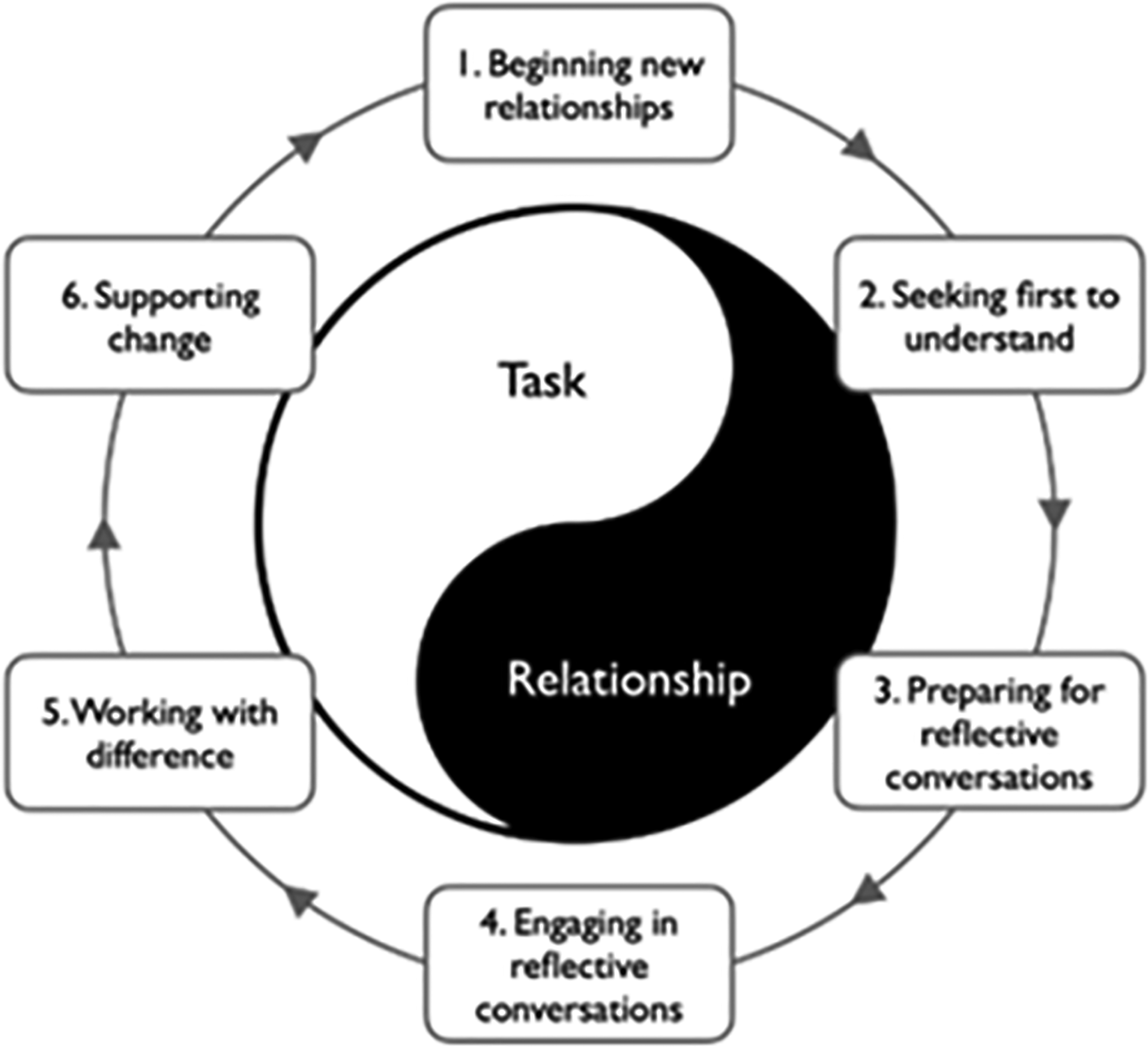
A six-step intensive 1:1 coach development workflow (Muir & North). 40
This combination of ethnographic strategies and action research offers a deeply contextualised and continuous analysis which speaks to assessing a form of life in a particular ecological niche as the findings are being implemented through the evolving coach and coach developer relationship – a critical depth and level of complexity that is rarely recognised in sport science and coaching research.
Data collection strategies
Surveys
To evaluate coach learning and development, multiple data collection strategies were employed: surveys, semi-structured interviews, observations, critical reflections and focus groups were conducted throughout the 20 weeks. A schematic overview of the research design and data collection process is found in Figure 2.
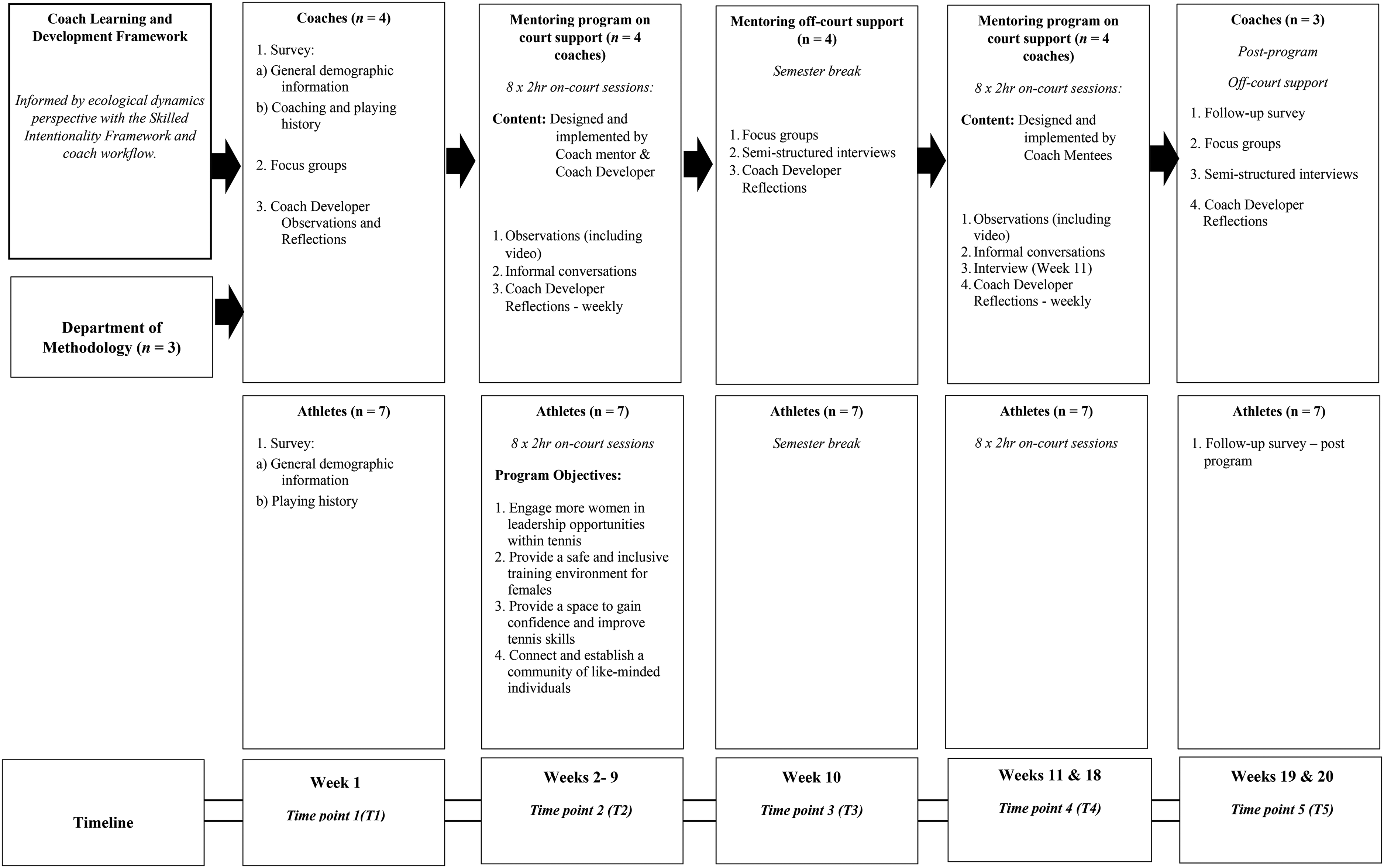
Schematic overview of the research design and data collection process for the coach learning and development framework.
Participant socio-demographic and coaching history
Participants were asked thirteen questions relating to age, coaching, and previous playing history, including current coaching qualifications, coaching years of experience, number of hours per week coaching, and the highest level of playing experience.
Motivations to coach
To capture reasons for coaching six open-ended items examined participants’ main reasons for wanting to coach in general and interest in the TA Coach Connect program. Participant expectations of the project and coaching areas of focus were also explored.
Semi-structured interviews
Interviews were developed based on empirical literature48,49 and piloted with a researcher outside of the Department of Methodology (see Appendix A). All coaches volunteered to take part in all data collection methods (N = 4). Interviews were conducted via Zoom by the primary investigator, recorded with the coaches’ permission, and transcribed verbatim post-interview. The interview contained open-ended questions designed to capture thoughts, perspectives, and feedback from the coach learning and development program (e.g., ‘What can you remember most about the on-court sessions?”; ‘To what extent has your involvement in this program changed your practice and views on coaching?’). Probe and follow-up questions were used for clarification or to obtain a greater depth in responses (e.g., ‘When you mentioned creating the right environment was an important part of the program’, what did you mean?’; ‘Can you tell me more about how you could change the environment in your training program?’). Interviews were on average 15–20 min in duration and conducted twice throughout the 20 weeks (see Figure 2).
Observations and critical reflection
In the dual role of practitioner-researcher, the primary investigator had the opportunity to unobtrusively observe behaviours and actions, sociocultural practices, and events at the initial stages of the coach learning and development relationship. The provision of coach learning and development through the TA Coach Connect program began with on-court educational support and extended as the tasks and relationships evolved throughout the coach learning and development workflow to include weekly check-ins, informal conversations, and interactions with others. While ‘seeking first to understand’, observant participation 39 enabled deeper insights into the functioning relationships, rules and peculiarities of the place and people, 11 which is integral to ethnographic research. 43 Video records of coaching sessions throughout the 20 weeks were also utilised as a feedback tool to review coaching behaviours (e.g., to assess the pattern and nature of social interactions between coaches and athletes).
Informal conversations also occurred within the context of coach developer observation, such as before and after training or correspondences between on-court sessions. These informal interactions contained less asymmetrical power relations than the semi-structured interviews. 50 However, the informal conversations were also coupled with the semi-structured interview guided by the first author's knowledge of the coaching and tennis landscape and aligned with the lines of inquiry devised by O'Sullivan et al. 11 Throughout observations, the first author often returned to the coaches to gather more data as relevant through a combination of informal conversations, assisting during training sessions and/or video recording where appropriate to pursue a greater contextual depth in research and comprehensiveness in understanding the coaches.
Focus groups
Focus groups were used so the Department of Methodology could collaboratively share feelings and perceptions of the coach learning and development program with the coaches. The semi-structured focus groups involved six participants (one member from the Department of Methodology was unavailable but was involved with informal conversations at a later date). Three focus groups took place during the program, ranging between 65 and 98 min, totalling 236 min (see Figure 2).
Documents
Based on the coaches’ needs, TA's coach learning resources (e.g., teaching content, session plans, Apps) were examined. The learning resources were designed and implemented by the TA Coach Development team to help support their coach education delivery (e.g., TA Club Pro qualification). The resources were also reviewed by the primary investigator prior to implementation. Additional electronic learning resources (e.g., podcasts, research papers) were frequently shared with the coaches.
Data analysis
Data analysis was a reciprocal process between data generation, scrutinising emergent themes from the data and consulting existing theoretical and conceptual frameworks that underpin the approach to coach learning and development (LDRF and coach development workflow 48 ). Data analysis commenced during initial data generation (Timepoint 1, See Figure 1), initially analysed for interpretation through descriptive “open coding” to develop descriptive and basic codes. 51 Here, the Department of Methodology (including the second and third authors), met monthly to act as critical friends, offering alternative perspectives and reflexively acknowledging multiple possible ‘truths’. A secondary coding cycle was then completed by the first author to begin interpreting, organising and synthesizing codes with theoretical considerations. Full transcripts from the semi-structures interviews completed throughout the 20 weeks, were analysed using reflexive thematic analysis adhering to Braun and Clarke's six-step framework 52 : (1) familiarising with the data (transcribing, reading/re-reading the data, noting down initial ideas); (2) generating initial codes (coding interesting features of the data in a systematic fashion, collating data relevant to each code); (3) searching for themes (collating codes into potential themes, gathering all data relevant to each potential theme); (4) reviewing themes (checking if the themes work in relation to coded extracts and entire data-set); (5) defining and naming themes (ongoing analysis refining the specifics of each theme and generation of clear names); and (6) producing the report (final opportunity for analysis, selection of vivid, compelling extract examples, final analysis of selected extracts, producing a scholarly report of the analysis). In the data familiarisation step, transcript reading, and initial one-page summaries of interview transcripts were sent to coaches for member checking and to provide an opportunity to challenge or correct any incorrect interpretations. 53 This step helped clarify explanatory meaning and accuracy of interpretation of transcript information.
Initial themes were developed deductively based on previous literature52,54,55 and support from the Department of Methodology. The first and second authors have a strong foundational understanding of coach learning and development theory to support interpretation, build on existing theoretical explanations, remain open to umbrella (hierarchical) codes that may encompass primary codes where appropriate and inform new lines of inquiry. Defined by Braun and Clarke52a theme captures an important aspect of the data in relation to the study questions, for example, ‘To what extent has your involvement in the program influenced your coaching practice?’ All interviews were then analysed using QSR's NVivo software (version 1.1.1). Once data were organised and coded in NVivo (all codes were classified under thematic headings), frequency count (FC) and references (R) were collated to better understand the emerging patterns. A summary table was created (see Table 1) to facilitate the reflexive discussion and continue renaming themes until a consensus was reached.
A reflexive thematic analysis summary of coach semi-structured interviews evaluating coach learning and development.
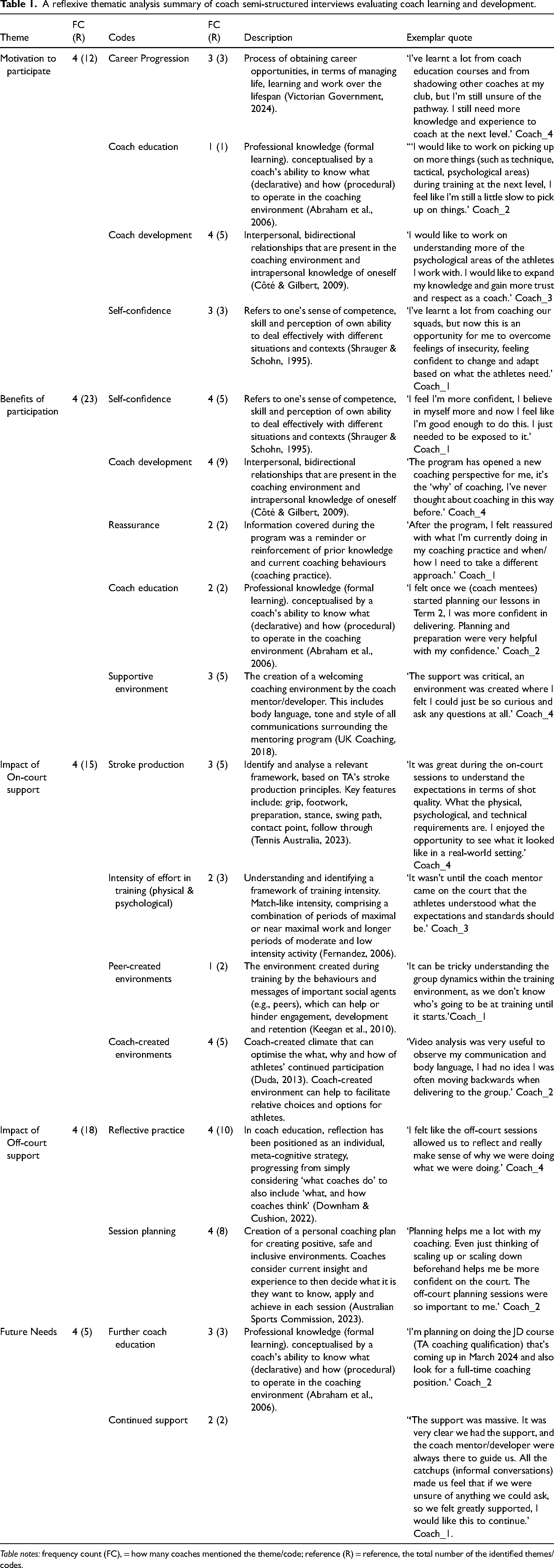
Table notes: frequency count (FC), = how many coaches mentioned the theme/code; reference (R) = reference, the total number of the identified themes/codes.
Qualitative rigour
The dual role of the primary investigator as a coach developer meant extra precautions were taken to maintain an appropriate level of reflexivity. The primary investigator is also a registered and TA qualified High-Performance coach, with over 30 years of coaching/mentoring and teaching experience. This dual role is a strength of the project, where prolonged embedded engagement while dwelling in the context of the phenomena can promote an accurate and truthful depiction of the participants’ lived experience. 56 To ensure trustworthiness (credibility, transferability, dependability and confirmability) of qualitative data interpretation, the following strategies were adopted.53,57 First, credibility of results was ensured through prolonged engagement. The primary investigator engaged with data continuously via transcribing, completing summaries, analysis and conducting ongoing reflective discussions with the research team. During interviews, coaches were encouraged to support their statements with examples, and the interviewer asked follow-up questions to obtain rich explanatory meaning. Ongoing reflective discussions between the Department of Methodology assisted with the naming and renaming of themes. Method triangulation was used by gathering and comparing data from across interviews, interviewer notes and interview recordings, 58 along with investigator triangulation (Department of Methodology) involvement in the data analysis process. 53 The Department of Methodology addressed transferability and dependability by acting as ‘critical friends’ 56 to ensure both interview content and follow-up analysis were aligned with the study purpose, participants and context. Confirmability was completed through one-page summaries sent to participants to confirm meaning and by providing direct quotes to illustrate results.
Results and discussion
Applying ethnographic and action research methods to a 20-week investigation on coach learning and development, the present study sought to untangle the challenges faced in creating effective coach learning and development models. Furthermore, this study aimed to introduce a group of applied practitioners and scientists (Department of Methodology) to further innovate coach development practices in tennis. Reflexive thematic analysis 52 generated an integrated coach learning and development framework in Australian female tennis coaching across five themes: motivations to participate; benefits of participation; impact of on-court support; impact of off-court support; and future needs (see Table 1 for definitions).
Motivation to participate
Initial motivations to participate spanned across coach development, career progression, developing self-confidence and coach education. Coach development was the most frequently identified reason for program participation, repeatedly seen as a way to ‘level up’ their coaching with exposure at the next level (Coach_2) and a desire to develop ‘… more knowledge and experience to coach at the next level’ (Coach_4). Coach development also offered more advanced topics and learning opportunities such as ‘understanding more of the psychological areas of the athletes to expand coaching knowledge and gain more trust as a coach’ (Coach_3).
Here, coach development is entangled with career progression, as further learning and growth may afford future career opportunities. The female coaching pathway in tennis was considered unclear, where some coaches saw the current program as an opportunity to gain exposure to, and experience within, further stages of the pathway. It is difficult to discern where the motivation to improve as a coach to better develop athletes ends and desire for career progression begins but it is likely a continuum, where athlete development is not quite a by-product of coach learning, but not always the guiding intention of the coach.
Building self-confidence through a sense of competence, skill and a perception of their coaching ability was an additional desired outcome for some coaches who saw their lack of self-confidence as a limiting factor in their career progression: ‘an opportunity to overcome feelings of insecurity and to feel confident to change and adapt based on what the athletes need’ (Coach_1). By applying a responsive learning and development framework, the program was adapted to incorporate individual coach motivations for participation, prioritising these coaching goals over pre-established learning outcomes through a combination of formalised content (e.g., TA documents) and informal/non-formal conversations. 59
Benefits of participation
Participants discussed a series of topics regarding their learnings from the program including self-confidence, supportive environments and reassurance alongside coach development and education. All participants highlighted the importance of coach learning and development as dynamic, demanding, and responsive to situational demands. 60 Coach_4 noted ‘the program opened a new coaching perspective for me, it's the ‘why’ of coaching, I’ve never thought about it in this way before,’ while Coach_2 was able to ‘further understand the language (coaching terminology)’.
The importance of developing self-confidence was repeatedly highlighted by participants, which when lacking can sometimes act as a rate limiter for female coaches in their development.61,62 A lack of self-confidence can manifest in different ways, such as low self-belief, a lack of conviction while delivering to a group, or overthinking and over-planning to a point where the coach becomes unresponsive to their athletes and environment.36,63 Participating in the program provided an opportunity and positive impact on their ability to deliver instructions to a group of athletes (Coach_2, Coach_3), and helped one coach ‘believe in herself and coaching abilities more than before’ (Coach_1). Coach developers also acknowledge the importance of reflective practice support for self-confidence and competence of participants.
Creating a supportive learning environment was an additional benefit of the program, with three coaches emphasising the role of coach developers in supporting their learning. This sentiment resonated throughout the interviews: ‘the support was critical, and an environment was created where I felt I could be so curious and ask any questions at all,’ (Coach_4). This highlights the need to create learning environments that are psychologically safe, especially in coach development settings where changes in behaviour may bring amplified (perceived) risk and self-doubt. 64 If an intervention, activity or session plan is unsuccessful, the consequences may seem more detrimental than simply not maximising athlete development in that session, such as an athlete not returning next week, judgement from parents or other coaches, and predominantly harsh self-judgement or self-talk. The collaborative, open learning environment is succinctly described by Coach_2: ‘the environment was very supportive because we (coaches) were able to back each other, and the coach mentor/developer also added to the knowledge and support.’
Impact of coach support, on and off the court
Coach support could be seen across coach development (coach-created environments, peer-created environments) and athlete development. Participants discussed the role of the coach in creating a motivational climate 65 to optimise athlete participation. While we may arbitrarily separate coach development and athlete development in discussion, they are entangled in reality. The way athletes would engage in the session differed throughout the program, and coaches’ ability to create an environment that matched the needs of the athletes was tested. At this level of tennis performance, there was an element of expectation from the athletes: ‘[they] had a different perspective of what they felt the environment should be’ (Coach_3). Coach_4 used the program as an opportunity to see what the next level of training design and athlete performance could look like, which led to discussions within the coaching group: ‘…it really made us think about getting the purpose right for the athletes’ (Coach_1).
A lack of responsiveness here, or a blind continuation of what training ‘should’ look like at this level, without considering the needs of the athletes themselves, could potentially have limited athlete development. Guidance from the coach developers within the program initially involved assisting with training design and delivery to address a lack of intensity of effort, but this became unsustainable. By stepping in for the coaches during their moments of need, the direct experience of learning to coach was reduced. Just as the coaches hoped to create rich learning environments for their athletes, the coach developers needed to become learning designers for their coaches to add value to the learning process. 62 In this instance, reflective practice and session planning emerged as a rich learning opportunity, allowing coaches to explore how reflection (within self and with others) could amplify their coaching practice. 49 The value of informal conversations to ‘help understand the purpose of training more’ was considered valuable by multiple coaches (1, 2, 4), and the ability to voice these ideas with coach developers provided additional insight to Coach_4.
Regarding stroke production, coaches highlighted the ‘need for guidance from the coach developers around the technical aspects of the game’ (Coach_1 and 2). Coach_4 identified how ‘beneficial the inclusion of technical discussions with the coach developers were to assist the coaches to identify how and when to make technical changes.’ During informal conversations with coach developers, coaches acknowledged feeling anxious about the formal assessment required on TA's stroke production principles to fulfil their next coaching qualification. Providing a psychologically safe learning environment throughout the program, particularly when attending to a more formalised and pre-determined part of the program offered coaches the opportunity to ‘feel supported’ when examining stroke-production ‘in a real-world setting’ (Coach_4).
Future needs
Coaches valued the amalgamation of formal, informal, and non-formal learning characteristics introduced by coach developers: ‘feeling greatly supported and hoping for this type of learning (ecological perspective) to continue in the future’ (Coach_1 and Coach_4). Encouraging coaches to develop constant ‘way-finding’ behaviours (for example, session planning and reflection), alongside a coach developer, 62 ‘made us feel that if we were unsure of anything we could ask’ (Coach_1). Coaches echoed ‘feeling invigorated after the program, with a clearer coaching pathway, as though they had just started on a coach learning journey’.
In contrast, Coach_3 mentioned the need for a career change and was not looking to do any coaching in the short term. Coach_3 felt ‘that there was little to no recognition as a female tennis coach’ in her daily coaching environment. This is a symptom of a much deeper, sociocultural issue that cannot be fully explored within the scope of this paper but is worth reiterating. While female coaches experience additional challenges, this can be exacerbated by a lack of recognition from Coach_3's perspective. Their ‘drop-out’ from the system or the program is not inherently problematic though, and we wanted to take this opportunity to address this dominant narrative. A hopeful by-product of deeply contextual learning opportunities is leading coaches out into other areas of their life, so this exploration beyond tennis may still viewed as a positive learning outcome. The systematic nature of the issues that may have led to this career change, however, warrants further investigation.
Limitations
The current study is not without limitations. Despite attempted recruitment across ACT, a limited number of tennis coaches, who met the inclusion criteria volunteered to participate. Anecdotally, reasons for lower interest resonated with pre-existing commitments, a negative culture towards the state and national governing body and a perceived fear of negative evaluation. To mitigate against this possibility, interviews were incorporated at various time-points (T3 & 5, see Figure 1) to help identify any changes in behaviour from a coaching standpoint. A second associated limitation was randomisation. Due to limited recruitment over time at baseline, a true randomisation procedure could not be implemented. Therefore, the possibility of skewness in coach characteristics or the tendency for more motivated coaches (or targeted coaches) to participate is possible. Small-scale recruitment coupled with non-randomisation leads to a broader, generalisability, limitation. Therefore, the recommendation to repeat and extend the program to a wider coaching context, with incentive to attract different levels of coaches may be logical. Disparity in age and experience of coach developers may also limit the generalisability of findings, and any observed effects should be interpreted with caution, due to any observer-expectancy biases that could be present.
Implications
From an ecological dynamics perspective, findings contribute to recent coach development literature endorsing the advancement of a learning and development framework supporting practice rather than being attached to one specific approach.60,62,66 Applying the LDRF framework to guide researchers, practitioners, clubs, and organisations to adopt contemporary learning design strategies within their coaching ecosystems, with a focus on the career progression of female coaches, could be beneficial. Findings also build on previous recommendations to close the ‘knowledge to practice gap’ in coach learning 19 by embedding coach developers within a Department of Methodology.
These findings represent a possible path forward for coach developers, suggesting that the role of the coach developer as an embedded member of a Department of Methodology is a viable option. Our research seems to have overcome several reported issues with coach development (e.g., a lack of bespoke individualised coach development, role clarity and decontextualised coach education) while also supporting the coaches to develop their careers beyond this program. This suggests that the coach developer was more effective in developing coaches’ coaching practice and pedagogies than in more traditional coach development settings. By working with a relatively small number of coaches in context this work presents a possible pathway for future coach developers and a conceivable alternative to critics who have suggested that a coach developer cannot fully prove effectiveness (e.g., continuous learning or the ability to directly impact how coaches behave when interacting with athlete learning or sporting experiences). Particularly findings suggest that as a part of LDRF the coach developers were able to support the career progression and self-confidence of the female coaches involved in this research. As such, it is worth coach developers and coach development administrators considering how this work could present a possible solution for future practice by extending coach development training (e.g., including a Department of Methodology) could be valuable in supporting female coach career progression.
Conclusion
In the context of Australian female tennis coaching, findings from a coach learning and development program provide valuable preliminary evidence (from combined data sources) supporting a framework that coach developers could deliver to coaches at any level of performance. Recognised by the primary investigator, a group of applied practitioners and applied scientists were aligned to innovate the coach development role further, potentially reducing the ‘knowledge to practice gap,’ in a specific female sport context. Utilising an ecological perspective and encouraging female coaches to develop constant ‘way-finding’ behaviours (amalgamating formal, informal, and non-formal learning characteristics) could also benefit. When considered at an individual coach and broader system level, findings suggest extended coach development training could be valuable in supporting female coach career progression.
Supplemental Material
sj-docx-1-spo-10.1177_17479541241287117 - Supplemental material for Removing the straight jacket in practice approach: An investigation into coach learning and development in Australian female tennis
Supplemental material, sj-docx-1-spo-10.1177_17479541241287117 for Removing the straight jacket in practice approach: An investigation into coach learning and development in Australian female tennis by Kylie Moulds, Alexandra Lascu, Alison Bai and James Davidson in International Journal of Sports Science & Coaching
Footnotes
Acknowledgements and disclosures
The authors would like to thank Tennis ACT and Tennis Australia for their collaboration and support. There was no financial assistance associated with this study. The authors report no perceived conflict of interest.
Declaration of conflicting interests
The authors declared no potential conflicts of interest with respect to the research, authorship, and/or publication of this article.
Funding
The authors received no financial support for the research, authorship, and/or publication of this article.

Supplemental material
Supplemental material for this article is available online.
Notes
References
Supplementary Material
Please find the following supplemental material available below.
For Open Access articles published under a Creative Commons License, all supplemental material carries the same license as the article it is associated with.
For non-Open Access articles published, all supplemental material carries a non-exclusive license, and permission requests for re-use of supplemental material or any part of supplemental material shall be sent directly to the copyright owner as specified in the copyright notice associated with the article.
