




Abstract
Recently there has been interest in using examining coaching practice through a lens of Professional Judgement and Decision Making. One core theory of decision making, Recognition Primed Decision Making, examines how people make decisions in limited time scales. Alternatively, when time allows, there is an opportunity for people to engage in slower thoughtful and Type 2 judgement and decision making (DM). In both cases it is hypothesised that professional practitioners (coaches) should draw on formalistic scientific rather than substantive heuristics or rules to maintain a professional standard. However, despite these ideas relatively little is known about the actual decision-making behaviour of coaches in practice. Against this premise 12 long jump coaches were asked to identify the strengths and weaknesses of a long jump athlete and offer a view on how they would work to improve his performance. All coaches were asked to identify what they would do if their first approach didn't work. Findings suggest that coaches have an initial tendency to engage in RPD type behaviour but drawing mainly on substantive rules. Notably, uncertainty pushed coaches to become more considered, and formalistic. In conclusion, coaches have the capacity to be ‘professional’ in their DM behaviour but may not use this capacity as the first resort.
Introduction
Professional Judgement and Decision Making (PJDM) has recently received a significant amount of attention as a concept to examine practice in domains of sport.1–4 This work draws together various theoretical positions on decision making, while also defining some core constructs; nested planning, adaptive expertise, and nature and use of knowledge.5,6 Briefly, nested planning refers to process of building a coaching plan where decisions made in situ are nested in medium term plans and long term goals. Adaptive expertise refers to physical, interpersonal, and mental adaptability, drawing on domain specific, metacognitive and innovative, skills and knowledge. A full description of these first two constructs can be found in aforementioned references. The third construct; nature and use of knowledge forms the theoretical basis to this study, with reference the first two constructs where necessary. In this study our aim is to examine decision making behaviour by coaches in a contextually framed scenario. In particular, to consider the type of decision taken and the type of knowledge drawn on in doing so.
In their seminal position paper, Kahneman and Klein 7 agreed that decision making (DM) had the capacity to become biased and flawed through overconfident reliance on and application of heuristics to solve problems and make judgements. Such overconfidence would be borne out of thinking that a swift naturalistic judgement and decision can be made based on ‘experience’ when, in fact, a more thoughtful approach should be taken. However, despite this possibility the same authors argue that professionals have the capacity to avoid such biased and flawed decisions through their expert knowledge of and skills within the fields they operate. It is of note therefore, that numerous researchers within coaching have identified problems of coaches making judgements and decisions drawing on ‘folk pedagogy’.8–11 The suggestion being that, while this folk pedagogy may have value, its experiential source often means it is without theoretical or critical basis. This indicates that coaches may therefore be prone to the biased and/or flawed DM Kahneman and Klein refer to. A further point made by these authors is that ‘The most common method for defining expertise in NDM research is to rely on peer judgments. The conditions for defining expertise are the existence of a consensus and evidence that the consensus reflects aspects of successful performance that are objective even if they are not quantified explicitly.’ (page 519). Taken to its logical conclusion, this infers that expertise is defined by the peer group. There are subsequent profound implications here about benchmarking performance. In established professions such as medicine or law, the requirement for high levels of accredited knowledge and skills is well established and ’baked in’ to governance, recruitment and development. However, in emerging ‘young’ vocations such as coaching this requirement often doesn't exist. Consequently, the peer group may well accept a level of expertise (i.e., folk pedagogies), that has led to ‘successful performance’, but does not create a high benchmark, e.g.,. 12 I.e. the peer group doesn't demand high levels of accredited levels of knowledge and skills.
Such a position has consequences for identifying coaching practice as being professional, when professionalism is a stated aim of the International Council of Coaching Excellence. 13 For example, Carr, 14 has identified that professions are defined by their recourse to theoretical and/or empirical knowledge in making judgements. Furthermore, Thompson 15 identifies that professions are characterised by practice that is checked, monitored and informed by a critically aware peer group, a view consistent with evidence in coaching efficacy. 12 In short, applying the concept of professionalism to coaching may well be provide higher benchmark than the expertise defined by the peer group. Indeed, this has been strongly inferred by reports examining poor or even illegal coaching practice. 16
The question that arises is; Do coaches engage in professional decision making in all of their decisions? To understand this question, it is useful to explore the Type 1 and 2 ideas of DM put forward by Kahneman 17 and the RPD theory suggested by Klein. 18
Within his work, Kahneman 17 identifies that judgments and decisions are made either through an intuitive, fast, Type 1 process, or through a more considered and slower, Type 2 process (Type 2 has been referred to as Classical Decision Making (CDM) in coaching). 19 Kahneman offers further useful insight, particularly about which type is used and when. For example, he suggests that the vast majority of decisions are made through Type 1 process since this is typically the most efficient in terms of using mental and time resources to solve problems and achieve goals. 7 Furthermore, the Type 2 system is used less frequently since it is too inefficient (at least in the short term), slow and effortful in dealing with most day-to-day and moment-to-moment problems. In fact, Kahneman states that, for many people, the Type 2 system is lazy such that ‘…if System 1 is involved, the conclusion comes first and the arguments follow’. 17 This view has important consequences for defining judgement and decision making as being professional as per our earlier points. If coaches consistently rely on Type 1 approaches in their coaching and neglect Type 2, their capacity to be professional both as a practitioner and learner inevitably becomes compromised. Indeed, in the absence of this more critical (but slower) thinking, professionals have been observed to become too reliant on easily accessed heuristics, often ideologically based, to solve problems.5,20
In contrast to Kahneman, Klein and colleagues
21
own work has focused on examining how practitioners can and do make expertise informed fast Type 1 decisions in pressurised circumstances (typically referred to as naturalistic decision making, NDM); for example, fire fighting.
18
Klein argues that professionals are able to consistently make correct decisions without the need to revert to slower Type 2 decisions. To exemplify this capacity the RPD model, one of the most consistently referenced models within the NDM literature, was developed (see Klein,
18
for an overview). This empirically supported model predicts that, in naturalistic environments, expert professionals are able to make use of recognised perceptual cues/patterns to make fast decisions. There are three levels to the RPD model that are enacted according to just how recognisable the perceptual cues are. In her work examining volleyball player decision making Macquet,
22
summarised the three levels to:
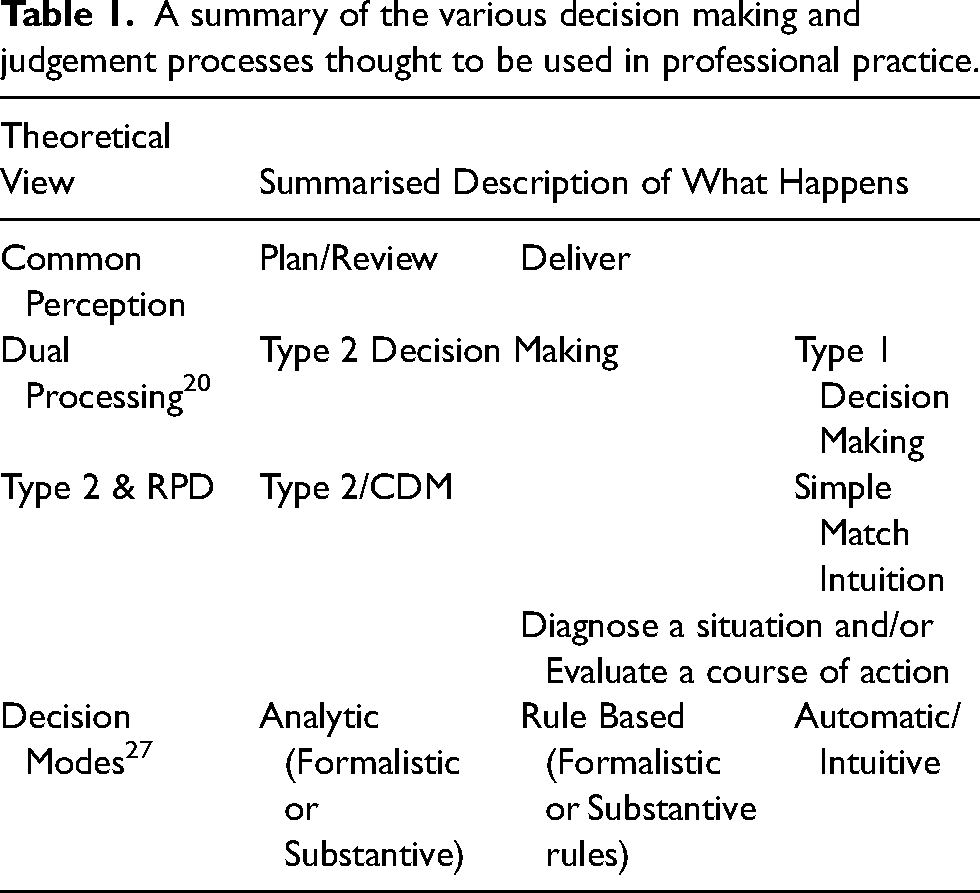
Simple Match. At this level cues in the environment immediately and automatically match, with no or extremely limited conscious activity, with a decision and action. Diagnose the Situation. This level is enacted when perceptual cues do not immediately offer a view on the expectancies in the environment. As such, the expert uses their experiential knowledge, both tacit and explicit, to simulate what may have led to the situation. A view is quickly established which matches a course of action and a decision is made. Evaluate a Course of Action. This level is enacted when the situation is recognised but a solution does not immediately present itself. The expert, again drawing on experiential knowledge, will then mentally simulate the consequences of one or two actions before choosing a course of action. The pattern matching is the intuitive part, and the mental simulation is the conscious, deliberate, and analytical part. This blend corresponds to the System1 (fast and unconscious)/System 2 (slow and deliberate) account of cognition.
18
All three levels of RPD are fast acting, while only the first level is truly intuitive, as Klein states:
In summary, the NDM view on professional practice places great emphasis on the professional's capacity to deal with issues as they arise. It relies heavily on the professional's capacity to respond intuitively, typically framing expectancies from perception through tacit knowledge learned through experience. When intuition cannot answer the problem there is recourse to more considered problem solving. However, this problem solving is rarely fully analytical in nature since the goal is satisficing rather than optimising – bringing into question just how ‘professional’ the approach is or can be.
Of course, the NDM approach is highly valuable to those who work in emergency or military situations where a lot of Klein's work has centred. However, as pointed out by Martindale and Collins 23 in their discussion of PJDM, not all occupations are defined by such high-pressure, short time frame environments. Sport professions such as coaching and sport psychology24–26 might still be identified as ‘naturalistic’ yet benefit from spending more analytical time 27 on problems as opposed to simply satisficing. In fact, for all these professions, critical thinking, planning and reflective practice are seen as being crucial to effective practice.28–30 Indeed, the simplistic, yet not completely unrealistic, view of coaching being a Plan-Deliver-Review process would suggest that two major parts of the process, planning and reviewing, have the potential to not be time pressured. There would therefore be times when Type 2 decisions could be made. Conversely, there will be times when quicker decisions need to be made when in deliver mode such as intervening during practice or delivering a half time competition team talk that recognition primed Type 1 decisions need to be made. Importantly, both satisficing and optimising approaches work, but only in contexts where they work. With limited time and resource, satisficing is known to outperform attempts to optimise. However, the opposite is also true.20,31 Indeed, contextual pressures of coaching can change from one sport to the next, i.e., Basketball to Track and Field or even within in one sport, a talent development environment or performance environment. These shifts can impact the frequency of different types of decisions required offering more reason to gain a better understanding of how decisions can gain and retain a professional basis.
So how does a coach retain a professional status in naturalistic settings if fully analytical DM is not possible? Is PJDM possible in naturalistic settings? The answer to this question must be in the way that the NDM and CDM (or Type 1 and Type 2) processes talk to each other. It is here we return to the first construct of PJDM identified by Collins et al.; 5 Nested Planning. Abraham and Collins, 19 discuss how a nested judgment and DM process can and should connect a thoughtful CDM process to the NDM processes
But even if nested planning is followed, it is the quality of knowledge, that moves beyond ‘folk’ knowledge that informs this decision making that brings the quality referred to by Carr. An insight to answering the question of professionalism comes from the review of DM and judgement by Yates and Tschirhart.
27
Among a broad range of issues covered by these authors they suggest DM can be an opportunity to engage in:
Full analytical DM. This strongly relates to the analytical Type 2 DM.
20
Rule based DM. This strongly relates to the heuristic based DM
20
and the Diagnose and Evaluate options within RPD identified earlier.
22
Automatic/intuitive DM. This strongly relates to Type 1
20
and the Simple Match option of RPD.
22
Notably, however, Yates and Tschirhart
27
augment their view on decision making with a view on the judgment that precedes it. They provide a distinction of how analytic and/or rule based decision making may follow a Formalistic (academic) or Substantive (folk) approach to making judgements and therefore making a decision. They identify that formalistic judgment draws on established formal ‘known’ rules or theory to guide judgement and DM. Alternatively, they identify that substantive judgment will draw on personal theory or rules to solve problems. In other words, PJDM should follow a formalistic path whereas weak(er) folk or heuristic based judgement and decision making will follow a substantive path. In short, it is theoretically possible for practitioners to maintain a professional approach, even in naturalistic settings, if they maintain a formalistic approach to their analytical and/or rule based judgements and DM that are or could be grounded in a longer term view of development goals. In the absence of these formalistic rules, coaches (people) will draw on either, weaker rules
32
(e.g., ‘in my experience’) or tacit heuristics (e.g., ‘it just works’), thus limiting the professionalism of a decision. A summary of the various approaches is shown in Table 1.
A summary of the various decision making and judgement processes thought to be used in professional practice.
There is one final note of critique to note before moving on. The focus on formalistic explicit knowledge, and a capacity to explain intuitive decisions seems to be the ideal ‘professional approach’. However, Thompson and Tangen offer a note of caution here. 33 Researching the field of fingerprint analysis, they note that the assumption that an expert analyst can explain their intuitive pattern recognition in court should be tempered. The results of their work noted that much of expert pattern analysis was based on tacit responses, not explicit consideration. However, even here the researchers further noted ‘Experts were more accurate than novices…. and experts were generally more accurate when they had more time’ (p.19). Going on to note; ‘Although non-analytic processing is important for fingerprint matching, these results also indicate that non-analytic processing alone is not sufficient to achieve maximum performance’ (p.20). In short, analytic thinking is an important contributor to practice, even when intuitive, tacit, responses are seemingly central to effective practice.
Summary and research questions
Taken in combination, the theoretical and conceptual approaches presented here (summarised in Table 1) offer a view on how people make decisions, drawing on different mental resources and processes that are dependent on the context within which they are made. However, as North 34 states, there is relatively little data within coaching to explore or support any of these views. This missing support is important for three reasons. Firstly, if we don't know how coaches are making decisions, we cannot accurately define coaching practice and whether it is professional or not. Secondly, if we can't define coaching practice, we can never be sure if we can identify, measure or assess coaching practice or its effectiveness (notwithstanding the external factors which will impact on this). Thirdly, without understanding how coaches are making decisions, or are getting better at making decisions, it is difficult to know if proposed or actual educational processes and professional development guidelines are fit for purpose.
Reflecting these assertions, the study presented here aimed to explore the DM processes used by a group of experienced athletics coaches in the discipline of Long Jump when analysing, diagnosing and prescribing the needs of a single long jump athlete. Furthermore, drawing on Yates and Tschirhart's
27
view that ‘people resort to formalistic procedures only when they can't use substantive ones, which are much more natural’ (p.433), the study also aimed to explore what coaches would do when presented with uncertainty regarding their judgements. In taking this approach, the following research questions were developed:
What approaches to DM do coaches take when presented with a contextualised real-world coaching problem? What knowledge sources do they draw on? How do coaches respond when placed in a position of uncertainty? If there are differences, what knowledge sources do they then draw on? What conclusions can be drawn regarding the identification, measurement and evaluation of coaching practice? What conclusions can be drawn regarding examining relevant educational processes and professional development guidelines?
Methods
Participants
Following ethical approval from University Ethics Committee, 12 British and Irish athletics coaches (all male; mean age 43.2, sd =3.6; mean years coaching 11.2, sd= 3.8), were recruited by personal contact. All had coached athletes to at least national level (participation of at least one athlete in at least one national championships) in a horizontal jumps event. At the time of the investigation, all were actively coaching. All participants were assured of confidentiality and provided informed consent.
Methodological approach and stimulus instrumentation
Accessing cognitions with practitioners in any meaningful way that translates into useful data from which transferable inferences can be drawn is problematic. Abraham et al., 24 identified that, in order to access meaningful cognitions with coaches, they must be engaged with a context that allows them to be in a knowledge object 35 coaching mind-set. This would ideally mean engaging a coach within and about their own coaching context. However, such an approach makes it difficult to control for within-group variance and develop results that are comparable across the group since each coach's context is unique. Consequently, a middle ground is needed, where a single context is developed that allows for comparisons to be made across a group yet is still meaningful enough to elicit relevant responses. In essence we draw in the ontology of pragmatism. Rather than seeing method as a free for all, or getting bogged down in methodological debate, this approach identifies the essence of the right tool for the right job.36,37 Examples of such approaches in coaching research have been relatively rare in recent times although the method had some popularity in the past and was successful in examining diagnostic skills in swimming coaches 38 and planning behaviours in basketball coaches. 39
More recently, the use of stimulus or simulation based approaches has been recommended by Gore and McAndrew 40 as a method for accessing cognition in practitioners. Given the questions that this study was trying to answer, employing this methodological approach was deemed appropriate.
In keeping with this approach, therefore, participants were presented with film (8 jumps at various venues and of various distances) plus competitive records and training data on a ‘US varsity level’ long jumper, age 20 and with a Personal Best (PB) of 8.05m. In fact, the stimulus was a conglomerate of several similar North American athletes, assembled in consultation with two NCAA Division 1 athletics coaches to generate a consistent picture of a ‘good, up and coming athlete’, based on the standards prevailing at that time.
Procedures
All participants received the information pack at least five days in advance. They were then interviewed in a single data collection session (lasting between 45 and 60 min) covering two stages. Under the first, participants were asked to describe:
Their evaluations of the athlete's strengths and weaknesses Their main aims for his immediate future development Some exemplar activities which they would employ
Participants were also asked to present a rationale justifying their decisions.
In the second stage and in order to introduce the element of uncertainty, participants were told to imagine that this diagnosis and treatment was not working and to reconsider what else they would do, using the same structure as in the first scenario. At this stage, two participants observed that this ‘simply wouldn't happen’ and refused to complete the second scenario. Data from both participants was consequently removed from the investigation.
Data analysis and member engagement
Data were transcribed and analysed using inductive analysis. 41 The inductive analysis was completed by a qualified athletics coach and experienced coach educator whom was familiar with the sport and the event. This coach was asked to identify key factors in relation to the main aims of the first stage of the interview. The coach was further asked to identify what he thought were the key rationales provided by the participants. A third researcher who was blind to the underpinnings or purpose of the investigation completed a further inductive analysis of a 10% sample of all of the interviews (i.e., selected single pages of transcriptions representing both the initial and follow up uncertainty responses). A confirmatory debate on all unclear issues was held between the coach and the third researcher. Summary data on their responses and the research team interpretation of them were subsequently sent to all ten remaining participants. All expressed their approval that the descriptions offered were a genuine reflection of their thinking and reasoning. Member checking has been criticised by Smith and McGannon 42 for having conflicting epistemological and ontological bases. We argue here, from a pragmatic point of view 36 that the process served to offer assurance that we have not overtly misrepresented the views of the coaches.
Finally, the first author completed a deductive analysis of the original inductive analysis. Initially this involved an analysis of the first stage responses largely against the PJDM, Decision Modes and Knowledge Source ideas contained in Table 1. Subsequently, a further similar deductive analysis was completed on the second stage responses. The completed deductive analysis was discussed and challenged between the first and second author to ensure a valid rationale for each deductive allocation could be offered. 42
Results and discussion
In keeping with other similar qualitative research, 43 it was deemed most meaningful to present results and the discussion of results in the same section since it is difficult to present results without aligned discussion.
Against the purposes of the investigation, results are presented focused on the perceptions, intended actions and reasoning reported within a table that is ‘a means of merging and synthesising data’. 40 Results from the ten participants who completed the whole investigation are presented in Tables 2 and 3. In all cases, the primary reasons and actions reported by each participant coach are presented; that is, the one they and the analysing coach felt was the most important rather than the one which they said first. Aligned with these responses, a deductive view on the approaches to problem solving and DM used by the coaches are presented in the final column.
Summary of coaches’ key cognitions responding to the initial stimulus.
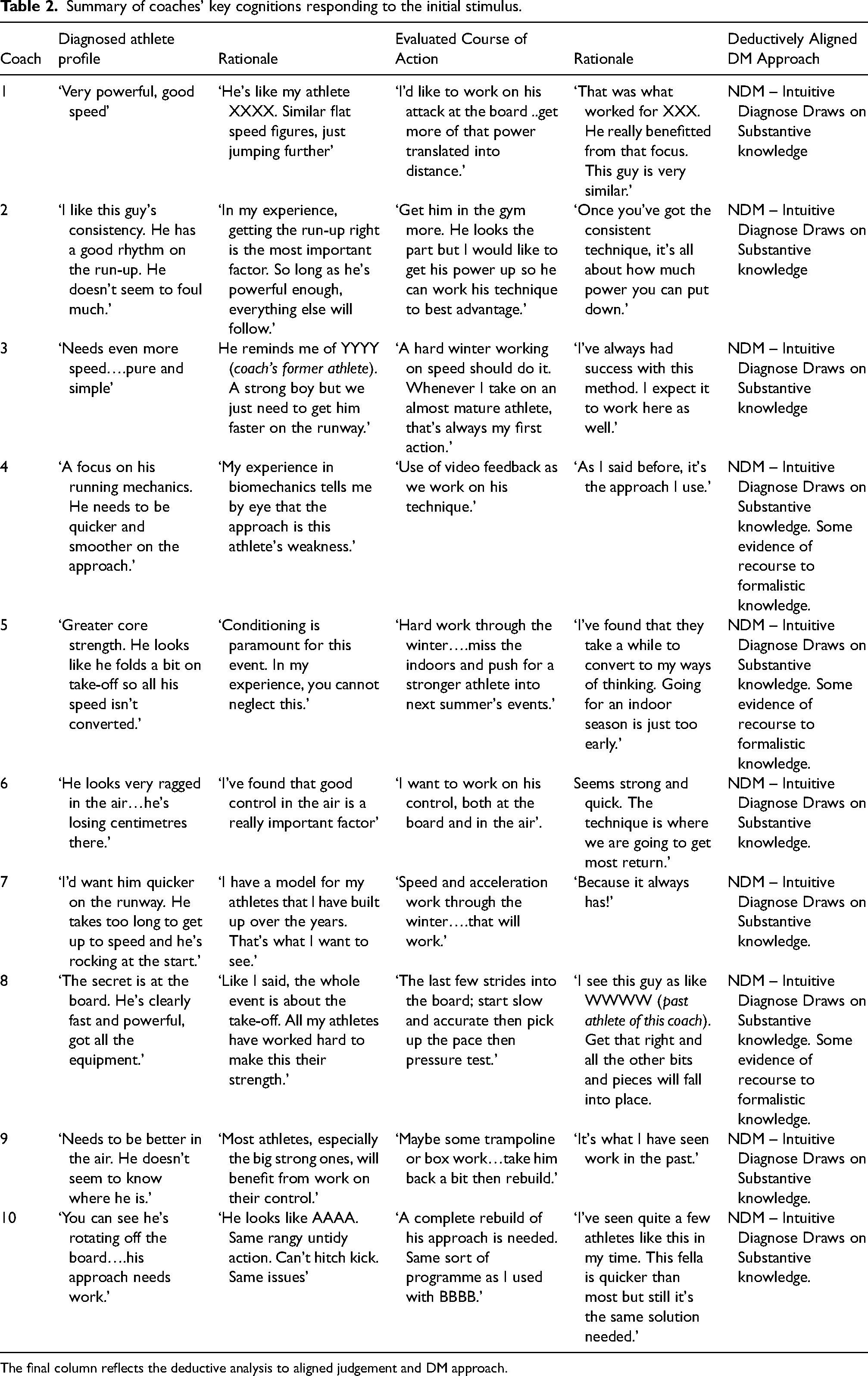
The final column reflects the deductive analysis to aligned judgement and DM approach.
Summary of coaches’ key cognitions relating to their response to the secondary stimulus.
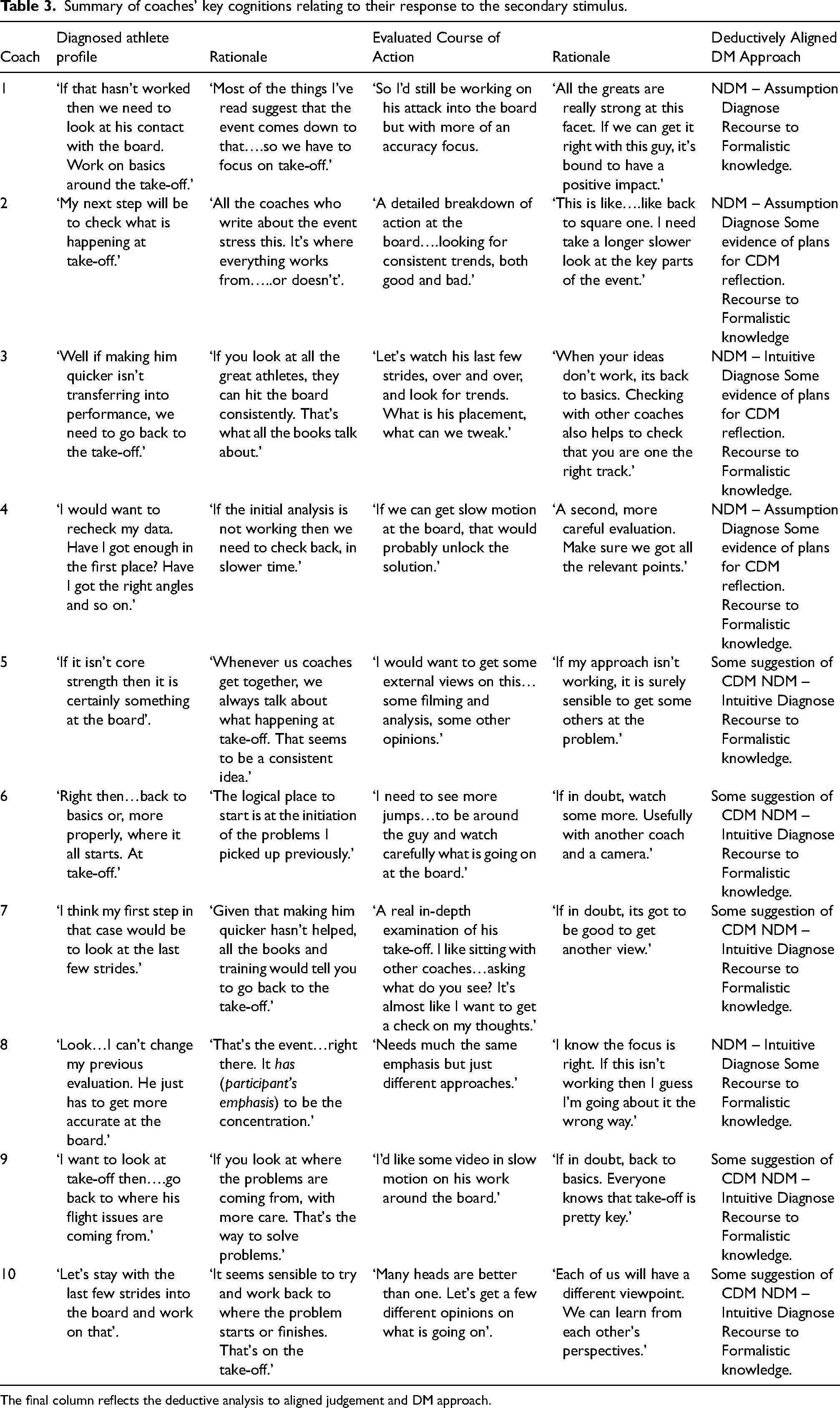
The final column reflects the deductive analysis to aligned judgement and DM approach.
Responses to initial stimulus
Reflecting the expected application of NDM style approaches in the first instance, participant responses in Table 2 display a personally orientated substantive approach. Our deductive alignment of responses as being substantive in nature as opposed to formalistic is made on the basis of the intuitive application of heuristic problem solving procedures to both diagnose and evaluate their course of action. For example, justifications for the diagnosis made and the actions suggested are almost all exclusively grounded in ‘my experience tells me…’ and ‘this looks like when….’ style explanations. Perceptions on strengths, weaknesses, and planned actions, reflected the initial snap diagnosis made with an expected response being the coaches’ evaluation. There was some similarity between the coaches, resulting in some level of clustering, i.e., those who thought the problems experienced by the athlete were technical whereas others thought the problem was one of strength and conditioning. However, the results in Table 2 are probably more defined by their apparent inter-individual variability depending on their initial diagnosis. In short, we suggest that responses were personally and substantively orientated, based almost exclusively on the coach's immediate perceptions and application of their athletic folk rules. This approach aligns mostly with a Type 1/NDM process with some Type 2 diagnosis and evaluation but that these largely drew on intuitive, substantive heuristics as opposed to a formalistic and analytic approach. Such a view would align with the thoughts of Chow and Knudson 44 who suggest that coaches ‘..not educated in exercise and sports science and rely on passed-down craft knowledge of sports techniques.’ (page 229). Of course, we should assume that despite the folkness of the rules applied, the expertise of these coaches would still lead to good decisions as per the predictions of Klein. Indeed, we are not saying that any of the answers offered wouldn't have achieved some level of satisfactory outcome, a key definer of effectiveness. Rather, that if the decisions taken by the coaches satisficed achieving a desirable outcome, inter-variability would suggest they were all missing an opportunity to optimise. So, even if there is some truth to the decisions taken by the coaches, the lack of consistency would suggest that they are also all missing something.
Responses to uncertainty stimulus
It is of great interest therefore that, when pressured by the manipulations and placed in a position of uncertainty by suggesting that their initial diagnoses/plans were not working or even incorrect, participants took more robust a ‘back to basics’ approach (see Table 3). This approach was almost identical across coaches and reflected a greater reference to a more formalistic knowledge that was, apparently, aligned with deterministic modelling identified as being required for an detailed view on key components of the long jump and the role of focusing on the take-off. 45 This would immediately challenge the view of coaches relying on craft knowledge described by Chow and Knudson, 44 in fact, deterministic modelling is proposed by these authors as being a preferred translational shift from sport science theory to practice.
Notably, the response to the uncertainty manipulation resulted in all coaches talking about the need to reduce uncertainty by acquiring more information, as coach 2 said, ‘I’ll need to take a longer slower look at the key parts of the event’. (Coach 2, Table 3). This more thoughtful analytic approach was also supplemented by a strong desire to get the opinions of other coaches to support the diagnostic view; ‘Checking with other coaches also helps to check that you are on the right track’ (Coach 3, Table 3) ‘I would want to get some external views on this…some filming and analysis, some other opinions’ (Coach 5, Table 3). Of further note was that only Coach 8 stayed with his original diagnosis, although accepting that what he had done must be at fault if no improvements had taken place. This is of note since this was the only participant whom seemed to engage a more formalistic needs analysis approach in his response to the initial stimulus. Against the review and summary of the main results offered, answers to the specific research questions become available.
Research questions 1 and 2
What approaches to DM do coaches take when presented with a contextualised real-world coaching problem?
What knowledge sources do they draw on?
Evidence presented here is that the coaches’ initial problem solving and decision making followed a non-nested naturalistic response. There was some evidence that the choice of approach was intuitive, i.e., there was an immediate application of a weaker problem solving rule to solve the issue that was directly attributed to in my experience. However, this application was apparently to engage mental modelling that both diagnosed how the athlete had arrived at their current status (i.e., second level RPD: diagnose the situation) and then evaluated a matched course of action (i.e., the third level RPD). It is of interest that there was no obvious doubt in the mind of any of the coaches that the intervention would work. So, while there was some explicit thought about how the athlete had arrived at the situation the coaches were presented with so that the second level of NDM was initiated, there was no evidence of them thinking through the consequences of various interventions before deciding on which to take. In short, there was an apparent confidence in creating a course of action based on a diagnosis that drew on an intuitive application of mental models. Such an approach would be in keeping with work examining satisficing expert performance where the conditions of a problem are recognisable and match with known interventions and ways of working.46,47
From a knowledge source perspective, the coaches seemed to have relied on substantive problem solving rules to offer a view on what they were perceiving. As mentioned earlier, the views offered differed across the coaches probably reflected pet opinions and views that immediately came to mind. This would also be reflective of the application of the availability heuristic as defined by Kahneman. 17 This is a phenomenon that is observed when humans intuitively go to the answer that immediately comes to mind, without Type 2 processes being implemented to check judgement, even when the opportunity exists. This approach is reflective of the reality already noted by Yates and Tschirhart 27 that people will select substantive knowledge ahead of formalistic knowledge when possible.
Given the processes at work here, there is a strange phenomenon occurring where the DM behaviour of the coaches is similar to experts in other fields, yet the DM behaviour seems to be more substantive and rapid when a potentially more ‘professional’ formalistic and slower approach is available. Of course, this may be an artefact of the methodological approach since there was no great pressure to defend or think through the interventions suggested. Equally, however, there was nothing to stop the coaches implementing a level of self-control 17 to check their answers before verbalising them. They may even have attempted to nest them in a bigger picture.
Research questions 3 and 4
How do coaches respond when placed in position of uncertainty?
If there are differences, what knowledge sources do they then draw on?
The manipulation of introducing uncertainty in this study produced results that were in keeping with what might be predicted from the theoretical ideas offered in Table 1. When presented with the uncertainty there was a strong consensus for a need to examine what was going on at the take-off board. While only some coaches shared a view that ‘all the books and training would tell you to go back to the take-off’ (Coach 7), the fact that this was a common theme would suggest a shared formalistic rule of how to go back to basics. Furthermore, there was an explicit identification that this recourse would lead to attempts to gain further information to further understand the problem that was occurring.
These approaches would still align with the RPD model. For example, there is an intuitive rule applied (stage 1), an attempt to diagnose the problem (stage 2) and steps taken to evaluate a course of action (stage 3). This explanation is consistent with Klein's view that Type 2 deliberative thinking is being engaged. Furthermore, an additional, more analytical, focus is suggested through more considered data collection methods, i.e., video use, and the view that discussions should occur with other coaches. In short, under this level of uncertainty the coaches are interested in going beyond searching for the first available idea (satisficing), instead wishing to explore options available to them and willing to do so through checking ideas with others, thus becoming analytical. This level of analysis would seem to have more to do with the analytical, deep reflections identified by 27 and. 48
We have already identified that the coaches seemed to progress to drawing on formalistic rules that link with deterministic modelling. However, the response of coach 8 referred to earlier, offers an alternative that is worthy of exploration. While this study did not explicitly go into depth to explore the knowledge streams that the coaches were analysing, there are some inferences that can be made. Abraham and Collins
49
identified three broad domains of knowledge that coaches can draw on when engaged in skill development activities;
Understanding of the performer. Understanding technique and tactics. Understanding of teaching and learning environments.
Examination of the responses in Table 2 and returning to the response to research question 1, suggests that the coaches are implicitly drawing in ideas that would align with their understanding of the athlete (based on what could be gleaned from the information they were provided with) and of the sport. It is noteworthy therefore that, when the pressure of uncertainty is added, the coaches become more focused on drawing upon their explicit understanding of the sport (i.e., the strong focus on what is happening at the board). It could be argued that becoming more deterministic would probably lead to considering the athlete as well, but in a more analytical approach. What becomes apparent is how the majority of coaches do not seem to draw on the learning and teaching knowledge stream, and this would be consistent with previous research in this area.
49
It is here that Coach 8 bucks this trend by sticking with his view on the sport specific problem and focusing instead on what he is doing wrong. This coach went on to state that there must be a problem with the training and, given the focus of this coach's view on the take-off, we deductively align this reflection with the coach referring to the learning environment. As such, across the 10 coaches there is a view emerging that all three knowledge streams identified by Abraham et al.
50
may be accessed during this more analytical process, although there was a definite bias towards the technical and tactical knowledge stream. We acknowledge here, that this brings a limitation of this study to the surface. We deliberately didn't ask the coaches about their beliefs or understanding of different theoretical perspectives, as we didn't want to frame questions and responses. However, knowing more about the coaches’ beliefs and understanding would have allowed for some more pointed probing of responses during the interview.
What conclusions can be drawn regarding the identification, measurement and evaluation of coaching practice?
Based on the responses from coaches in this study, the methodological approach has strong validity in reflecting how decisions would be made in the field. For example, after the point of uncertainty was offered, there was nothing stopping the coaches offering another pet theory as to what could be worked on, but they didn't, 10 of the 12 coaches moved to a more considered, analytical approach. Accordingly, we are confident that all the processes engaged with by the coaches in this study are somewhat typical for these coaches. In this study, the process was dependent on judgements and DM that are influenced by accurate perception of the problems, the availability of matched actions, and the availability of mental models that allow rapid, yet considered judgements to diagnose situations and evaluate courses of actions.
Against this evidence it would seem fair to say that, in order to identify coaching practice, we have to go beyond what can be observed to considering the process that led to what is observed. 51 Given the apparent centrality of judgement and DM to practice this centrality must then flow through to measurement and evaluation of practice. Finally, this must also reflect the contexts within which judgements and decisions are made and therefore the manner in which they are made. 27
What conclusions can be drawn regarding examining relevant educational processes and professional development guidelines?
Given the breadth of ideas covered in Table 1, there is clearly no one silver bullet that will meet the educational demands of developing coaches. Furthermore, as identified earlier, the nature of this study means that it is limited in depth of analysis, breadth of scope examining coaching practice, and to the demographics of the coaches involved. As such, the conclusions drawn are equally limited in their transferability. Notably, however, some commentary can be made with respect to the current industry vogue of examining formal and informal learning.52,53 Within formal learning, making use of reflective practice 28 and communities of practice 54 to engage with and embed formal knowledge are often seen as something of a panacea for developing coaches. However, this study would suggest that some caution should be applied.
All of the coaches did identify that critical reflection against theoretical standards and engaging with other coaches would be something that they would employ. Crucially, however, the coaches only seemed to move to this position after it had been suggested that their initial intuitive responses had been unsuccessful. In other words, asking people to be more thoughtful may only work if the circumstances make this meaningful for the coach. Furthermore, this move to a more thoughtful approach may only occur if the coach actually recognises uncertainty in their practice; notably, the two removed from the investigation certainly didn't. It is this capacity to recognise uncertainty that may need work before reflective practice can have any meaningful impact. As such, formal methods of education that do not develop perceptual skills and expectancies in coaches but move straight to reflective learning processes may find little learning actually occurs. In short, if coaches have low (or even no) expectations of what they will see and how things will develop, they may never experience the uncertainty or surprise that would make reflecting and talking to other coaches a meaningful experience. 50 It is worth noting that slower CDM-style check thinking was a normal second stage to intuitive DM in samples of high level adventure sport and rugby coaches. 2 Perhaps this is a causative factor as well as a feature of high level practice?
Inadvertently, this study may offer one way of creating contextualised uncertainty that is meaningful to coaches. Asking different coaches to examine the same case led to skilled intuitive responses. We have argued that the variability in answers means that there was a lack of coherence, which then appeared in the second round as a result of uncertainty. However, the variability could well also have been used functionally as a discussion point for exploration. In short, asking coaches to engage intuitively with the same ‘data’ in a training exercise could generate meaningful variability and thus uncertainty for a later more considered debrief with formalistic models.
Indeed, the previously stated issue of people being unlikely to engage in formalistic knowledge unless they have to 27 should cause some alarm to those who develop and deliver formal learning programmes. Formal programmes can ignore the knowledge that learners come and just hope that any new knowledge delivered will simply supersede current knowledge and its application. 8 This may indeed be a desired outcome, however, the nature of NDM means it is unrealistic. If new formalistic knowledge does need to supersede substantive knowledge in the DM processes of coaches it must first connect with this substantive knowledge and the perceptual cues that are linked to it. Furthermore, application of this new formalistic knowledge must be able to experientially evidence that it leads to better outcomes for the coach. 11
Where next?
This study has illuminated some insight to in situ decision making, but it is bounded by the sport, the method and the number of coaches. Much more work is needed in the area of coach decision making. While being focused more on sport performance than coaching, Bossard et al. 47 noted one area in particular that caught our attention, the role of emotion in decision making. Their main conclusion was a lack of research in this space in sport. One study reviewed, examining film director's decision making stood out however. 55 Like coaches, directors have a process that reflects; plan deliver and review. It is of interest therefore that this study noted how moderate fear would encourage more rational (Type 2) thinking. Furthermore, that higher anger and fear was connected more with experiential, and expertise based intuitive response that both satisficed the situation and regulated the emotion. Given the clear concerns in sport around pitch side behaviour, aligned with studies concerned with inappropriate coach training behaviour, examining and/or developing decision making around emotion in situ offers one clear direction.
Footnotes
Declaration of conflicting interests
The authors declared no potential conflicts of interest with respect to the research, authorship, and/or publication of this article.
Funding
The authors received no financial support for the research, authorship, and/or publication of this article.
