




Abstract
Performance Analysis (PA) is viewed as an integral feature of soccer; however, the processes underpinning such practice are often described as simple, linear procedures. This fails to acknowledge the dynamism of PA and given increased investment and employment of analysts in professional soccer, scrutiny of the current processes and duties associated with the role would seem timely. To this purpose, eight full-time analysts in the English Football League (EFL) and English National League (National League) participated in in-depth semi-structured interviews and transcripts were subjected to inductive reflective thematic analysis. The data analysis revealed two higher-order categories (Flying solo / Coach control) and four themes classified as lower-order (PA pragmatism / Identifying indicators / The reticent coach / Autocratic presentations). The findings of this study highlight that the responsibilities of the performance analyst range from acting on their own initiative to responding to requests and instructions from the coach. Subsequently, the responsibility for individual actions/activities related to PA is dependent on what aspects of analysis are to be used, who is the recipient of the data/video/presentation, when in the relationship between analyst and coach the activities are developed and when in the match-play process they are carried out.
Introduction
According to Fernandez-Echeverria et al. 1 the purpose of Performance Analysis (PA) is the formation of an objective record of performance, generated by means of the systematic and rigorous observation of match and training performance. With this record then provided to a coach, it can be examined to support the individual and group's development and performance. As such, information acquired by PA may supplement the knowledge a coach has to aid them in identifying successful elements of performance as well as classifying, diagnosing, and correcting technical and tactical faults.2–4 The predominant focus of a performance analyst in soccer in England concerns the compilation of video and statistics to various members of an inter-disciplinary coaching team.2,5 Across the three phases of match play (pre-match, half-time and post-match), video and statistics are provided to various coaching and sports science staff.6–8 Consequently, this research focused on PA which takes place across the match-day and includes the provision of video and statistics to players, coaches and the multidisciplinary team which supports player and match performance.5,7 The use of PA by soccer coaches has increased exponentially in the past twenty years with growing numbers of full-time analysts employed by soccer clubs and players subject to more analysis than ever before.1,5,6 Coaches now have access to a range of video and data to evaluate and manage the performance of individual players, specific units within a team (e.g., defensive unit) and the whole team.5,7,8 As such, it has been argued PA is firmly lodged in the coaching process of soccer.7–9 Indeed, by conducting rigorous observation of performance during training and competition environments, PA can facilitate a more objective record of performance.3,4 Such knowledge, it is argued, can then be used to aid reflection by coaches and players which may promote positive change in performance10,11 and aid the development of the coach-player relationship12,13 culminating in PA being perceived as a critical tool to improving coach effectiveness.
Despite the rapid increase in number of performance analysts employed in professional soccer, and the important role PA can play in supporting coach decisions, the relationship between coach and analyst has garnered only limited research attention recently. Yet, the intricacies of the relationship between the coach and analyst has garnered only limited research attention recently. Research has instead focused on the types of PA coaches use,5,7 as well as the barriers there are to coaches using PA5,14 and the process of PA used in soccer,2,5 but not the detail of how the relationship between coach and analyst is established and managed. This is despite requests, over the last 5 years, for more applied research to focus on how PA is used by coaches and the role analysis plays in sport.15–17 Historically, there have been attempts to investigate the use of PA by coaches and several models outlining the nature of PA in applied sport environments have been developed(e.g.,18–20). Such models of PA aim to identify the interconnected components and propose a schematic of the process which conveys how PA takes place. However, these models have been criticised for attempting to present PA as possessing a ‘magical quality’(20 p.846) in which PA is seen as being able to provide coaches with the potential magic bullet information to underpin their decision-making process. Models of PA have been highlighted as failing to capture the unpredictable and changing nature of sporting performance.21,22 Additionally, the models do not capture the nuance of the coach-analyst relationship, which are significant if the analyses are to successfully underpin the work of the interdisciplinary team.23–25
Studies investigating the applied use of PA by coaches have frequently used small scale case studies investigating the use of PA by a single coach.26,27 Furthermore, research into the different forms of PA used by coaches has tended to use questionnaires
2
or interviews with coaches or players to investigate their engagement with PA.
15
Obtaining qualitative information about PA from the perspective of analysts working fulltime in paid roles in soccer clubs could further inform coaches’ and analysts’ understanding of the complex process of PA and better reveal how the findings from analysis are generated and used to inform coaching practice. Consequently, the aims of this study were to investigate, from the perspective of the analyst, the role of the coach in PA across the three phases of the match-day (pre-match, half-time and post-match) and to examine the application of PA in soccer within these three phases. This included scrutiny of the following:
The coach and performance analyst's relationship How findings from PA are transferred to interested parties The responsibilities of a performance analyst when working in soccer
Method
Participants and setting
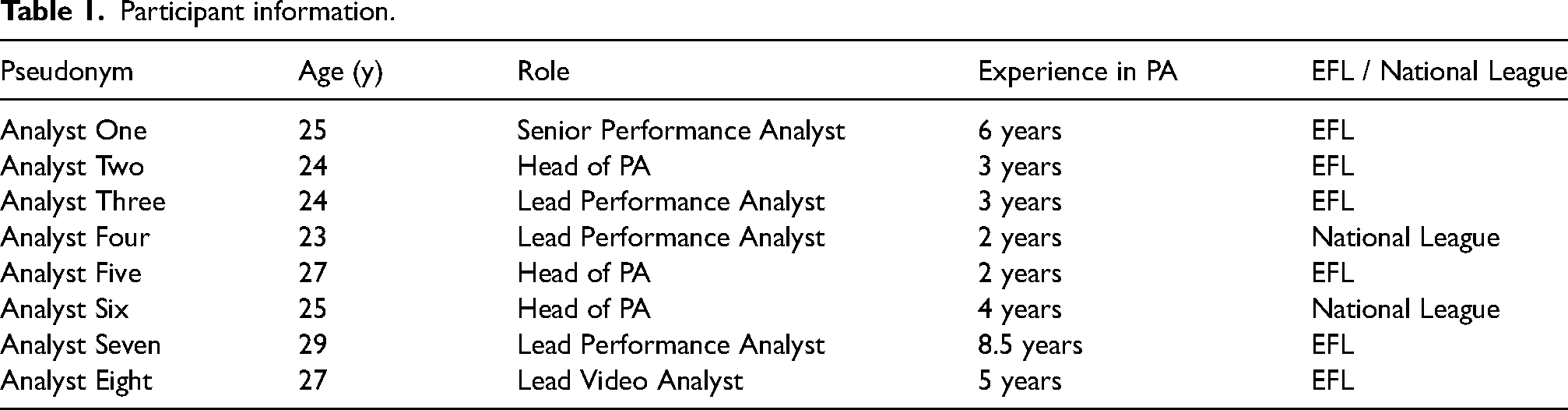
The research targeted performance analysts working in the EFL and National League. a The use of this level of participant was done to ensure the interviews reflected the opinions and experiences of individuals who had knowledge of / responsibility for the holistic process of performance analysis within a soccer team. Consequently, the analysts recruited could discuss, from their personal perspective, the use of PA by coaches during the three phases of a match-day (pre-match, post-match, and match-day). N.B. Where possible when referenced by the analyst, the coach and their role/responsibility are identified. The selection criteria involved participants a) working full-time as the lead performance analyst at their club, b) having been employed in their current role for a minimum of 12 months and c) currently working at a club in either the EFL or National League. We interviewed a total of eight male, full-time performance analysts working within the EFL (n = 6) and the National League (n = 2). Participants had (mean ± SD) 4 ± 2 years of experience (range = 2.0–8.5) working full-time as a performance analyst (see Table 1).
Participant information.
Theoretical framework
In sport, managers, coaches, players and performance analysts can be affected by individuals such as parents, budget-holders and decision-makers, and whose behaviour cannot be understood through a simple cause and effect positivist approach. 28 As a result, this research was conducted from an interpretivist viewpoint as the research focussed on investigating the experiences of the participants and their practices. This allowed the analysts every-day experiences and actions to be viewed in light of the environments in which they work.29,30 As such, interpretivism enabled greater focus on the context (including, for this research, aspects such as the club and participation level of players, coaches, and analysts) in which the participants operated and allowed detailed scrutiny of their own personal experiences and knowledge. The interpretivist approach considers reality to be a representation of the individual perspective of the participant (analyst) and how they make sense of their subjective reality and attach meaning to it. 31 Therefore, the adoption of an interpretivist approach allowed each participant within this research to discuss their own personal experiences, and for this to be seen in the light of their own context, experience, and knowledge. 32 This enabled the interpretation rather than simply the ‘measurement’ of findings.33,34
Data collection
Semi-structured interviews were used with each performance analyst interviewed by the first author once. This allowed the performance analyst to reflect on their individual experiences and opinions. The first author was trained in qualitative data collection and had experience carrying out interviews as a data collection method for research projects. Rich data were gathered using well-structured interview guides and careful active listening from the interviewer regarding both what is said and unsaid.35–37 In addition, the interviewer made a concerted effort to establish a rapport with the interviewee through ‘small-talk’, reviewing the purpose of the interview 38 at the outset of the conversation and the use of probing questions. Institutional ethics approval was obtained, and all performance analysts provided informed consent in writing. Before the interviews, pilot interviews were conducted with two performance analysts working outside of the EFL and National League to determine if the interview schedule was appropriate. The performance analysts participating in the pilot interviews worked full-time in soccer academies. No edits were made to the interview schedule; however, the transcripts were not included in the research as the analysts did not meet the inclusion criteria.
The interviews were all conducted either over the telephone (n = 3) or in person (n = 5). Phone interviews were used due to the geographically dispersed participants 39 and the availability of participants working in elite sport meaning a convenient time and location for face-to-face interviews was difficult to arrange. Within both face-to-face and phone interviews, responsiveness was displayed by techniques such as the interviewer saying ‘okay’ after answers, rephrasing the answers by stating such phrases as ‘so if I understand correctly you are saying’ and by linking the current question to the previous questions. In conjunction with these strategies, to circumvent the lack of non-verbal cues during phone interviews the researcher, where appropriate, offered a verbal response e.g., backchannelling – ‘hmm’, ‘yes’ to the interviewee's replies throughout the interview. 40
Interview guide
A semi-structured interview guide was developed by the lead author, following discussions with co-authors and in line with previous research on the use of PA in soccer. This interview guide (see appendix 1) was then used as a framework for the interview, though clarification and elaboration probes, prompts and new questions were used 41 to respond to the interviewee and explore answers as necessary. The mean duration of semi-structured interviews was 56 min (range = 51–72 min).
Questions were included at the start of the interview to build a rapport and encourage interaction between participant and interviewer (e.g., ‘How was your last game?’). Open-ended questions were used to introduce topics (e.g., ‘What methods of PA do you use in your current role?’) and then more specific questions were asked to gain detailed examples of processes, procedures, and interactions (e.g., ‘What specific things do you choose to show your players in match preparation?’).
After the opening questions focused on building a rapport and gaining demographic information of the participants (e.g., age, qualifications, experience in PA), the questions focused on four specific areas:
Pre-match use of PA. Half-time use of PA. Post-match use of PA. Opportunities and barriers to the process of PA.
Data analysis
The data analysis was completed by the first author, with some discussions taking place between the first author and co-authors to clarify the first authors thought process and to act as a sounding board for theme identification. The first author had experience conducting qualitative data analysis including the thematic analysis used in this research. A six-stage process of inductive reflective thematic analysis 42 was used to analyse the data gathered through the interviews. Directly after each interview, a post-contact recording sheet was completed to document immediate reflections and analysis of the interview. After this initial stage of reflection, the first phase of thematic analysis began. 42 The interviews were transcribed verbatim, including all verbal utterances (e.g., coughs, pauses, sighs). The second stage involved generating initial codes from the interview transcripts. All transcripts were coded line-by-line for as many potential themes and patterns as possible and these were then sorted into latent themes that identified rudimentary assumptions, thoughts, beliefs, and concepts present in the interviews 42 in stage three of the thematic analysis process. In stage four, the latent themes were re-examined by the first author and reconsidered, and then defined and given a title in stage five. Finally, in stage six, concise, coherent, and logical examples were selected from the coded transcripts to provide sufficient evidence of the themes within the data. 42 Each interviewee was provided with a copy of their interview transcript after the first stage of thematic analysis and then with a copy of the themes after the sixth stage of analysis to inform participant checks. These checks allowed interviewees to reflect on both the transcripts and themes as a true reflection of the interview and the performance analyst's personal experiences. No changes were made to either the themes or interview transcripts following the participant checks.
Results
The data analysis revealed two higher-order categories (Flying solo / Coach control) and four themes classified as lower-order (The reticent coach / PA pragmatism / Identifying indicators / Autocratic presentations). A framework of higher and lower-order themes is shown in Figure 1.
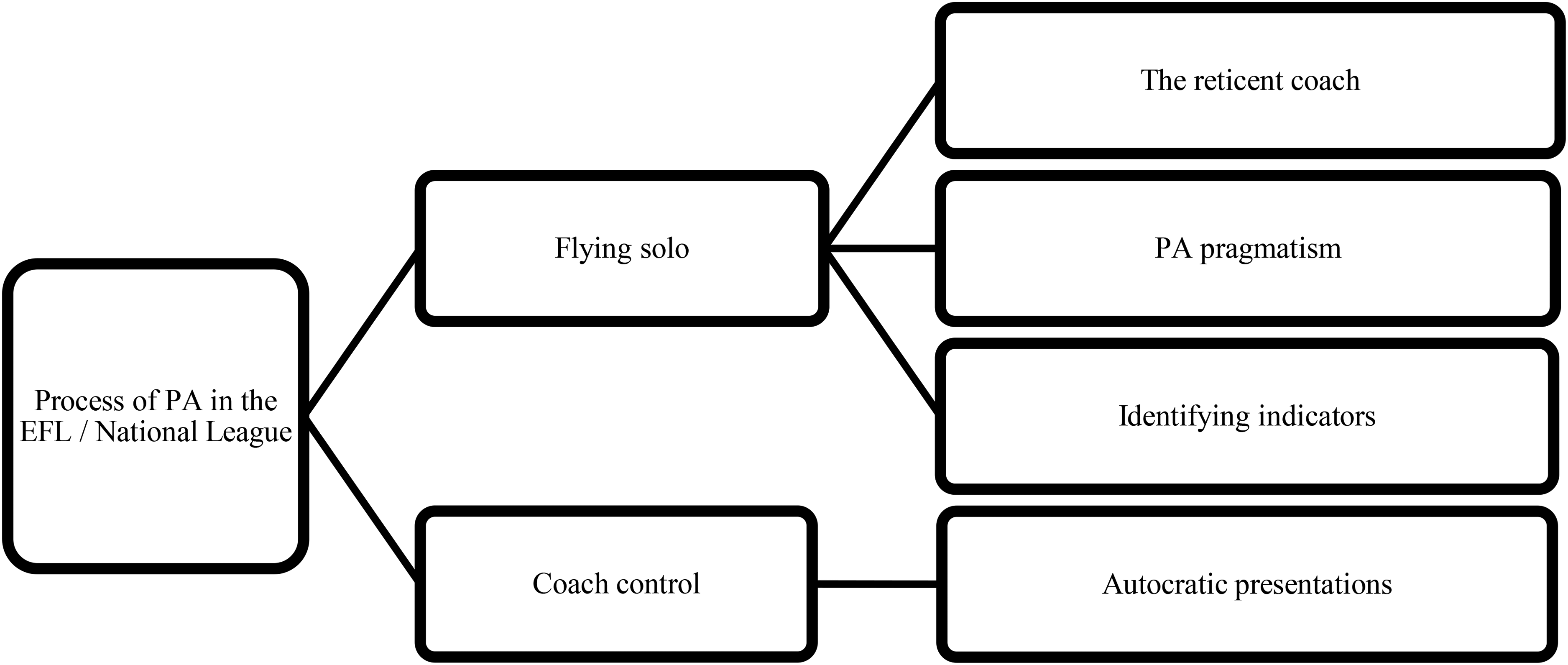
Framework comprising two higher-order themes and four lower-order themes associated with the process of PA in the EFL and National League.
The first higher-order theme, Flying solo, highlights the aspects of PA led by the analyst and the second higher-order, Coach control, scrutinises the way in which the coach leads the player-facing aspects of PA.
Flying solo
Within this theme there are three lower order themes - The reticent coach / PA pragmatism / Identifying indicators. The first lower order theme; The reticent coach, discusses the reluctance of some coaches to use PA to underpin their practice. Meanwhile the PA pragmatism theme focuses on the way performance analysts were required to experiment with different forms of PA before they discovered the types of analysis engaged in by the coach. Finally, the lower order theme Identifying indicators discusses the way in which coaches lacked involvement in the identification of the Performance Indicators (PIs) used in PA.
The reticent coach
A performance analyst is often required to make decisions regarding how and what specific performance data were collected given they often worked with coaching staff uninterested in PA. Previous research has emphasised coaches disengagement with PA may be due to a lack of knowledge, education, or time available to work with an analyst.5,14,17 However, this theme highlights that a lack of interest might also play a role. Both Analyst One and Six highlighted the lack of engagement of their coaches and felt their roles were not integrated with coaching staff. For example, Analyst One stated that: ‘He [lead coach] isn’t into it [PA] and I don’t think he's, I don’t think he knows what it all [PA] entails’. Analyst One believed the coach should take the initiative and start engaging with PA by working more closely with him to aid performance development. Such reflections emphasise the complexity of the role of the analyst 43 and the vulnerability they might experience within a soccer club.44,45 Similarly, Analyst Six focused on the negative attitude of his coach in developing the role of the performance analyst: ‘He's [coach] not really much into it [PA], so I just use what I have got already… he's got to buy in to it. There's got to be a point where he's got to start because that's the way the game's going’. This supports previous research emphasising that coaches may lack engagement with sport science due to a lack of ‘buy-in’ or a coaching philosophy reticent to use PA 46 which may then limit the amount of time and attention a coach will give a support service such as PA. 17 This lack of interest might be due to a lack of knowledge on how to use PA and embed it within their practice16,46 or that coaches might even lack an interest in using PA.
Analyst Six felt frustrated that he did not experience a working environment that was utilising PA effectively, highlighting a disconnect in the way the coach engaged in PA. Such a divide has previously been associated with novice coaches16,47; however, Analyst Six emphasises the same challenge could occur with more experienced and qualified coaches. Therefore, although PA is becoming increasingly common in soccer, not all coaches value the development of a strong working relationship with an analyst or are aware of the way in which analysis may be used by a coach.6,16,48 Paradoxically, some clubs are employing more performance analysts despite evident scepticism from some coaches. This emphasises the need for analysts to understand the organisation in which they are operating and appreciate the social-political context of the club in which they work. Such context may impact on the coaches at the club14,43,49 and how they choose to engage with the analyst and use PA.
The frequent lack of involvement or ‘buy-in’ of the coach in this process may be explained in a variety of ways, including a lack of knowledge, skill, interest or even time available to work with the analyst on a one-to-one basis.2,16,46,50 Whilst the coach may not be expected to be involved in the data gathering of PA, it could be anticipated that they may want to have input on the elements of match play that should be filmed and live coded to ensure that the analyst captures the aspects of play the coach wants to address. Similarly, if the coach has an active involvement in the focus of PA, it could facilitate more effective capture of what they require and what the coach's interpretation of subjective measures of performance are. As such, it is important to begin to understand PA may be carried out in an environment where a coach is reticent to work with an analyst and understand PA.
PA pragmatism
The performance analysts were required to adapt and change the aspects of PA that were presented to a coach to identify what the coach would engage with. The relationship between the performance analyst and coach often started with a phase of trial-and-error, where the analyst provided multiple PA outputs to the coach before refining the components of analysis pending what was used by the coach. Analyst Three stated, At the start it was ‘this is what you can have’ and now it has got to the stage where we [coach and performance analyst] just, we know what we want as such … There is no point in me sitting there and doing something for 2 h if I know it isn’t going to be used.
Identifying indicators
The analysts recognised that coaches lacked involvement in the identification of the PIs used in PA, emphasising the limited collaboration between coach and analyst in developing how analysis often takes place. This was despite the analysts believing the coaches had a desire to lead other aspects of PA (e.g., directing the content of post-match video feedback for players). Coaches would frequently pick and choose when and where they worked with an analyst and how they engaged in PA. Limited input was given by the coach regarding what constituted a PI and the development of the definitions of PIs was commonly carried out by the performance analysts alone. Analyst Eight argued, ‘It is the same every week, obviously I decide what constitutes a chance and things like that but yeah it's systematic. I just have set things that I key… generally speaking, it is the same every time’. This suggests the analyst may be seen as only a data collector by the coach. It also reveals Analyst Eight was often required to use tactical knowledge to decide the key factors of performance to be tracked, emphasising the need for analysts to have a high-level of sport specific knowledge in order to be able to work effectively in soccer. This reiterates previous research highlighting that analysts might have trouble establishing an analysis system because of the actions and knowledge of coaches. 53 This is particularly relevant given the recent advance in the use of data in sport,54,55 which means a coach could access more data than ever before. However, without a strong working relationship between coach and analyst, data may be captured by the analyst but not then be used to inform the decision making of the coach. 44 Similarly, Analyst Seven stated that matches were live-coded dependent on what he saw during a match: ‘Whilst the game is going on, I would code what I would call key level stuff… see it log it’. The notion of seeing an action take place during a match and then live-coding it indicates this was rarely agreed in advance by coach and analyst. This contrasts with Bampouras et al.(27 p. 479) who argued the analyst was a ‘hired hand’ operating under the guidance of, and in response to, the direction of the coach. Instead, the lack of coordination between coach and analyst in identifying PIs could be seen as an example of how the analyst may become isolated and/or experience vulnerability 49 if they fail to build a close relationship and trust with a coach.44,53 Analyst Six also emphasised the choice of what to code was made by him: ‘I usually live code on match days and the intern films… [What to code is] just left to me’. The lack of agreed PIs and definitions between coach and analyst could lead to the coach being provided with misguided or irrelevant data. The regular lack of collaboration also emphasised that the work of an analyst could occur in isolation 46 which may subsequently lead to segregated analytics.
The lack of input from the coach highlighted within this research is in contrast with previous research which has emphasised the active role a coach can play within PA.52,53 Furthermore, the recurrent lack of input from the coach to the performance analyst to select PIs and develop associated definitions was also mentioned by Analyst Two who stated the live coding process during a match was driven by the performance analyst: ‘I code as much as I can because you never know what they might ask for [post-match], if you know what I mean’. As such, the live coding was based on his own knowledge and not clearly decided with the coach before a match. Consequently, there could be confusion on subjective PIs such as ‘change in possession’ and ‘switch in play’ that are more subjective. As such it is possible that there may be training sessions, tactical planning and team selection decisions made on data based on differing interpretations of subjective PIs.
Coach control
The Coach Control higher order theme discusses the aspects of PA which the coach prioritised being involved in. The Autocratic presentations lower order theme highlights the aspects of PA which coaches were keen to lead (and be seen to lead by players) was pre-match and post-match presentations.
Autocratic presentations
The performance analysts often formulated the way data was collected via trial-and-error with little direction from coaches. In other instances, coaches frequently directed how the findings of PA were used, particularly with regards to the elements of PA players engage with such as presentations. This suggests the coaches with whom the analysts worked did so on a continuum from coach-controlled to analyst-controlled, depending which aspect of PA is being completed and/or when in the relationship the analysis is carried out.
Analyst Eight recognised that the opposition analysis presentations were solely focused on guidance from the coach, whilst he edited the video and compiled the slides for the coach: ‘I just download [from a database of matches available to all clubs in league] the past two or three games from who we are playing next and just clip it into, just like you do with your own games, clip it into particular instances that the [coach] wants to see’. Consequently, the performance analyst may have limited input regarding the content of the pre-match video and presentations, instead just compiling the specific example(s) the coach wants, reinforcing more of a coach-controlled context of pre-match analysis.2,16,52 Similarly, Analyst Three received a list for what was required in order to ‘put together a video’ for pre-match team meetings. He went on to say that ‘sometimes you will have some best practice at the end of the last game, [that] we have done well, sometimes it is [all] the opposition, so the video itself can last from 6 min to 11’. Similarly, the structured approach to performance review in the post-match phase of the coaching process again often involved the performance analyst responding to the coaches’ needs and compiling videos and presentations under their instruction.6,52 Analyst Three emphasised the structured approach used: After the game they [coach and assistant coach] both have their own MacBook's. They will take them home with them then on Sunday. They will watch it [the full match] back. I will watch it back Sunday morning and then sort of you are going to get a phone call at some stage during the day. They [coach and assistant coach] will speak to each other and then if there is anything that they might want [to show players] we can make sure we have that. Well, I have already clipped it during the game so by Saturday evening, Sunday morning the player clips are up. We have a thing where the players have a log in and by Sunday morning [at the] latest the player clips are up. [Pause] And usually Sunday afternoon, the gaffer [lead coach], ready for the Monday, will message me and ask me to clip certain things that he wants to show the players [in post-match presentation] on Monday.
Thus, it appears individual coaches engage with their performance analyst on a continuum depending what aspect of the analyst's role is being carried out. As such, a performance analyst might play a marginal role in the development of players,14,27,43,49,56 and often uses only limited amount of their expertise and capability. In contrast, the themes identifying indicators and the reticent coach indicate that coaches, at times, will expect their analyst to work alone with limited guidance particularly regarding the formulation of PIs and the creation of PA systems.
Performance review at half-time frequently involved the performance analyst reacting to the coaches’ need to show players specific aspects of their performance. The process of using video feedback at half-time was often sporadic and instigated by the coaches who liaised with the performance analyst during the match, usually via a radio transceiver, reinforcing the inconsistent use of PA at half-time.
16
Analyst Four described a process where, during a match, he was required by the coach to give PA feedback at half-time: I am on the walkie-talkie all the way through the half so if there is anything they [coaches] want to see at half-time then I will carry it [laptop] down with me. Generally, it is a trend that we are not doing well enough, i.e., a winger might be out of position when he is trying to pass the full back so if I can find two clips of that during the half, I will show them [coaches] that at half-time. Occasionally we will call one [player] over [at half-time] and say have a look at that but nothing where we sit them [whole squad] down and say look at this here. You don’t have time and I don’t think they would take it in, because they are that pumped up and there is that much going on. They might have had a bollocking. I don’t think they would really take it in.
Where PA was used at half-time the focus of the feedback was on match performance, however, it also included coaches requesting to see key refereeing decisions. Analyst Two highlighted that video feedback during a match may not always be used for tactical development but can be used for more contentious reasons: If I go down at half-time [to the dressing room] it's usually because there is a major incident, usually. Like a penalty or an offside … Just to clear it with them [coach and assistant coach] really so they know if the decision was right or wrong and then to be on the ref's back.
Discussion
The findings of this research suggest that a performance analyst working in soccer can experience a variety of interactions with a coach ranging from being required to act on their own initiative to responding to requests and instructions from the coach. Therefore, it is too simplistic to state that the role of the coach within PA is to act as the arbiter of analysis between the data collector (the performance analyst) and the data recipient (the player). In this respect, PA and the various tasks carried out by an analyst appear to be on a continuum from coach-controlled to analyst-controlled, dependent on what aspects of analysis are used, when the analyst and coach develop them and when in the match-play process they are carried out.
The coach-controlled aspects of PA highlighted by the analysts (e.g., post-match presentations, opposition analysis reports and half-time feedback) are perhaps unsurprising given the coach is the head of an interdisciplinary team58,59 and these aspects of PA appear more player facing than others (e.g., identification of PIs, match-day filming process). However, this potentially risks the perception, of the performance analyst being seen (by the coach) as a glorified video editor; a perception that appears to undersell the opportunities available to a coach if they engage more readily in PA.2–4 Like this research, coaches’ engagement with PA has previously been highlighted as utilising the analyst to support their personal actions/opinions 49 and coaches use of PA has been questioned as potentially being tokenistic, trend following behaviour. 17 However, this seems to downplay the potential benefits a coach could experience by working closely with a performance analyst and gaining a better understanding of PA.2–4 Despite attempts to produce lists of subjective PIs within PA in soccer, 60 this research suggests it is common for the analyst alone to identify PIs and develop operational definitions for these events. This reaffirms previous research suggesting the isolated nature of the work of performance analysts 49 and the influence this can have on the use of PA by coaches. If a coach and analyst were to work in collaboration to identify the PIs it could lead to greater clarity and less subjectivity. In addition, collaboration when formulating the types of PA to be conducted could avoid the period of trial-and-error described in this research as the analyst ‘feeling’ their way into understanding the types of analysis that will be used by the coach. Such an approach would appear consistent with previous research emphasising the need for analysts to develop trust and role clarity when working with soccer coaches. 44 It is worth noting, however, that the coach and analyst engaging in a period of trial and error could be argued to contribute to the building of trust between the two roles as they learn how to work in collaboration and what each requires of the other.
A solution to aid the development of the relationship between coach and analyst, and which could lead to the more in-depth use of PA by coaches concerns the development of a context-specific process of PA. This would mean the PA that takes place is tailored to the situation in which it is performed. In a similar manner, it has been proposed that the development and delivery of coaching CPD should consider the micro- (e.g., situated activities, location, individuals), meso- (e.g., at an institutional/club level) and macro-structures (e.g., at a systems / organisational level) that operate to influence a coach. 61 Once these have been considered, a coach education programme can become a personalised learning activity that is delivered in-situ to coaches. 61 Such a proposal could also guide the use of PA by a coach, where the various structures at a macro, micro and meso level should be scrutinised to form the basis of the context upon which PA could be developed. This would allow an individual, context, and situation-specific process to be developed addressing, amongst other factors, the individual coach and analyst working together whilst considering the club and its resources. This should lead to the clear identification of the roles and responsibilities of the analyst and the coach across the coaching process, ensuring a more organised and methodological use of PA. 20
It is important to recognise this research is not without limitations. As mentioned earlier a narrow definition of PA was used in this research and as such exploring coaches’ engagement with other PA elements such as recruitment, training, data science and motion tracking via technologies like global navigation satellite systems (GNSS) was beyond the scope of this research. While it is not anticipated that these technologies would have been used on a regular basis by the participants in this research, mainly due to the affordability and accessibility of such aspects of PA, it would be interesting to establish the coaches’ engagement with such elements. Secondly, it remains unclear if the findings observed here would be translated to performance analysts working in higher standards of soccer, e.g., the Premier League with different facilities, budgets and playing ability. The findings must therefore be generalised to other soccer and sporting environments with some caution. A further limitation is the lack of perspective from the coaches with whom the performance analysts worked. Future research might seek to interview coaches in order to develop greater detail on the context in which PA took place and rationale for their use of PA across pre-match, match-day and post-match.
Conclusion
This research presents PA as a complex process, dependent upon multiple factors if it is to be utilised more effectively within the coaching process. These findings build on several previous investigations(e.g., 2,21) contributing empirical data on the coach and performance analyst's relationship, the individuals involved in PA, the way PA data were transferred to interested parties and the responsibilities of a performance analyst when working in soccer. This research highlights the unidirectional, de-contextualised models of the PA process proposed by others(e.g., 18,19) should be used with caution. 20 Consequently, there appears to be a theory-to-practice gap insomuch as PA in competitive soccer environments is far more complex than the simplistic models presented thus far.
Further research could take an action research / case study approach. This would allow scrutiny of the context-specific process of PA ‘in-situ’ to identify how PA is conducted alongside analysis of the coach and analyst interactions. Several studies (e.g., 62,63) that have investigated the processes involved in performance enhancement and sport coaching have used ethnographic or case study approaches which have involved participant observation, interviews, and short stories. The use of participant observation of performance analysts and coaches in practice could offer additional information and provide a timely and detailed insight into the use of PA. [64,65]
Footnotes
Declaration of conflicting interests
The authors declared no potential conflicts of interest with respect to the research, authorship, and/or publication of this article.
Funding
The authors received no financial support for the research, authorship, and/or publication of this article.

Notes
Appendix 1. Semi-structured interview guide
What methods of PA do you use in your current role?
What are your roles and responsibilities pre match? How were these processes decided/developed? What specific things do you choose to show/share with your players/coaches in match preparation? Who was involved in this development process? What challenges do you experience carrying out PA pre match? How do you overcome these?
What are your roles and responsibilities on a match day? How were these processes decided/developed? What specific things do you choose to show/share with your players/coaches on a matchday? Who was involved in this development process? What challenges do you experience carrying out PA on a match day? How do you overcome these?
What are your roles and responsibilities post-match day? How were these processes decided/developed? What specific things do you choose to show/share with your players/coaches post-match? Who was involved in this development process? What challenges do you experience carrying out PA post-match? How do you overcome these?
Review of discussions – any additional information?