




Abstract
Transformational leadership in sports is generally associated with positive athlete outcomes. The Transformational Coaching Workshop was developed as a person-oriented workshop to enhance youth sport experiences. However, evidence of participants’ perceptions of the workshop and how it may be improved is lacking. This study investigated coaches' perceptions of the Transformational Coaching Workshop, its outcomes and applications, and areas for improvement. Youth handball coaches were interviewed immediately (n = 10) and 6 months (n = 5) after participating in the Transformational Coaching Workshop, and the club's sporting director was interviewed 6 months following the workshop. Interviews were recorded and transcribed verbatim, and data were analysed using a reflexive thematic analysis. Overall, the workshop was well received by the coaches, highlighting the importance of a coach development program on the interpersonal aspect of coaching, and pinpointing relevant and practical examples and interactive learning experiences as effective components of the workshop. Furthermore, the workshop made the coaches more confident in their approach to leadership and provided tools and ideas for implementing transformational leadership in their daily coaching practices. It was also perceived to lead to actual behaviour changes, including challenging the players to take more responsibilities and fostering more frequent informal interactions and counselling with them. However, to ensure the long-term sustainability of the Transformational Coaching Workshop, additional follow-up activities such as seminars, colleague observations, and club involvement were recommended. In conclusion, this study contributes to the existing literature on the potential efficacy of the Transformational Coaching Workshop while identifying areas for further improvement.
Coaches play a crucial role in shaping athletes’ sport experiences through their regular interactions with athletes. 1 However, while effective coaching requires professional knowledge and interpersonal skills when interacting with athletes, existing coach training primarily focuses on sport-specific knowledge, neglecting the interpersonal aspect of coaching. 2 Accordingly, there is an increasing recognition that more research is needed to understand coaches' interpersonal knowledge and behaviours. To address this need, coaching researchers have utilized frameworks such as self-determination theory 3 and achievement goal theory 4 to explore coaches' interpersonal behaviours (e.g. Erickson and Côté 5 and Webster et al. 6 ). Although these studies offer valuable insights into how motivational theories can impact athletes’ outcomes, there is a need to expand upon these frameworks and investigate how specific coaching leadership behaviours and interactions can influence athlete development. The Transformational Leadership (TFL) theory 7 is a well-studied framework applied in various contexts to shed light on effective leaders’ interpersonal behaviours.
Generally, evidence from the sport context, using questionnaire studies, support the positive association between perceived transformational leadership behaviour and athletes' outcomes. These include higher levels of cohesion, 8 well-being, 9 prosocial behaviour, 10 satisfaction, 11 self-regulation of learning, 12 personal and social skills, goal setting, and initiative. 13 Furthermore, the positive impact of transformational leadership behaviours has been indicated across a variety of sport contexts, including professional, 14 recreational, 15 youth, 16 adults, 17 male, 12 female, 18 and across a variety of sports (e.g. floorball, soccer, golf, and water polo and tennis9,19).
The 4 I's of transformational leadership – idealized influence, inspirational motivation, intellectual stimulation, and individualized consideration7,20 – have been further defined in the sport context through observation studies that aim to identify how coaches display transformational leadership in training and competitions. More specifically, Turnnidge and Côté 21 were the first to develop a systematic observation coding system (Coach Leadership Assessment System; CLAS) to assess coaches’ leadership behaviours. Turnnidge and Côté 21 identified behaviours related to the 4 I's of transformational leadership as well as toxic, transactional, and neutral behaviours in the sport context. As a follow-up, Lefebvre et al. 22 used the CLAS to assess coaches’ behaviours with their athletes in training and competition. While finding that most of the coach behaviours were neutral (∼ 75%), ∼ 20% of coaches’ behaviours in training and competition were transformational, with individualized consideration and inspirational motivation displayed most frequently.
As studies within the sport context have been able to identify transformational leadership behaviours that enhance coach–athlete interactions, researchers have started investigating how transformational leadership may be developed in coach education programs.23,24 The Transformational Coaching Workshop (TCW 24 ) was developed as an evidence-based, person-centred workshop for the sport context. The development of the TCW was structured around five principles of effective knowledge mobilization25,26: (1) knowing the audience and the issues, (2) identifying credible messengers, (3) creating audience-specific messages and practices, (4) selecting effective methods for conveying messages, and (5) evaluating the effectiveness of the workshop. Furthermore, the content and structure of the workshop were informed by the Behaviour Change Wheel, 27 including the Capability, Opportunity, Motivation – Behaviour model (COM-B 27 ) as an evidence-based framework for behaviour change. The COM-B model proposes that capability, opportunity, and motivation are the underlying mechanisms behind successful behaviour change. Thus, the TCW includes a variety of components (e.g. video clips of transformational coaching, stories about the 4 Is with relevant examples, and analysis of real coaching situations) designed to improve coaches’ capabilities, opportunities, and motivation to perform transformational leadership behaviours (see Turnnidge and Côté 24 for a more detailed description of the development and content of the workshop).
To date, the effectiveness of the TCW has been investigated in two studies. First, in an observational study, Lawrason et al. 23 reported the practical significance of the workshop with eight coaches observed before and after the intervention. Because of the small sample size, the authors relied on effect sizes to identify meaningful patterns of behaviour change pre- and postworkshop, even if statistical significance was not achieved. Similarly, Hummell et al. 28 concluded in favour of the effectiveness of the TCW as they identified an increase in coaches’ perception of capability and opportunity to display transformational coaching behaviours after the workshop, albeit non-significant when adjusting for multiple comparisons. While these two studies have provided some insights related to the significance of the workshop on coaches’ behaviours, an evaluation of how coaches experience and perceive the workshop's content and delivery is needed. Accordingly, the purpose of the present study was to investigate coaches’ perceptions of the TCW, the perceived outcomes and applications of the workshop, and how the TCW may be improved.
Method
Research design and philosophical position
A qualitative research design utilizing semi-structured interviews was used to examine the research question. The use of qualitative interviews is generally recognized as a beneficial methodology to collect information-rich data about informants’ perceptions and opinions of a program. 29 In fact, qualitative interviews have previously been used to examine perceptions of participating in coach development programs in general 30 and a transformational leadership development intervention with physical education teachers in particular. 31
Philosophically, the study was grounded in an interpretivist paradigm (see e.g. Moon and Blackman 32 ), informed by a relativist ontology and constructionist epistemology. The relativist ontology acknowledges that coaches’ perceptions are complex and that they may have different interpretations of the same phenomenon or experience. 33 The constructionist epistemology posits that the findings are shaped by the interaction between the researcher and the informants, 34 thus acknowledging that the researchers’ values, beliefs, and experiences shape the dynamics of the interaction and the outcomes of the research process.
Adjustments of the TCW
The content of the TCW, as described in detail by Turnnidge and Côté 24 was adapted to fit the Norwegian sport context. Specifically, to better understand the audience and the issue (Martin-Ginis et al. 26 ; principle 1), informal meetings and interviews were conducted prior to the study with coaches from the target group (i.e. coaches of youth sport athletes) and sport associations. From this process, it was recommended that the facilitator of the workshop should have practical experience working with youth sport athletes and academic expertise. To provide examples of transformational coaching behaviours from the Norwegian context, two training sessions from a Norwegian elite youth soccer team were filmed and included in the workshop. The team was strategically chosen as the coach had formal coaching competence, held a UEFA (Union of European Football Associations) B license, worked at an academic institution (PhD candidate but had no academic role in the current project), and was familiar with the concept of transformational coaching. In addition, publicly available video clips from a variety of Norwegian sports were used to replace the original coaching clips of the TCW. Also, several example stories of transformational leadership behaviours in the Norwegian context were included in the workshop. Such examples have previously been described in a youth soccer team case study that promoted participation, performance and personal development (see Erikstad et al. 35 ).
Participants
The study was registered with the Norwegian Social Science Data Services (NSD) and the ethics committee of the relevant university. A local Norwegian sport club was approached and after being informed about the study's purpose, agreed to invite their coaches to participate in the TCW and two interviews. While the club is a multi-sport club, it was decided that only handball coaches should be invited to the study due to the seasonal workload for coaches in other sports. The selection of coaches was done through purposeful sampling. The club identified coaches that represented a variety of youth handball coaches (e.g. age, gender, and experience) and further asked them if they were interested in voluntarily participating in the study. Coaches who were positive about participating (n = 14) were formally invited. This resulted in 14 coaches (8 males, 6 females) who participated in the workshop and the subsequent interviews. All coached athletes 13–19 years of age. The coaches were, on average, 42.2 (SD = 8.8) years old, had coached the team for a mean of 5.0 years (SD = 3.1), and had, on average, 19.6 (SD = 3.6) players on their team.
In addition, the club's sporting director was invited and agreed to attend the TCW and a follow-up interview. The sporting director, a middle-aged individual, possessed prior coaching experience spanning both elite and recreational levels within the handball domain. Out of the 14 coaches who took part in the TCW, four were unavailable for an immediate interview after the workshop, and an additional five were unavailable for interviews six months later. The coaches who were unavailable for interviews cited various reasons such as work-related travel. No discernible patterns or characteristics, such as age or experience, were evident among the coaches who could not be interviewed. All informants gave their written informed consent prior to data collection.
Procedures
Coaches participated in the workshop on a weekday at the beginning of the handball season. The TCW was conducted on two separate days because of the coaches’ schedules, with six coaches participating on day one, and the remaining eight coaches participating on day two. The workshop was delivered as outlined by Turnnidge and Côté 24 with the abovementioned adjustments and lasted ∼ 4 hours on both occasions. The main workshop facilitator had academic expertise, evidenced by a relevant PhD and scholarly publications on the topic. Additionally, they brought over a decade of athletic experience, notably in elite youth soccer, alongside about ten years of coaching experience, including elite youth soccer. Moreover, this individual had undergone training in delivering the TCW, which was critically assessed based on two pilot workshops, the second being recorded on video. The workshop was conducted with one teaching assistant (i.e. grad student) who had previously attended and received training by the research group in delivering the workshop. The primary responsibility of the main facilitator and assistant was centred on guiding and facilitating group discussions throughout the sessions.
Data collection
After the participants had taken part in TCW, interviews were conducted at two-time points. The first interview (n = 10) was conducted 5–7 days after the workshop and aimed to investigate coaches` immediate perceptions of the workshop, including how they perceived the workshop influenced their capabilities, opportunity, and motivation (see Michie et al. 27 ) to use transformational coaching behaviours, and suggestions for improvements. Thus, the interview guide was designed to focus on three main sections: (1) impressions of the workshop, (2) the outcomes and applications of the workshop, and (3) suggestions for improvements. For instance, the first section asked, ‘Can you first tell me what you thought about the workshop you attended?’ The second interview (n = 5) was conducted 6 months after participating in the workshop and involved the same three sections with an overall aim to understand perceptions of the workshop over time. For instance, it was asked, ‘It's been about 6 months since you attended the workshop on transformational leadership. Looking back, could you share your thoughts on the workshop now that some time has passed?’ In addition, the club's sporting director was interviewed at the 6-month follow-up to grasp the club's perspective on having the coaches participate in the workshop. Thus, 16 interviews were conducted, lasting, on average, 53 minutes. The interviews were conducted by two members of the research team with previous experience in the role. However, the workshop facilitators were not part of the interview process. The informants had the opportunity to read the transcripts of the interviews, but none chose to do so.
Data analysis
The interviews were audio recorded and transcribed verbatim. Data were analyzed using a reflexive thematic analysis.36,37 The reflexive thematic analysis consists of six phases: (1) familiarization, (2) coding, (3) generating initial themes, (4) developing and reviewing themes, (5) refining, defining, and naming themes, and (6) writing up. During the first phase, the first author listened to all audio and read and reread the transcribed documents. Initial analytic observations were noted (e.g. interesting quotes and ideas for themes). For stages 2–4, topics, codes, and themes were identified through a combined deductive and inductive approach. Three topics were deductively created following the interview guide and aim of the study: (1) impressions of the workshop, (2) outcomes and applications of the workshop, and (3) suggestions for improvements. Under each topic, codes and themes were identified through an inductive approach to best represent meaning as communicated by the participants. The codes and themes developed held significance to the research and conveyed a sense of meaning but were not determined by their frequency of appearance. 36 Acknowledging the subjectivity of the researcher in the analytic process, findings, and themes were discussed in the research group to reflect upon the coding (see Braun and Clarke37,38). In the fifth phase, themes were named to capture the essence of the content. Finally, the themes were presented in the present manuscript in the final phase of the analysis. To ensure the anonymity of the informants, team names, places, and names of individuals have been removed or changed with pseudonyms. As the interviews were conducted in Norwegian, all the quotes presented have been translated as accurately as possible.
Methodological rigour
The interpretive stance of this paper recognizes the inherent subjectivity in the investigation of reality. 32 However, strategies were used throughout the research process to contribute to the credibility and trustworthiness of the findings. Purposefully selected informants contributed to collecting rich and credible data from individual experiences, ensuring authenticity. Moreover, care was taken to ensure that the analysis remained rooted in the authentic voices of the study's informants. The research team, having prior experience in transformational coaching studies, was aware of the potential impact of their background. To recognize these influences, they engaged in regular critical discussions (i.e. ‘critical friends’ 39 ) with other team members. These discussions fostered reflexivity and ensured that the interpretations of the findings were grounded, reasonable, and consistently aligned with the study's objectives and data. Overall, implementing these strategies laid the groundwork for a rigorous methodological framework, enabling a nuanced investigation of the dynamics between researchers and data and enhancing the trustworthiness of the research process.
Results
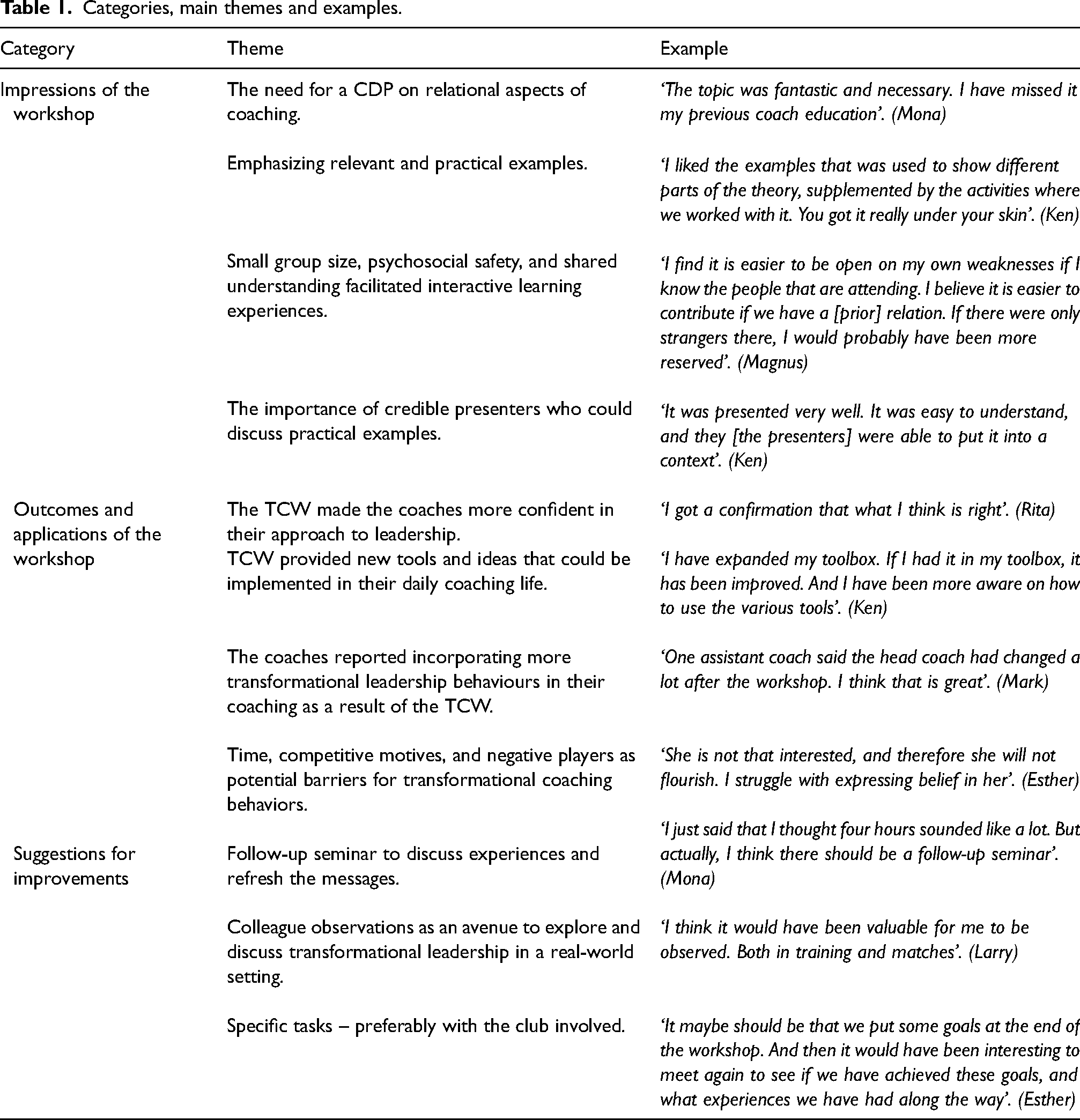
The interviews captured a broad range of the coaches’ backgrounds and experiences of the workshop. Notably, all coaches reported investing much time in coaching their team – typically exceeding 10 h weekly in total, pinpointing that much of their involvement with the team was outside of the organized practice hours (e.g. planning, team management, and matches). The themes that were developed are presented under the three topics: (1) impressions of the workshop, (2) outcomes and applications of the workshop, and (3) suggestions for improvements (see Table 1 for an overview of topics, main themes, and examples).
Categories, main themes and examples.
Impressions of the workshop
The coaches all had positive things to say about the workshop, with comments like ‘It was fantastic’ (Mona) and ‘I'm normally pretty good at being critical, but this was good’ (Rita). They also described that the workshop became a topic of conversation between the coaches after the workshop: ‘It became a talking point among the coaches that had participated. All were very fond of the course and were glad they were invited’ (Magnus). The participants’ experiences of the workshop resulted in four themes.
The need for a coach development program on relational aspects of coaching
Through the interviews, it was understood that all coaches acknowledged the importance of positive coach–athlete interactions and considered transformational leadership an appropriate framework to guide coach development in youth sport. Mona said that ‘The topic was fantastic and necessary. I have missed it in my previous coach education’. Several coaches noted that they were former players who had personally experienced how their coach's leadership style impacted them positively and negatively. For instance, their adverse encounters involve criticism and shouting from their coach. With such experiences in mind, they identified that other coach education programs had not adequately addressed the importance of interpersonal skills in coaching. ‘Other courses have more focus on drills, and the different phases in the game. There is much less emphasis in how to lead’ (Ken). Thus, it was evident that they felt a need for coach development programs focusing on interpersonal aspects of coaching as a supplement to other coaching courses (focusing on professional knowledge).
Emphasizing relevant and practical examples
The interviews revealed that the activities, stories, and examples provided in the workshop were perceived as useful for understanding transformational coaching behaviors, reflecting on practices, and discussing behaviours and solutions that facilitate positive athlete outcomes. Ken commented, I liked the examples that were used to show different parts of the theory, supplemented by the activities where we worked with it. You got it really under your skin, and understand that you have to work with these things.
Specifically, the stories of a successful youth sport coach were highlighted as influential because they provided clear examples of transformational leadership behaviors and demonstrated how these behaviors could lead to positive outcomes for athletes. The coaches appreciated that the examples were from a variety of youth sport contexts but also included examples from their sport (i.e. handball). They also found it valuable to discuss video examples of various leadership styles, both positive and negative, to reflect on the impact of coaching behavior and consider alternative approaches to problem-solving. ‘The power of example is also when you see negative behaviours, and how that can destroy an athlete’ (Larry).
Small group size, psychosocial safety, and shared understanding facilitated interactive learning experiences
The informants highlighted the interactive nature of the workshop as an enjoyable and effective learning method. For instance, Ken emphasized this point, stating, ‘Most importantly, we were allowed to discuss between us coaches. Put it into our daily context. And also engaging in discussions with the lecturer. That interaction is, for me, the best part of it’. However, several coaches highlighted that the composition of the groups is crucial for creating open and informative interactions, and appreciated being in a small group with coaches they were somewhat familiar with (i.e. from the same club, similar age cohorts, and same sport). Magnus illustrated this point by saying: I find it is easier to be open on my own weaknesses if I know the people that are attending. I believe it is easier to contribute if we have a [prior] relation. If there were only strangers there, I would probably have been more reserved.
Nevertheless, they believed that diversity of experiences within the group was useful to enhance the learning experience, but the differences should not be too significant in terms of the coaching context (e.g. age of athletes and competitive level).
The importance of credible facilitators that could discuss practical examples
It was also evident that the workshop facilitators were important for communicating the message effectively. Theoretical expertise, pedagogical competence, and ability to discuss practical examples were highlighted as key elements of the successful delivery of the workshop. For instance, Ken said: It was presented very well. It was easy to understand, and they [the facilitators] were able to put it into a context. (…) My impression was that he [main facilitator] had academic weight, as well as he had the practical approach – because he has that practical experience – that made it a good mix.
Outcomes and applications of the workshop
Through the interviews, it was evident that the workshop was perceived as useful by the coaches in multiple ways and that they implemented transformational coaching behaviours as a result of the workshop. However, the coaches also identified barriers that made it more difficult to engage in transformational coaching behaviors.
The TCW made the coaches more confident in their approach to leadership
Generally, the coaches experienced that their leadership style aligned with the principles of transformational leadership, contrary to the more toxic leadership behaviours displayed by some of their colleagues who chose not to participate. Nevertheless, the workshop served as a reminder of the importance of interpersonal relationships and increased their motivation to continue nurturing positive coach-athlete relations. ‘Everybody I talked to said they learned something’ (Magnus). Rita shared a story of a conflict she had with a fellow coach who believed that yelling at the players was necessary to motivate them, and the workshop boosted her confidence in opposing this approach: I got a confirmation that what I think is right. Like someone I coached with earlier, they yelled at the girls. ‘We have to be clear, and they have to put up with it. It was always like that when I played – we got a clear message’. (…) We have had those discussions. Where I stand on the side and say that they must rather focus on what is good. I have been part of those discussions, and feel that here I get confirmation that what I have argued for has been right.
TCW provided new tools and ideas that could be implemented in their daily coaching life
The workshop provided the coaches with tools and ideas for implementing transformational coaching, as illustrated by Ken who stated, ‘I have expanded my toolbox. If I had it in my toolbox, it has been improved. And I have been more aware on how to use the various tools. And the effect they have’. Furthermore, the coaches highlighted that the examples presented during the workshop offered practical and transferrable knowledge they could include in their coaching. ‘I was pleasantly surprised by the number of examples that I could take with me directly into the coaching job’ (Larry). Moreover, coaches acknowledged that the workshop had prepared them to handle issues that may occur in their everyday coaching. For instance, Larry said; ‘I have found myself in several situations where I have noticed that this is something I have prepared for. I have thought this through in another way than before [participating in the workshop]’. He elaborated by noting a shift in his interactions, placing more importance on understanding his athletes' concerns when they approach him, leading to a humbler approach in his relationships with the athletes.
The coaches reported incorporating more transformational leadership behaviours in their coaching as a result of the TCW
At the first interview, all coaches identified transformational coaching behaviours they wanted to improve, including being more aware of their own body language, involving athletes in decision-making, focusing on positives rather than negatives, and building stronger relationships with athletes. The follow-up interviews revealed that the workshop had resulted in actual changes in these behaviors. For example, the sporting director reported that other coaches had noticed a significant change in one of the coaches’ leadership styles after the workshop, from being ‘authorative, loud and angry’, to aligning more with the principles of transformational leadership (e.g. more understanding and pro-social in interactions with athletes). ‘One assistant coach said the head coach had changed a lot after the workshop. I think that is great’ (Mark). Similarly, the coaches interviewed reported multiple changes or adjustments after the workshop, including challenging the players to take more responsibilities, acknowledging the contributions for each athlete, and admitting mistakes.
Challenging the players to take more responsibilities and reflect upon their game
Following the workshop, coaches reported that they increasingly encouraged athletes to take on more responsibility in both training and competitions. More specifically, coaches challenged players to lead parts of the training session, reflecting on the content of the training sessions, reflecting on how situations may be solved differently, and be responsible for time-outs. Magnus reflected upon the effect of starting to let the players take responsibility of the timeout: I think it is amazing, 2-3 players are now active. And they say things that are obvious, such as effort and running back to the defense. But they say it instead of the coach. Then my job is to reinforce them. I think that is great.
However, it was noted that professional knowledge is important in recognizing opportunities and asking relevant questions. For instance, Larry said: ‘It is about stopping the play at the right time. “In this situation, what do you think is a good move?” I think a background as a player, and to have professional knowledge, contributes to asking the right questions’.
Enhancing positive coach–athlete relationships through individualized coaching
The coaches said they became increasingly aware of the importance of positive coach–athlete relationships and what they could do to enhance them. Greeting the players by name, asking about their life outsidesport, and adjusting their coaching to athletes’ needs were examples of initiatives to facilitate positive coach–athlete relationships. They also highlighted that the workshop made them identify how small things that may have a big impact on players can be implemented in their coaching. For instance, Larry said at follow-up: I have become better at sending an SMS or message of some sort to the boys if there have been minor issues. (,,,) That has been a direct result of participating in the workshop – I have realized that those small things can mean a lot.
Influencing athletes through appropriate role modelling
The coaches said they were increasingly aware of how they shape athletes’ sport experience through the example they set. For instance, Patrick said he became more aware of his own attitudes towards training, and joins the players for physical training. It may also be the only opportunity I have to train myself. At the same time, they see that I also have to work hard on the last laps. And I can understand them better. I did that previously too, but now I understand the importance of it. That I don’t just stand and say what they’re supposed to do, but that I join them in strength training, circle training or stretch-outs, and set a good example.
Another coach shared an incident where he got frustrated at a player during a match and substituted the player off and yelled at the player. After the match, he privately apologized to the player, and highlighted the importance of being vulnerable. ‘If you look away from the fact that I still feel bad about it, I believe it is positive for the players to see that the coach is a human that makes mistakes’ (Magnus).
Time, competitive motives and negative players as potential barriers for transformational coaching behaviors
The coaches outlined some of the main reasons that inhibit them from engaging in transformational coaching behaviours, including lack of time, disinterested/negative players, and the desire to win matches. Indeed, the coaches noted that transformational coaching behaviours may require more time, which presents challenges considering their commitments to their professional roles and their personal lives. Elinor exemplified this point: ‘I have a job where I work days and evenings, and sometimes weekends too. So it doesn’t always add up’. Similarly, Rita said, ‘It is the time issue. How much time should we allocate to this (i.e. the coaching role)? You need to prioritize. Maybe, I need to take it from my spare time. The workshop made me think that it is worth it’.
Furthermore, the coaches said transformational coaching behaviours are more difficult to exhibit when interacting with negative or disinterested players. For instance, Larry said, ‘You are also driven by results, no doubt about it’. Magnus also shared from earlier experiences about a group where the coach felt the players needed to be ‘whipped’ to perform and exhibit effort, and that such behaviors do not align with transformational leadership. Esther also talked about her challenges with a player; ‘She is not that interested, and therefore she will not flourish. I struggle with expressing belief in her’.
Suggestions for improvements
The interviews revealed a successful transfer of the key messages of the workshop, yet additional follow-up activities were recommended to ensure the effectiveness of the workshop. Coaches reflected on past coach development programs, noting that while some had short-term effects, the effect often faded over time. Larry exemplified this by stating: I think that some follow-up after a few months would have been useful to work with it and keeping it fresh. So that it does not disappear, like very many courses do – where the techniques are used only for the first three weeks.
Similarly, Elinor said ‘I think that for many people, everyday life comes and then it (lessons learned from the TCW) disappears a little’. The coaches discussed several ways such follow-up could be implemented, including a follow-up seminar, colleague observations, and club-based follow-up activities with specific tasks.
Follow-up seminar to discuss experiences and refresh the messages
Due to the perceived importance of transformational leadership and the positive perceptions of the workshop, a follow-up seminar was perceived as an avenue to refresh the key messages of the workshop. ‘I just said that I thought four hours sounded like a lot. But actually, I think there should be a follow-up seminar’ (Mona). Also, it was highlighted that it would be useful for the coaches to gather and discuss their experiences with implementing transformational coaching behaviors in their everyday coaching.
Colleague observations as an avenue to explore and discuss transformational leadership in a real-world setting
Several coaches suggested colleague observations as a potential follow-up initiative. ‘I think it would have been valuable for me to be observed. Both in training and matches’ (Larry). Coaches believed that observing and being observed could help them practice and build confidence in using transformational leadership behaviours, discuss their experiences, and reinforce the newly acquired skills and knowledge. Colleague observations were estimated to be particularly relevant because the coaches were from the same club, creating the potential for a supportive and collaborative coaching culture centered around transformational coaching.
Specific tasks – Preferably with the club involved
Finally, it was suggested that the coaches could be assigned specific tasks to work with after the workshop. As an example, Ken said, ‘It would be natural that you get kind of homework based on the topics you had that evening. Then we could work on it for a period of 2–3 weeks, before coming together and discussing it’. Esther also identified goal-setting as a potential task: ‘It may be that we put some goals at the end of the workshop. And then it would been interesting to meet again to see if we achieved these goals, and what experiences we have had along the way’. However, the coaches acknowledged that such suggestions would be time-consuming and that the responsibility for such follow-up should be at the club-level for it to be practically feasible.
Discussion
Grounded in transformational leadership theory, the TCW was developed as a person-oriented coach development program to enhance youth`s sport experiences. 24 While previous studies have investigated the effect of the workshop using observational 23 and quantitative methods, 28 the present study investigated coaches’ perceptions of the TCW through qualitative interviews, including perceived outcomes and applications, and potential areas for improvement. The main findings indicate that the workshop was well-received by Norwegian youth handball coaches and provided them with tools and ideas to motivate and enable them to put transformational leadership behaviors into practice. However, coaches noted that the effects of the isolated workshop may be limited over time, highlighting the need for additional follow-up. Overall, this study adds to the literature highlighting the TCW as an avenue to improve coaches’ leadership behaviors.23,28
The coaches highlighted that the workshop provided them with knowledge and tools for implementing transformational leadership, resulting in a positive change in their perception of capability, opportunity, and motivation 27 to employ these behaviours in their coaching practices. The results are in line with a recent study by Hummel and colleagues, 28 where coaches who participated in the TCW reported higher levels of perceived capability and opportunity to utilize transformational coaching behaviors compared to a control group that did not attend the workshop. The coaches in the present study highlighted that the activities of the TCW, such as stories, video clips, goal setting, and planning diary (see Turnnidge and Côté 24 ), contributed to this change. As these activities were included in the workshop after a careful process informed by behaviour-change theory 27 and principles for effective knowledge mobilization,25,26 the study highlights the potential benefit of using an evidence-based approach in developing coach education programs. Also, the coaches enjoyed the interactive nature of the workshop; thus, this study adds to the increasing body of evidence that interactive, collaborative learning environments are more enjoyable and enhance the overall learning experience. 40 As the coaches highlighted that being in an environment with coaches they were familiar with (i.e. coaches in the same club) facilitated the discussions, the composition and organization of workshop participants seem important for adaptive interactions. This is underpinned by evidence highlighting that feeling psychologically safe can increase reflection and make individuals more open-minded and willing to share. 41
With regard to workshop engagement, coaches in the present study expressed that transformational coaching aligned well with their existing beliefs. However, their participation in the workshop further enhanced their confidence in applying this leadership style. It is worth noting that the coaches in the present study said that other colleagues with more toxic leadership styles chose not to participate in the workshop. Similarly, Hummel et al. 28 discussed a potential ceiling effect for motivation among coaches who participated in their study. Therefore, it is crucial for the TCW to recruit coaches representing various leadership styles to ensure the workshop's influence extends beyond coaches who already embrace its key messages. Given the diversity among participants, this would also provide an opportunity for a more comprehensive understanding of the workshop's impact.
Further, and in line with the COM-B model that proposes that capabilities, opportunities and motivation are the underlying components behind behaviour change, 27 participating coaches reported actual change in their behaviours as a result of the workshop. These results contribute to the growing evidence that one-time transformational leadership interventions can be effective at changing leaders’ behaviours in diverse populations, including organizational leaders, 42 physical education teachers, 31 and youth sport coaches.23,43 More specifically, intellectual stimulation behaviours (e.g. challenging the players to take responsibility and reflect upon their game) emerged in this study as the transformational leadership behaviour coaches found most straightforward to implement. Similarly, Lawrason et al. 23 found a medium to large effect size for the increase in intellectual stimulation behaviours in coaches after participating in the TCW, and increased levels of intellectual stimulation among intervention coaches were also identified in the study by Vella et al. 43
However, it was noted that the behaviours aligning with intellectual stimulation (e.g. asking players to reflect upon their game in specific situations) may require specialized expertise, including knowing when to pause play to emphasize a potential learning opportunity and what questions to ask to be executed effectively. Empirical evidence supports the idea that effective leadership and coaching are not solely defined by transformational qualities but also include a foundation of instrumental leadership or professional knowledge and behaviours.44,45 Moreover, researchers have previously found that coaches continued using high levels of prescriptive instruction despite the intention to display more intellectual stimulation behaviours (e.g. being a ‘facilitator of knowledge creation’ 46 ). Such findings highlight the challenge of identifying and incorporating opportunities to exhibit intellectual stimulation behaviours as domain-specific content is delivered.
Despite positive perceptions of the TCW, the informants highlighted that follow-up activities were recommended to ensure the workshop's effectiveness, adaptation, and implementation. Indeed, evidence suggests that brief interventions may improve short-term behaviours, while maintaining long-term behaviour change is more challenging. 47 As behaviour change often has small effects that are typically not sustained over time, it is suggested that behaviour change interventions target multiple levels within systems to sustain their impact over time. 48 That may indicate that behaviour change in a sporting context is more likely if interventions target the individual coach and the environment surrounding the coach (e.g. other coaches in the club, and club representatives and values). Therefore, it is suggested that coach development programs, including the TCW, collaborate closely with clubs, regional bodies, and national coaching organizations to integrate the tenets of transformational coaching into their overarching coaching philosophies.
In a broader picture, the present study highlights the TCW as an avenue to improve coaches’ interpersonal skills, which is important given the positive impact of transformational leadership on athletes’ positive experiences in sport.12,14 Unlike traditional coach development programs that prioritize technical and tactical skills, providing practice plans and drill sheets while neglecting interpersonal aspects, 2 TCW addresses this crucial gap, as corroborated by the coaches’ insights in this study. Thus, coaches who undergo the TCW may be better prepared to foster healthier athlete-coach relationships, positively influencing athletes’ motivation, satisfaction, and overall performance. Nevertheless, it is essential to acknowledge that various leadership frameworks, like identity leadership, 49 yield positive athlete outcomes. Although transformational leadership shares conceptual overlap with other leadership theories, 50 these frameworks may also benefit other coach development programs.
Methodological considerations
The present study investigated coaches’ perceptions of participating in the TCW, thus adding to existing research using observational (Lawrason et al. 23 ) and quantitative 28 study designs. The qualitative approach allows insight into how coaches perceive the value of the workshop and how it may be improved, which is important as researchers have emphasized the significance of understanding the perceived usefulness from the perspective of intended users and identifying opportunities for program enhancement in program evaluations.51,52 Nevertheless, it is important to consider limitations when interpreting the findings.
First, qualitative studies are subject to potential social desirability biases where participants may respond in a way that they believe is socially acceptable or desirable, potentially influencing the accuracy and reliability of the findings. Second, transformational leadership is generally perceived as beneficial because of its potential positive effect on athletes. Thus, it is important to acknowledge that the study addressed coaches’ perceptions of the effect of the workshop, and little is known about whether the workshop led to positive athlete outcomes. Finally, the informants were a small group of youth handball coaches who coached athletes of mixed skills, motives, and ambitions. How the workshop is perceived by other coaches within the target group of the TCW (e.g. coaches for elite youth sports and/or individual athletes) remains uncertain.
Conclusions
In conclusion, the present study adds to the literature on the potential effectiveness of the TCW, thus indicating the value of an evidence-based intervention on the interpersonal aspects of coaches. The workshop was thereby found to be a valuable supplement to traditional, more professional, knowledge-oriented courses. Furthermore, the study highlights potential areas for improvement of the TCW, particularly relating to additional follow-up activities (e.g. a follow-up seminar or specific tasks that the club follows up on) to ensure the workshop's effectiveness over time. Furthermore, further investigation across various youth sport contexts may be warranted to better understand the workshop's effect and how it may be improved.
Footnotes
Declaration of conflicting interests
The author(s) declared no potential conflicts of interest with respect to the research, authorship, and/or publication of this article.
Funding
The author(s) received no financial support for the research, authorship, and/or publication of this article.
