




Abstract
The objective of the study was to examine the match-running load of female soccer players competing at distinct age groups (U15, U18 and senior cohorts) belonging to the same professional club, over a competitive season. The external load variables of the official matches were monitored with Global Positioning System (GPS) technology: total distance (TD), at >18 km·h−1 (running), at >21 km·h−1 (high-speed running, HSR) and at >24 km·h−1 (sprint, SPR) distances, efforts at >85% of the maximal sprint speed (>85% MSS), acceleration load (aLoaD), accelerations (ACC2 and ACC3, >2 and >3 m·s−2) and decelerations (DEC2 and DEC3 <−2 and <−3 m·s−2). Overall, distances covered at running, HSR and sprinting were greater for senior players than their younger peers (U15 and U18; p < 0.05). Regarding HSR and sprints, no difference was found for sprints accumulated by central defender (CD) players in comparison to U18 and U15 (p > 0.05). In addition, U18 and senior players engaged more often in ACC and DEC, >2 and >3 m·s−2, respectively, than U15 players (p < 0.05). In conclusion, older female soccer players are exposed to higher match load than their younger peers. These findings could be useful for soccer coaches to design specific speed development programmes across the long-term athletic development pathway.
Introduction
In recent decades, worldwide participation in women's soccer has increased dramatically, ratified by recent data from a FIFA (Fédération Internationale de Football Association) survey reports of more than three million registered female youth players (<18 years old) and approximately one million adult players; furthermore to support women's football, FIFA has launched a development programme aiming to increase the number of young and adult female players to 60 million by 2026. 1 This growing popularity of women's soccer, evidenced by increasing financial support and participation rates, has stimulated sports scientists to comprehensively investigate running demands during matches2–6 and training sessions.7,8 However, despite this popularity on women's soccer, an evident gap remains in the literature. Specifically, there is a discrepancy when comparing the match-related physical demands between male and female soccer players,9,10 especially regarding the running patterns completed by academy female soccer players.
Electronic Performance Tracking Systems (EPTS) have become an essential tool for soccer coaches, with the Global Positioning System (GPS) being the most commonly used, likely due to their user-friendly nature, allowing coaches to effectively quantify the physical workload accumulated by players during matches.11,12 Comprehensive data on match-related running and acceleration (ACC) activities can be used by soccer coaches to benchmark the players’ game requirements. This data can support decisions for programming training workload within the microcycle according to the physical demands of each player during in-season matches.13,14 While the integration of this technology for monitoring external load demands is widespread in professional soccer, its application in youth soccer matches remains limited. 15 This limitation may be attributed to the high cost associated with GPS technology, which could potentially hinder its availability for certain clubs aiming to monitor running demands in academy soccer matches. 16 Consequently, little is known about differences in match-related physical demands between elite senior and youth female soccer players from the same club. Utilizing teams from the same professional club offers an advantageous approach by mitigating the potential bias of comparing teams belonging to different contexts, cultures, habits, training methodology and playing styles. By limiting the influence of external factors, this study can focus on the differences that exist in the demands of competition between different age categories.
Analysing match physical load between elite senior and youth female players may be helpful for soccer coaches to ascertain when youth players can achieve volumes (i.e. total distances) and intensities (i.e. distances covered at fixed speed thresholds) comparable to those in adult soccer matches. 12 This is particularly important because youth players (U15 and U18) need to be physically fit to progress through different age categories and competitive levels. 16 For example, Ramos et al. 11 demonstrated a progressive increase in high-intensity activities (i.e. HSR and sprints) and total number of ACCs (>1 m s−2) and decelerations (DCCs, <−1 m s−2) in female soccer players representing the national Brazilian teams (senior > U20 > U17). Similarly, Kobal et al. 17 conducted a study that quantified the match-running demands in a high-level female academy over one season during the national Brazilian championship. Overall, the authors reported that senior players engaged more often in high-intensity activities such as top speed, sprints, number of ACCs (>3 m s−2) and DCCs (<−3 m s−2) compared to U20 and U17 age groups. These studies represent a critical contribution to the limited body of research in this field, shedding light on the evolving physical demands experienced by female soccer players from academy to senior team squads.
Nevertheless, the current literature on the physical demands of female soccer matches within elite academy squads is primarily derived from Brazilian competitions.11,17 To broaden our understanding, it is important to investigate match data from different countries and leagues. This approach is relevant for soccer coaches seeking to improve their knowledge of long-term physical development, as differences in cultural playing style and game schedules may lead to distinct match-related physical demands.15,18 In this regard, the aim of this study was to quantify and compare the match-play running loads of youth (U15 and U18) and senior elite female soccer players from a Spanish LaLigaF club over a full competitive season.
Methods
Participants
Forty-two players from different age categories of the same professional Spanish club, senior team (n = 18; age, 22.7 years old; stature, 169.4 cm; body mass, 64.2 kg), U18 team (n = 18; age, 18.4 years old; stature, 164.3 cm; body mass, 58.6 kg) and U15 team (n = 16; age, 15.7 years old; stature, 162.2 cm; body mass, 54.0 kg), were included in this study. The referred professional team was playing in the Spanish Women's First Division (LaLigaF). Players also were categorized based on positional groups: fullback (FB = 10; senior = 4; U18 = 3; U15 = 3), central defender (CD = 10; senior = 4; U18 = 3; U15 = 3), central midfielder (CM = 5; senior = 2; U18 = 2; U15 = 1), wide midfielder (WM = 16; senior = 4; U18 = 4; U15 = 8) and forward (FW, n = 11; senior = 4; U18 = 6; U15 = 1).
The senior team performed five field-based sessions (90 minutes each session), three strength/conditioning session (40 minutes each session) and one official game per week. Under-18 team performed four field-based sessions (90 minutes each session), three strength/conditioning sessions (30 minutes each session) and one official game per week. Under-15 team performed three field-based sessions (75 minutes each session), one strength/conditioning session (45 minutes) and one official game per week. Data were collected as part of the daily professional team routines across the season. Thus, no authorization was required from an institutional ethics committee. 19 Nevertheless, this study followed the Declaration of Helsinki and players provided informed consent before participating, and the identities of the players were anonymized.
Measures
All external load demands were monitored using GPS units. A total of 10 GPS-derived external match load variables have been measured during the official matches. The variables analysed were the total distance (TD, m), running distance (running: >18 km·h−1, m), high-speed running distance (HSR: >21 km·h−1, m), sprinting distance (sprinting: >24 km·h−1, m), efforts at >85% of the maximal sprint speed (>85% MSS, counts), acceleration load (ACCLoad, au), ACCs and DCCs >2 m·s−2 (ACC > 2 m·s−2, counts; DEC < −2 m·s−2, counts) and ACCs and DCCs >3 m·s−2 (ACC > 3 m·s−2, counts; DEC < −3 m·s−2, counts). The dimensions of speed, ACC and load are common for describing conditional demand in women's competitive matches. 6
The ACC load is a variable calculated where all ACCs and DECs were made to be positive, and this variable provided an indication of the total ACC requirements of the athlete, irrespective of velocity. Previous research studies have shown an inter-unit coefficient of variation of 2% to 3%, 20 and these are lower than typically seen between devices using the traditional effort detection-based approach to ACC assessment. 20
Procedures
The study was conducted in the 2021–2022 competitive season. The external match load was collected using GPS devices (WIMU PRO, RealTrack Systems, Almería, Spain). Players wore a GPS device from the beginning of the warm-up until the end of the match. The GPS device was fitted to the upper back (i.e. between the shoulder blades) of each player using an adjustable neoprene harness. After each game, the data were extracted to a computer and analysed using SPRO software V.980.
The GPS devices utilized in this investigation function at a frequency of 10 Hz and are compatible with both the Galileo and American satellite constellations, a feature that appears to offer enhanced precision. 21 Data collection occurred in outdoor soccer fields, ensuring an uninterrupted acquisition process devoid of any infrastructure-related interference. Throughout the matches, an average of 11 satellites remained connected to each device, while the dilution of precision (DDOP) value stood at 0.96. These devices, along with their measurements, demonstrate validity and reliability when employed for GPS-based time–motion analysis in soccer. Notably, for the distance covered variable, the accuracy ranges from 0.69% to 6.05%, with test–retest reliability at 1.47 and inter-unit reliability at 0.25. Similarly, the mean velocity variable exhibits accuracy at 0.18, an intra-class correlation of 0.951 and an inter-unit reliability of 0.03. 22 Remarkably, these devices have been bestowed with the FIFA Quality Performance certificate, further attesting to their efficacy and adherence to rigorous standards.
A total of 30 matches were analysed, distributed across teams as follows: senior = 30, U18 = 26 and U15 = 19. All matches consisted of two halves of 45 minutes each, with each team allowed a maximum of five substitutions. The senior team plays in the Spanish Women's First Division (LaLigaF), with matched held nationwide. The U18 team plays in group 2 of the league Liga Nacional, with the longest travel time being 2 hours by bus. The U15 team competes in a territorial league, with the farthest game located 40 minutes away. Match results were as follows: the senior team (win = 21; draw = 2; lost = 7), the U18 team (win = 15; draw = 3; lost = 8) and the U15 team won all matches. These 30 matches were divided into 434 individual GPS files represented by different playing positions: senior = 188 (FB, 41; CD, 51; CM, 17; WM, 42; FW, 37), U18 = 148 (FB, 21; CD, 42; CM, 39; WM, 20; FW, 26) and U15 = 98 (FB, 8; CD, 16; CM, 11; WM, 28; FW, 35). All players were required to complete at least one full match to be included in this study. Goalkeepers and players who did not meet this criterion were excluded from the study. The average of all matches played was calculated for each of the external load variables.
Statistical analysis
Data are presented as mean and standard deviation. Generalized mixed models (GMMs) were used to examine match-play running activities across the groups of female soccer players. The GMM was chosen based on the distribution (i.e. gamma [scale] and Poisson [counts] and the Akaike information criterion [AIC]). Lower AIC values represented a better model fit. The age category (senior, U18 and U15), the playing position (CD, FB, CM, WM and FW) and the interaction (age categories × playing positions) were modelled as fixed factors, while “player's ID” was included as a random factor. To examine differences in running demands among all playing positions, age categories were pooled in the analyses to minimize type II error due to the small number of observations. Post hoc pairwise comparisons between the estimated marginal means were performed. The significance level was set as p < 0.05 for all statistical comparisons. We used the standardized estimated difference as the effect size (ES) for interpreting the magnitude of the estimated effects between age categories, calculated from the ratio of the mean difference to the pooled standard deviation. 23 The ES was classified as trivial (<0.20), small (>0.20–0.50), medium (>0.50–0.80) and large (>0.80). The statistical analyses were performed using the Statistical Package for the Social Sciences (SPSS V.21, IBM Corp., Illinois, USA) for Windows.
Results
There were statistical differences in match-play running demands of female soccer players between age categories (all p < 0.001; Figure 1). The TD covered in soccer matches was lower in the U15 team (9196 ± 764 m) than in the senior (9820 ± 677 m; p < 0.001; large ES = 0.88) and U18 groups (10,085 ± 985 m; p < 0.001; large ES = 0.98). The running distance in the senior group (662 ± 244 m) was greater than in the U18 team (433 ± 185 m; p = 0.018; large ES = 1.04) and in the U15 category (362 ± 180 m; p < 0.001; large ES = 1.34), while players in the U18 team achieved higher running distance than that observed in the U15 category (p < 0.001; small ES = 0.39). The HSR distance in the senior group (362 ± 168 m) was greater than in the U18 (185 ± 123 m; p = 0.003; large ES = 1.18) and U15 (161 ± 101 m; p < 0.001; large ES = 1.35) groups, while players in the U18 team completed more HSR distance than in the U15 team (p = 0.001; small ES = 0.21). Similarly, the sprinting distance in the senior group (113 ± 76 m) was greater than in the U18 (45 ± 53 m; p = 0.011; large ES = 1.01) and U15 (33 ± 32 m; p < 0.001; large ES = 1.23) categories, while players in the U18 team achieved higher sprinting distance than players in the U15 group (p = 0.011; small ES = 0.25). No statistical difference was found for the number of sprints >85% MSS between age categories (p > 0.05).
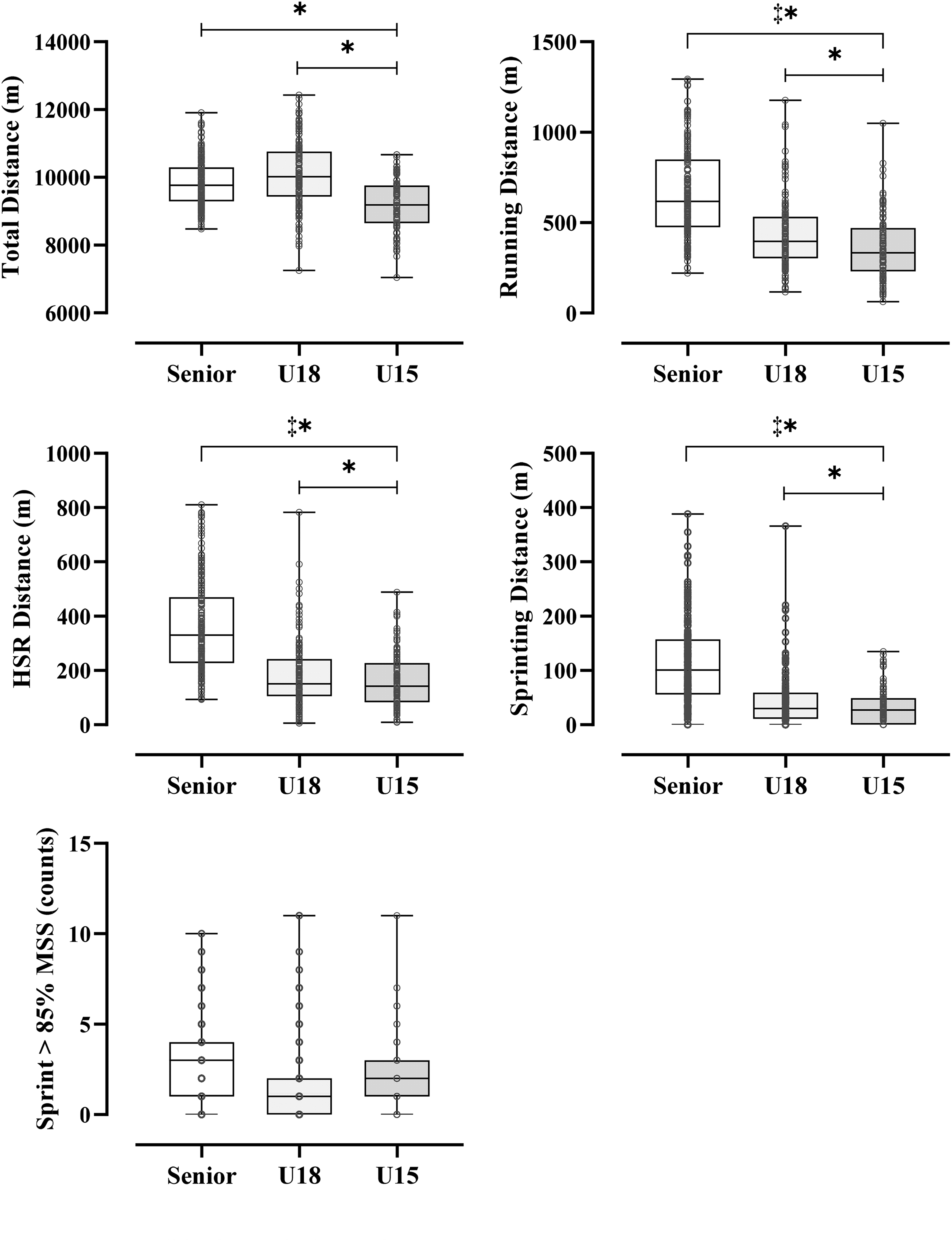
Match-play running distances covered at distinct intensities according to age categories in elite female soccer players. HSR = high-speed running, MSS = maximal sprint speed, * = statistical different from U15 (p < 0.05), ‡ = statistical different from U18 (p < 0.05).
There were statistical differences for match-play ACC and DEC actions of female soccer players across age categories (all p < 0.001; Figure 2). The numbers of ACC >2 m·s−2 and >3 m·s−2 were greater in the senior (161 ± 24 and 35 ± 11 counts, respectively) and U18 categories (180 ± 30 and 37 ± 11 counts, respectively) than in the U15 category (144 ± 33 and 29 ± 11 counts; all p < 0.001; moderate to large ES = 0.58 and 1.14, respectively). Similarly, the numbers of DEC < −2 m·s−2 and < −3 m·s−2 were greater in the senior group (180 ± 26 and 30 ± 6 counts, respectively) and U18 category (192 ± 36 and 28 ± 8 counts, respectively) than in the U15 category (155 ± 46 and 23 ± 10 counts; all p < 0.001; moderate and large ES = 0.73 and 0.90, respectively). The ACC load in the senior (2919 ± 176 au) and U18 categories (3039 ± 225 au) were greater than in the U15 group (2719 ± 279 au; all p < 0.001; large ES = 0.92 and 1.29, respectively).
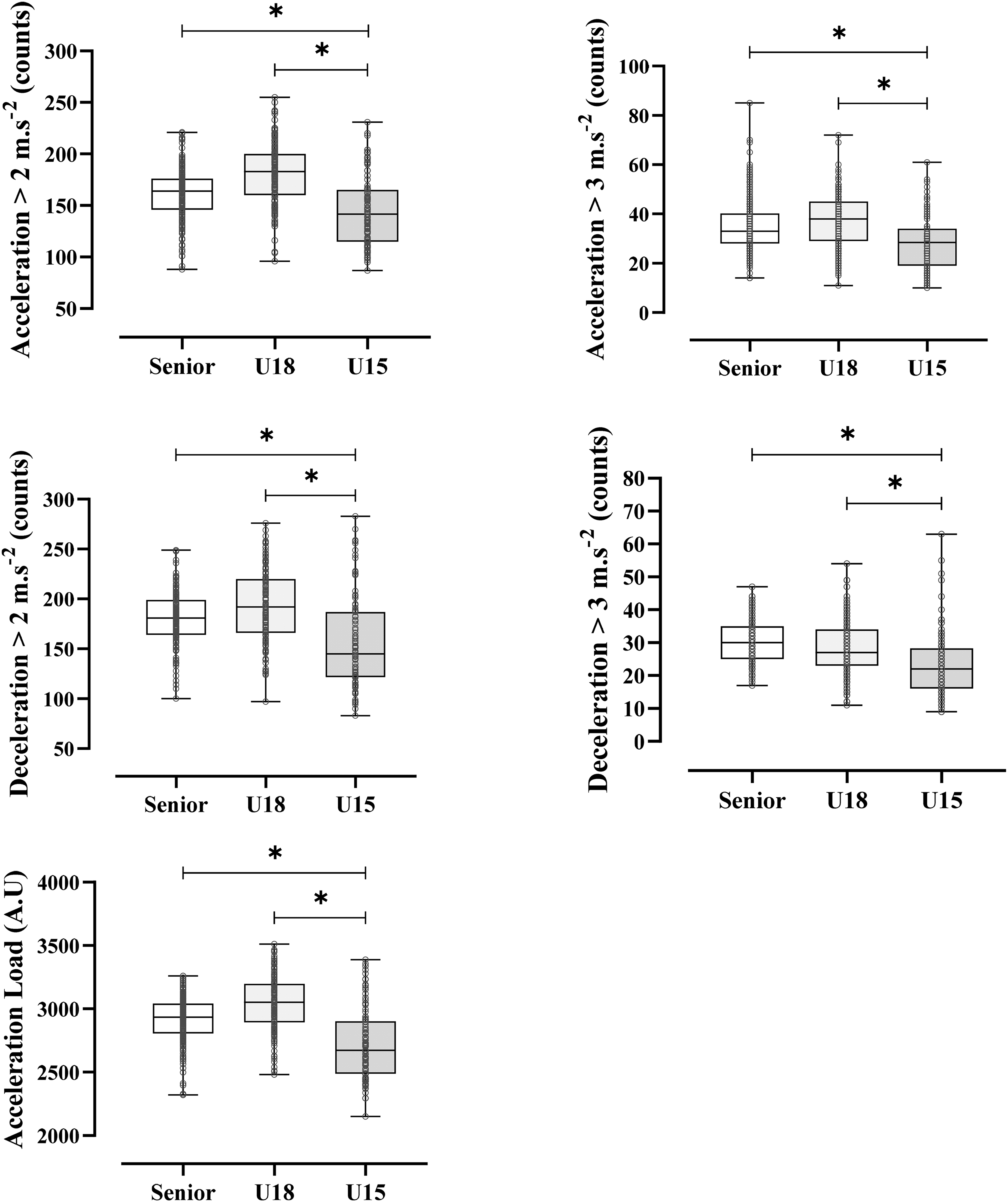
Match-play acceleration and decelerations actions covered at distinct intensities according to age categories in elite female soccer players. * = statistical different from U15 (p < 0.05), ‡ = statistical different from U18 (p < 0.05).
The comparisons of the match-play running demands by age categories and playing positions are shown in Table 1. FWs in the senior and U18 groups covered greater TD than FW players in the U15 age category (p < 0.001). No statistical differences were found between playing positions (p > 0.05). The running distance was greater for the CD, WM, CM and FW players in the senior group in comparison with their peers in the U15 players (p < 0.05), while FW in the U18 group covered more running distance than FW in the U15 category (p < 0.05). The playing position analysis showed that FW and FB players performed higher running distance when compared with CD, WM and CM players (p < 0.05). The HSR distance was greater for the CD, FB, WM, CM and FW in the senior category when compared with the players in their respective playing position in the U15 category (p < 0.05). In addition, CM and FW players in the senior category achieved higher HSR distance than their respective peers in the U18 category (p < 0.05). The playing position analysis showed that the FB and FW performed greater HSR distance in comparison with the CD, CM and WM players (p < 0.05). The sprinting distance was greater for the FB, WM, CM and FW in the senior category when compared with the players in their respective playing positions in the U15 group (p < 0.05), while FW in the U18 achieved higher sprinting distance than FW in the U15 group (p < 0.05). In addition, the FB, CM and FW players in the senior category covered greater sprinting distance than their respective peers in the U18 category (p < 0.05). The playing position analysis showed greater sprinting distance for FW in comparison with the CD, CM and WM players (p < 0.05).
Match-play absolute running demands according to playing positions and age categories in elite female soccer players.
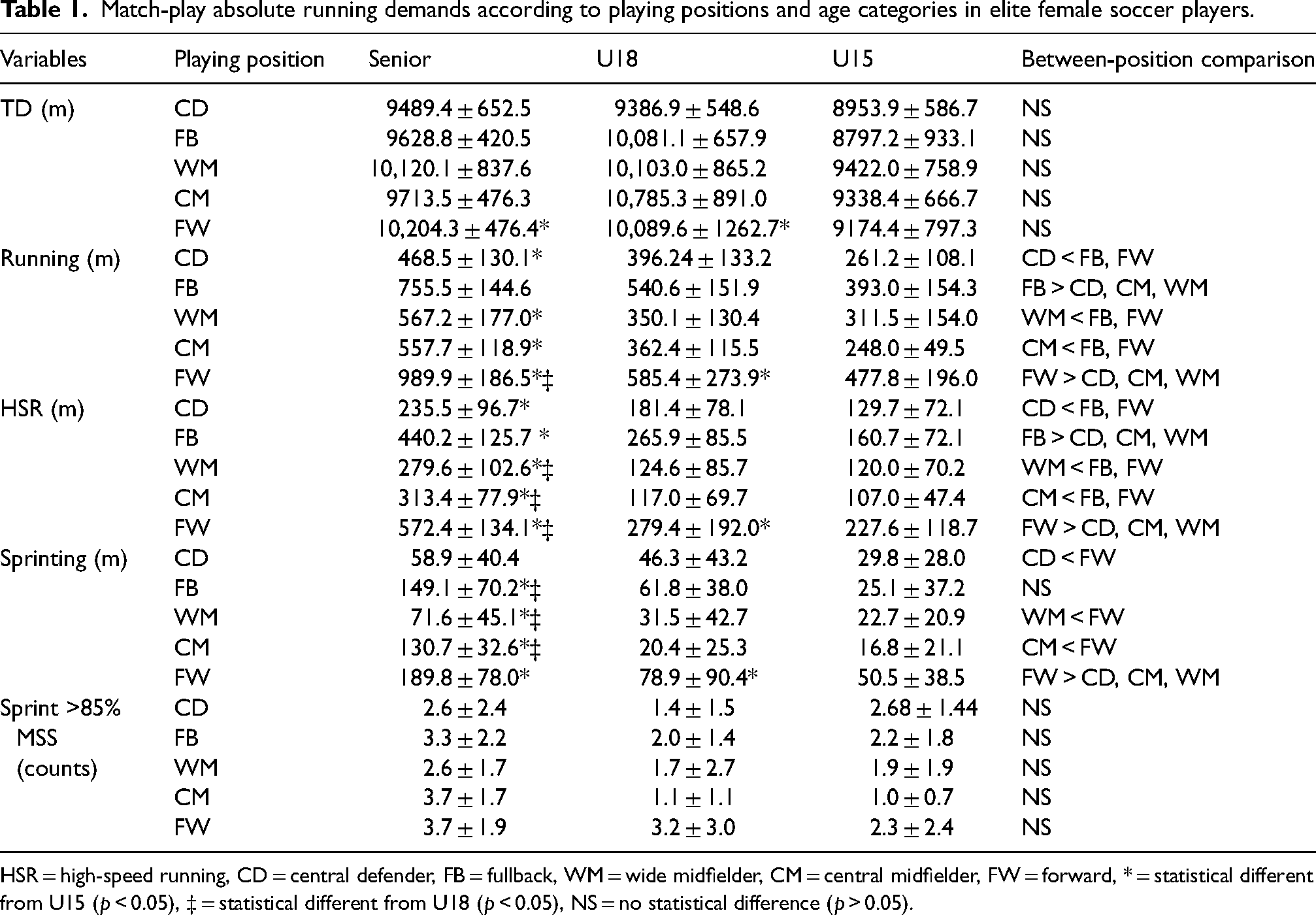
HSR = high-speed running, CD = central defender, FB = fullback, WM = wide midfielder, CM = central midfielder, FW = forward, * = statistical different from U15 (p < 0.05), ‡ = statistical different from U18 (p < 0.05), NS = no statistical difference (p > 0.05).
The comparisons of the match-play number of ACC and DEC actions by age categories and playing positions are shown in Table 2. CDs in the senior and U18 performed a higher number of ACC >2 m·s−2 and >3 m·s−2 in comparison with the CD in the U15 category (p < 0.05). In addition, WM in the U18 team performed more ACC >2 m·s−2 than their respective peers in the U15 category WM (p < 0.05). CDs in the senior group and WM and FW in the U18 team completed more DEC < −2 m·s−2 and < −3 m·s−2 when compared with their respective peers in the U15 category (p < 0.05). In addition, FW in the senior group performed more DEC < −3 m·s−2 than their respective peer in the U15 group (p < 0.05). FWs in the senior and U18 categories achieved greater ACC load in comparison to the FW in the U15 category (p < 0.05). There were no statistical differences in the number of ACC and DEC among playing positions (p > 0.05).
Match-play ACC and DCC actions according to playing positions and age categories in elite female soccer players.
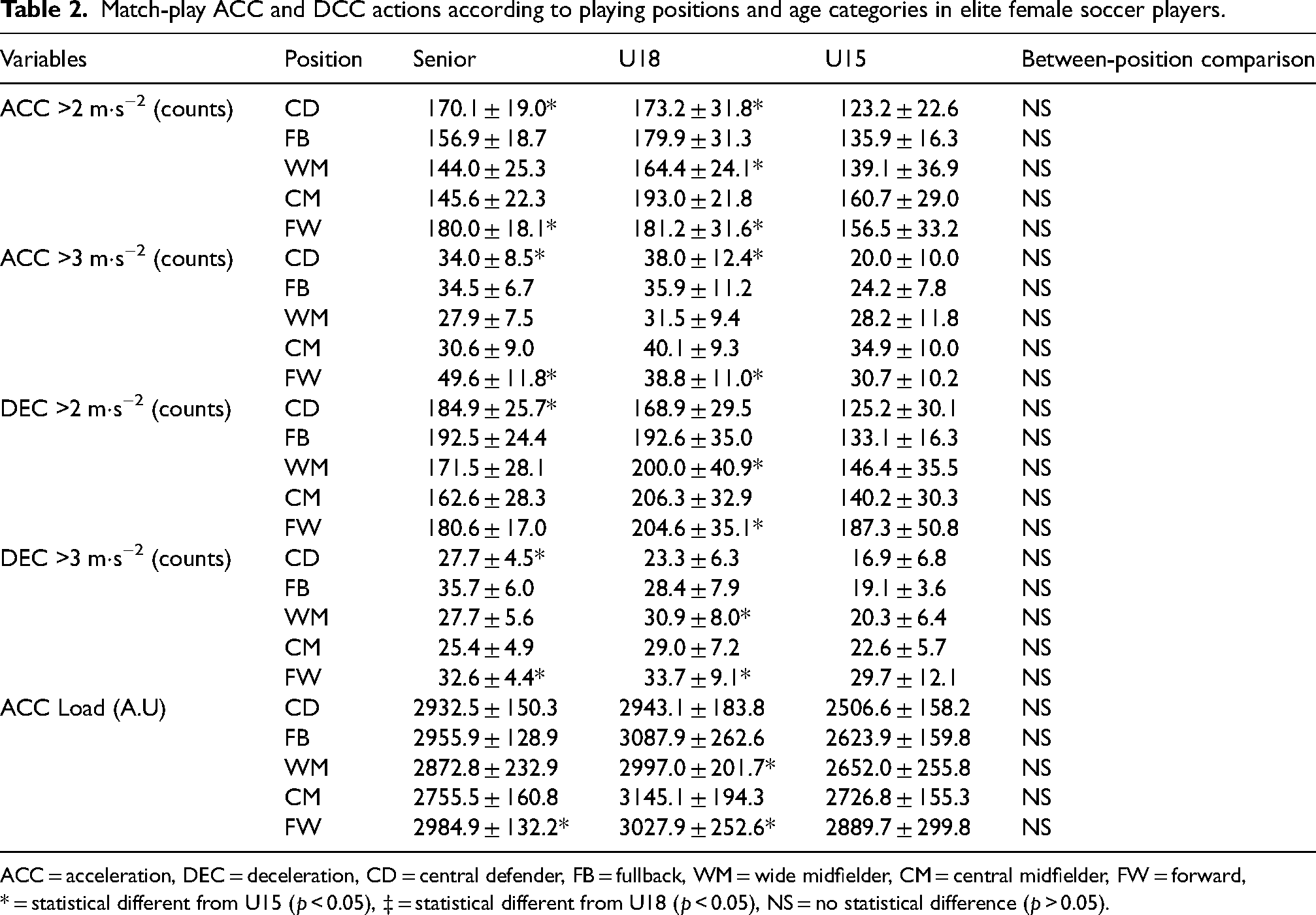
ACC = acceleration, DEC = deceleration, CD = central defender, FB = fullback, WM = wide midfielder, CM = central midfielder, FW = forward, * = statistical different from U15 (p < 0.05), ‡ = statistical different from U18 (p < 0.05), NS = no statistical difference (p > 0.05).
The ES of the comparison of match-play running demands between age categories in female soccer players are displayed in Figure 3.
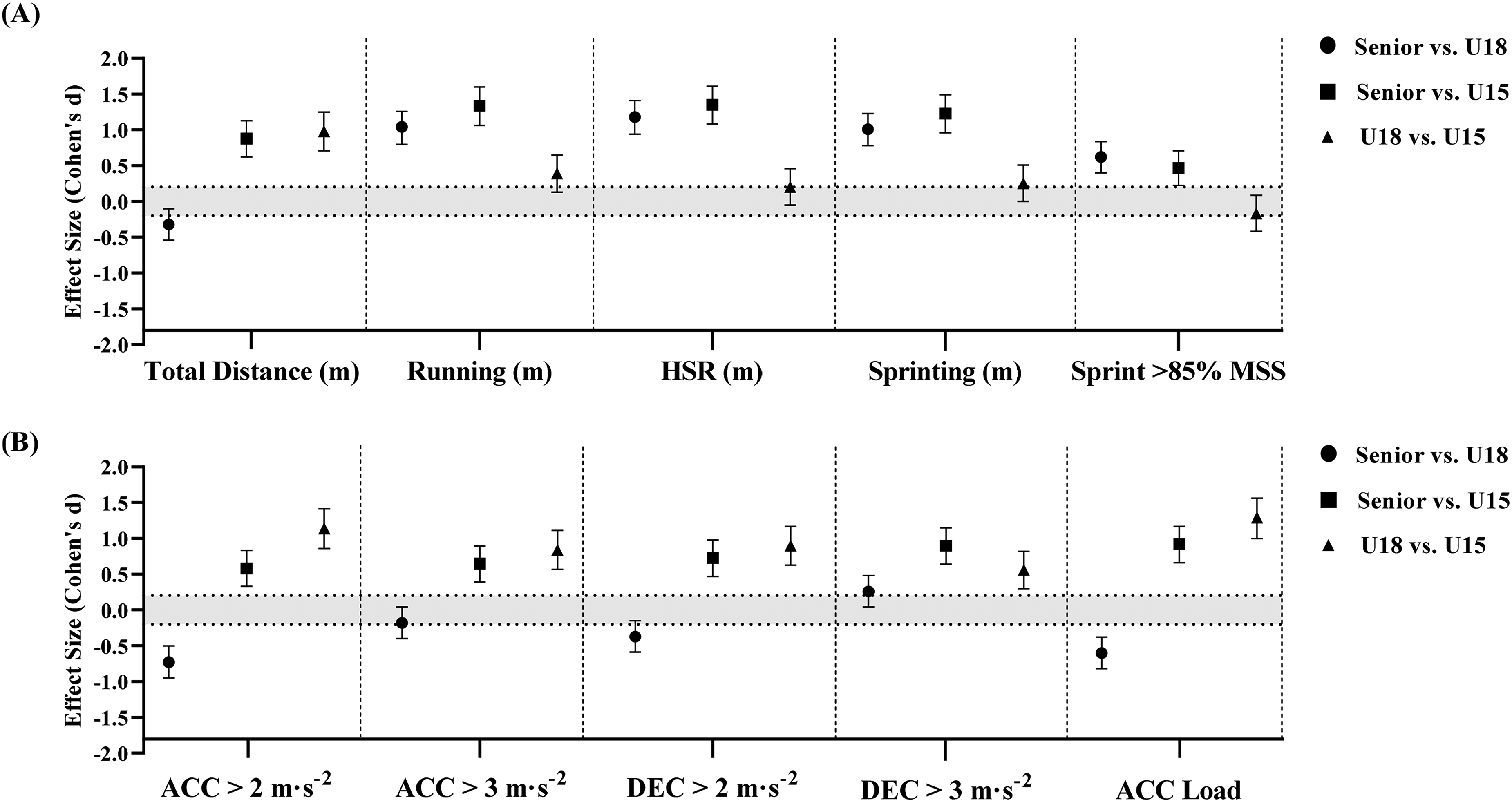
Standardized mean difference (Cohen's d) among age categories for match-play running demands (A) and acceleration/deceleration actions (B) of female soccer players. HSR = high-speed running, MSS = maximal sprint speed, ACCs = accelerations, DECs = decelerations. The dashed line denotes the upper and lower limits of a small effect size (ES = 0.20).
Discussion
In this study, we quantified the match-play running load in high-level female senior, U18 and U15 soccer players from a Spanish LaLigaF club over a full competitive season. The results of the present study were as follows: (a) absolute match-running demands progressively increase across age groups in the order of senior >U18 and >U15, while the number of sprints based on individual thresholds (i.e. 85% MSS) showed no significant difference among the age groups (p > 0.05); (b) senior and U18 players engaged more frequently in ACC and DEC >2 and >3 m·s−2 compared with the U15 players, with no statistical differences between the senior and U18 groups (p > 0.05); and (c) position-specific differences in match-play load were evident across the age groups. These findings have implication for soccer coaches training younger female players for competing in the higher age categories.
In the current study, we applied the same absolute speed thresholds to examine if the running demands of academy female soccer players are comparable with those of elite senior players during matches. Our findings showed that match-running loads increased with age (senior > U18 > U15 age categories), confirming previous studies using fixed speed thresholds.11,12,24 Owing to differences in methodology (i.e. speed thresholds) across studies, making direct comparisons between data set are difficult. However, data from Brazilian national teams also found a progressive increase in high-intensity (15.6–20 km·h−1) and sprinting (>20 km·h−1) distances covered by female soccer players. These age-related differences in absolute running distances among age groups align with the reported improvements in maximal running speed throughout adolescence in elite female players.25,26 The lack of statistical differences between age groups using individualized speed thresholds (i.e. 85% MSS) suggests that speed thresholds derived from senior players may not be directly applicable to female younger players. Therefore, individualized, or at least, age-specific thresholds might be necessary for a better understanding of match-running demands for each age category. On the other hand, using fixed speed threshold in elite academy might be insightful for soccer coaches to understand the absolute soccer match-running demands across talent pathways, that is U15 to senior.12,27 Thus, the choice of speed thresholds (i.e. fixed or age-specific threshold) for monitoring running demands should be tailored to the specific objectives of the analysis.
HSR and sprinting actions are key physical abilities in soccer matches, contributing significantly to the weekly accumulated physical load for players.28–30 In this study, senior players covered greater HSR and sprinting distances despite accumulating the same TD as the U18 group. This indicates senior female players experience a heightened physical demand during matches compared with younger counterparts. The lack of significant difference in TD among age categories implies that match-running volume may not be sensitive to discriminate physical load in female soccer players as running intensity. 16 Indeed, in most intra-playing position comparisons, senior players exceeded younger players in HSR and sprinting distances, but not in TD. Given that the long-term athletic development of youth female soccer players should be a priority for soccer coaches, it is important to develop well-designed speed training programmes to enhance their performance. Thus, soccer coaches should address underpinning factors (i.e. mechanical and physiological) to build up speed ability, preparing youth female players for competing in the older age categories. 31 Key specific factors influencing speed ability included motor skill improvements (i.e. sprinting mechanics), the lower body's capacity to absorb and return high ground reaction force (i.e. tendon stiffness and eccentric work) and force production ability (force–velocity–power of the lower body).32,33 Therefore, training techniques focusing on reactive strength ability, such as plyometric exercises, might be particularly beneficial for enhancing the speed performance of youth female soccer players.34,35
There are several training methods to enhance sprint performance.33,36,37 A recent meta-analysis involving football code player cohorts demonstrated the effectiveness of secondary (i.e. assisted or resisted sprinting), tertiary (i.e. strength-power and plyometric) and combined (i.e. secondary and tertiary) training methods on sprint performance over distances of 0–5, 0–10 and 0–20 m. 38 Notably, this study found that only sport-specific and primary training methods, such as sprinting and running drills, were ineffective in enhancing the performance. A previous study on female soccer players showed that plyometric training (12 sessions; one per week) significantly improved 10 m sprint performance (Δ < 0.18 seconds), surpassing the smallest worthwhile change (SWC = 0.02 s). 39 While the impact of these training methods on female players’ match-running performance are still unknown, a large correlation was found between peak match speed and 10 m (p = 0.56) and 15 m (p = 0.56) sprint times. 40 Moreover, data from male soccer players revealed that players achieved very high sprinting speeds (>90% of their MSS) during matches, suggesting that sprint speed can influence players’ physical performance during a match. 41 Therefore, soccer coaches are advised to incorporate sprint tests in their routine to benchmark data across age categories and gauge the effectiveness of speed development programmes. Future studies should explore the impact of neuromuscular training on match-running performance in female players.
ACC and DEC are defined as positive and negative changes in speed. Even at low speeds, these actions impose higher energy and neuromuscular demands compared to steady running due to the cost of overcoming inertia. 42 In fact, estimates of high-speed distance (speed >14 km·h−1 vs metabolic power >20 W·kg−1) using GPS can increase from 13% to 19% of the TD in training sessions when taking into account the ACC/DEC metabolic cost. 43 On the other hand, distances covered in DEC >−2 m·s−2 are significantly correlated with changes in average force during countermovement jump eccentric (r = −0.47) and concentric (r = −0.49) phases measured 30 minutes post-match, and with change in plasma CK 48 hours post-match (r = 0.58), using pre-match values as reference. 44 This means that quantifying ACC and DEC can provide more accurate information related to match energy and mechanical demands, with implications for post-competition fatigue and muscle damage. In this study, U18 and senior players engaged more often in ACC and DEC >2 m·s−2 and >3 m·s−2. As such older players tend to face greater mechanical and energetic loads compared to younger peers, and this partly agrees with a previous study comparing the number of ACC and DEC >1 m·s−2 among national team players from U17, U20 and senior cohorts. 11 In the referred study, 11 in playing positions such as midfielders and FWs, players in the senior team performed more ACC and DEC than the U15 and U20 teams, and the latter ones were also different from each other. Considering that the transition from U15 to U18 in the current investigation reveals the necessity of improving ACC abilities, especially in FW, WM and CD, it is advisable to implement different field-based35,45 and gym-based46,47 training strategies to develop specific features of the neuromuscular and energetic systems of young female soccer players. For instance, eccentric overload training in female players enhanced the distances covered in ACC and DEC >3 m·s−2, and maximum ACC and DEC values during a soccer match, when compared with a control grouρ. 47 Therefore, practitioners are suggesting to devote training time to stimulate increments in ACC and DEC abilities that can be detectable during the competition.
Even though non-significant, U18 players exhibited moderate differences in match-play performance (ACC >2 m·s−2 [ES = 0.73]; ACC load [ES = 0.60]) compared with senior players. Previous data from elite male soccer players competing in the Danish First League have shown that U19 players performed more of ACC (>2 m·s−2) per minute than their senior counterparts . 48 This disparity might be attributed to the gameplay tactics prevalent in youth soccer and the inexperienced players’ potential inability to regulate their pace throughout a match. 48 Additionally, senior players tend to engage in more high-intensity activities during matches, possibly increasing the game's locomotor intensity. This is supported by the observed trivial effect size (ES = 0.18) in our study for ACC >3 m·s−2, coupled with the fact that senior players accumulated more HSR and sprinting distances than the U18 group. Thus, it is possible to suggest that the U18 female soccer players recruited in this study likely demonstrate ACC performance during matches comparable with that of senior players.
This study had limitations that need to be addressed. Firstly, the investigation focused on three teams from a single football club, limiting the generalizability of results to broader contexts. Nonetheless, our findings offer insights that could assist soccer coaches in understanding the match physical demands across different age categories. However, a limitation arises from the difficult to comprehensively compare locomotor activity with existing literature due to partial difference of available ranges in this study. Furthermore, the non-inclusion of contextual match variables (such as location, score and quality of the opponent), which significantly influence players’ physical responses during competition, may have influenced the results. It is imperative to acknowledge these factors when generalizing the findings. Finally, beyond the metrics relative to external load, integrating internal load data, such as the rating of perceived exertion and heart rate-derived metrics, would have enriched our comparative analysis across age groups. Further research is needed to elucidate the competition demands across locomotor, mechanical and neuromuscular dimensions. Such studies can inform reference values for soccer match loads, enabling tailored interventions aligned with player age categories.
In conclusion, our results indicate that based on senior-derived speed thresholds, match-running demands progressively increased progressively among U15, U18 and senior female soccer players. Specifically, older players cover greater HSR and sprinting distances and more frequently engage in ACCs and DCCs >2 m·s−2 and >3 m·s−2 than their younger counterparts. Such insights could be useful for soccer coaches to support their long-term athletic development programmes, ensuring that younger female players are prepared to compete in older age groups.
Practical applications
The findings of this study offer insights for soccer coaches aiming to refine training practices in elite youth female soccer players during long-term athletic development programmes. The progressive increase in high-intensity actions (HSR, sprint, ACC and DEC) indicates the importance to enhance speed abilities as female players’ progress towards age groups. Considering that the ability to accelerate and decelerate the body over a short distance and achieve high running speeds are key parameters in soccer, we recommend the systematic integration of specific speed development programmes for preparing youth female soccer players to compete in older age groups. In practice, soccer coaches are advisable to combine both nonspecific (i.e. gym-based and plyometric training) and specific (i.e. resisted or unresisted speed drills) training methods. Such a multifaceted approach, emphasizing the underpinning mechanical and neuromuscular determinants of speed, can promote long-term training adaptation.
Footnotes
Declaration of conflicting interests
The authors declared no potential conflicts of interest with respect to the research, authorship and/or publication of this article.
Funding
The authors received no financial support for the research, authorship and/or publication of this article.
