




Abstract
Coaches are faced with navigating a complex and dynamic environment that requires the wise and measured management of numerous competing factors. Traditional and contemporary approaches are often contrasted, with traditional approaches thought to be beneficial for outcomes like speed of skill acquisition but criticised for being overly prescriptive, and contemporary approaches praised for facilitating individualised learning and transferrable skillsets. We contend that the task for coaches is not deciding which approach is “better” and strictly conforming to one approach, rather it is determining which approach or learning principles best suit the athlete's learning requirements. Coaching is not an exact science, it is an art, in which skilled coaches need to be open, adaptable, and flexible in their approach, constantly considering the complexities of the wider coaching process. In this article, we discuss how coaching practices have the potential to be enhanced by integrating key principles from both traditional and contemporary (CLA) approaches to adapt practice to the emerging situation and meet the skill development needs of their athletes while considering the intricacies and subtleties that typify real-world coaching environments.
Keywords
Introduction
The sports coaching context is characterised by complex and dynamic environments. At any one time, a sports coach is juggling a plethora of competing factors that they need to successfully navigate to guide athletes to their performance goals. Consider a junior gymnastics coach tasked with teaching a 6-year-old how to perform a basic handstand. What instructions should they provide to facilitate safe technique? How do they balance the athletes’ expectations of the timeline of progress? Is the gymnast motivated to engage in the current training schedule or are they expected to participate by their parents? These questions represent a fraction of the diverse influences in the coaching process. 1 It is important to note that these factors are not static, with some factors becoming less prominent at certain times (e.g., physical maturation) and others emerging to take their place (e.g., reduced motivation toward training). The evolving nature of the performance context necessitates skilled coaches be adaptable and flexible, capable of responding quickly and effectively to the dynamic needs of their athletes and the changing contextual demands. 2
A key challenge for coaches is deciding on which approach or approaches should be implemented and when to facilitate athlete development and performance. Most recently, traditional coaching approaches have frequently been contrasted with more contemporary methodologies, such as constraints-led approaches. 3 Traditionally, a prescriptive style has been utilised by coaches, involving direct instruction and repetitive drill-based practice that aims to have athletes reproduce a specific movement technique, with low levels of movement variability. 4 This approach is grounded in traditional representation-based accounts of motor learning and control, most notably, Schmidt's schema theory, 5 in which movements are controlled via internal representations (i.e., motor programs) in the brain that are developed through repetition and then adjusted to meet the parameters of various tasks.
In recent years, such approaches have been criticised for being a “one-size-fits-all” methodology where explicit instructions prevent athletes from developing their own individualised functional movement solutions. 6 Additionally, it has been proposed that the use of isolated skill drills limits the transfer of athlete behaviours from training to competitive performance. 7 In response to some of these concerns, contemporary skill acquisition methodologies, such as the constraints-led approach (CLA), have emerged, grounded in nonlinear theories of motor control like ecological dynamics and dynamical systems. a
A CLA finds its roots in an ecological approach to motor control and learning, suggesting that the development of skilled action is a self-organising process of mutually influencing interactions between individual (e.g., athletes physical characteristics), environmental (e.g., crowd noise), and task constraints (e.g., task rules and field dimensions). 9 It is proposed that movement skills emerge from these interacting constraints, rather than the acquisition of an internal movement representation as is the case with representation-based accounts of motor control (e.g., schema theory). 10 Considered in this way, the term skill adaption has been proposed as an alternative to skill acquisition, suggesting that the development of skilled behaviour is not about acquiring and updating a specific motor program, rather, it is “enhancing one's functionality in a performance environment which can be continually improved.” 9
In some contexts, criticism of traditional coaching approaches is warranted; however, it can be argued that the restrictive nature of traditional coaching approaches is based on an outdated view of representation-based accounts of motor learning and control. For example, theories such as Fitt's and Posner's model for stages of learning 11 and Schema theory propose that learning is a linear process, whereby motor programs are developed in the early stages of learning through repetitive drill-based practice and prescriptive instructions to reduce movement variability and combat the high attentional demands associated with this stage of learning. As athletes progress through each stage, instructions become less prescriptive, and practice becomes more variable.5,11 However, since these early theories of motor control and learning, representation-based accounts have evolved considerably, with contemporary accounts such as Todorov's Optimal Feedback theory 12 and Anderson's Adaptive Control of Thought, 13 acknowledging the nonlinearity of behaviour and the need to account for this through varied learning experiences. 14
The coaching literature indicates that contemporary representation-based accounts (perhaps intuitively) may have filtered into applied coaching practice, with elite coaches being found to acknowledge the nonlinearity of learning, while effectively utilising elements of traditional coaching such as direct instruction.15–17 Though it is sometimes proposed that CLA methodologies are the only way to facilitate the development of adaptable, individualised movement solutions, contemporary representation-based accounts (e.g., Optimal Feedback Theory) do provide an alternative approach for coaches to achieve adaptive behaviour. 18 These similarities indicate that the distinction often drawn between different approaches is not as distinct as is often suggested. In fact, previous research demonstrates that both traditional and ecological-based approaches (e.g., CLA) have been utilised successfully18,19 and that coaches should consider the needs of the context rather than adherence to a specific approach. 20
Skilled coaches often demonstrate the integration of traditional and CLA methodologies effectively - perhaps even within one practice session - for the enhancement of movement skills, with each approach presenting distinctive strengths and weaknesses.6,15,17,21 We contend, therefore, that throughout the coaching process understanding how to utilise each approach, or principles of each approach, considered against the background of influencing factors - including the athlete and their targeted learning goals – is a key objective for skill development. 2 Comprehending the diverse learning outcomes of traditional coaching and CLA can aid coaches in determining the most suitable approach for each learning scenario. The task for coaches, therefore, lies in ascertaining which approach or principles of an approach would best suit the athlete's developmental phase and learning requirements.
Coaching is an art, requiring the ability to discern when and where to utilize an approach to successfully satisfy the learning needs of their athletes. A focused skill drill, for example, is effective for some scenarios, whereas game-based practice is more suitable in other situations. 16 This sentiment was raised in a recent commentary by Bobrownicki et al., 22 on the CLA in American football, stating that “a significant issue when translating motor learning scholarship is strict adherence to any one theoretical stance to inform specific facets of practice…rather than consideration of how such issues will fit within the complexities of the wider coaching process.” 22 (p2) In this paper, we explore how traditional coaching and CLA approaches may be integrated into coaching practice to best fit the context and individual needs of the athlete. We discuss how coaching practices have the potential to be enhanced by considering key principles from traditional and contemporary (CLA) approaches as tools that can be utilised to adapt practice to the emerging situation and meet the skill development needs of their athletes while considering the intricacies and subtleties that typify real-world coaching environments.
Skill acquisition approaches applied in sport coaching
What are traditional and constraints-led approaches?
Traditional and contemporary coaching approaches, such as CLA, are grounded in distinct theories of motor learning and control. Early representation-based accounts of motor control (i.e., Schema Theory and Fitts and Posner) forms the foundation for traditional coaching practice. From this perspective, motor learning is viewed as progressing through three distinct phases of learning: cognitive, associative, and automatic, with the aim to develop automatic motor programs that can be enacted when necessary. According to this model, attentional demands are highest early in learning (i.e., cognitive stage). To mitigate these high attentional demands, coaches have traditionally utilised highly prescriptive and repetitive methods to reduce movement variability and develop a consistent motor program. The emphasis of an “ideal” movement pattern or consistent motor program that can be reproduced with minimal variability in traditional coaching is widely criticised by proponents of CLA methodologies. However, it is misplaced to suggest that traditional coaching approaches accurately grounded in representation-based theory advocate for completely isolated and repetitive learning environments at all stages of learning.
For 50 years proponents of representation-based theory have highlighted the importance of sampling a range of environmental situations to acquire critical information to guide behaviour. For example, Schmidt 5 advocates for the sampling of a wide range of situations to build a robust recall schema. Likewise, Marteniuk 23 on information processing in motor skills explains that learners should be exposed to as many environmental situations as possible to develop a motor schema that meets the demands of each movement situation. Furthermore, contemporary representation-based accounts of motor control have questioned the linearity of the learning process. For example, Todorov's 12 Optimal Feedback Theory of sensorimotor control departs from early ideas of a desired trajectory, embracing the ecological dynamic concept of functional variability, emphasizing the need for motor variability and the use of feedback to correct movements that interfere with the achievement of task goals.12,14 From this perspective, the focus is not on enforcing a specific technique as is often the case in traditional coaching; rather, it is about providing corrections to movements that inhibit goal-directed action. That is to say, a movement should not be corrected based on what it looks like necessarily, but on whether it is capable of achieving task goals.
Taking these developments into consideration, CLA and traditional approaches to human movement have moved closer together, both highlighting the importance of movement variability in practice, nonlinearity of learning and sampling or integrating critical performance information into training. The assumptions that underpin each approach can be divided into five main areas: 1) the nature of perception; 2) motor control; 3) skill acquisition and movement patterns; 4) movement variability; and 5) approach to practice (see Figure 1 for summary). The following sections aim to briefly discuss each key area to contextualise the practical implications of how and when principles of each approach can be used for achieving specified performance outcomes.
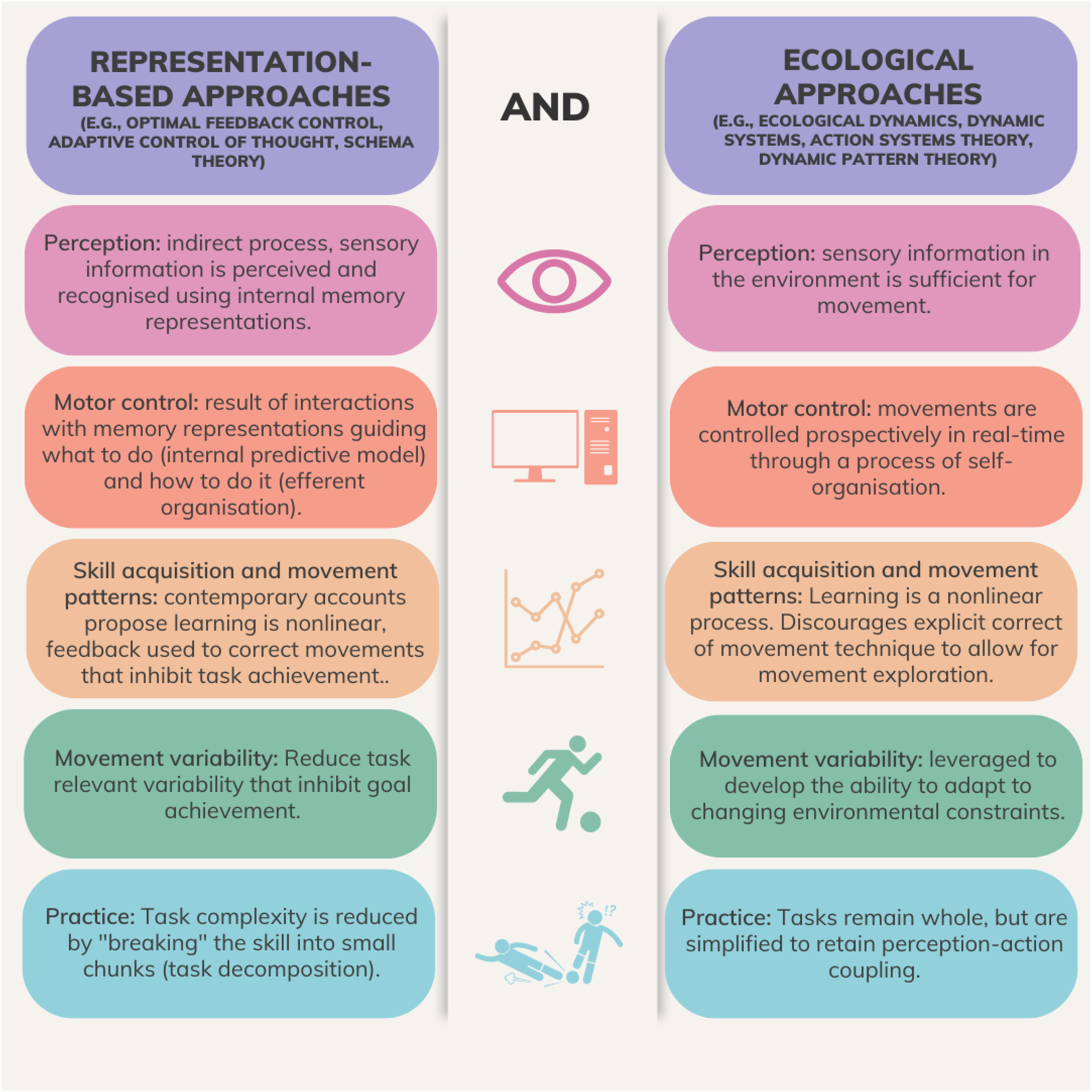
Key characteristics of theoretical underpinnings of representation-based and ecological approaches to coaching.
Nature of perception
A representation-based account of perception proposes that the senses are responsible for detecting environmental information. Sensory information is then perceived and recognised using past knowledge (i.e., internal representations); guiding the production of goal-directed actions.
24
Consider the following example: A rugby player senses an attacking player running at them (sensory detection) via light reflected towards and received by the visual system. This sensory information is passed along to the brain for neural processing. The brain then interprets this incoming sensory information by drawing upon individual knowledge (e.g., past experiences, internal predictions) to recognize that the incoming stimulus is an opponent that needs to be tackled (or not!) and then produces the appropriate movement response.
Interpreted through a representation-based lens, internally stored memory representations are central to the decision-making process involved in selecting the appropriate movement response and the planning and execution of motor commands to carry out a selected movement, referred to as efferent organisation. 24 As perception of the environment is considered incomplete, the decision on what movement to perform begins with the interaction between incoming sensory information and existing memory representations; relevant memory representations are then activated, like previous experiences and outcomes. Internal predictions of movement responses are then evaluated alongside memory representations to assess the potential consequences of various actions. Following the decision-making process, efferent organisation occurs, in which motor commands are planned using information from previous actions and outcomes, then organised for the chosen action (e.g., to tackle the incoming player). Finally, real-time adjustments are made via a feedback loop to align the movement being executed with the initial response selected.6,24
Ecological approaches, however, assume that all information required for movement is within the immediate environment. Perception and action, therefore, are linked, with sensory information complete and capable of directing movement. 10 Gibson 25 explains that “we must perceive in order to move, but we must also move in order to perceive.” 25 (p223) In this way, perception is direct and interpretation of a stimulus within the environment is unnecessary. When a batter in baseball, for example, perceives a pitch, information about the speed of the ball, the trajectory of the ball and time it will take to arrive are all immediately available.10,26
Motor control
From a representation-based perspective, motor control is the result of interactions with memory representations to decide what to do and how to do it. As sensory information is viewed as being incomplete the decision about what movement to perform is based on internal predictive models that are formulated using sensory cues present in the environment, memory representations, and predicted outcomes. These internal predictive models are not just templates that are selected during decision-making and run-off; rather, the interacting process of efferent organisation constructs how a movement will be performed by planning and organising motor commands.24,27 Viewed this way, the decision of what movement to perform and how to perform it are “literally manufactured” using current environmental information and memory representations (e.g., previous experiences, skill outcomes, internal predictions). Bartlett, 28 for example, explains “When I make the stroke I do not, as a matter of fact, produce something absolutely new, and I never merely repeat something old. The stroke is literally manufactured out of the living visual and postural schemata of the moment and their interrelations. I may say and think that I reproduce exactly a series of text-book movements, but demonstrably I do not.” 28 (p201)
Schmidt's Schema theory further unpacks the underpinning mechanism of the efferent organisation or “manufacturing” of movement execution by detailing the interaction between (generalised) motor programs and recall schema (memory representations).5,27 Taken together, representation-based accounts of motor control indicate that if performance involves parameterising/adaption, this should be reflected in practice too. This notion is at the heart of “good coaching” regardless of which approach is adopted and highlights the point that traditional forms of coaching that implement unchanging, repetitive drills cannot be attributed to representation-based theory. Such forms of coaching, in fact represent poor coaching practices and warrant criticism not just from proponents of the CLA approach, but supporters of representation-based accounts of motor control.
In the same way, the internal predictive models and efferent organisation is the mechanism of motor control in the representation-based approach, self-organisation is the central mode of control in the ecological approach. Self-organisation refers to a nonrepresentational form of movement control, whereby motor programs are not necessary to guide action; rather, movement solutions organise dynamically as the result of continuous interactions between the individual, task and environment.7,10 Like representation-based accounts, optimal learning focuses on exposure to different task variations, however, ecological approaches diverge here as the purpose of task variations is not to develop robust recall schema (i.e., motor program theory), but to establish relevant perception-action couplings to develop an athlete's ability to attune to various opportunities for action (i.e., affordances) and support the self-organization of movement patterns. 10
Skill acquisition and movement patterns
Contemporary representation-based accounts acknowledge the nonlinearity of learning, suggesting that task goals are often achieved consistently with movement patterns that display a range of variation.12,14 Therefore, a coach is discouraged from prescribing a very specific movement pattern; rather, they provide feedback only to correct those movements that inhibit task achievement. 14 From this perspective, the coach aims to develop a movement technique that achieves the desired behavioural goals. The key point here is that technique is characterised by goal achievement, not by a predetermined technical model or whether a movement looks correct. Subsequently, deviations from what looks correct are permissible, even a necessary part of dealing with the complexity of the learning landscape, if these deviations do not interfere with task goals, whereby corrective feedback should be applied. 12
The value of errors is an area that appears to have been misinterpreted within traditional coaching approaches, which are commonly associated with prescriptive and repetitive forms of training that tend to focus on the development of an “ideal” technique, often failing to make the distinction between correcting deviations that look incorrect and those that inhibit task achievement. This suggests that incorrect movements are viewed as valuable from some representation-based perspectives. Research supports this notion. with findings on the concept of contextual interference 29 and method of amplification of errors 30 demonstrating the value placed on “incorrect” movements. Like contemporary representation-based accounts, a CLA assumes learning is nonlinear; characterised by abrupt and often sudden changes in performance over time. 31 Aligning with optimal feedback control theory, a CLA posits that “incorrect” movements are not always a cause for correction. However, a key distinction between these approaches is that a CLA discourages explicit correction of movement technique. From a CLA perspective, the exploration of incorrect movements represents an important part of the learning process, even when it interferes with behavioural goals. These deviations are viewed as contributing to an athlete's search for movement solutions that satisfy the unique individual, task and environmental constraints within the learning landscape.31,32
Movement variability
Contemporary representation-based accounts of motor control tend to distinguish movement variability as either task-relevant or task irrelevant.12,14 As described in previous sections, contemporary-based accounts do not attempt to reduce all variability from the learning process but only variability that inhibits the achievement of the desired movement outcome (task-relevant variability). Todorov 33 describes this as the minimal intervention principle (MIP), whereby a coach should only intervene when deviations in movement patterns interfere with performance outcomes. Echoing this principle, Wolpert and Flanagan 34 propose that internal models function to minimise task-relevant variability. Subsequently, the function of the coach is to direct an athlete's perception away from sensory information that interferes with desired task goals (task-relevant variability) toward task-relevant information while allowing scope for variability to occur in aspects of a movement that are irrelevant to performance outcomes.
The call for reduced variability in representation-based accounts of motor control is an area that has been frequently misapplied within traditional approaches to coaching, in which coaches can often try to eradicate any form of variability, failing to distinguish what is relevant and irrelevant variability. Subsequently, traditional coaching approaches have been criticized for being too restrictive, limiting opportunities for an athlete to explore individualised movement solutions and limiting development of the capacity to adapt to the changing demands of the performance context. 10 However, these criticisms cannot be attributed to representation-based perspectives, which account for and advocate for certain types of variability and should be more appropriately linked to “poor coaching” practices.
Developing the capacity to adapt to environmental changes while satisfying the demands of a dynamically changing performance context is a key characteristic of skilled athletes. Müller et al.,, 35 for example, observed that under occluded vision, highly skilled cricket batsmen showed individual differences in movement pattern variables (i.e., weight transfer and bat downswing), but no significant differences in task achievement. These findings suggest that replicating ‘ideal’ movements is not always necessary for skilled performance and that there is at least some variation in techniques used by skilled performers in attaining successful performance outcomes. In line with this notion, a CLA advocates for constraint manipulation to encourage movement exploration; aiming to develop the capacity to adapt and vary movement patterns necessary for skilled performance. 36
Approach to practice
From both a representation-based and ecological approach, the stage of learning is a key driver behind how practice is delivered and designed. Though traditional coaching has been criticised for delivering isolated skill drills, such practice primarily occurs during the early stages of learning (i.e., cognitive stage). As highlighted by Marteniuk 23 on information processing in motor skills “…after a learner has acquired the basic idea of the skill, he should practice in game-like situations as much as possible. For it is only in these situations that an individual learns the appropriate types of movements for the many possible different situations.” 23 (p214) Traditional coaching, therefore, may emphasize mimicking and repeating movement patterns – but a correct interpretation of representation-based accounts would have this type of practice occurring only at the very earliest stage of learning and would move quickly from some base repetition once a basic skill pattern is developed. Similarly, a CLA does not exclusively consist of game-based practice, especially in the early stages of learning. Like Marteniuk, 23 proponents of the CLA specify that early in learning “…low-task and environmental variability may be initially beneficial to guide exploration towards one or two functional solutions…” 9 In addition, Renshaw et al., 9 explain that as learners become more skilled, they “…may be presented with greater variability in individual, task and environmental constraints to promote more adaptable behaviour.” Taken together, both approaches acknowledge the need to simplify tasks early in learning and progress toward more representative, game-like situations as soon as possible. A key difference, however, stems from how practice is simplified in the early stages of learning.
The focus of practice from a representation-based account is for the skill to become autonomous, allowing for cognitive resources to be utilised for other tasks, such as perceptual-cognitive skills. 6 To achieve this level of skill automation, practice tasks are commonly “broken” down into simpler chunks - referred to as task decomposition. As skilled behaviour is viewed as an emergent process that is reliant on a continuous perception-action coupling, an ecological dynamics approach (e.g., CLA) advocates for the use of task simplification. Task simplification aims to present athletes with training experiences that situate learning within competitive contexts (i.e., small-sided games), preserving coherence between movement patterns and critical aspects of performance information.7,31
Applications of theory in coaching practice
The approach adopted by a coach is proposed to emerge from individual perceptions, formal education processes and informal learning experiences. 37 A criticism of current coach education processes is an overemphasis on ‘traditional’ pedagogical approaches to athlete development, with it being suggested that practitioners often neglect to incorporate available evidence on contemporary approaches, like CLA. 38 A previous meta-analytic review suggests that formal coach education opportunities are dominated by ‘traditional’ approaches to coaching. 39 Furthermore, coach education programs are focused primarily on what to coach, with content centred around the acquisition and transfer of technical knowledge, rather than how to coach. 39
As a consequence, an issue that has been raised in the literature is that ‘traditionally’ educated coaches may be at risk of not developing the appropriate tools on how to coach and the knowledge underpinning why a particular principle should be applied, instead they repeat technical knowledge they have learned to their athletes.38,40 Subsequently, ‘traditionally’ educated coaches may be unable (or unwilling) to adapt their practice to the emergent situation. This appears to be particularly evident early in a coach's development, with research suggesting that novice coaches are hesitant to hesitant to adapt their coaching from perceived best practice (or what they were taught). For example, Nash and Sproule 41 found that compared to an expert swimming coach, a novice coach is more inclined to adopt an approach that aligns with perceived best practice, rather than adapting their practice to the evolving situation. Further research, however, indicates that as a coach gains more informal experiences relevant to their specific context, their coaching practices may begin to become more flexible, sometimes utilising a combination of both “traditional” and contemporary approaches to meet the needs of their athletes.15,17
Experiential data on elite Danish swimming coaches found the overall coaching philosophy emphasized time spent reproducing the same movement patterns repeatedly until an athlete achieves mastery (i.e., traditional coaching). 17 Similarly, Brackley et al., 15 noted that in a cohort of elite Australian swimming coaches, most came through ‘traditional’ coach education programs, however, in real-world practice they utilised a mixture of contemporary and traditional approaches. These findings indicate that although traditional coach education may be dominant, as coaches develop the practicalities of ‘real-world’ coaching environments require an adaptability in methods to manage the many emergent and dynamic variables present in their environment.
The adaptability demonstrated by skilled coaches seems to be characterised by an integration of both “traditional” and contemporary coaching principles.15,17 Recently, coach education researchers have started to advocate for “… research-informed practice, absent of strict theoretical boundaries and instead, considering contemporary pedagogy as drawing on the needs of the context, the experience of the coach and the best available evidence.” 20 Coaches are therefore encouraged to consider why they are implementing a specific approach, what consequence that approach will have and whether it will meet the emerging demands of the athlete in that situation. The following section aims to present coaches with clear principles for the integration and practical application of coaching approaches to guide the development of adaptable coaching practices.
Principles for practically applying traditional and contemporary coaching approaches
The decision of which aspects of an approach to implement depends on a range of complex factors, including the athlete and their performance goals. Aspects of both traditional and contemporary (CLA) approaches can be effective in meeting learning and performance goals and have distinct advantages and disadvantages that coaches could consider in making coaching choices. To be effective, coaches can consider the following principles to guide the integration and practical application of traditional and contemporary approaches in practice:
Set clear intentions for training. Align instructional content with the individual needs of the athlete and learning outcomes of the coaching context. Balance the amount of movement variability in practice. Allow more opportunities to make mistakes in practice. Set flexible practice structures to allow for the nonlinearity of learning. Appropriately represent the demands of competitive environments in practice. Simulate critical information sources to develop connections with relevant performance information.
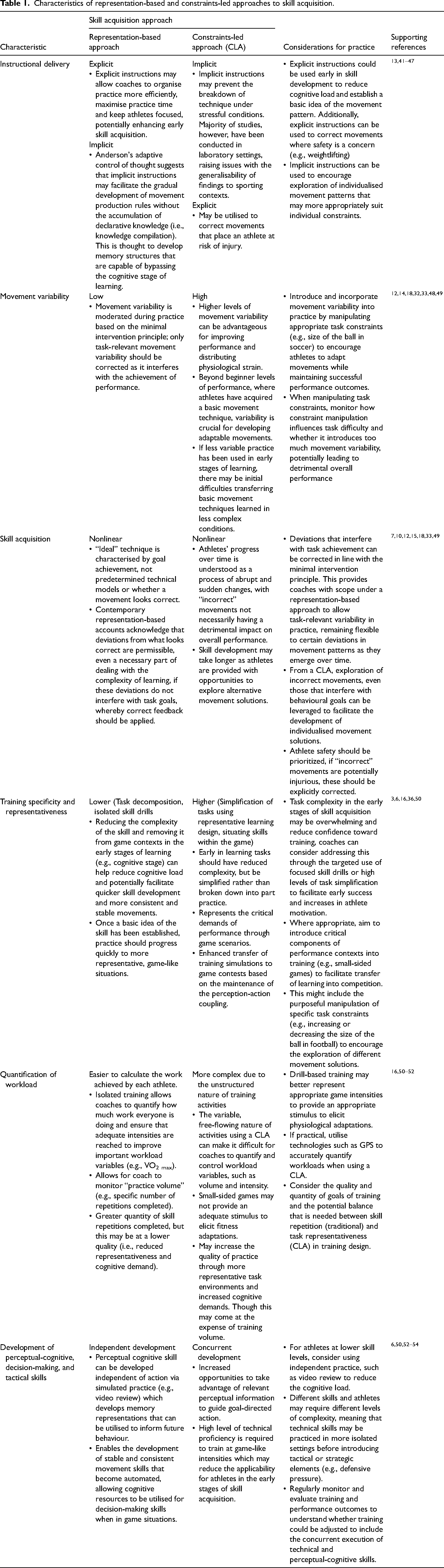
Traditional and CLAs potentially foster different learning outcomes based on their theoretical understanding of learning and performance, and coaches can use this knowledge to determine the best approach for a specific learning situation or context. The coach's challenge may be to constantly assess whether the approach matches the athlete's needs in terms of learning and performance. Table 1 provides a summary of key characteristics of traditional and CLAs to aid coaches in making decisions about how to achieve each principle. Drawing on key characteristics of traditional and a CLA, each principle is presented, and the practical applications are discussed.
Characteristics of representation-based and constraints-led approaches to skill acquisition.
Set clear intentions for training
Though a CLA may increase task representativeness and transfer to competitive contexts, it can be difficult for coaches to quantify and control training workloads. It is, therefore, important that coaches set clear intentions on the aims of the training activity/session and do not try to achieve “too much” in one session. Specifically, research indicates that small-sided games are effective for developing tactical and strategic skills, however, this may come at the expense of fitness adaptations. 55 A comparison of small-sided games and specific interval training drills revealed that football players with the highest VO2peak demonstrated the lowest VO2peak in small-sided games. 55 Although small-sided games (i.e., CLA) may facilitate the development of tactical and strategic skills, isolated structured interval training drills may be required for athletes to reach adequate intensities to elicit fitness adaptations. Coaches, therefore, could consider implementing more drill-based training as the primary mode of fitness development and game-based methods (e.g., CLA) as a way of developing tactical and strategic skills to ensure that athletes are producing the appropriate training intensities to elicit the desired physiological adaptions.
The use of isolated skill-drills also allows coaches to accurately monitor movement repetitions (not just physical load). The coach may need to consider the balance of quality and quantity in practice, where isolated skill-drill practice provides for more repetitions of the skill but perhaps at lower “quality” - lower representativeness and cognitive demand - than game-based practice.56,57 According to the ecological dynamics perspective as a basis for CLA and adopting conceptions of a task-relevant variability from Optimal Feedback Theory from more traditional approaches, practice should involve ‘repetition without repetition’ 58 ; with skills practiced often, but not in a repetitive fashion. Coaches, therefore, should aim to balance the need for skill repetition with the task representativeness and variability in load planning for skill practice. 6
Aligning instructional content with individual needs and learning outcomes
Coaches are encouraged to remain adaptable in their overall instructional approach, adapting content based on a number of interacting factors present in their context, such as the characteristics of the athlete (e.g., skill level), type of skill being learned, and the training objectives.2,6 Coaches can utilise two different instructional methods – described broadly as explicit and implicit - to enhance or inhibit the achievement of an athlete's learning outcomes. 6
Coaches implementing explicit instruction will tell the learner how they want the skilled executed; viewed as possessing a greater level of knowledge and experience that they aim to impart to their athletes. 59 From the perspective of CLA, implicit instructions such as analogies are intended to facilitate performers to “think less” about what they are doing, reducing overload of working memory and utilising less conscious control over movements, allowing exploration of alternative movement patterns.44–46 This approach has been shown to improve movement outcomes in sports such as swimming, weightlifting and tennis.18,48,49 While often associated with a CLA, 60 implicit learning blurs the line and can be aligned with a representation-based account of motor control. Anderson's Adaptive Control of Thought describes the gradual development of movement production rules from the accumulation of declarative knowledge through a process referred to as knowledge compilation; however, within this framework the use of secondary tasks to engage working memory (i.e., instruction via analogies), facilitates the direct development of implicit memory structures, effectively by-passing the cognitive stage of learning.13,61
Coaches should cautiously weigh up their instructional approach using their expert knowledge and understanding of the athlete and how such an approach would facilitate or inhibit the achievement of specific training outcomes. From a practical perspective, we contend that implicit and explicit should be considered as co-existing approaches that ebb and flow across the long-term development of an athlete. Collins et al., 47 noted that perhaps there is a ratio of explicit and implicit knowledge that exists with the athlete, and the role of the coach is to alter this ratio via instruction rather than completely adopting either an explicit or implicit approach. Consider the following practical example:
An experienced coach of a beginner-level weightlifter may identify the tendency for their athlete to push the bar away from their body - a biomechanically poor position. Explicit instruction elicits limited change, therefore, using their wisdom and judgment as a practitioner the coach identifies that their athlete may be overloaded cognitively - based on their skill level. A reasonable approach would be to reduce the volume of explicit instruction and begin incorporating some implicit instructions to simplify information to also reduce information overload, such as “Try and flick the bottom of your shirt with the barbell”, an approach that is effective for improving performance outcomes in weightlifting movements for beginners.
Although in the above example, several instructional strategies may be utilised, the decision-making process must consider the overall athlete system.
Balance the amount of movement variability in practice
Contrary to conventional coaching wisdom, the promotion of movement variability in training has been shown not to be detrimental to performance outcomes (e.g., forehand accuracy in tennis) and may be an important part of the skill development process.49,62 Lee et al., 49 found that novice youth players practicing the tennis forehand under an ecological dynamics-informed approach (nonlinear pedagogy) demonstrated increased variability of movement patterns relative to explicit-based coaching, yet both groups significantly improved performance outcomes. These findings suggest that the promotion of movement variability in training may effectively facilitate the learning process without compromising performance outcomes. Coaches can promote movement variability through the purposeful manipulation of task constraints in training. For example, to encourage the development of more accurate passing in congested situations in invasion sports, coaches may manipulate the constraint of number of players, field dimensions, or starting distance between defenders.53,63,64
Both representation-based accounts and a CLA approach advocate for the importance of movement variability in practice, therefore, the above constrained game can be explained through different theoretical mechanisms. From a CLA, varying constraints are proposed to encourage exploration and facilitate the self-organisation of individualised movement solutions and the creation of more adaptable and flexible movement patterns.53,63,64 Alternatively, Schema theory would suggest that the constrained game contributes to the development of a richer memory schema of the passing skill. 27 The constrained game provides varied situations that facilitate the development of a more elaborate memory representation, providing the athlete with a broader range of experiences to draw upon, allowing them to be more adaptable with their skill execution during actual game scenarios. 27 This example highlights that despite the different proposed theoretical mechanisms, the same practical interventions can be utilised by both approaches to achieve similar performance outcomes.
Both representation-based and ecological dynamics approaches both emphasise the importance of finding balance in movement variability during practice. Both perspectives agree that the quantity of variability is a key factor in successful performance outcomes. 65 Coaches are encouraged to find a balance between “too much” and “not enough” movement variability in training. Though guided by different theoretical mechanisms, the stage of development of the learner is a common factor that underpins a coach's approach to the balancing of movement variability. For example, cognitive load theory suggests that in novice performers the addition of more information sources (e.g., movement variability) increases cognitive load and may overload the learner, negatively impacting performance outcomes. 66 Therefore, in the early stages of development, practice is characterised by low levels of variability to reduce cognitive load and facilitate the development of a basic movement pattern. Similarly, during the learning to co-ordinate stage, a CLA recognises the need for reduced variability by decreasing the complexity of an activity (e.g., 1 versus 0 game), while still encouraging exploration of different movement solutions. Regardless of the coaching approach being utilised, the individual characteristics of the athlete are at the centre of coaching practice when considering how to implement movement variability.
Consistent with this notion, Brackley et al., 15 reported that elite swimming coaches consider the individual characteristics (e.g., individual constraints) of their athletes as a key influencing factor in the learning process. One coach explained that “You’re looking at each individual athlete because each of those athletes will respond differently to certain sorts of stimuli. So, I’d have two sprinters at the same time and the same age, but you’d have to train them differently.” 15 (p6) Utilising a CLA, coaches can effectively cater to the individualised needs of each athlete by leveraging movement variability through task constraint manipulation, allowing learners to explore alternative movement patterns that may appropriately satisfy their individual constraints.54,62
Similarly, representation-based approaches like optimal feed-back theory, can introduce movement variability through the same task constraint manipulation. However, in the latter approach, variability is moderated during practice based on the minimal intervention principle, whereby only task-relevant movement variability would be corrected by coaches as it is perceived to interfere with the achievement of performance. 14 By contrast, a CLA manages movement variability through constraint manipulation as it pertains to a learner's exploration of individualised movement solutions.
Allow the opportunity to make mistakes in practice
An important element of “good coaching” that is shared by representation-based accounts and a CLA approach is allowing the freedom to explore “suboptimal” or “incorrect” movement patterns, as increased movement variability may be interpreted as ineffective training even though they may be an important element of the learning process. 54 Through a representation-based account this can be achieved by incorporating principles like contextual interference or amplification of errors, which aim to create situation where athletes are performing more “incorrect” movement patterns. Similarly, a CLA can purposefully manipulate key task constraints within the practice environment (e.g., court size, ball size) to encourage learners to explore a range of movement solutions, even those that are considered “sub-optimal”. Findings from Lindsay et al., 18 suggest that deviation from a prescribed technical template does not have a negative impact on overall performance. From the view of optimal feedback theory these deviations could be interpreted as irrelevant variability and therefore “exploration” that does not impede overall goal achievement. Alternatively, a CLA proposes that these deviations, regardless of whether they are task-relevant or irrelevant, were a necessary part of the learning process to arrive at individualised movement solutions. Overall, coaches, therefore, are encouraged to consider that occasionally withholding correction when a “sub-optimal” movement is displayed can benefit overall learning and is not always an indication of ineffective practice.
Set flexible practice structures to allow for the nonlinearity of learning
Drawing on the assumption that skill development is a progressive, linear process, traditional approaches focus on directing the athlete's attention to the conscious reproduction of a prescribed movement model. The advantage of this linear view is that it can allow coaches to develop structured training programs, focused on the achievement of specific learning objectives. This is akin to the concept of linear periodization, in which training variables such as movement intensity, volume, order, and frequency are logically structured to maximise training adaptations. 67
Contemporary approaches (i.e., CLA) view training as inherently nonlinear, with “sub-optimal” movements believed to be an important part of learning. However, this does not mean that coaches adhering to a nonlinear pedagogy will not provide explicit correction in certain circumstances. For example, in weightlifting when the barbell is further away from the body than from the floor this will create a lower moment arm and place more stress on the lower back, placing the athlete at risk of injury.68,69 Corrective feedback, therefore, would be prudent to ensure athlete safety. In contrast to the linear view of training – often associated to traditional coaching - changes in learning are not proportional in nonlinear systems; if a coach makes large changes to an activity (e.g., a change in field size) this may only result in small changes in movement. This has important practical implications for coaches, suggesting responses to training will be different across individuals and not necessarily in line with the intended changes. 49
Represent the demands of the competitive environment in practice
A key criticism of traditional approaches is the isolated, structured nature of practice, in which athletes are progressively taken through technical skill-drills that increase in complexity and are then applied within a game scenario, referred to as task decomposition. 6 However, referring to representation-based accounts of motor learning and control (e.g., Marteniuk's information-processing in motor skills; schema theory, model for stages of learning), it is clear that isolated practice is emphasised early in learning, with progression to more complex and representative environmental situations consistently emphasised once a basic idea of a skill has been developed. In this way, the use of isolated practice activities is guided by the stage of development, primarily being used in the early stages of learning rather than an approach that is used widely across all individuals and situations. The misapplication of isolated activities is certainly an issue and indicative of poor coaching, with the potential to have long-lasting negative impacts on athletic development. The efficacy of structured skill drills, for example, was viewed negatively by a sample of international rugby players; believing that such drills did not prepare them for game situations. 51
An increase in complexity to more representative, game-like activities is a feature of representation-based approaches to coaching, but from task decomposition rather than simplification (e.g., CLA). Alternatively, to maintain representative training environments, even in the early stages of learning, the CLA advocates for task simplification as opposed to breaking the skill down into simpler parts (e.g., task decomposition). This would involve practicing a skill through a simplified game scenario - such as 3 vs 2 - where task constraints are manipulated (e.g., reduced players on the field) to challenge learners, yet simplify the perceptual and action elements of complete game context. 10 Task simplification is proposed to enhance the transfer of training simulations to game contexts based on the maintenance of the perception-action coupling or the representation of “game-like” perceptual information, allowing athletes to develop the capability to perceive and utilise different opportunities for action (affordances), such as how to successfully perceive opportunities to pass into emerging space between defenders.50,52
Simulate critical information sources to develop connections with relevant performance information
As discussed previously, representation-based approaches tend to focus on developing technical skills in isolated contexts until an acceptable level of mastery is achieved before being applied to performance contexts. 27 This is based on the notion that across the various stages of learning (i.e., cognitive to autonomous) attention is limited and cannot deal sufficiently with developing both technical and tactical skills concurrently. Therefore, according to representation-based accounts, perceptual-cognitive skills (e.g., decision-making) are often developed independent of movement skills via simulated training (e.g., video review) and are proposed to build the memory representations necessary to inform future behaviour. The independent development of these processes is particularly important in the early stages of learning where cognitive loads are high. 6 A CLA acknowledges that such strategies are useful but only so far as they educate a learner's attention and are therefore not utilised as frequently. Consequently, a CLA proposes developing perceptual-cognitive, decision-making, and tactical skills concurrently with technical skills in order to simulate critical information sources found in competition.7,54 The advantage of this approach is that athletes may experience more opportunities to take advantage of relevant perceptual information that guides goal-directed interactions with critical information sources found in competition (e.g., defender position, passing opportunities). 70 This means that technical, tactical, and decision-making skills can be developed concurrently, offering a potential advantage over isolated skill drills. 16
While aiming to develop these skills concurrently, it is important that the stage of learning is considered (Representation-based account: cognitive, associative, and autonomous; ecological-based account: coordination, control, and skilled optimization), regardless of what approach is being implemented. The aim of both traditional and CLA's is to progress to representative game intensities, for developing such skills. A limitation of developing such skills concurrently is that athletes need to be highly skilled to train at representative intensities, reducing the applicability of such approaches for athletes in the early stages of skill acquisition. 55 For example, in sub-elite Australian rules football players it is recommended that training drills should be executed at approximately 219 m·min−1 to represent 100% ball-in-play intensity. 71 Both representation-based and CLA's would advocate that game-based practice at such high intensities may not be possible for athletes at lower skill levels and need to be scaled back, sacrificing match-play intensity to facilitate skill execution. 71 However, as pointed out in earlier sections, the manner in which this scaling back is enacted with differ between approaches, with representation-based accounts proposed task decomposition and ecological approaches advocating for task simplification.
Conclusion
A review of the literature suggests that aspects of traditional coaching and a CLA each have distinct strengths and weaknesses, with coaches needing to evaluate or re-evaluate whether to integrate approaches within the context of a range of factors, including the athlete and the learning goals of the practice session or training program. A coach's decision-making processes should be tailored to the individual athlete and their targeted learning outcomes. Traditional coaching and a CLA yield diverse learning and performance outcomes; comprehending these outcomes can support skilled coaches in determining the most suitable approach for a particular learning scenario. The task for coaches, therefore, is to figure out which approach best suits an athlete's developmental phase and learning and performance requirements.
Footnotes
Declaration of conflicting interests
The authors declared no potential conflicts of interest with respect to the research, authorship, and/or publication of this article.
Funding
The authors received no financial support for the research, authorship, and/or publication of this article.
