



Abstract
The performance assessment of relevant biomechanical factors is essential for appropriate age-related training progression in volleyball spike (VS). This study aimed to investigate the differences in upper limbs’ (a) range of motion (ROM), (b) angular velocities, and (c) muscular activity during VS among under 16- (U-16), under 18- (U-18), and under 20- (U-20) year-old female volleyball players. The kinematic variables of the spike performances were recorded using six optoelectronic cameras (Vicon Motion system, UK). Additionally, the wireless Trigno system (Delsys, USA) was used to record the electromyographic signals. The one-way ANOVA (1d SPM analysis) exhibited a significantly greater wrist internal rotation (p < .001), wrist adduction velocity (p < .001), and palmaris longus activity (p < .001) in the acceleration phase in U-20, compared to the U-16 group. Additionally, the U-20 and the U-18 players portrayed a significantly greater shoulder external rotation (p < .001) and internal angular velocity (p = .035) relative to the U-16 group. A significantly greater pectoralis major (p < .001), biceps brachii (p < .001), and anterior deltoid (p < .001) activity was observed in the U-20 group, compared to younger groups. This study suggests that older players employ more upper limb muscular activities during spike with the presence of blocks, which enables them to hit the ball with greater velocities and direct the ball in their desired direction through increased wrist ROMs.
Introduction
Quantitative analysis of sport movement provides coaches and trainers with valuable insights towards performance deficits and core causes of errors (e.g. movement timing or coordination). A kinematic analysis can portray information about the range of motion (ROM) variability of the movement, which has been considered a valuable asset for enhancing sports performance. 1 For example, higher throwing velocity in baseball pitchers had a positive correlation with the greater range of external shoulder rotation. 2 Moreover, the kinematics analyses offer a better understanding of performance development and were beneficial for strength and conditioning coaches and athletic coaches in designing training programs. Like the kinematic analysis, the electromyography (EMG) analysis, which exhibits muscle activation pattern, has been used to understand human movement, and has helped individuals to optimize performance, and prevent muscle injuries caused by overuse or fatigue. 3 Together kinematic and EMG analyses have been widely examined in skills that involve overhead throwing activities, including tennis serving, 4 handball throwing,5,6 and volleyball spiking.7,8
In volleyball, the most important offensive action is the volleyball spike 9 (VS) and the effectiveness of the VS was closely related to the outcome of the match. 10 After two or three counter movement approach steps with arm swing, 10 players transferred the horizontal momentum of the body into the vertical acceleration. 11 However, due to the complexity of overall performance in the VS, it is imperative to perform not only great jumping performance, but also effective upper limb coordination. 12 To understand the upper limb kinematics pattern differences in each crucial movement phase during volleyball spiking across the players, the VS has been divided into three phases: wind-up, cocking, and acceleration.13,14 The wind-up phase begins with the athlete's shoulder abduction and extension. The cocking phase then begins with the initiation of external shoulder rotation. Lastly, the acceleration phase begins with forceful internal shoulder rotation until the moment of ball impact. 13 Similarly, following proximal-to-distal sequencing is an important aspect to achieving maximal upper limb velocity following high speed or rotation of the ball. 10 Proximal-to-distal sequencing in volleyball spiking is characterized by an efficient and coordinated sequence of joint motions, starting from the proximal segments (initiating the movements, e.g. arm) of the chain towards the more distal segments (concluding the movement, i.e. wrist).14,15 The velocity of both proximal and distal segments is in proportion; nevertheless, the final velocity of the ball corresponds most closely to the velocity in the last distal segment (i.e. wrist). 14 Therefore, wrist biomechanics during the VS may be considered a crucial parameter.
In the literature, upper limbs ROM and time-series coordination of VS were found to be different regarding sex,10,16 success rate,8,17 technique, 18 and level of experience.6,12,18 The upper limb kinematic differences in VS revealed a significantly earlier and higher extended elbow in a ball-hitting motion in elite players compared to less experienced athletes. 12 Moreover, maximal elbow extension angular velocity was higher in elite female players, compared to those with less experiences.12,18 Significantly higher trunk flexion was found in elite players relative to the low-level players during similar overhead throwing movement, such as team-handball throw. 11 Currently, the systematic review study by Oliveira et al. (2020) summarized kinematic parameters of VS associated with ball speed, direction of spike, and jump height. 19 The findings of the aforementioned study indicated a relationship between ball speed and velocity variables of the spike arm and trunk. Additionally, trunk rotation appears to be associated with cross-court spike performance (zone IV), while spike jump height is dependent on the velocities of the center of mass. 19 Moreover, differences in kinematics according to level of experience, technique, injury presence and sex were investigated. 19 However, age-related differences using time-series in upper limb kinematics and muscle activity in overarm throwing activities, such as a volleyball, has yet to be examined. Similar coordination pattern differences in elite players were evident compared to those with less experiences, 19 but older groups may increase upper arm ROM performance and stability. 20 Moreover, players’ biological development is one of the main aspects of sports training. 21 Therefore, an understanding of age-related upper limb kinematics and muscle activity differences could help coaches and trainers while monitoring, enhancing coordination development, and training design, all of which would enhance VS performance. 22 The purpose of this study was to examine the differences in upper limbs (a) ROMs, (b) angular velocities, and (c) muscular activities of VS under three different age groups: under 16- (U-16), under 18- (U-18), and under 20- (U-20) year-old female volleyball players. According to the literature discussed above, the biomechanical parameters of performing VS may differ across age groups due to age and playing maturity of the players. Therefore, we hypothesized there would be significant differences across upper limb joint ROMs, joint angular velocities, and muscular activity in U-20, compared to the U-16 group.
Methods
Participants
Twenty-four young, female volleyball players were recruited for this study. They were divided into three groups: under 16 years old (U-16, n = 8, age: 15.2 ± 1.6 years, height: 155 ± 7.9 cm, body mass: 51.4 ± 4.8 kg), under 18 years old (U-18, n = 8, age: 17.4 ± 1.1 years, height: 161 ± 8.4 cm, body mass: 63.1 ± 5.7 kg) and under 20 years old (U-20, n = 8, age: 18.9 ± 1.8 years, height: 166 ± 11.2 cm, body mass: 68.4 ± 6.6 kg). Inclusion criteria included a minimum of 3 years of volleyball training experience and participation in regional and national competitions. All participants regularly participated in volleyball training at least three times a week during the season and mastered fundamental volleyball skills (e.g. passing, setting, and spiking). Participants reported no history of musculoskeletal injuries (i.e. muscle, ligament, and tendon rupture, joint dislocation, and bone fracture) within the past year. Participants were right-dominant players. The purpose of the study was fully explained to the participants, and their legal guardians (in case they were under 18) signed a written consent form prior to the data collection. The institutional review board of the Faculty of Physical Culture of the Palacký University in Olomouc has ethically approved this study (ethical code 79/18).
Instrument and procedure
Following a 10-min dynamic warm-up, participants performed volleyball-specific warm-ups (including underarm and overarm setting, jumping, and spiking) before the data collection. Participants’ skin surface was then cleaned using isopropyl alcohol, and then, six wireless electrodes (Trigno™, Wireless Systems, Delsys Inc., USA) were attached to the bulky part of the Biceps Brachii (BB), Triceps Brachii (TB), Palmaris Longus (PL), Pectoralis Major (PM), Anterior Deltoid (AD) and Posterior Deltoid (PD). 3 The muscular activity amplitudes during both maximum voluntary isometric contractions (MVICs, two sets for five seconds) were recorded prior to the spiking performance measurement. The average of two MVIC trials was used for the EMG normalization. Both the MVICs and the spiking performances were recorded at the sampling frequency of 1000Hz.
The PlugInGait model was utilized in the study. Thirty-seven passive reflective 14mm diameter markers were attached to the body landmarks (head, C7, T10, right scapula, clavicle, sternal notch, acromion, upper arms, lateral humeral epicondyles, forearms, ulnar and radial styloid processes, anterior superior iliac spine, posterior superior iliac spine, thighs, lateral femoral epicondyles, tibia, lateral malleoli, 1st metatarsals, and heels). Nevertheless, since this study focused on upper limbs, the trunk, upper arms, forearms, and wrists, markers were used for calculations pertaining to the center of the shoulder, elbow, and wrist joints, as well as the position of the trunk, upper arm, forearm and hand segments. 23 Afterward, each player performed six spikes with the presence of two blocks in a real-game-simulated condition. 8 The aim of the participants (attackers) during the spiking from the center of the playground (i.e. position III) and after three approaching steps (i.e. second tempo of attack) was to hit the ball into the opponents' court to score a point with no instruction for the spike direction or focusing on the technique. 8 The defenders were asked to simulate the game's situation (i.e. try to anticipate the attackerś movements and primarily block the forward direction of the ball). 8 A setter was appointed to set the ball with the demands of the highest possible accuracy and reliability of the sets. 8 Six motion capture cameras (MX13, Vicon Motion Systems, Oxford, UK) were used to record the spatiotemporal three-dimensional trajectory of the attached markers with the sampling frequency of 200fps.
Data Analysis
Prior to the data reconstruction and analysis, each spiking trial was trimmed from the start of the plant phase to the ball-hitting moment. 14 The data reconstruction and marker labeling were conducted using Vicon® Nexus software (Version 2.10.0, Oxford Metrics, Oxford, UK). The patten, spline, and rigid body methods were used to fill the missed markers (not more than 10 frames). A fourth-order Butterworth filter (Zero-lag), with a cut-off frequency of 10Hz, was applied to smooth the marker trajectories and model output and remove any noises. 24 To identify the joints and segments, the corresponding static trial markers were used. The relative orientation of two adjacent segments in three dimensions (flexion/extension, abduction/adduction, and external/internal rotation) was used to calculate each shoulder, elbow, and wrist joint angles. 6 The absolute angle of the trunk was calculated as the trunk angle. 25 The corresponding joint and trunk angular velocities were calculated using the central difference method. The accuracy of current kinematics analysis approach has been investigated with the root mean squared error of 0.6° 26 in Vicon MX cameras and was previously used in overarm throwing studies.8,11
To compute the muscle activities, the entire EMG signals of all muscles were full-wave rectified, and then band-pass (20–400Hz) filtered using a fourth-order Butterworth filter. 27 The root mean square (50ms windows) of the filtered signals was processed for calculation of the activity amplitudes of the muscles. The ensemble peak activity during each data point of every spike performance was divided by the MVIC magnitudes to calculate the activity percentage for each trial. Thereafter, the joint ROMs, angular velocities, and muscle activities were trimmed to 101 data points for further calculations. Out of six trials, the average of the best three performances, based on wrist tangential velocity at the moment of impact, was used for statistical calculations. 8
Statistical Analysis
The Shapiro–Wilk normality test was used to check the normality of data distribution for all datasets. One-way ANOVA was conducted to examine the differences between the joint ROMs and angular velocities, and BB, TB, PL, PM, AD, and PD muscular activities of the U-16, U-18, and U-20 volleyball players during VSs (α < 0.05). Where the inter-group differences were found, a paired sample t-test (Bonferroni correction α < 0.05 / 3 < 0.017) was used as a post-hoc to compare group-by-group differences. The spm1d package (v0.4.3) (www.spm1d.org) was used for these analyses. For identification of magnitude of changes with the main effect, the Eta-squared (η2) measures were provided and interpreted as small (< 0.01), medium (≥ 0.06), or large (≥ 0.14). 28 Data and statistical analyses were performed using MATLAB (v. 2020b, MathWorks, Inc., Natick, MA, USA).
Results
Normality of data distribution was confirmed by Shapiro–Wilk normality statistical test (p > .05). The one-way ANOVA (SPM1d-ANOVA1) showed that the U-20 group internally rotated their wrist significantly more than the U-18 and U-16 groups from 19% to 62% (p < .001, η2 ≥ .14) of the spike performance (Figure 2). No significant differences were found between the groups in the trunk, shoulder, and elbow joints ROM.
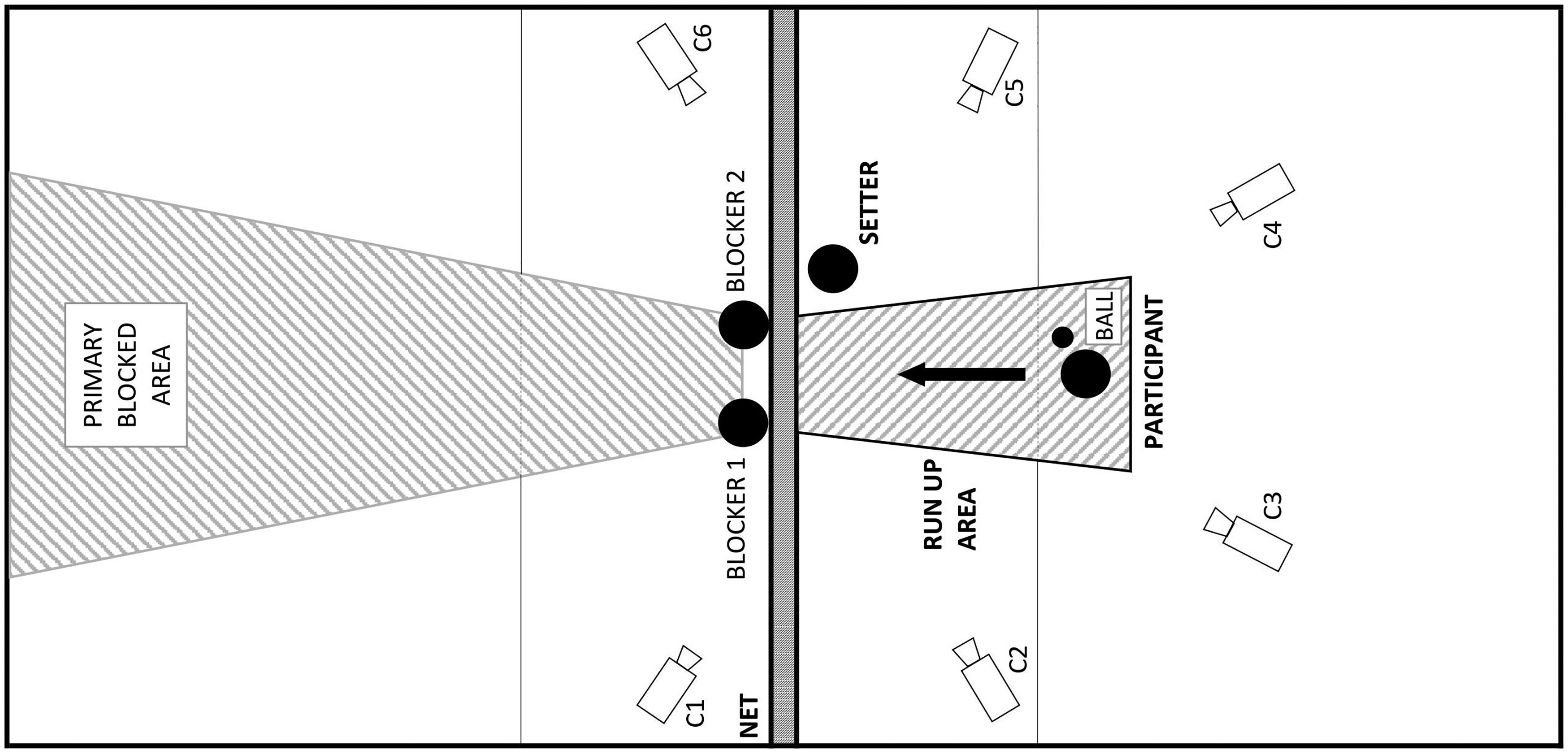
3-D motion capture set up with the schema of the procedure.
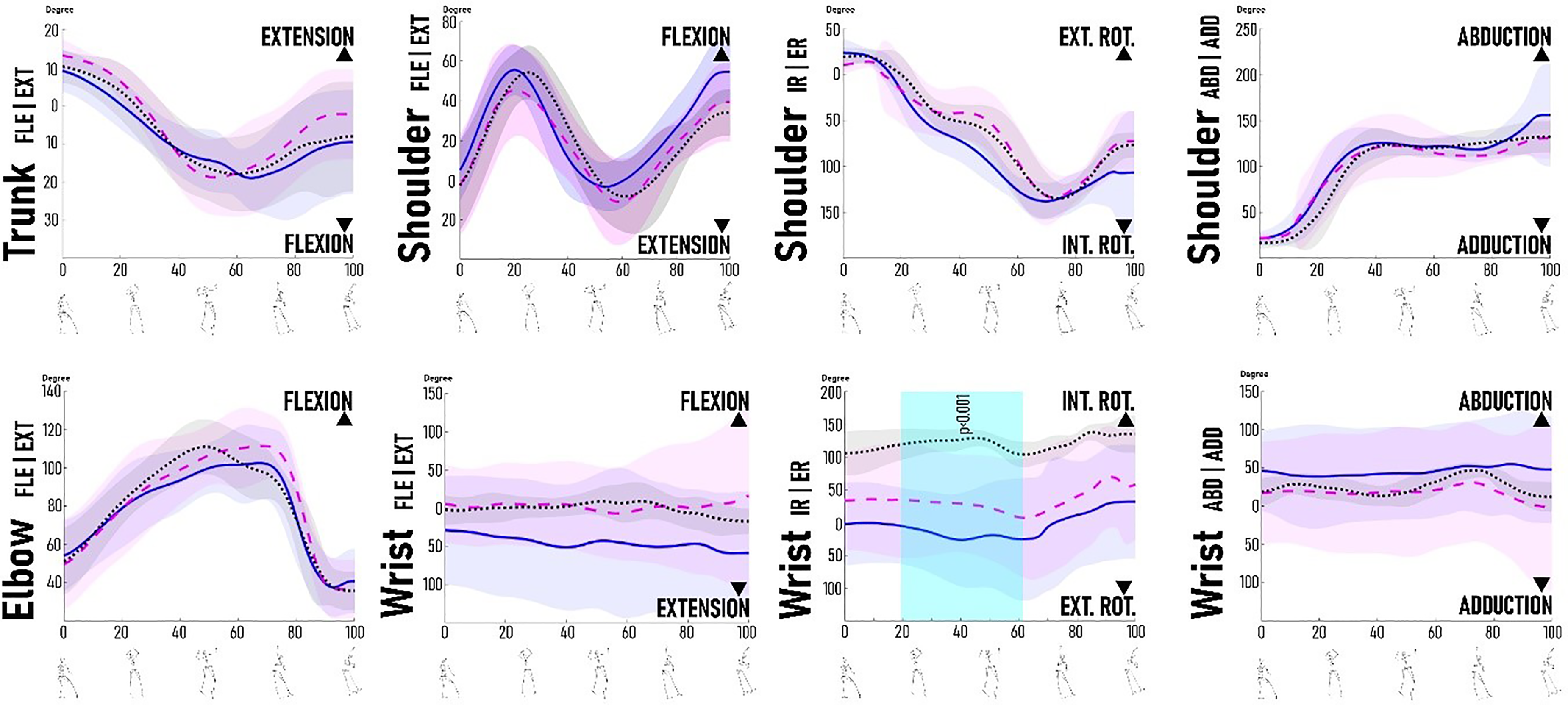
The trunk, shoulder, elbow, and wrist ROMs and their differences between U-16 (solid blue line), U-18 (magenta dashed lines), and U-20 (black dots).
The trunk, shoulder, elbow, and wrist joints’ angular velocities and their differences between the groups were shown in Figure 3. Compared to U-20 and U-18, U-16 players had significantly fewer shoulder external rotation angular velocities at around 19% to 22% (p = .044, η2 ≥ .01) and 85% to 89% (p = .035, η2 ≥ .06) of the spike performance, while they produced more shoulder external rotation angular velocities at 58% to 68% (p < .001, η2 ≥ .14) of the performance. In the wrist joint, the U-20 and U-18 groups produced significantly greater adduction velocities than the U-16 group at 77% to 86% (p < .001, η2 ≥ .14) of their performance. No significant differences were found in the trunk and elbow joint angular velocities, or with the shoulder angular velocities in the sagittal and frontal planes and the wrist in the sagittal and horizontal planes.
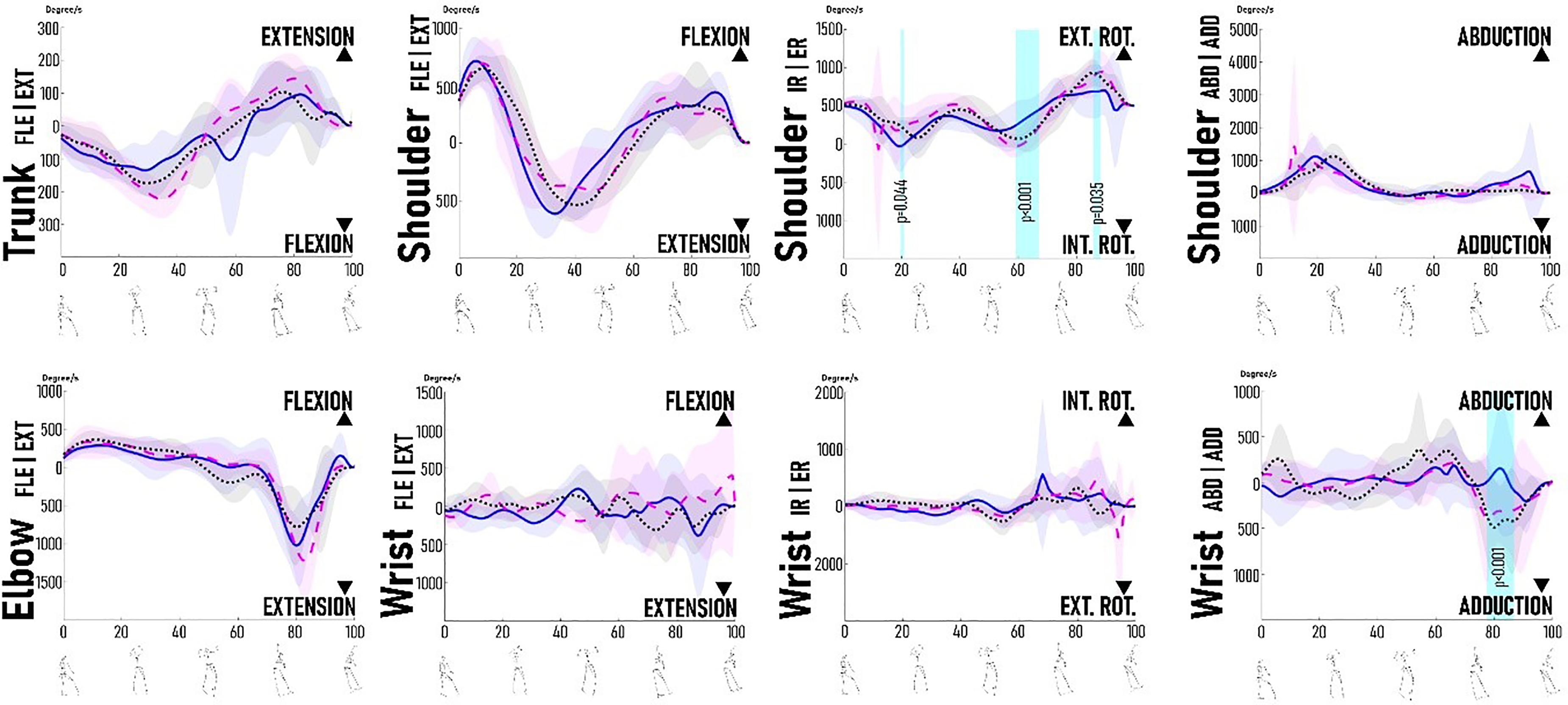
The trunk, shoulder, elbow, and wrist joints angular velocities and their differences between U-16 (solid blue line), U-18 (magenta dashed lines), and U-20 (black dots).
Figure 4 highlights the muscular activities. The result showed the U-20 group had significantly greater muscle activities of the BB at 23% to 26% (p = .029, η2 ≥ .14), 43% to 49% (p < .001, η2 ≥ .14), and 74% to 76% (p < .041, η2 ≥ .01) of the spike performance relative to the U-18 and U-16 groups. In PM, the U-20 group produced the higher muscle activities in the first 29% (p < .001, η2 ≥ .14), 35% to 37% (p < .044, η2 ≥ .01), 54% to 73% (p < .001, η2 ≥ .14), 78% to 86% (p < .001, η2 ≥ .14), and 91% to 97% (p < .001, η2 ≥ .14) of the spike performance, compared to the U-18 and U-16 groups. The U-20 group produced the greater values of AD activities at 47% to 63% (p < .001, η2 ≥ .14) and 85% to 94% (p < .001, η2 ≥ .14) of spike performance relative to the U-18 and U-16 groups. In PD, the U-16 group had significantly greater values at 14% to 16% (p = .038, η2 ≥ .06) of the spike performance than the U-20 and U-18 groups.
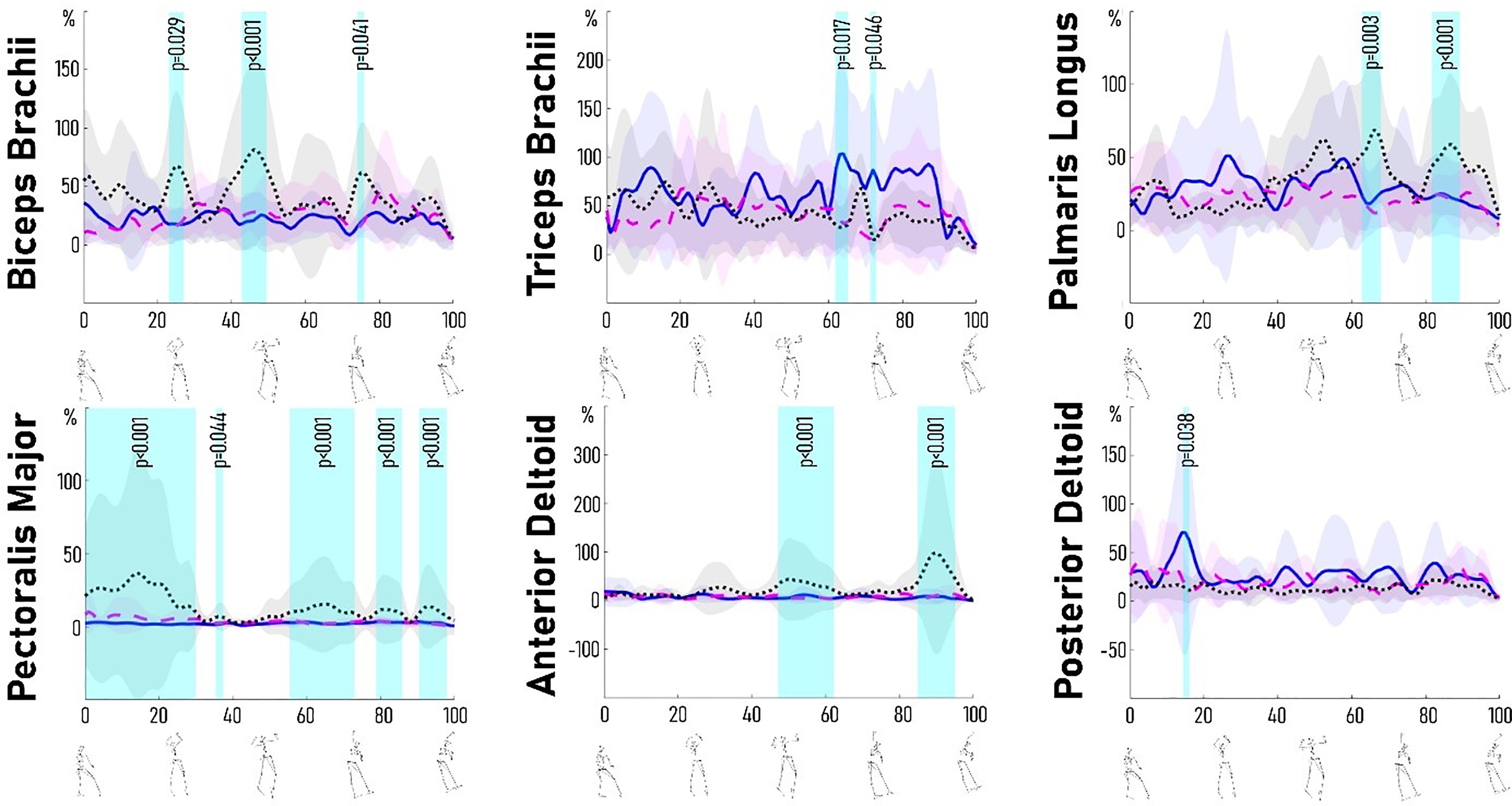
Muscular activity of the Biceps brachii, Triceps brachii, Palmaris longus, Pectoralis major, anterior deltoid, and posterior deltoid, and their differences between U-16 (solid blue line), U-18 (magenta dashed lines), and U-20 (black dots).
Discussion and implication
The purpose of the study was to examine the differences in upper limbs (a) ROMs, (b) angular velocities, and (c) muscular activities of VS under three different age groups of female volleyball players: under 16 (U-16), under 18 (U-18), and under 20 (U-20) years. What differentiated the present study from others was the examination of upper limb kinematics and muscle activity using time-series and comparisons within the age groups in an overarm hitting motion, specifically in VSs.
Range of motion
ROM is the capability of a joint to go through its complete spectrum of movements. We hypothesized that there would be a significant difference in maximal angles between the U-20 and the U-16 group. A significant difference regarding ROMs across the age groups was found in the wrist joint. During the cocking phase, the U-20 group performed significantly greater in wrist internal rotations than U-16 and U-18 groups and had different movement patterns across a sequence of spike performances. We assumed that the U-20 group was actively preparing their wrists for the ball impact, which was typically set from the right side from a setter. Furthermore, regarding the greater wrist internal rotation in U-20 groups, players might perform with more cross-diagonal trajectory during the spikes. Moreover, greater values of wrist internal rotation in U-20 may suggest that these attackers were trying to avoid blocking players to score a point. Indeed, Figure 2 shows less values of wrist flexion angle in U-16 compared to older groups; however, no significant difference was found in the wrist flexion angle among the groups.
Our findings first suggest that there was less experience with the benefits of wrist motions in the U-16 group compared to older groups. It's been well known that the wrist action in VS imparts ball topspin which causes the ball to drop in flight. 29 Regarding the physics involved, this phenomenon is known as the Magnus effect, leading an increased chance of the ball landing in the court. 30 Moreover, it has been observed that spikers who exhibit greater wrist flexion at ball impact can enhance both ball direction and striking speed. 31
Elite volleyball players performed an earlier elbow extension during the cocking phase, compared to the less experienced athletes. 12 In the current study, although the final elbow extension was performed almost at the same time across the groups, the U-20 players initiated elbow extension earlier, in approximately 50%, compared to almost 80% in younger players. Moreover, with greater elbow flexion in the cocking phase, followed by an earlier extension, we could assume a more effective stretch-shortening cycle of spiking in upper arm muscles in the U-20 group, compared to the younger groups. 32 Greater elbow extension in a ball-hitting moment was found to be a factor that caused higher spike velocity, 6 but also had a risk of shoulder muscles injury. 33 Despite non-significant differences in the current study, we found that the youngest players performed less elbow extension in the ball-hitting moment.
An active trunk flexion movement supports the acceleration of the spiking arm. 34 Additionally, it has been provided that a 0.2° increase in the shoulder-hip angle increased the volleyball ball speed by 0.28 m/s. 35 Nevertheless, no significant difference was found in trunk flexion across the age groups in the present study. Of all the joints, the shoulder produced the greatest ROM. During the ball-hitting moment, the shoulder abduction angle in female elite players was found to be between 130° and 133°. 35 This was in line with our results in U-18 and U-20 groups. A non-significant higher shoulder abduction (approximately 30°) during the ball-hitting moment was found in U-16, which could indicate that different ball-hitting strategies were utilized by young players with less experience.
Angular velocity
We hypothesized there would be significant differences across upper arm joints maximal angle velocity in U-20, compared to the U-16 group. Indeed, a significant difference in angular velocity was found in the wrist joint, when older players in the U-18 and U-20 groups performed in the acceleration phase before the ball impact significantly greater adduction velocities than the U-16 group. This finding can support the assumption about the “frozen” (less flexion) wrist in the U-16 group. This is important because adopting wrist movement (adduction) during the ball-hitting moment has been indicated an important factor for enhancing ball velocity and ball rotation, which helps to achieve a higher victory success rate in volleyball.17,29 Additionally, generation of momentum in the pelvis and torso with the following transition into great angular shoulder internal velocity and elbow flexion and extension angular velocities were found as essential factors to increase VS velocity. 6 In connection with this, a significant difference was found in greater shoulder internal rotation angular velocity at the current study, particularly before the ball-hitting moment in U-18 and U-20 compared to the U-16 group. This fits well with a previous study where the shoulder internal rotation angular velocity was consistently found to be a major contributor to ball velocity. 36 Moreover, a greater range between internal and external shoulder angular velocity in the acceleration phase in U-20 and U-18 could mean a more efficient spike execution mechanism. 6
Significantly higher elbow extension velocity with higher ball-hitting speed was previously found in top level female volleyball players (age: 23.3 ± 2.8), compared to female elite youth (age: 15.2 ± 0.5). 12 Although the current study is not providing ball speed, we have not found any significant differences in maximum elbow velocity across the age groups. Additionally, elbow extension angular velocity has been found to be between 975 and 1615°/s in elite female players.12,18 This may correspond with our finding when younger and less experienced female players achieved the peak of elbow extension angular velocity only between 750 and 1000°. In a previous study on handball throwing, a significant difference in ball velocity was observed in men's team-handball throwing. 5 Depending on the player's experience in training and competition, an effective proximal-to-distal sequence in maximal joint movements following higher ball speed velocity was found in elite players (25.3 ± 3.2 years, experience: 13.4 ± 2.1 years; ball speed: 24.2 ± 1.2 m/s), compared to experienced (age: 19.1 ± 3.1 years, experience: 6.6 ± 2.0 years, ball speed: 22.7 ± 2.8 m/s) and less experienced (age: 19.0 ± 5.2; experience: 1.6 ± 0.9, ball speed: 17.8 ± 2.1 m/s). 5
EMG muscle activity
The EMG muscle activity was investigated during upper extremity sports. 37 Nevertheless, only a few studies examined upper muscle activities inVS.7,13 Muscle firing patterns of eight glenohumeral muscles was quantified during the VS and serve in elite female players. 13 Different muscles activity in each phase of VS were examined under five different phases as follows: wind-up, cocking, acceleration, deceleration, and follow-through. Miura et al. (2020) investigated the effects of ball impact position on shoulder muscle activation during stand spiking in male volleyball players for injury prevention. 7 However, none of the studies included players’ upper arm kinematic analysis or age-related differences during the VS.
We hypothesized there would be significant differences in maximal muscular activity in the U-20, compared to the U-16 group. A significantly greater muscle activity in PL was found in the U-20 compared to the U-16 and U-20 groups in the acceleration phase. This significantly greater PL activation may partially correlate with our previous ROM and angular velocity results because PL participates in wrist movement and wrist flexion. Therefore, the assumption could be partially confirmed that the U-20 group with greater PL activity can use the wrist movement benefits more actively through greater wrist flexion, internal rotation, and adduction angular velocity before the ball-hitting moment. However, it should be noted that despite the higher values of wrist flexion angle in U-20 and U-18 groups during the spike execution time, compared to U-16 group, we have not found a significant difference in wrist flexion across the groups. Non-significant difference in wrist flexion in U-20, compared to U-18 and U-16 groups, may be explained by higher standard deviation in the ROM.
The current study also observed significantly greater PM activity in the U-20 group in wind-up and acceleration phases, compared to younger groups. In the wind-up phase of the VS, rapid adduction of upper limbs ends important arm swing which starts in the approach phase. 10 Therefore, with significantly greater PM activity in the wind-up phase, we could assume a more effective arm swing and more importantly, as corresponded with the ROM results, greater internal rotation compared in the U-20, compared to the U-16 and the U-18 players.
During the wind-up phase of the VS, peak activity was recorded in the AD. 13 This is most likely because the AD is important to help rapidly elevate the arm overhead. In the presented study, we also found a significantly greater AD in the wind-up phase in the U-20, compared to the younger groups, which could suggest more rapid dominant arm elevation. Moreover, greater AD activity in U-20 group appears to be related to horizontal adduction while the shoulder internally rotates. However, a significant peak of AD activity in the U-20 players was found particularly before the ball-hitting moment. One of the main roles of AD is shoulder internal rotation. Besides, the AD role becomes more significant (even more than PM) from 90° to full shoulder internal rotation. 38 Since volleyball players need to internally rotate their shoulder to execute spike, they need a strong AD activity (more motor unit firing rate) to hit the ball stronger (or faster). 19 Through a kinematic chain, the shoulder internal rotation (or arm) transfers a useful momentum to the forearm and hand, which aids in faster spike. 39
A significantly greater BB (shoulder flexor and adductor) activity during the cocking phase in U-20 may also help players to generate higher shoulder compressive force 40 and greater abduction and flexion of the shoulder during the acceleration phase. However, there was no significant greater shoulder adduction and flexion when performed by the U-16 players. Because the TB (long head), together with the BB (both heads), cross the shoulder, they both generated activity in the cocking phase to stabilize the shoulder. Furthermore, high eccentric contraction by the TB was needed to help control the rate of elbow flexion followed by rapid elbow extension. 37 Significantly greater activity was found in the TB during the acceleration phase in the U-16, compared to the U-18 and the U-20 groups. Therefore, this could be explained through the higher peak elbow extension angular velocity in the U-16 group.
It is important to note that greater muscular strength allowed an individual to potentiate earlier and decreased the risk of injury. 41 However, higher muscular activity did not simply lead to higher performance outcomes.42,43 For instance, Gowan et al. (1987) found 50% greater PM a BB activity in amateur pitchers compared to elite players. 42 Therefore, higher muscular activity in amateur players could relate to better throwing efficiency with better coordinated body segments in elite players. 42 Additionally, increased movement accuracy and reduced EMG activity were found by adopting an external focus of attention in basketball free throws. 43 Understanding complex biomechanical principles, including time-series of ROM, joint angular velocities, and muscle activation in VS performance across different age groups can be helpful to trainers, coaches, and physicians to provide appropriate training methods. Moreover, the overview of the present study may help health professionals to better understand upper limb joint and muscle injuries.
Interval of interest in the data collection was defined from the start of the plant phase to the ball-hitting moment. 14 Therefore, the limitation of this study would be due to the absence of ball speed. However, the prior objective of the study was to provide upper limb time-series differences in kinematics and muscle activity during the VS. The time-series of upper limbs ROM, joint angular velocity, and muscle recruitment patterns could influence spiking techniques 18 and ball-hitting positions. 7 Nevertheless, the current study was performed in real-game-simulated conditions with the presence of the blocks. The U-16 group exhibited the greatest standard deviations in their performance (especially in ROM and angular velocities of the trunk, elbow, and wrist), which suggests less stability in performing VS due to their less experience. Lack of significant difference in the ROM and angular velocities in the elbow and shoulder could be due to the small sample size or real-game situations. Also, the greater standard deviation could also be another reason for the lack of significant differences between the age groups. This highlighted the necessity of a larger sample size for future studies. Indeed, complex biomechanical analyses of VS are still challenging. Investigating upper limb kinematic and EMG data during volleyball spiking across different age groups in real-game-simulated conditions yields valuable and unique information that is not currently available in the literature. However, future research should focus on examining age-related biomechanical differences in VS biomechanics during actual game conditions, such as during competitive matches.
Conclusion
A significantly greater wrist internal rotation, angular adduction velocity, and musculus PL activity was found in the acceleration phase in the U-20, compared with the U-16 group, suggesting more upper limb coordination maturity exists in older players, allowing them to have higher ball and rotation speed of active wrist movements in ball-hitting motions. Additionally, the U-20 and U-18 players performed with a significantly greater range between shoulder external and internal angular velocity, compared with the U-16 group. In addition, greater muscle activity of the musculus PM, BB, and AD was observed in the U-20 group, compared to younger groups. The findings of the present study provide a complex biomechanical and time-series overview of the upper limbs VS performance of age-related differences in young female volleyball players.
Footnotes
Author note
Javad Sarvestan is currently affiliated with Biomechanics and Functional Morphology Laboratory, CIPER, Faculdade de Motricidade Humana, University of Lisbon, Portugal.
Declaration of conflicting interests
The author(s) declared no potential conflicts of interest with respect to the research, authorship, and/or publication of this article.
Ethical approval
The institutional review board of the Faculty of Physical Culture of the Palacký University in Olomouc has ethically approved this study (ethical code 79/18).
Funding
The author(s) received no financial support for the research, authorship, and/or publication of this article
