




Abstract
This study assessed the between-day reliability of change of direction (COD) biomechanics and speed in youth soccer players using inertial measurement units (IMUs) and high-speed video. A soccer-specific COD test including a 180° pivot turn was performed in both directions by 15 elite female (age: 15.3 ± 0.6 years; height 162.6 ± 5.5 cm; body mass: 56.7 ± 7.1 kg) and 22 elite male (age: 15.4 ± 0.5 years; height 169 ± 5.9 cm; body mass: 58.5 ± 8.5 kg) youth soccer players in two consecutive days. The reliability of the variables was quantified by using intra-class correlation coefficient (ICC) analysis with limits of agreement (LoA) and Bland–Altman plots. Based on the results, neither peak resultant acceleration (PRA) nor peak angular velocity (PAV) during final foot contact was sufficiently reliable for 180° pivot turn biomechanics (poor reliability, < 0.5), but the reliability of players’ running time to turn and total time was between acceptable to good (0.9>; > 0.7). However, when analyzing females and males separately, the PRA and angular velocity ICC's for females had poor to acceptable reliability, when turning left, and were statistically different from males (Z-score > 1.96). Acceptable to good reliability with reasonable (max 15% difference) LoA implies that speed measures in different phases of COD could reliably reproduce individual differences in 180° pivot turn COD speed. Sex-related differences in repeatability of acceleration and angular velocity call for more comprehensive research in the future. PAV and PRA would not be recommended for the purpose of analyzing individual repeatability of specific steps of COD movement.
Introduction
Change of direction (COD) tests are commonly used in youth soccer to evaluate physical performance. However, the tests vary based on durations, lengths, and turning angles of COD.1,2 COD movement is characterized as running with pre-planned directional change and defined as COD speed, whereas agility includes also recognition of a stimulus, reaction, or execution of a physical response. 3 Soccer is a sport where agility plays an important role in evading opposing players to create scoring chances or react to opposing players’ movements while defending. 4 Research in youth soccer has shown that it is possible to discriminate between elite and sub-elite players based on agility/COD speed testing, 5 it is possible to use dexterity scores to predict agility, 6 and that COD speed and reactive agility (RAG) tests are reliable in youth soccer players and also discriminate between U19 and U17 players. 7 Based on research, agility and COD speed are independent skills, 4 and the improvements gained in training in soccer require specific training—including reactive components to improve agility and movements without ball to improve COD speed.4,8 Therefore, the correct terminology on what is being tested is important and not always well explained in studies on COD ability. Testing and monitoring methods that combine physical and cognitive methods better are warranted, as well as variables that might explain the differences during the important phases of the movement.4,9
COD speed and performance have been shown to decline, and the COD deficit increased (i.e., the time difference between a COD over a given distance compared to the same distance covered while sprinting in a straight line) in previous research for different age groups. 9 This has been shown to exist across adolescent (U15) and adult soccer players. 10 In U13–U15 players, motor coordination has been shown to be influencing agility/COD speed regardless of maturation status. A longitudinal study by Forsman et al. 11 showed that soccer-specific agility stayed relatively high through season in U12–U14 players. Therefore, reliable methods of COD movement analysis for youth age groups are warranted. However, research on COD speed should not automatically be related to agility, because agility involves a coupled sensorimotor reaction to an external stimulus and requires different monitoring strategies to quantify factors related to on-field performance. 12
T-test, zigzag test, 5-0-5, arrowhead test, and Illinois agility run are typical COD speed tests used in team sports.2,13 The outcome variable used is the time to complete the test. Reliability of these types of tests is good; however, there can be more variability in the results in younger age groups.14,15 Other concerns relate to the degree to which the tests quantify soccer-specific performance and the validity to discriminate COD ability from speed, since linear speed has a major effect on finishing time, possibly masking the actual COD ability. 16 In biomechanical analysis, COD ability has been evaluated using ground reaction forces (GRFs), joint angles, and speed using force plates, motion capture systems, and timing gates or lasers.17–19
Multi-dimensional approach for player development requires data collection methods that capture variables of the movement on specific timepoint that are relevant for the execution. Inertial measurement units (IMUs) have potential in measuring COD movement patterns during sport-specific movements and could provide more specific information about performance enhancement or injury risk. IMUs could be utilized to provide information about the quality of not only whole-body movements but also individual segments during a COD movement. 20 Previous studies have aimed to quantify running kinetics in soccer players and knee kinematics during COD tasks in soccer players. These studies have concluded that the reliability of IMU-derived measurements is poor and has not recommended IMU measures for kinematic analyses.21–23 However, the reliability of cumulative impact loading has been reported to be acceptable as well as workload measures across playing positions in soccer players.24,25 In addition, the intra-unit reliability for evaluation of step metrics in team sport-based tasks and concurrent validity for ball touches and releases in soccer have been reported to be acceptable,26,27 suggesting the usefulness of IMU-based measures in soccer-specific tasks.
COD movement has been studied earlier using IMUs.28–30 Used variables include peak accelerations (center of mass and segmental), resultant accelerations, COD counts, COD angles, and estimated GRFs. 31 The reliability of measures of the movement—forces, mechanical load, or acceleration—is inconsistent, and more research is needed. In runners, tibial accelerations measured with IMUs have been shown to be affected by technique, velocity, and stiffness, 32 and lower back accelerations have been used to define a stable individual running pattern. 33 Angular velocities measured from the trunk have also been used when studying turning while walking.34,35 However, these IMU variables have not been used earlier together with speed measurements to explain individual differences in COD, during COD speed tests.
In soccer players, reliable individual COD speed measures with IMUs could be used in studies assessing on-field performance and possibly provide information to fill the gaps about the individual characteristics in agility. Therefore, the primary aim of this study was to assess the between-day reliability of soccer-specific COD test (including wall pass and fast 180° pivot turn) measured with IMUs. Secondary aim was to compare differences in reliability between females and males. Reliable testing methods with IMUs could provide youth soccer stakeholders a more appropriate method to assess COD technique for player development or injury prevention purposes.
Materials and methods
Participants
Thirty-seven (15 female, 22 male) elite-level youth soccer players from a local club in Calgary, Alberta, completed both baseline testing sessions and were included in the analysis of this study. Baseline characteristics of the players are presented in Table 1. Playing years, playing position, injury history, and limb dominance were collected with a baseline questionnaire, and participant height, body mass, and sitting height (for the use of percentage of adult height) were measured before the testing session with portable measurement units (Seca GmbH, Seca 217, and Seca 437). To be eligible to participate, the participants needed to be injury free. Participants wore t-shirt and shorts and were barefoot for the weight and height measurements. The dates of the tests were scheduled for a week when none of the teams had games and the training schedule was easy. The study ethics were approved by the Conjoint Medical Ethics Committee (REB19-0428), and all participants signed a written mature minor consent prior to participation.
Baseline characteristics.
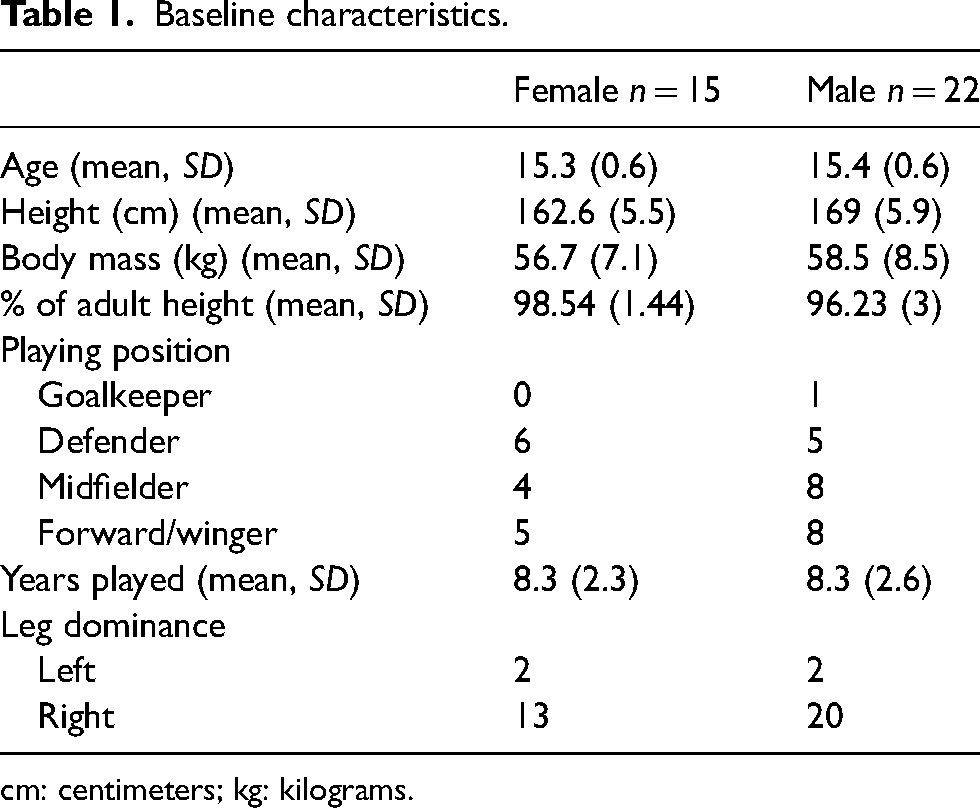
cm: centimeters; kg: kilograms.
Testing protocol
The soccer-specific COD test that was used was initially presented by Pasanen et al. 36 in 2015. Participants performed the test on two consecutive days in October 2021 on a turf field in an indoor soccer facility. Participants arrived at the facility as teams and performed a standardized neuromuscular training warm-up before the testing session. After team warm-up, participants performed one practice run per side (left/right) to get familiarized with the running sequence. The test started with a wall pass (“give and go”) from a trained research assistant (RA), followed by a maximal effort COD trial including 180° pivot turn. The participants performed only one trial per side, to minimize the learning effects and have the participants perform as naturally as possible. Figures 1 and 2 show the sequence of the run and a player performing the test.
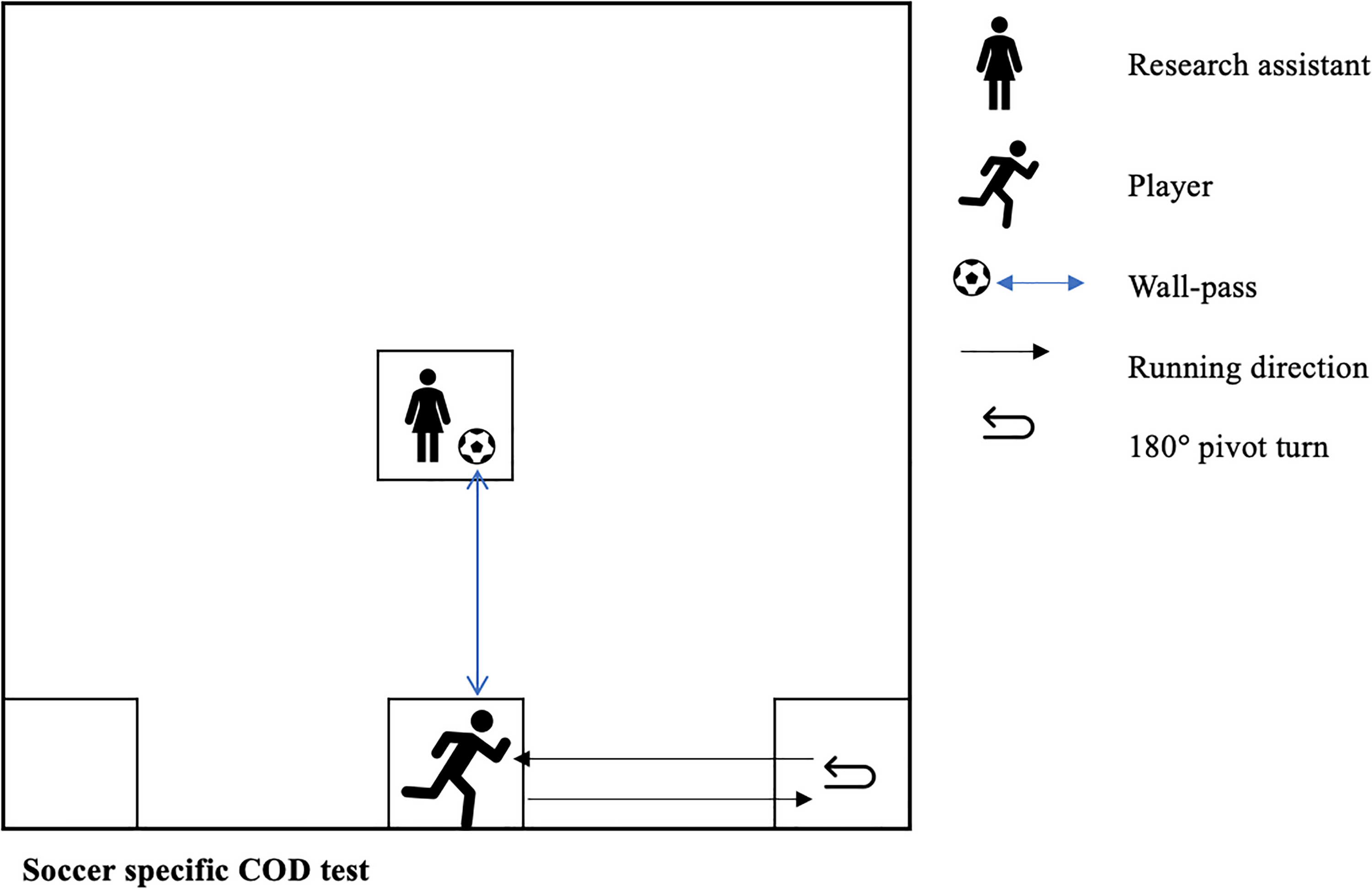
Map of the test, displaying left turning 180° pivot turn.
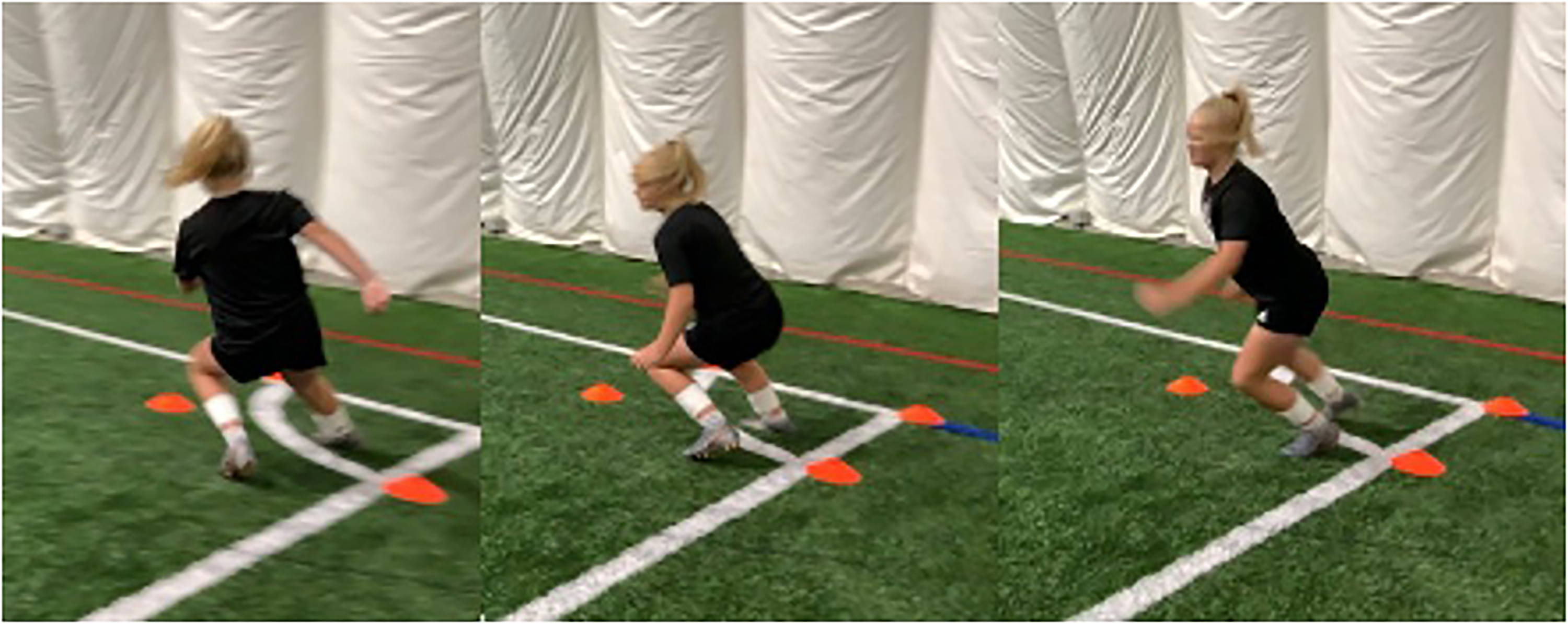
Change of direction test: player making a left turning 180° pivot turn.
Data collection
Acceleration (m/s2) and angular velocity (rad/s) were collected with wireless dual-g triaxial IMU devices (Vicon Blue Trident, ± 16 g, 1125 Hz, ± 2000°/s). The IMU was placed on participants’ lower back (L4 level) by RAs, who were trained by an experienced physiotherapist. Vicon iCaptureU application was used to control the devices and for synchronized video recording of the trials. Raw IMU data were downloaded after the session and stored for the analysis. Final foot contact of 180° pivot turn was identified from IMU data with the use of a specific MATLAB (MathWorks Inc., Natick, MA, USA, Version R2022b) script and verified by comparing the obtained timepoint with the timepoints from iCaptureU videos of the trials. Peak resultant acceleration (PRA) and peak angular velocity (PAV) were calculated for all trials after filtering the raw data using sixth-order Butterworth filter with cutoff frequency of 40 Hz. The cutoff frequency was based on fast Fourier analysis of the data and previous studies on using IMUs in COD analysis. 29
Statistical analysis
Statistical analysis was performed in R-studio (R-foundation, 2022.07.1). Intra-class correlation coefficient (ICC) was used to calculate the between-day reliability for PRA and PAV during the pivoting phase (Figure 2) of the 180° pivot turn for both sides (left/right) and time to turn (TTo) and total time (TotalT) from initial ball touch to initial ground contact when player returned to the starting square. Two-way random effects ICC (ICC 2,1) was used and interpreted as follows: excellent ≥ 0.9; 0.9 > good ≥ 0.8; 0.8 > acceptable ≥ 0.7; 0.7 > questionable ≥ 0.6; 0.6 > poor ≥ 0.5; and unacceptable < 0.5. 37 Z-test was used to calculate if there was a statistically significant difference between the ICC values of females and males. Critical value for the Z-test was set at 1.96.
Limits of agreement were used as the method to describe absolute reliability as recommended by Atkinson and Nevill, 37 and associated Bland–Altman plots were used to show the schematical measurement. In addition, heteroscedasticity was examined from the Bland–Altman plots by calculating the correlation coefficient between absolute differences and the means. The limits of agreement were represented as absolute values and ratios.
Results
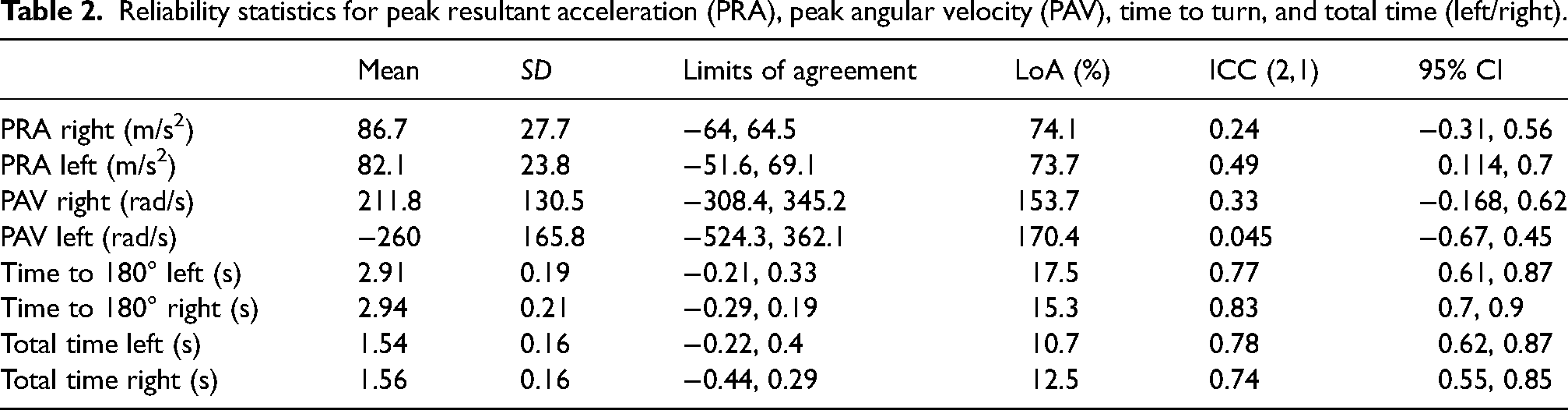
Between-day reliability for both PRA and PAV was unacceptable (<0.5), and as the limits of agreement were >70% for PRA and >150% for PAV (Table 2), these variables would not be recommended for test–retest analysis of COD. However, when females and males were analyzed separately (Table 3), the ICC for PRA was from poor to acceptable for females whereas the repeatability for PAV measurements was unacceptable. For males, PRA and PAV ICCs remained unacceptable. The reliability for both sides for the running TTo and the TotalT was from acceptable to good. When analyzing groups based on sex, the reliability of TTo and TotalT was from acceptable to good for females and from poor to acceptable for males. The means of the measures between the 2 days were not different, suggesting that a learning effect did not influence the results.
Reliability statistics for peak resultant acceleration (PRA), peak angular velocity (PAV), time to turn, and total time (left/right).
Differences between males and females on between-day ICC values. Z-score significance level set at > 1.96.
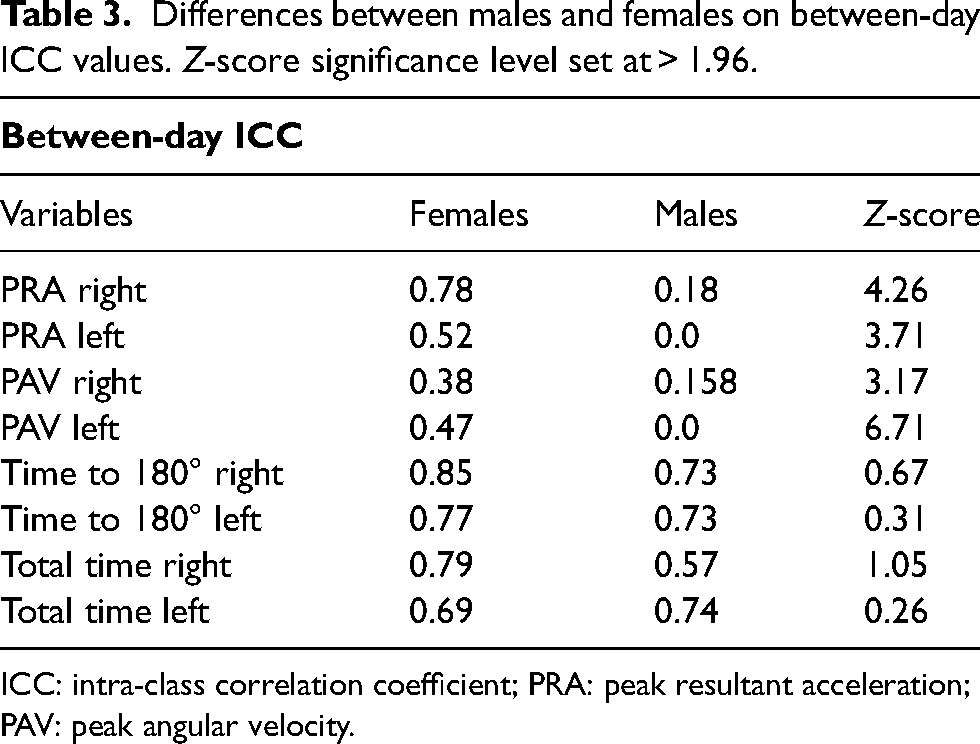
ICC: intra-class correlation coefficient; PRA: peak resultant acceleration; PAV: peak angular velocity.
Running times were not correlated to acceleration or angular velocity regardless of turn side or sex, suggesting that peak acceleration or angular velocity per se is not enough to quantify individual performance during COD. Based on the Bland–Altman plots (Figure 3), slight heteroscedasticity was suspected, and based on correlation between absolute differences and individual means, PAV (both sides) and TTo (left) proved to be heteroscedastic. Due to this, the limits of agreement were presented additionally as ratios, as suggested by Atkinson and Nevill. 37 Limits of agreement show that the expected difference between test–retest for both PRA and PAV was large (approximately ±65 m/s2 or ∼70% for PRA and ±350 rad/s or over 100% for PAV; Table 2), which explains the unacceptable ICC values and underlines the high within-subject variability of these metrics between days.
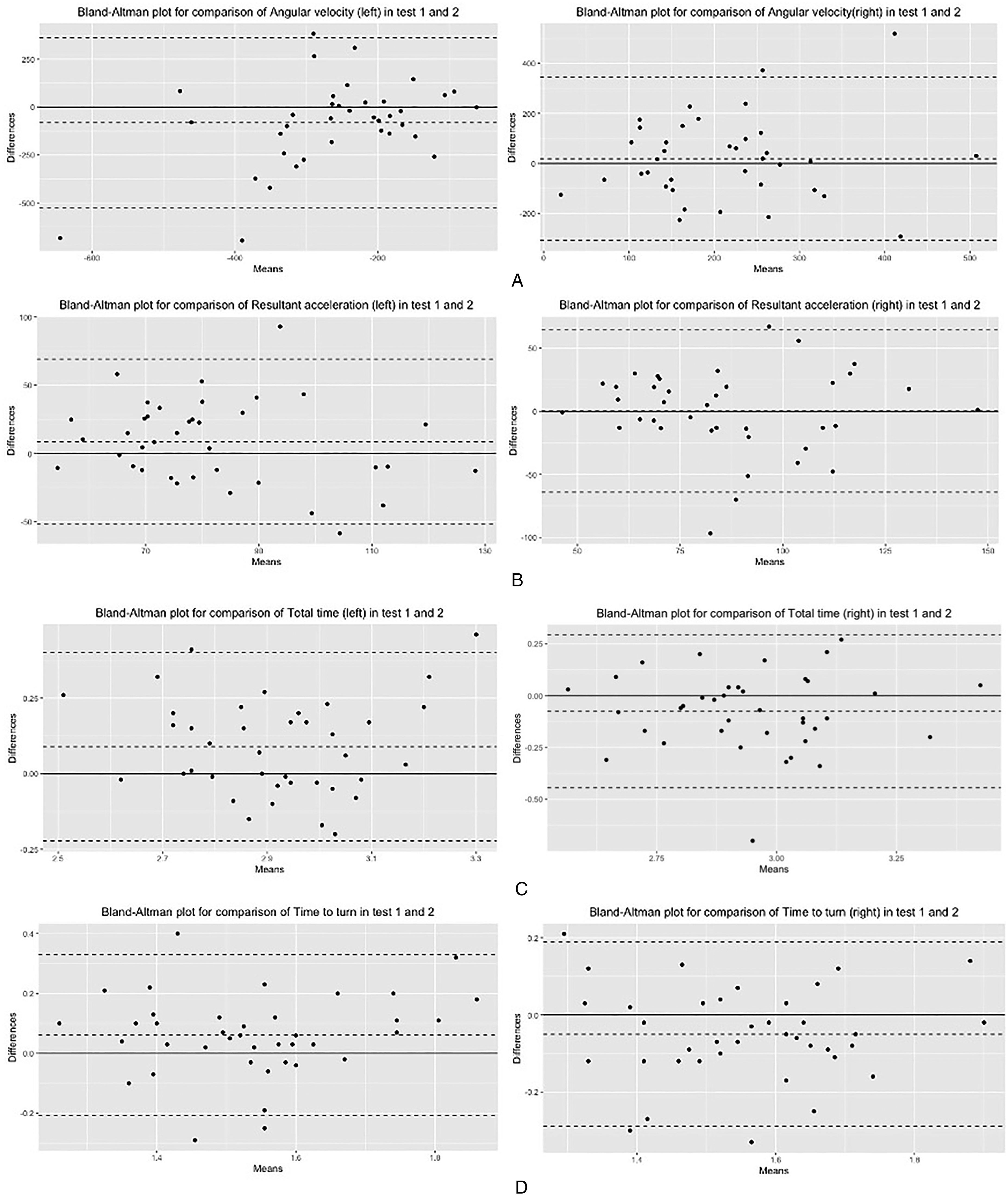
Bland–Altman plots for (a) peak angular velocity, (b) peak resultant acceleration, (c) total time, and (d) time to turn, with limits of agreement (LoA).
The ICC values for both PRA and PAV for females were significantly different (Z-score > 1.96) from the ICC values of males, whereas the speed-related ICCs were similar between the sexes (Table 3).
Discussion
This study determined the between-day reliability of IMU-measured PRA, PAV, TTo, and TotalT during a 180° pivot turn in a soccer-specific COD test. PRA and PAV showed unacceptable reliability regardless of the turning side (left/right) and unacceptable limits of agreement, whereas TTo and TotalT achieved acceptable to good reliability. In addition, females and males did not have comparable reliability for PRA and PAV, indicating that females tended to have better repeatability for these specific variables regardless of turning side. These results imply that PRA and PAV would not reproduce reliable results for COD tests for youth soccer players and therefore would be considered as unsuitable, but timing different phases of the trial could be used for player evaluation. Monitored sex-related differences call for further studies on the phenomena and inclusion of other IMU-captured variables in the analysis.
Previous studies analyzing the reliability of IMU metrics have mostly concentrated on manufacturer-provided metrics, like IMU step metric or impact load,25,26 showing acceptable reliability. However, COD-related reliability studies are more often laboratory-based, and due to inconclusive results, the recommendations for metrics are lacking. 31 There are more studies published using IMUs for analysis while running, which also have been reported to be far away from real-world conditions. 38 Research has shown that for running, approximately 4–5 days of data collection with IMUs is necessary to define a stable running pattern.33,39 The unacceptable reliability found in our results could be related to not having enough trials per individual. The biomechanical execution of 180° pivot turn is more complex than running, and for the purpose of this study, players only did trials on two consecutive days. Movement variability has also been seen in studies looking at jump landings, suggesting day-to-day variability in high-energy movements.40,41 However, lower back-measured PRAs for drop landing and rebound jumps have shown moderate to good reliability in previous studies. 42
Between-day reliability of running times related to 180° pivot turn was acceptable or good. Similar results have been seen when analyzing the reliability of other COD tests including 180° pivot turns. 43 This is an important result for this study as well, as it shows that although the players finished the task at the same speed, the way of performing the actual pivot turn varied based on PRA and PAV values. To understand this variability and how it is possibly related to biomechanical factors during the COD movement would be the goal for future studies. In this study, the skeletal maturity was assessed by measuring sitting height and calculating the percentage of adult height (Table 1). An individual is generally considered to have passed their peak height velocity (PHV) once they reach 97% of their adult height. 44 Female players’ mean of percentage of adult height was over 98% (SD = 1.44), but for males, the mean was under 96% (SD = 3), indicating that several male players were still in PHV stage. Less mature individuals have been shown to have greater differences in performance between testing and training sessions, 14 which could explain the differences that were seen in the reliability values between males and females in our study. In addition, this would further suggest that caution should be used when evaluating maturing athletes and especially comparing athletes in different maturational stages with each other.
This was the first study to report between-day reliability for PRA, PAV, TTo, and TotalT during a soccer-specific 180° pivot turn. Based on these results, PRA or PAV cannot be recommended to be used as individual factors of COD repeatability. However, these metrics might prove useful in combination with other variables, especially when trying to explain differences between males and females and changes throughout the maturational status.
Conclusion
The between-session reliability of acceleration and angular velocity–related variables was unacceptable, whereas speed-related variables showed acceptable to good reliability. In addition, female soccer players showed better reliability in acceleration and angular velocity–related variables than males. Based on these results, COD speed in different stages of a soccer-specific test is a reliable method to discriminate between athletes. Acceleration and angular velocity–related variables need to be combined with other variables to possibly provide more information in the future, related to differences between athletes, regarding sex and maturational status.
Footnotes
Acknowledgments
The authors would like to thank Eric Gibson, Meghan Critchley, Sophia Lederhos, Maria Morales Ordonez, James Baysic, Briana Toews, Haley Truscott, Nesa Keshavarz Moghadam, Sushrut Mohapatra, Nicholas Ang, and Carla van den Berg for their assistance with data collection.
Declaration of conflicting interests
The author(s) declared no potential conflicts of interest with respect to the research, authorship, and/or publication of this article.
Funding
The author(s) disclosed receipt of the following financial support for the research, authorship, and/or publication of this article: This research received internal funding from the Faculty of Kinesiology, University of Calgary—Dean's Doctoral Scholarship and external funding from Sport Institute Foundation of Finland—research grant 20210058. Partial funding was provided by the NSERC Wearable Technology Research and Collaboration (WeTRAC) CREATE training program.
