




Abstract
Several severe performance blocks have been described in the sport psychology literature, in particular the lost move and the yips. Beyond the identification of the traumatic situations associated with these problems, there is a lack of understanding of the process that ultimately culminates in performance blocks. In the present study, a situated and dynamic analysis of a specific type of block in acrobatics was conducted to: (i) identify the propensities of trampolinists to develop lost move, (ii) categorize the types of moves involved, (iii) determine the circumstances of the occurrence of lost moves as typical situations, and (iv) describe the evolution of the loss and its duration. The nine national and international-level French-speaking coaches we interviewed were asked to describe the lost moves they had experienced as coaches. Prior to their interview, each coach had to answer a questionnaire in which they were asked to identify the number of lost moves they experienced. Based on our results, lost moves appeared as evolutive adaptative processes with four steps: disruption, manifestation, contamination, and final adaptation. The phenomenon appeared as observable behavioral manifestations emerging from the interaction between athletes’ dispositions and the situations in which they find themselves throughout their sporting careers. Thus, lost moves might be considered as transitional states in skill development to which an athlete’s performance can branch off. Three main levels of concrete interventions were described, including careful consideration of the athletes’ dispositions and life-course circumstances, avoiding contamination, time off, and engaging in other activities.
At the 2020 Tokyo Olympic Games, Simone Biles, considered to be the best gymnast of all time, drew the attention of the world sports community by withdrawing from competition because of the “twisties.” In her own words, Biles defined the twisties as a random loss of body control and spatial orientation that had initially occurred on bars and beams and then on vault and floor. 1 Given her fame, sports fans all over the world learned about this spectacular phenomenon, although it has long been known to professionals in the world of acrobatics (trampolining, diving, acrobatics, and skiing).2,3 The inability to perform previously automatic skills has been described with a variety of names: a balk (aborting a skill in the middle of skill execution) or a mental block in gymnastics, 4 lost move syndrome (LMS) in trampolining, 5 sports performance phobia in tennis and baseball, 6 and yips in golf and cricket.7–9 Paradoxical performance 10 and performance blocks 11 appear to encompass these multiple performance disorders that have been studied in sports psychology. Paradoxical performance can be characterized as a situation in which athletes are able to perform and intend to perform but do not succeed in doing what they intended. 12 First proposed by Bennett et al., 11 (p. 19) performance blocks can be “characterized by a sudden and temporary loss of fine, and/or gross motor, and cognitive control, manifesting as locked, stuck, or frozen movements.”
The small number of studies on performance blocks have given the most attention to yips and LMS,5,7,13,14 and these have at times been studied together.11,12,15 Mostly observed in golf, yips have been defined as “a psycho-neuromuscular impediment affecting the execution of fine motor skills during sporting performance” 16 (p. 177) and have often been linked to focal dystonia, a neuromuscular movement disorder characterized by involuntary movements affecting the execution of a skill previously performed with ease. 17 In this context, yips are considered a neuromuscular problem leading to involuntary movements that occur throughout the execution of a skill. In contrast to yips and prevalent in artistic sports (e.g. trampolining, gymnastics, and diving), LMS refers to a psychological disturbance or a traumatic experience. The phenomenon has been described as a psychological condition in which athletes lose the ability to execute a particular skill that was previously automatic/able.5,18 As evidence that this syndrome is not well-defined and poorly understood, there is a wide range of LMS descriptions associated with the multiplicity of disorders observed in acrobatic sports. For example, in gymnastics, Maaranen et al.19,20 examined a specific disorder, flikikammo, that describes a temporary condition in which gymnasts lose the ability to perform previously automatic backward skills for reasons unrelated to slumping, choking, or fear of injury. The authors described how gymnasts cannot move backward when they experience physiological states such as feeling sick to the stomach while thinking about the move. Thus, athletes affected by flikikammo are physically able to perform the moves but cannot execute them on demand due to other factors that are still unknown. In cheerleading, Lawrence investigated the specific tumbling skills affected by mental blocks, a phenomenon in which a gymnast's “mind no longer allows her to perform a physical skill that was previously well-learned and automatic.” 21 (p.1) Finally, trampolining “black out” 22 describes an unsuccessful performance of a previously well-learned movement or element by either too much or not enough rotation in the somersault. Of the 58 trampolinists who completed a questionnaire, 31 (60%) reported having experienced a “black out.” To our knowledge, this study is the only one that contributes to identifying the prevalence of blocks in trampolining. However, it does not explain all the blocks that can be experienced in trampolining, nor the mechanisms of appearance and evolution over time. Furthermore, it is difficult to assess its contribution given the limited methodological information presented in this study. From field experience, Calmels 23 observed and described the many manifestations of a “refusal to initiate a movement” in several sports such as diving, trampolining, and gymnastics as encompassing the interruption of the run-up to a dive and the failure to initiate a rotation in trampoline. She described but failed to really define and distinguish them from other types of blocks. According to the author, the reasons for refusals are difficult to identify and might be related to the athlete’s learning process, over-analysis of movement, fusion of motor patterns, perceptual and decisional saturation, difficult life episodes, or injury. Finally, while the psychological characteristics and consequences of trampolinists experiencing lost moves (LMs) have been investigated, 5 little is known about the circumstances of LM occurrence and why an athlete would experience LM. 24
Many of these studies have been derived from cognitive epistemology and have enhanced our understanding of LM in acrobatics, which can be summarized as the phenomenon in which the motor program corresponding to a movement that has been stored is becoming dysfunctional. 25 This approach to the phenomenon reduces descriptions in a linear way. Yet, such explanations fail to include the various adaptations between the athletes and the situations that lead to all types of LM, including the variability in occurrence, the circumstances of appearance, and the evolution over time. It is, nevertheless, likely that the onset of a movement loss is not a binary process (I can/I can’t do it) but rather a gradual or quick change in the acrobatic development emerging from the interaction between the athlete and the situation.26,27 It is also likely that the process of loss occurs in a jerky manner, with brief losses, occasional recoveries, readjustments in the coaching, and so on. Thus, we may indeed lack knowledge about a long and dynamic process that ultimately culminates in the lost move state. An alternative way to study LMS would be to take a situated approach in which the interaction between the athlete and the situation might well explain the emergence of LM. This approach has been taken in previous studies of performance in general and in acrobatic sports,26,28 doping, 29 and learning.30,31 In this approach, performance in general and, therefore, lost move states was found to emerge from the interaction between athletes’ propensities to act, including mental and physical dispositions and resources such as technical skills and cultural habits, and a specific environment by building the situation. 32 By using a situated approach, our design allowed the identification of the circumstances of occurrence, the evolution of the phenomenon over time and the conditions for the emergence of this kind of maladaptation.
Acrobatic sports appear to be a fertile ground for observing and understanding LM, and trampolining is one of the fundamental disciplines of acrobatic sports. 27 It is a discipline in its own right, and yet most disciplines also use it for learning acrobatic movements in which acrobatic skills are required (e.g. gymnastics, tumbling, and freestyle skiing). In its competitive format, trampolining consists of chaining 10 acrobatic moves by a series of bounces on the trampoline bed and flights in which various body rotations are combined.33,34 Since its appearance at the 2000 Sydney Olympic Games, trampolining has continued to evolve in terms of requirements, equipment, and, therefore, the number and types of rotation performed during the acrobatic moves. In the 2000s, the best athletes had an average of two triple rotations per 10 routine moves. Today, not only has the number of spins and twists increased in elite trampolining, but more complex movements are learned and executed at a very young age. Moreover, LM is an issue that trampoline coaches face, which leads them to question where it may come from or how to deal with it when it occurs.35,36 Thus, it would be relevant to examine the perspective of coaches who have observed LM during their careers by asking them to describe both the LM observed and the athletes who experienced it.
To summarize, several severe performance problems have been described in the sports psychology literature under disparate labels and terms that are often used interchangeably. Bennett et al. 11 proposed the performance block concept and introduced a generic terminology that was expected to facilitate the identification of performance issues/disorders. However, they only focused on LM and yips and even studied them together,11,37,38 failing to grasp the complexity of the phenomena that in many cases were not comparable in terms of characteristics, consequences, or intervention. For example, being suddenly lost in the middle of a movement or stopping a movement could inherently lead to a serious injury in acrobatics, which is not the case for yips in golf. 19 The generic term “blocks” implies that a typical problem in sports has been identified, but it overlooks the differences between sports and the specificity of blocks within the same sport, thus making it difficult to give an accurate account of this type of state. Specifically in acrobatics, no study has examined in detail the various LM observed in acrobatics. Understanding of the phenomenon and the design of effective interventions to address LM are limited because no clear and organized classification of its multiple forms in acrobatics exists, nor does insight into its evolution over time. Therefore, in the present study, a situated and dynamic analysis of LM in acrobatics was conducted to (i) identify the propensities of trampolinists to develop LM, (ii) categorize the types of moves involved, (iii) determine the circumstances of the occurrence of LM as typical situations, and (iv) describe the evolution of the loss and its duration.
Methods
Participants
We assumed that elite trampolining coaches’ experiences would offer a credible and relevant testimony of the various types of LM that might occur in trampolining. As presented in Table 1, nine French-speaking coaches agreed to participate in this study (five Canadian and four French coaches). The five male and four female coaches were on average 43 years old (R = 29–62, SD = 10.24) and had an average of 23 years of coaching experience (R = 12–35, SD = 8). Most coaches had the highest level of coaching certification in their country, and at the time of the interview, they were coaching national- and/or international-level athletes.
Participants’ demographic data.
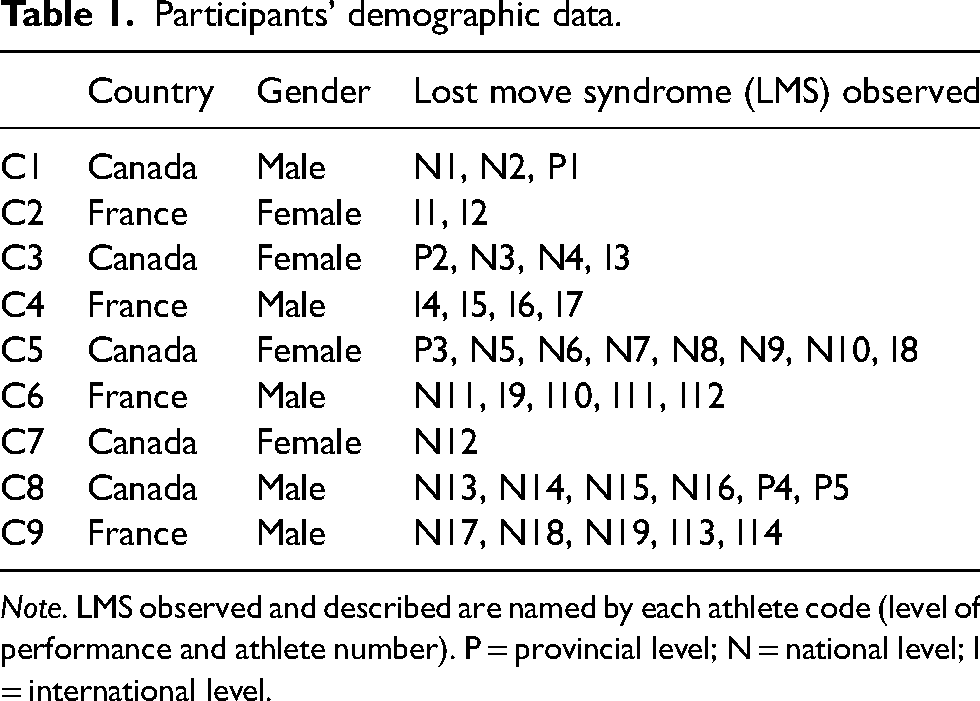
Note. LMS observed and described are named by each athlete code (level of performance and athlete number). P = provincial level; N = national level; I = international level.
The coaches had trained several hundred trampolinists at all levels and several dozen at the national/international level (between 35 and 50 at the national competitive level). The LM described by the coaches involved athletes performing at three levels of competition, but most were national and international adolescent and adult athletes, both male and female. We can, thus, assume that their testimony is representative of that of the subgroup of athletes affected by this phenomenon.
Data collection
The two authors contacted the potential candidates by email with a description of the study and an invitation to participate. This first contact made it possible to verify that each participant met the selection criteria and was voluntarily willing to participate. In order to participate in the study, coaches had to (i) be a trampolining coach at the competitive level and (ii) have experience with LM as a coach. Prior to their interviews, the coaches were asked to reflect on their experience with LM throughout their careers. More precisely, they were, thus, sent a short questionnaire in which they were asked to (a) identify the number of LM they had experienced as coaches, (b) briefly describe the LM, and (3) describe the athletes involved in the move loss. The interview guide was organized into four main sections. First, the coaches were asked to provide demographic information (i.e. age, level of education, the number of years coaching, and the number of athletes coached since the beginning of the coaching career). Second, they were asked to elaborate on the LM they had identified on the preliminary questionnaire (e.g. How many LM have you experienced as a coach? For each of them, what was the type of movements involved?) Third, they were asked to reflect on how they describe and explain each of them (e.g. What was the context of occurrence of each LM? How each LM evolved over time? How did you interpret the situation when it first occurred? How do you interpret the situation now?). Finally, the coaches were asked to describe the athletes affected by it (e.g. How would you describe this athlete? Did you identify any warning signs? Do you think there was anything specific about the athlete that predisposed him/her to this?).
Data analysis
Interviews were first transcribed verbatim and re-read to ensure familiarity with the content, and we then conducted a thematic analysis according to Jones. 39 First, open coding was conducted by carefully reading the data and assigning a code to all statements related to research questions (e.g. description of the athletes and description of the LM). These codes were then noted, and each relevant statement was organized under its appropriate category on a computer, along with any notes taken by the two authors during each interview. Second, axial coding was conducted in order to find statements that fit into the categories. Third, patterns in and explanations for the codes were identified (e.g. psychological state, life event, and impossibility to stop the action). Last, selective coding was performed by reading through the raw data for cases that illustrated the analysis or explained the concepts (i.e. athlete dispositions, life-course circumstances, disruption while starting the move, and disruption while finishing the move). The quality standards for qualitative research according to Smith and McGannon 40 were followed. The data were organized into tables to facilitate critical discussion with regard to the study's purpose. In parallel, the experience of the first author as a high-level trampolinist but also an experienced mental performance consultant in this sport brought her practical knowledge about the discipline as well as the LM phenomenon. In parallel, during several research meetings, the second author with also a high experience in mental consulting and psychological research in acrobatic sports acted as a critical friend throughout the research process (i.e. data collection, analysis, and data interpretation) in minimizing the first author’s internal bias about LM. The protocol followed the APA's Ethics Code and the guidelines of the Declaration of Helsinki. Participants were ensured that all the procedures would be based on a proper anonymization process, and informed consent was obtained at the time of original data collection.
Results
The results presented in this section are intended to depict the data regarding our four aims as perceived by the trampolining coaches (i.e. propensities to develop LM, types of moves, circumstances of occurrence, and dynamics of occurrence and evolution). Using interview quotations, 55 raw data themes were developed related to the coaches’ experiences of LM. Following the identification of first-order themes (13), four general dimensions were identified: athlete dispositions, life-course circumstances, disruption while starting the move, and disruption while finishing the move (see Figures 1 and 2).

Propensities to develop lost move (LM).
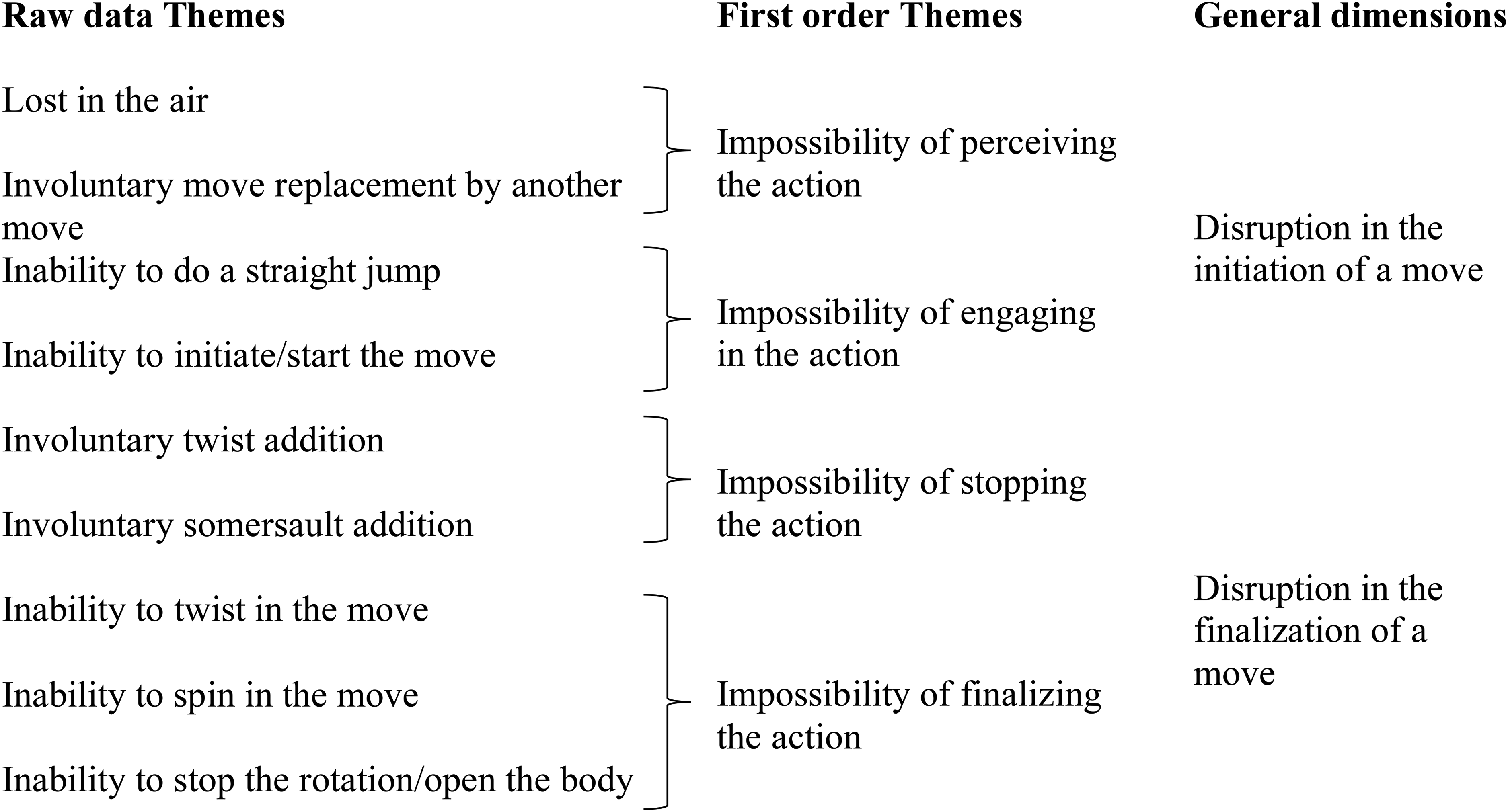
Classification of lost move (LM) observed in trampolining.
Propensities to develop LM
According to the coaches, the athletes’ dispositions and specific life-course circumstances were linked to the LM appearance (see Figure 1). The athlete dispositions were organized into four main first-order themes (i.e. level of development, acrobatic style, psychological characteristics, and physiological states). Regarding the level of development, the LM mainly concerned teenage athletes, often young learners (i.e. early specialization in trampolining) who had been spotted as talents by a federation that had very high hopes for them. Also, the athletes who had experienced LM were described as having special and very different acrobatic styles (e.g. talented athletes, fast progress, and aerial). Their psychological characteristics encompassed many qualities such as perseverance, being hardworking, and perfectionism but also included nervousness, anxiousness or emotionality, and lack of confidence. Also, modifications in bodily sensations, mental fatigue, and a lack of power or spatial orientation were reported as the physiological states the athletes were experiencing when the LM occurred the first time. In parallel, the coaches described five important life-course circumstances regarding the athletes experiencing LM (i.e. learning background, life events, season demands, previous performance, and triggering situations).
First, very different learning backgrounds characterized the athletes’ experiences prior to the LM (e.g. lack of fundamentals, easy acrobatics learner, instinctive learning, and complex move learning). Thus, whether they were instinctive or easy learners, with a solid foundation (part-method learning) or lacking in the fundamentals, all the athletes experienced LM. Second, family separation and changes in the sports structure, such as an arrival at the national training center, were cited as the two important life events prior to the LM. Third, the coaches described specific season demands such as learning a move, returning to training, or competition preparation as specific times of the season when the athletes were caught in LM. Fourth, regarding their previous performances, the coaches described very different types of performance prior to the appearance of LM such as previously falling in training or competition, competitive under-performance, and even success. Finally, the coaches situated the appearance of LM in several triggering situations such as a lack of motivation or focus, a bad habit, physical fatigue, or a stressful context. To summarize, LM was described as appearing in very varied situations and as affecting athletes with very different profiles and experiences, revealing the importance of interactions between the athletes’ dispositions and the life circumstances in which they evolve at a given time in their careers.
Types of LMs
The coaches’ accounts of the LM observed during their careers could be organized into two main categories, a disruption in the initiation or in the finalization of a move (see Figure 2). The disruption in starting the move essentially concerned the impossibility of perceiving the actions or of engaging in previously mastered actions. For example, several trampolinists were described as no longer able to gain height (i.e. straight jumps) because they engaged in back somersaults instead.
In the same vein, the disruption in finishing the move concerned the impossibility of stopping or finalizing previously mastered actions. One of the cases most described by the participants concerned trampolinists adding a somersault instead of a twist. Thus, the LM corresponded to two main issues (i.e. disruption while starting a move and disruption while finishing a move) and the temporal analysis could be summarized as comprising three main stages: a first manifestation, a potential adaptation state, and a final adaptation state. More precisely, for each LM described by the participants, two or three dynamic states emerged from the analysis. Overall, the description of the propensities to develop LM (see Figure 1) and the description of the types of LMs (see Figure 2), as well as their temporal evolution, suggest that they can be modeled as the dynamic process illustrated in Figure 3 to reflect the complexity of the LM states observed by the coaches.
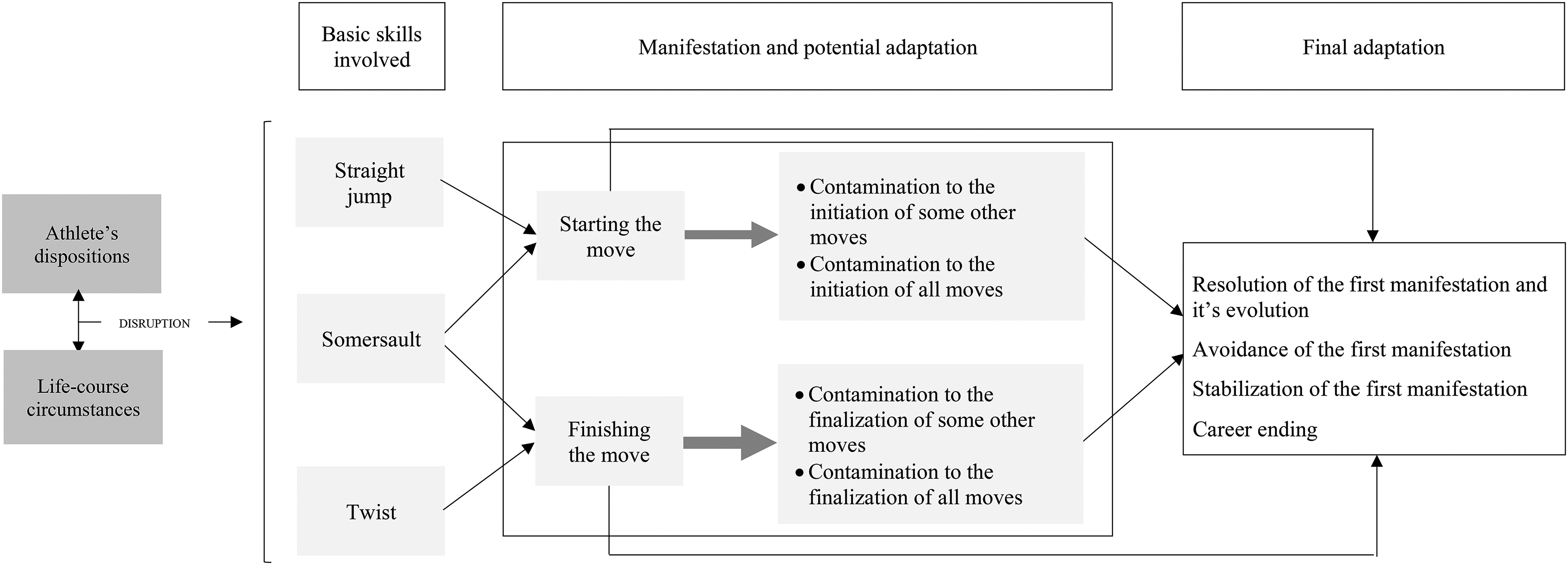
Modeling the lost move (LM) process.
More precisely, the coaches listed psychological states and characteristics describing the athletes when the first manifestation of LM occurred without being able to say whether it emerges from dispositions or circumstances. In convergence with a situated approach, we, thus, considered that the interaction between dispositions and the situation fostered the emergence of the first manifestation of LM. As presented in Figure 3, the LM process is a dynamic evolution that emerges from an interaction between athletes’ dispositions and the life-course circumstances in which they find themselves. From this interaction, a disruption emerges in a basic acrobatic technical skill (i.e. straight jump, somersault, and twist). More specifically, the first manifestation of LM can be observed in (i) the inability to start a movement at the time of the height gain (i.e. straight jumps) or the time of the somersault (e.g. a trampolinist who is gaining height with straight jumps and then somersaults backward after a certain height) or (ii) the inability to finish a movement at the moment of a somersault or a spin (e.g. when opening the body to stop the rotation and perform a spin, the trampolinist keeps his/her body closed and enters another somersault instead). From this first event, some trampolinists move directly to final adaptation, namely, resolving the first manifestation, avoiding it (i.e. putting the move aside, not doing it anymore), stabilizing it (i.e. rare or frequent occurrences of the first manifestation), or ending their careers. In a large majority of cases, the coaches observed a spectacular development, namely, the contamination of other movements or of the whole repertoire of mastered movements that can lead to all four final adaptations but in the most observed being the end of the career. For example, an athlete who was no longer able to initiate a simple forward rotation was progressively blocked from starting one or more other front moves. Another coach described that his athlete became progressively unable to complete any back moves while retaining the ability to perform front moves. Regarding avoidance, most athletes who finally put a move aside experienced contamination to many moves they previously mastered. Note that most of the time, the moves set aside were basic moves (e.g. front somersault with a half twist—Barani) that the national/international-level athletes did not use in competition, while this move was still performed in part of more complex moves (double somersault with a half twist—Barani out). When these moves were required in the competition category, the trampolinists took a break from competition until they felt confident to return to competition. The final state of stabilization goes through many different potential adaptations: some athletes experience more or less contamination while others experience none. Stabilization often took time and patience from athletes facing this problem but also from coaches observing the phenomenon.
Discussion
The present study aimed to (i) identify the propensities of the trampolinists to develop LM, (ii) categorize the types of moves involved, (iii) determine the circumstances of the LM occurrence as typical situations, and (iv) describe the evolution of the LM and their duration.
Based on the description of the coaches we interviewed, LM appeared as an evolutive adaptative process with four steps: disruption, manifestation, contamination, and final adaptation. First, disruption results from the interaction of an athlete's disposition and life-course circumstances, which explains why any trampolinist in any situation can experience LM. Second, the manifestation induced by disruption concerned three basic skills that make up all complex movements: straight jumps, somersaults, and twists. This manifestation was observable by the coaches as the inability to start or finish a move that could then evolve to contaminate some or all other moves mastered by the athlete. In addition, Seiler and Schmieder 22 concluded that, during a complex movement task, the combination of summersaults and twists was most prone for LM, while in the present study, coaches described many complex combinations at the beginning and end of a movement. The final adaptation encompassed the resolution, avoidance, or stabilization of the first manifestation or even the ending of the career. The description of LM as a process is complementary to current considerations that describe them only as a psychological disorder or traumatic experience.5,18 In the present study, LM appeared as observable behavioral manifestations emerging during the development of interaction between athletes’ dispositions (including psychological characteristics) and the situations in which they evolve throughout their sporting careers. From this developmental perspective, LM might be considered as a disruption in the relative equilibrium in which the acrobatic skills’ evolution occurs. The first manifestation of the LM reflects the approaching of equilibrium limits. Then, the successive adaptations lead to gradual or quick bifurcations to unwanted states expressing an overtaking of the equilibrium (i.e. avoidance, contamination, and stabilization) or to a return to the previous equilibrium (resolution). 41 Furthermore, the present study shows that the LM should be understood as a dynamic process comprising several stages and not as a stable, fixed, and negative state. This original and innovative situated approach explains LM as emerging from the interaction between the athlete and the situation.
The athletes’ behavioral disruptions and lived experiences described by the coaches were dysfunctional ways to perform and experience acrobatic moves. They suggest irrelevant as opposed to meaningful worlds of acting (i.e. elements of a situation that are merely considered for performing versus those that meaningfully emerge in the athletes’ experience).26,42 LM might here be understood as a disconnection between acrobats and the crucial elements they need to use in order to perform their moves in relation to the specificity of the context. Indeed, according to the coaches, it was as if the athletes had lost their landmarks, as well as the actions that needed to be launched in relation to them. The efficient organization of moves in acrobatic sports, 26 thus, drifted into original and irrelevant patterns that were included in the large potentialities of actions available to them for performing a move.7,27,43–46 Such drifts emerge because the complexity and the relative instability of move acquisition are linked to many degrees of freedom that are available and usable for controlling and performing a move. While learning had led the athletes to constrain and release them in a specific pattern that corresponded to efficient performing, a new and dysfunctional move (DM) suddenly emerged by recombining former acquisitions. Indeed, the coaches described these DMs as always corresponding to the re-use or recombination of parts of various moves that the athletes had already performed and controlled. DMs combining the same basic types of moves (somersault, twist, or straight jumps) indicate that the severity of LM is not in the moves themselves but in the combination or intrinsic organization the athletes give them in order to perform and control them. Thus, it is the “choice” of the good pattern that appears to be affected, modifying the expected and right combination and the temporal sequencing of the part of the move that led to a DM observed as an LM. In relation to the list of propensities to develop LM that the coaches identified, this suggests that the intrinsic organization of complex acrobatic moves is sensitive to a series of initial conditions including learning background, life circumstances, and season demands. It might be hypothesized that the long time dedicated to learning, improving, and practicing a move does not lead to a robust intrinsic organization of a well-executed move but to a combination of moves so precise that the margins of error are greatly reduced and the vulnerability to drift into a new organization including DM is increased. According to this interpretation, increasing accuracy will fragilize intrinsic organization, provoking a greater sensitivity to perturbation and the emergence of LM. Striving for perfection in athletes’ developmental processes increases the risks of emerging dysfunctionalities, and such a pursuit should be conducted with care, including the supervision of propensities to develop LM.
Our results also showed that the final adaptations to LM can lead not only to positive endings with resolution, but also to more dramatic consequences such as avoidance, stabilization, and career-ending. This might be analyzed differently because this dynamic process depends on many factors such as the context in which the LM emerged, the skills of the coaches to help the athletes, and the acrobats’ psychological skills to cope with the problem. In any case, despite the dramatic consequences that were observed, positive outcomes can still be envisaged, and this may inspire future research to clarify and deepen our understanding of the most efficient strategies to hold in reserve in the case of LM.
Practical implications
The results of this study offer practical implications for coaches. Three main levels of intervention are possible: (i) propensities to LM, (ii) the first manifestation, and (iii) potential adaptation. The first level of intervention would be to prevent the occurrence of the first manifestation through careful consideration of the athletes’ dispositions and life-course circumstances. In particular, coaches should be aware of the acrobatic and psychological backgrounds of their athletes so that they can take into account their personal dispositions in planning/instructions. This would include such factors as whether they have progressed quickly, learned complex movements quickly or, conversely, shown slow progression. In addition to understanding their athletes’ dispositions, coaches would benefit from considering the life-course situations in which the acrobats find themselves (i.e. learning background, life events, season demands, previous performances, and triggering situations). For example, red flags might be the recent separation of an athlete's parents or an athlete's deep fatigue, both situations that might require a reduction in the training load, more rest time built into the schedule, or even the interruption of training for a few days.
The second level of intervention would be at the first manifestation of LM, which is the athlete's inability to start or finish a movement. At this stage of the LM process, we advise cutting off its potential progression by putting the movement aside and distracting the athlete with a focus on other movements. For example, if the first manifestation appears on a backward movement, it would be important to work on the forward movements, thus avoiding contamination. In this way, the process could move directly toward a final adaptation in which the first manifestation is resolved.
The third level of intervention would concern the athletes who are in the contamination stage. A more marked break from practice is advisable: time off and engaging in other activities, whether acrobatic or not. In parallel, a collaboration with a sports psychologist or a mental performance consultant should be scheduled. The return to training may need to take into account possible anxiety symptoms, which can be reduced by cognitive behavioral therapy or eye movement desensitization and reprocessing interventions, which are known to be effective in the treatment of trauma of any kind. 47
Implications
The results of the present study contribute to the current literature in two ways. First, they allow us to better situate LM within performance blocks, which encompass quite different phenomena, such as yips. In addition, the present study provides a detailed organization and description of multiple manifestations of LM observable in trampolining. Thus, within performance blocks, LM has been described in detail as a specific phenomenon needing to be examined and addressed with a focus on its specificities, from research and intervention perspectives. Furthermore, the LM process described by coaches in the present study not only indicates the complexity of the LM experience, but also organizes the different levels at which the phenomenon can appear, its dynamic evolution, and, thus, the possibilities for prevention and intervention. Indeed, this model might well be helpful in examining LM in other acrobatic sports such as gymnastics and diving. Finally, the present study is a first step in the understanding of the trampoline coaches’ role in the LM process.
Limitation and future studies
Although memory bias may appear to be an important limitation of this study, it was surprising to find that most of the coaches had accurate and detailed memories of LM that they observed during their careers. In addition, the pre-interview reflection allowed coaches to recall much of their experience about LM. Given the importance of the coach's role in an athlete’s technical development, examining his/her role in the occurrence and management of LM now appears important. First, the phenomenon of LM would benefit from being addressed from the perspective of the coach–athlete relationship (e.g. role of the coach in the LM onset and techniques used to manage it once it has occurred). In addition, to account for the relevance of the model proposed in the present study, future studies should examine the LM process from the perspective of athletes who have experienced it. At the same time, other studies could attempt to answer why an athlete stabilizes, resolves, or avoids LM. Similarly, the three levels of intervention derived from this model would benefit from being tested with trampolinists in concrete LM situations.
Conclusion
To conclude, according to our model (see Figure 3), LM occurrence and evolution result from the interaction of trampolinists’ dispositions and life circumstances, which can generate a disruption in starting or finishing one of the three basic skills (i.e. straight jump, somersault, and twist). This disruption, which first appears at the beginning or end of a movement, evolves (see manifestation and potential evolution) to final adaptation (i.e. avoidance, stabilization, or resolution of the first manifestation and its evolution, or ending the career). Such a situated approach enabled us to examine LM as emerging from the interaction between athletes’ propensities to act, including mental or physical dispositions and other resources such as technical skills or cultural habits, and a specific environment by constructing its situation.26,32
Footnotes
Declaration of Conflicting Interests
The author(s) declared no potential conflicts of interest with respect to the research, authorship, and/or publication of this article.
Funding
The author(s) received no financial support for the research, authorship, and/or publication of this article.
