




Abstract
This study examined the psychometric properties of the Coach–Athlete Relationship Questionnaire (CART-Q) in a sample of 1344 Brazilian youth and adult athletes. Participants completed the CART-Q and the Basic Needs Satisfaction in Sport Scale (BNSSS). Data analysis was conducted through Confirmatory Factor Analysis (CFA), Structural Equation Modeling (SEM), Cronbach's alpha, composite reliability, multigroup analysis, and Pearson's correlation (p < .05). CFA confirmed a multidimensional structure containing the three dimensions of Closeness, Commitment, and Complementarity: χ² (37) = 264.10; χ²/df = 5.13; CFI = .96; TLI = .94; and RMSEA = .068. Internal consistency was satisfactory (>.70). SEM model showed an acceptable fit (χ² (56) = 593.28; χ²/df = 2.71; CFI = .90; TLI = .90; RMSEA = .057), indicating that the three dimensions of the CART-Q predicted positively all basic needs satisfaction subscales (β range = .11 to .38). CART-Q was revealed to be invariant across gender, sport type, and age group. It was concluded that the CART-Q can satisfactorily be used in research studies involving Brazilian athletes regardless of their age group, gender, and sport.
Introduction
In the last decade, there has been a significant increase in the amount of research on the quality of the coach–athlete relationship (CAR),1–12 which was predominantly concentrated in the UK.1–6,12 This region stands out wide in the world for the work developed by researchers, who over the last decades have leveraged research focused on social interactions in the sports environment, with a view to build psychometric scales to assess CAR, as well as to use these scales for consultancy work and for the training of coaches across different sports and performance levels.
CAR refers to a psychological construct characterized by the interdependence of coaches and athletes’ thoughts, feelings, and behaviors that may capture either functional or dysfunctional relationships within the sports context. There is consensus in the literature that the relationships between coaches and athletes are developed based on respect, affection, and commitment, and the quality of these relationships can contribute to the development of sports performance and personal growth.13–15 On the other hand, CAR based on distancing and absence of commitment, for example, can result in interpersonal conflicts, dissatisfaction, and lack of motivation inside and outside the sports context.1–5
Researchers have been more concerned with the search for contexts that promote positive experiences, happiness, and well-being, as opposed to the exclusive focus on the development of the technical and tactical aspects of sports.2,3 Research3,9,11 has been indicating significant associations between basic psychological needs (BPN) (autonomy, competence, and relationship) and the CAR. The findings of this research point out that athletes and coaches who perceive their basic needs as being satisfied in the sports context and those who establish good relationships based on affection, commitment, and respect are more likely to increase their levels of athletic satisfaction. Traditionally, social relations in this environment have been analyzed in a multidimensional perspective, through leadership approaches in the sports context,16,17 which characterizes leadership as an interactional process based on personal and contextual factors, especially in the role and behaviors of the sports coach. However, with the advance of research in social psychology in sport over the past 20 years,2–5 the literature has pointed out the importance of studying the dynamics involved between coaches and athletes in a bidirectional or relational way, whereby both play an active role in creating a social situation based on interpersonal behaviors, feelings, and thoughts that are unique to them.2,3,5,6
The conceptual advancement was primarily based on the theory of interdependence, 18 whereby the interdependence and bidirectionality that exist between relationship members in the everyday social interactions were advocated/emphasized alongside the importance of the interplay of members’ interpersonal affective (emotions), cognitive (thoughts), and behavioral aspects within their dyadic relationships. 18 Although there are other models to assess the CAR, such as the Motivational Model by Mageau and Vallerand, 18 based on the Cognitive Assessment Theory, the 3 + 1 “Cs” Integrated Model is considered the most comprehensive to understand the complexity of the relationship established between the coach and athlete. 12 This model is based on the concepts of the Interdependence Theory, Interpersonal Theory, and Social Relationships Theory, highlighting the importance of evaluating the perceptions of both subjects (coaches and athletes) acting in the sports context.
Thus, 3 + 1 “Cs” model12,19,20 has been guided the research on the CAR5 over the past two decades or so and has encouraged researchers to assess CAR from a bidirectional perspective. The model considers that the relationships are influenced by the individuals’ characteristics (e.g. sex, age, personality, years of experience); characteristics of the social and sporting context (e.g. norms, roles, customs, types of sports), and characteristics of the relationship (e.g. time, type of relationship, same-sex relationships).1–3
The conceptual model of the 3 + 1 “Cs”5,12 was developed in order to understand how the quality of the CAR plays a role in both performance and well-being. The dimension of “Closeness” reflects the feelings of mutual respect, trust, and appreciation. The dimension of “Commitment” refers to the thoughts of maintaining a close-nit relationship over a long-period of time. Lastly, the dimension of “Complementarity” is synonymous with cooperation and captures the degree to which the coach and the athlete are responsive, receptive, at ease, and ready.5,12 Jowett and Ntoumanis 21 developed the original version of the Coach–Athlete Relationship Questionnaire (CART-Q) in an attempt to measure the 3Cs.
Based on the 3 + 1Cs model, researchers from several countries7,22–28 have focused on the cross-cultural adaptation of the CART-Q with the aim to tangibly measure a key relationship in sport. Brazil, as a Portuguese-speaking country, started this type of investigation with the adaptation of the CART-Q from the perspective of athletes in 2015 8 and coaches in 2019. 11
The psychometric properties of the initial questionnaire were tested, showing that the CAR is best represented in a model of three first-order factors represented by the three dimensions (closeness, commitment, and complementarity) or by a second-order model in which the three dimensions (closeness, commitment, and complementarity) of the CART-Q are included. The original instrument was widely tested, adapted, and validated for several cultures (USA, Belgium, China, Greece, UK, Spain, Sweden, and Brazil), showing that the CART-Q versions have good psychometric properties in confirmatory factor analysis (CFA), reliability and address the basic elements proposed by the conceptual model of the 3Cs.7,22,23 Additionally, researchers examined the correlations of the quality of the CAR in different cultures, such as Switzerland, 24 Hungary, 25 Greece, 17 Cyprus, 26 Britain, 27 and Australia. 28
In Brazil, there is low involvement of young people in the practice of physical activity and sports at different levels (school, recreational, regional, state, national). According to data from the Brazilian Institute of Geography and Statistics, 29 in the census carried out between 2014 and 2015, engagement of 37.9% of the population was observed, with some factors considered associated with participation as being male, being aged between 15 and 17 years old and between 18 and 24 years old and having higher levels of education.
According to the notes by the IBGE, 29 the regions that stood out the most in terms of involvement were the Mid-west region, followed by the South region, with the most frequent modalities being soccer, walking, and gym activities. When the population was asked about the main reasons given for non-participation, a lack of interest and lack of time for involvement were identified, which may result from the accumulation of diverse or alternative interests and demands as age increases.
A strategy to increase the participation of adolescents and young people in sport has been carried out over the years through the National Sports Council, based on programs to encourage the practice of physical and sports activities for the population. Among the programs are school competitions or student competitions that have been taking place for 41 years, with initiatives that include School Games, Student Olympics, Youth Games, School Championships, University Games, among others. Over time, these programs have undergone modifications and. based on the funding sources guaranteed by the bills, have contributed to greater investment, involvement, and participation by public and private school students in the country. 30
Nonetheless, young people's involvement in sport is limited due to lack of interest and lack of time, 29 which demonstrates that motivation is an intervening factor in their practices. Given this information, we look at the motivational issue as an environmental and modifiable factor for their participation in sports. 2 Thus, by acknowledging that sports environments can have an impact on motivation, sports experiences and the permanence or abandonment of young people in sport, the present study aimed to identify the role a key social relationship plays in youth sport, based on the assessment of CAR. The practical significance of this study revolves around acknowledging the important role quality relationships play in youth sport and thus investing in developing sport programs that are motivational and relational.
This notion has been intensively investigated in the international stage, mainly in Europe and United Kingdom more specifically. The authors show that to achieve effective training, the maintenance of healthy social relationships is essential. This is because coaches with a focus on technique achieve good performance from their athletes, but coaches who establish harmonious and healthy connections with their athletes have the key to stimulating their skills and potential, thus, ensuring performance 7 (Phillips, Jowett, Krukowska-Burke, Rhind 2023) and personal satisfaction 8 (Gosai, Jowet & Nascimento Junior, 2023).
The present study was motivated by the research conducted thus far and the belief that CAR can be the fundamental basis in the process of human flourishing through sport. And starting from this premise, research in Brazil aims to deepen the knowledge about this key social relationship in sport, with a view to, later, create opportunities for sports training programs that focus on developing technical-relational environments. That is, training environments that are not solely about athletes’ technical skills, but that are also based on quality social relationships. 8
These environments could provide opportunities for the athletes to improve physical, technical, and tactical skills but also create functional and fulfilling social relationships, as in the sports programs developed in Europe. Research shows that effective training occurs when relational environments are fostered, containing openness to information, demonstration of positive interpersonal feelings, the establishing of clear roles, in addition to teamwork, responsive behaviors, and focus on team spirit.8–12 Subsequently, a relational environment favors both athletes and coaches. In such environments, athletes and coaches are self-determined, have high intrinsic motivation and feel autonomous, competent, and connected resulting in greater accountability and responsibility.3,11
It is thus important to explore the applicability of the theory and evidence generated elsewhere to Portuguese-speaking countries, their realities, norms, and cultures of each region. Additionally, the visibility of Brazilian athletes performing on the world stage has highlighted the importance of research for sports practice. For example, investigations about the intervening psychological aspects on sports performance and the creation of technical training programs (physical, technical, and tactical skills development) and relational factors (promoting healthy interactions, well-being, and autonomy) that can give performers a competitive edge are significant and sought after by national sport organizations and practitioners.
The nature of CAR and its characteristics in the Brazilian sports scenario
According to the theoretical basis of the present study, it appears that there are several factors that influence in the quality of the CAR. As reported by Jowett et al. 5 in the 3 + 1Cs model, antecedent factors precede the relationship established between coaches and athletes, including individuals such as age, sex, experience in the sport, personality, among others. Sociocultural characteristics are also considered as antecedents of quality relationships, such as norms, customs, roles, and cultural characteristics specific to sport and/or society. Finally, the third antecedent comprises the characteristics of the relationship, which includes the type of relationship established (typical relationship between people with no kinship or atypical relationship between people who share a parental relationship—parents and children, husband/ wife), the duration of relationships, relationships in transition, and whether the individuals who relate (coaches/athletes) are of the same sex or not.
When considering these indicators in the Brazilian sports context, research carried in 2015 verified the psychometric properties of the CART-Q for young athletes and highlighted that that high quality CAR contributed to the satisfaction of the BPN of autonomy and connectedness. 8 More recently research conducted by Freire et al. 12 found that young female athletes showed higher perceptions of CAR quality, and this relationship quality also had an impact on team cohesion and their motivation.
Brazil is considered as a country of cultural plurality that stands out on the world stage for its hospitality and for the harmonious, receptive, and intimate form of human relationships. These characteristics can contribute to the strengthening of ties and the way in which people establish relationships in different environments, one of which is the sporting context. In this way, these characteristics can significantly contribute to the strengthening of relationships between coaches and athletes in the sporting context. Nonetheless, the dynamics of CAR are likely to differ according to the level of competition (recreational, university, high performance), since regularity in training and frequency in meetings between coaches and athletes can be decisive for the quality of the relationships coaches and athletes establish.
The characteristics of competition can also interfere in the way individuals establish relational exchanges in the training environment. This aspect can be identified in the way in which the preparation that precedes such competitions is carried out. If the training environments focus only on technique, athletes may be well prepared technically and tactically for the competition, but they may not be able to withstand the stresses arising from it and thus be resilient enough to overcome them; because in times of difficulties, if the relationships are not strong enough with peers and coach, they can be easily worn out and break up. 6
Thus, if sports environments are systematically organized to provide quality connections and constructive partnership between coaches and athletes on a daily basis, it is then possible that such aspects will possibly extend to relationships with teammates and partners, providing the basis for handling and coping with stressful events arising from competition throughout the sporting season more effectively. 9 These factors, in addition to the rules, norms, and roles assumed in the sports context, require more investigation in the Brazilian sports context.
The systematic review by Kravchychyn and Oliveira 32 was focused on the Brazilian sports programs and covered three main axes: (a) sports management (benefiting people in social vulnerability, vision sport, management difficulties, and positive experiences of socialization); (b) contents and teaching methods (with a predominance of socio-educational and technical-tactical references). Thus, the socio-educational references primarily comprise aspects related to inclusion, citizenship and health promotion, autonomy, and cooperation, while the technical-tactical references contemplate the instrumentalization for practice, preparation for competitions, and the focus on the teaching-learning process.
The third axis is focused on professional training and intervention. It captures the training of social agents who work in the sports context and includes hierarchical relationships, the improvement of social relationships, and the teachers’ disregard for students’ difficulties. Thus, based on previous research that showcased the significance of quality coach–athlete relationships and the realities within which Brazilian sports programs are embedded, this study aimed to further understand the role of quality coach–athlete relationships in youth sport in an effort to address the gap that exists around the importance of developing not only technical but also relational environments that contribute to effective training, athlete improved performance, human development, and well-being.
Present study
CAR is pointed out by the literature as a key element for positive results within sports context.8–11 Vieira et al. 8 observed that the quality of the CAR was a protective factor for team cohesion among Brazilian professional football athletes. Contreira et al. 11 verified that the quality of the CAR can be considered a determining factor for BPN satisfaction among young Brazilian athletes as well as sporting satisfaction. Thus, the purpose of this study is to examine the psychometric properties of the CART-Q in a heterogeneous sample of Brazilian athletes taking into consideration previous limitations. 7
First, CFA was performed to test an 11-item model, based on the three-factor structure, in accordance with the original measurement model of the 3 Cs. 29 Specifically, our study seeks to confirm the factor structure of the scores obtained from the scale with a large sample of adult and young Brazilian athletes. Secondly, multigroup analysis was conducted to examine the applicability of this scale in groups with different characteristics, such as gender (male and female), age group (youth and adult), and sport type (team and individual) in agreement with several authors’ recommendations.7,22,23,30 While there is no young version of CART-Q, the scale has been used and has adequate internal consistency reliability among youth sports practitioners.8–10 A sample of young and adult athletes will show whether the instrument is equivalent in all genders, ages, and sport type through invariance measurement, which is an advance of this study. In this perspective, the invariance of the CART- Q across young and adult athletes will help researchers and professionals to understand the phenomenon of CAR in sport in different life stages.
The psychometric properties of the CART-Q were tested with a sample of Brazilian adult athletes in past reseach. 7 The authors conducted a cross-cultural adaptation, content validity, internal consistency, construct validity, internal and external validity, and temporal stability. 7 Nonetheless, some limitations were pointed out by the authors. Data collection was carried out just with adult athletes who all came from the same locality/state and performed at the same level. Such a sample may not be representative enough of Brazil. Thus, the present study aims to rectify it with a larger (>1000) and heterogeneous sample from several regions of Brazil and collected data from different time points in the athletic season to decrease bias as well as conduct additional analysis to examine the evidence of validity, trustiness, and sensitiveness of the CART-Q.
We hypothesized the following: (a) the Brazilian version of the CART-Q will display an acceptable fit; and (b) the multigroup analysis will show measurement invariance across various groups (e.g. gender, age group, and sport type). 2 Additionally, nomological validity analysis was conducted, assessing the associations between CART-Q subscales and BPN satisfaction (i.e. autonomy, competence, and relatedness) based on the SDT framework using structural equation modeling (SEM) procedures. Based on previous research findings,3,10,11,31 the following hypothesis was formulated: the CART-Q subscales of closeness, commitment, and complementarity will be positively correlated with BPN.
Methods
Participants
A total of 1376 youth and adult Brazilian athletes competing in local, state, and national competitions from 2016 to 2019 participated in the study. It is noteworthy that the competitions comprise the different competitive levels and are organized by the entities responsible for the sports and by the federations of each region of the country. Such considerations follow the methodological structure of the sample presented in the original instrument developed by Jowett and Ntoumanis. 21
From the total sample, 32 athletes were excluded for not answering the questionnaires completely. Although all instructions regarding reading and filling out the instruments were given to all athletes, this aspect was considered a criterion to exclude missing data from the sample. As a result, 1344 athletes (male = 757 and female = 587) aged between 14 and 45 years were included in the final sample (M = 18.34; SD = 4.18). The participants represented the five regions of Brazil: South (n = 549); Northeast (n = 440); North (n = 175); Mid-west (n = 135); and Southeast (n = 45). Their sports experience ranged from 1 to 16 years (M = 3.61; DP = 3.15). The participants represented the following sports: soccer (n = 172), futsal (n = 218), handball (n = 108), basketball (n = 149), judo (n = 65), volleyball (n = 230), swimming (n = 98), chess (n = 13), tennis (n = 5), table tennis (n = 24), karate (n = 20), rugby (n = 58), cycling (n = 25), wrestling (n = 11), gymnastics (n = 6), beach volleyball (n = 35), and track and field (n = 107). To test measurement invariance of the items of the subscales of the CART-Q, groups were created as follows: (a) age groups (<18 years and ≥18 years); (b) type of sport (individual and team sports); and (c) gender (male and female). For detailed information on group characteristics, see Table 1.
Sample characteristics.
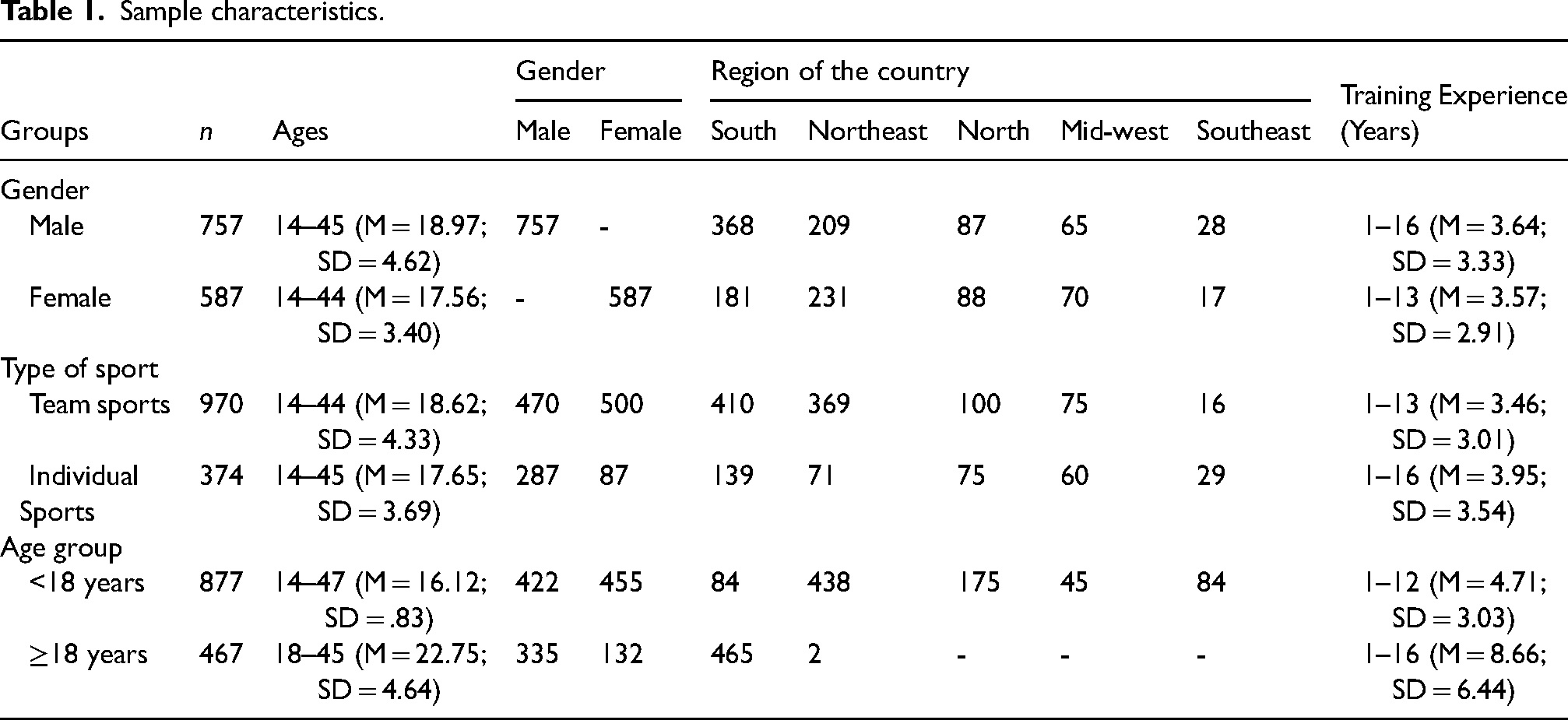
From the 1344 participants, 541 youth male (n = 269) and female (n = 272) athletes, aged between 14 and 17 years (M = 16.13; SD = .83), also responded a measure of the BPN satisfaction in order to examine the nomological validity between CART-Q subscales and the satisfaction of the three BPN satisfaction based on the SDT framework.32,33
Instruments
The Brazilian version of the CART-Q—Athlete Copy was used. 7 The 11-item direct perspective CART-Q has four items assessing closeness (e.g. “I like my coach”), three items assessing commitment (e.g. “I am committed to my coach”), and four items assessing complementarity (e.g. “When I am coached by my coach, I am ready to do my best”). All CART-Q items were measured on a 7-point Likert scale ranging from 1 (“Strongly Disagree”) to 7 (“Strongly Agree”). The past literature supported the factorial validity, test-retest reliability, and internal consistency reliability of this scale with athletes.34,35
The Brazilian version of the Basic Needs Satisfaction in Sport Scale (BNSSS) was used. 36 The Brazilian scale consists of 12 items divided into three subscales: competence (e.g. “I am skilled in my sport”), autonomy (e.g. “I feel like I practice my sport for pleasure”), and relatedness (e.g. “There are people in my sport who care about me”). Participants respond items on a 7-point-response scale ranging from 1 (not entirely true) to 7 (totally true). Past research has supported the factorial validity, test-retest reliability, and internal consistency reliability of this scale with athletes.37,38
Procedures
Initially, the researchers contacted the competition's organizers with the purpose of obtaining an agreement to perform the research. Afterwards, the study was approved by the local Research and Ethics Committee (protocol number 1.648.086). Data was collected in the hotels and/or hosting locations of the athletes/teams in the cities in which the competitions took place, from 2016 to 2019. Athletes responded to the questionnaires in a private room, without the presence of the coaches, and lasted between 15 and 20 minutes. The order of the questionnaires was randomized among participants.
The criteria for participating in the study were that athletes have been competing for at least 1 year and belong to one of the teams/clubs taking part in the sports tournament where the data was collected. Participants who did not respond to any of the instruments were excluded of the study. Each participant provided an informed consent before participating in the study. For the athletes under 18 years, the parents or legal guardians signed a free informed consent term.
Data analysis
First, descriptive statistics, as well as bivariate correlations, were calculated for all variables using SPSS v.22.0 (IBM, Armonk, NY, USA). Further, a CFA was performed to test the factor structure of the Brazilian version of the CART-Q. The sample size of the CFA was determined based on the recommendations of at least 10 participants by parameter estimated of the model. 39 In order to guarantee the adequacy of the sample, the Monte Carlo Bootstrapping technique was applied and the power of the analysis was calculated. 40 The present study opted for defining factor loadings above 0.50 as acceptable, since such values guarantee an explained variance of the item in at least 25%, and since it is also suggested by several researchers in psychometry.41,42
Consequently, SEM specification was performed to test the nomological validity between CART-Q subscales and BPN satisfaction. Recommendations of several authors were followed for SEM analysis. 43 For nomological validity assessment, a two-step approach based on the recommendations of Kline 43 was followed: (a) test the factor structure of the model; (b) test the proposed associations between the constructs under analysis. A bootstrap resampling procedure (2000 samples) was performed considering a confidence interval at 95% (CI 95%) to assess significance. An effect was considered significant (p < .05) if its CI 95% did not include zero, as suggested by Hayes. 44 CFA and SEM procedures were conducted using AMOS v. 22.0 (IBM, Armonk, NY, USA).
The verification of the existence of outliers was performed using the square distance of Mahalanobis (D²), since the inexistence of these cases is an assumption for this analysis. 44 Since normality is also an assumption for performing CFA and SEM, it was verified through studying the univariate distribution using skewness and kurtosis (ISkI < 3.0 and IKuI < 10), and multivariate distribution through Mardia's coefficient for multivariate kurtosis. 42 The algorithm of maximum likelihood for estimation of the parameters was used.42,44
The evaluation of measurement and structural model fit was performed throughout the following indices: Chi-square (χ² and p-value); normalized Chi-square (χ²/degrees of freedom); Comparative Fit Index (CFI); Tucker–Lewis Index (TLI); Root Mean Square Error of Approximation (RMSEA) with its respective CI at 90%. The following cutoffs were indicative of acceptable model fit: CFI and TLI ≥ 0.90 and RMSEA ≤ 0.08. 39
In addition, the convergent validity was analyzed (in order to verify if the items were related to their respective factors) through the calculation of the Average Variance Extracted (AVE), considering values of AVE ≥ 0.50. 39 Composite reliability (CR) and Cronbach's alpha (α) were calculated to evaluate the internal consistency of factors, adopting scores ≥ 0.70 as acceptable values. 39
In order to determine if the measurement model would be equivalent in groups with different characteristics, a multigroup analysis was conducted. 45 Invariance procedures suggested by Byrne 44 were followed: (1) the measurement model should provide adequate fit in each sample; and, (2) configural, metric, scalar, and residual invariance criteria should be respected. A change of less than 0.01 in CFI and 0.015 in RMSEA provided evidence for metric invariance. A change of less than 0.01 in CFI and 0.015 in RMSEA provided evidence for scalar invariance as suggested by several authors.44,46
Lastly, multilevel linear regressions were applied. 47 We analyzed the variations among athletes’ responses grouped by gender (male and female), type of sport (team and individual), and age group (<18 and ≥ 18). We applied varying intercept models, considering athletes (Level 1) nested in groups (Level 2; gender and type of sport). We also considered an interaction term of the “type of sport” variable with the “age group” variable. The inclusion of the interaction term allows us to analyze if there are differences in athletes’ sports by their age group. We applied AIC criteria to compare and choose the best model for our data. We ran the model estimations based on maximum likelihood and used the “lme4” 48 package to analyze the models in the R statistical software (R Core Team, 2018). Models’ estimations were extracted considering a confidence interval of 95%.
Results
Preliminary analysis
A preliminary analysis of the data showed no missing values or univariate and multivariate violations. The descriptive statistics of the items indicated some deviations from univariate normality, since skewness values varied from −3.29 to −.68 and kurtosis from −.29 to 13.83. 49 Further, the normalized coefficient of Mardia 50 of the multivariate kurtosis (125.15; p < 0.001) was above the score of 5.00, which Bentler and Wu 51 suggests as an indicator of deviation from multivariate normality. Thus, the Bollen–Stine Bootstrap with 2000 samples was performed in order to obtain a corrected value of the estimated coefficients of the Chi-square to the estimator of maximum likelihood. 52 Results showed that both the VIF test and tolerance test scores respected previously reported cutoffs ensuring the appropriate conditions to test the structural model.
Descriptive statistics and internal reliability
Data indicated higher means for the three subscales of the CART-Q (see table 2). The AVE values of the three CART-Q subscales were as follows: Closeness = .50; Commitment = .38; and Complementarity = .45. Commitment and complementarity presented convergent validity below the cutoff, however, close to the recommended value (AVE > .50). The values of CR were satisfactory for the evaluation of the internal consistency (Closeness = .80; Commitment = .68; and Complementarity = .77). The total Cronbach's alpha (α) (α = .87) and its values for the dimensions of the Brazilian version of the CART-Q were satisfactory (Closeness = .77; Commitment = .67; and Complementarity = .75).
Descriptive statistics, internal consistency, and convergent validity.
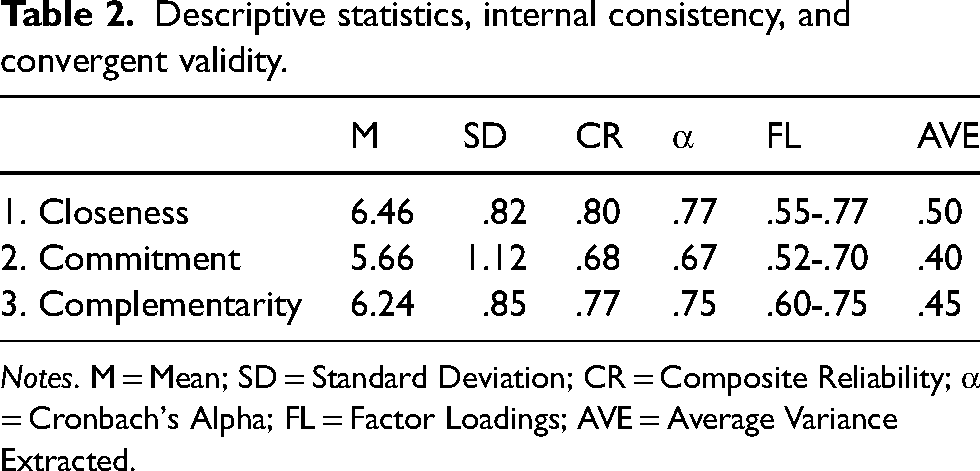
Notes. M = Mean; SD = Standard Deviation; CR = Composite Reliability; α = Cronbach's Alpha; FL = Factor Loadings; AVE = Average Variance Extracted.
Factor structure
Results of the CFA models suggested an adequate fit to the data, as shown in Table 3. Specifically, the 11-item model consisting of three factors had an acceptable fit to the data in the total sample (χ² (37) = 264.10; χ²/df = 5.138; CFI = .96; TLI = .94; RMSEA = .068 (.05−.08)). The Bootstrap replications (p < .001) and the CI 95% indicated the stability of the factorial estimations, meaning the acceptable adjustment of all models for the data (i.e. models 2–7). All standardized factor loadings of the items (all statistically significant for p < .01) presented factorial validity, since the 11 items of model 1 presented factorial loadings between 0.52 and 0.77. Similar results were found for all subsamples under analysis (i.e. models 2–7).
Goodness-of-fit indexes of coach–athlete relationship questionnaire (CART-Q) in all samples of the study.
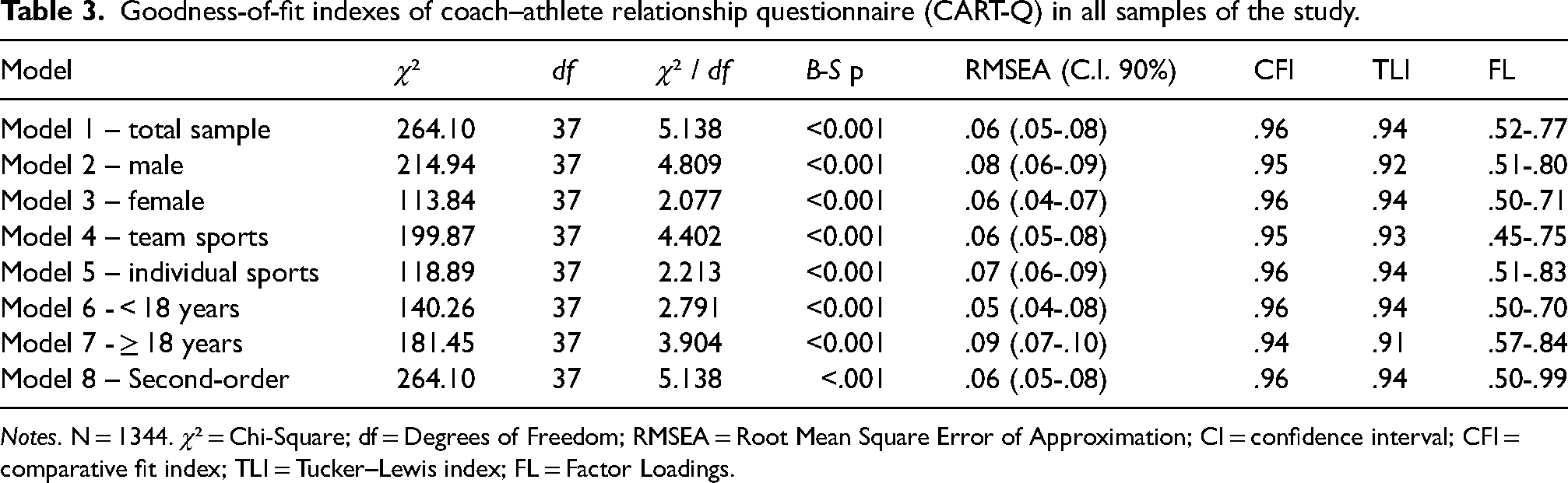
Notes. N = 1344. χ² = Chi-Square; df = Degrees of Freedom; RMSEA = Root Mean Square Error of Approximation; CI = confidence interval; CFI = comparative fit index; TLI = Tucker–Lewis index; FL = Factor Loadings.
The latent factors (closeness, commitment, and complementarity) of the first-order model presented moderate to strong correlations (r > 0.90), suggesting the existence of a second-order factor (CAR), which was tested in model 8. The second-order model for total sample fit was identical or higher than the first-order models (χ² (37) = 264.10; χ²/df = 5.138; CFI = .96; TLI = .94; RMSEA = .068 (.05-.08)), demonstrating support to the hierarchical model (see Table 3). Such hierarchical model has already been tested in previous studies.3,7
Factorial invariance
We investigated the factor invariance as a function of participants’ gender, type of sport, and age group, using multigroup analysis. By means of this technique, we could confirm that the designed instrument functions similarly for each group. Therefore, this analysis allowed us to confirm that the psychometric properties of the CART-Q do not vary for either gender, type of sport, and age group. Firstly, the configural model was compared to the metric model in all groups to test measurement invariance. Our results show that the differences (Δ) between criteria were below cutoffs, moving on testing scalar invariance for all samples. Thus, the configural model was compared with the scalar model, presenting changes in CFI and RMSEA within range (i.e. Δ< .01). Further, the configural model was compared with the residual invariance model. We verified that ΔRMSEA was within range (i.e. Δ< .01) in all groups, while changes in CFI were above the critical cutoff in each model comparison. Nevertheless, this criterion is considered optional by the literature 47 and will be discussed further. Therefore, our results suggest that invariance remained stable with each subsequent model constraint (see Table 4), achieving acceptable measurement invariance between samples under analysis.
Goodness-of-fit indexes for the invariance of the total sample model of the Brazilian version of CART-Q.
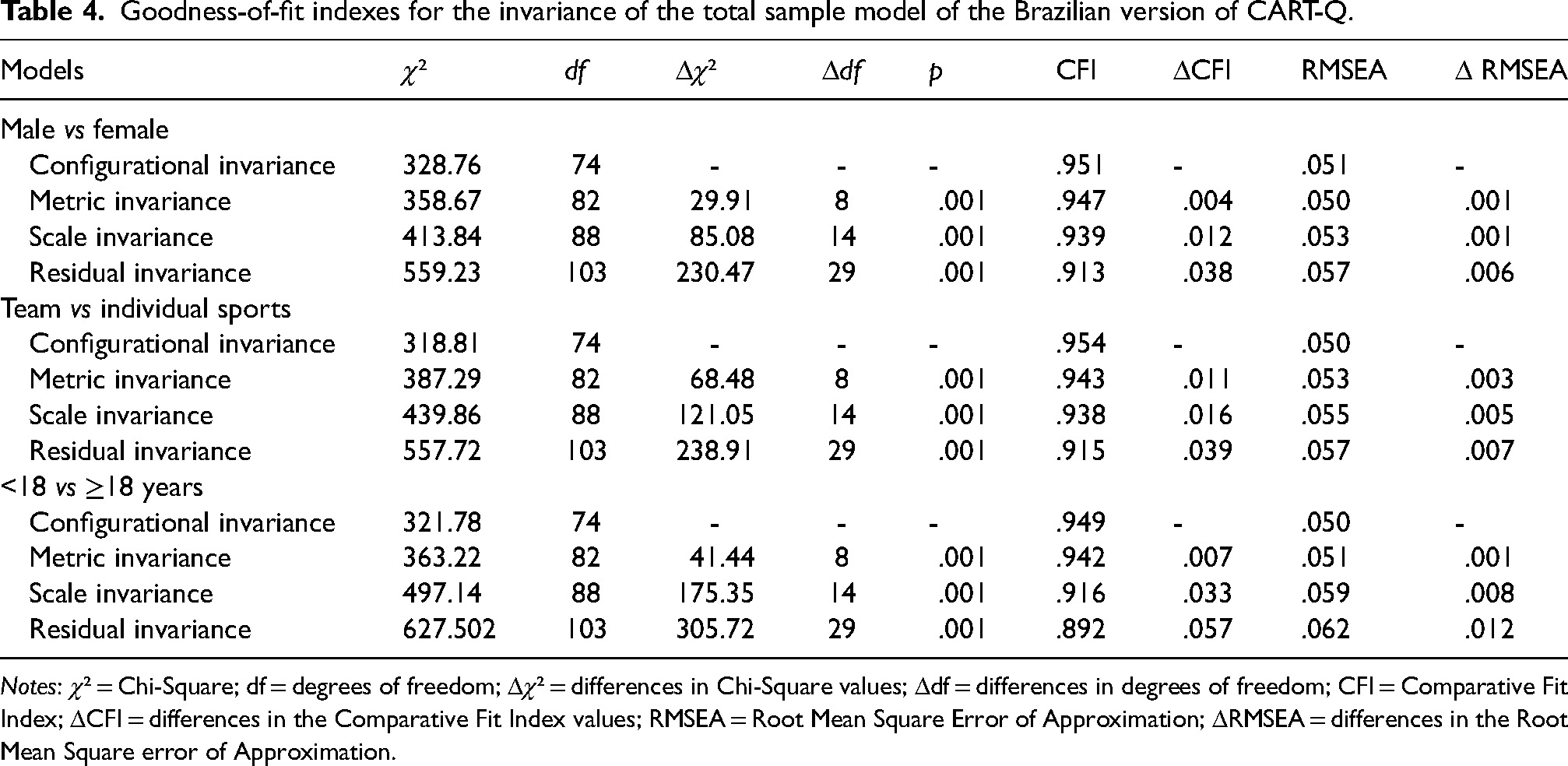
Notes: χ² = Chi-Square; df = degrees of freedom; Δχ² = differences in Chi-Square values; Δdf = differences in degrees of freedom; CFI = Comparative Fit Index; ΔCFI = differences in the Comparative Fit Index values; RMSEA = Root Mean Square Error of Approximation; ΔRMSEA = differences in the Root Mean Square error of Approximation.
Multilevel linear regression
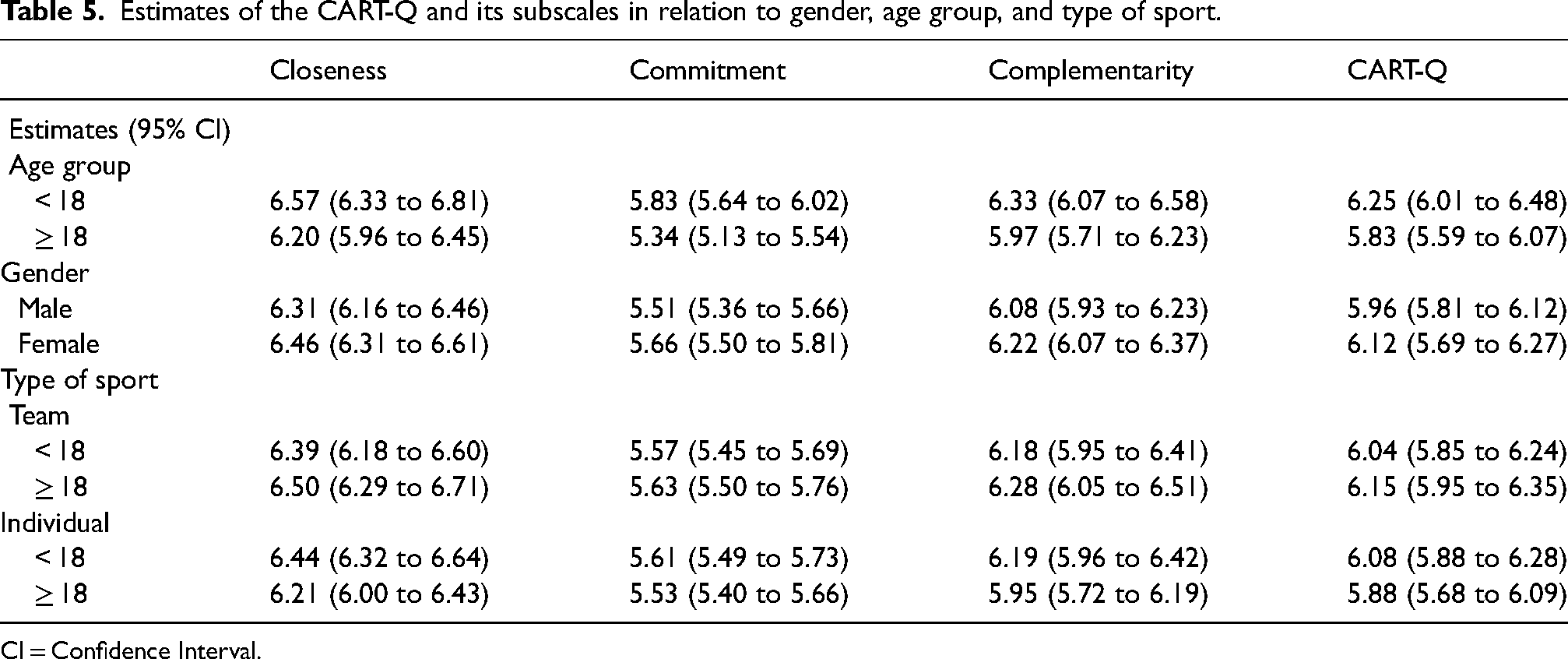
Multilevel linear regression estimates are presented in Table 5. Models indicate substantial age group variations in the CART-Q and its dimensions, which younger athletes presented higher scores than older athletes. There were no substantial variations when grouped by gender. We did not observe substantial variation between young and older athletes competing in team sports. However, we found substantial variations between young and older athletes competing in individual sports for Closeness and Complementarity dimensions.
Estimates of the CART-Q and its subscales in relation to gender, age group, and type of sport.
CI = Confidence Interval.
Nomological validity
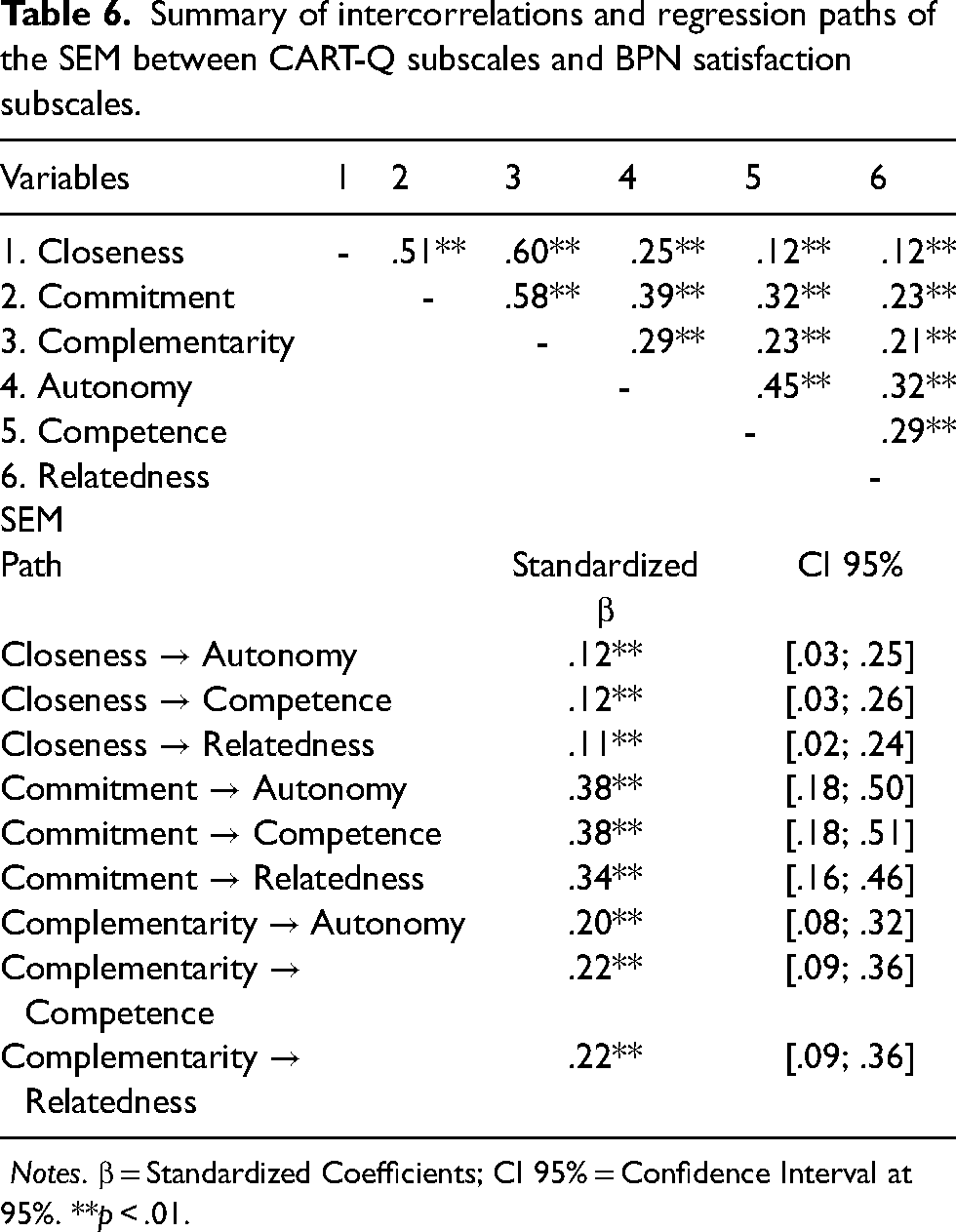
Table 6 reveals that all CART-Q subscales were significantly and positively associated BPN satisfaction (r range = .12–.33). Since we verified some deviations from univariate and multivariate normality for the SEM sample, the Bollen–Stine Bootstrap with 2000 samples was also performed to obtain a corrected value of the estimated coefficients of the Chi-square to the estimator of maximum likelihood. 47 The nomological validity examination between CART-Q subscales and BPN satisfaction conducted through the structural model (i.e. SEM model) showed an acceptable fit (χ² (56) = 593.28; χ²/df = 2.712; CFI = .90; TLI = .90; RMSEA = .057 (.05–.06)). The standardized coefficients displayed interesting results (see Table 5). First, CART-Q subscales predicted positively all BPN satisfaction subscales as theoretically proposed (β range = .11–.38). Specifically, CART-Q subscales explained a significant amount of the variance of autonomy (R2 = .24, p < .01), competence (R2 = .25, p < .01), and relatedness (R2 = .20, p < .01). Overall, nomological validity was achieved as it was previously hypothesized.
Discussion
The present investigation aimed to examine the psychometric properties of the Brazilian version of CART-Q in a large sample of adults and young athletes, considering the limitations presented in past research.6,21,22,53 According to the integrated 3 + 1Cs model of the CAR, 12 characteristics such as gender, type of sport, and age have significant influence on the quality of CAR. 48 Hence, the present findings are relevant to the study of the CAR. The contributions of this investigation are highlighted as it seeks to advance the limitations identified in the first study of cross-cultural adaptation of the scale to the Portuguese language, 8 especially regarding the sample. The present study considered a larger sample, athletes from all regions of Brazil and greater range of sample age. This information corroborates the Integrated 3 + 1Cs model, which considers the relevance of the individual characteristics (e.g. age, sex, time of experience, personality), context, and the relationship itself, and are essential for a detailed understanding of established relationships.
Another important factor is the attention given to the results identified in the present study to athletes under 18 years old. This sample of young athletes reported higher levels of relationship quality with their coaches than older athletes. This data is corroborated by the study conducted by Contreira et al. 11 when evaluating relational, motivational, and athletic satisfaction aspects in dyads formed by young Brazilian athletes and coaches. The authors observed that although the findings were significant for coaches and athletes, young people revealed to be more interdependent in the relationships formed with their coaches, in turn these relationships to satisfy their BPN.1–11
Our results may point to the need for higher attention to sports training programs developed in Brazil. Given the importance quality relationships play in satisfying the BPN of athletes, developing environments that go beyond the technical-instructional aspects of the sport and thus emphasize the development of functional, healthy, and harmonious relationships that are characterized by respect, trust, commitment, and collaboration maybe a useful step in the right direction for youth sports. 11 Athletes in this study that originated from different social, economic, and family contexts reflecting the landscape of Brazil, may find in sport and through the coach, a figure of attachment and support. 20
Overall, the original structure of the instrument with 11 items and three dimensions (closeness, commitment, and complementarity) was maintained, corroborating results from previous research that was carried out in other cultures.22,30,54,55 Based on the present results, the instrument presents satisfactory internal consistency, factor structure, factor invariance, sensitiveness to individual characteristics variation, and nomological validity to assess the athlete-coach relationship according to the athletes’ perspective.
Thus, CART-Q can be used in the Brazilian context for research among young and adult athletes at different competitive levels. Identifying affective, cognitive, and behavioral aspects would help improve scientific research on social interactions at national and international levels. Additionally, it might improve the coaching and instruction in sports programs and in the practices of physical education teachers, coaches, and sports psychologists who work directly with this population.
According to the evidence of convergent validity and internal reliability, the questionnaire presented AVE > 0.5 for Closeness and AVE <0.5 for the other subscales, but close to it. Although Commitment and Complementary did not meet our cutoff point, this was the first time that this analysis was conducted with the Brazilian population 7 and with a large sample of athletes.7,21,22,27,53 Additionally, all items presented factor loading over the cutoff point of 0.5, which means the adequacy of the measures (e.g. items) in relation to a specify construct (e.g. factors). Furthermore, CR and Cronbach's alpha were satisfactory, which guarantee the evidence of internal consistence of the constructs.6,21,22,53 Both analyses are sensitive to the number of items and to the homogeneity of the factor loadings. 56 Thus, depending on these characteristics, both analyses can provide values that need to be interpreted on its own assumptions rather than the pre-defined cutoff points.
The CFA indicated evidence of an adequate data fit (see Table 3). The 11-item model consisting of three factors or dimensions of Closeness, Commitment, and Complementarity had an acceptable fit to the data in the total sample, which is in line with past studies that reported the psychometric properties of the CART-Q in different cultures.12,21,22,53 The findings also showed similar results for all subsamples under analysis (i.e. models 2–7). Such findings are considered robust, since previous research has never performed this type of analysis in subgroups.7,21,22,30,53 Moreover, this study is the first to report findings of the CART-Q's factor invariance. Using multigroup analysis, we were able to demonstrate that the psychometric properties of the CART-Q do not vary for gender, age group, or sport type. Thus, these findings suggest that the CART-Q can be used with all participants regardless of whether the athletes are males or females, youth or adult, and participate in an individual or team sport.
In relation to the multilevel linear regression models, the present results diverge from the Baker, Yardley, and Côté's study, 48 since we found higher scores for young athletes and no substantial variation according to gender. However, our findings are similar in relation to higher scores for team sports. The models indicate substantial age-related differences between young and adult athletes. Young athletes had higher estimates in all three dimensions of the CART-Q than adult athletes. These findings agree with the 3 + 1 Cs 12 model, which states that age is an intervening factor in the perception of the affective, cognitive, and behavioral aspects of the relationship with the coach; whether younger athletes need closer bonds to develop and progress in and through sport than older athletes require more investigation. Nonetheless, past research shows that younger athletes have a need for closer relationships with their coaches, and this maybe because coaches help them define a vision of the future as well as stimulating and encouraging them.11,35 Older athletes may expect a coach that is focused on performance, such as fixing tactical aspects of the game, refining techniques, and advancing competition skills.7–11 It is possible that Brazilian coaches may be more concerned with nurturing stronger connections with the younger than older athletes in the way of developing respect, trust, commitment, and cooperation within the context of sport.11,35 The question here is, could older more senior athletes be missing out on better working relationships with their coaches? More research is warranted.
This information is in accordance with the premises of the integrated model, 5 which highlights aspects related to the strengthening of bonds between coaches and young athletes, due to the transition phase from adolescence to young/adult age in which athletes attach great value to the adults who lead them. Thus, the model considers that experience and age are antecedent factors that directly influence CAR, because the relationship is dynamic and changes its status over time, regulating the interactions between the partners.
In this sense, closeness, commitment, and complementarity between coach and athlete, as well as open channels of communication, can promote the quality of the relationship. 5 These findings are confirmed by the research developed by Contreira et al. 9 when analyzing the dyadic relationships of Brazilian coaches and athletes. According to the authors’ findings, athletes considered the relationship with the coach to be extremely important for satisfaction in the sporting context. Jackson, Grove, and Beauchamp 31 reinforce this statement by informing that youth athletes need qualified and experienced coaches who give them support and guidance to face the adversities of the sporting context. Thus, athletes who perceive their coaches as sources of guidance/inspiration tend to show higher respect and confidence, learn technical and tactical skills more easily, and perceive themselves to be more satisfied and competent within their sport.
When considering the various factors that precede high- or low-quality relationships and their consequences on intrapersonal, interpersonal, and performance factors, there is a need to carry out qualitative and quantitative research that deepens the analysis of CAR, with a view to focus on different levels of performance (participation, university, high performance) and in different regions of the country. It is important to understand the nature of the relationships established from the perspective of the coaches and athletes of the sports context and the impact of these relationships at different phases of their development.
Finally, the results showed that the CART-Q subscales are positively correlated with the BPN subscales, presenting evidence of validity based on external variables. In line with past research,1–12 the findings of this study demonstrated that the quality of the CAR, characterized by trust and respect, commitment, and collaboration, is a strong predictor of Brazilian athletes’ psychological needs satisfaction. Thus, the relationship with a coach can help athletes’ autonomy (ability to feel in control of their actions and decisions), competence (the need of an individual to feel efficient enough to reach their desired results), and relationship (capacity of individuals to perceive themselves truly connected to a social environment). Jowett et al. 3 found in European-based athletes that needs satisfaction has the capacity to explain the link between relationship quality and important outcomes, such as self-determination, motivation, and well-being. Contreira et al. 11 analyzed the mediating role of the CAR in association with the satisfaction of BPN and sport satisfaction of young Brazilian athletes. Their results demonstrated that the quality of the CAR can be considered a determining factor for the satisfaction of BPN among young Brazilian athletes as well as sport satisfaction. Overall, the present research findings highlight that the three basic needs satisfaction of autonomy, competence, and relatedness are central nutrients that can be found in high quality relationships comprising closeness, commitment, and complementarity.
Limitations and future research
There are limitations that require to interpret the findings of this study with caution. First, the geographic distribution of the sample was imbalanced. Brazil is a large country with cultural variation. Thus, future research may need to consider ways to balance the sample between its regions. This study tested the Brazilian version of the CART-Q with a large sample of athletes while testing its invariance as previous research has suggested. 21 Another limitation is that only 17 different sports were included in our study, and some sports had only a small number of participants (e.g. badminton, judo, chess, and cycling). Thus, future research should recruit higher sample and variety of sports. Further, as a small number of female participants were included across our study, future research should include a larger number of female participants to ensure a gender balance. In addition, a temporal stability analysis was not performed, which could present a greater contribution to the findings. To overcome these limitations, future research should consider gathering a sample of athletes to the temporal stability analysis. Future research might also consider conducting alternative psychometric analytical methods, such as the Item Response Theory. As a suggestion for a future research project, the scale can be integrated and used in the assessment in longitudinal designs carried out among Portuguese-speaking countries (e.g. Portugal, Angola). Furthermore, we recommend mixed methods studies, based on different sources of information (e.g. athlete, coach, and parents) to add new insights to the CAR theory.
Regarding practical implications, the investigations carried out so far in the Brazilian scenario about CAR contribute to understanding how sports environments are organized for the development of young athletes. It is also possible to understand the nature of the relationships established between coaches and athletes in a deeper way, as well as to think about programs to strengthen the relationships between universities/research groups and sports organizations at different levels. Therefore, following the statement of the systematic review conducted by Kravchychyn and Oliveira, 32 investing more in programs for training and professional intervention of social agents involved in Brazilian social sport is necessary, especially when it comes to the figure of the sports coach, responsible for conducting and managing training environments.
Data from previous studies and the present research reinforce the scientific service produced within universities and its association with the practical context of sports training. It is important to promote knowledge for coaches, physical trainers, sports psychologists, and physical education professionals about the importance of creating harmonious environments whereby dialogue and effective communication, not only focused on technical and physical training, but also relational. Such knowledge can be acquired formally (e.g. in class) or informally (i.e. experientially) through, for example, teaching or instructing, mentoring, observing, monitoring, and coaching the coach to foster quality relationships and better communication in interaction. The design of an evidence-based intervention program for Brazilian coaches and/or athletes that aims to raise awareness of the role and significance of the CAR for athlete performance and well-being as well as to change attitudes among coaches and athletes would need to be a priority in an attempt to bring about the positive change that is required at all levels and types of sport in Brazil. The 3 + 1Cs conceptual model of the CAR quality and its accompanied instrument (CART-Q) provide a means by which the relational coaching environment can be profiled and measured within the Brazilian sport. Specifically, it offers a unique opportunity to check and challenge the performance environment within which Brazilian coaches and athletes operate in with the positive intend to nurture a thriving sport culture underpinned by healthy and harmonious coach–athlete relationships.
Conclusion
Several analyses of validation based on a large sample of athletes were conducted generating findings that supported a three-factor structure of the 11-item Brazilian version of the CART-Q. This factorial structure for the Brazilian athletes is in line with other validations. Additionally, we found that youth athletes presented higher scores of CAR than adults’ athletes suggesting the differential treatment athletes may experience from their coaches. Coaches need to be aware of the impact of their actions on athletes and how they might influence athletes’ sport experience and future career. It indicates that coach education programs need to emphasize the importance of interpersonal knowledge (e.g. development of good quality relationship, emotional intelligence) for effective and successful coaching. 57 Based on our findings, the counterpart of this research will be based on guidance to sports professionals about CAR and its implications for performance. In addition, they can be guided as to the necessary knowledge about the profiles of athletes, relationships, leadership styles, motivations, and other intervening psychological aspects.
Collectively, the findings of this study and others that have been conducted over the past two decades1–10 would seem to suggest that organizations (e.g. National Sport Organizations) and agents (e.g. coaches, performance directors, sport psychologists) would do well to use the validated instrument of the CART-Q in their professional practice to understand from a theoretical and empirical basis the psychosocial aspects that permeate quality coach–athlete relationships. Moreover, the accumulated evidence would seem to suggest that it is practically important to shift attention to the creation of sporting environments that are more relational because the quality connections afforded between coaches and athletes can be a game changer for sports. Acknowledging that there is a decline of young people participating in sport in Brazil and elsewhere, effective coaches who appreciate the role and significance of quality CAR could be instrumental in engaging and retaining more young people in sport. Coaches have a responsibility to make sport a rewarding and fulfilling experience but they need the support (e.g. education, training, continuous development) of their sport organizations. Moreover, at a time, where sports integrity has been affected by abuse, gambling, doping, diversity, and inclusion issues just to mention a few, the quality of coach–athlete relationships may be the cornerstone for the change needed to revitalize the entire sport industry worldwide. Coaches and athletes united are at the heart of ethical sport.
Summary of intercorrelations and regression paths of the SEM between CART-Q subscales and BPN satisfaction subscales.
Notes. β = Standardized Coefficients; CI 95% = Confidence Interval at 95%. **p < .01.
Footnotes
Declaration of conflicting interests
The author(s) declared no potential conflicts of interest with respect to the research, authorship, and/or publication of this article.
Funding
The author(s) disclosed receipt of the following financial support for the research, authorship, and/or publication of this article: The authors received financial support from the Coordenação de Aperfeiçoamento de Pessoal de Nível Superior for the research.
