




Abstract
The coach-created motivational climate refers to the environmental factors that influence the athletes’ emotional, cognitive, physical and social experiences and could be more or less empowering. The present study aimed to determine the connection between the empowering and disempowering motivational climate (EDMC) with other variables, from several sports (328 males and 118 females; M age = 17.60 years; SD = 6.27) completed questionnaires assessing perceptions of coach-created motivational climates, burnout, fear of failure and grit. Structural equation modeling revealed that the empowering motivational climate is negatively related with burnout and with fear of failure. In addition, the disempowering motivational climate is positively related with burnout and with fear of failure. In turn, the grit dimension, perseverance of effort, was not significantly associated with burnout; it showed, however, a significantly negative association with fear of failure. The EDMCs were not related with grit-perseverance of effort and grit-consistence of interests. Overall, this study suggests that creating empowering environments can play a crucial role in mitigating emotional and physical exhaustion, as well as the fear of failure that athletes often experience in the context of sports.
Introduction
The motivational climate created by the coach has a great influence on the quality of the sports practice engagement—they can lead to greater focus, persistence and enjoyment, resulting in improved performance and productivity, as well as in the development of the overall well-being of the athletes—they are more likely to experience a sense of purpose, fulfillment and positive mental health outcomes. 1 This is even more evident when it comes to emotional and behavioral immediate responses as well as throughout the entire sports experience.2,3
The social context and the motivational climate created by a coach can have a significant impact on an individual's satisfaction or frustration of their basic psychological needs. The three basic psychological needs—autonomy, competence and relatedness—are essential for human motivation and well-being. 4
Autonomy refers to the sense of having control and choice over one's actions and decisions. When individuals feel supported in their autonomy, they are more likely to experience self-determined motivation, which is driven by internal factors such as personal interest and enjoyment. This type of motivation is associated with better outcomes, including improved performance, well-being and overall health. 4
Competence involves feeling capable and effective in one's activities and pursuits. When individuals perceive that they have the necessary skills, resources and opportunities to succeed, they are more likely to experience a sense of competence. This feeling of competence contributes to intrinsic motivation and a willingness to engage in challenging tasks, leading to personal growth and enhanced performance. 4
Relatedness refers to the sense of belongingness and connection to others. When individuals feel a sense of social support, positive relationships and connectedness, it satisfies their need for relatedness. This need is crucial for overall well-being and can foster motivation and engagement in various domains of life. 4
The satisfaction of basic psychological needs promotes self-determined motivation, possibility of achieving a satisfactory state of health and overall well-being and performance enhancement. On the contrary, the frustration of the basic psychological needs reveals a positive relation with controlled motivation and harmful malaise for the person's integral health. 4
In the sports context, the coach develops a style that supports autonomy when promoting the individual efforts of each of his players and simultaneously creates the necessary conditions for them to experience a sense of free will and self-approval. 5
According to empirical studies, motivational climate supporting autonomy promotes harmonious passion (a deep interest or enjoyment in an activity that is freely chosen and aligned with one's values and identity), 6 optimal performance (individuals have a sense of control over their actions and decisions, which can enhance their motivation and performance) 7 and commitment (individuals have the freedom to make choices and have a say in their work or activities, they tend to feel more invested and committed to their goals) 8 ; decreases fear of failure (individuals may perceive failures as learning opportunities rather than sources of shame or anxiety, leading to a healthier approach to challenges) 9 and reflects a significant impact when it comes to burnout prevention. 10 In this sense, the perception of autonomy can help individuals to maintain a sense of control and reduce feelings of being overwhelmed or exhausted, which are common symptoms of burnout.
By contrast, in social contexts characterized by the controlling style, repressive measures and forms of manipulation are resorted to, with the purpose of pressuring the athlete to act, feel or behave in a specific way. 11 A controlled motivational climate causes an increase of negative emotions, fear of failure and burnout9,10,12 diminished performance, 13 as well as their physical and emotional well-being. 14 For this reason, the motivational climates created by the coaches have a great influence in the development of the mentality and goal orientation of the athletes. 15
The psychological and social climate created by the coach can be constructed in a way that promotes greater empowerment and optimization of athletes’ potentialities and resources 16 or, symmetrically, could disempower the athlete, harming his well-being and optimal performance. 1
The empowering and disempowering motivational climate
Sport is a very rich environment in providing interaction experiences, and its benefits depend on factors anchored to the atmosphere perceived by the practitioner. The socio-affective atmosphere or motivational climate is determined by the organizational culture of the club, by the coach and parents, as well as by peers and significant others who, together, influence the integral development of the athlete, exercising a prominent role in the way the practitioner grows, recedes or is inhibited in the process of construction and transformation of its athletic identity.
In this sense, it is essential to study and evaluate the current particularities in the socio-affective sports climate, the quality of the relationship between coaches, athletes, peers and parents, as they determine the satisfaction of needs for personal affirmation, the perception of equal opportunities and the pleasure for the activity performed.
The empowering and disempowering climates are variables related to issues of power and leadership structure between the coach and the athlete and the study of their direct and indirect effects on the levels of motivation of the practitioner and the way he/she sees the performance of the sporting activity in the training and competitions is essential.
Effectively, the empowering and disempowering motivational climates (EDMCs) reveal crucial aspects present in the relational dynamics that the athlete and the coach experience, having, therefore, a preponderant influence on the well-being of both and on the quality of sports practice, namely, in terms of their emotional and behavioral responses immediately and throughout their sport experience.
Two of the most relevant contemporary socio-cognitive theories in the field of sport that support the theoretical framework of the present investigation are achievement goal theory (AGT)17,18 and the self-determination theory (TDA).4,19 Both theories reveal key dimensions of the motivational climates created by the coach that will ultimately influence the way athletes feel, think and act. 20
These argue that the social and psychological context or motivational climate created by the coach substantially influences the athlete's experience in sport, namely, the development of their motivation and well-being.
The in-depth study of the interpersonal dynamics present in the athlete-coach relationship, as well as the understanding of the influence of their environment, is central to the training process. For this reason and as revealed by various empirical studies, there is a need to build a systematic and sufficiently comprehensive model that facilitates the practical intervention of coaches and main sports agents. 21
In view of this objective, Duda 20 developed a multidimensional conceptualization of motivational climate, who proposes a configuration of the motivational scenario of empowerment from the task-oriented dimensions—encouraging autonomy and social support—and the scenario of disempowerment characterized by the ego-oriented dimensions and controlling style.
The dimension of social support is defined by the way in which the coach endorses the individual values of each player, as a person and as an athlete. 22 Effectively, in a socially supportive environment, the coach ensures that sport participants feel that they are cared for and valued as people and not just as athletes.22,23 Indeed, the motivational contexts that foster social support in athletes leverage the satisfaction of the basic psychological need for relationship 24 and express a positive association with the various types of self-determined motivation. 25
In this sense, the existence of a motivational climate of greater or lesser empowerment and of greater or lesser disempowerment is evident, depending on the psychosocial characteristics that stand out in the environment.
It is therefore considered that an empowering motivational climate will promote on the athletes a state of integral health with a positive impact of the quality of involvement in sports. 1 Whereas effects of a disempowering motivational climate are associated with negative sport-related outcomes.1,26,27
The links across grit, empowering and disempowering climates, fear of failure and burnout
According to Raedeke and collaborators,28,29 burnout is defined as a multidimensional syndrome characterized by three dimensions: the emotional and physical exhaustion associated with intense training and competition, the reduction or loss of the feeling of achievement in athletes who feel incapable of achieving their goals and who evolve below expectations and finally, the devaluation of others expressed by loss of interest, a carefree attitude and resentment toward the sports context.
Regarding empowering climates, studies revealed that they were positively associated with pleasure7,30 and with overall self-worth16,31 and negatively with physical illness 24 and with burnout.10,32
Conroy et al. 33 conceptualized fear of failure as the tendency to appraise threat to the achievement of personally meaningful goals when one fails in the performance. Individuals who have learned to associate failure with aversive consequences will perceive failure as threatening and experience fear and apprehension in evaluative situations.
It is worth noting that studies that evaluated the relationship between motivational climates and fear of failure showed that if the coach considers that mistakes are part of learning, transmitting a task-oriented climate will reduce the athlete's anxiety 34 and in parallel the fear of failure. 9
If the coach punishes the athlete's mistakes, emphasizing an ego-oriented climate, it will promote the athlete's fear of failure. 35 According to Moreno-Murcia et al., 9 the fear of failure is characterized by the feeling from which the athlete perceives surrounding stimuli as being potentially dangerous, reducing their perception of competence. 36 In this sense, a high level of fear of failure showed a strong association with psychological stress and burnout. 37
The grit construct has been subject of great interest in recent years. Despite that, little has been investigated in the scope of sports context, so current research exposes some conceptual aspects about grit, still unclear, which are mirrored in a very embryonic phase.
The empirical research that explored the theme of grit, defining it as passion and long-term perseverance 38 showed that mastery in sport requires a resistance to maintain involvement in projects that take time to complete. 39 Researching its relationship with the type of orientation, revealed that task orientation is associated with high levels of grit, since the athlete privileges, in his sports practice, hard and persistent work in order to achieve success and believe that their abilities are flexible. 40 From this point of view, studies have shown that a task-oriented motivational climate, a growth mindset and a personal task orientation, together, can help explain the grit levels in people. 41
In fact, grit can explain the quality that differentiates these highly successful individuals from all the others. 41 While disappointment and boredom can lead most people to change paths, the individual with grit will keep its course despite the struggles. 40
In accordance with Crédé et al., 42 the two dimensions that constitute grit, are the core ingredients of success, assuming that perseverance in effort contributes to the achievement of mastery—despite failures and setbacks—and consistency in interests promotes the commitment to deliberate practice in pursuit of mastery.
The perseverance in effort is associated with a persistent work to achieve certain goals, surpassing obstacles and challenges in the absence of immediate feedback. The consistency in interests, on the other hand, covers the commitment with a certain domain, being a characteristic of individuals who persist in a certain path or career for long periods of time. 43
In line with several studies, perseverance in effort revealed heavy evidence about its impact on promoting positive results, in terms of performance and psychological well-being. The dimension of effort perseverance showed a negative correlation with academic maladjustment, 44 perceived stress,45–46 burnout 47 and academic procrastination. 48
Teuber et al. 49 showed that both perseverance in effort and consistency of interests are protective factors when it comes to school burnout. However, only perseverance in effort contributed significantly to student engagement. The increase of grit in the school context was also negatively correlated with stress, anxiety and depression.45,49,50
Although grit has been studied extensively in a variety of achievement domains and has been consistently related to a variety of adaptive correlates, the studies that evaluated the influence of grit on social and psychological outcomes in the sport domain are still limited.
Current research
The aim of the present study was to explore and analyze the multidimensional model of EDMCs and how they relate to fear of failure (i.e. fear of shame and embarrassment, fear of devaluing self-esteem, fear of having an uncertain future, fear that important others will lose interest, fear of worrying important others, burnout (i.e. exhaustion, reduction of the feeling of achievement and devaluation of others) and grit (i.e. consistency of interest and perseverance of effort) in sport domain.
The empowering climate should allow it to be possible to compete while minimizing the fear of failure and social evaluation, supporting practitioners even when they make mistakes, valuing the process, commitment and cooperation, more than the results, promoting at the same time, training and competitions, the athletes’ passion and persistence giving them legitimacy to make decisions and, above all, leverage their perception of power, personal autonomy and emotional well-being.
It is important to examine the relationships between empowering climates, motivational structures, persistence and passion in athletes, as well as their impact on fear of failure and burnout. While there may be some studies that have explored these variables individually, the investigation of their associations is still relatively underexplored. Therefore, the study of these variables can provide valuable insights into the factors that influence athlete performance and well-being.
Understanding the relationships between empowering climates, grit, fear of failure and burnout can help coaches and organizations to create environments that promote athletes’ well-being and performance. Besides that, by identifying the factors that influence these variables, coaches can develop strategies to enhance athlete motivation, reduce the risk of burnout and promote long-term success.
We hypothesized that an empowering climate would negatively relate to burnout and fear of failure, whereas a disempowering climate would positively relate to burnout and fear of failure. The previous research suggests that an empowering motivational climate is linked with health and functioning 1 while a disempowering climate is associated with higher levels burnout.10,32
Based on this, an empowering motivational climate that emphasizes personal improvement, effort and mastery would reduce the risk of athlete burnout and fear of failure. In contrast, a disempowering motivational climate that emphasizes winning, comparison to others and external standards of performance would increase the risk of athlete burnout and fear of failure.
We predicted that grit-consistency of interest and grit-perseverance of effort would negatively relate to burnout and fear of failure. Higher levels of grit were associated with reduced levels of burnout, 51 perceived life stressors 52 negative emotions. 53
We also inferred that an empowering climate would positively relate to grit-consistency of interest and grit-perseverance of effort and that a disempowering climate would negatively relate with grit-consistency of interests and grit-perseverance of effort. Previous studies revealed that higher levels of grit are linked with higher levels of well-being, 41 self-esteem 54 and life satisfaction. 55
While there may not be specific studies that examine the relationships between empowering and disempowering with grit, it is plausible to assume that an empowering climate could promote grit among athletes. In this sense, athletes in a supportive and positive environment are more likely to feel motivated and engaged in their sport activity, leading to a greater sense of purpose and commitment to achieving their goals.
Conversely, a disempowering climate may hinder the development of grit among athletes. In this case, athletes in a negative sport environment may feel demotivated and disengaged, leading to a lack of passion and perseverance toward their goals. In this line of thought, our research is needed to fully understand the relationships between empowering and disempowering climates with grit.
Materials and methods
Participants
In this study, we recruited 446 federated athletes of collective modalities, such as football (37%), basketball (32%) and rugby (31%). The athletes were from different levels of competition (district, regional, national and international). Their ages ranged from 11 to 25 years (M = 17.60 years, SD = 6.27). The a priori sample size calculator for structural equation analysis 56 was used to calculate the minimum participants required for this study, considering the following parameters: predicted effect size = 0.25, desired statistical power = 0.95, probability level = 0.05, number of latent variables = 6, number of observed variables = 19. 57 The results suggested a minimum of about 361 participants, which was respected in the present study.
Measures
Empowering and disempowering motivational climate: Participants’ perceptions of coach-created empowering and disempowering features of the motivational climate were measured on the EDMC questionnaire (EDMCQ-C) developed and validated for the English language by Appleton et al. 58 and validated for Portuguese by Oliveira et al. 59 The instrument consists of 32 items grouped into 5 first-order factors, originating from 2 s-order factors. The distribution of first-order factors is as follows: task orientation (9 items); autonomy support (5 items); social support (3 items); ego involvement (7 items) and the controlling style (8 items). The first three factors come from the second-order factor defined by empowerment and the last two stem from the disempowerment factor. The items are answered using a 5-point Likert scale, in which (1) corresponds to “strongly disagree” and (5) corresponds to “strongly agree.”
Burnout: Burnout factors were measured using the athlete burnout questionnaire (ABQ) developed and validated for the English language by Raedeke and Smith 28 and adapted and validated for Portuguese by Pires et al. 60 This questionnaire consists of 15 items that assess the frequency of feelings related to burnout in sport. Each item represents a sub-scale of burnout manifestation in athletes 27 : (a) physical and emotional exhaustion, (b) decreased sense of sporting achievement and (c) devaluation of others. The answers are given on a Likert-type scale ranging from “almost never” (1) to “almost always” (5), with the following intermediate frequencies being: “rarely” (2), “sometimes” (3) and “often” (4).
Grit factors were calculated using the originally GRIT-S Scale validated by Duckworth and Quinn. 61 The instrument integrates two first-order factors: consistency in interest (items: 5, 6, 1, 2) and perseverance in effort (items: 9, 12, 11, 10) and a second-order factor called Grit. Items are answered using a Likert-type scale with five response alternatives: (a) very similar to me, (b) quite similar to me, (c) a little similar to me, (d) not very similar to me and (e) not at all similar to me.
Fear of failure: Participants’ fear of failure was assessed with the Performance Failure Appraisal Inventory (PFAI) from Conroy, Willow and Metzler, 33 validated for Portuguese by Correia, Rosado and Serpa. 62 This instrument has 25 items grouped into 5 dimensions, namely: (a) fear of shame and embarrassment (7 items); (b) fear of devaluing self-esteem (4 items); (c) fear of having an uncertain future (4 items); (d) fear that important others will lose interest (5 items) and (e) fear of worrying important others (5 items). The relationships between these perceptions can be represented by a single second-order factor that represents the fear of failure. The answers are given on a Likert-type scale ranging from (1): I don’t believe at all and (5): I believe 100%.
Procedures
Data collection was carried out after the club representatives agreed to participate in the investigation, and a date was set for the on-site fulfillment of the questionnaires. Regarding the inclusion criteria, athletes of any federated team sports over 13 years of age were eligible for the study. Regarding the exclusion criteria, athletes who had any psychiatric or neurological pathology, athletes under the age of 13 and non-federated practitioners were excluded.
All participants accepted voluntarily to participate in the study under the guarantee of anonymity of their responses. All athletes (and their parents when appropriate) were instructed about the purpose and procedures of the study before giving their consent, the questionnaires were self-administered and took about 10 min to complete. When there was no possibility of doing so on-site, it was carried out in a virtual way, to which a link was sent via email with the sports questionnaire, containing all the necessary information for the clarifications of the participants
In the consent process, the participants were informed about the possible risks, benefits, procedures to be performed, relevant information to the research, by reading the informed, free and clarified consent (CILE).
The study was conducted in compliance with the Declaration of Helsinki (2013) and the Norms of Ethics in Research in Sciences of Sports and Exercise and approved by the Ethics Council for Research at the Faculty of Human Kinetics (CEIFMH) (reference number: 4/2021).
Data analysis
Measures of central tendency (means) and dispersion (standard deviation) as well as bivariate correlations were calculated for all variables under study. Then a two-step approach to a maximum likelihood structural model was performed using the AMOS 27.0 software. 63
In the first phase, the measurement model was calculated, through a confirmatory factor analysis in order to evaluate the psychometric properties of the respective model, as well as the adjustment values to the data of the measurement model.
Convergent validity was calculated from the average variance extracted (AVE), considering adjusted values, coefficients ≥.50,64,65 as well as discriminant validity, assuming to be appropriate when the square of the correlations between the factors is lower than the AVE value of each of the factors. 65
Additionally, the composite reliability of each of the latent variables under study was calculated to determine the internal consistency, 66 assuming coefficients ≥.70 as the cutoff value for its adequacy.65,66
In a second moment, the structural model was developed to test the hypotheses of the study. The suitability of the measurement and structural model was analyzed using traditional incremental indices: Comparative Fit Index (CFI) and Tucker–Lewis Index (TLI) and absolute: standardized root mean residual (SRMR) and root mean square error of approximation (RMSEA) and its respective confidence interval, as suggested by several authors.63,65,67,68
For the referred indices, we adopted the cutoff values suggested by some authors63,66: CFI and TLI ≥ .90; RMSEA and SRMR ≤ .08. The standardized direct effects on the dependent variables under study were calculated using a bootstrap resampling procedure (1000 bootstrap samples), using a 95% confidence interval (CI). Direct effects were considered significant (≤0.05) if the 95% CI does not include zero. 69 It was chosen to consider the confidence intervals to the detriment of the probability of significance (p value), due to recent evidence of mediation without a significant relationship between the variables. 70
Results
Preliminary analyses
The full information robust maximum likelihood (FIML) was used to deal with the small amount of missing data at the item level (random missing = 3%), as proposed by Enders. 71 Then, we moved on with the analysis of descriptive statistics and bivariate correlations. Skewness and Kurtosis values (between −2 and +2 and −7 and +7, respectively) did not reveal deviations from univariate normality. 65
The Mardia coefficient (2333.46) exceeded the expected values for multivariate normality. Thus, the Bollen–Stine bootstrap was used in the following analyses. 72 Additionally, the variance inflation factors (VIF) were analyzed to verify the potential existence of multicollinearity between the variables. The VIF values among the variables under study ranged between 1.17 and 2.94, demonstrating acceptable conditions to conduct the regression model.63,65
Main analyses
Table 1 presents the means, standard deviations, bivariate correlations, convergent validity values and internal consistency of the variables under study. Participants revealed high values in the empowering climate (M = 4.30; SD = . 60), moderate levels of grit-consistency of interests (M = 3.40; SD = .98) and low levels in the disempowering climate (M = 2.32; SD = .82), grit-perseverance of effort (M = 2.16; SD =1.11), burnout (M = 1.63; SD = .76) and fear of failure (M = 2.20; SD = .77). The correlation pattern between the variables under study was significant among all variables (p < .01).
Descriptive statistics, bivariate correlations, AVE and composite reliability coefficients.
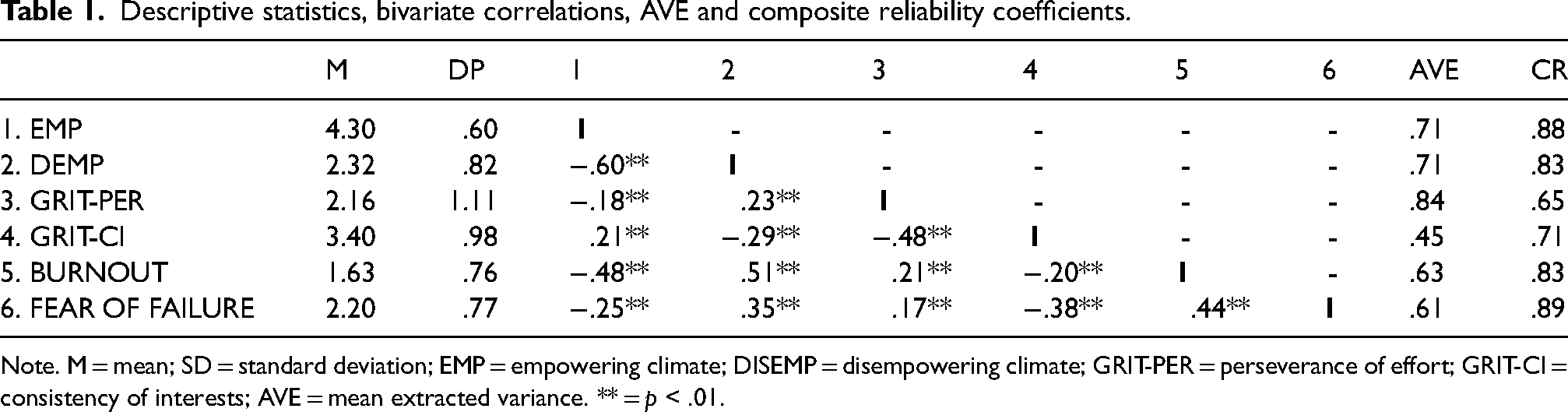
Note. M = mean; SD = standard deviation; EMP = empowering climate; DISEMP = disempowering climate; GRIT-PER = perseverance of effort; GRIT-CI = consistency of interests; AVE = mean extracted variance. ** = p < .01.
The measurement model test includes six related latent variables: empowering and disempowering climate, grit-perseverance of effort, grit-consistency of interests, burnout and fear of failure and revealed adjusted values of convergent validity (AVE > .50), except in grit-consistency of interests, since the value was below .50 (AVE = .45).
There were no problems of discriminant validity, since the square of the correlations between the factors was lower than the value of variance extracted from each of the factors, as well as adjusted internal consistency values (>.70).
Nevertheless, the results of the measurement model revealed that it fitted the data: χ2/df = 2.69(137), B-S p < .001, TLI = .931, CFI = .945, SRMR = .052, RMSEA = .062 (CI −90% = .054, .069). In this way, the results support the preliminary conditions suitable for carrying out the structural model and analyzing the direct effects between the variables under analysis presenting the means, standard deviations, bivariate correlations, convergent validity values and internal consistency of the variables under study.
Participants revealed high values in the empowering climate (M = 4.30; SD = .60), moderate levels of grit-consistency of interests (M = 3.40; SD = .98) and low levels in the disempowering climate (M = 2.32; SD = .82), grit-perseverance of effort (M = 2.16; SD =1.11), burnout (M = 1.63; SD = .76) and fear of failure (M = 2.20; SD = .77). The correlation pattern between the variables under study was significant among all variables (p < .01).
The standardized direct effects of the structural model are shown in Table 2. Empowerment climate is negatively associated with burnout (β = −.26, CI = −.401, −.098; p = .003) and with fear of failure (β = −.08, CI = −.200, −.015; p = .043). In contrast, the climate of disempowerment is positively associated with burnout (β = .33, CI = .175, .500; p = .005), and with the fear of failure (β = .26, CI = −.833, −.351; p = .003).
Direct effects of the variables under the study.
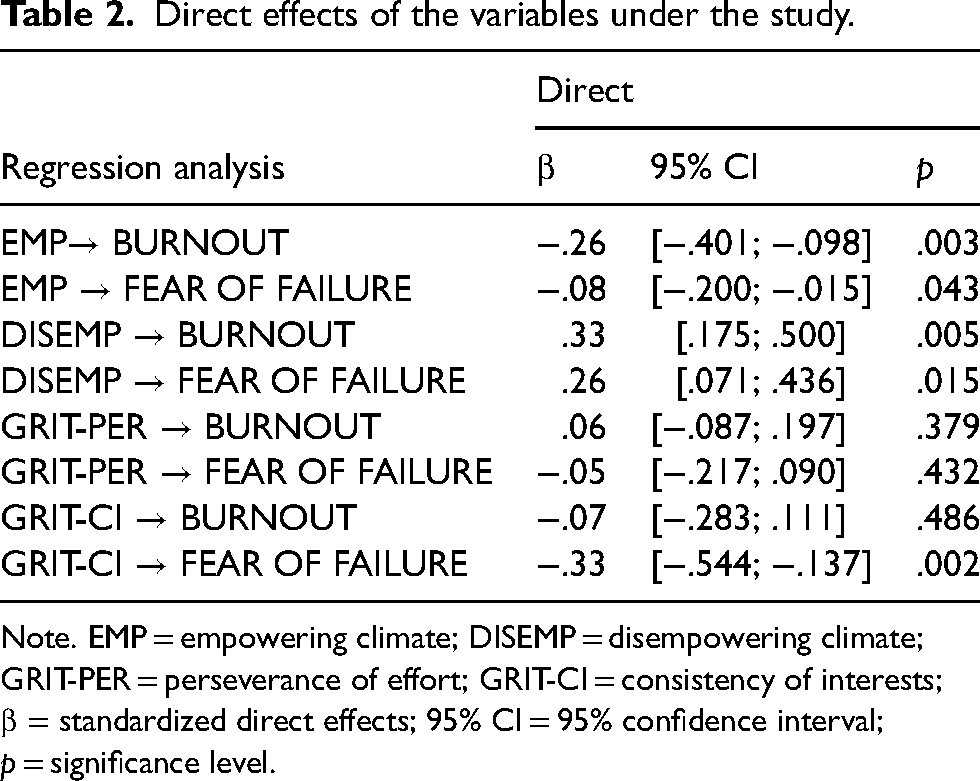
Note. EMP = empowering climate; DISEMP = disempowering climate; GRIT-PER = perseverance of effort; GRIT-CI = consistency of interests; β = standardized direct effects; 95% CI = 95% confidence interval; p = significance level.
In turn, grit-perseverance of effort was not significantly associated with burnout (β = .06, IC = −.087, .197; p = .379) or with fear of failure (β = −. 05, IC = −.217, .090; p = .432). In contrast, grit-consistency of interests was not significantly associated with burnout (β = −.07, IC = −.283, .111; p = .001), however, it showed a negative and significant association with the fear of failure (β = −.33, IC = −.544, −.137; p = .002).
Nevertheless, the results of the structural model revealed that it fitted the data: χ2/df = 2.95 (138), B-S p < .001, TLI = .920, CFI = .936, SRMR = .068, RMSEA = .066 (CI −90% = .059, .074), which overall explain 33% of the variance of burnout and 23% of the variance of fear of failure.
Meanwhile, the correlational analysis between the EDMC with grit-perseverance of effort and grit-consistency of interests showed non-significant relation (Figure 1).
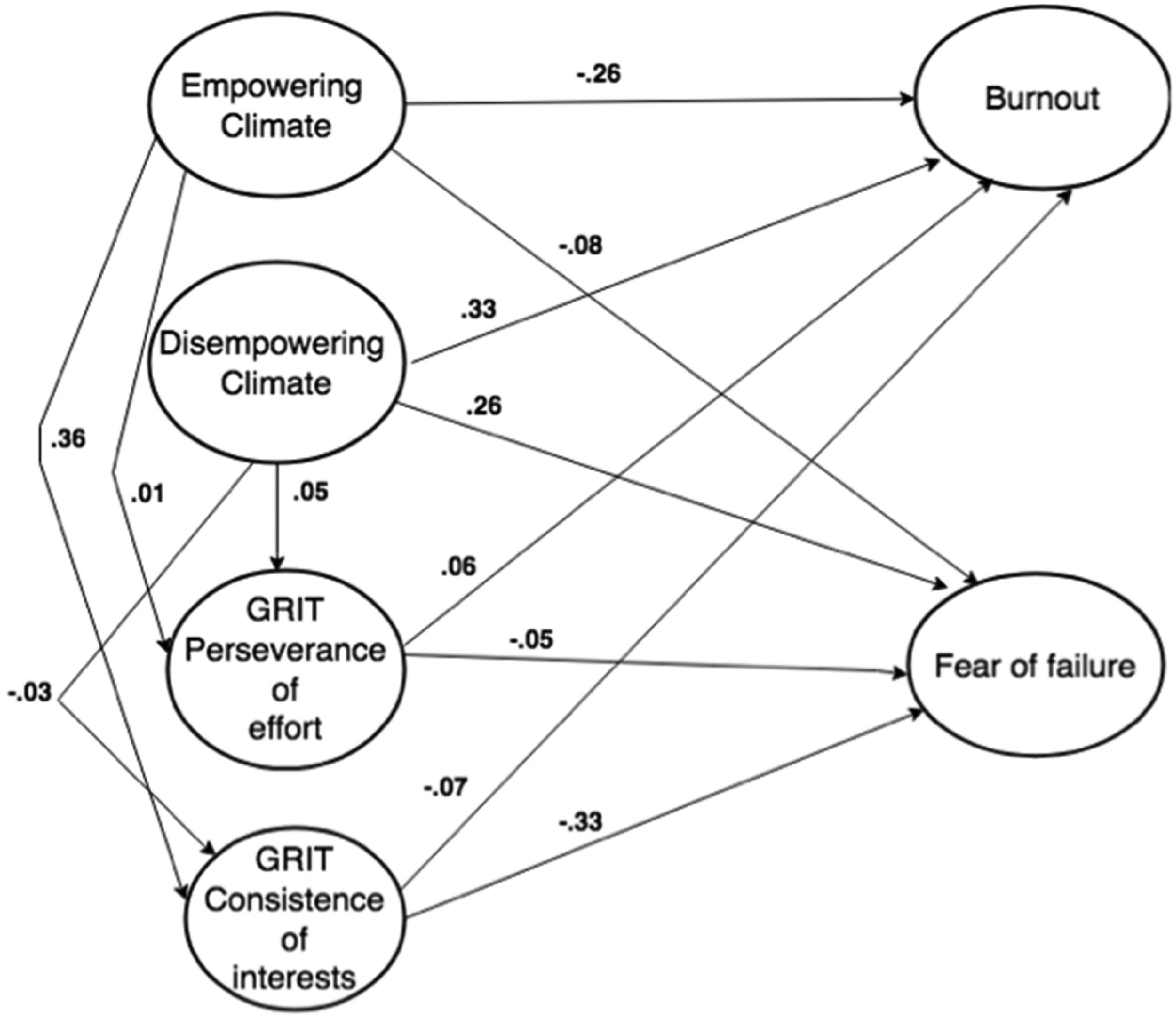
Diagram of the global results of the study.
Discussion
The purpose of this study is to examine the relations between the empowering and disempowering climate with burnout, fear of failure and grit according to the multidimensional and hierarchical conceptual model of motivational climates created by Duda, 20 that integrated the AGT and the SGT dimensions of the motivational climate, assuming that the literature is scarce on the relationships between these constructs.
There are few studies that equate the relationships between empowering climates with the levels of persistence and passion of athletes, with their impact on the fear of failure and on burnout. There is also not enough scientific evidence on how these variables are associated, so the investigation of these variables was considered of great relevance and was developed in this study.
Our findings showed that perceptions of an empowering motivational climate (task-involving, autonomy and socially supportive) were negatively associated with maladaptive outcomes for the athletes. Specifically, structural equation modeling revealed significant direct negative effects between perceptions of an empowering motivational climate on burnout and fear of failure. Contrary, the perceptions of a disempowering motivational climate (ego-involving and controlled coaching) were positively related with burnout and fear of failure.
Overall results were in line with our hypothesis, confirming that the perceptions of the motivational climate created by the coach are considered one of the most influential factors in determining whether athletes have a positive or negative experience in sport. 73 There is substantial evidence in literature research that the psychosocial environment created by the coach has a significant impact on athletes’ perceptions, emotions and behaviors. 1
Contrary to our hypothesis, the results obtained in the structural model show that the grit-perseverance of effort was not significantly associated with burnout, nor with the fear of failure.
This empirical evidence contrasts with previous studies found in the school context that showed a negative relationship between grit and burnout and other associated psychological symptoms. 74 It is important to highlight that there are no previous studies on the influence of the grit-consistency of interests and the grit-perseverance of effort in the context of sport in terms of exhaustion, reduction of the feeling of achievement and devaluation of others. Further research to understand the nature of grit and its impact on athletes’ behavior and outcomes, would be relevant and valuable in the context of sport.
In contrast, the grit-consistency of interests, was not significantly associated with burnout. Grit-consistency of interests presented, however, a negative and significant association with the fear of failure. Considering that the grit-consistency of interests, contemplates the commitment to a certain domain, being a characteristic of individuals who persist on a certain path or career for long periods of time, 43 the results obtained suggest that people who have this characteristic, which is linked to a superior ability to deal with stress and to actively persist in their career, show a lower tendency for fear of failure.
Contrary to our hypothesis, the results showed that the empowering climate is not significantly related with grit-perseverance of effort and grit-consistency of interests. These results suggest that grit it is closer to a personality trait anchored by high self-determination and better adaptability being less influenced by variations in social context.
Disempowering climates did not show an association with the grit-perseverance of effort and the grit-consistency of interests. These results must be interpreted considering the particularities of our sample, whose perception of empowering climates was high, and the perception of disempowering climates was low. Therefore, it will be interesting to verify whether this association remains at the same level in extreme groups (where levels of disempowerment are extremely high). In this case, the heightened perception of disempowering climates may eventually lower levels of grit-perseverance in effort and grit-consistency of interest.
In conclusion, this study highlights the significance of empowering climates in sports, which can contribute to the development of leadership and life skills among athletes. Such empowering climates can promote a positive and supportive environment, which can enhance athletes’ motivation, performance and well-being.
Furthermore, the study suggests that sports organizations should adopt a power structure that promotes empowerment for all its members, including managers, coaches and other staff. By creating a culture of empowerment, sports organizations can foster a sense of ownership, responsibility and commitment among their members, which can translate into better outcomes both on and off the field.
Overall, the findings of this study underscore the importance of empowering climates in sports, which can have far-reaching implications for athletes, coaches, sports organizations and society at large.
Limitations and future research directions
Understanding the limitations of our study is crucial to help researchers and practitioners to build upon existing knowledge and design future studies that address these concerns. It also encourages critical thinking and a balanced interpretation of the study's results and implications.
The transverse nature of the study does not allow to infer causality between the variables, however, future research including longitudinal designs is warranted to further understand the links and causal relations between the perceptions of EDMC with burnout and fear of failure, as well as between grit factors with burnout and fear of failure.
Another limitation of this study concerns the gender homogeneity of the sample. The sample was uneven as the number of male athletes was much higher compared to the number of female athletes, making it impossible to determine the differences between genders regarding the relationships between the various dimensions studied. Researchers who are interested in replicating the current work should therefore make sure to recruit a larger proportion of female athletes.
Furthermore, the age invariance was not possible to study, because the number of individuals per age group was insufficient compared to the number of parameters to be estimated in the structural model.
It is indeed important to consider the timing and context of the tasks when studying the empowering climate in sports. The motivational climate can vary depending on the phase of the season, the specific challenges and demands faced by athletes and other situational factors. For instance, during the middle and end of the season, athletes may experience higher levels of stress and pressure, which can impact their perception of the motivational climate.
Overall, understanding the dynamics of EDMC in sports is an ongoing process, and further research is needed to explore how different factors (phase of the season; level of pratice; personal goals), influence athletes’ perceptions of the motivational climate in different contexts.
Finally, it is important to reinforce the investigation about the grit concept in sports context—namely, its impact on performance optimization—in order to fill the gaps in the scientific literature on this subject and to enable a more comprehensive reading on the influence of situational and environmental factors on grit.
Conclusion
In summary, perceptions of an empowering motivational climate were negatively associated with burnout and fear of failure. Conversely, perceptions of a disempowering motivational climate were connected positively with burnout and fear of failure.
No direct links were observed from grit-perseverance of effort and grit-consistency of interests with burnout and both EDMCs. At the same time, grit-consistency of effort expressed a significant negative relation with fear of failure, suggesting that its interaction with situational factors may reduce the fear of failure, however, it is necessary to continue researching, so we can better understand the effects of grit on burnout and fear of failure.
The results of this study highlight that the perception of an empowering motivational climate can significantly impact the athletes’ experience of their sport, including their thoughts, feelings and actions. If the coach-athlete interaction is positive and supportive, it can enhance the athletes’ involvement in the sport and contribute, physical and emotional well-being.
Conversely, the perception of a disempowering motivational climate characterized by a negative and unsupportive coach-athlete interaction, can hinder the athletes’ involvement in the sport and potentially harm their physical and emotional well-being. Therefore, it is important for coaches to be mindful of how they communicate and interact with their athletes to create a positive and supportive environment that fosters the athletes’ growth and well-being.
Footnotes
Author contributions
Conceptualization by CB; methodology by CB and AR; software by CB; validation by DM; formal analysis by CB and DM; investigation by CB; resources by CB; data curation by CB and DM; writing–original draft preparation by CB; writing–review and editing by RB and AR; visualization by RB and AR; supervision by AR and AHM; project administration by AH-M. All authors have read and agreed to the published version of the manuscript.
Institutional review board statement
The study was conducted in accordance with the Declaration of Helsinki. Ethical approval was obtained by the Ethical Committee of the Faculty of Human Kinetics before data collection (reference number: 4/2021).
Data availability
Materials described in the manuscript, including all relevant raw data, will be freely available to any researcher wishing to use them for noncommercial purposes, without breaching participant confidentiality.
Declaration of conflicting interests
The authors declared no potential conflicts of interest with respect to the research, authorship, and/or publication of this article.
Funding
The authors received no financial support for the research, authorship, and/or publication of this article.
Informed consent statement
Applicable.
