



Abstract
The management of training load in youth team-sport athletes is important. There is, however, a lack of research on practitioners’ perceptions and understandings of managing training load during this period and what this means in terms of maturational status and injury risk. This study aimed to investigate academy football practitioners’ perceptions and understanding of training load, maturation and injury risk in young male footballers. Coaches, sports scientists, medical staff and key stakeholders from a professional football club academy in England participated in focus groups investigating their understanding and perceptions of training load, maturation and injury risk. A qualitative descriptive methodology utilising framework analysis was used to capture and better understand participants’ views. Findings revealed that practitioners consider managing training load during adolescence to be comprised of, and mediated by, three key elements: club philosophy, factors inside the club's control (periodisation strategy; staff member practice), and factors outside the club's control (life load; growth and maturation). This study is an important addition to the current literature on managing injuries through the growth spurt by investigating how different stakeholders perceive training load, maturation and potential strategies to mitigate risk.
Introduction
Youth academies are central to the long-term development of English soccer players 1 with success generally defined as the attainment of a professional contract and/or playing elite-level football. 2 The long-term development of players involves the complex interaction of physical, psychological, environmental and sociocultural factors. 3 Injuries can significantly impact player development, primarily through reduced training and match exposure, which may prevent individuals from transitioning from academies to first-team football. 4 The elite youth football setting presents some unique injury risk factors, including the adolescent growth spurt, a phase that has been associated with an increased injury risk in some studies.5–11 Common growth-related injuries include growth-plate fractures, apophysitis and apophyseal avulsion fractures. 12 Furthermore, the inter-individual variation in maturation during adolescence is large, making it difficult for practitioners to accommodate for differences in growth and maturational status. 13 Despite this being a critical period for development and of high importance to football academies, there is a lack of research on how to most effectively manage training load through this period.
An adequate training dose is essential for the development of physical fitness and sporting skills (technical, tactical and psychological). 14 An inadequate training load may under prepare the athlete for performance,15,16 whereas, a greater training load with insufficient recovery may cause overtraining, overuse injury or burnout. 17 It should be noted, however, that the causal effects between training load and injuries are complex and poorly understood.18–20 For training load in youth athletes, the consensus statement for youth athletic development recommends three key considerations: (1) they should comprise of diversity and variability of athletic exposure; (2) they must avoid inappropriate training and competition that exceeds safe load thresholds, to mitigate the risk of overuse injuries and other health problems and (3) they must provide sufficient and regular rest and recovery, to encourage positive adaptations and progressive athletic development. 21 These recommendations, although useful, are limited to general observations and do not provide depth of insight into how this could be done practically in specific sports.
Factors contributing to the management of training load in youth team-sport athletes has highlighted some key challenges and potential solutions. 22 As noted, periodising training load is paramount to providing a sufficient dose and allowing for recovery from the programme. This can be difficult when multiple organisations (school, club, county and national) are planning training and competition in isolation,23,24 therefore, one organisation would unlikely have all training load information. A second challenge is the large inter-individual and intra-individual variation in training load for youth team-sport athletes. 25 Another key training load challenge in youth sports is balancing and maintaining both academic and sporting successes. 22 Finally, it is also challenging for practitioners to accommodate for differences in growth and maturational status; as chronological age groups may not account for differences in growth rate or maturational status.
To further our current understanding of injury risk reduction and the management of training load in adolescent athletes, it is important to consider injury prevention models and practices. There are several key considerations for developing and implementing injury reduction programmes, including administrative support, an interdisciplinary implementation team, identifying logistical barriers and solutions, an evidence-based and context-appropriate injury reduction programme, and educating staff and users.26,27 The successful implementation of an injury risk reduction intervention should include key stakeholders and end-users’ in the design process.27–31 Moreover, an evidence-based context-specific injury reduction training programme in youth team sports should prioritise collaboration and integration between stakeholders. 30 This idea further links with the “iterative sequence of prevention” approach, which involves an interdisciplinary collaboration between technical coaches, sports scientists and medical staff to have a meaningful impact on injury risk by accounting for medical, coaching and performance best practices.32,33 As elite-level contexts are unique and continuously evolving, therefore, interventions must be adaptable to fit this dynamic and rapidly evolving environment. 33
In light of the preceding discussion, the overall aim of this study was to investigate English football academy practitioners’ perceptions and understanding of training load, maturation and injury risk. This study also aimed to uncover current practices within the club regarding training load during adolescence and formulate practical strategies to help reduce injury risk among male youth football players during the adolescent growth spurt.
Methodology and methods
Context
This study took place inside a Category 3 Academy English Football Academy during the 2019 to 2020 season.
Subjects
Eleven staff were recruited using convenience sampling by the lead researcher based on being the key stakeholders (department heads) within the academy, as well as, the members of staff who work with the U13 s to U16 s age groups. They were recruited through email, one invited member of staff could not attend due to an alternative work commitment meaning 11 of the 12 staff invited attended the session. Two focus groups were conducted, one with six participants and the other had five participants. Each focus group included a mix of senior staff, coaches, sports scientists and medical staff to provide a range of viewpoints from each discipline. There was no presence of non-participants. The groups were split to have the most senior staff spread between both groups so that the discussions and outcomes of both groups include key stakeholders.
Methodology
A qualitative descriptive approach was taken in this study. Qualitative description is a pragmatic approach to research, which focuses on descriptions of phenomena. 34 As such, this approach allowed us to understand the academy staff and their view of the situation, problems and practical strategies through focus groups as the method of data collection. Allowing practitioners to share their perceptions on the subject, as well as, identifying barriers and facilitators of the specific context was key in this study, and focus groups were considered well-suited to this aim. Further, we utilised the framework approach for analysis because it can be used in deductive, inductive and combined types of qualitative research and can be adapted depending on the research question. 35 This allowed findings from current literature and novel insights to be synthesised together within this study. The framework method is also not aligned with a particular epistemological, philosophical, or theoretical approach but rather a flexible tool that can be adapted for use with many qualitative approaches that aim to generate themes. 35 In this way, this method is appropriate under a qualitative descriptive approach. Framework analysis provides clear steps to follow and produces highly structured outputs of summarized data which can be beneficial where not all members have previous experience in conducting qualitative research. 35 The trustworthiness and credibility of the study were demonstrated using the Consolidated Criteria for Reporting Qualitative Research 36 (Appendix 1) and the four-dimension criteria to assess the rigour of qualitative research 37 (Appendix 2).
Ethics
Ethical approval was gained from the University of Bath, Department for Health ethical committee (REACH) (EP 17/18 239). Before data collection, participants were recruited by email, informed consent was obtained from all participants and the focus group was clearly explained to them through email and the participant information sheet. The focus groups were transcribed by the first author (DJ) verbatim after the completion of both focus groups. Transcripts were checked for accuracy against the audio recordings and corrected for anomalies, and member checked by participants.
Data collection
Data collection for this study took place in the form of focus groups, and all data were collected by the first author of this manuscript who acted as the moderator (D.M. Johnson, MRes, PhD Candidate, Male). The moderator had received focus group training and completed a pilot focus group with a representative sample before data collection. DJ has no personal experience in academy football as a player, but before data collection had worked in academy football for 3.5 years, 1.5 of which were in the specific academy within this study. As a result, relationships were pre-established between the moderator and participants. Participants were aware of the moderators’ role and that the research and findings in this study could affect practice within the academy. Furthermore, the participants knew of the researcher's interest in the topic. Focus groups were used to allow interaction between participants so that they could come to a shared understanding of action points related to the topic.
Focus groups were conducted in a classroom inside the academy's office facilities over successive weeks.
Focus groups were recorded with a dictaphone placed in the middle of the table, there was a second dictaphone as a backup. The focus group started with each participant introducing themselves for the recording and giving an overview of their role at the club. The first author then provided post-it notes to each participant to note down their thoughts on training load in adolescent footballers. Participants were then instructed to share their ideas and group any similar ideas. The lead author did not contribute to the first task or offer opinions in the discussion but rather asked questions for more detail or clarity and aimed to involve each member in the discussion. The first author collected field notes during the focus group to support data analysis. The first focus group was a total duration of 01:34:14 and the second was a total duration of 00:57:54. Focus groups continued until data saturation when participants no longer had any further comments or information to add. 38 There were no follow-up interviews or focus groups. Transcripts were emailed to all participants for comment or correction, as a form of member checking.
Data analysis
All data analysis was performed by the lead author (DJ) who was embedded within the research context and had the greatest knowledge of the specific subject area, with a review, discussion and input by the wider research group to ensure resonance and trustworthiness. The seven-step procedure for framework analysis was used (1) transcription (see above), (2) familiarisation with the interview, (3) coding, (4) developing a working analytical framework, (5) applying the analytical framework, (6) charting data into the framework matrix and (7) interpreting the data. 35 For familiarization with the focus groups, the recording was listened to twice by the lead author and the transcripts were also read twice. Coding was performed by the lead author by adding notes to the transcription. After careful consideration, a set of codes, each with a brief definition were generated. This formed the initial analytical framework. The research group then met for a verification process where the themes and codes were discussed and amended. The analytical framework was then applied to each transcript. The transcript was systematically coded to the framework and meaningful text was highlighted with the corresponding code. After coding the transcripts using the analytical framework, data was summarised in a matrix. The matrix was created in Microsoft Excel (2018), using one row per focus group participant and one column per code. Themes were then generated by analysing the matrix and combining code which could be grouped into related topics. The lead author generated themes based on the research objectives and inductively generated novel concepts from the data. Themes, codes and results were then shared with select focus group participants for member checking.
Findings and discussion
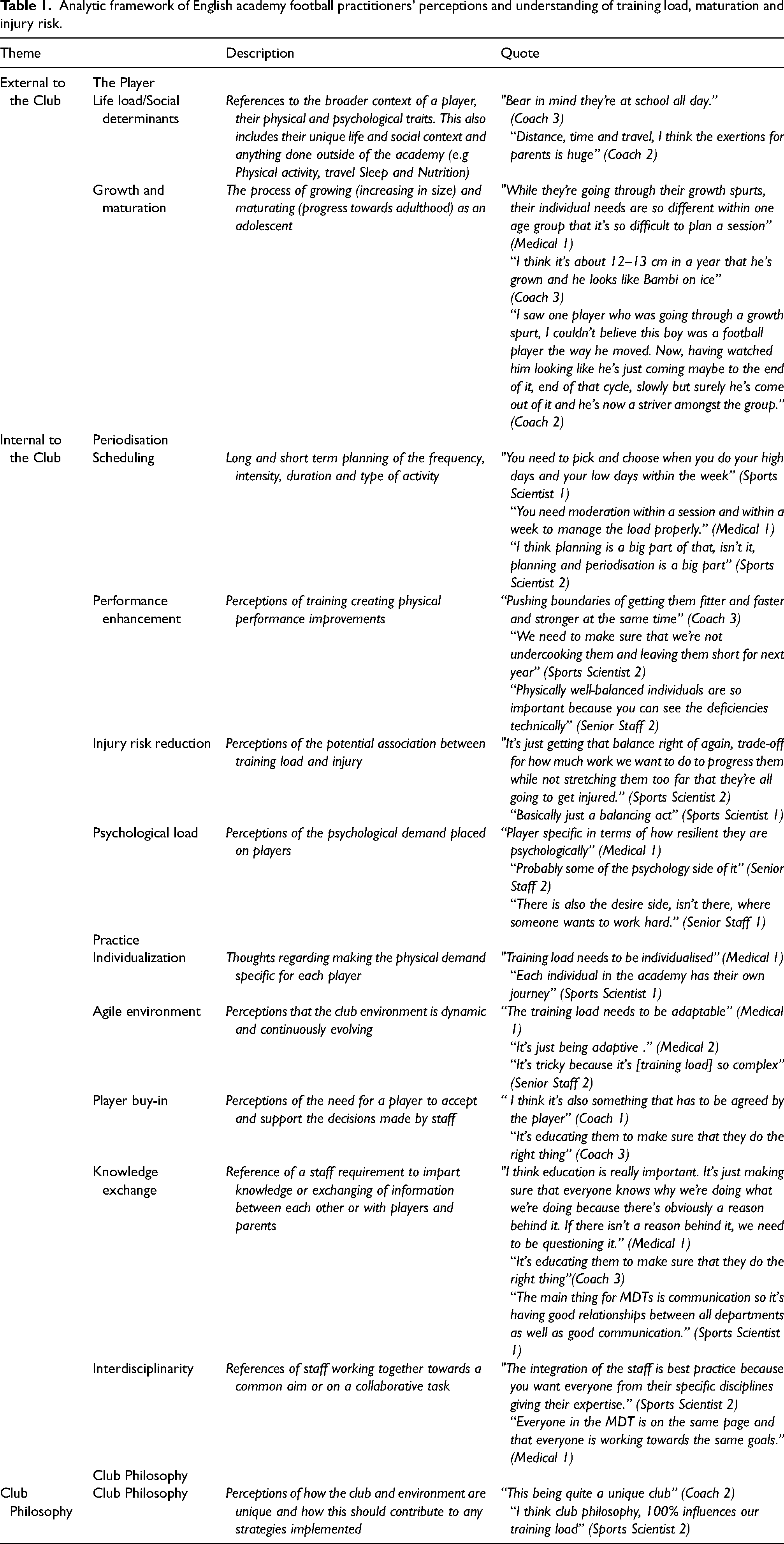
The findings of this research are presented in Table 1 and Figure 1. The three themes (club philosophy, elements internal to the club and elements external to the club) will next be presented and discussed in turn.
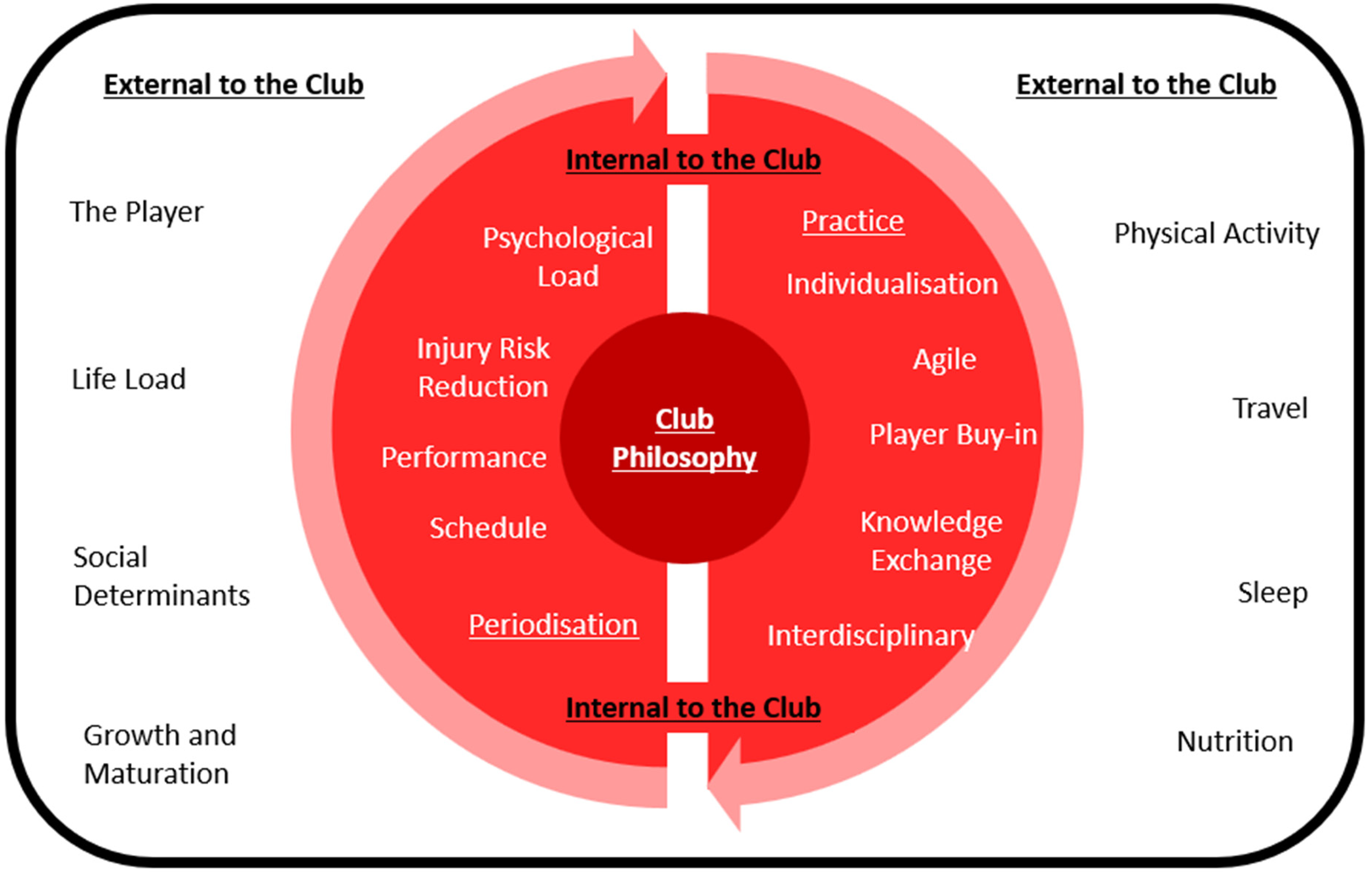
A graphic representation of English academy football practitioners’ perceptions and understanding of training load, maturation and injury risk (themes are underlined).
Analytic framework of English academy football practitioners’ perceptions and understanding of training load, maturation and injury risk.
Theme 1: Club philosophy
A central issue around managing training during adolescence was the club philosophy. Club philosophy, in this study, is considered as ‘perceptions of how the club and environment are unique and how this should contribute to any strategies implemented’. The uniqueness of the club was important to participants, with one noting ‘This being quite a unique club’ (Coach 2). This was seen as a potential challenge when developing a periodisation strategy, as participants considered that their environment is unique and strategies might not transfer between this environment and others. Moreover, the club's attitudes toward player development and style of play were also said to impact the management of training load during adolescence ‘I think club philosophy, 100% influences our training load’ (Sports Scientist 2).
Theme 2: Internal to the club
The next layer to managing training during adolescence was the processes conducted inside the academy. This was split into two key categories, periodisation and practice, each of which had subthemes. Periodisation is a common idea in sport and is defined as the planned manipulation of training variables to maximise training adaptations and reduce the risk of overtraining. 39 Participants of the focus group mentioned scheduling as part of periodisation, that is, the long-term and short-term planning of the frequency, intensity, duration and type of activity ‘you need to pick and choose when you do your high days and your low days within the week’ (Sports Scientist 2). They also mentioned that periodisation is potentially linked to improvement in performance ‘pushing boundaries of getting them fitter and faster and stronger at the same time’ (Coach 3). There was also a reference to the potential association between training load and injury ‘It's just getting that balance right of again, trade-off for how much work we want to do to progress them while not stretching them too far that they’re all going to get injured’ (Sports Scientist 2). This theme suggests that the participants of the focus group have identified the importance and also the complexity of managing training load for this population. Managing training load for youth athletes is a challenge which occurs across sports.22,40 Moreover, Scantlebury 22 explored the factors contributing to managing the training load for youth team-sport athletes further, highlighting some key challenges and potential solutions. Managing the schedule and training load is one particular challenge,24,25 this challenge was identified in the present study including the periodisation of the training at the academy. The participants in this study identified interdisciplinary working as a potential solution to this problem; integration between staff members could allow for best practices from each discipline (physical, medical and coaching) when planning the schedule and training load. Both performance and injury are key considerations when planning training for adolescent athletes, and research has shown there are unique injury risk factors in youth football. 10 Caution should be taken when interpreting training load and injury as the causal effects between training load and injuries are complex and poorly understood.18–20 It is, however, important to balance injury and physical performance during this phase, as growth-related injuries can have lasting negative effects on strength and endurance function. 41 Moreover, adolescents who suffer from growth-related injury might need to continue a dose of plyometric training to facilitate the retention of power performance. 42 The psychological load was another theme mentioned by the participants. These were comments or acknowledgements of the psychological demand placed on players. The participants felt that psychological resiliences should be accounted for when planning load ‘Psych for sure, yes. Some need rest from football. Some need football every single day of their lives’ (Sports Scientist 2).
Practice was the next theme for inside the academy. In this context, it refers to how staff are expected to, or should work, within the academy. Interdisciplinary is the first sub-theme, which included references to staff working together toward a common aim or on a collaborative task, this can be represented best by the following quote, ‘the integration of the staff is best practice because you want everyone from their specific disciplines giving their expertise’ (Sports Scientist 2). This study used an interdisciplinary approach, as the iterative sequence of prevention model suggests the involvement and collaboration between technical coaches, sports scientists and medical staff to have a meaningful impact on injury risk. 33 The shared understanding acquired during these focus groups aimed to account for medical, coaching and performance best practices. 32 Knowledge exchange is another theme under practice. Knowledge exchange is the requirement of staff to impart knowledge or exchange information between each other or with players and parents, ‘I think education is really important. It's just making sure that everyone knows why we’re doing what we’re doing because there's obviously a reason behind it. If there isn’t a reason behind it, we need to be questioning it’ (Medical 1). Player buy-in was another consideration of good practice by the staff, they suggested that ‘it's also something that has to be agreed by the player’ (Coach 1) and therefore it is important to communicate with the player and acknowledge their views along with those of the staff when making decisions. This idea is supported by injury risk reduction intervention literature, which suggests seeking the end-users’ perspectives on the problem. 29 In a similar study, gymnastic coaches also highlighted the need for further education to support adolescent gymnasts. 40 Moreover, coach education has been previously used as an attempt to reduce the risk of injury in sport.43,44 ‘Agile’ refers to the perception that the club environment is dynamic and continuously evolving, ‘the training load needs to be adaptable’ (Medical 1). Again this fits with the iterative sequence of prevention approach, which suggests that the contexts in which injury reduction interventions are applied are unique and continuously evolving, especially at the elite level. 33 This idea again matches the perceptions that the club environment is dynamic and continuously evolving in the sub-theme of the agile environment. The final aspect of practice refers to individualisation; this is the perception that the physical demand should be specific for each player ‘training load needs to be individualised’ (Medical 1) and that this should be included in longitudinal planning ‘each individual in the academy has their own journey’ (Sports Scientist 1). The staff also perceived that there are several factors that contributed to individualisation including psychological load, mentioned above, ‘player specific in terms of how resilient they are psychologically’.
Theme 3: External to the club
The next main theme refers to phenomena occurring external to the club, including life load (physical activity, travel, nutrition and sleep), and growth and maturation. Life load and social determinants refer to the broader context of a player, their physical and psychological traits. This also includes their unique life and social context and anything done outside of the academy (e.g., physical activity, travel, sleep and nutrition). Managing or understanding a youth athlete's activity outside of the academy or elite environment is a challenge across sports.24,25 Knowledge exchange between staff, parents, players and other external stakeholders (school, county and national) could be a potential solution. Both of these findings align with previous research that suggests collaboration and communication are potential solutions. 22 This challenge should also be considered as broader than just training load; life load might be a more appropriate term to characterise the variety of stressors (e.g., academic stress, travel, poor sleep and poor nutrition) or assistors (e.g., academic support, travel support or reductions, good sleep and good nutrition) involved. Key quotes to summarise this include ‘Bear in mind they’re at school all day’ (Coach 3) and ‘distance, time and travel’ (Coach 2). School or academic stress is part of this consideration of life load. 22 To overcome this challenge, the academy must take a player-centred approach in which they support their education and communicate effectively with all parties about periods of high sporting stress and high academic stress.
Growth and maturation were also identified as a theme. These processes of growing (increasing in size) and of maturing (progress towards adulthood) have both been defined in previous literature. 13 The staff referred to the potential effect of this on planning appropriate training loads ‘while they’re going through their growth spurts, their individual needs are so different within one age group that it's so difficult to plan a session’ (Medical 1) and ‘ensure that they’re getting good quality work but at the same time they’re not overstressing and making that growth-related injury significantly worse’ (Sports Scientist 1). Research has previously identified risk factors that are associated with an increased likelihood of injury during adolescence. This includes maturity status,5–7,10 rate of growth in stature8,10 and lower limb growth rate.10,45 This finding also fits with research in gymnastics, where coaches suggested modifying training during growth. 40 Moreover, these gymnastics coaches suggested, or already under-took, modifications to training during the growth spurt including reducing training load and minimising high-impact loads. 40 However, currently, there is limited evidence on practical solutions to address these risks. 46 These risk factors have been identified by the practitioners in the present study and peer-reviewed studies as important in the prescription of appropriate training load during the adolescent growth. This does pose a new additional problem of determining what is an appropriate training load. There is a large inter-individual and intra-individual variation in training load for youth team-sport athletes, 25 meaning that the individualised monitoring of athletes is paramount, as athletes may have dramatically different schedules and different responses to the same dose of training load.
Limitations
This study only represents the perceptions of staff from one football club. Moreover, the lead author's positionality could affect the interpretation of results, as they were embedded within the research environment and that research within this area is following his current understanding and desire to develop knowledge in the area of ‘training load and injury in academy football players’. Resultantly this could affect the results produced by giving larger or smaller preferences to the themes generated based on their viewpoint. The relationship between the lead researcher/author and participants was pre-established as they were embedded within the research context. This could have potentially affected the results gained from the study as participants could have felt that what was said during the focus group might be perceived negatively or not accepted. There is also the possibility that if a participant's relationship with the lead researcher was negative they may not have perceived any value in sharing within the discussions. This study did use several strategies to overcome these potential issues, including a verification process with the research group, member checking with the participants, using the Consolidated Criteria for Reporting Qualitative Research 36 (Appendix 1) and the four-dimension criteria to assess the rigour of qualitative research. 37 This study did not identify any diverse cases; this could be due to the homogeneity of the participants, as all study members had a similar socio-economic background, educational background, worked at the same football club and would have discussed this topic or similar as part of their work. This study provides an important addition to the research on managing injuries through the growth spurt. Despite its limitations, it adds an example of how a context-specific injury risk reduction strategy could be created. Currently, the literature lacks any possible solutions specific to academy football that account for the novel biological changes occurring during adolescence. 47
Conclusion
This study aimed to investigate academy practitioners’ perceptions and understanding of training load, maturation and injury risk. This study also aimed to uncover current practices within the club regarding training load during adolescence and formulate practical strategies to help reduce injury risk among youth soccer players during the growth spurt. When conducting injury risk reduction research it is important to consider how a study fits within the wider research and the process undertaken to achieve a successful outcome. This study fits in a wider research area, aiming to design strategies for reducing injuries during adolescence. This study represents an attempt to better ‘identify’ both facilitators and barriers to injury reduction strategies in this context. 27 Moreover, this study aimed to include all key partners in this design phase of the intervention to allow for an interdisciplinary approach toward injury reduction strategies. Moreover, gaining administrative support from key stakeholders, using an interdisciplinary implementation team, as well as, identifying logistical barriers and solutions are key in developing injury reduction strategies. 26 The next steps should aim to design an evidence-based and context-appropriate reduction programme, as well as, train those implementing the strategy. 26 As well as generating knowledge, this study has contributed to a better shared understanding of the topic and provided ideas about applying knowledge in practice, which is important in injury reduction in youth team-sport athletes. 30 Moreover, practitioners’ perceptions about injury and injury reduction can influence programme uptake. 31 Injury reduction strategies can be more successful by identifying perceived barriers and facilitators among stakeholders.30,31 Furthermore, best practice in youth team sports would develop an evidence-based context-specific injury reduction training programme and implementation plan, through collaboration and integration between stakeholders. 30 Overall, our findings suggest that practitioners consider managing training load to be comprised of three elements. These elements include club philosophy, factors inside the club's control (periodisation strategy; staff member practice) and factors outside the club's control (life load; growth and maturation). Moreover, the information gained from this study aimed to have a meaningful real-world impact on practice to act as part of an intervention design process, by identifying factors contributing to the management of training load, maturation and injury risk in adolescent footballers.
Footnotes
Disclosure statement
The lead author (DJ) was embedded within the academy during the data collection of this study, the authors report no other conflict of interest.
Declaration of conflicting interests
The author(s) declared no potential conflicts of interest with respect to the research, authorship, and/or publication of this article.
Funding
The author(s) received no financial support for the research, authorship, and/or publication of this article.
