



Abstract
Although neuromuscular injury prevention programs decrease injuries, implementation is challenging. Netball Australia developed the Netball KNEE program – a netball-specific warm-up program designed for netball coaches, players and support staff to enhance movement efficiency and prevent injury. It contains exercises for warm-up/footwork, strength, balance/landing and agility. This study aimed to explore the Reach, perceived Effectiveness, Adoption, Implementation and intended Maintenance of the Netball KNEE program in community netball. Community netball coaches (n = 257) from 52 community netball clubs completed an online survey on their familiarity with the KNEE program (Reach), satisfaction and perceived effectiveness (Effectiveness), use of the program in training (Adoption), use of specific program components and provision of feedback (Implementation) and intended future use of the program (Maintenance). 66.5% of coaches who responded to the survey were familiar with the KNEE program (Reach), and 43.0% of coaches reported using the program weekly (Adoption). Most coaches who were familiar with the program were satisfied with it (87.2%) and perceived it to be effective in reducing injuries (77.0%) (perceived Effectiveness). Only 58.7% of the 155 of coaches who adopted the program reported using all activity categories (warm up/footwork, strength, balance/landing and agility) (Implementation). Warm up/footwork activities were reported to be used most commonly (by 99.4% of coaches). Reported provision of feedback on program key principles (e.g., take off, landing, deceleration, changing direction) was variable (54.2%–97.4%) (Implementation). Study findings suggest the need for strategies to improve the reach, adoption and implementation of the KNEE program in community netball.
Introduction
Netball is often considered the national game for females in Australia with approximately half a million participants nationally. 1 It requires rapid change of direction, acceleration, deceleration and landing, which places players at risk of lower limb injury. Adolescent females – a population that commonly plays netball – are four times more likely to sustain an anterior cruciate ligament (ACL) injury than males. 2 Between 2000 and 2004, netball resulted in 4596 Australian hospital admissions, the most common reason being an ACL rupture. 3 Peak incidence of ACL reconstruction surgery in Australia is found in females 15–19 years-of-age. 4
Injury prevention programs (IPP), such as the FIFA 11+, have been developed to address biomechanical risk factors for injury and have established efficacy in reducing the risk of lower limb injuries.5,6 In adolescent female sport, large-scale studies have demonstrated that neuromuscular warm-up IPP focusing on knee control, core stability and balance/landing technique are effective in reducing the rate of ACL injuries by 64%, 5 and the overall risk of serious injury by half. 7 Compliance with IPP implementation in terms of completing the recommended number of sessions, 7 performing the range of exercise types in the program 8 and providing feedback on technique 8 has been shown to be positively associated with greater injury reduction.
Based on growing evidence for IPP use in other sports, the high incidence of injuries in netball and the specific requirements of netball (i.e., sudden stopping when receiving the ball), Netball Australia developed the Netball KNEE program (KNEE program). This IPP includes warm-up/footwork, strength, balance/landing and agility exercises specific to netball. 9 One of the key focuses of the KNEE program is safe landing technique. 9 Unlike other sports such as football, 10 landing from a jump is the movement most commonly associated with ACL injuries in elite netball. 11 A netball-specific neuromuscular warm up program has been shown to improve landing technique in netball players. 12
The KNEE program is freely available online (https://knee.netball.com.au/) and is provided to coaches through netball clubs and Netball Australia's coach accreditation courses; however, little is known about its implementation. One observational study investigated the implementation of the KNEE program at training in community netball. Authors identified that no team performed the entire KNEE program and teams only performed an average of 14% of the recommended activities. 13 Although this study provides initial data on poor implementation of the KNEE program, larger population studies across multiple netball clubs are needed. Concerns about implementation of IPP in other sports have been identified14–17 with researchers using the Reach, Effectiveness, Adoption, Implementation and Maintenance (RE-AIM) framework 18 to understand IPP implementation.14,15 The aim of this study was to use the RE-AIM framework to explore the implementation of the KNEE program in community netball. Study findings will help develop targeted strategies to improve implementation of the KNEE program and provide the basis for stakeholder engagement. 19
Methods
Study design and participants
Netball clubs across Southeast Queensland, Australia, who were competing in a community netball competition were invited to participate in this cross-sectional study via email. Club email addresses were sourced from Netball Association websites. Clubs who agreed to participate were provided a link to an online survey to distribute to their coaches. Ethical approval was granted from institutional Human Research Ethics Committee (Approval #: 2017001750). All participants provided informed consent prior to participation.
Data collection
Participants completed an online survey (hosted by SurveyMonkey) that asked about personal and netball demographics (e.g., age, sex, coaching accreditation courses completed, years of coaching experience and age of players coached) and establish RE-AIM of the KNEE program (Supplementary File). The survey was designed from previous IPP implementation research 14 and piloted with a group of three netball coaches to ensure readability and understanding prior to data collection. Coaches provided overall feedback on the survey verbally and via email. No concerns were identified.
Reach
Coaches were provided with a brief description of the KNEE program, and then were asked if they were familiar with the program, and from what sources (if any) they had received information about the program (e.g., netball clubs, netball associations, coaching clinics/courses, other netball coaches). There was also an option for coaches to provide a free-text response.
Perceived effectiveness
Coaches who were familiar with the KNEE program were asked how satisfied they were with the program. Satisfaction was evaluated on a 5-point Likert-scale ranging from ‘very satisfied’ to ‘very dissatisfied’, with an option for coaches to indicate that they had not used the program. A second 5-point Likert scale (‘completely agree’ to ‘completely disagree’) was used to assess level of agreement on a series of statements pertaining to the effect of the KNEE program in reducing injuries, aiding return to play, improving sport performance, player enjoyment and perceived value as well as ease of getting players to do the program. 14
Adoption
Coaches who were familiar with the KNEE program were asked if they used the KNEE program as part of their training every week, in some weeks, at the start of the season only or not at all. They were asked which players they used the KNEE program with (‘all players’, ‘players with a history of injury only’ or ‘other’). 14
Implementation
Coaches were asked to indicate which of the four components of the program (warm up/footwork, strength, balance/landing and agility 9 ) they used. The KNEE program includes strength exercises for three difference muscle groups: quadriceps, gluteals/hamstrings and abdominals/core. 9 Coaches were provided a list of exercises from the Junior, Recreational and Elite programs that address these muscle groups (e.g., squats, lunges, bridges, arabesques, deadlifts, Nordics, front and side planks) and were asked to indicate any exercises that they used. They were also presented with the key principles of the KNEE program (take off, landing, deceleration, changing direction 9 ) and were asked to indicate which of these activities they provided feedback to players on technique.
Intended maintenance
To establish maintenance of the KNEE program, we asked coaches if they intended to use the KNEE program or another IPP with their netball team in the future (‘Yes’, ‘No’, ‘I don’t know’). 14 We also asked coaches what information they felt would be useful to know about IPP in netball (e.g., the KNEE program, how to implement an IPP, how to incorporate injury prevention activities into training/pre-game warm-up) and how they would like to receive this information (e.g., email, social media, online resource, hands-on training).
Data and statistical analysis
Raw survey data was exported in Microsoft Excel (Version 16.16.1), and statistical analysis was conducted in IBM SPSS 25 (SPSS Inc.). Frequency of responses was calculated and reported as number (percentage).
Reach of the KNEE program was defined as the coaches who were familiar with the program. Free-text responses that identified the same or similar sources from which coaches received information about the KNEE program (e.g., online/social media, physiotherapist) were grouped by the research team.
Adopters of the KNEE program were defined as coaches who were familiar with and used the KNEE program in all training sessions, some training sessions or at the start of the season. Non-adopters of the KNEE program were defined as coaches who were familiar with the program but did not use it or were not familiar with the program. Personal and netball demographics were compared between adopters and non-adopters using Chi-square and Fisher's exact tests for categorical variables (e.g., sex and highest coach accreditation level completed), and t-tests for continuous variable (e.g., age). Significance was set at p < 0.05 with Bonferroni correction for multiple comparisons (p = 0.008 for data with three categories and p = 0.005 for data with four categories).
Coaches who implemented the KNEE program were considered to be those who used all four components of the KNEE program (warm up/footwork, strength, balance/landing and agility). To understand KNEE program implementation, we also report the frequency (percentage) of coaches who: (a) used each individual component of the program; (b) used exercises for each of the target muscle groups in the strength component of the program (quadriceps, gluteals/hamstrings and abdominals/core); and (c) provided feedback on the key principles of the KNEE program (take off, landing, deceleration, changing direction).
Results
Participants
One-hundred sixty clubs were emailed an invitation to participate in this study using a club email address sourced from a Netball Association website, from which 52 (32.5%) clubs indicated their agreement to participate and forward the invitation to their coaches. Forty-four clubs (84.6% of the 52 clubs who agreed to participate) had coaches participate in the study.
A total of 308 coaches accessed the survey link, with 81.2% (n = 250) completing the survey in full, 2.3% (n = 7) completing it in part (defined as completion of demographic, frequency of activity use, provision of feedback and familiarity with the KNEE program questions) and 16.6% (n = 51) did not complete the survey. Participant characteristics are presented in Table 1.
Demographics for all coaches and those who reported using (adopters) and not using (non-adopters) the knee program.
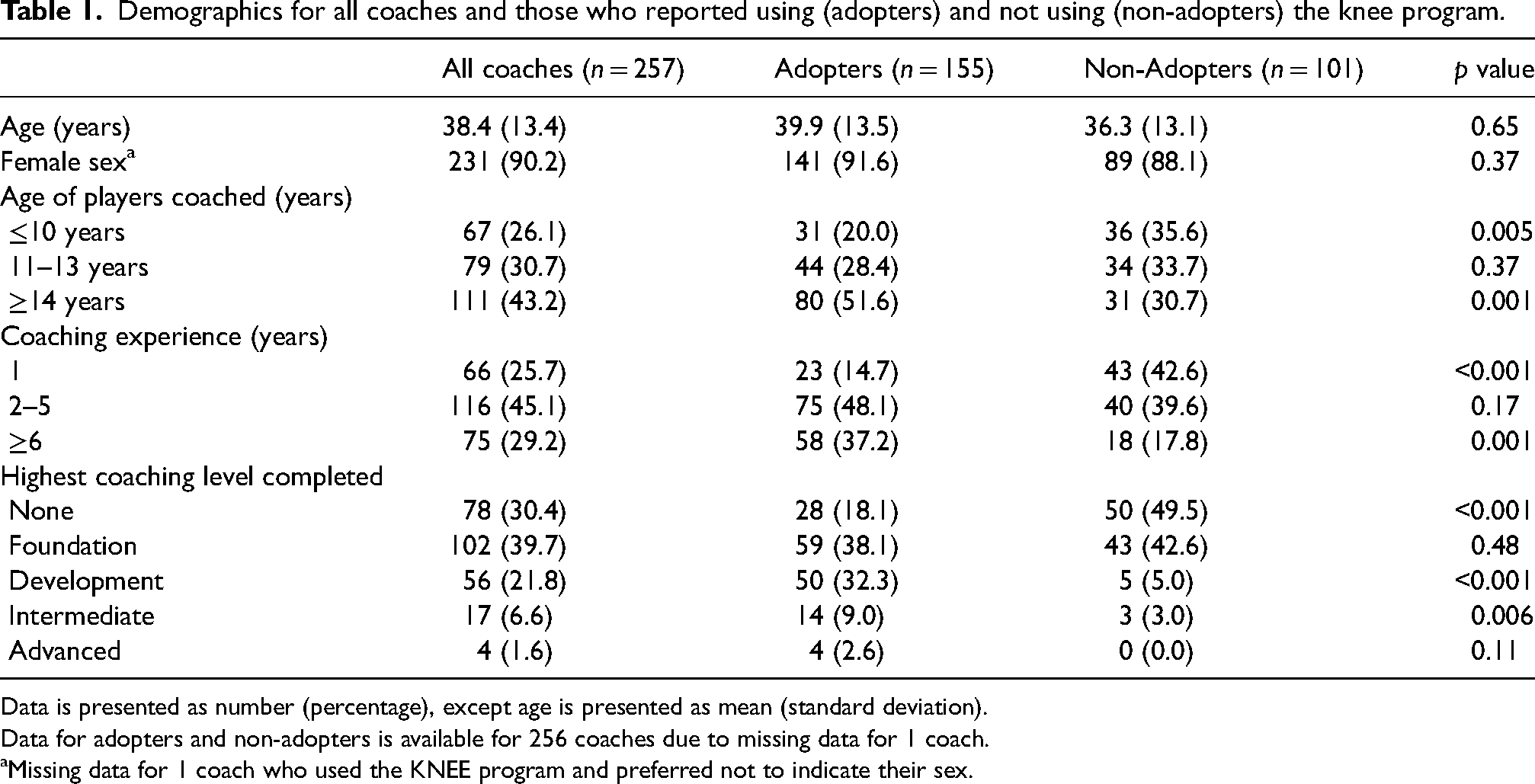
Data is presented as number (percentage), except age is presented as mean (standard deviation).
Data for adopters and non-adopters is available for 256 coaches due to missing data for 1 coach.
Missing data for 1 coach who used the KNEE program and preferred not to indicate their sex.
Reach of the KNEE program
Two-thirds of coaches (66.5%; n = 171) were familiar with the KNEE program. Coaches who were familiar with the KNEE program identified that they received information about the program from the following sources: netball club or association (69.6%, n = 119), coaching courses (45.6%; n = 78), other netball coaches (19.3%; n = 33), online/social media (from free-text responses: 7.6%; n = 13) and physiotherapists (from free-text responses: 2.9%; n = 5).
Perceived effectiveness of the KNEE program
Among coaches familiar with the program, 87.2% were either satisfied (n = 73) or very satisfied (n = 71) with the KNEE program (n = 165 due to missing data). Eleven coaches (6.7%) were neither satisfied nor dissatisfied, and 10 (6.1%) coaches did not have an opinion as they were not using the program. No coaches reported being dissatisfied with the program. Table 2 shows the reported level of agreement to statements about the implementation and perceived effectiveness of the KNEE program.
Coach perceived effectiveness of the KNEE program (n = 165).
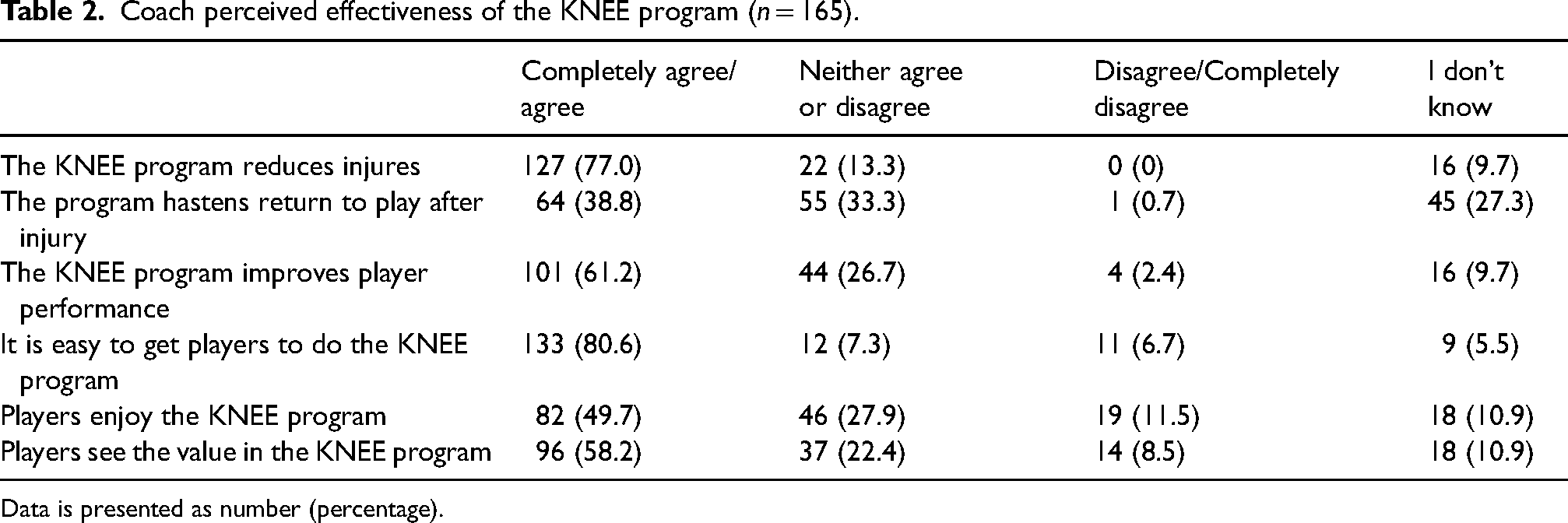
Data is presented as number (percentage).
Adoption of the KNEE program
A total of 155 coaches (60.5% of the 256 respondents) adopted the program in some form. 43.0% of coaches who responded to the survey (110 out of 256), and 70.9% of coaches who were familiar with the program (110 out of 155) reported using the KNEE program weekly. Thirty-nine coaches (15.2% of survey respondents and 25.3% of those familiar with the program) used the KNEE program in some weeks and six coaches (2.3% of survey respondents and 3.9% of those familiar with the program) used it at the start of the season only. Almost all coaches (98.7%; n = 153) reported using the KNEE program with all team players (with two coaches (1.3%) only using it with players with a history of injury).
About 39.5% (n = 101) of coaches were classified as non-adopters, with 85.1% (n = 86) of non-adopters reporting not being familiar with the program and 14.9% (n = 15) familiar with the program but not using it in any of their trainings. Coaches who adopted the KNEE program were more likely to have completed higher levels of coaching accreditation (i.e., development and intermediate; p < 0.006), coach players aged ≥14 years (p = 0.001) and have ≥6 years of coaching experience (p = 0.001) than coaches who did not adopt the program (Table 1). Alternatively, non-adopters were more likely to have no recognised coaching accreditation courses (p < 0.001), be in their first year of coaching (p < 0.001) and coach players ≤10 years of age (p = 0.005) (Table 1).
Implementation of the KNEE program
From the 155 coaches who adopted the KNEE program, 58.7% (n = 91) of coaches reported using all four activity categories from the KNEE program (warm up/footwork, strength, balance/landing and agility). Warm up/footwork, strength, balance/landing and agility activities were reportedly used by 99.4% (n = 154), 78.1% (n = 121), 77.4% (n = 120) and 77.4% (n = 120) of coaches, respectively. Within the three target muscle groups in the strength component of the KNEE program, more coaches included quadriceps exercises (squats and lunges; 97.5%, n = 118) than hamstring/gluteal (bridges, deadlifts and Nordic hamstrings; 49.6%, n = 60) or abdominal (front/side plank; 41.3%, n = 50) exercises. Provision of feedback on technique for the key principles of the KNEE program (take off, landing, deceleration, changing direction) among adopters of the KNEE program was variable, ranging from 97.4% (n = 151) for change of direction, 83.9% (n = 130) for landing, 66.5% (n = 103) for take-off and 54.2% (n = 82) for deceleration.
Intended maintenance of the KNEE program
In terms of future use of the KNEE program, 73.2% (n = 183) of the 250 coaches who answered questions about program maintenance indicated that they intended to use the KNEE program or another IPP with their team in the future, 25.2% (n = 63) of coaches did not know if they would implement an IPP and 1.6% (n = 4) of coaches indicated that they would not implement an IPP. In response to questions about assistance for future implementation and intended maintenance, 76% (n = 190) of coaches indicated that it would be useful to receive specific information about the KNEE program, 76.8% (n = 192) wanted information on how to incorporate injury prevention activities into training/pre-game warm-up, and 55.2% (n = 138) indicated that it would be useful to be educated on how to implement an IPP generally. In terms of dissemination of this information, coaches indicated their preferences as follows: information sent via email (72.4%; n = 181), a link to an online resource (66.8%; n = 167), a hands-on workshop/training session (60.0%; n = 150) and tips posted on social media (47.6%; n = 119).
Discussion
The aim of this study was to investigate the implementation of the Netball KNEE program in community netball using the RE-AIM framework. Despite the KNEE program being freely available online, promoted to coaches through clubs/associations and included in national coach accreditation courses, only two-thirds of coaches who participated in this study were familiar with the KNEE program, and only 43% of coaches used it weekly in their netball training. Among coaches who adopted the program, 58.7% of coaches used exercises from all four activity categories (warm-up/footwork, strength, balance/landing and agility) with other coaches omitting one or more activity category (most commonly strength, balance/landing and agility). Reported provision of feedback on technique, a key part of IPP, was variable.
Implementation of IPP in sport has been shown to be challenging, and our findings suggests that netball is no exception. The reach of the KNEE program (66.5%) is similar to what has been reported in soccer, with 58% 15 of soccer coaches aware of the FIFA 11+ program and 65% 17 of soccer coaches aware of IPP generally. Self-reported adoption of IPP in female soccer and basketball ranges from 20% to 34%,15–17 which is comparable to the self-reported adoption of the KNEE program in community netball (43.0%).
Similar to other IPP, the KNEE program consists of different activity categories. Many coaches who adopted the KNEE program (41.3%) reported that they did not use exercises from all activity categories. Almost all coaches used activities from the warm-up/foot component of the program, with only about three-quarters of coaches using strength, balance/landing and agility exercises. This is consistent with observations of KNEE program implementation in netball training sessions that found that warm-up/footwork activities were more commonly performed. 13 In soccer, Donaldson et al. 15 found that 89% of coaches surveyed implemented the warm-up component of the FIFA 11+ program, whereas only 47–58% performed the strength/plyometric/balance or speed/agility exercises. Greater implementation of warm-up activities may be because they are listed first in the KNEE and FIFA 11+ programs and/or they contain typically warm up activities that are familiar to coaches, such as jogging. 13 It is also possible that strength, balance/landing and agility activities in IPP may be omitted because they are perceived to be more difficult to implement than the warm-up activities or to shorten the time to complete the program. These hypotheses are supported by qualitative data from netball 20 and handball 21 which found that difficulty of exercises, program repetition, and time to complete IPP are barriers to implementation. Omission of strength exercises, particularly hamstring and abdominal exercises which were performed by fewer coaches, is concerning as poor hamstring muscle strength 22 and poor trunk stability 23 have been shown to increase risk of ACL injuries. Further, the low inclusion of balance/landing and agility training is problematic as these movements are associated with ACL injuries in netball 11 and other sports. 10 Further research is needed to better understand the barriers to implementing these components of the KNEE program so that targeted interventions can be developed.
Verbal feedback on correct movement patterns is an essential component of injury prevention, 8 but research shows that the provision of feedback during IPP implementation is variable. 24 The KNEE program manual provides coaches with information on appropriate technique for the key principles of the program (take off, landing, deceleration and direction change) and states that ‘provision of feedback is essential to the success of the program’. 9 In our study, between 54.2% and 97.4% of coaches reported that they provide technical feedback on the key principles of the KNEE program. This self-report data on provision of feedback is higher than that identified in an observational study which found that feedback on KNEE program activities was only provided 44.2% of the time it was required. 13 These differences may be due to coaches over-stating their provision of feedback or not recognising when feedback is needed. In soccer, lack of knowledge on how to give adequate feedback 15 and lack of recognition of the relationship between poor technique and injury risk 25 have been identified as barriers to feedback provision. Lack of feedback on landing technique and deceleration are particularly concerning in netball, as landing is the most common movement associated with ACL injuries and the requirement to suddenly stop momentum when receiving the ball is a feature of netball that is thought to be associated with increased injury risk. 11
Our data on characteristics of coaches who did and did not adopt the program, perceived effectiveness of the KNEE program and coaches’ thoughts on intended maintenance provide important suggestions to improve KNEE program implementation in community netball. Completion of coaching accreditation courses, more years of coaching experience and coaching older youth teams were positively associated with adoption of the KNEE program. This suggests that education about the KNEE program and how to incorporate it into training should be targeted to new coaches of younger teams who have not completed coaching accreditation (perhaps via email, online resources and specific training courses, as suggested by coaches). Netball associations and clubs may also want to consider encouragements, incentives and/or requirements for coaches to complete accreditation courses. Coach education has been found to be effective in improving IPP implementation and provision of feedback 26 ; however, it is recognised that education alone does not result in behaviour change, and support and review from clubs and sport governing bodies is needed.15,27 As recommended in injury prevention literature, it is important that end-users, researchers and sport-specific experts work together in the co-creation and implementation of IPP. 19 In Australia, researchers have successfully partnered with a sport governing body, consulted content and context experts as well as engaged with implementers and users to develop and implement an IPP for elite women's Australian Football.28,29 A similar approach of engaging with netball coaches, players, associations/clubs, governing bodies and context-specific experts should be considered to review the KNEE program and its implementation, with planned process evaluation. 30 Although this study provides preliminary information on strategies to improve implementation, further qualitative research is needed to better understand barriers and facilitators to IPP in netball and gain perspectives from coaches, players and netball administrators on how these could be addressed. The importance of engaging players in this process is reinforced by our finding that less than half of coaches believed the KNEE program was enjoyable for players.
Although this study provides important information on the implementation of IPP in community netball, there are limitations to consider. First, as this study collected self-reported data, reported use of injury prevention activities may be inaccurate due to recall or desirability bias. Second, although many coaches and clubs participated in the survey, all clubs were located within Southeast Queensland. Caution should be applied when extrapolating results to other settings. Further, the study was conducted in community netball clubs to understand the use of IPP in recreational competitions, which encompasses most of the netball participation in Australia. 31 Findings may not apply to representative or elite clubs. Third, as the survey was distributed through netball clubs, we are unable to calculate participation rate as we do not know how many coaches received the email invitation to complete the survey. Coaches who were familiar with and had adopted the KNEE program may have been more likely to response to the survey than those who were not familiar with or who did not use the program, thus biasing the sample. Finally, this study provided limited opportunity for open-ended coach responses. Qualitative research is needed to better understand facilitators and barriers to adoption and implementation of the KNEE program.
Conclusion
This study demonstrates that while two-thirds of coaches are familiar with the KNEE program, only 43% of coaches use the program weekly. The variable provision of feedback and limited use of strength, balance/landing and agility activities suggests that the injury reduction impact of the KNEE program as it is currently being implemented is likely low. Strategies are needed to increase adoption and implementation of the KNEE program in community netball.
Supplemental Material
sj-pdf-1-spo-10.1177_17479541231185917 - Supplemental material for There is low adoption of injury prevention programs in community netball
Supplemental material, sj-pdf-1-spo-10.1177_17479541231185917 for There is low adoption of injury prevention programs in community netball by Lauren Davies, Tess Saad and Michelle D Smith in International Journal of Sports Science & Coaching
Footnotes
Acknowledgements
The authors thank the community netball coaches for their participation in this study.
Declaration of conflicting interests
The author(s) declared no potential conflicts of interest with respect to the research, authorship, and/or publication of this article.
Funding
The author(s) received no financial support for the research, authorship, and/or publication of this article.

Supplemental material
Supplemental material for this article is available online.
References
Supplementary Material
Please find the following supplemental material available below.
For Open Access articles published under a Creative Commons License, all supplemental material carries the same license as the article it is associated with.
For non-Open Access articles published, all supplemental material carries a non-exclusive license, and permission requests for re-use of supplemental material or any part of supplemental material shall be sent directly to the copyright owner as specified in the copyright notice associated with the article.
