



Abstract
Through interactions with important social agents (coaches, parents, and peers), youth athletes will infer that being successful in sport falls somewhere along the continuum between (a) improvement and hard work and (b) winning at all costs. The environment created as a result of these interactions has important implications for athlete mental health and future sport participation. This study examined the relationships between peer-initiated motivational climate, athlete wellbeing, and intention to return to the team. Youth athletes (N = 130; Mage = 13.45 years) from nine competitive ice hockey teams completed a questionnaire near the end of season. Using mixed-effects linear modeling, findings revealed that a task-related peer climate significantly predicted wellbeing (β = 0.32, 95% CI [0.18, 0.47]) and intention to return (β = 0.43, 95% CI [0.17, 0.68]), whereas an ego-related peer climate was not significantly related to wellbeing (β = 0.10, 95% CI [−0.07, 0.26]) or intentions to return (β = −0.29, 95% CI [−0.58, 0.01]).
Introduction
There is a comprehensive literature base that presents the benefits of sport and physical activity for physical and psychosocial outcomes for youth participants. 1 Of particular interest, sport participation is associated with positive indices of athlete wellbeing. When compared with nonparticipants, sport participants report increased psychological resilience and wellbeing, as well as lower anxiety and depressive symptoms. 2 Despite the mental health benefits tied to sport participation, research indicates that up to 70% of children will drop out of organized sport before entering adolescence. 3
When we look at the existing empirical evidence, youth sport attrition has been tied to the social environment. 4 Findings from previous reviews have identified that intrapersonal and interpersonal constructs were more frequently associated with dropout. At the interpersonal level, decreases in relatedness, fewer quality friendships, and poor relationships with the coach were associated with greater attrition rates. 4 Research also suggests that motivation for sport that arises through social relationships may systematically vary for different types of agents such as coaches, parents, and friends. 5
Motivational climate in sport
Given the established research indicating that youth athlete’s interactions with important social agents (i.e. coaches, parents, friends) play a part in youth sport adherence,4,6 it is important to better understand the way youth perceive these interactions. A growing body of literature has examined the motivational climate as an indicator of youth sport experience. 7 Generally speaking, motivational climate refers to the structures and criteria used by key social agents (e.g. coaches, parents, peers) to promote and evaluate achievement and competence. 7 Motivational climate has its theoretical roots in achievement goal theory, 8 which describes the pursuit of different individual goals across two different perspectives. These include ego (or performance) goals which emphasize outperforming others, whereas task (or mastery) goals emphasize learning and improving. 8
A small collection of research has focused on the peer-initiated motivational climate. For instance, task-related behaviors between teammates have been positively linked to positive character, 9 intrinsic motivation, 10 and group cohesion. 11 Research related to mental health, however, is sparse. Smith and colleagues 12 found that higher athlete burnout was associated with higher ego- and lower task-related climate perceptions. Ntoumanis and colleagues 13 found a comparable relationship with emotional wellbeing (measured as subjective vitality and burnout). In a similar vein, Vitali and colleagues 14 found that a coach task-related climate had a protective effect that promoted resilience and perceived competence and buffered against feelings of burnout.
Regarding adherence, we must look to research in coach- and parent-initiated climate. These studies have found that a higher task- and lower ego-related climate as initiated by the coach was related to higher intentions to return to sport in the future.13,15 A similar pattern of results has been reported for the parent-initiated climate and karate participants’ desire to remain involved in their sport; 16 however this relationship has yet to be established for peers. This is important because teammates have a particularly strong influence on the social dynamics and ultimately the overall experience for youth. 17 It is this experience that will undoubtedly contribute to decisions around future participation with that team.
This study examined the relationship between peer-initiated motivational climate, athlete wellbeing, and intentions to return to the team in a youth sport context. Based on the existing literature, it was hypothesized that a higher task-related peer motivational climate will be positively related to wellbeing and intentions to return. On the other hand, an ego-related peer motivational climate will be negatively related to wellbeing and intentions to return.
Method
Participants
Participants (N = 130; Mage = 13.45 years, SD = 1.82) were athletes on nine competitive male (n = 86, k = 6) and female (n = 44, k = 3) youth ice hockey teams from a single city in Northeastern Ontario, Canada. In terms of age groupings, participants ranged between the U13 (n = 48, k = 3), U15 (n = 45, k = 3), and U18 (n = 37, k = 3) age categories. All teams were selected via pre-season tryouts. At each level, there were two male teams and one female team. Participants reported an average of 3.72 years (SD = 2.36) competing with their current team, and an average of 9.20 years competing in ice hockey more generally (SD = 2.06).
Procedure
After receiving institutional ethics approval, the lead author contacted the organizational leadership of two competitive hockey clubs and was granted permission to recruit teams involved in the U13, U15, and U18 age divisions (one male and one female competitive league). Coaches were sent a letter of information outlining the study, and the lead author and one research assistant followed up with those who agreed to participate to arrange a session with the team to recruit their athletes. This involved a brief overview presentation of the study where athletes received a letter of information and a parental consent form to take home. Only participants with signed parental consent were eligible to participate in the study. Study data are available from the lead author upon reasonable request.
Data collection took place in a hockey arena meeting room prior to a weekly practice near the end of each team’s regular season. Participants were instructed to complete the paper-and-pencil questionnaire on their own and ask questions and were reminded of their right to omit questions or cease participation by returning a blank questionnaire. Participants were compensated for their time in the form of a $5 gift card to a local sporting goods store.
Measures
Peer-initiated motivational climate
Athletes’ perceptions of task- and ego-related motivational climate as initiated by peers were measured using the Peer Motivational Climate Scale for Youth Sport (PeerMCSYS 18 ). Items in the PeerMCSYS began with “On this team, most athletes…” and measured perceptions of a task- (12 items) and ego-related climate (9 items). Athletes indicated their degree of agreement with each item on a 7-point Likert-type scale anchored at 1 (Strongly disagree) and 7 (Strongly agree). Scores for each subscale were averaged to reflect the peer-initiated motivational climate (αtask = 0.90 and αego = 0.82).
Wellbeing
Athlete wellbeing was measured using an adolescent version of the short form of Keyes’ Mental Health Continuum (MHC-SF 19 ). This is a 14-item measure of an individual’s emotional, psychological, and social wellbeing. Reflecting on the past month, participants rated how they have felt on a 6-point Likert scale ranging from 1 (Never) to 6 (Everyday). Consistent with previous research, 20 averaged scores reflected an overall score for athlete wellbeing (α = 0.94).
Intention to return to the team
A three-item measure assessed athletes’ intention to return to the team. Participants reported whether they would return to their current team in three different circumstances: (a) when the league starts again the next season, (b) if given the choice to play with any team the next season, and (c) if the team changed to a new organization the next season. Participants rated their degree of agreement on a 7-point Likert-type scale anchored at 1 (Not at all) and 7 (Completely). Scores were averaged to reflect intention to return to the team (α = 0.94). This measure has been used in previous research with youth athletes.21,22
Data analysis
Data were deemed to be missing at random using Little’s MCAR test (p > 0.05) and replaced using an expectation–maximization algorithm. Given the nested structure of the data (i.e. athletes nested within intact teams), the two main study hypotheses were tested using linear mixed-effects modeling in R statistics. 23 All models used a maximum likelihood estimator to compute standard errors that are robust to non-normality. Assumptions for the multilevel models were first evaluated. Separate null unconditional models were specified to evaluate the between-group variance in wellbeing and intentions to return to the team. The intraclass correlation coefficient for each criterion variable refers to the amount of variance explained by team membership, with 3% between-group variance in wellbeing and 21% between-group variance in intention to return to the team, supporting the inclusion of random intercepts. Task- and ego-related climate perceptions were included as fixed effects. Means, standard deviations, and bivariate correlations for study variables are reported in Table 1.
Descriptive statistics for study variables.

Note: Scale reliability values can be found on the diagonal * p < 0.05, ** p < 0.01, *** p < 0.001.
Results
Peer-initiated motivational climate and athlete wellbeing
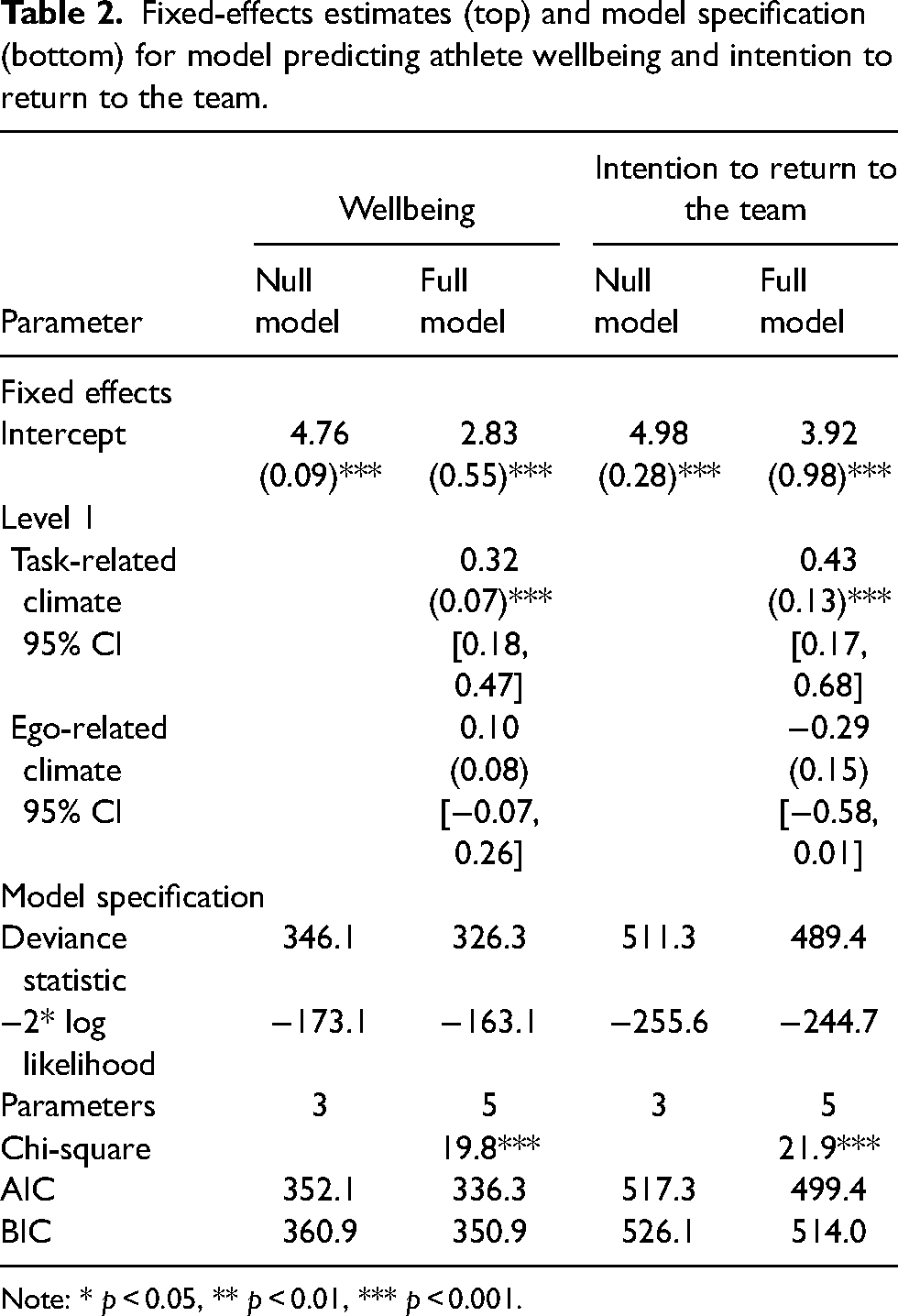
Including perceptions of peer-initiated motivational climate in the prediction of wellbeing resulted in a significant increase in model fit, χ2 (2) = 19.80, p < 0.001, compared with the null model. A pseudo-R2 value indicated that the model accounted for 13% of the variance in wellbeing. In terms of level 1 and 2 variance components, 13.9% of the variance could be attributed to the individual level and 45.7% to the team level. An examination of the specific predictors in the model revealed that task-related climate perceptions were significantly positively related to wellbeing (b = 0.32, p < 0.001) and ego-related climate perceptions were not significantly related (b = 0.10, p = 0.26).
Peer-initiated motivational climate and intentions to return to the team
Including perceptions of peer-initiated motivational climate resulted in a significant increase in model fit, χ2 (2) = 21.90, p < 0.001, compared with the null model. A pseudo-R2 value indicated that the total model also accounted for 13% of the variance in intention to return. In terms of level 1 and 2 variance components, 12% of the variance could be attributed to the individual level and 18.2% to the team level. An examination of the specific predictors in the model revealed that task-related climate perceptions were significantly positively related to intentions to return to the team (b = 0.43, p < 0.001) and ego-related climate perceptions were not significantly related (b = −0.29, p = 0.06). An overview of the analyses can be found in Table 2.
Fixed-effects estimates (top) and model specification (bottom) for model predicting athlete wellbeing and intention to return to the team.
Note: * p < 0.05, ** p < 0.01, *** p < 0.001.
Discussion
It has been established in previous research that peers are an important source of influence in the social sport environment. 6 Through the lens of the peer motivational climate, this study was designed to explore the relationship between success-focused peer behaviors, mental health, and adherence among youth sport athletes. Overall, findings of this study revealed that participants who reported higher perceptions of a task-related peer motivational climate also reported higher perceptions of overall wellbeing and a higher intention to return to the team in the future. On the other hand, there were no relationships found with respect to an ego-related peer climate.
The findings help fill an important gap in the literature with respect to the relationship between motivational climate and positive mental health outcomes. The findings build upon the previous work12,14 where task-related climate perceptions are associated with positive and adaptive mental health outcomes (e.g. lower burnout, higher resilience). Comparable to those studies, our results illustrated that when competitive youth sport teams promote success in sport as equivalent to effort, improvement, cooperation, and teamwork, they also experience positive wellbeing, which encapsulates emotional, social, and psychological domains. Notably, the hypothesized negative relationship between an ego-related climate and wellbeing was not supported.
There are two possible explanations for this lack of relationship found between an ego-related peer climate and wellbeing. First, it is possible that the context in which this study was completed (i.e. competitive ice hockey in Canada) may have altered the perception of behaviors typically considered ego-related as more normative in nature. This would detract from an expected negative relationship with wellbeing. In this sample specifically, outplaying teammates may be normalized as players reach the age where they can be drafted to Major Junior or recruited to play intercollegiate hockey, and therefore wellbeing could be closer tied to other behaviors. Alternatively, the dual continuum model of mental health proposed by Keyes 24 suggests two related but distinct continua: the presence or absence of mental health and the presence or absence of mental illness. If not the normative influence argument, perhaps ego climate is related to other mental health indicators along the continuum, such as anxiety or depression.
This study also extended previous research related to athlete adherence, which had typically focused on parent- and coach-initiated motivational climates.13,15,16 Like mental health, these previous findings suggest that a higher task-related motivational climate based on coach and parent behaviors was associated with higher athlete adherence. A higher ego-related climate, on the other hand, was associated with lower adherence. Although the task-related findings were supported, this study did not find the same relationship with ego climate. Further research is needed to better establish these links, as the relationship between ego climate and intention to return to the team was in the expected direction but did not meet the statistical significance threshold (p = 0.06).
Limitations and future directions
First, this study used a cross-sectional design. The cross-sectional design does not allow for the inference of causality because data was collected and measured at one point in time. As such, it is not possible to determine if climate perceptions lead to positive mental health and adherence or if athletes with more positive mental health and a greater desire to stay on the team in the future perceive the action of teammates in different ways. A longitudinal test of the relationship awaits future research. In addition, it is worth noting the constraints on generalizability. In this study, competitive ice hockey athletes from a single region in Canada were the participants, and certain culture-related behaviors exist in competitive ice hockey that may not translate to other competitive or recreational youth sport settings. As such, it is advised that future research extend the sampling reach to tackle these important constraints on the current findings. In addition, this study only examined a positive indicator of athlete mental health (i.e. wellbeing). Although recent research 25 has advised the consideration of mental health outcomes that extend beyond symptomology (e.g. depression, anxiety), it may in this case help balance our understanding of the ego climate and mental health relationship.
As an additional future direction, future research should more closely examine the interactive effects of task- and ego-related climates, and whether an “optimal mix” of climates exists to promote youth sport outcomes such as mental health and adherence. This will help researchers avoid “construct discrimination” and be aware of the biases toward each of the respective climates. 26 For instance, what if the potential negative effects of an ego-related climate are dampened when a higher task climate is also present? These profile combinations are seldom considered by researchers, 27 and the mechanics of the working relationship between the two need to be subjected for further investigations. 26
Conclusion
This study examined how peer interactions as captured by the motivational climate relate to mental health and adherence. Partially supporting the hypotheses, athletes who perceived a higher task-related peer motivational climate also experienced greater wellbeing and had higher intentions to return to the team for the following season. No significant relationships were found with respect to an ego-related climate. In other words, when peer-to-peer interactions around what it means to be successful focus on self-improvement and effort (task climate), positive outcomes also exist related to mental health and adherence. Although this research is foundational in nature, the applied implications of this research suggest that those in sport leadership positions (e.g. coaches, captains) would be wise to educate athletes on the importance of their interactions with teammates and explain how these performance-related cognitions (what it means to experience success) can translate to outcomes beyond performance.
Footnotes
Declaration of conflicting interests
The author(s) declared no potential conflicts of interest with respect to the research, authorship, and/or publication of this article.
Funding
The author(s) disclosed receipt of the following financial support for the research, authorship, and/or publication of this article: This work was funded by the Canada Research Chairs program.
