




Abstract
Men’s elite ice hockey is one of the most commercialised, popular, and patriarchal sports in the global North. With reference to the scarce corpus of ice hockey research from non-American countries, in this article we examine the online portrayals of men who play professional ice hockey in two clubs in Norway and Sweden. We pose two research questions and theoretically informed hypothetical assumptions associated with them that we evaluate with the overall aim of broadening the empirical scope of critical studies on men and masculinities in ice hockey. Using a quantitative content analysis, we compare and cross-analyse the online representations of men and masculinities by investigating the Instagram posts of 21 players from Frölunda HC and Vålerenga Hockey. The results demonstrate the importance of a situational and contextual understanding of hegemonic masculinity and broaden the scope of the “ice hockey playing man” that is often perceived as a narrow stereotype.
Introduction
Men’s elite ice hockey, under the umbrella of the National Hockey League (NHL), is one of the most commercialised and popular sports in the global north. However, together with other professional leagues, and the Asian-European Kontinental Hockey League (KHL) as the main challenger, the globalisation of the game has largely been ignored by sport scholars (Carlsson, Backman, and Stark 2020). Due to its widespread popularity and commerciality, ice hockey has, for example in Finland (Ahonen 2020) and Canada (Gruneau and Whitson 1993), set the agenda for the country’s sporting culture and sports policy. This influence, in combination with research results identifying the ice hockey culture as misogynistic and homophobic (Allain 2008; Alsarve and Angelin 2020; MacDonald and Lafrance 2018), points to a delicate democratic issue. To formulate this in more critical and feminist terms, in many cases a commercialised, globalised and popular sport like men’s ice hockey epitomises the dominant patriarchal power in a society, where players and the sports culture exemplify key ingredients of hegemonic masculinity and the upholding of patriarchal power in general (Connell 2005; Theberge 1998). With reference to the scarce corpus of research on men who play ice hockey in non-American countries and the feminist need to critically understand the so-called hypermasculine components or requirements of the sport, it is important to study portrayals of men who play elite ice hockey in hockey-obsessed sports contexts beyond North America (see e.g., Alsarve 2021; Gee 2009; Tjønndal 2016). The Nordic region constitutes such a context and, therefore, in this article we study and compare online portrayals of men who play professional ice hockey in Norway and Sweden, with a view to broadening the empirical scope of masculinity studies of hockey players. In addition, the method used represents a novel contribution to the identification of multiple masculinities represented by ice hockey players, and by analysing how processes of commercialisation and professionalisation may impact such representations, in contexts with high degrees of gender equality, this article contributes to the field of critical studies on men and masculinities (CSMM).
Research Questions and Hypothetical Assumptions
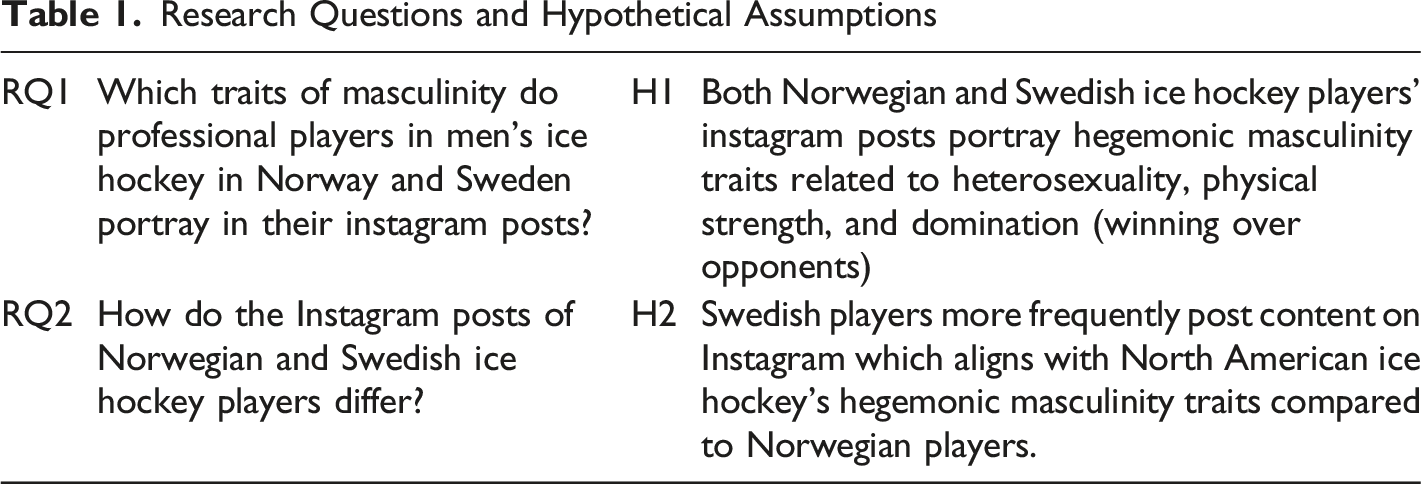
The theoretical basis for the formulation of the research questions and hypotheses is presented in the previous research and theory sections below. We continue with a brief contextualisation of Swedish and Norwegian ice hockey. Following this, we present previous research on ice hockey, gender, and the use of social media. Before the results of the quantitative content analysis are presented, we outline our sample and the method used. Lastly, we conclude with a discussion of the results and a summary of the main findings.
Contextual Setting: Gender Equity and Professional Ice Hockey in Norway and Sweden
Norway and Sweden have several cultural, linguistic, and political similarities. Like the other Nordic countries (Denmark, Iceland, and Finland), they are often ranked as two of the most gender equal places globally (World Economic Forum, 2022). The high ranking in gender equality is also reflected in sport when it comes to opportunities and conditions for women working as athletes and coaches (Hovden 2012; Piggott 2021; Tjønndal 2021), as well as for women in leadership positions in sports organisations (Elling, Hovden, and Knoppers 2019). In other words, the gender equality norm is strong in both countries. Both countries also have laws (discrimination acts) that promote equal rights and combat all forms of discrimination based on sex, transgender identity or expression, ethnicity, religion or other belief, disability, or sexual orientation. Laws and policies in both countries are permeated by juridical principles that ultimately affect the public and dominant masculinities in Sweden and Norway. Obviously, private and other informal challenges continuously occur and although both countries are ranked highly in gender equality indexes, the rate of men’s violence against women, as a sign of gender inequality, is also high (this is often called the “Nordic Paradox”) (Wemrell et al. 2021).
The ice hockey cultures differ considerably in Norway and Sweden. In Norway, ice hockey is not perceived as one of the core national sports, such as football, cross-country skiing, ski jumping or handball. Many major Norwegian cities do not even have ice hockey stadiums. It is therefore not very surprising that very little research on ice hockey players has been carried out in Norway by Norwegian sports scholars. Although a few medical studies have been conducted on players’ health issues (Gouttebarge and Kerkhoffs 2017; Moseid et al. 2018; Nordstrom et al. 2020), as far as we can ascertain no previous studies of gender and Norwegian ice hockey players have been done before our study. Symptomatically, no Norwegian contribution was included in the 2020 special issue on European ice hockey in Sport in Society (Carlsson, Backman, and Stark 2020). This mediocre interest on the part of the Norwegian public and academia corresponds with the sport’s financial circumstances, with the best players often moving to other leagues in Sweden, Finland, or North America. This “skill-draining” is also present in several other contexts and can be understood as a side-effect of sport’s globalisation and commercialisation (cf. Crossan 2020).
In contrast, ice hockey in Sweden has developed into a commercialised, professionalised and popular sport. The popularity of the national team Tre Kronor [Three Crowns in English] and individual stars like Börje Salming, Peter “Foppa” Forsberg and many others cannot be over-estimated in a national context. In the 2000s several large and modern arenas were built, thus forging closer collaborations between club executives, local politicians, and entrepreneurs (Alpenberg 2020). Swedish ice hockey has in many ways been inspired by NHL clubs and several players have had professional careers in North America, which means that the connection to North American hockey masculinity might be stronger in Sweden than in Norway. However, the Swedish media has also reported on professional Swedish players’ violent, misogynistic and aggressive behaviour both on and off the ice (Careborg and Billger 2005; Mattsson 2017; Tolén 2018), which has muddied the image of the sport somewhat.
Previous Research on Masculinities in Sports and (Social) Media
In this section, we outline previous research that addresses: (1) athletes’ self-representations and representations of gender in (social) media and (2) the positioning of certain men and masculinities as hegemonic, yet complex, identities in ice hockey and other sports. After this review, we present our theoretical concepts.
In the traditional media, sporting men have long received significantly more coverage than sporting women (Cooky, Messner, and Musto 2015). Social media has the potential to challenge this order, although some studies have demonstrated that women athletes often feel obliged to adopt a sexualised self-representation to attract sponsorship (Kane, LaVoi, and Fink 2013). Research also indicates that sexually suggestive photos generate more likes and comments than others (Geurin-Eagleman, and Burch 2016).
As far as we can ascertain, no research has been carried out on men who play professional ice hockey and the gendered (re)presentations of these players in social media. However, some studies have examined athletes’ self-representations in private social media channels like Instagram and Twitter (Lebel and Danylchuk 2014; Li et al. 2021; Smith and Sanderson 2015; Geurin-Eagleman and Burch 2016). Exploring Olympic athletes’ self-representations on Instagram, Geurin-Eagleman and Burch (2016) found that athletes mostly posted personal pictures from daily life and only a few pictures from their professional lives. Due to this, the professional pictures had the most likes, and profiles with the best balance between personal and professional content had significantly more followers. Similar studies have also found personal content to dominate women athletes’ self-representations and link these gender differences to dominating traits of femininity and masculinity (Li et al. 2021). In contrast, men’s masculine traits appear to have a greater commercial value (Greer, Hardin, and Homan 2009). These results fit Arai, Ko, and Ross’ (2014) model of the athlete brand image, which describes three central categories of content that athletes use in their branding projects: athletic performance, attractive appearance and marketable lifestyle. In their study, Arai, Ko, and Ross (2014) suggest that a balance between these categories creates the strongest athlete brand image and, hence, the greatest commercial value.
Sports-related social media research has mostly engaged with questions about how individuals, clubs and organisations strategically use social media as a communicative branding instrument (Geurin-Eagleman and Burch 2016; Grimmer and Clavio 2019; Kautz, Schaffrath, and Gang 2020). In a review of 70 sport management articles, Filo, Lock, and Karg (2015) found that research tended to focus on the operational and user-focused dimensions of how this communication ultimately aimed to cultivate relations between individuals and brands. Some studies apply a gender perspective, although these have predominantly focused on women’s sports (cf. Rahbari 2019).
For some time, research has demonstrated that professional commercialised sport, such as men’s elite ice hockey, promotes and preserves certain men and masculinities as a norm, while other men/masculinities and women/femininities are either marginalised or subordinated (Connell 2005; Kidd 1987; Matthews 2016; Messner, Duncan, and Jensen 1993; Musto, Cooky, and Messner 2017; Hovden and von der Lippe 2019). In this promotion, sport regulations, the financial and cultural circumstances and the function of the (social) media are key. Messner, Dunbar, and Hunt (2000) identified a so-called “Televised Sports Manhood Formula” in their analysis of televised sport and showed how this ideological narrative contained themes demonstrating white men as the voices of authority, aggressive players as prize winning and how sport in general was a man’s world. In a more recent media study, MacDonald and Lafrance (2018) identified several stereotypes at play in the Gongshow Magazine. The authors argued that this not only had consequences for how the players in men’s ice hockey understood themselves but also for how they were understood in society in general. What stood out was how the hockey lifestyle magazine promoted a supersaturated and stereotypical representation of men who play elite ice hockey as arrogant, irresponsible, partying, and excessive alcohol consuming, who continuously objectified women (MacDonald and Lafrance, 2018).
However, ideals of masculinities are often complex and contradictory. In a study of how the hockey star Sidney Crosby was constructed in the Canadian media, Allain (2011) found that while Crosby was portrayed as an appropriate (superhero) model of masculinity, there was also a contesting narrative labelling Crosby as a whining and crying wimp. As a concluding thought, Allain (2011) argued that identity constructions should be understood as fluid and open for debate and resistance. While professional stars seemed to shoulder a romanticised notion of masculine and national identity, if such ideals and expectations were not pursued, they could be ridiculed and taunted. Another conclusion that Allain (2011) drew was that any essentialised understanding of masculinity must be called into question. The study clearly illustrates how men and masculinities are constantly (re)interpreted and constructed from institutional and cultural sources (such as the media).
The above research suggests that in addition to the image content, comments and number of likes are important aspects to include in a social media analysis. Men’s self-portraits with comments (from other men) are interesting phenomena per se. Longstaff (2020) understands this as a self-objectification or commodification with homoerotic undertones, i.e., men looking at men looking at men (see also Nayak 2016). Men’s interactive display of their bodies echoes the ideal of the “metrosexual man” that emerged in the 1990s with sport stars like football player David Beckham as front man. Self-chosen exposure, as a visual commodification, is also embedded in a personal branding discourse with a view to attracting sponsorship, collaborations and even partnerships beyond an athlete’s competition days (Geurin-Eagleman and Burch 2016). A single Instagram post with a photo and several likes and comments from followers can thus be said to be a complex construction underpinned by commercialism, sexuality, power, gender ideals, fashion and so on, which again provides interesting data for the study of men and masculinities.
Hegemonic Masculinity: A Definition
Men and masculinities are constructed individually, relationally, situationally and in structural (national) settings (Connell 2005). Social media exposure, financial potentiality and cultural status might make certain constructions more desirable and influential than others, i.e., in each situation men and masculinities can be analytically placed in a social hierarchy. Interpreting this as an institutionalisation of social relations and gender inequality, Connell (2005, 54) describes how “Thus men’s greater sporting prowess has become a theme of backlash against feminism. It serves as symbolic proof of men’s superiority and right to rule” (see also e.g., Messner 1992, 2007). Some sports can generate the hegemonic masculinities that Connell points to here. Hegemonic masculinity is defined as “the configuration of gender practice which embodies the currently accepted answer to the problem of the legitimacy of patriarchy, which guarantees (or is taken to guarantee) the dominant position of men and the subordination of women” (Connell 2005, 77). The research results above outline some of the gender practices that shape sport and ice hockey masculinities as hegemonic and their potential to uphold the current gender order.
The hypotheses presented in our introduction indicate the potential ability of Norwegian and Swedish ice hockey players to portray hegemonic masculinities in terms of heterosexuality, physical strength, domination (as in winning over opponents) and ability to use violence. To paraphrase Connell (2005), ice hockey, especially in Sweden, should provide notions of masculinity that in turn help to reproduce a patriarchal hegemony. That is, the celebration of certain men’s force, toughness and direct confrontation has consequences for gender relations in society at large (Whitson 1994). While these further consequences of hegemonic masculinities are important to bear in mind, our main aim in this article is to employ a quantitative analysis of the content of Instagram posts and images and identify the hegemonic traits in them.
Methods
Quantitative content analysis is a systematic and replicable method for analysing both written and visual content in digital spaces (Fylling and Tjønndal 2021; Riffe et al. 2019). Furthermore, it is a valuable way of examining social media in sport settings (Smith and Sanderson 2015; Geurin-Eagleman and Burch 2016). Although Instagram now boasts more active users than Twitter, Chawansky (2016) argues that athletes’ use of Instagram is an underexplored area in social scientific research on gender and sport.
As a contribution to this field of research, our study is based on a quantitative content analysis of Instagram posts created by men who play professional ice hockey in one Swedish and one Norwegian club. We chose to analyse athletes’ data from Instagram because at the time of data collection (spring of 2021) this was the social media platform with the highest activity level from the athlete group we drew our sample from (Bundon 2018). Platforms such as TikTok and Twitter could have fulfilled the same analytical purpose, as all these represent digital spaces for both spontaneous and strategic communication by athletes. However, selecting another social media platform would in this case have led to a less diverse athlete sample with only a few people generating a lot of content, versus a wide range of players posting various content. In other words, we have chosen Instagram because it is the most popular digital space for the athletes included in our sample.
Sample
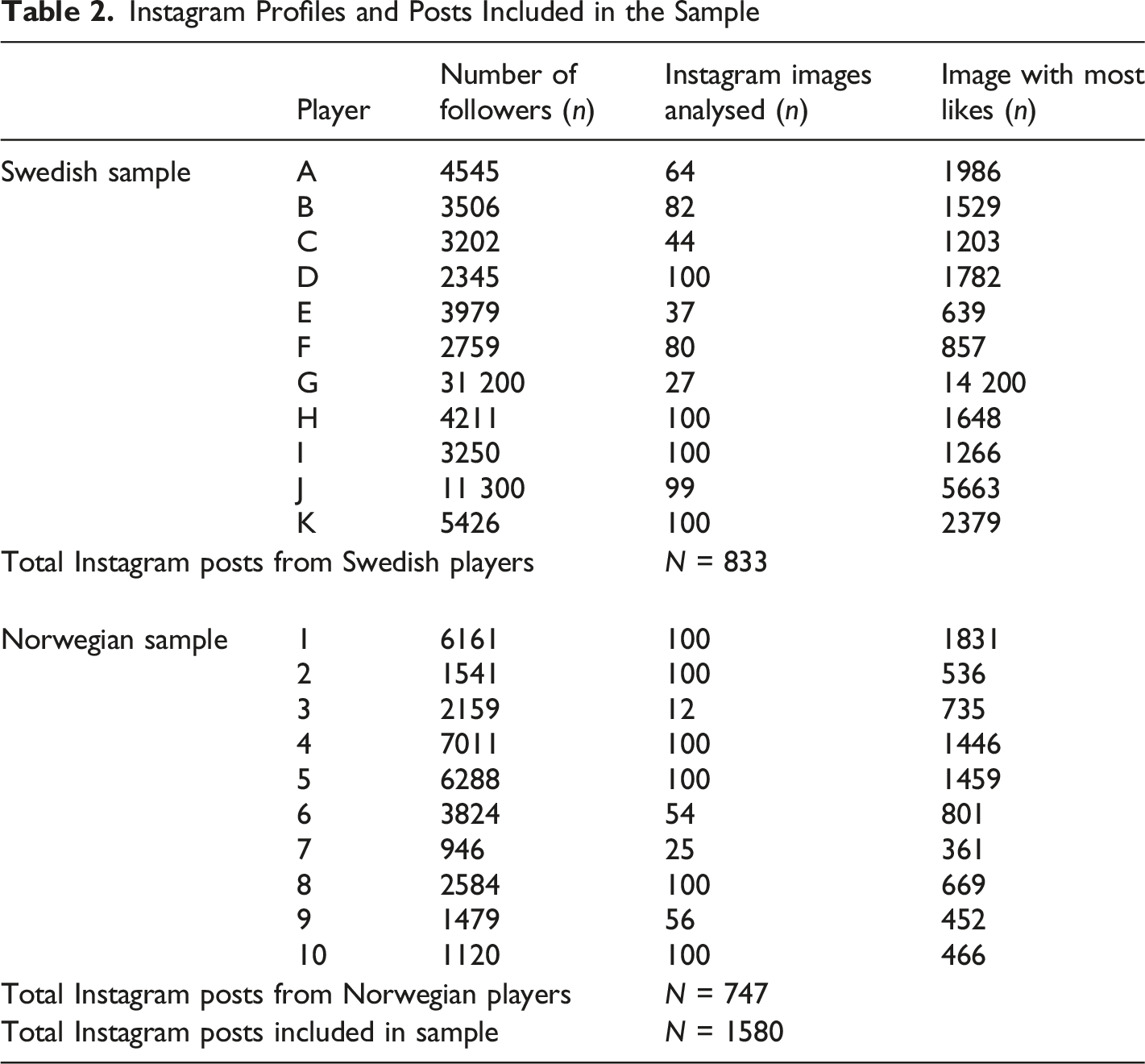
To identify our sample of professional ice hockey players in Sweden and Norway, we narrowed our search to the highest men’s ice hockey league in each country: Fjordkraft-ligaen (Norway) and Svenska Hockeyligan (SHL) (Sweden). From each league, we selected the team with the most Instagram followers (of the official team account). In the case of Norway, Vålerenga Ishockey (@vifhockey) with 21 thousand followers stood out with the most followers in Fjordkraft-ligaen (numbers of followers measured 13.06.2021). In the rest of the clubs in the league with Instagram accounts the followers varied between a few hundred to 3–4 thousand, apart from Stavanger Oilers (@stavangeroilers) with 15.6 thousand followers. In the case of Sweden, over 89.6 thousand profiles followed Frölunda HC (@frolunda_hc). Every SHL team had an Instagram account and in the rest of the 14 clubs the number of followers varied between 60 thousand to 10.8 thousand (numbers of followers measured on 13.06.2021).
Based on this strategy, we selected players from Vålerenga (Norway) and Frölunda HC (Sweden) for our quantitative content analysis. To answer the study’s research questions, it was necessary to select clubs with a substantial number of followers and players who actively used Instagram. Our familiarity with both teams from a semiotic and historical perspective helped us make meaning of the images during the analytical process.
Instagram Profiles and Posts Included in the Sample
Data Collection and Quantitative Codebook
One of the authors collected Instagram posts from Frölunda HC’s players, while another collected Instagram content from Vålerenga’s players. The following (Anagnostopoulos et al. 2018) variables were registered for each Instagram post in the data collection: (1) athlete’s name, (2) date the photo was taken, (3) number of likes, (4) number of comments, (5) photo caption and (6) keywords relating to the main content of the photo. The data collection took place in May-June 2021.
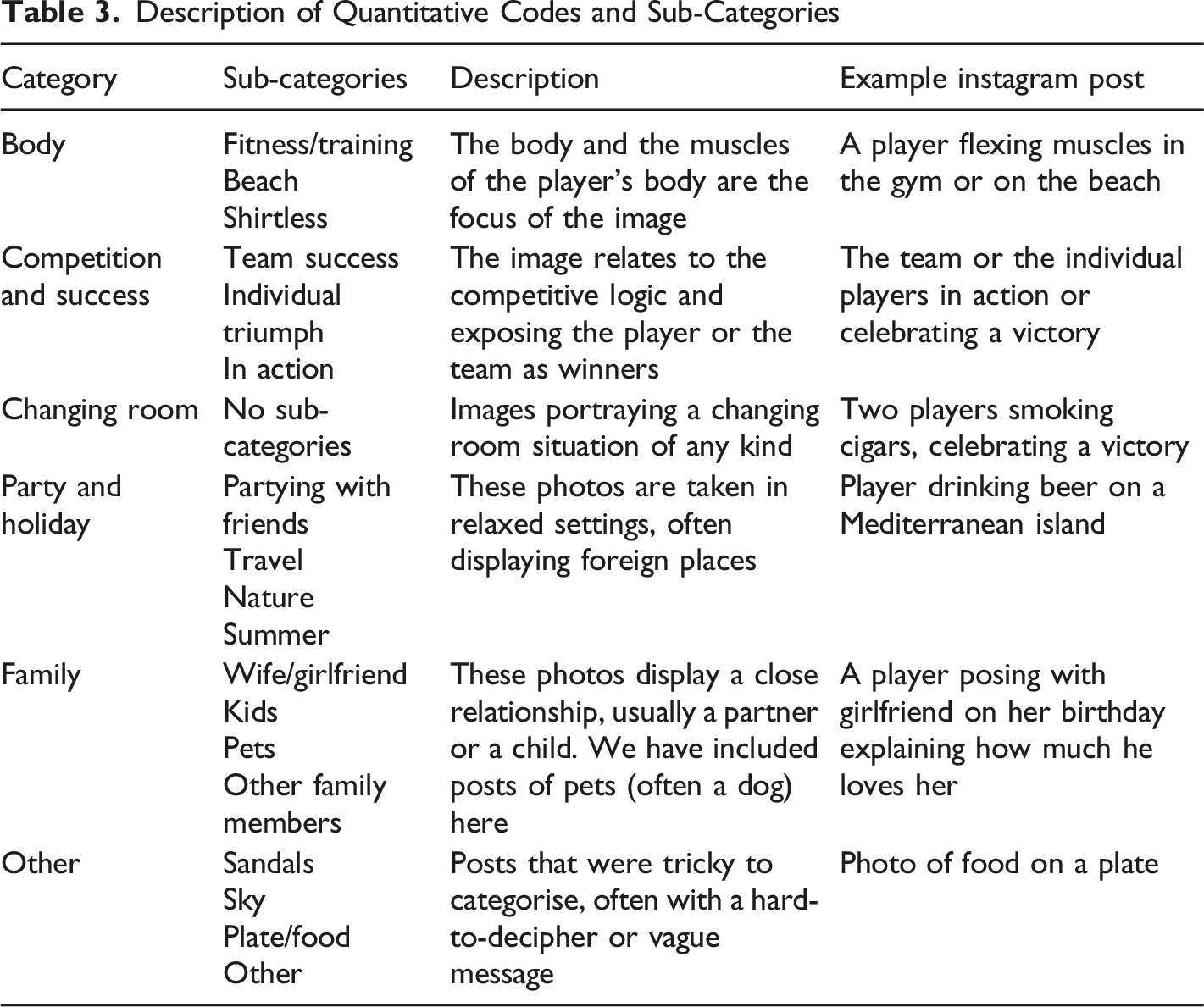
Each photo was coded, which we deductively developed based on existing research on athletes in social media (Pegoraro, 2010; MacDonald and Lafrance 2018; Arai, Ko, and Ross 2014; Geurin-Eagleman and Burch 2016) and theoretical perspectives on masculinity (Connell 2005). After the coding process, the Instagram posts were sorted into the following 5 categories: (1) body, (2) family, (3) changing room, (4) party and holiday and (5) competition and success. In this coding and sorting process, we were guided by the overall aim to explore the players’ digital representations of gender and/or how they constituted themselves as men.
To be transparent in our quantitative content analysis approach, we added sub-categories to each code. For instance, posts coded in the category “body” consisted of photos displaying different settings, given that bodies are (ex)posed in different milieus. A post of a player flexing his body during strength-training thus includes the sub-category “fitness/training.” Another post showing a player exposing his bare torso on the beach during a summer holiday was thus coded as “body” and the sub-category ‘beach’. The Instagram content in the “competition and success” category included pictures of the players on the ice, either in a match situation (sub-category “in action”), celebratory pictures after winning a competition, or an individual’s success in signing a new contract (sub-category “individual triumph”). The “changing room” category included pictures of players in the changing room before or after a match or training session. The “party and holiday” category consisted of pictures of players partying with friends, travels, or summer holidays. Lastly, the “family” category displayed pictures of players with their partners (sub-category “wife/girlfriend”—no openly homosexual partner relations were found) or children (sub-category “children”).
Posts that did not fit the above categories were coded as “other”. Such posts included pictures of a pair of sandals, a lunch plate, a blue sky with some clouds, house roofs etc. Excluding such images from the content analysis is consistent with similar studies in the existing literature (see, for example, Anagnostopoulos et al. 2018; Parganas et al. 2015). Here the “other” category represents content that is not relevant for the scope of this quantitative content analysis (and does not appear in tables 5–7).
Regarding the connection between the quantitative codebook, the literature review and the theoretical framework, we identify that some categories and sub-categories more closely connect to the concept of hegemonic masculinity (Allain 2008, 2011, 2019; Connel 2005; MacDonald and Lafrance 2018; Messner, Dunbar, and Hunt 2000; Messner 1992, 2007), others relate to findings from previous research on athletes and social media (Arai, Ko, and Ross 2014; Greer, Hardin, and Homan 2009; Li et al. 2021) and we therefore developed some sub-categories inductively, based on recurring content in the analysed posts. The categories we interpreted as closely connected to the concept of hegemonic masculinity were: “body,” “changing room,” and “competition and success,” but posts in “family” and “party and holiday” also displayed such content. In these categories, demonstrations of, for instance, muscularity (power), winning (domination), heterosexuality, whiteness and financial status were apparent to us. “family” and “party and holiday” we developed based on previous research, which has demonstrated that a marketable lifestyle consisting of such content (e.g., travelling, partying, exploring and doing things with family or your partner) is important for athletes” brand building on social media (Arai, Ko, and Ross 2014). Since previous research suggests that a marketable lifestyle is often combined with factors related to attractive appearance and athletic performance, our interpretation is that the other categories (e.g., “body” and “competition and success”) also connect to this research. Even though this research does not explicitly link to the concept of hegemonic masculinity, such ingredients help constitute hegemonic relations (Connell 2005).
Quantitative Coding and Reliability
To ensure a shared meaning of which content the different categories should reflect, we had an initial discussion about their perceptions of the categories and the coding process. The author who collected the data from Frölunda HC and the author who collected the Instagram data from Vålerenga then coded the respective Instagram posts. After this, the author who had done the initial coding of the Norwegian data surveyed the coding of all the images in the sample to identify any inconsistencies between the two sets. Some discrepancies between the two coders’ interpretations were identified and synchronised by means of discussion between the three authors. For example, photos of pets were at first interpreted differently in some cases, but after our joint discussions all the posts of pets were coded into the Family category and the sub-category “pets.” Each discrepancy in the coding process was thus solved jointly.
Outliers
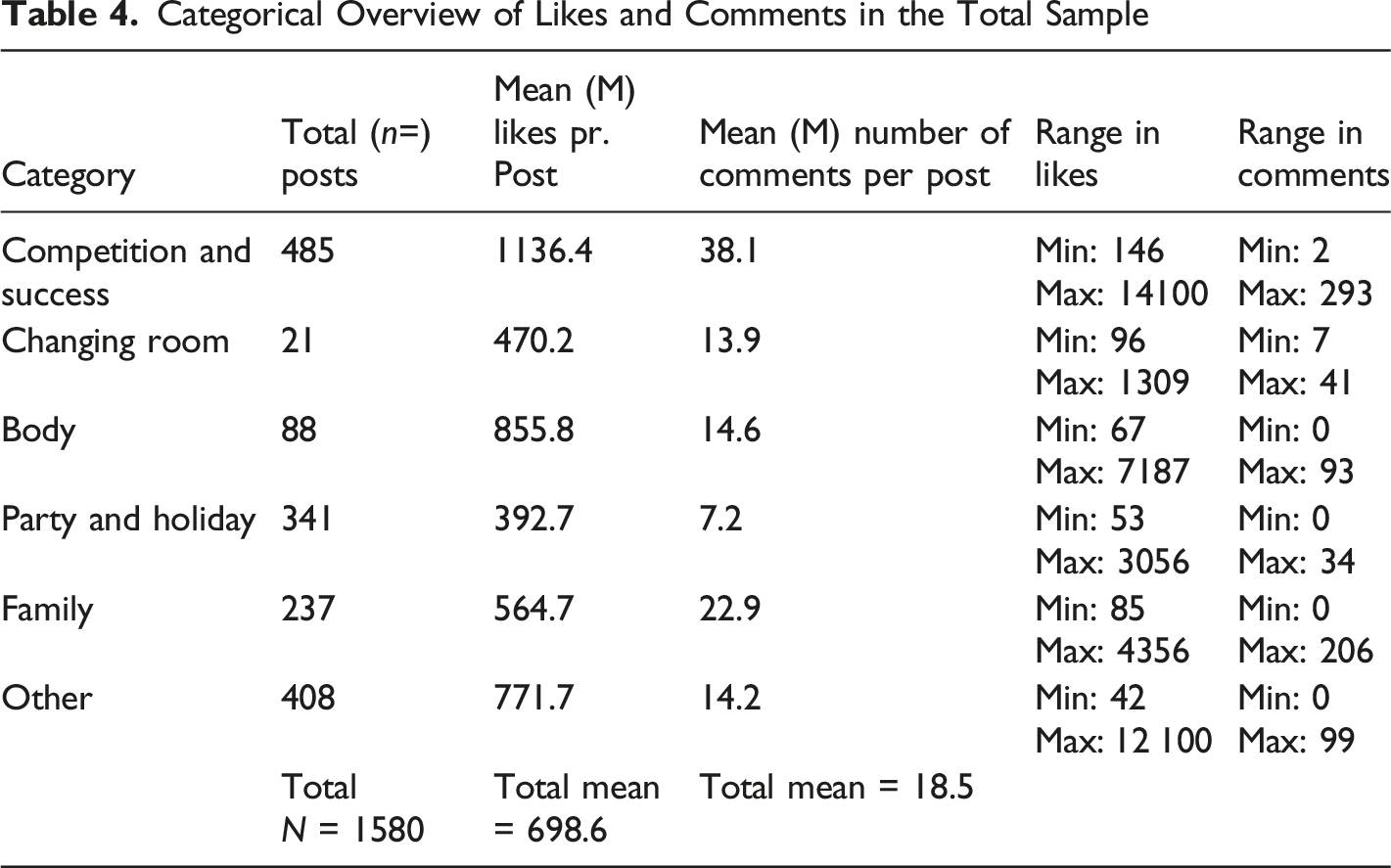
Relatively few posts stood out in terms of the quantity of fan engagement (likes and comments). Posts with pictures of newborn babies in the “family” category by the profiles with the most followers could generate up to 12.1 thousand likes (compared to a mean of 771.7 likes in the same category) and 206 comments (compared to a mean of 22.9 comments in the same category). The reader should take this into account when viewing this category in the results (tables 4–7).
Results
Description of Quantitative Codes and Sub-Categories
Categorical Overview of Likes and Comments in the Total Sample
Categorical Overview of Sub-Categories for Each Country and in Total
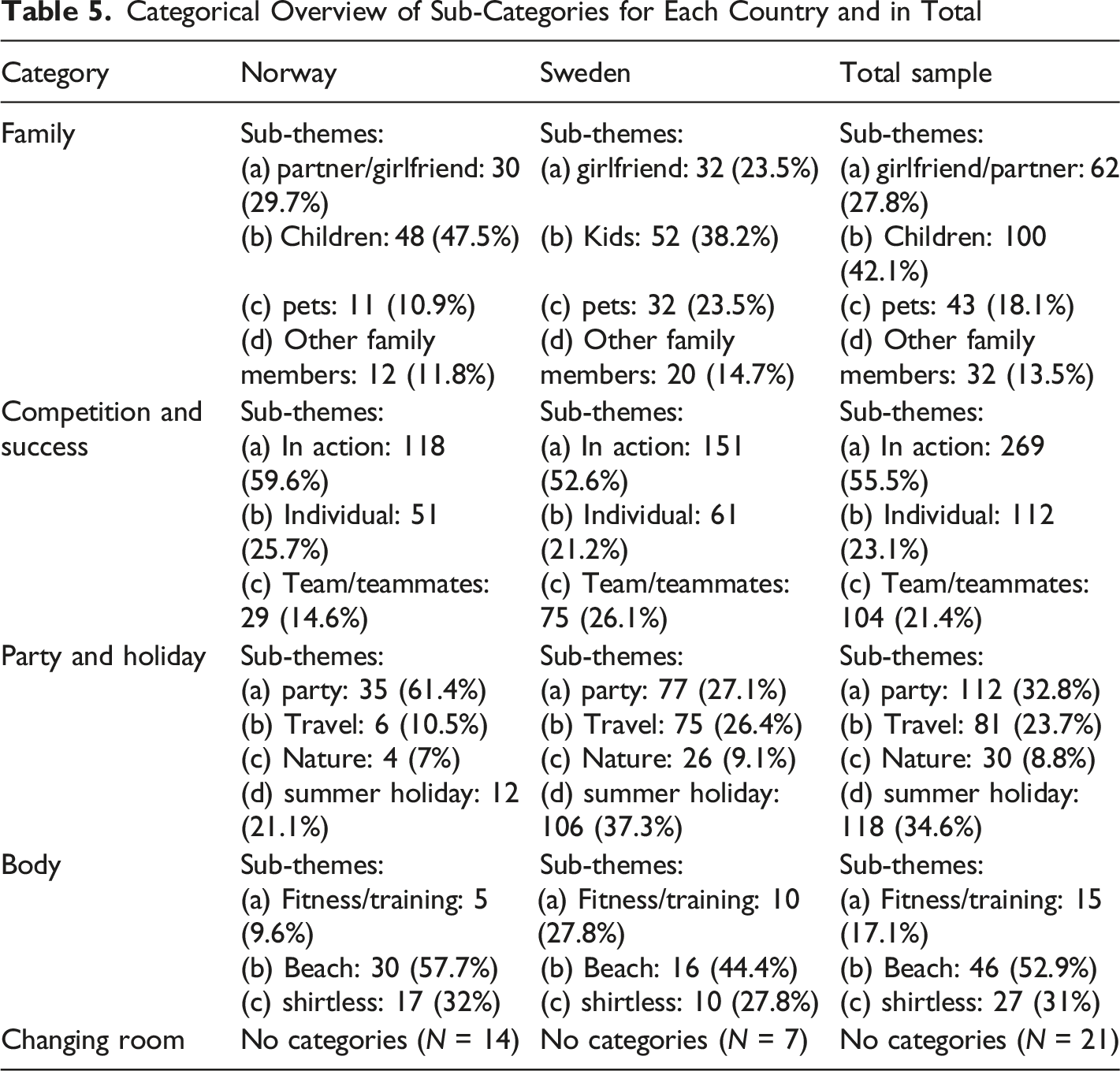
In terms of fan engagement on the Instagram posts, there are some prominent differences in the likes and comments in the different categories represented in the data material (see table 4). The most liked category was “competition and success” (mean likes = 1136.4), followed by “body” (mean likes = 855.8) and “other” (mean likes = 771.7). “competition and success” was the most commented category (mean comments = 38.1), followed by “family” (mean comments = 22.9) and “other” (mean comments = 14.2).
The category “competition and success” includes posts of players in action on the ice (matches or training, 55.5% of posts in the “competition and success” category), posts of the individual player in hockey equipment standing still on the ice (23.1%) and posts of the team/teammates on the ice (21.4%). The category “party and holiday” is dominated by posts of players enjoying their summer holidays (34.6% of Party and holiday posts) and posts of players partying (32.8%). 23.7% of the posts in this category are of travelling and 8.8% are nature related (going hiking, camping etc.). In the “family” category, the sub-category “children” is the most frequent type of post (42.1% of Family posts), followed by posts of wives/girlfriends (27.8%), pets (18.1%) and other family members (13.5%). Posts in the “body” category are dominated by pictures of players in a beach setting (52.9%). Other sub-categories of posts in this category include fitness (17.1%) and photos of shirtless/bare chested players (31%).
National Differences: Frölunda vs. Vålerenga
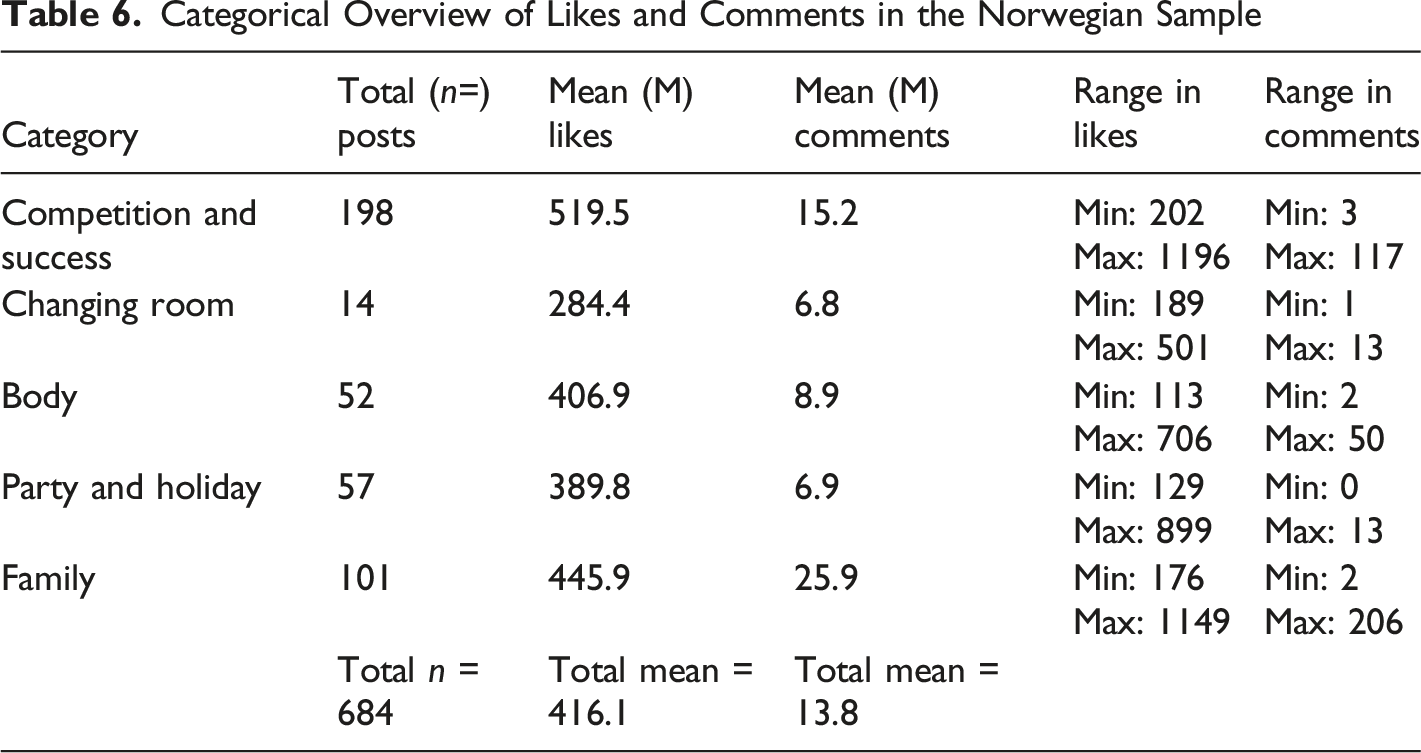
Categorical Overview of Likes and Comments in the Norwegian Sample
Categorical Overview of Likes and Comments in the Swedish Sample
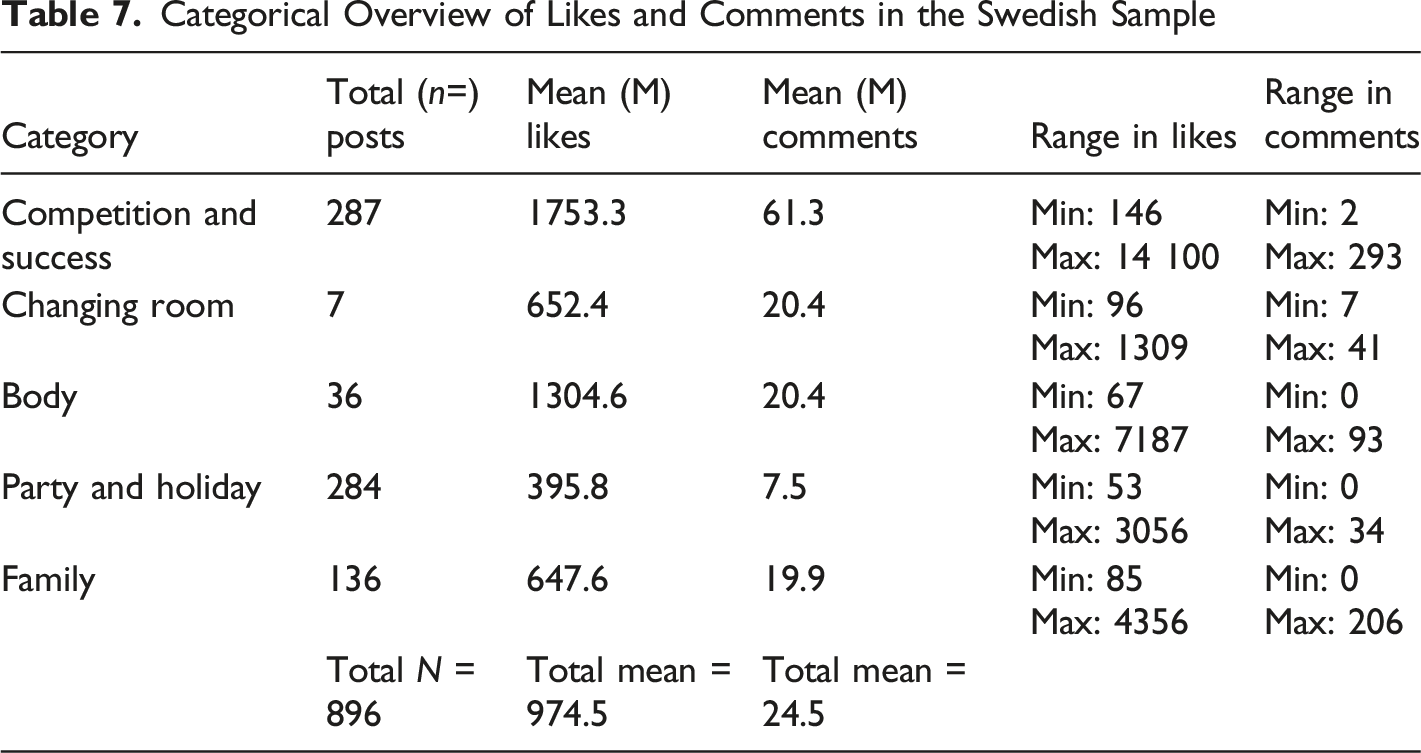
The category with the most frequent posts and most fan engagement in both samples was “competition and success,” with 287 posts with 1753,3 mean likes and 61,3 mean comments in the Swedish sample (table 7) and 198 posts with 519,5 mean likes and 15,2 mean comments in the Norwegian sample (table 6). In the Norwegian sample (table 6), “family” is the second most popular category of posts (n = 101), with 445.9 mean likes (min = 176, max = 1149) and 25.9 mean comments (min = 2, max = 206). In the Swedish sample, “party and holiday” is the second most popular category (n = 284), with 395.8 mean likes (min = 53, max = 3056) and 7.5 mean comments (min = 0, max = 34). Another difference is the “body” category, where there are more posts in the Norwegian sample (n = 52) than the Swedish (n = 36), while the Swedish “body” posts generate more fan interaction (mean likes = 1304.6 and mean comments = 20.4) than the Norwegian ones (mean likes = 406.9 and mean comments = 8.9).
The two samples differed in terms of the number of sub-categories in some of the categories (table 5). The most notable differences are in the comparisons between the sub-categories “children,” “wife/girlfriend,” and “pets” in the “family” category (table 4), where the Swedish players have more pictures of pets, while the Norwegian players have more pictures of their wives/girlfriends and children. Further, the sub-categories “summer holiday” and “party” in the category “party and holiday” differed between the samples, with the Norwegian sample having relatively more posts in the “party” sub-category and the Swedish sample more posts in “summer holiday.”
Discussion
In this section we discuss our results and hypotheses in relation to the results, previous research, and the concept of hegemonic masculinity. We structure this section according to the two research questions and affiliated hypotheses. Finally, this section includes a discussion of the study’s limitations.
Traits of Masculinity Among Norwegian and Swedish Ice Hockey Players on Instagram
At an aggregated level, the results show that men who play ice hockey represent a number of traits, where images from family life are mixed with relaxed holiday images and ice hockey-related competition and training images. Allain (2019) has argued for a more multifaceted understanding of ice hockey masculinities and the variations in our results both suggest and underline the plurality of the representations of men playing ice hockey. In our results, this complexity appears most clearly in the posts of men holding their new-born child. Portraying intimacy and love, emotions that are seldom associated with ice hockey playing men, the posts also include a (heterosexual) worshipping of the wife’s act of giving birth. Interestingly, this “balancing” between personal and professional content on elite athletes’ social media profiles are also shown to be essential for having commercial success in terms of engaging fans and sponsors (Arai et al. 2014), adding another dimension to why athletes may choose to add intimate content on their social media accounts (Geurin-Eagleman and Burch 2016).
This leads us to an evaluation of the first hypothesis: Both Norwegian and Swedish ice hockey players’ Instagram posts portray hegemonic masculinity traits related to heterosexuality, physical strength and domination (winning over opponents). Our results show players’ benignity to demonstrate a heterosexual, competitive, successful, strong and popular self. The heterosexuality norm is most evident in the posts showing players’ family pictures (with wives or girlfriends and/or children), while the norms of being able to display physical strength and domination are demonstrated in the “competition and success” and the “changing room” categories (posts showing success (trophy awards), game or training situations and body flexing). The fact that the posts in the “competition and success” category by far gained the most likes in total (and for each sample) aligns with earlier findings (Geurin-Eagleman and Burch 2016; Lebel and Danylchuk’s 2014) and may indicate that this implies a certain reproduction of the masculine dominance (Greer, Hardin, and Homan 2009) and hegemonic masculinity (Connell 2005) in sports.
To a large extent, these results echo previous research on sport masculinities as voices of authority and the sport as a man’s world (cf. Messner, Duncan, and Jensen 1993). However, it is questionable, and difficult to identify, whether, and eventually how, our sample demonstrates a homophobic or misogynistic culture; a manifestation found in previous research (Allain 2008; Alsarve and Angelin 2020; MacDonald and Lafrance 2018). Sweden’s and Norway’s discrimination laws, which prohibit offensive acts, could explain this absence. Still, there are no examples in our result that really challenge aspects like whiteness and the heteronormative assumption i.e., the key characteristics of a hegemonic masculinity (Connell 2005). From our results, the space, conditions, and enactment of homosexual and feminine empowerment can thus be interpreted as minimal, narrow and even absent. This absence and non-encouragment does not necessarily mean that the players portray a homophobic and misogynistic culture. It is worth repeating here that Connell (2005) defines gendered practices and the hegemonic forms of masculinity as situational and temporal, meaning that a homophobic, misogynistic and aggressive culture does not exhibit these traits continuosly but only in appropriate situations.
Expressions of Hegemonic Masculinity as Variable by Place and Time
Our second hypothesis is that: Swedish players more frequently post content on Instagram which aligns with North American ice hockey’s hegemonic masculinity traits compared to Norwegian players. The background to the hypothesis is Swedish hockey’s more extensive commercialism and popularity. That is, men who play ice hockey in Sweden have greater societal significance than ice hockey in Norway. Our results also show how Swedish ice hockey players portray traits that North American ice hockey researchers have found. The Swedish sample frequently posted content related to “party and holiday,” where players demonstrate a financial capacity and a wealthy lifestyle off the rink. This tendency to promote oneself as an “arrogant, irresponsible and partying dude” in the Swedish sample reflects what the media has described as “the stereotypical hockey player” (MacDonald and Lafrance 2018). As a contrast to this, in the Norwegian sample “family” is the second most posted category, where the posts show players’ amorous and close relations with family members. Both the Norwegian and the Swedish examples thus relate to heteronormativity as a hegemonic trait.
Despite the differences both samples portray traits that Connell (2005) puts at the core of hegemonic masculinity where both partying and heterosexual family relations may also be considered as marketable lifestyles linked to athletes’ branding strategies on social media (Arai, Ko, and Ross 2014; Geurin-Eagleman and Burch 2016; Li et al. 2021). Not surprisingly, we identify that athletes from both countries frequently post content displaying physical strength and domination, traits that in turn can be regarded as related to hegemonic attributes (cf. Allain 2008, 2011, 2019; Connell 2005; MacDonald and Lafrance 2018; Messner, Dunbar and Hunt 2000; Messner 1992, 2007).
In relation to time as a factor of hegemonic masculinity expressions, there is a tendency in our sample to show younger players as more inclined to post content relating to their bodies and looks, while older players with families are more inclined to post content showing their children and partners – often in terms of explicit declarations of love. Considering research on younger people having a greater focus on body appearance and looks on social media (Gattario and Frisén, 2019; Gattario et al. 2015), these variations in responses may be due to the Swedish sample including younger players. As age is a crucial factor when it comes to family life, it could also explain some of the differences between the Norwegian and Swedish players in the “family” and “party and holiday” categories, where the “family” category has more content than the “party and holiday” category in the Norwegian sample, while this is the opposite in the Swedish sample. The fact that the “party and holiday” category is the second biggest category in the Swedish sample in terms of the amount of content could also mean that Swedish players try harder to present themself as a “stereotypical hockey player” (MacDonald and Lafrance 2018), due to a more professionalised hockey in Sweden than in Norway. In other words, the differences in the men’s portrayals between the Norwegian and Swedish sample might just as well be an expression of time (age) as an influencing factor for expressions of hegemonic masculinity as variable by context.
As already indicated, ice hockey is more popular in Sweden than in Norway, both in terms of fan engagement and financial resources in the leading hockey clubs. Further, an increased commercialisation of the sport may lead to a view of players as “products” representing a club or the sport itself. This can affect the content of the comments to their Instagram posts in terms of “dehumanisation” (Lowrey 1976) and more “unfiltered” feedback from fans (Utych, 2022). It may also affect players in terms of which content they choose to post in their media channels and whether they are trying to promote a serious and professionalised representation of themselves, as found in earlier research (Stokvis 2000). This reasoning points to the limitations of using the term “trait” when describing a hegemonic masculinity (Connell 2005). There is a risk of only linking ice hockey players’ performances and portraits to their individual qualities, i.e., obscuring the contextual and structural factors.
Ice hockey players’ sporting successes and their associated hegemonic representations of a dominating, winning, training, strong and endurable subject include capacities that could be transferred to other situations beyond sport (Connell 2005). In contrast to other studies of the representations of women and femininities, we interpret this positioning as revealing tendencies towards a sexualised self-representation (Geurin-Eagleman and Burch and 2016; Kane, LaVoi, and Fink 2013). Such “alignments” are absent in our data, as is the online exposure of sexualisation, ridicule and aggression towards men who play ice hockey (cf. Kavanagh, Litchfield, and Osborne 2019; McCarthy 2021). Put differently, men who play ice hockey portray other types of characteristics that, in turn, contribute to the maintaining of men’s superior positions in the prevailing gender order.
Limitations
While athlete age appears to be an important factor for the types of masculinity traits portrayed on Instagram, developing the analysis based on athlete age, rather than athlete nationality, might have provided the results with additional depth and understanding of how expressions of masculinity are variable by place and time. Another significant limitation relates to the sample size. It would have strengthened the robustness of our quantitative content analysis greatly to have included other national contexts in our analyses. Further research into expressions of masculinity in professional ice hockey should expand to other geo-social contexts.
Conclusion
Our study has examined masculinity traits portrayed in Instagram posts of men who play professional ice hockey in Norway and Sweden, and it has explored whether or not there are differences between the players’ posts in the two Nordic countries. The results of our quantitative content analysis support Connell’s (2005) arguments that dominant gender expressions are contingent on place and time. In other words, understanding masculinity in a national context is important to advance our knowledge of men and masculinities. In the main, our results confirm hypothesis one. Both Norwegian and Swedish professional ice hockey players’ Instagram posts portray hegemonic masculinity traits related to physical strength, heterosexuality, and domination over opponents. For instance, posts in the “body” and “competition and success” category demonstrate hegemonic representations of men who play ice hockey as dominating, strong and aggressive. However, we could not find any Instagram posts supporting players’ benignity to violent actions or what previous research has indicated as a misogynistic and homophobic culture in hockey (MacDonald and Lafrance 2018). This absence could be due to the type of data we analysed, or the fact that there are laws against discrimination and prohibiting acts in both countries. On the other hand, a qualitative study that analyses the content of the comments would perhaps identify this type of action and attitude. As previous research on athletes and social media has illustrated (Geurin-Eagleman and Burch 2016), Instagram posts represent images that are curated for the public—they may have less to do with who the athletes are and more to do with how they think the public wants to consume them. Exploring the nature of athletes’ representations of masculinity on social media through the lens of Goffman’s idea of presentation of self could fruitfully advance the study of men and masculinities.
The second hypothesis is also confirmed. The Instagram posts show that both Norwegian and Swedish players frequently post content on Instagram which aligns with hegemonic masculinity traits. However, we found some differences between the two national contexts in that the Norwegian players posted more family-oriented content, while the Swedish players posted more content related to partying and holidays, traits also found by North American ice hockey researchers. In other words, the types of hegemonic masculinity traits that are most frequently portrayed on Instagram, varies between the two national contexts. This could be explained by the more professionalised and commercialised context in Sweden, or the age difference between the players in the two countries, where the Swedish sample included younger players than the Norwegian one.
Overall, our results demonstrate that ice hockey playing men’s representations of masculinity on Instagram reflect the hegemonic masculinity traits found in previous research, and that these traits also should be regarded as complex and multifaceted. Although players demonstrate competitive and caring traits, none of the examples in our data really challenge whiteness and heteronormativity, i.e., key ingredients of the masculinities in the dominating hegemony. In this way, our study shows that masculinities can be portrayed in different ways in different (national) contexts, but that the hegemonic “drone tone,” i.e., the force that contributes to the maintaining of men and masculinities as dominant, permeates both arenas.
Footnotes
Acknowledgements
The authors would like to thank the Swedish Research Council for Sport Science for supporting this work under Grant D2019-0039.
Declaration of Conflicting Interests
The author(s) declared no potential conflicts of interest with respect to the research, authorship, and/or publication of this article.
Funding
The author(s) disclosed receipt of the following financial support for the research, authorship, and/or publication of this article: The authors would like to thank the Swedish Research Council for Sport Science for supporting this work under Grant D2019-0039.