



Abstract
Technology has become an important resource in sport that can help athletes improve their performance. However, the factors that predict the use of technology among athletes are unknown. In an effort to understand the current use of technology, we examined factors that impact technology use in sport. Human technology research in other domains suggests that an individual's trust in technology may be an important predictor of whether they use technology. Specific to sport, an athlete's use of a coach, self-regulated learning, skill level, playing experience, and gender may also influence their technology use. Therefore, the purpose of the present study was to determine which factors predict golfers’ use of technology and, through a secondary analysis, to explore how predictive factors differed between athletes who used technology and/or a coach. A one-time survey that gathered demographic and golfing-specific (Skill Level, years of playing Experience) information, and measured technology use, coach use, trust in technology, and self-regulated learning was completed by 313 golfers. Logistic regression determined that golfers’ use of a coach, trust in technology, self-regulated learning, and skill level predicted their use of technology. Further, a two-way factorial analysis of variance demonstrated that there were differences in trust in technology, self-regulated learning, and skill level between golfers who did and did not use technology. The findings of this novel study create a foundation for future research in this area and are the first step in determining how athletes can best use technology in their training and competition.
Introduction
The use of technology in sport has increased exponentially in recent years. It is expected that the global sports technology market will grow at an annual rate of 16.8% between 2021 and 2028. 1 Technology has been defined as any system that can assess and perform at least part of a task an individual would be required to do.2,3 For example, technology can take over a task typically performed by humans or perform tasks beyond the capabilities of human operators. In sport, motion capture systems can analyze the biomechanics of an athlete, while wearable technologies can provide real-time feedback in an athlete's respective sporting environment. 4 Current research surrounding technology in sport focuses on the validation of these technologies and their role in performance enhancement and injury prevention.4–6
Similarly, there has been an increase in the use of technology in golf as a way to supplement the learning environment. 7 As with other sports, golf technology literature has primarily focused on how technology can be used to improve performance in both an athlete and a coaching context.6,8–10 For instance, it has been observed that golfers who trained with the aid of video instruction demonstrated greater improvement in accuracy distance compared to self-guided and verbal instruction groups. 9 While it has long been hypothesized and since supported that technology in golf can be used to improve some measures of performance, there is limited research investigating the factors that influence technology usage.11–13 It is possible that performance benefits may vary, depending on the context that technology is used.
Use of a coach
Coaches in performance sport place a great amount of emphasis on recording, analyzing, and monitoring their athletes and therefore, value using tools and resources that are designed to improve athlete performance. 14 Technology is used to guide coaches’ instructional behavior. It has been proposed that technology allows a coach to provide more informational feedback to an athlete compared to a coach without the use of technology. 15 Since technology has become more prevalent in sport, it is more common for coaches to use technology in their practice. Rittenberg et al. 11 found that in a sample of Professional Golf Association (PGA) instructors, 96.5% of respondents indicated that they used technology in their practice. Further, coaches who had more trust in technology used it more frequently in their practice. 11 Given that many coaches use technology, it is possible that golfers who use a coach also use more technology, simply due to their association with a coach or instructor. While a golfer's coach may influence their technology usage, other factors that are specific to the golfer could be of importance as well.
Trust in technology
Trust in technology has been identified as an important factor that contributes to an individual's use of technology. 16 Trust, in relation to technology, is “the attitude that an agent will help achieve an individual's goals in a situation characterized by uncertainty and vulnerability” (p. 54) 16 ; in this definition, the agent refers to technology. Human technology trust is dependent on many factors, including the performance and purpose of an automated system. 17 The amount of trust will vary based on how well the automation can execute a task and how well the operator understands the automated system's role. 18 Therefore, trust in technology is largely dependent on both the operator and automated systems.
In other domains (e.g. industry, defense and security, and transportation), it has been demonstrated that low levels of trust by operators lead to less use of technology, while high levels of trust lead to greater use.2,15,19 These findings have also been reflected in a sport setting, where Dithurbide and Neyedli 12 determined that owning a distance measuring device (DMD) was positively related to golfers’ trust in technology. Further research in sport has found that other variables such as athlete skill level and gender also predicted technology trust. 12 Therefore, trust in technology, a variable that is strongly related to technology use, seems to also interact with many other factors. Other psychosocial variables that were either related to trust in technology or technology use were identified and are reviewed below.
Self-regulated learning
An athlete-related variable that may associate with trust in technology is the extent to which a learner is inclined to self-manage their own practice activities. Recent research suggests that self-regulated learning capabilities (i.e. self-processes, such as goal setting, self-monitoring, and self-evaluation that enable one to manage parts of their own practice activity) are essential to optimize skill acquisition during elite sport training.20–22 Self-regulated learning is defined as “learners’ awareness and control of their thoughts, actions, emotions, and motivations in the pursuit of goals” (p. 113). 21 Self-regulated learners engage in a number of processes involving planning, monitoring and evaluating, and adapting, making them proactive, strategic, and persistent learners. 21 It has been hypothesized that technology allows for improved feedback in training, encouraging even more self-monitoring and self-evaluation than when there is no technology present. 23 For example, video instruction could become a resource that facilitates golfers’ self-monitoring and evaluation of the mechanics of their swings. Therefore, it is possible that golfers who have higher self-regulated learning capabilities use technology more; in this case, trusting in technology would relate to positively seeing technology as an asset for self-management. Alternatively, learners who are high in self-regulatory learning tendencies may not wish to relinquish expectations to self-regulate toward a technological agent; in this case, we would expect a null or inverse relationship with trust in technology.
Skill level
Another athlete-related variable that may associate with trust in technology is skill level. Dithurbide and Neyedli 12 demonstrated that highly skilled golfers trusted technology more than golfers who were not as skilled. Broadly speaking, studies of high performers in sport show they have a tendency to seek out resources that will support their development, including better training mates, the right coach, supportive/accountable training environments, and training aids.24,25 Since technology is used as a training aid in golf, it is possible that highly skilled athletes use more technology than those who are less skilled. The handicap index, a universal measure of a golfer's demonstrated ability, may influence technology usage in these athletes. 26 Therefore, golfers who have a lower handicap (higher skill level) may use technology more than golfers who have a higher handicap (lower skill level).
Playing experience
Experience has also been shown to be an important variable in technology usage research. It has been demonstrated that individuals with greater subject matter expertise, which is often the result of extensive experience in one area, are less likely to rely on automation than novices.18,27,28 Therefore, golfers with more years of playing experience may use less technology due to them holding a level of mastery that novice golfers do not have. Research in golf has found that there is no relationship between experience and technology use in coaches. 11 It is possible that this phenomenon is coach-specific and that golfers with more years of experience use technology less than golfers with fewer years of experience. Alternatively, experience may act differently in golf compared to other domains, such that—similar to golf coaches—experience has no influence on golfers’ technology usage.
Gender
Finally, gender is another variable that may affect trust in technology. Dithurbide and Neyedli 12 found that female golfers had higher trust in technology compared to male golfers. This finding regarding trust in technology is congruent with research about interpersonal trust in social psychology, where females have been shown to trust more than males. 29 Furthermore, golf is entrenched in a male-dominated culture that creates stark gender differences between males and females (i.e. sense of belonging, confidence). 30 Trust research in golf and other domains along with the long-standing gender differences in golf provides context for including gender in our study, as it may act as a covariate to technology use.
The factors identified above—use of a coach, trust in technology, self-regulated learning, skill level, playing experience, and gender—all may influence the use of technology in golfers. However, these factors have yet to be investigated cumulatively in golf or sport.
Research questions and hypotheses
Based on the gaps in the current literature, we proposed two research questions. The present study sought to determine (a) which factors—including the use of a coach, trust in technology, self-regulated learning, skill level, years of playing experience, and gender—will predict technology use by golfers and (b) whether these predictive factors are influenced by a golfer's technology use and/or use of a coach. It was hypothesized that the use of a coach, trust in technology, self-regulated learning, handicap, years of playing experience, and gender would each predict technology use among golfers. Further, it was also hypothesized that there would be differences in these predictive factors between different combinations of coach and technology usage. To our knowledge, this study is the first to investigate the contribution of the aforementioned learning factors that influence technology usage in athletes (i.e. golfers). The findings from this study will provide a foundation for future research in this area.
Methods
Participants
It was determined from an a priori power analysis (conducted in G*Power2, goal: 0.8 power, with α = 0.05) that at least 60 golfers would need to be recruited based on the effect size (partial R-squared = 0.16) for the relationship between trust and technology use. 12 Three-hundred and thirteen golfers fully completed an online survey, where 82.4% of participants were male (mean age = 53.42; age range = 18–85). All golfers were registered members of Golf Canada and therefore, were able to track their competitive performance scores and consequently provided an official scoring record to calculate a handicap index. Golfers also had to be 18 years of age or older. Participants who fully completed the survey were given the opportunity to enter a draw for a $100 gift card at a major golf equipment store. All participants provided informed consent and this research was approved by the host University's Research Ethics Board.
Study design
Golfers were recruited for this cross-sectional study using social media (Twitter, Facebook, and Instagram). Participants were invited to anonymously complete the one-time survey, through the online survey software Opinio.
Measures
The online survey comprised questions regarding demographic and golfing-specific information, coach use and technology use, trust in technology, and self-regulated learning.
Demographic information and golfing-specific questions
Golfers were first asked to provide basic demographic information, including their age, gender, and information regarding where they play (such as their home province and where they hold a golf membership). Golfers then reported golfing statistics, such as the number of years they have been playing (experience) and their handicap index (skill level). The handicap index was a self-reported interval variable that golfers retrieved through their Golf Canada account. It is calculated using a golfer's lowest 8 out of their 20 most recent rounds and can be used to determine a course handicap. 26 The course handicap is the number of strokes a golfer receives at a specific course, making it so golfers of differing skill levels can compete against each other on a fair and equal basis.
Coach use and technology use
Participants were asked whether they use a coach, instructor, or professional for golf lessons. For respondents that did use a coach, they were asked to indicate how many hours they spend in golf lessons. Although this provided us with a continuous measure of coach use, the present study sought to describe differences between those who did and did not use a coach. Therefore, coach use was evaluated as a categorical measure. technology use was then assessed by asking golfers to indicate how many hours they spend practicing or training with technology over the course of a typical season. In line with the measure of coach use, technology use was included as a categorical measure to describe differences between those who did and did not use technology. Participants with a response above zero hours were coded as using technology, whereas participants with a response of zero were coded as not using technology. Categorical measures of coach use and technology use were selected due to uncertainty with the self-report measure of time. This approach is appropriate for this stage of the research and will provide a general understanding of the golfers who use a coach and/or technology.
Trust in technology
Golfers then reported their trust in technology using a modified, validated trust in automation scale. 31 Cronbach's alpha was calculated to confirm the internal reliability of the scale (ɑ = .95). This scale had the same questions as Jian et al.s’ 31 trust scale but was adjusted for a golf setting. 12 Eighteen items assessed a golfer's general attitudes regarding technology in sport and their trust in technology to improve their skill acquisition, performance, and confidence during practice and competition. Sample questions included “The technology does not always provide me with good information to benefit my game”, “I can trust the technology”, “The technology improves my skill acquisition (i.e. how I gain skills)”, “The technology improves my confidence in my skills during rounds of play”, and “The technology improves my performance during learning activities/practice.” Respondents judged each statement on a 7-point Likert scale, ranging from 1 = “completely disagree” to 7 = “agree”.
Selfregulated learning
Finally, golfers completed the Self-Regulation of Sport Practice Survey. 32 This validated scale was used to determine golfers’ perceptions of their metacognitive and motivational capabilities to manage their efforts in sport practice tasks. Cronbach's alpha was calculated to confirm the internal reliability of the scale (ɑ = .97). Twenty-six total items assessed golfers’ agreement with the use of planning, checking, and evaluating reflecting in relation to their practice and the use of self-processes to recruit effort and remain efficacious through challenges during practice. The scale was prefaced with reference to challenging tasks and sample questions included “I determine how to approach a practice task before I begin”, “I look back to check if what I did in practice was right”, “I reflect upon my actions at practice to see whether I can improve them”, “I know how to handle unforeseen situations during practice, because I am resourceful”, and “Even when I don’t like a task during practice, I work hard.” Respondents judged each statement on a 7-point Likert scale, ranging from 1 = “completely disagree” to 7 = “agree”.
Data analysis
All statistical analyses were performed using SPSS v.27 for Mac. For the trust in technology questionnaire, reverse score questions were flipped so a higher value indicated greater trust in technology. Scores from both the trust in technology and self-regulated learning questionnaires were averaged to create a single score of each variable for each participant. Means and SDs were then calculated for the overall sample.
An a priori regression model for Technology Use (dummy code: 0 = no, 1 = yes) among golfers was built to address research question (a). Gender (dummy code: 0 = male, 1 = female), coach use (dummy code: 0 = no, 1 = yes), handicap, trust in technology, self-regulated learning, and experience were entered into a backward logistic regression. At each step, variables were chosen based on their likelihood ratio with a removal criterion of .1.
To address research question (b), we created groups based on coach use and technology use for further analysis. Means and SDs were then calculated on a by-group basis. A factorial analysis of variance (ANOVA) (two-way) was conducted to compare the main effects of coach use and technology use as well as their interaction effects on handicap, trust in technology, and self-regulated learning. Given that there were unequal sample sizes for each group, bootstrapped confidence intervals were used to make inferences regarding the difference between means if the omnibus test was significant. Due to the a posteriori nature of this analysis, we refrained from proposing the rank order of predictive strengths and combinations of significant predictor variables and allowed this aspect of the study to remain exploratory.
Results
Descriptive statistics for the overall sample (N = 313) are presented in Table 1. There were moderate correlations 33 between trust in technology and handicap index, and trust in technology and self-regulated learning (Table 2). Collinearity statistics were within acceptable ranges. All variables had a variance inflation factor (VIF) well below 10 (highest VIF = 1.39) and a tolerance greater than 0.2 (smallest tolerance = .72).
Descriptive statistics for the overall sample of 313 golfers.
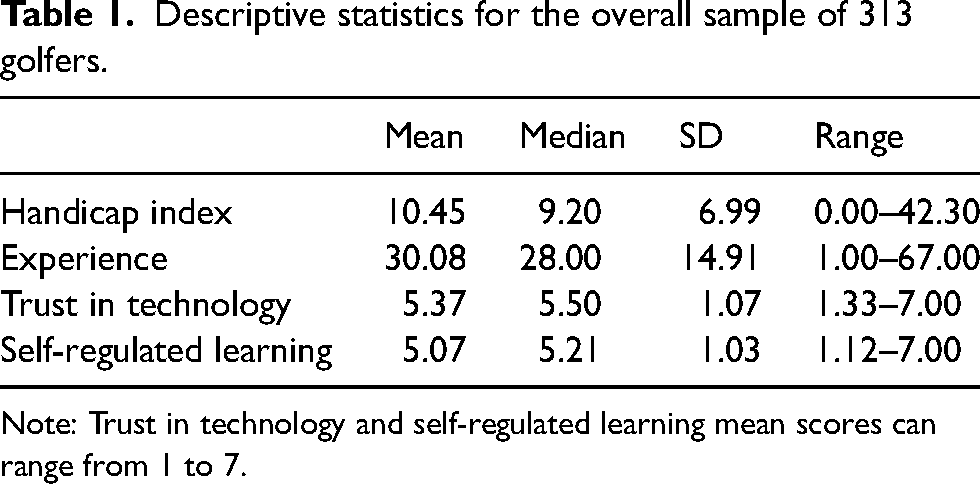
Note: Trust in technology and self-regulated learning mean scores can range from 1 to 7.
Intercorrelations between predictor variables.

The first model of the backward regression (predictor variables: experience, coach use, gender, trust in technology, self-regulated learning, and handicap index) significantly predicted technology use among golf athletes, χ2(1) = 129.98, p < .001. Experience was removed in the second model because there was no significant difference in model fit with this predictor removed, χ2(2) = −.16, p = .69. In the third model, Gender was removed without a significant difference in fit, χ2(3) = −1.23, p = .26. Following the principal of parsimony, the resultant model was the best model of technology use (Table 3). In this model, coach use, trust in technology, and handicap index significantly predicted technology use. Self-regulated learning was marginally significant but was retained because removal decreased model fit. Participants that used a coach were 11.38 times more likely to also use technology compared to those that did not have a coach. As trust in technology increased, golfers were more likely to use technology (odds ratio (OR) = 3.06). Finally, as handicap index increased, golfers were less likely to report technology use (OR = .91); better-performing golfers were more likely to use technology.
Final model of technology use from backward regression.
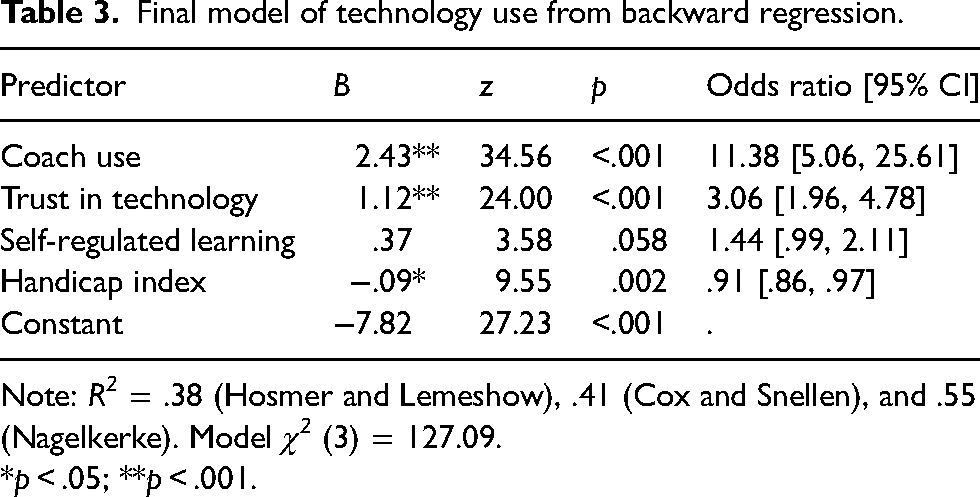
Note: R2 = .38 (Hosmer and Lemeshow), .41 (Cox and Snellen), and .55 (Nagelkerke). Model χ2 (3) = 127.09.
*p < .05; **p < .001.
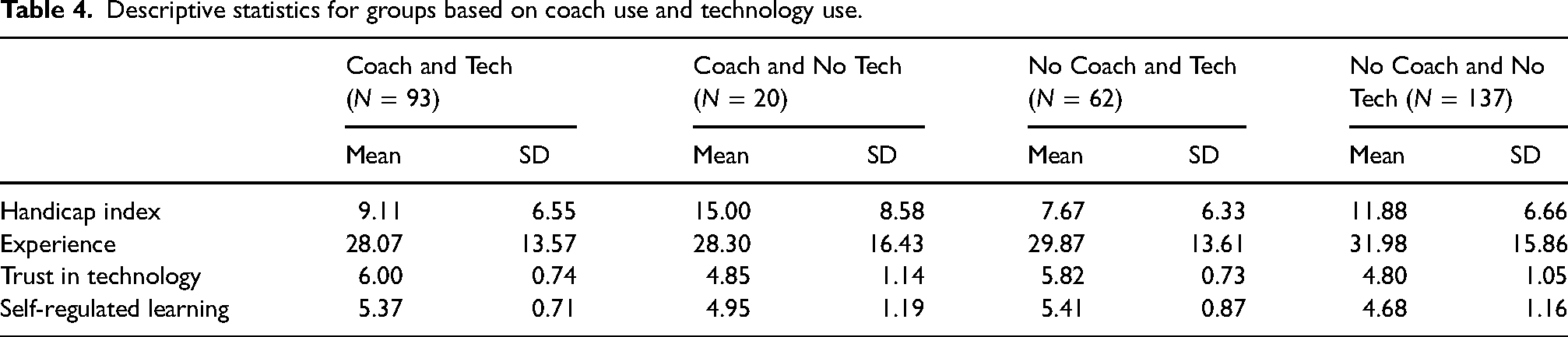
Due to the strength of coach use as a predictor of technology use, groups were created based on these two variables and descriptive statistics were calculated accordingly (Table 4). A factorial ANOVA was conducted to compare the main effects of coach use and technology use on levels of trust in technology, self-regulated learning, and handicap index, which were the retained predictors for the backward regression. The results of the factorial ANOVA are presented graphically in Figure 1.
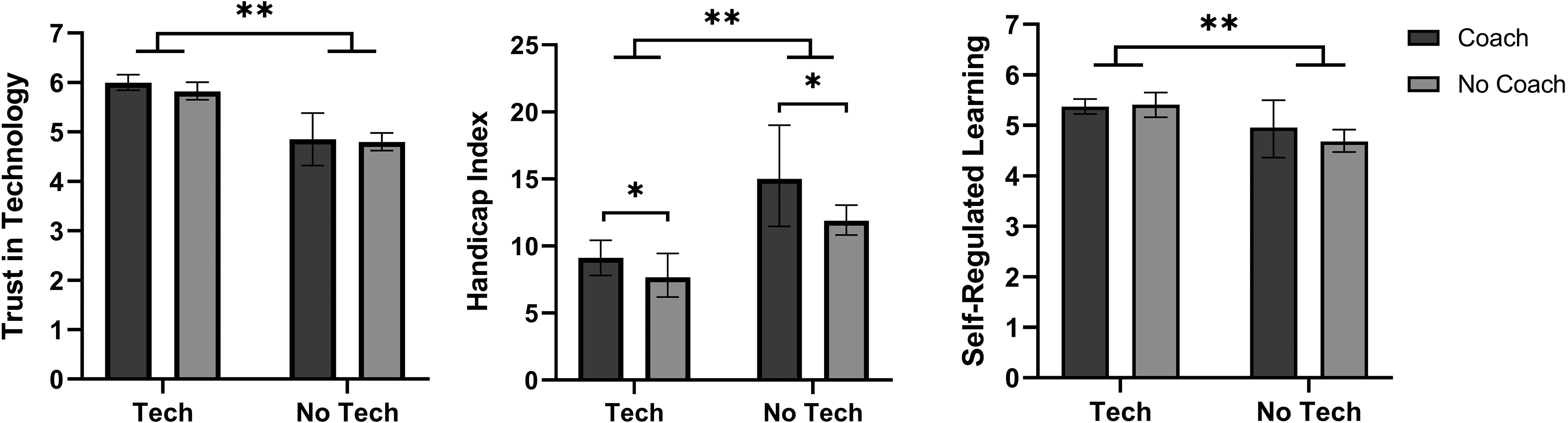
Mean trust in technology (left), handicap index (center), and self-regulated learning (right) by coach use and technology use. comparisons are shown between those who used technology (Tech) versus those who did not (No Tech) and those who used a coach (Coach) versus those who did not (No Coach).
Descriptive statistics for groups based on coach use and technology use.
There was a significant main effect of coach use, F(1, 306) = 5.50, p = .02, ηp2 = 0.018, and Technology Use on handicap index, F(1, 306) = 26.93, p < .001, ηp2 = 0.081. There was a nonsignificant interaction effect between coach use and technology use on handicap indexs, F(1, 306) = .74, p = .39, ηp2 = 0.002.
There was a significant main effect of technology use on trust in technology, F(1, 295) = 62.22, p < .001, ηp2 = 0.174. There was a nonsignificant main effect of coach use on trust in technology, F(1, 295) = .67, p = .41, ηp2 = 0.002. Furthermore, there was a nonsignificant interaction effect between coach use and technology use on trust in technology, F(1,295) = .20, p = .65, ηp2 = 0.001.
Finally, there was a significant main effect of technology use on self-regulated learning, F(1, 251) = 13.72, p < .001, ηp2 = 0.052. There was a nonsignificant main effect of coach use on self-regulated learning, F(1, 251) = .55, p = .46, ηp2 = 0.002. There was a nonsignificant interaction effect between coach use and technology use on self-regulated, F(1,251) = 1.04, p = .31, ηp2 = 0.004.
Discussion
This research sought to determine which factors predicted golfers’ technology use. Golfers’ use of a coach, trust in technology, self-regulated learning, and skill level each contributed to the model that predicted the use of technology during training. However, golfers’ years of playing experience and gender were not predictive of their technology use and therefore, our hypothesis was only partially supported.
The use of a coach or instructor was an overwhelmingly strong predictor of golfers’ technology use, where golfers who used a coach for golf lessons were more likely to use technology. As demonstrated in a study of golf coaches and instructors, where 96.5% of respondents used technology in their training and instruction, technology use is prevalent among golf coaches. 11 Therefore, golfers who participate in lessons (and hence, use a coach) may be more likely to use technology simply due to its presence in the training environment. However, there may be further complexity to the relationship between a golfer's use of technology and use of a coach. Coaches who use technology may act as a model for athletes to use technology in their individual practice and competition. This could explain the predictive strength of this variable as golfers who use a coach may see the coach's use of technology as credible and see the coach's interactions with the technology as providing them with a sense of direction and instruction. Future research should seek to separate the amount of technology used by golfers individually (in practice and competition) and with their coach.
Consistent with previous research in the domains of industry, defense, and security, 18 a golfer's trust in technology was predictive of their use of technology, such that golfers with higher trust in technology were more likely to use technology. These results are also in line with previous studies conducted in golf, where the same relationship has been found.11–13 Trust has become an all-important variable in human technology research as it has been shown to guide an individual's dependence on an automated system.16,18 Many studies have investigated the mediating effect of trust between technology use and personal variables, such as self-confidence and experience.11,18 However, there remains uncertainty regarding the direction of this relationship. In other words, it is unclear whether trust leads to use of an automated system or whether the use of technology leads to trust. If trust does precede use—as hypothesized—it is important that an individual's trust is calibrated with the capabilities of the technology. For example, if technology does not perform to the standard an individual is expecting, they will fail to use it appropriately. In golf, this may result in inaccurate training progressions or yardage calculations.
Golfers’ skill level was another significant predictor of their technology use, as it was determined that those with higher skill level were more likely to use technology. This finding is consistent with research conducted in the sport expertise domain, where highly skilled performers were typically found to be more likely to seek out resources that support their practice efforts. 25 Therefore, it is possible that highly skilled golfers were more likely to use technology because they viewed it as a resource that could help them improve their performance.
In other domains, subject matter expertise—often the result of extensive experience—has been cited as an important factor that influences whether an individual chooses to use technology.27,28 Individuals with more experience have been shown to use technology less compared to those with less experience. 28 However, previous research in golf failed to demonstrate an association between experience and technology use. 11 A similar result was found in our study, where the number of years golfers had been playing was not found to be predictive of their technology use. In non-golf research on skill acquisition and athletic talent development, experience does not always have a relationship with an individual's skill level. Although more experience can be associated with greater ability or skill to do a task, metrics associated with deliberate and amassed quality practice are stronger predictors of skill. 34 In golf, handicap index is a readily accessible, objective metric of skill level. Thus, this explains why Handicap Index contributed more to our model than experience as it is a more reliable index of skill.
Although the coefficient associated with self-regulated learning did not reach conventional levels of significance (i.e. α = 0.05), keeping it in the regression model predicting technology use improved the fit. The results indicated that golfers who were higher in self-regulated learning capabilities were more likely to use technology. In a review of the topic across diverse samples from different sports, individuals who were higher in self-regulated learning capabilities partook in more self-monitoring and self-evaluation compared to those who were low in self-regulated learning capabilities. 21 Technology, therefore, may be viewed among golfers that are high in self-regulated learning as a resource to enhance self-monitoring and self-evaluation more than if there was no technology present. 23 The effect of self-regulated learning on technology use may have been stronger if the measure was context-specific. In other words, if questions related to self-regulated learning had been presented in technology-specific phrasing, stronger effects may have been found. Future research should reword self-regulated learning question stems with more reference to technology in order to determine whether the predictive effects of self-regulated learning are stronger than those presented in this study.
The present research also conducted an exploratory analysis to determine whether the predictive factors of technology use (trust in technology, self-regulated learning, and skill level) were influenced by a golfer's use of a coach and/or technology. Given that the use of a coach was strongly related to technology use, this analysis could determine whether there were differences in athlete-related factors between combinations of coach and technology use. This analysis, of course, mirrored the results of the regression analysis, such that there were differences in golfers’ trust in technology, skill level, and self-regulated learning between those who used and did not use technology. Critically, there was only a difference in golfers’ skill level (as measured through handicap index) for those who used a coach compared to those who did not. Therefore, it seems as though the influence of the use of a coach and technology on factors specific to the golfer work in an additive rather than synergistic manner.
Our findings help provide a better understanding of the factors that influence golfers’ use of technology. In an increasingly technology-enabled world, it is often assumed that automated systems are beneficial to human performance. Similarly, technology has been shown to improve performance across a variety of sports, including golf, by providing athletes with more feedback than they may be able to derive on their own.8,9,15 As mentioned previously, research in other domains has investigated the importance of appropriate technology usage, such that operators do not over or under rely on technology. 18 If golfers were to over rely (use too much) on technology, they could become dependent on the continual feedback which may result in them losing confidence in their own ability upon removal of the automated system. 13 This is particularly important in golfers as most high-level golf tournaments do not allow the use of technology (such as DMDs) in competition. If golfers are using technology in practice, they may undergo drastic decreases in confidence while in competition, which could impact their performance. 13 Furthermore, classic learning perspectives argue that information that distracts a learner from their personal error detection and correction mechanisms can undermine an individual's ability to retain information. 35 Therefore, it is also possible that golfers may not learn as effectively when interacting with technology during their training and as a result, perform poorly in competition.
It is becoming evident that golfers’ interactions with technology are multidimensional. The present study demonstrates the importance of variables specific to the golfer, such as their trust in technology, self-regulated learning, and skill level. These personal factors are also influenced by the use of a coach and the technology itself.11,18 Therefore, our study is the first step in investigating the complexities of human technology interactions in the sport setting, leaving ample opportunity for future research. In particular, the present study only focused on whether individuals use technology or not, but future research could focus on how the use of technology (with or without a coach) affects an individual practice session. With the focus on an individual practice session, psychological variables such as self-regulated learning may play a more important role in how technology affects the practice session. Other research methods may be able to better determine the influence of coach and/or technology use on variables personal to the golfer. For example, an experimental design could ensure that each combination of coach and technology use is investigated (e.g. a coach with no technology, technology with no coach). Future research should also seek to determine which type of technology is being used (e.g. radar technologies, video) to provide additional insight into technology use in sport.
Limitations include that both coach use and technology use was measured as categorical variables, instead of continuous variables. While we believe a categorical measure of these variables is appropriate for this stage, future research should attempt to quantify coach and technology use as continuous variables. Since time is a difficult variable to retrospectively report, record keeping via time books or observation of practice may afford more exact estimates. These methods may also help determine exactly when and how golfers are using technology. It is also important to recognize that the generalizability of these results may be limited. As acknowledged previously, golf is a technology-friendly environment, where technology is easily accessible and relatively cost-efficient (e.g. DMDs are available for free via phone applications and video analysis software can be purchased for a small cost). 11 Golf is, therefore, an excellent platform to study human technology interactions; however, it may limit the ability to apply these results to other sporting contexts. Further research should be conducted in sports and sporting environments where the use of technology is limited or inaccessible, to allow for a broader application of these results. Finally, the popularity of technology and golf resulted in a large sample size, which allowed us to model the relationship of multiple predictor levels. With large sample sizes comes the risk that a very small effect is deemed significant, even though the effect may have little practical significance. That said, the effect sizes in our findings were typically moderate to large.
Conclusion
The findings of the present study indicate that a golfer's use of a coach, trust in technology, self-regulated learning, and skill level are important predictors of whether they use technology in their training and competition. While human technology research is prevalent in other domains (e.g. aviation, transportation), this study is the first to assess the factors that influence an athlete's use of technology. Furthermore, this study also explored the influence of coach and/or technology use on factors specific to the golfer. The results presented provide a foundation for further research on human technology interactions in athletes. Moving forward, the predictive factors of technology use that were identified in the current study should be assessed in more depth; particularly, with different combinations of coach use and technology use. As technology's presence continues to increase in sporting environments, this research will help work toward determining ways to integrate golf technology into an athlete's training and competition.
Footnotes
Declaration of conflicting interests
The authors declared no potential conflicts of interest with respect to the research, authorship, and/or publication of this article.
Funding
The authors received no financial support for the research, authorship, and/or publication of this article.

Data availability statement
A subset of the raw data will be stored on Dalhousie's Institutional Dataverse hosted on the Scholars Portal Dataverse website, which can be accessed for free by anyone. The data is stored on Canadian servers and will be kept in this repository indefinitely.